
Showing 14 items matching " detritus"
-
 Warrnambool and District Historical Society Inc.
Functional object - Ginger Ale Bottle, John Fletcher. Koroit Street, Warrnambool, c. 1930
... The bottle contains a green marble and some marine detritus. The bottle is discoloured with stains and dirt and has lettering etched into the side and base....The bottle contains a green marble and some marine detritus. The bottle is discoloured with stains and dirt and has lettering etched into the side and base. ...This bottle was found in sea water while the donor was snorkelling in Stingray Bay, Warrnambool. It is a marble stopper bottle from the Warrnambool cordial factory of John Fletcher. Th bottle was filled upside down so that as soon as the filling ceased the marble was forced down to seal the bottle against a rubber ring (missing in this bottle). Pressure inside the bottle would keep the marble pressed against the top of the neck. To open the bottle the marble was pressed down so that it fell into the body of the bottle. John Fletcher as a young boy worked at Rowley's Cordial Factory in Banyan Street, Warrnambool. He then worked for John Davis who had established the Union Cordial Factory in Koroit Street in the 1860s. In 1885 John Fletcher bought Davis' business and operated it until 1930. It was then bought by Ralph Reeves. John Fletcher manufactured soda water, lemonade, tonic waters, ginger ale, sarsaparilla, cordials, hop beer and hop bitters.This bottle is of some interest as an example of a marble stopper bottle over 90 years old and as a memento of the Warrnambool soft drinks business of John Fletcher, a prominent businessman in Warrnambool for over 40 years.This is a clear glass bottle with a rounded body, a heavy indentation near the base of the neck and a thick tapering neck with a round opening. The bottle contains a green marble and some marine detritus. The bottle is discoloured with stains and dirt and has lettering etched into the side and base.John Fletcher Ginger Ale Warrnambool This bottle is the property of John Fletcher Warrnambool and cannot be legally used by others Gjohn fletcher warrnambool, cordial manufacturers in warrnambool -
 Hymettus Cottage & Garden Ballarat
Functional object - Boot Jack, Beetle boot jack
... Typical of the mass produced small items manufactured in the late nineteenth and early twentieth century for domestic use along with clothes irons, boot scrapers and griddle irons, these beetle-style boot jacks were usually located in the vestibule near the door to wedge the booted foot into and pull, removing the boot before stepping into the house with any detritus on the boot....Typical of the mass produced small items manufactured in the late nineteenth and early twentieth century for domestic use along with clothes irons, boot scrapers and griddle irons, these beetle-style boot jacks were usually located in the vestibule near the door to wedge the booted foot into and pull, removing the boot before stepping into the house with any detritus on the boot. Beetle boot jack Functional object Boot Jack ...Typical of the mass produced small items manufactured in the late nineteenth and early twentieth century for domestic use along with clothes irons, boot scrapers and griddle irons, these beetle-style boot jacks were usually located in the vestibule near the door to wedge the booted foot into and pull, removing the boot before stepping into the house with any detritus on the boot. -
 Federation University Art Collection
Painting, Alan Bates, 'Pink Landscape' by Alan Bates, 1994
... Works can speak of landscape or the weathered detritus randomly found in abandoned industrial areas including the dockside. ...Works can speak of landscape or the weathered detritus randomly found in abandoned industrial areas including the dockside. ...Alan BATES Known for his interest in the minimalist harmonies of paint, Alan Bates lives in regional Victoria and his works resource local places. Works can speak of landscape or the weathered detritus randomly found in abandoned industrial areas including the dockside. Alan Bates is a graduate of the University of Ballarat (now Federation University), and has been exhibiting regularly since 1990. This item is part of the Federation University Art Collection. The Art Collection features over 2000 works and was listed as a 'Ballarat Treasure' in 2007.Abstract landscapeSigned lower right side 'Alan Bates '94'art, artwork, alan bates, bates, landscape, abstract, oil, oil on duckcloth, alumni -
Women's Art Register
Archive (Collection) - Elizabeth Gower Artist Archive
... ... Detritus...1952- Pattern Colour Recycling Detritus Abstraction Feminism Everyday Collage Mixed Media Archive Elizabeth Gower Artist Archive ...pattern, colour, recycling, detritus, abstraction, feminism, everyday, collage, mixed mediapattern, colour, recycling, detritus, abstraction, feminism, everyday, collage, mixed media -
Women's Art Register
Archive (Series) - Gower, Elizabeth. Artist File 1
... ... Detritus...Pattern Colour Recycling Detritus Abstraction Feminism Everyday Collage Mixed Media Foolscap white archival 4 flap folder or document wallet Archive Gower, Elizabeth. ...List of Images, CV, Newspaper Clippings, Invitations, Photographs, Promotional Material, Artwork Imagepattern, colour, recycling, detritus, abstraction, feminism, everyday, collage, mixed mediapattern, colour, recycling, detritus, abstraction, feminism, everyday, collage, mixed media -
Women's Art Register
Archive (Series) - Elizabeth Gower. Duplicate File 1
... ... Detritus...Collage Mixed Media Pattern Colour Recycling Detritus Abstraction Feminism Everyday Foolscap manilla file Archive Elizabeth Gower. ...List of Images, CV, Newspaper Clippings, Invitations, Photographs, Promotional Material, Artwork Imagecollage, mixed media, pattern, colour, recycling, detritus, abstraction, feminism, everydaycollage, mixed media, pattern, colour, recycling, detritus, abstraction, feminism, everyday -
Women's Art Register
Archive (Series) - Elizabeth Gower. Slide Kit
... ... Detritus...Collage Mixed Media Pattern Colour Recycling Detritus Abstraction Feminism Everyday Set of slides in Polypropylene sleeves, within a Polypropyline binder and slipcase. ...collage, mixed media, pattern, colour, recycling, detritus, abstraction, feminism, everydaycollage, mixed media, pattern, colour, recycling, detritus, abstraction, feminism, everyday -
Women's Art Register
Archive (Series) - Elizabeth Gower, Digitised Slide Kit
... ... Detritus...Collage Mixed Media Pattern Colour Recycling Detritus Abstraction Feminism Everyday Archive Elizabeth Gower, Digitised Slide Kit ...collage, mixed media, pattern, colour, recycling, detritus, abstraction, feminism, everydaycollage, mixed media, pattern, colour, recycling, detritus, abstraction, feminism, everyday -
 City of Moorabbin Historical Society (Operating the Box Cottage Museum)
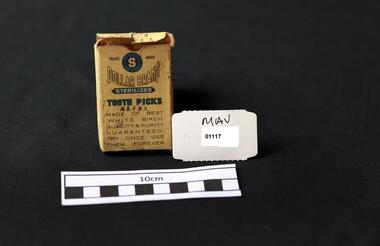
Containers, paper packet toothpicks 'Peacock', Peacock brand China, mid 20thC
... A toothpick is a small stick of wood, plastic, bamboo, metal, bone or other substance used to remove detritus from the teeth, usually after a meal. ...A toothpick is a small stick of wood, plastic, bamboo, metal, bone or other substance used to remove detritus from the teeth, usually after a meal. ...A toothpick is a small stick of wood, plastic, bamboo, metal, bone or other substance used to remove detritus from the teeth, usually after a meal. A toothpick usually has one or two sharp ends to insert between teeth. They can come in both wood and plastic, and can also be used for picking up small appetizers (like cheese cubes or olives) or as a cocktail stick. Toothpicks are well known in all cultures. Before the toothbrush was invented, teeth were cleaned with hard and soft dental woods. The first toothpick-manufacturing machine was developed in 1869, by Marc Signorello. Another was patented in 1872, by Silas Noble and J. P. Cooley A small paper packet containing wooden toothpicksTRADE $ MARK / DOLLAR BRAND / STERILIZED / TOOTHPICKS / (chinese characters) / MADE OF BEST / WHITE BIRCH / QUALITY & PURITY / GUARANTEED / TRY ONCE USE / THEM FOREVER. wood, toothpicks, dental cleaning, dentists, timber, birch trees, signorello marc, noble silas, cooley j. p. , moorabbin bentleigh cheltenham, maret gardeners, early settlers, -
 The Beechworth Burke Museum
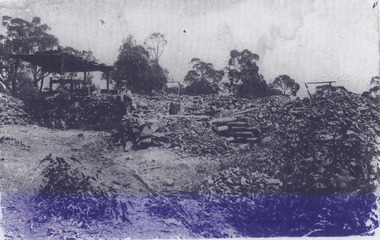
Photograph - Photograph - Reproduction, Unknown
... The foreground of the image is littered with piles of smashed rock and detritus, known as ‘mullock’, beside a reinforced mine shaft, a vertical access passageway allowing miners to enter the mine and haul ore out using lifting technology such as a poppet heads, whims or windlasses. ...The foreground of the image is littered with piles of smashed rock and detritus, known as ‘mullock’, beside a reinforced mine shaft, a vertical access passageway allowing miners to enter the mine and haul ore out using lifting technology such as a poppet heads, whims or windlasses. ...This image is a reproduction of an 1899 original depicting the 'Williams Good Luck Mine' on the Mopoke Reef (also called 'Morepork Gully') in the Dingle Ranges, approximately three miles from Beechworth. The foreground of the image is littered with piles of smashed rock and detritus, known as ‘mullock’, beside a reinforced mine shaft, a vertical access passageway allowing miners to enter the mine and haul ore out using lifting technology such as a poppet heads, whims or windlasses. A group of miners and a dog appear close to an open-sided miner’s hut. Following the discovery of gold at Beechworth in 1852, rushes quickly followed at surrounding creeks and gullies in the district. In the late nineteenth and early twentieth centuries, small syndicates of miners continued to work old or abandoned quartz reefs, often persisting without the assistance of heavy machinery to remove the large amounts of rock, in order to obtain yields at ever greater depths. The group of miners in this photograph are Mr. Roger Williams and Sons, who revived operations at the ‘Old Good Luck’ mine on the Mopoke Reef in the Dingle Range near Beechworth around 1892, working the site for more than two decades. An emigrant from Cornwall with experience in the tin mining industry, 19 year old Roger Williams senior sailed to New Zealand in 1840, then to Australia where he spent time in the Bendigo Gold Fields before settling in Beechworth in the early 1860s. Mr Williams senior worked on various mining activities in the district, including the Rocky Mountain Tunnel project. Conversant with the character of gold-bearing reefs in the area, the syndicate dug an eight hundred foot tunnel, digging down as far down as two hundred feet with little capital save their labour, to connect and provide better working access to the mass of reefs and veins in the vicinity. Progress was hampered by poor air quality charged with fumes from dynamite and large quantities of rock had to be crushed to obtain payable yields. The Victorian Goldfields are filled with ruins and remnants of the area's rich mining history, ranging from small alluvial diggings to the remains of huge mining companies. Site names often changed several times throughout the nineteenth and twentieth centuries. Some sites were abandoned and forgotten, others were worked continuously over many decades. The names of mines were often repeated at different locations throughout the Victorian Goldfields. For example, there is a Mopoke Gully heritage mine near Fryers Creek, Victoria. 'Mopoke' is a common onomatopoeic name for Morepork and Australian Boobook owls. This image has historical, social and research significance for patterns of emigration during of the Victorian Gold Rush, and the historical, social and environmental impacts of mining at Beechworth at the turn of the nineteenth and twentieth centuries. As gold became scarce and government support and large company investment waned, poor hard-working miners laboured intensively to make a living through periods of high unemployment. This image can be compared and studied alongside other historical mining photographs and objects in the Burke Museum Collection. It has potential to improve our understanding of miners working conditions and the shifting character of mining in the Beechworth district. Black and white rectangular reproduction photograph printed on matte photographic paper.Obverse: Williams Good Luck Mine Beechworth / Roger! / Reverse: 6858 / burke museum, beechworth museum, beechworth, gold fields, gold rush, victorian gold rush, gold ming history, colonial australia, australian gold rushes, mining technology, beechworth historic district, indigo gold trail, migration, indigo shire, good luck gold mine, victorian goldfields, mining syndicates, gold fever, quartz-mining, small-scale mining, old good luck mine, mopoke gully, quartz reefs beechworth -
 The Beechworth Burke Museum
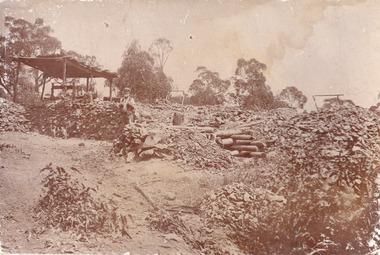
Photograph
... The foreground of the image is littered with piles of smashed rock and detritus, known as ‘mullock’, beside a reinforced mine shaft, a vertical access passageway allowing miners to enter the mine and haul ore out using lifting technology such as a poppet heads, whims or windlasses. ...The foreground of the image is littered with piles of smashed rock and detritus, known as ‘mullock’, beside a reinforced mine shaft, a vertical access passageway allowing miners to enter the mine and haul ore out using lifting technology such as a poppet heads, whims or windlasses. ...This image is a reproduction of an 1899 original depicting the 'Williams Good Luck Mine' on the Mopoke Reef (also called 'Morepork Gully') in the Dingle Ranges, approximately three miles from Beechworth. The foreground of the image is littered with piles of smashed rock and detritus, known as ‘mullock’, beside a reinforced mine shaft, a vertical access passageway allowing miners to enter the mine and haul ore out using lifting technology such as a poppet heads, whims or windlasses. A group of miners and a dog appear close to an open-sided miner’s hut. Following the discovery of gold at Beechworth in 1852, rushes quickly followed at surrounding creeks and gullies in the district. In the late nineteenth and early twentieth centuries, small syndicates of miners continued to work old or abandoned quartz reefs, often persisting without the assistance of heavy machinery to remove the large amounts of rock, in order to obtain yields at ever greater depths. The group of miners in this photograph are Mr. Roger Williams and Sons, who revived operations at the ‘Old Good Luck’ mine on the Mopoke Reef in the Dingle Range near Beechworth around 1892, working the site for more than two decades. An emigrant from Cornwall with experience in the tin mining industry, 19 year old Roger Williams senior sailed to New Zealand in 1840, then to Australia where he spent time in the Bendigo Gold Fields before settling in Beechworth in the early 1860s. Mr Williams senior worked on various mining activities in the district, including the Rocky Mountain Tunnel project. Conversant with the character of gold-bearing reefs in the area, the syndicate dug an eight hundred foot tunnel, digging down as far down as two hundred feet with little capital save their labour, to connect and provide better working access to the mass of reefs and veins in the vicinity. Progress was hampered by poor air quality charged with fumes from dynamite and large quantities of rock had to be crushed to obtain payable yields. The Victorian Goldfields are filled with ruins and remnants of the area's rich mining history, ranging from small alluvial diggings to the remains of huge mining companies. Site names often changed several times throughout the nineteenth and twentieth centuries. Some sites were abandoned and forgotten, others were worked continuously over many decades. The names of mines were often repeated at different locations throughout the Victorian Goldfields. For example, there is a Mopoke Gully heritage mine near Fryers Creek, Victoria. 'Mopoke' is a common onomatopoeic name for Morepork and Australian Boobook owls.This image has historical, social and research significance for patterns of emigration during of the Victorian Gold Rush, and the historical, social and environmental impacts of mining at Beechworth at the turn of the nineteenth and twentieth centuries. As gold became scarce and government support and large company investment waned, poor hard-working miners laboured intensively to make a living through periods of high unemployment. This image can be compared and studied alongside other historical mining photographs and objects in the Burke Museum Collection. It has potential to improve our understanding of miners working conditions and the shifting character of mining in the Beechworth district.Sepia coloured rectangular photograph printed on gloss photographic paper mounted on card.Obverse: Reverse: A02497/ 1997.2497/ 'Good/ Luck/ Mine'/ Morepork/ Gully/ Mrs Joyce/ Bright/ Tunnel/ 800 ft/ 1899. burke museum, beechworth museum, beechworth, gold fields, gold rush, victorian gold rush, gold ming history, colonial australia, australian gold rushes, mining technology, beechworth historic district, indigo gold trail, migration, indigo shire, good luck gold mine, victorian goldfields, mining syndicates, gold fever, quartz-mining, small-scale mining, old good luck mine, mopoke gully, quartz reefs beechworth -
 Nillumbik Shire Council
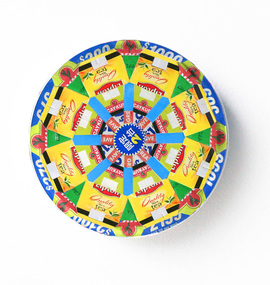
Collage: Elizabeth GOWER (b.1952 SA, AUS -), Cycles 7, 2015
... The immediate tactile connection with the material excesses and detritus of contemporary consumer culture informs the theoretical framework and conceptual understanding of Gower's practice, and associates her work with ideas of recovery and re-purpose, sustainable practice and thrift strategies that critique excesses of mass production and the notion of impermanence. ...The 'Cycles' series is an extension of two large scale provisional installations '150 Rotations', Melbourne Now, National Gallery of Victoria, and '356 Rotations', AC Institute in New York, which also re-purposed and aestheticised multiple paper units into hundreds of circular motifs.The immediate tactile connection with the material excesses and detritus of contemporary consumer culture informs the theoretical framework and conceptual understanding of Gower's practice, and associates her work with ideas of recovery and re-purpose, sustainable practice and thrift strategies that critique excesses of mass production and the notion of impermanence. This series was made ‘in transit’ during the artist’s recent studio residencies at Point[B], New York and Laughing Waters, Eltham, and at three temporary studios in Rome, Berlin and Collingwood.Kaleidoscope pattern of multiple segments (logos-Lipton tea) from commercial (food) catalogues on commercial packaging (cardboard - round lid). No inscriptions and markingscycles, gower, collage, pattern, logos, commercialism, consumerism, repurpose, recycle, riverbend, laughing waters -
 Nillumbik Shire Council
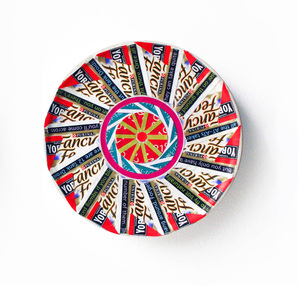
Collage: Elizabeth GOWER (b.1952 SA, AUS), Cycles 11, 2015
... The immediate tactile connection with the material excesses and detritus of contemporary consumer culture informs the theoretical framework and conceptual understanding of Gower's practice, and associates her work with ideas of recovery and re-purpose, sustainable practice and thrift strategies that critique excesses of mass production and the notion of impermanence. ...The 'Cycles' series is an extension of two large scale provisional installations '150 Rotations', Melbourne Now, National Gallery of Victoria, and '356 Rotations', AC Institute in New York, which also re-purposed and aestheticised multiple paper units into hundreds of circular motifs.The immediate tactile connection with the material excesses and detritus of contemporary consumer culture informs the theoretical framework and conceptual understanding of Gower's practice, and associates her work with ideas of recovery and re-purpose, sustainable practice and thrift strategies that critique excesses of mass production and the notion of impermanence. This series was made ‘in transit’ during the artist’s recent studio residencies at Point[B], New York and Laughing Waters, Eltham, and at three temporary studios in Rome, Berlin and Collingwood.Kaleidoscope pattern of multiple segments (logos-Purina 'fancy feast') from commercial (food) catalogues on commercial packaging (cardboard - round lid). No inscriptions and markingscycles, gower, collage, pattern, logos, commercialism, consumerism, repurpose, recycle, riverbend, laughing waters -
 Nillumbik Shire Council
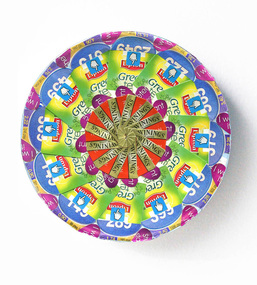
Collage: Elizabeth GOWER (b.1952 SA, AUS), Cycles 10, 2015
... The immediate tactile connection with the material excesses and detritus of contemporary consumer culture informs the theoretical framework and conceptual understanding of Gower's practice, and associates her work with ideas of recovery and re-purpose, sustainable practice and thrift strategies that critique excesses of mass production and the notion of impermanence. ...The 'Cycles' series is an extension of two large scale provisional installations '150 Rotations', Melbourne Now, National Gallery of Victoria, and '356 Rotations', AC Institute in New York, which also re-purposed and aestheticised multiple paper units into hundreds of circular motifs.The immediate tactile connection with the material excesses and detritus of contemporary consumer culture informs the theoretical framework and conceptual understanding of Gower's practice, and associates her work with ideas of recovery and re-purpose, sustainable practice and thrift strategies that critique excesses of mass production and the notion of impermanence. This series was made ‘in transit’ during the artist’s recent studio residencies at Point[B], New York and Laughing Waters, Eltham, and at three temporary studios in Rome, Berlin and Collingwood.Kaleidoscope pattern of multiple segments (logos-Lipton 'Green Tea') from commercial (food) catalogues on commercial packaging (cardboard - round lid). No inscriptions and markingscycles, gower, collage, pattern, logos, commercialism, consumerism, repurpose, recycle, riverbend, laughing waters
