
Showing 2174 items matching " domestic item"
-
 Victorian Interpretive Projects Inc.
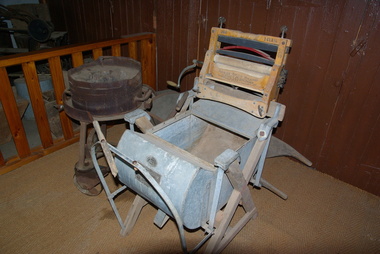
Domestic Item, Washing Machine
... Domestic Item...Washing Machine Domestic Item ...Washing machine in the Bon Accord Museum, Burra, South Australia.washing, washing machine, burra -
 Sunbury Family History and Heritage Society Inc.
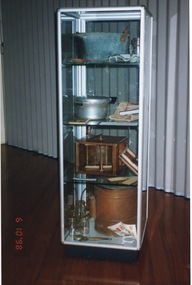
Photograph, Domestic items, 6th August 1998
... The display of large domestic items was one of a number that were mounted in the former Sunbury museum. ...A non-digital coloured photograph of former domestic items displayed in a tall glass showcase. ...The display of large domestic items was one of a number that were mounted in the former Sunbury museum. ...The display of large domestic items was one of a number that were mounted in the former Sunbury museum. The exhibition was featuring domestic items that were used in households in Sunbury during the nineteenth and first 5 decades of the twentieth century. The former Sunbury & District Heritage Association mounted the exhibition in August 1998.Some of the items in the exhibition were things of the past and many younger people would not have been familiar with those items.A non-digital coloured photograph of former domestic items displayed in a tall glass showcase. A concertina door is behind the display case.sunbury & district heritage association, museums, sunbury, domestic items, households -
 Clunes Museum
Domestic object - FLAT IRON - DOMESTIC
... ...domestic item...Example of domestic items used prior to the invention of electricity...Example of domestic items used prior to the invention of electricity flat iron domestic item "METTERS K P B VIC" RAISED ON BODY THE NUMBER "5" IS RAISED ON BODY CAST METAL FLAT IRON FOR PRESSING CLOTHES Domestic object FLAT IRON - DOMESTIC ...Example of domestic items used prior to the invention of electricityCAST METAL FLAT IRON FOR PRESSING CLOTHES"METTERS K P B VIC" RAISED ON BODY THE NUMBER "5" IS RAISED ON BODYflat iron, domestic item -
 Sunbury Family History and Heritage Society Inc.
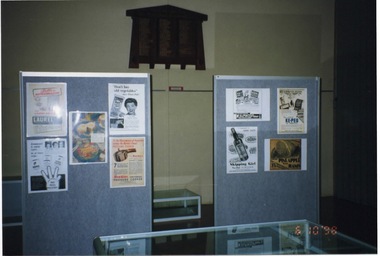
Photograph, October 1998
... As the name suggests the exhibition featured a variety of domestic items that were used by many people in past years. ...A non-digital coloured photograph of a variety of copies of advertisements of domestic items from past times. hey are displayed on two boards in a museum....As the name suggests the exhibition featured a variety of domestic items that were used by many people in past years. ...The display of advertisements were part of a 'Times Past' exhibition mounted in the former George Evans Museum in Sunbury in October 1998. As the name suggests the exhibition featured a variety of domestic items that were used by many people in past years. IT was mounted by the members of the Sunbury & District Heritage Association. The exhibition was one of many featuring aspects of Sunbury's history that have been mounted in the George Evans Museum.A non-digital coloured photograph of a variety of copies of advertisements of domestic items from past times. hey are displayed on two boards in a museum.exhibitions, 'times past' exhibition, george evans museum, sunbury, sunbury & district heritage association -
Clunes Museum
Container - BOTTLE
... ...DOMESTIC ITEM...LOCAL HISTORY DOMESTIC ITEM CONTAINERS DOMESTIC ITEM (BOTTLE) GREEN BLOWN GLASS BOTTLE MADE FROM MOLTEN GLASS WITH PONTEL BASE Container BOTTLE ...GREEN BLOWN GLASS BOTTLE MADE FROM MOLTEN GLASS WITH PONTEL BASElocal history, domestic item, containers, domestic item (bottle) -
 Warrnambool and District Historical Society Inc.
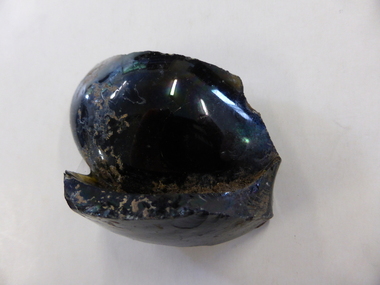
Bottle, Bottle fragment Woodford hotel est 1845, 19th century
... This is a fragment of a black bottle or other domestic item. It is made of heavy glass and is curved and could be part of the base of the object. ...If this item comes from the time of the Travellers’ Rest Hotel in Woodford then it is of considerable interest as an early memento of that hotel and the early days of Woodford. history of woodford travellers’ rest hotel, woodford warrnambool history This is a fragment of a black bottle or other domestic item. It is made of heavy glass and is curved and could be part of the base of the object. ...This fragment was found in Bridge Road, Woodford on the site of the Travellers’ Rest Hotel, Woodford and it is believed that it may date from the time when the hotel was operating. The Travellers’ Rest Hotel in Woodford was established some time in the 1840s with the first known date, 1847. It pre-dates the settlement of Warrnambool founded in late 1847. The Travellers’ Rest Hotel was established by William Kirby and his wife Mary took over the hotel management when her husband was drowned in August 1847. The hotel had seven other licensees and closed in 1875. If this item comes from the time of the Travellers’ Rest Hotel in Woodford then it is of considerable interest as an early memento of that hotel and the early days of Woodford. This is a fragment of a black bottle or other domestic item. It is made of heavy glass and is curved and could be part of the base of the object. history of woodford, travellers’ rest hotel, woodford, warrnambool history -
 Flagstaff Hill Maritime Museum and Village
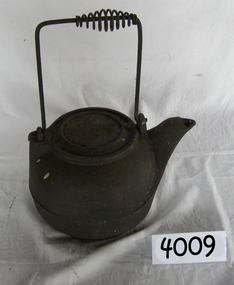
Domestic object - Kettle, T & C Clarke and Co Ltd, Late 19th to early 20th century
... ...Domestic Item...The company's product range included thousands of items, both domestic and industrial. T. & C. Clark were pioneers in the use of enamelled cast ironware, after taking out a patent in 1839 guaranteeing their products to be free of lead or arsenic. ...The item is significant as it was used as a domestic kitchen item to boil water safely without the concern that the metal may contain lead or arsenic as earlier cooking utensils had. flagstaff hill warrnambool shipwrecked-coast flagstaff-hill flagstaff-hill-maritime-museum maritime-museum shipwreck-coast flagstaff-hill-maritime-village Kettle Domestic Item Cooking Kitchen Ware Cast Iron T & C Clark & Co T & C Clark Kettle metal has spiral wire piece on handle painted black Domestic object Kettle T & C Clarke and Co Ltd ...T. & C. Clark & Company Limited was based at Shakespeare Foundry in Wolverhampton England and was founded in 1795 by Thomas and Charles Clark. The company grew to be one of the largest iron foundries in Wolverhampton and were pioneering in the manufacture of enamelled cast iron cookware and sanitary wares. The company's product range included thousands of items, both domestic and industrial. T. & C. Clark were pioneers in the use of enamelled cast ironware, after taking out a patent in 1839 guaranteeing their products to be free of lead or arsenic. The company became the largest employer in Wolverhampton employing between 600 to 700 people.The item is significant as it was used as a domestic kitchen item to boil water safely without the concern that the metal may contain lead or arsenic as earlier cooking utensils had. Kettle metal has spiral wire piece on handle painted black T & C Clarkflagstaff hill, warrnambool, shipwrecked-coast, flagstaff-hill, flagstaff-hill-maritime-museum, maritime-museum, shipwreck-coast, flagstaff-hill-maritime-village, kettle, domestic item, cooking, kitchen ware, cast iron, t & c clark & co -
 Mont De Lancey
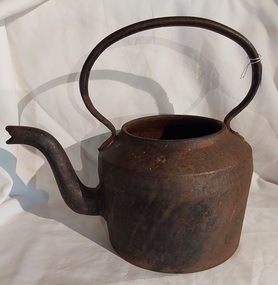
Functional object - Cast Iron Kettle, Unknown
... Heavy duty cast iron kettles were used as a domestic item to boil water safely without the concern that the metal may contain lead or arsenic as earlier utensils had. ...It was used as a domestic item to boil water safely without the concern that the metal may contain lead or arsenic as earlier utensils had....Heavy duty cast iron kettles were used as a domestic item to boil water safely without the concern that the metal may contain lead or arsenic as earlier utensils had. ...Heavy duty cast iron kettles were used as a domestic item to boil water safely without the concern that the metal may contain lead or arsenic as earlier utensils had. The household depended on constant hot water availability for all cooking, washing and other household chores.A large vintage rusted black cast iron heavy kettle with no lid. It has a flat base and mushroom shaped handle welded onto the pot below the rim of the pot opening. It has a rim to position the teapot lid. The goose neck spout has a shaped pouring end. It was used as a domestic item to boil water safely without the concern that the metal may contain lead or arsenic as earlier utensils had.kitchenware, kettles, kitchen equipment -
 Mont De Lancey
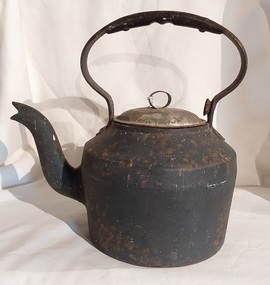
Functional object - Cast Iron Kettle, Unknown
... Heavy duty cast iron kettles were used as a domestic item to boil water safely without the concern that the metal may contain lead or arsenic as earlier utensils had. ...It was used as a domestic item to boil water safely without the concern that the metal may contain lead or arsenic as earlier utensils had....Heavy duty cast iron kettles were used as a domestic item to boil water safely without the concern that the metal may contain lead or arsenic as earlier utensils had. ...Heavy duty cast iron kettles were used as a domestic item to boil water safely without the concern that the metal may contain lead or arsenic as earlier utensils had. The household depended on constant hot water availability for all cooking, washing and other household chores.A large heavy black cast iron kettle with a curved handle, goose neck spout with a shaped pouring end and a removable lid with a small looped open knob. It has a flat base and mushroom shaped handle welded onto the pot below the rim of the pot opening. There is a shaped grip underneath at the top hold it steady. It was used as a domestic item to boil water safely without the concern that the metal may contain lead or arsenic as earlier utensils had.On the base - 'England. First quality. No.3 6 pints. C. Clark and Co Ltd'kitchenware, kitchen equipment, kettles -
 Flagstaff Hill Maritime Museum and Village
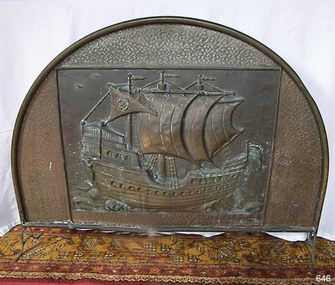
Domestic object - Fire screen
... ...domestic item...Open fires were common in Australia in the 19th and early 20th century, for both cooking and heating. flagstaff hill warrnambool shipwrecked-coast flagstaff-hill flagstaff-hill-maritime-museum maritime-museum shipwreck-coast flagstaff-hill-maritime-village fire screen fire guard domestic item heating cooking Fire screen, crescent shaped, brass pressed sheet, with a ship motif within a rectangular area. ...This decorative fire screen is placed in front of an open fireplace to prevent hot sparks and ash from causing damage. Open fires were common in Australia in the 19th and early 20th century, for both cooking and heating.Fire screen, crescent shaped, brass pressed sheet, with a ship motif within a rectangular area. Ship is a 3 masted sailing vessel, a Spanish galleon. Made in England, c. 1930.flagstaff hill, warrnambool, shipwrecked-coast, flagstaff-hill, flagstaff-hill-maritime-museum, maritime-museum, shipwreck-coast, flagstaff-hill-maritime-village, fire screen, fire guard, domestic item, heating, cooking -
 Flagstaff Hill Maritime Museum and Village
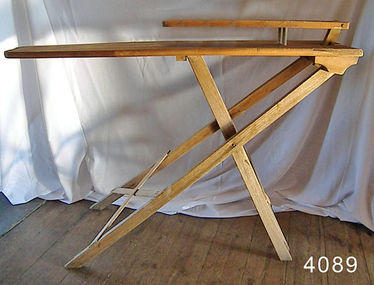
Furniture - Ironing board, 1910-1930
... ...Domestic Item...In 1892 Sarah Boone obtained a patent in the United States for improvements to the ironing board, allowing for better quality ironing of shirt sleeves. A domestic item with an interesting history of development, significant as it shows the progress and the evolution of a domestic item designed to make housework more efficient. flagstaff hill warrnambool shipwrecked-coast flagstaff-hill-maritime-museum flagstaff-hill-maritime-village Domestic Item Ironing Board Ironing Clothes Wrinkles in Clothes Henry W. ...Ironing is the use of a machine, usually a heated tool (an iron), to remove wrinkles from fabric. The heating is around 180–220 °Celsius, depending on the fabric type. Ironing works by loosening the bonds between the long-chain polymer molecules in the fibres of the material. While the molecules are hot, the fibres are straightened by the weight of the iron, and they hold their new shape as they cool. Some fabrics, such as cotton, require the addition of water to loosen the intermolecular bonds. Many modern fabrics developed in or after the mid-twentieth century require little or no ironing. Permanent press clothing was developed to reduce the ironing necessary by combining Wrinkle resistant polymers with cotton. The first known use of the iron for removing wrinkles in clothes is known to have occurred in China, and the electric iron was invented in 1882, by Henry W. Seeley. Seeley patented his "electric flat iron" on June 6, 1882 (U.S. Patent no. 259,054). On 15 February 1858 W. Vandenburg and J. Harvey patented an ironing table that facilitated pressing sleeves and pants legs. A truly portable folding ironing board was first patented in Canada in 1875 by John B. Porter. The invention also included a removable press board used for sleeves. In 1892 Sarah Boone obtained a patent in the United States for improvements to the ironing board, allowing for better quality ironing of shirt sleeves.A domestic item with an interesting history of development, significant as it shows the progress and the evolution of a domestic item designed to make housework more efficient.Wooden Ironing board with press board for sleeves, board is folding.Noneflagstaff hill, warrnambool, shipwrecked-coast, flagstaff-hill-maritime-museum, flagstaff-hill-maritime-village, domestic item, ironing board, ironing, clothes, wrinkles in clothes, henry w. seeley, w. vandenburg and j. harvey -
 Flagstaff Hill Maritime Museum and Village
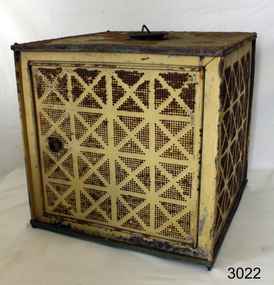
Domestic object - Food Safe, Willow Ware Pty Ltd, 1920-1950
... ...Domestic Item...This item gives a snapshot into early Australian manufacturing specifically aimed at the Australian market. warrnambool shipwrecked-coast flagstaff-hill flagstaff-hill-maritime-museum shipwreck-coast flagstaff-hill-maritime-village Willow Ware Domestic Item Coolgardie Meat Safe meat safe food safe food preservation "Made in Australia" "Willow" Safe metal kitchen safe with two shelves, a hinged door and latch and a small swivel wire handle at the top. cream colour . ...Willow started business in 1887 as a metal working company based in Melbourne Australia, making tinned biscuit and tea canisters. The outbreak of the First World War saw their manufacturing change to making armaments and essential packaging for the war effort. In the early 1920’s, the Willow brand was established. Making tin plated canisters and baking pans with the well-known Willow pattern, imprinted on them. Some other items in production at this time include billies, boilers, basins and Coolgardie safes. In the late 1950’s, the company ventured into plastics production. Stepping away from its very successful tin plating industry of more than 50 years. In 1965, the company name changed to Willow Ware Pty Ltd, to be more closely linked to its Willow brand. Willow Ware is still in business today. A food safe known as a “Coolgardie” meat storage made by an emerging Australian company no longer in bushiness. This item gives a snapshot into early Australian manufacturing specifically aimed at the Australian market. Safe metal kitchen safe with two shelves, a hinged door and latch and a small swivel wire handle at the top. cream colour . "Made in Australia" "Willow" warrnambool, shipwrecked-coast, flagstaff-hill, flagstaff-hill-maritime-museum, shipwreck-coast, flagstaff-hill-maritime-village, willow ware, domestic item, coolgardie meat safe, meat safe, food safe, food preservation -
 Flagstaff Hill Maritime Museum and Village
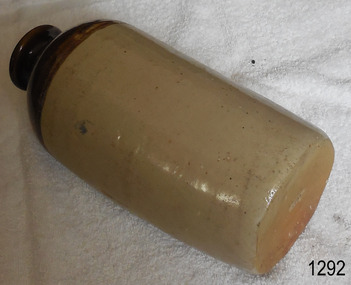
Ceramic - Hot water bottle, late 19th - early 20th century
... ...domestic item...This bottle is of historic significance, as an example of personal heating equipment used in the late 19th and early 20th centuries. flagstaff hill warrnambool shipwrecked-coast maritime-museum shipwreck-coast flagstaff-hill-maritime-village domestic item hot water bottle heating equipment ceramic bottle stoneware bottle potter earthenware personal item bed warmer foot warmer flat-sided hot water bottle household item stoneware clay ceramic Inscription hand written on base of bottle "Mrs K. ...This hot water bottle was designed to lay flat in a bed between the sheets. Its purpose was to warm the bed before use. The bottle was filled with hot water then a stopper was placed in the top to seal it, preventing the water from running out. The inscription on the attached label of this hot water bottle gives both the donor's details and the location of the bottle when it was first displayed at Flagstaff Hill Maritime Village. the "P.M.O." are the initials for the Port Medical Office. The donor's details are also written in pencil on the base of the bottle. In the 16th-century people warmed their beds with the 'bed warmer', which was a long-handled, metal pan filled with hot coals and embers and covered with a lid. The pan was placed between the bedsheets to warm the bed before the person retired to sleep for the night. In the early 19th-century earthenware bed warmers came began to be used for the same purpose. They would be filled with hot water and sealed then often wrapped in fabric. The ceramic material would hold the heat for quite some time, without being too hot for the person in bed to also warm their feet as they went off to sleep. Hot water bottles were later made from glass, copper, brass or tin. Some manufacturers made them into decorative pieces that still had practical use. In 1903 a patent was taken out for the first rubber hot water bottle, invented by Slavoljub Eduard Penkala, a Croatian engineer. This bottle is of historic significance, as an example of personal heating equipment used in the late 19th and early 20th centuries.Hot water bottle, earthenware, pale colour with brown glaze on top over the shoulder and mouth section and clear glaze on the remainder of the sides. The cylindrical bottle tapers to a slightly narrower base. One side of the bottle, about a sixth of the circumference, is flat. The base of the bottle has a handwritten inscription. An inscription was on the paper label originally attached to the bottle. Inscription hand written on base of bottle "Mrs K. Rob _ / Browns Rd / Offic / 3 _ _ 9" Inscription on paper label " "Mrs K Robinson Browns Rd Officer 3809 - Hot water bottle P.M.O." flagstaff hill, warrnambool, shipwrecked-coast, maritime-museum, shipwreck-coast, flagstaff-hill-maritime-village, domestic item, hot water bottle, heating equipment, ceramic bottle, stoneware bottle, potter, earthenware, personal item, bed warmer, foot warmer, flat-sided hot water bottle, household item, stoneware, clay, ceramic -
Flagstaff Hill Maritime Museum and Village
Domestic object - Colander, Kande Kitchenware, Circa 1924
... ...Domestic Item...An appliance made by an early and successful Australian company that manufactured metal kitchen items during the first half of the 20th century. flagstaff hill warrnambool shipwrecked-coast flagstaff-hill-maritime-museum shipwreck-coast flagstaff-hill-maritime-village Colander Kitchen Item Domestic Item Kitchen Strainer Colander enamel rusty holes in base of bowls, 2 handles, bowl shape. ...Kande Kitchenware was established by Patrick Kavanagh and William English (the name Kande was formed from their initials, K and E) in 1922 and had its Sydney factory in Little Collins Street, Surrey Hills. Kavanagh and English, a subsidiary of Kande Kitchenware, became a limited company in 1924, with both founders as directors. Another director was Test cricketer Jack Gregory, an all-rounder who slipped easily into the role of businessman. Gregory enjoyed success in business as on the cricket field, helping the company grow from a tiny operation to a major manufacturer and exporter that employed 80 people in 1931. They managed to survive the Depression and kept manufacturing at least until the late 1960s.An appliance made by an early and successful Australian company that manufactured metal kitchen items during the first half of the 20th century. Colander enamel rusty holes in base of bowls, 2 handles, bowl shape.flagstaff hill, warrnambool, shipwrecked-coast, flagstaff-hill-maritime-museum, shipwreck-coast, flagstaff-hill-maritime-village, colander, kitchen item, domestic item, kitchen strainer -
 Flagstaff Hill Maritime Museum and Village
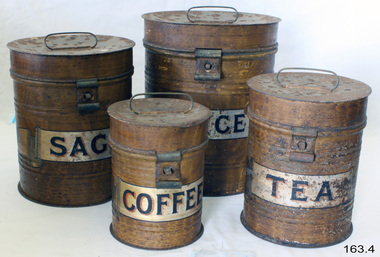
Container - Kitchen Canister set, 1850-1870
... ...domestic item...The subject items are now sought by collectors. flagstaff hill warrnambool shipwrecked coast flagstaff hill maritime museum flagstaff hill maritime village great ocean road canister canister set rice canister kitchen canister food storage domestic item Respectively labelled "COFFEE," "TEA," "SAGO," "RICE" Canister set; set of four canisters. ...In early civilization's cereal grains such as maize, wheat, barley etc. were stored in large airy buildings, often raised up from the ground to reduce infestation by pests and vermin. Ancient Egyptian and early Hebrew writings include reference to such buildings. Smaller quantities of food were stored in baskets made from woven grasses or leaves. In more recent times but prior to the invention of the refrigerator many food products were stored in the home as preserves or pickles, often in heat sealed jars. Dry food items were stored in vermin proof metal containers and could be found in any early colonial kitchen. Items such as coffee, tea, rice and sago were stable food types and needed longer term storage and a higher degree of protection from vermin and the elements, a common material used during this time was sheet metal or tin such as is used today in a common form of storage the biscuit tin. An early example of colonial food storage used in a domestic setting, it is interesting to note the subject items have provision to be locked. This indicates the value early colonial settlers placed on the contents and used to prevent pilfering. The subject items are now sought by collectors. Canister set; set of four canisters. Cylindrical matching kitchen storage tins with hinge lid that has a latch closure, and a folding handle on top of lid. Canisters are painted brown and the body has a graphic of a scroll in gold with printed label of contents. The canisters range from small to large, "COFFEE", "TEA" , "SAGO", " RICE" (respective RNs 163.1, 163.2, 163.3, 163.4)Respectively labelled "COFFEE," "TEA," "SAGO," "RICE" flagstaff hill, warrnambool, shipwrecked coast, flagstaff hill maritime museum, flagstaff hill maritime village, great ocean road, canister, canister set, rice canister, kitchen canister, food storage, domestic item -
 Flagstaff Hill Maritime Museum and Village
Domestic object - Wicker Basket, Late 20th century
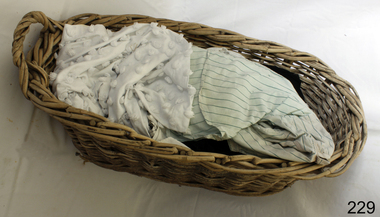
... ...domestic item...The craft has been used over the centuries to produce similar items for domestic use. This basket is currently not associated with a historical event, person or place at this time and is being used to augment Flagstaff's village display. flagstaff hill warrnambool shipwrecked coast flagstaff hill maritime museum maritime museum shipwreck coast flagstaff hill maritime village great ocean road basket cane basket laundry laundry basket washing basket domestic item Cane or wicker laundry basket with one handle, handmade and varnished. ...Containers like this handmade and varnished cane or wicker basket have been used in homes for decades for carrying wet or dry laundry items. The basket is an example of late 20th century cane ware. The craft has been used over the centuries to produce similar items for domestic use. This basket is currently not associated with a historical event, person or place at this time and is being used to augment Flagstaff's village display.Cane or wicker laundry basket with one handle, handmade and varnished. Basket is oval shaped., flagstaff hill, warrnambool, shipwrecked coast, flagstaff hill maritime museum, maritime museum, shipwreck coast, flagstaff hill maritime village, great ocean road, basket, cane basket, laundry, laundry basket, washing basket, domestic item -
 Flagstaff Hill Maritime Museum and Village
Equipment - Balance Scale, Rebure Germany, 1930s
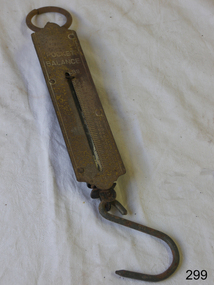
... ...Domestic Item...A mass produced utilitarian item made for domestic use, there is no history or manufacturing provenance currently available....Flagstaff Hill Warrnambool Flagstaff-Hill-Maritime-Museum Maritime-Museum Shipwreck-coast Flagstaff-Hill-Maritime-Village Spring Balance Scale Rebure Scale Company Rebure Germany Domestic Item Kitchen Weighing Scale Rebure Pocket Balance. ...A mass produced utilitarian item made for domestic use, there is no history or manufacturing provenance currently available.The subject item at this time cannot be associated with an historical event or person It is believed the item was manufactured in Germany pre World War ll, in the 1930s, as other examples from the period are on a number of internet sale & auction sites. This item is regarded as a collectors piece however information and company history regards the manufacturer "Rebure" has not yet been established. Balance spring scale elongated brass graduation scale to 100 Lbs hook at one end and a ring the otherRebure Pocket Balance. Made in Germany measures from 0 to 100LBSflagstaff hill, warrnambool, flagstaff-hill-maritime-museum, maritime-museum, shipwreck-coast, flagstaff-hill-maritime-village, spring balance scale, rebure scale company, rebure germany, domestic item, kitchen weighing scale -
 Flagstaff Hill Maritime Museum and Village
Functional object - Rail holder, Before1984
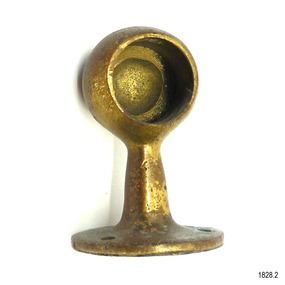
... ...domestic item...Similar fittings are still used today in the 21st century. flagstaff hill warrnambool maritime museum maritime village shipwreck coast rail holder rail fitting brass ware domestic item bathroom furnishing ball rail fitting single outlet rail holder Rail holder; one of two brass rail fittings. ...This rail holder is one of a pair of two. The opening in the sphere holds one end of a rail and the screw holes allow the holder to be attached to a flat surface such as a wall or shelf. Pail holders can be found in homes, marine vessels, offices, hotels and many other locations. They are used with a fitted rail for hanging towels, coat hangers in cupboards and wardrobes and curtains over windows. They can also be used for the ends of handrails and shelf rails.This rail holder represents the the type of fittings used on ships in the 19th century. Similar fittings are still used today in the 21st century.Rail holder; one of two brass rail fittings. Hollow sphere on top of a pedestal that has a round base with three holes in it. The sphere has an opening on one side.flagstaff hill, warrnambool, maritime museum, maritime village, shipwreck coast, rail holder, rail fitting, brass ware, domestic item, bathroom furnishing, ball rail fitting, single outlet rail holder -
 Flagstaff Hill Maritime Museum and Village
Domestic object - Pitcher, Circa 1940s+
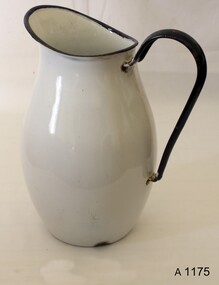
... ...domestic item...A mass produced utilitarian item made for domestic use no history or manufacturing provenance currently available. ...Item at this time cannot be associated with an historical event, person or place, provenance is unknown, item assessed as a collection asset. flagstaff hill warrnambool shipwrecked-coast flagstaff-hill flagstaff-hill-maritime-museum shipwreck-coast flagstaff-hill-maritime-village domestic item jug enamel jug enamel ware drink ware pitcher None Pitcher or jug; enamel French pitcher design, white with blue handle, curved lines, bulbous body. ...A mass produced utilitarian item made for domestic use no history or manufacturing provenance currently available. This design is European and was made by many manufactures from 1900 up to today, the same design and manufacture of new items can be currently sourced from Romania. Item at this time cannot be associated with an historical event, person or place, provenance is unknown, item assessed as a collection asset.Pitcher or jug; enamel French pitcher design, white with blue handle, curved lines, bulbous body.Noneflagstaff hill, warrnambool, shipwrecked-coast, flagstaff-hill, flagstaff-hill-maritime-museum, shipwreck-coast, flagstaff-hill-maritime-village, domestic item, jug, enamel jug, enamel ware, drink ware, pitcher -
 Flagstaff Hill Maritime Museum and Village
Domestic object - Butter Pat, Late 19th to mid 20th century
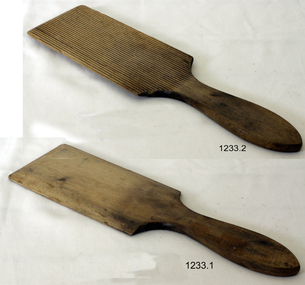
... ...domestic item...An everyday item in most farm households from the 17th up until the mid 20th centuries significant as it gives a snapshot into the domestic lives of people with farms or small holdings that made their own butter either for sale or for their own use. flagstaff hill warrnambool shipwrecked-coast flagstaff-hill-maritime-museum shipwreck-coast flagstaff-hill-maritime-village domestic item butter pats butter making dairy item Textured with horizontal lines A pair of Butter Slices (pat) wooden flat with shaped handle. ...Scotch hands have also come to be known as butter beaters, butter hands, butter workers or butter pats depending on what part of the world or time period you were in. They are wooden spatulas used when making butter used to press freshly churned butter to remove the watery buttermilk during the butter finishing or working process, also as an aid to distribute salt through the butter. Removing the buttermilk and adding salt helps to prevent rancidity in finished butter, with one side of the paddle ribbed or grooved to allow the buttermilk to drain away from the butter during pressing. The ungrooved side may be used for shaping the butter into its final form. The highest quality Scotch hands are made out of sycamore wood, but they can also be made out of metal.An everyday item in most farm households from the 17th up until the mid 20th centuries significant as it gives a snapshot into the domestic lives of people with farms or small holdings that made their own butter either for sale or for their own use.A pair of Butter Slices (pat) wooden flat with shaped handle. Side for shaping butter is textured Textured with horizontal linesflagstaff hill, warrnambool, shipwrecked-coast, flagstaff-hill-maritime-museum, shipwreck-coast, flagstaff-hill-maritime-village, domestic item, butter pats, butter making, dairy item -
Blacksmith's Cottage and Forge
Wash Board, Unknown
... ...domestic item...Source: wikipedia.com wood glass laundry wash board soap housewife domestic item None Wooden framed wash board - slatted. ...A washboard is a tool designed for hand washing clothing. The traditional washboard is usually constructed with a rectangular wooden frame in which are mounted a series of ridges or corrugations for the clothing to be rubbed upon. For 19th century washboards, the ridges were often of wood; by the 20th century, ridges of metal were more common. A "fluted" metal washboard was patented in the US in 1833. Zinc washboards were manufactured in the US from the middle of the 19th century. In the late 20th century and early 21st century, ridges of galvanized steel are most common, but some modern boards are made of glass. Source: wikipedia.comWooden framed wash board - slatted. The glass insert is corrugated and nailed to the wooden frame.Nonewood, glass, laundry, wash board, soap, housewife, domestic item -
Blacksmith's Cottage and Forge
Matchbox
... ...domestic item...box domestic item matches heating phosphorous ply wood three stars jonkoping vulcan sweden Matchbox ...box, domestic item, matches, heating, phosphorous, ply wood, three stars, jonkoping vulcan, sweden -
Blacksmith's Cottage and Forge
Steel, Unknown
... ...domestic item...Steels were used to sharpen knives. steel cutlery domestic item ivory Made in England Steel with an ivory handle - light yellow. ...Steels were used to sharpen knives.Steel with an ivory handle - light yellow. Tapers at end. Grooves along length.Made in Englandsteel, cutlery, domestic item, ivory -
Blacksmith's Cottage and Forge
Tin - quinine, Unknown
... ...domestic item...Domestsic item - medicinal tin medicine domestic item quinine QUININE 5 GR. Small tin with inscription on hinged lid Tin - quinine ...Domestsic item - medicinalSmall tin with inscription on hinged lidQUININE 5 GR.tin, medicine, domestic item, quinine -
 Flagstaff Hill Maritime Museum and Village
Textile - Wall Hanging, curtain, 1854-1855
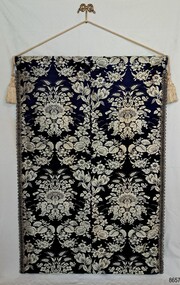
... ...Domestic Item...Flagstaff Hill Maritime Museum and Village Great Ocean Road Shipwreck Coast shipwreck artefact memorabilia curtain saloon curtain Schomberg wall hanging Decorative Object Domestic Item Warrnambool Flagstaff hill Maritime Museum Maritime Village maritime history shipwreck stranding Schomberg curtain Schomberg wall hanging luxury ship 1855 damask silk damask blue and cream captain’s cabin ladies’ saloon clipper ship migrant emigrant Liverpool to Australia Captain James Nicol Forbes James Forbes Captain Forbes Bully Forbes James Baines & Co James Baines Cape Otway Aberdeen Prince of Waterloo Wakefield Cleopatra Maria Thomas Mackay Black Ball line Marco Polo sailing record Lightning Isabella Jaffray Nocol Blakiston Robinson Alexander Hall steamer Queen Captain Helpman James Lawrence steamer Burra Burra steamer jane Elizabeth water police customs agents Lloyds agent ship’s band walk to Warrnambool march to Warrnambool steamer Champion Agnes Nicol Robinson Arthur William Rudd OBE MA LLB This wall hanging, also known as the Schomberg Curtain, was created from a curtain recovered from the stranded luxury ship Schomberg in December 1855. ...The striking fabric of this wall hanging was recovered from the sinking Schomberg. It was originally one of the many curtains adorning the captain’s cabin and ladies’ saloons that attracted first-class passengers to this luxury vessel, built for comfort and speed. The clipper ship was on its maiden voyage, full of passengers emigrating to Australia in 1855. Its commander was Captain James Nicol Forbes, who had been selected by James Baine & Co for his navigation skills, experience, and reputation for breaking sailing records. However, on December 26th, 1855, the vessel became stranded and sank west of Cape Otway, not quite reaching its destination of Melbourne. A reporter explored the Schomberg before its journey; the following detailed description is an excerpt of his article published in a newspaper after the disastrous voyage was announced. “ … descending by a flight of stairs, covered with carpet of a very rich pattern, we came to the saloon passengers’ cabin. This is a noble place, and all that refined taste would suggest has been done to make each berth a miniature palace. The bedding is of the very best material, and the fittings are replete with every convenience. The carpets are of various coloured velvet pile, and the curtains are of satin damask, lined with white satin … The fronts of the berths are highly decorated, and festoons of flowers are painted on the panels … No two berths are furnished with the same-coloured material … the visitor is, therefore, much pleased with the variety which he has to inspect….” (Trove: Shipping Gazette and Sydney General Trade, 31 Dec 1955, p. 283) The curtain material, ‘folded into a single piece and parcelled for protection’, has been passed down through generations of Captain Forbes’ relatives, starting with his half-sister Isabella Jeffrey Nicol. The curtain has remained with the family, although some transition details are incomplete. About a century later, Isabella and Blakiston Robinson’s great-grandson and his wife had the fabric professionally mounted as a wall hanging to showcase the beauty of the woven brocade. Eventually, the custodianship of the curtain was transferred to the donor, who is also a great-grandson of Isabella and Blakiston. He and his wife hung the curtain on the wall of a high-ceilinged room in their home, away from direct light, making it visible for all to appreciate its beauty and significance. In 2024, they donated the curtain for inclusion among the collection of artefacts that help tell the story of the Schomberg and those who sailed on its first and last voyage. The donor’s aunt was highly involved in the family’s history. She had collected and recorded information that dates back to pre-1341. A footnote included in a handwritten letter dated April 20, 1959, from the late Arthur William Rudd, OBE, MA, LLB, husband of another of the donor’s aunts, states, “The curtains you mentioned came from the Schomberg. AWR.” CAPTAIN JAMES NICOL FORBES (1821-1874) and the donor’s family: - Captain Forbes was born in Aberdeen. In his late teens, he moved to Liverpool, a hub for international trade and an emigration port. By the age of 25, he was master of the Prince of Waterloo and later, the Wakefield. He then commanded the Cleopatra for the James Baines Co., which, two years later, transferred him to command the Maria, providing fast and lucrative passage to the gold fields in Ballarat, Australia. James Baines Co. and shipbuilder Thomas Mackay formed the Black Ball Line of clipper ships in 1852. Forbes was appointed master of the largest ship in the fleet, the marvellous Marco Polo. He broke the record time for the passage to Australia, taking only 68 days at sea, and the return journey in only 76 days, a total of 5 months and 21 days. On his second voyage to Melbourne in the Marco Polo the following year, he took 75 days, and 95 days on the return trip. His accomplishment made him famous. James Baines reported that the Marco Polo was the only ship, sail or steam, to do the round trip within 6 months, and it had done it twice. Captain Forbes then took command of the American-built clipper Lightning, one of four built for the Black Ball line. His 19-year-old half-sister, Isabella Jaffray Nicol, was also onboard when he sailed for Melbourne in 1854. During the 77-day voyage, Isabella met Blakiston Robinson, and not long after the ship arrived in Melbourne on July 31, the couple married, with James Nicol Forbes as a witness, on August 16. When Forbes returned to Liverpool, he took a record-breaking 63 days, which has never been bettered. James Baines Co. ordered a new luxury emigrant ship from Alexander Hall of Aberdeen; the Schomberg was the largest sailing ship ever built in Britain. On October 6, 1855, the vessel departed Liverpool commanded by Captain Forbes, with 430 passengers on board, 54 of whom were First Class. It had almost completed its voyage to Melbourne when, on the night of December 26, it ran aground west of Cape Otway. Captain Doran, master of the steamer Queen, responded to the distress signal while on its way to Portland and, with the agreement of his passengers, rescued as many as possible from the Schomberg and returned to Melbourne with them. Captain Helpman, master of the steamer Champion, rescued most of the remaining Schomberg passengers on December 27. On Friday, 28th, Captain James Lawrence was on his way to Adelaide in the steamer Burra Burra, and called past the Schomberg. He reported that the remaining crew were all doing their duties, but the Schomberg was deteriorating on a sand spit and had about 16 feet of water in its hold. That same day, the schooner Jane Elizabeth collected 220 packages of passengers’ luggage to deliver to Melbourne on the 29th. Two steamers also arrived on the 29th with 20 men to collect passengers’ luggage and valuable ship’s cargo items. They were accompanied by water police, customs agents, company representatives and a Lloyds agent. The decision was made to abandon ship on the 30th due to rough and unsafe conditions. The officials and Captain Forbes voyaged to Melbourne, while the seamen remained behind awaiting rescue. Evacuation by sea became too risky, so on January 2, 1856, while the first Mate and Steward remained at the wreck site, the rest of the crew began the 70-mile march to Warrnambool, led by the band. They arrived on January 5th and left for Melbourne on the steamer Champion on January 10th. Parts of the Schomberg wreck ended up in New Zealand. The curtain is important for its connection to the Schomberg, which was unique for being designed and built in Aberdeen, and commanded by an Aberdonian who was the most celebrated clipper captain of the age. The ship was the largest sailing ship ever built in Britain, and reported as the largest vessel that sailed to Australia. The curtain is an example of the rich decorative furnishings available in 1855. The preservation and respect the donor and his family have shown towards the curtain over many decades reflect its important role in telling the family’s history; the journey, the romantic attachment, the family connection to the sea, and travel in gold rush times. The curtain is significant for its connection to James Nocol Forbes, a famous sailing ship commander who broke several sailing records, one of which has never been bettered. This wall hanging, also known as the Schomberg Curtain, was created from a curtain recovered from the stranded luxury ship Schomberg in December 1855. The woven satin damask fabric in blue and cream has been meticulously joined to blend the intricate pattern. The reverse features a soft cream lining. The hems at the top and bottom of the fabric hold wooden rods. The side edges feature decorative braid that has been hand-stitched in place. On the reverse, the bottom hem includes the same braid, which remains unseen from the front, and the centre of the top hem has a hand-worked, unused buttonhole. Each of the hems varies in depth. The curtain was tastefully mounted later to highlight the beauty of the original saloon curtain. A decorative twisted cord of cream silk threads, accented with gold highlights and decorative tassels, was coiled and attached to the ends of the top rod. The elegant display was completed with an ornate gold hook, chosen to complement the wall hanging.flagstaff hill maritime museum and village, great ocean road, shipwreck coast, shipwreck artefact, memorabilia, curtain, saloon curtain, schomberg, wall hanging, decorative object, domestic item, warrnambool, flagstaff hill, maritime museum, maritime village, maritime history, shipwreck, stranding, schomberg curtain, schomberg wall hanging, luxury ship, 1855, damask, silk damask, blue and cream, captain’s cabin, ladies’ saloon, clipper ship, migrant, emigrant, liverpool to australia, captain james nicol forbes, james forbes, captain forbes, bully forbes, james baines & co, james baines, cape otway, aberdeen, prince of waterloo, wakefield, cleopatra, maria, thomas mackay, black ball line, marco polo, sailing record, lightning, isabella jaffray nocol, blakiston robinson, alexander hall, steamer queen, captain helpman, james lawrence, steamer burra burra, steamer jane elizabeth, water police, customs agents, lloyds agent, ship’s band, walk to warrnambool, march to warrnambool, steamer champion, agnes nicol robinson, arthur william rudd obe ma llb -
 Flagstaff Hill Maritime Museum and Village
Domestic object - Food Safe, Willow Ware Pty Ltd, 1950s to 70s
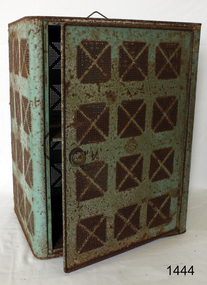
... ...domestic item...This food safe is a mass-produced item made for domestic use by Willow Manufacturing in Australia fin the mid-20th century. ...The maker, Willow, has a name associated with practical and reliable domestic products. flagstaff hill warrnambool flagstaff hill maritime museum shipwreck coast flagstaff hill maritime village great ocean road food storage food preservation Willow Willow Manufacturing Willow Australia kitchen storage food care 19th century 20th century Willow Ware domestic item coolgardie meat safe meat safe food safe coolgardie Marked "Made in Australia" "Willow" Metal kitchen safe with two shelves, a hinged door and latch and a small swivel wire handle at the top. ...This food safe is a mass-produced item made for domestic use by Willow Manufacturing in Australia fin the mid-20th century. Willow started a business in 1887 as a metalworking company based in Melbourne Australia, making tinned biscuit and tea canisters. In the First World War, the company began manufacturing armaments and essential packaging for the war effort. In the early 1920s, Willow produced domestic kitchen bakeware such as tin-plated canisters and baking pans labelled with the well-known Willow brand. Other items at this time include billies, boilers, basins and Coolgardie safes. In the late 1950s, the company ventured into plastics production. and in 1965, the name changed to Willow Ware Pty Ltd, to be more closely linked to its Willow brand. Willow Ware is still in business today.The Australian food safe is an example of domestic food storage and preservation in Australian homes from the mid-19th century and early 20th centuries. It is part of the evolution of food preservation methods leading up to our modern electric appliances. The maker, Willow, has a name associated with practical and reliable domestic products.Metal kitchen safe with two shelves, a hinged door and latch and a small swivel wire handle at the top. Painted light green. Airflow holes have been formed in each side panel. Made by Willow, Australia.Marked "Made in Australia" "Willow"flagstaff hill, warrnambool, flagstaff hill maritime museum, shipwreck coast, flagstaff hill maritime village, great ocean road, food storage, food preservation, willow, willow manufacturing, willow australia, kitchen storage, food care, 19th century, 20th century, willow ware, domestic item, coolgardie meat safe, meat safe, food safe, coolgardie -
 Flagstaff Hill Maritime Museum and Village
Domestic object - Butter Pats, Late 19th to mid 20th century
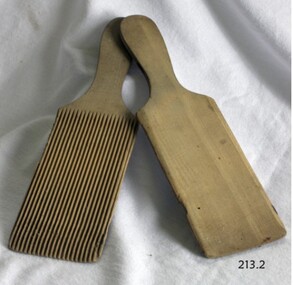
... ...domestic item...An everyday item in most farm households from the 17th up until the mid 20th centuries significant as it gives a snapshot into the domestic lives of people with farms or small holdings that made their own butter either for sale or for their own use. flagstaff hill warrnambool shipwrecked-coast flagstaff-hill-maritime-museum shipwreck-coast flagstaff-hill-maritime-village domestic item butter pats butter making dairy item Textured with horizontal lines A pair of Butter Slices (pat) wooden flat with shaped handle. ...Scotch hands have also come to be known as butter beaters, butter hands, butter workers or butter pats depending on what part of the world or time period you were in. They are wooden spatulas used when making butter used to press freshly churned butter to remove the watery buttermilk during the butter finishing or working process, also as an aid to distribute salt through the butter. Removing the buttermilk and adding salt helps to prevent rancidity in finished butter, with one side of the paddle ribbed or grooved to allow the buttermilk to drain away from the butter during pressing. The ungrooved side may be used for shaping the butter into its final form. The highest quality Scotch hands are made out of sycamore wood, but they can also be made out of metal.An everyday item in most farm households from the 17th up until the mid 20th centuries significant as it gives a snapshot into the domestic lives of people with farms or small holdings that made their own butter either for sale or for their own use.A pair of Butter Slices (pat) wooden flat with shaped handle. Side for shaping butter is textured Textured with horizontal linesflagstaff hill, warrnambool, shipwrecked-coast, flagstaff-hill-maritime-museum, shipwreck-coast, flagstaff-hill-maritime-village, domestic item, butter pats, butter making, dairy item -
 Flagstaff Hill Maritime Museum and Village
Ceramic - Cover, circa 1883
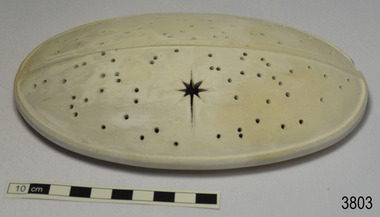
... ...domestic item...Divers can still access parts of the scattered wreck and other artefacts recovered in the 1970s and 1980s can be viewed in both public and private collections. flagstaff hill warrnambool flagstaff hill maritime museum maritime museum shipwreck coast flagstaff hill maritime village great ocean road john chance west coast trader george roper w. h. potter & sons w.t. dickson and son captain john ward russell stourbridge bricks port phillip heads lonsdale reef dive wreck vhr s286 coastal trader ceramic vintage ventilated cover domestic item Cover; unglazed white ceramic, oval shape. ...This ceramic cover was recovered from the wreck of the 1882-1883 George Roper between the late 1960’s to early 1970’s. It is one of the shipwreck artefacts in the John Chance Collection. The purpose of the cover is unclear. The holes could be for ventilation. The cover may have been used to protect food or keep it at an even temperature. It may also have been used for covering fragrant petals, allowing some scent to escape through the holes. The residue around the underside of the holes and their random placement indicate that the cover could be partially handmade. The discolouration could have come from its time in the sea. The GEORGE ROPER 1882 - 1883 - The George Roper was a 4-masted iron sailing ship built in Liverpool, England, in 1882 for fast international trade with Australia. The large vessel was launched in February 1883. The ship was on its first trip, departing Liverpool for Melbourne, captained by John Ward and a crew of 31. She had almost reached her destination on July 4 1883, approaching Port Phillip Bay and being towed by the steam tug William. The weather changed to rough with fog and both the George Roper and the William hit the dangerous Lonsdale Reef at Port Phillip Heads. The Captain and crew were eventually rescued and taken to Queenscliff. Salvage syndicates were able to recover a lot of the cargo before the George Roper broke up and sank. Amongst the cargo was soft goods, draperies, household items, spirits of malt and distilled liquors, chemicals, dynamite, and 1,400 tons of steel rails for the Victorian Government. Also in the hold were Russell Stourbridge bricks, as paying ballast. The ventilated cover is as an example of domestic ceramic ware of the 1880s. The cover also holds significance as it was recovered by John Chance, a diver from the wreck of the George Groper in the 1960s-70s. Items that come from several wrecks along Victoria's coast have since been donated to the Flagstaff Hill Maritime Village’s museum collection by his family, illustrating this item’s level of historical value. The George Roper is considered historically and archaeologically significant and as such, is listed on the Victorian Heritage Database, VHR S286. It is an example of a vessel built specifically for fast travel to and from Australia with a large shipment of cargo. The George Roper’s cargo of steel rails adds to the historical significance of international trade to the growing colony of Australia and Victoria in particular, with rail transportation soon to become a faster and safer form of transportation between colonial towns. Divers can still access parts of the scattered wreck and other artefacts recovered in the 1970s and 1980s can be viewed in both public and private collections. Cover; unglazed white ceramic, oval shape. The cover has holes randomly poked through its surface, one large hole is a six pointed star shape. Underneath there is a narrow rim placed slightly inside the edge. There is residue on the underneath around the holes. There is orange-brown discolouration and areas where the surface is lighter coloured. flagstaff hill, warrnambool, flagstaff hill maritime museum, maritime museum, shipwreck coast, flagstaff hill maritime village, great ocean road, john chance, west coast trader, george roper, w. h. potter & sons, w.t. dickson and son, captain john ward, russell stourbridge bricks, port phillip heads, lonsdale reef, dive wreck, vhr s286, coastal trader, ceramic, vintage, ventilated cover, domestic item -
 Glenelg Shire Council Cultural Collection
Clothing - Apron, 1900s
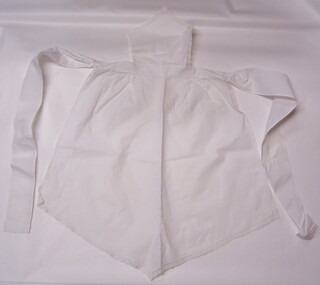
... ... domestic item...Part of Graham Collection, donated by the Family of Misses Mary and Edith Maude Graham, of 4 Blair Street, Portland. clothing womens history needlework domestic item Lace edged white lawn apron with attached bib. ...Part of Graham Collection, donated by the Family of Misses Mary and Edith Maude Graham, of 4 Blair Street, Portland.Lace edged white lawn apron with attached bib. Both bib and apron, pentagonal shape.clothing, womens history, needlework, domestic item -
 Glenelg Shire Council Cultural Collection
Clothing - Apron, 1900-1940
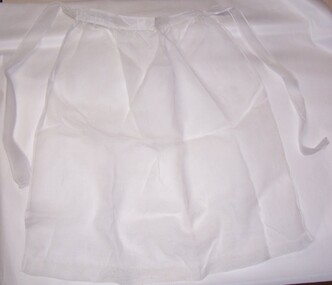
... ... domestic item...Part of Graham Collection, donated by the Family of Misses Mary and Edith Maude Graham, of 4 Blair Street, Portland. clothing domestic item apron needlework womens history White half apron. ...Part of Graham Collection, donated by the Family of Misses Mary and Edith Maude Graham, of 4 Blair Street, Portland.White half apron.clothing, domestic item, apron, needlework, womens history
