
Showing 9 items matching " elector's right"
-
 Bendigo Historical Society Inc.
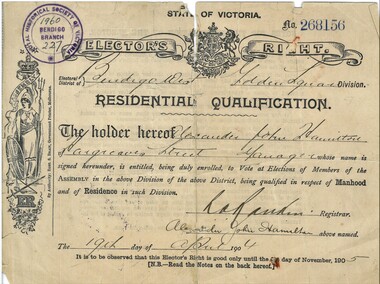
Document - HAMILTON COLLECTION: ELECTOR'S RIGHT - ALEXANDER JOHN HAMILTON, 1904
... HAMILTON COLLECTION: ELECTOR'S RIGHT - ALEXANDER JOHN HAMILTON...Elector's Right...Elector's Right (No. 2681560) Residential Qualification for Alexander John Hamilton, Hargreaves Street. ...Elector's Right alexander john hamilton Elector's Right (No. 2681560) Residential Qualification for Alexander John Hamilton, Hargreaves Street. ...Elector's Right (No. 2681560) Residential Qualification for Alexander John Hamilton, Hargreaves Street. Manager. Dated 19.4.1904. Electoral District Bendigo West. Division Golden Square. State of Victoria Assembly.elector's right, alexander john hamilton -
 Bendigo Historical Society Inc.
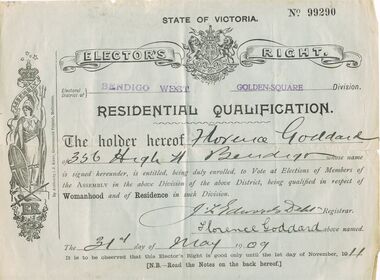
Document - 'ELECTOR'S RIGHT' CERTIFICATE FOR RESIDENTIAL QUALIFICATION, 1909
... 'ELECTOR'S RIGHT' CERTIFICATE FOR RESIDENTIAL QUALIFICATION...'Elector's Right' - Certificate of Residential Qualification for Florence Goddard, Bendigo West. ...PERSON Individual Florence Goddard Florence Goddard Golden Square Bendigo West. 'Elector's Right' - Certificate of Residential Qualification for Florence Goddard, Bendigo West. ...'Elector's Right' - Certificate of Residential Qualification for Florence Goddard, Bendigo West. Entitled to vote ''in respect of Womanhood and of Residence'' in the Golden Square Division, 1909.person, individual, florence goddard, florence goddard, golden square, bendigo west. -
 Bendigo Historical Society Inc.
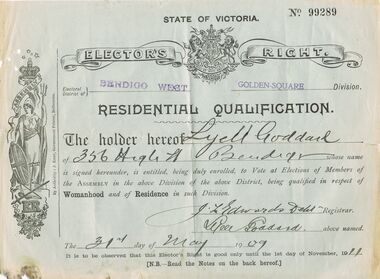
Document - 'ELECTOR'S RIGHT': CERTIFICATE OF RESIDENTIAL QUALIFICATION, 1909
... 'ELECTOR'S RIGHT': CERTIFICATE OF RESIDENTIAL QUALIFICATION...'Elector's Right' - Certificate of Residential Qualification for Lyell Goddard, Bendigo West. ...PERSON Individual Lyall Goddard Womanhood and Resistance Golden Square Division. 'Elector's Right' - Certificate of Residential Qualification for Lyell Goddard, Bendigo West. ...'Elector's Right' - Certificate of Residential Qualification for Lyell Goddard, Bendigo West. Entitled to vote ''in respect of Womanhood and of Residence'' in the Golden Square Division, 1909.person, individual, lyall goddard, womanhood and resistance, golden square division. -
 Stawell Historical Society Inc
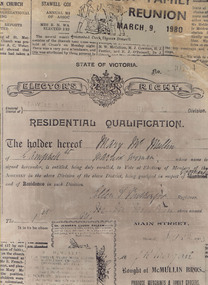
Photograph, Mrs Mary McMullin's Elector’s Right
... Mrs Mary McMullin's Elector’s Right....This photograph of a document no 280754 of - State pf Victoria Elector Right holder Mary McMullin - also McMullin Family Reunion March 9, 1980. ...Mrs Mary McMullin's Elector’s Right. Photograph ...This photograph of a document no 280754 of - State pf Victoria Elector Right holder Mary McMullin - also McMullin Family Reunion March 9, 1980. Add for R. McMullin - Receipt from McMullin Bros. Receipt September 22, 1903. Advertisement 1889. R Mc Mullin. Mc Mullin family reunion information advertisement, receipt and electoral right photographed on top of Stawell Times News. Black and white photograph of a document. Electoral Right. Residential Qualification. The holder hereof Mary Mc Mullin of Campbell St. Photo also includes cut-outs of Mc Mullin Family Reunion March 9, 1980 and receipts from McMullin Bros., Produce Merchants & Family Grocers.Electoral Right. Residential Qualification. stawell -
 Bendigo Historical Society Inc.
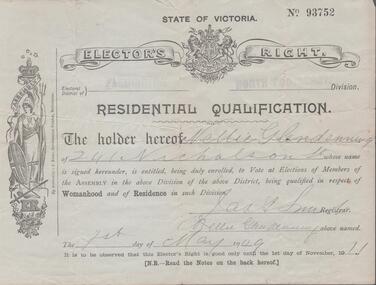
Document - ELECTOR'S RIGHT
... ELECTOR'S RIGHT...Elector's right for the State of Victoria No. 93752 Electoral district of Flemington, North Footscray division. ...Dated 1st dy of May, 1909 Document ELECTOR'S RIGHT ...Elector's right for the State of Victoria No. 93752 Electoral district of Flemington, North Footscray division. Residential qualification: the holder hereof Nellie Glendemming of 241 Nicholson Street is entitled to vote at elections of members of the Assembly in the above division being qualified in respect of Womanhood and of Residence in such division. Dated 1st dy of May, 1909government, state, electoral right -
 Orbost & District Historical Society
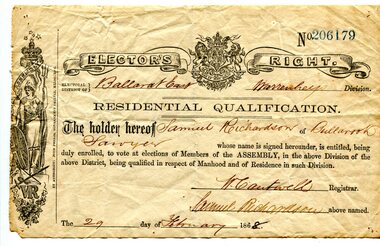
certificate, 29th February 1868
... suffrage richardson-samuel elector's-right-certificate...This Elector's Right Certificate, No. 206179, is for Samuel Richardson, a sawyer, who lived at Bullarook in the Ballarat East Division. ...A white paper certificate with black print and hand-written details. at the top is the British coat-of-arms. It is an elector's right certificate made out to Samuel richardson....It is an elector's right certificate made out to Samuel richardson. certificate Ferris, John ...This Elector's Right Certificate, No. 206179, is for Samuel Richardson, a sawyer, who lived at Bullarook in the Ballarat East Division. It has been signed by W. Cantwell, the registrar and by Samuel Richardson. As a resident and a male he was entitled to vote in the Ballarat East Division at Victorian State elections. Samuel Richardson was a sawmiller and farmer in Orbost. He built The Curlip, a wooden paddle-steamer of 9 tons gross and dimensions of 43 feet long, 10 feet wide and a depth of 3 feet, on the slipway at their Tabarra sawmill in 1890. This item is associated with the Richardson family, early Orbost pioneers,A white paper certificate with black print and hand-written details. at the top is the British coat-of-arms. It is an elector's right certificate made out to Samuel richardson.suffrage richardson-samuel elector's-right-certificate -
 Warrnambool and District Historical Society Inc.
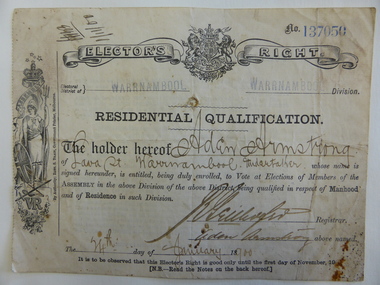
Original Document, Residential Qualification: Aden Armstrong, Circa 1900
... elector's right certificate...This is an original Elector’s right certificate of 1900 for the Warrnambool Electoral District. ...Blue stamped number 137050 on top right corner. Back is printed with notes for the elector....This is an original Elector’s right certificate of 1900 for the Warrnambool Electoral District. ...This is an original Elector’s right certificate of 1900 for the Warrnambool Electoral District. This entitled the owner to vote at elections held for the Legislative Assembly in the Government of Victoria. The voter had to be male and resident in the electorate( in this case Warrnambool).This certificate was issued to Aden Armstrong an undertaker with a business in Timor Street opposite the Old National Bank which was at the corner of Kepler and Timor Streets. The Registrar who signed the certificate was Richard Geilhofer. The certificate was one of the items in the Henri Worland collection of historical society in 1973 by the Warrnambool City Council via Keith Arnel the Town Clerk. The timeframe of this document is on the cusp of major electoral change in Australia with the Federation of Australian states happening in 1901 and the granting of the vote for Australian women in the various states over the next decade.This item would have been a common item at the time as all those entitled to vote had to present same. It has local significance with Aden Armstrong being in business in Warrnambool for a number of years.Cream coloured paper with black text. Victorian coat of Arms at centre top of document. Drawing of lady holding shield on left side Handwritten information is written in faded black ink. Blue stamped number 137050 on top right corner. Back is printed with notes for the elector.Signature and date 1/11/00 at top left. Warrnambool is stamped in dark blue twice at top. Aden Armstrong of Lava St Warrnambool, Undertaker is written on the form with his signature at bottom right. Also signed by the registrar of the day, Richard Geilhofer. Date is also included 24th January 1900 elector's right certificate, aden armstrong, warrnambool, warrnambool undertakers -
 Bendigo Historical Society Inc.
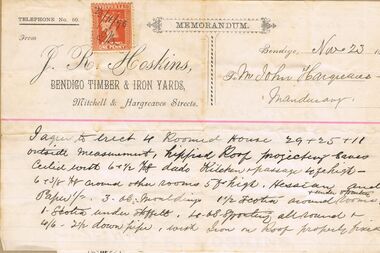
Document - LUDERMAN COLLECTION: SPRING GULLY, MANDURANG DOCUMENTS
... ... Elector's Right...Hoskin, Bendigo Timber and Iron Yards relating to construction of residence in Spring Gully (1896); Certificate of Registration of Residence Area for Thomas Snowdon, adjoining Hargreaves residence 200 yards from Reservoir; Elector's Right for John Billman Hargreaves of Mandurang, Tanner; handwritten note (Bairnsdale 24.1.34) on John Billman Hargreaves born 1861 on 14 June on Sheepwash Creek in Mandurang riding Shire of Strathfieldsaye near Bendigo possibly registered at Strathfieldsaye, Kangaroo Flat or Bendigo. ...PERSON Individual hargreaves Hoskins Hargreaves Snowdon Elector's Right Tanner's gold Mining Compagnie North Lord Warden Tribute Co. ...Document. Pastel Drawing Book, 'Bulldog' Series No. 589, containing series of invoices and documents relating to the Hargreaves family. Items stuck in book in order includes: invoices from J.R. Hoskin, Bendigo Timber and Iron Yards relating to construction of residence in Spring Gully (1896); Certificate of Registration of Residence Area for Thomas Snowdon, adjoining Hargreaves residence 200 yards from Reservoir; Elector's Right for John Billman Hargreaves of Mandurang, Tanner; handwritten note (Bairnsdale 24.1.34) on John Billman Hargreaves born 1861 on 14 June on Sheepwash Creek in Mandurang riding Shire of Strathfieldsaye near Bendigo possibly registered at Strathfieldsaye, Kangaroo Flat or Bendigo. Father's name John Hargreaves (English) mother's name Hosannah Hargreaves nee Billman'; 2 scrip certificates issued by 'Tanners Gold Mining Compagnie Pipers Hill, Sheepwash' overwritten on top of document ( underneath North Lord Warden Tribute Co., ) scrip certificate issued to John B. Hargreaves on 25 September 1882; invoice Jas. Knowlton, late J. Moody, watchmaker and jeweller, No. 1 Bath Corner, Bendigo 3.8.1895 for Diamond brooch; invoice H. Credginton watchmaker and jeweller and optician for 1 gem ring. Loose document inside contains written advice re taking wool off sheep skins and curing hides.person, individual, hargreaves, hoskins, hargreaves, snowdon, elector's right, tanner's gold mining compagnie, north lord warden tribute co., knowlton, credgington -
 Flagstaff Hill Maritime Museum and Village
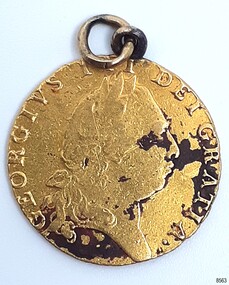
Currency - Guinea Coin, The Royal Mint, 1793 George III Spade Guinea, 1793
... right, laurel wreath on head) Reverse text; 'M.B.E.ET.H.REX.F. D.B.ET.L.D. S.R.I.A.T.ET.E' '1793' (translates to: King of Great Britain, France and Ireland, Defender of the Faith, Duke of Brunswick and Lüneburg, Arch-Treasurer and Elector of the Holy Roman Empire) Reverse relief; a spade-shaped image i.e. ...right, laurel wreath on head) Reverse text; 'M.B.E.ET.H.REX.F. D.B.ET.L.D. S.R.I.A.T.ET.E' '1793' (translates to: King of Great Britain, France and Ireland, Defender of the Faith, Duke of Brunswick and Lüneburg, Arch-Treasurer and Elector of the Holy Roman Empire) Reverse relief; a spade-shaped image i.e. ...The coin was discovered by Julie Wilkins, a Victorian scuba diver who had already experienced more than 500 dives in Australia and overseas. She was holidaying in Peterborough, Victoria, and looking forward to discovering more about the famous Loch Ard ship, wrecked in June 1878 at Mutton Bird Island. The fast Glasgow-built clipper ship was only five years old when the tragedy occurred. There were 54 people on board the vessel and only two survived Julie's holiday photograph of Boat Bay reminds her of her most memorable dive. Submerged in the calm, flat sea, she was carefully scanning around the remains of the old wreck when, to her amazement, a gold coin and a small gold cross suddenly came up towards her. She excitedly cupped them in her hands, then stowed the treasures safely in her wetsuit and continued her dive. She soon discovered a group of brass carriage clock parts and some bottles of champagne. It was a day full of surprises. The items were easily recognisable, without any build-up of encrustations or concretion. Julie secretly enjoyed her treasures for twenty-four years then packed them up for the early morning train trip to Warrnambool. After a short walk to Flagstaff Hill Maritime Museum and Village, her photograph was taken as she handed over her precious find. She told her story to a local newspaper reporter, lunched a café in town then took the late afternoon train home. Her generous donation is now part of a vast collection of Loch Ard shipwreck artefacts, including the gold watch and the Minton Majolica model peacock. The coin is a British 1793 George III Gold Spade Guinea. It was already 83 years old when the Loch Ard had set sail. The loop and ring have been added, perhaps as a pendant, pocket watch accessory or similar purpose. It may have been worn for ‘good luck’ on the long journey to Australia, where ships had to carefully navigate the treacherous Bass’s Strait before arriving at their destination of Melbourne. Sadly, many met their fate on that short stretch of ocean aptly named the Shipwreck Coast. The coin is very recognisable even though it was exposed to the wrecking of the ship, its consequent movement, and the sea's turbulence. Its bent, scratched, buckled, split, dinted and worn condition is part of its story. The red-brown-black discolouration is similar to that found on other gold coins, sometimes called the ‘corrosion phenomena’. Studies suggest the possible cause is contaminants in the minting process reacting to the coins’ environment. The GEORGE III GOLD SPADE GUINEA: - The British Guinea was introduced in 1663 and was circulated until 1814. It was made of 22 carat gold, was 25 to 26 cm in diameter and weighed 8.35 grams. It had a value of 21 British shillings. The guinea coin ceased circulation after 1816 and was replaced by the one-pound note. However, the term ‘guinea’ continued to represent 21 shillings. King George (1738-1820) had six gold guinea designs minted during his reign from 1760 and 1820. Each of the six had different obverse portraits, all facing the right. There were three different reverse sides. The Spade Guinea was the fifth issue of the coin, introduced in 1787 and produced until 1799. The reverse shows a royal crown over a flat-topped shield with the Royal Arms of Great Britain, used in Scotland between 1714 and 1800. The shield images are, from left to right, top to bottom, the Arms of England and Scotland, the Arms of France, the Arms of Ireland, and the Arms of the House of Hanover. The Gold Guinea is also part of Australia’s history. It was the first coin mentioned in the announcement of Governor King of New South Wales his Australian Proclamation of a limited variety and denomination of coins accepted for use in the Australian Colony. The historic and decorative George III Spade Guinea has been reproduced for special collections of coins. However, replicas and imitations have also been made as souvenirs for tourists, as gaming tokens and chips for gamblers, and as ‘fake’ coins for profit. These coins differ in many ways; they may be only half the weight of the genuine coin. Often have a small stamp on the obverse with “COPY” or the manufacturer’s name or initials. Some have scalloped edges, some have dates that are different to the original dates of issue, and some even have text in Latin that translates as something very different to the original coin.The King George III Guinea was only produced from 1663 to 1814 and was the first English coin to be mechanically minted. The coin is the fifth edition of the King George III Guinea, the Spade Guinea, was only produced between 1787 and 1799. It is the only edition with this portrait of King George and the only one with the Royal Coat of Arms of Great Britain in Scotland on the reverse side. This edition was also the last guinea in circulation, because the sixth edition was reserved as the Military guinea. This edition of the Guinea is unique; This coin is the only guinea in our collection. It was minted in 1793, so it is now over 230 years old. The Gold Guinea is part of Australia’s history; it was the first coin in the list of coins for use in the Australian Colonies, mentioned by Governor King of New South Wales in his Australian Proclamation speech of 1800. The George III Spade Guinea was included in the Limited Edition Sherwood 12 Coin Collection of Notable Coinage of Australia. This coin is the only known guinea coin recovered from the wreck of the Loch Ard. It was already 85 years old when the ship was wrecked.Gold coin; British. 1793, King George III of the United Kingdom of Great Britain and Ireland (1760-1820), Spade Guinea. Yellow gold coin with gold metal loop mount and a gold ring through the loop. The design is the fifth issue of the George III Gold Guinea. The obverse relief is a portrait of George III facing right. Reverse relief is a crown above the Coats of Arms (1801-1816) of flat top spade-shaped shield divided into four quadrants that depict crowned lions, fleur de lies, a harp. These images are identified as, from left to right, top to bottom, England and Scotland, France, Ireland and Hanover. Inscriptions are minted around the rims of each side. The coin is dated 1793. Its surface has dark areas on both sides and the reed edge and surfaces are well worn. The loop mount is bent and the ring is buckled. The coin was recovered from the wreck of the ship Loch Ard.Obverse text; 'GEORGIVS III DEI GRATIA' (translates to George the Third, by the Grace of God) Obverse relief; (King George III bust, facing right, laurel wreath on head) Reverse text; 'M.B.E.ET.H.REX.F. D.B.ET.L.D. S.R.I.A.T.ET.E' '1793' (translates to: King of Great Britain, France and Ireland, Defender of the Faith, Duke of Brunswick and Lüneburg, Arch-Treasurer and Elector of the Holy Roman Empire) Reverse relief; a spade-shaped image i.e. (Crown with fleer de lies, above Shield with crowned lions in different postures, a harp, and other details)flagstaff hill maritime museum and village, warrnambool, great ocean road, shipwreck coast, royal mint, british coin, currency, guinea, military guinea, australian currency, british guinea, gold coin, spade guinea, king george iii, george iii, fifth portrait, arms of england and scotland, arms of france, arms of ireland, arms of the house of hanover, coins, gold coins, gold medallion, georgian era, 1793, numismatics, contamination phenomena, gold corrosion, good luck, lucky charm, pendant, lucky coin, trade, loch ard, wreck of the loch ard, 1878, mutton bird island, peterborough, scuba diver, 1980s, guinea coin, gold guinea, shipwreck artefact, relic, julie wilkins
