
Showing 232 items matching " food storage"
-
 Whitehorse Historical Society Inc.
Container - Food Canisters
... ...food storage & preservation...Four square cream plastic food storage containers with red lids and a window down centre to show the contents....Used by donor in her home since 1950s domestic items food storage & preservation Four square cream plastic food storage containers with red lids and a window down centre to show the contents. ...Used by donor in her home since 1950sFour square cream plastic food storage containers with red lids and a window down centre to show the contents.domestic items, food storage & preservation -
 Musculoskeletal Health Australia (now held by the Glen Eira Historical Society)
Photograph - Solo photo, November to December 1989
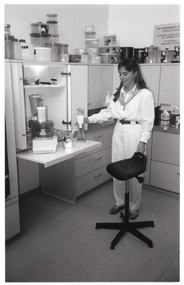
... ... food storage...On top of the kitchen cupboards, there are several round plastic food storage containers of various sizes stacked upon one another....On top of the kitchen cupboards, there are several round plastic food storage containers of various sizes stacked upon one another. ...Through its quarterly newsletters, the Arthritis Foundation of Victoria (AFV), formerly the Rheumatism and Arthritis Association of Victoria (RAAV), was able to inform its members about the latest arthritis-friendly kitchen appliances and aids, and how to use them. In this photo, a woman stands beside a Sit-Stand Chair (a high mobile stool on castors) and a pull-out shelf, on which sit various electric kitchen appliances (such as a food processor and an immersion blender). The photo was taken at the Independent Living Centre, which contained a specially designed demonstration kitchen through which innovative designs and aids for people living with arthritis could be showcased. According to an earlier article appearing on page 3 of the No 33, August 1984 edition of RAAV's quarterly newsletter, News Review, the Independent Living Centre was the venue for the launch of Arthritis Week in May 1984.B&W photo of a woman standing beside a pull-out kitchen shelf and a high stool on castors. On top of the shelf are some kitchen appliances, such as a food processor and a hand-held immersion blender. On top of the kitchen cupboards, there are several round plastic food storage containers of various sizes stacked upon one another.[On a yellow sticky note, in blue ink] The aid (crossed out) 'Sit Stand Chair' can be wheeled into position and easily adjusted to a suitable height. [On a yellow sticky note, in blue ink] Joan - Use whichever of these is (crossed out) gives the clearer idea. This one perhaps - Jenny.arthritis foundation of victoria, afv, rheumatism and arthritis association of victoria, raav, independent living centre, demonstration kitchen, arthritic aids, kitchen aids, kitchen gadgets, kitchen appliances, kitchen sink, food processor, blender, immersion blender, stick blender, kitchen canisters, food storage, pantry storage containers, swivel chair, sit-stand chair, pull-out workbench, retractable bench top, sliding bench top, adaptive kitchens, accessible kitchens, disability-friendly kitchens, modified kitchens, yooralla society of victoria, living with arthritis, pain management, arthritis update, news review, 1990, 1984 -
 Flagstaff Hill Maritime Museum and Village
Container - Kitchen Canister set, Late 19th to early 20th century
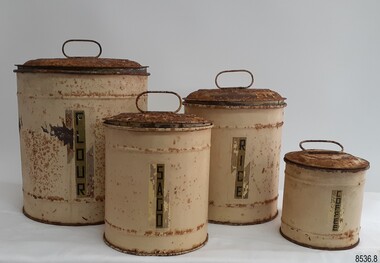
... ...dry food storage...This set of kitchen food containers is an example of colonial food storage used in a domestic setting to store and preserve dry ingredients. ...This set of kitchen dry food canisters is made of metal; each container has a different height, width and capacity. The rolled thin metal has created a strong, round design with decorative rings on the circumference. The base and close-fitting lid protect the contents from vermin and most insects, and the handle on top aids in the removal of the lid. Metal containers like these are reusable and can be re-purposed, which is advantageous when living in regional or rural areas. The type of manufacture indicates that the set was made in the late 19th to early 20th century. Gradually, colourful and attractive plastic kitchenware began to replace metalware. One of the canisters is labelled 'coffee'; coffee plants and seeds were transported from Brazil into Australia in 1788 when the First Fleet arrived although their growth was unsuccessful. However, by the 1920s, a tenth of the Australian population was drinking readily stored coffee. Large quantities of harvested grains such as maize, wheat and barley were protected from pests by being stored in airy buildings, often raised from the ground. This was an age-old practice used by civilizations such as the ancient Egyptians and early Hebrews. Smaller quantities of food for short-term use in the homes were stored in woven baskets or clay pots.This set of kitchen food containers is an example of colonial food storage used in a domestic setting to store and preserve dry ingredients. These canisters give a snapshot of early domestic life in Australia. Canister set; four cylindrical cream coloured metal canisters with domed lids that have lift-up handles on top. They are made from rolled metal and the bases and lids have a side seam. Each canister is a different size and displays a label for different contents. The adhesive labels are vertical, and a gold colour with black vertical text. The cream paint has brush strokes and small areas have exposed green paint under the cream. The insides of the bases are painted dark grey but the lids have no paint underneath. The empty canisters can fit one inside the other. Labels, in descending order: "FLOUR" "RICE" "SAGO" "COFFEE"flagstaff hill, flagstaff hill maritime museum and village, warrnambool, maritime museum, maritime village, great ocean road, shipwreck coast, canister set, kitchen storage, food storage, metal canisters, dry food storage, food packaging, kitchen container, vintage, flour, rice, sago, coffee, kitchenalia, late 19th to early 20th centuries, nesting canisters -
 Cheese World Museum
Jar, Pottery cream jar
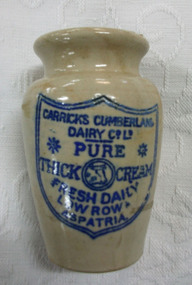
... ...food storage & preservation...Uebergang catalogue No.O 30 Carrick's Cumberland Dairy is a UK firm located at Low Row near Brampton. dairying domestic items food storage & preservation rural industry agriculture allansford uebergang bottles food technology jars carricks cumberland dairy co ltd cream food storage stoneware CARRICKS CUMBERLAND/ DAIRY CO LTD/PURE/THICK CREAM/ FRESH DAILY/ LOW ROW/ ASPATRIA Small urn-shaped stoneware cream jar with blue shield-shaped label printed on the front, featuring a logo of a cow's head in a circle with double line around it. ...The Percy Uebergang family lived at Tooram Park, Allansford from 1912 until 1992. The cream jar was part of the collection of items given into the care of the Cheese World Museum. Uebergang catalogue No.O 30 Carrick's Cumberland Dairy is a UK firm located at Low Row near Brampton.Small urn-shaped stoneware cream jar with blue shield-shaped label printed on the front, featuring a logo of a cow's head in a circle with double line around it.CARRICKS CUMBERLAND/ DAIRY CO LTD/PURE/THICK CREAM/ FRESH DAILY/ LOW ROW/ ASPATRIAdairying, domestic items, food storage & preservation, rural industry agriculture, allansford, uebergang, bottles, food technology, jars, carricks cumberland dairy co ltd, cream food storage, stoneware -
 Flagstaff Hill Maritime Museum and Village
Domestic object - Food Safe, Willow Ware Pty Ltd, 1950s to 70s
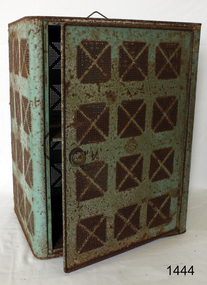
... ...food storage...The Australian food safe is an example of domestic food storage and preservation in Australian homes from the mid-19th century and early 20th centuries. ...This food safe is a mass-produced item made for domestic use by Willow Manufacturing in Australia fin the mid-20th century. Willow started a business in 1887 as a metalworking company based in Melbourne Australia, making tinned biscuit and tea canisters. In the First World War, the company began manufacturing armaments and essential packaging for the war effort. In the early 1920s, Willow produced domestic kitchen bakeware such as tin-plated canisters and baking pans labelled with the well-known Willow brand. Other items at this time include billies, boilers, basins and Coolgardie safes. In the late 1950s, the company ventured into plastics production. and in 1965, the name changed to Willow Ware Pty Ltd, to be more closely linked to its Willow brand. Willow Ware is still in business today.The Australian food safe is an example of domestic food storage and preservation in Australian homes from the mid-19th century and early 20th centuries. It is part of the evolution of food preservation methods leading up to our modern electric appliances. The maker, Willow, has a name associated with practical and reliable domestic products.Metal kitchen safe with two shelves, a hinged door and latch and a small swivel wire handle at the top. Painted light green. Airflow holes have been formed in each side panel. Made by Willow, Australia.Marked "Made in Australia" "Willow"flagstaff hill, warrnambool, flagstaff hill maritime museum, shipwreck coast, flagstaff hill maritime village, great ocean road, food storage, food preservation, willow, willow manufacturing, willow australia, kitchen storage, food care, 19th century, 20th century, willow ware, domestic item, coolgardie meat safe, meat safe, food safe, coolgardie -
 Friends of Westgarthtown
Functional object - Coolgardie Safe, Carl Ziebell, direct descendant, c. 1915
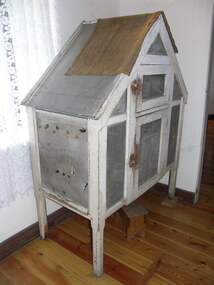
... ...food storage and preservation...As an early form of sustainable refrigeration, it contributes valuable interpretive depth to domestic, rural and goldfields history. domestic items food storage and preservation food safe storage pantry carl ziebell No visible markings Handmade food safe with white painted wooden frame and perforated zinc screen panels. ...This Coolgardie safe is a significant example of late-19th-century Australian ingenuity and domestic adaptation in response to the challenges of life in remote and harsh environments. Invented in the late 1890s by Arthur Patrick McCormick at Coolgardie, then the center of a major Western Australian gold rush, the safe represents an important technological response to the need for preserving perishable foods in extreme heat before the availability of mechanical refrigeration. Using the same evaporative principles employed by explorer’s canvas water bags, the Coolgardie safe utilised a timber frame, zinc metal sheets, wire mesh panels and wet hessian cloth to create a naturally cooled storage chamber. When placed in a draught or breeze, evaporation lowered the internal temperature, allowing miners, settlers and later rural households to keep meat, dairy and vegetables safe for longer periods. Sylvia Schultz (nee Ziebell) remembers the Coolgardie safe at Ziebell’s Farmhouse “was always positioned in the pantry where it is today, near the window to allow the breeze in”. Items the Ziebell’s stored in the safe included meats, milk and cream, and home-made goods. This object embodies a pivotal moment in Australia’s social and technological history, illustrating resourcefulness, adaptation to climate, and the lived realities of those who settled and worked in remote regions. As an early form of sustainable refrigeration, it contributes valuable interpretive depth to domestic, rural and goldfields history. Handmade food safe with white painted wooden frame and perforated zinc screen panels. Galvanised sheet roof. Raised four beveled legs. Two rectangular doors, bottom door large, opens to main area with one shelf. top door small, opens to triangular roof section. Movable latches of wood on both doors.No visible markingsdomestic items, food storage and preservation, food, safe, storage, pantry, carl ziebell -
 Flagstaff Hill Maritime Museum and Village
Functional object - Food Safe, 1890 to 1925
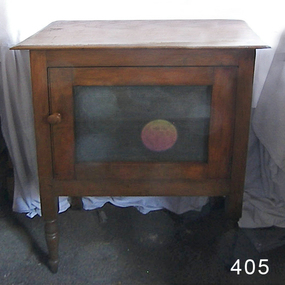
... ...food storage...After the second world war, most households had replaced their food storage cupboards or safes with refrigerators. ...The first commercially available, Australian-made domestic refrigerator to operate without ice was produced by Edward Hallstrom in 1923. It used kerosene as a power source and was promoted as ideal for outback stations where ice was not available. According to Museum Victoria, Hallstrom introduced the 'Silent Night' which ran on electricity or gas in 1935. However, Hailstorm's great-grandson, stated that the Silent Night refrigerator was introduced in 1928. Although Australians were among the pioneers of refrigeration in the 1850s, the technology wasn't adapted for domestic use until many decades later. The first domestic electric refrigerator was sold in America in 1913. It had an air-cooled refrigeration unit mounted on top of an ice box. The Frigidaire and Kelvinator brands date from 1918 when the first self-contained fridges were sold. Before this food safes were used as well to keep food away from flies and to keep items cool.A significant item used from the late Victorian era until around 1940 when people were beginning to be able to afford domestic refrigerators. After the second world war, most households had replaced their food storage cupboards or safes with refrigerators. The subject item gives a snapshot of domestic life from this time.Wooden kitchen safe with 3 metal perforated panels & 2 shelves inside. Was painted light Green but has been restoredflagstaff hill, warrnambool, shipwrecked-coast, flagstaff-hill, flagstaff-hill-maritime-museum, maritime-museum, shipwreck-coast, flagstaff-hill-maritime-village, refrigeration, refrigerator, food storage, food safes, edward hallstrom -
 Orbost & District Historical Society
butter cooler
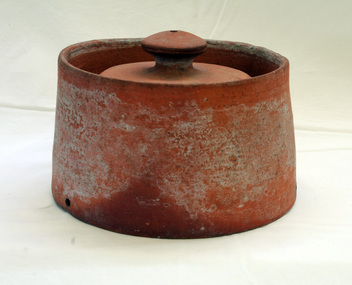
... butter-cooler ceramics earthenware domestic food-storage food-preservation...It would have been before the time of mass food processing factories and before domestic refrigeration was common. butter-cooler ceramics earthenware domestic food-storage food-preservation Round earthenware butter cooler. ...This domestic kitchen appliance is typical of the period when food processing was done at home. It would have been before the time of mass food processing factories and before domestic refrigeration was common.Round earthenware butter cooler. Red/orange in colour.Has lid. Small holes at bottom so that butter could breathe. Handle on top for lifting cover. Inside is glazed.butter-cooler ceramics earthenware domestic food-storage food-preservation -
 Flagstaff Hill Maritime Museum and Village
Functional object - Food Safe
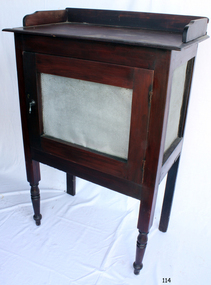
... ...food storage...flagstaff hill warrnambool shipwrecked coast flagstaff hill maritime museum maritime museum shipwreck coast flagstaff hill maritime village great ocean road food safe kitchen safe kitchen furniture food storage food preservation Wooden Kitchen Safe for storing food, with hinged door (with key-hole) and three galvanised preformatted sheet metal windows. ...Wooden Kitchen Safe for storing food, with hinged door (with key-hole) and three galvanised preformatted sheet metal windows. Front legs machine turned wood.flagstaff hill, warrnambool, shipwrecked coast, flagstaff hill maritime museum, maritime museum, shipwreck coast, flagstaff hill maritime village, great ocean road, food safe, kitchen safe, kitchen furniture, food storage, food preservation -
 Flagstaff Hill Maritime Museum and Village
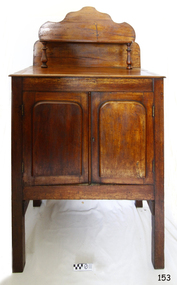
Functional object - Food Safe, 1920s
... ...Food Storage...After the second world war, most households had replaced their food storage cupboards or safes with refrigerators. ...The first commercially available, Australian-made domestic refrigerator to operate without ice was produced by Edward Hallstrom in 1923. It used kerosene as a power source and was promoted as ideal for outback stations where ice was not available. According to Museum Victoria, Hallstrom introduced the 'Silent Night' which ran on electricity or gas in 1935. However, Hailstorm's great-grandson, stated that the Silent Night refrigerator was introduced in 1928. Although Australians were among the pioneers of refrigeration in the 1850s, the technology wasn't adapted for domestic use until many decades later. The first domestic electric refrigerator was sold in America in 1913. It had an air-cooled refrigeration unit mounted on top of an ice box. The Frigidaire and Kelvinator brands date from 1918 when the first self-contained fridges were sold. Before this food safes were used as well to keep food away from flies and to keep items cool.A significant item used from the late Victorian era until around 1940 when people were beginning to be able to afford domestic refrigerators. After the second world war, most households had replaced their food storage cupboards or safes with refrigerators. The subject item gives a snapshot of domestic life from this time.Wooden kitchen food safe, 2 door with wire mesh at sides. Raised back panel has shaped edges and includes a shelf above bench area that has turned legs. The safe has 4 plain legs.Noneflagstaff hill, warrnambool, flagstaff hill maritime museum, maritime museum, shipwreck coast, flagstaff hill maritime village, great ocean road, food safe, kitchen safe, kitchen furniture, food storage -
 Flagstaff Hill Maritime Museum and Village
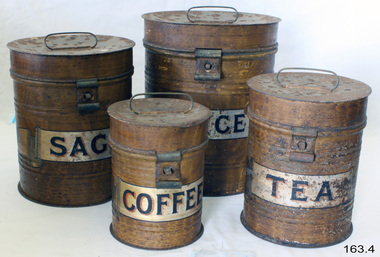
Container - Kitchen Canister set, 1850-1870
... ...food storage...Items such as coffee, tea, rice and sago were stable food types and needed longer term storage and a higher degree of protection from vermin and the elements, a common material used during this time was sheet metal or tin such as is used today in a common form of storage the biscuit tin. ...An early example of colonial food storage used in a domestic setting, it is interesting to note the subject items have provision to be locked. ...In early civilization's cereal grains such as maize, wheat, barley etc. were stored in large airy buildings, often raised up from the ground to reduce infestation by pests and vermin. Ancient Egyptian and early Hebrew writings include reference to such buildings. Smaller quantities of food were stored in baskets made from woven grasses or leaves. In more recent times but prior to the invention of the refrigerator many food products were stored in the home as preserves or pickles, often in heat sealed jars. Dry food items were stored in vermin proof metal containers and could be found in any early colonial kitchen. Items such as coffee, tea, rice and sago were stable food types and needed longer term storage and a higher degree of protection from vermin and the elements, a common material used during this time was sheet metal or tin such as is used today in a common form of storage the biscuit tin. An early example of colonial food storage used in a domestic setting, it is interesting to note the subject items have provision to be locked. This indicates the value early colonial settlers placed on the contents and used to prevent pilfering. The subject items are now sought by collectors. Canister set; set of four canisters. Cylindrical matching kitchen storage tins with hinge lid that has a latch closure, and a folding handle on top of lid. Canisters are painted brown and the body has a graphic of a scroll in gold with printed label of contents. The canisters range from small to large, "COFFEE", "TEA" , "SAGO", " RICE" (respective RNs 163.1, 163.2, 163.3, 163.4)Respectively labelled "COFFEE," "TEA," "SAGO," "RICE" flagstaff hill, warrnambool, shipwrecked coast, flagstaff hill maritime museum, flagstaff hill maritime village, great ocean road, canister, canister set, rice canister, kitchen canister, food storage, domestic item -
 Flagstaff Hill Maritime Museum and Village
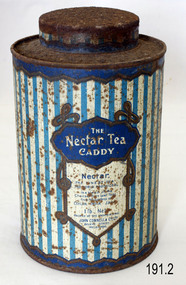
Container - Tea Container, J Marsh & Sons (Tin Container Fabricators), 1900-1940
... ...food storage...Tin, "Choicest Nectar Tea" is an example of retail packaging, for domestic goods, the tin was made by J Marsh and Sons, Melbourne, for John Connell & Co Ltd, Melbourne, Victoria, Australia, 1900-1940 Item at this time cannot be associated with an historical event, person or place, provenance is unknown, item assessed as a collection asset. flagstaff hill warrnambool flagstaff hill maritime museum maritime museum shipwreck coast flagstaff hill maritime village great ocean road tea canister tea caddy tea tin container kitchen storage food storage food nectar tea john connell melbourne J March & Sons John Connell & Co Ltd On label "The Nectar Tea Caddy" and "Nectar, the finest tea the world produces, is a blend of the Choicest Pure Leafed Teas from the Gardens of Ceylon, India, Java" Container; tea caddy for "Nectar Tea" brand, 1 lb. ...Tin, "Choicest Nectar Tea" is an example of retail packaging, for domestic goods, the tin was made by J Marsh and Sons, Melbourne, for John Connell & Co Ltd, Melbourne, Victoria, Australia, 1900-1940Item at this time cannot be associated with an historical event, person or place, provenance is unknown, item assessed as a collection asset.Container; tea caddy for "Nectar Tea" brand, 1 lb. Packed by John Connell and Co Ltd, Melbourne. Blue and white vertical stripe decoration. On label "The Nectar Tea Caddy" and "Nectar, the finest tea the world produces, is a blend of the Choicest Pure Leafed Teas from the Gardens of Ceylon, India, Java"flagstaff hill, warrnambool, flagstaff hill maritime museum, maritime museum, shipwreck coast, flagstaff hill maritime village, great ocean road, tea canister, tea caddy, tea tin, container, kitchen storage, food storage, food, nectar tea, john connell, melbourne, j march & sons, john connell & co ltd -
 Flagstaff Hill Maritime Museum and Village
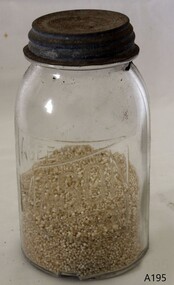
Container - Preserving Jar, 1932-1948
... ...food storage...Item at this time cannot be associated with an historical event, person or place, provenance is unknown, item assessed as a collection asset. flagstaff hill warrnambool flagstaff hill maritime museum shipwreck coast flagstaff hill maritime village great ocean road jar glass jar preserving jar food preserving food storage agee mason agee mason jar John Landis Mason "AGEE / MASON / JAR" imprinted into side of glass Clear glass preserving jar with metal screw lid grooved base for lid clip. ...The Mason jar, named after American tinsmith John Landis Mason, who patented it in 1858, is a molded glass jar used in home canning to preserve food. The jar's mouth has a screw thread on its outer perimeter to accept a metal ring or "band". The band, when screwed down, presses a separate stamped steel disc-shaped lid against the jar's rim. An integral rubber ring on the underside of the lid creates a hermetic seal. The bands and lids usually come with new jars, but they are also sold separately. While the bands are reusable, the lids are intended for single-use when canning. Glass jars and metal lids are still commonly used in home canning while they have been largely supplanted by other methods for commercial canning (such as tin cans and plastic containers). Item at this time cannot be associated with an historical event, person or place, provenance is unknown, item assessed as a collection asset.Clear glass preserving jar with metal screw lid grooved base for lid clip."AGEE / MASON / JAR" imprinted into side of glassflagstaff hill, warrnambool, flagstaff hill maritime museum, shipwreck coast, flagstaff hill maritime village, great ocean road, jar, glass jar, preserving jar, food preserving, food storage, agee mason, agee mason jar, john landis mason -
 Flagstaff Hill Maritime Museum and Village
Container - Fruit Preserving Jar, John Landis Mason, 1858-1910
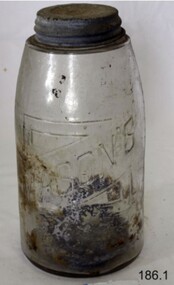
... ...food storage...An early item used in most kitchens by women who preserved fruit and vegetables before the arrival of refrigeration giving a snapshot into the domestic lives of families during the late 19th to early 20th century's and how they preserved food for later use without refrigeration. warrnambool flagstaff-hill flagstaff-hill-maritime-museum maritime-museum shipwreck-coast flagstaff-hill-maritime-village food preserving mason jar john landis mason domestic container glass jar fruit & vegetable jar food storage preserving jar "Mason's Patent Nov 30th 1858" Preserving glass jar. ...The Masons patent of Nov 30th, 1858 phrase was originally embossed on countless glass fruit jars and canning jars, most ranging in age from circa 1858 to the mid-1910s. John Landis Mason was awarded patent No 22186, issued on November 30, 1858, by the U.S. Patent & Trademark Office it was termed an "Improvement in screw-neck bottles", for his invention concerning the process of creating a threaded screw-type closure on bottles and jars. Similar screw-threading had been done before on some bottles, but the process of forming the upper lip area of the container so that it was smooth, even, and sturdy enough for a lid of standard size to be screwed thereon was difficult and expensive to do properly, often with unsatisfactory results. His improvement revolutionized home canning in the United States and many other countries. In any case, throughout the next 60-odd years, production of jars with the Nov. 30, 1858 embossing continued at a high rate, with untold tens of millions being produced. The phrase was soon considered an important marketing device, adding to the perception of quality and reliability of the container to the average consumer. This perception continued to at least 1879 21 years after the patent was issued, nearly every glass bottle factory was likely producing their version. The 1880s and 1890s likely saw the peak of popularity of these jars. A considerable percentage have a mold number or letter on the base, a means of identifying the particular mold in use at the factory.An early item used in most kitchens by women who preserved fruit and vegetables before the arrival of refrigeration giving a snapshot into the domestic lives of families during the late 19th to early 20th century's and how they preserved food for later use without refrigeration. Preserving glass jar. Glass lip with metal screw top lid. Inscription pressed into glass."Mason's Patent Nov 30th 1858"warrnambool, flagstaff-hill, flagstaff-hill-maritime-museum, maritime-museum, shipwreck-coast, flagstaff-hill-maritime-village, food preserving, mason jar, john landis mason, domestic container, glass jar, fruit & vegetable jar, food storage, preserving jar -
 Flagstaff Hill Maritime Museum and Village
Textile - Flour Bags (5)
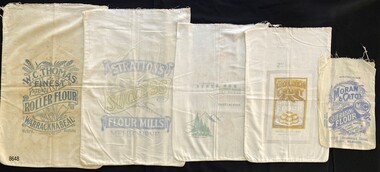
... ...food storage...Flagstaff Hill Maritime Museum and Village Great Ocean Road Shipwreck Coast flour bags calico domestic object textile food storage A set of five flour bags originating from different Victorian places. ...Flour bags were used when purchasing flour from the late 19th century to the mid 20th century. They were able to be reused for bulk storage of dry goods or sewn into domestic objects such as tea towels, pillowcases or waggas.The flour bags provide both a snapshot of different producers and stockists of flour in Victoria and an example of a useful domestic packaging product, from the early 20th century.A set of five flour bags originating from different Victorian places. Stratton's in Melbourne, McAlpin's in Melbourne / Ballarat, Moran & Cato's in Fitzroy, Golden Crust from South Yarra and W.C. Thomas from Warracknabeal. Each bag is made from calico with an image on the front that relates to the company.flagstaff hill maritime museum and village, great ocean road, shipwreck coast, flour bags, calico, domestic object, textile, food storage -
 Flagstaff Hill Maritime Museum and Village
Textile - Flour bag - W.C.Thomas, Warracknabeal
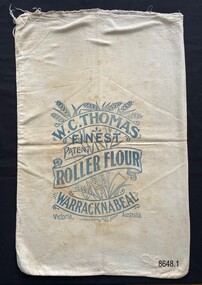
... ...food storage...Flagstaff Hill Maritime Museum and Village Great Ocean Road Shipwreck Coast flour bags calico domestic object textile food storage W.C. Thomas Warracknabeal Flour mill W.C. ...This flour bag came from the W.C. Thomas Flour Mill at Warracknabeal, Victoria. W.C. Thomas ran a number of flour mills throughout the Victorian wheat belt, with the Warracknabeal Mill operating from 1884 to 1964. After their use for flour storage, flour bags were able to be reused for bulk storage of other dry goods or sewn into domestic objects such as tea towels, pillowcases or waggas.This is a good example of a flour bag from a prominent Victorian flourmill, operating from the late 19th century to the mid-20th century.Calico flour bag for 'Roller Flour' from the flour mill of W.C. Thomas in Warracknabeal, a large wheat growing area in Victoria. The stencil on the front of the bag includes an image of wheat overlaid with the written information in scroll format.W.C. Thomas, Finest, Patent, Roller Flour, Warracknabeal, Victoria, Australia. Wheat image.flagstaff hill maritime museum and village, great ocean road, shipwreck coast, flour bags, calico, domestic object, textile, food storage, w.c. thomas, warracknabeal, flour mill -
 Flagstaff Hill Maritime Museum and Village
Textile - Flour bag - Stratton's, Melbourne
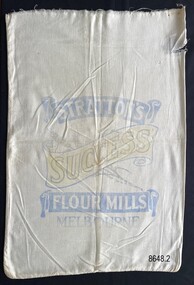
... ...food storage...Flagstaff Hill Maritime Museum and Village Great Ocean Road Shipwreck Coast calico domestic object textile food storage Stratton's flour bag Stratton's, Success, Flour Mills, Melbourne Calico flour bag for 'Success Flour' from Stratton’s flour mill in Melbourne. ...Flour bags were used when purchasing flour from the late 19th century to the mid 20th century. They were able to be reused for bulk storage of dry goods or sewn into domestic objects such as tea towels, pillowcases or waggas.The flour bag provides an example of a useful domestic packaging product, from the early 20th century.Calico flour bag for 'Success Flour' from Stratton’s flour mill in Melbourne. The stencil on the front of the bag includes the image of a wheat stalk overlaid with the written information in scroll format.Stratton's, Success, Flour Mills, Melbourneflagstaff hill maritime museum and village, great ocean road, shipwreck coast, calico, domestic object, textile, food storage, stratton's, flour bag -
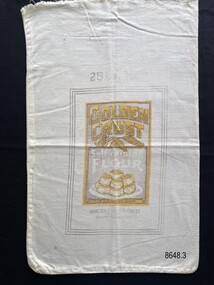 Flagstaff Hill Maritime Museum and Village
Textile - Flour bag - Golden Crust
... ...food storage...Flagstaff Hill Maritime Museum and Village Great Ocean Road Shipwreck Coast calico domestic object textile food storage flour bag Golden Crust 25lbs, Golden Crust, Self-raising Flour, Blended with Phosphate Aerator, Hancock’s Golden Crust Pty.Ltd. ...Flour bags were used when purchasing flour from the late 19th century to the mid 20th century. They were able to be reused for bulk storage of dry goods or sewn into domestic objects such as tea towels, pillowcases or waggas.The flour bag provides an example of a useful domestic packaging product, from the early 20th century.Calico flour bag for Golden Crust Self-raising flour, 25lb. The stencil on the bag includes the manufacturer’s address and images of heads of wheat and a plate of scones. 25lbs, Golden Crust, Self-raising Flour, Blended with Phosphate Aerator, Hancock’s Golden Crust Pty.Ltd. South Yarra, Vicflagstaff hill maritime museum and village, great ocean road, shipwreck coast, calico, domestic object, textile, food storage, flour bag, golden crust -
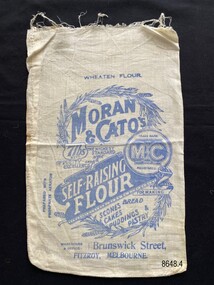 Flagstaff Hill Maritime Museum and Village
Textile - Flour bag - Moran & Cato's
... ...food storage...Flagstaff Hill Maritime Museum and Village Great Ocean Road Shipwreck Coast calico domestic object textile food storage Moran & Cato's flour bag self-raising flour Front - Wheaten Flour, Moran & Cato's, Trade mark The M & C Brand Registered, 7lbs Nett, The Highest Standard of Purity and Excellence, prepared with phosphate aerator, Self-raising Flour, For making scones bread cakes puddings & pastry, Warehouse & Office- Brunswick Street, Fitzroy, Melbourne Back - Moran & Cato's, Cleaned Fruits are Perfection, (advertising text), The Same High Quality, The Same Prices at all our Branches. ...The flour bag is an example of packaging from the grocery store, Moran & Cato's. Moran & Cato's were a large chain of grocery stores operating from the late nineteenth century to the mid twentieth century across Victoria, Tasmania and New South Wales. The address on the flour bag is for the warehouse (wholesale depot) of the business which was a significant building in Brunswick St, Fitzroy.The flour bag provides a snapshot of packaging for a well known grocery store of the early twentieth century. The advertisement on the back for 'Cleaned Fruits' is an example of advertising that highlighted important facts relevant to that time (e.g. "latest Special Machinery" and "with running water").Small calico flour bag for self-raising flour (7lb) supplied from Moran & Cato's in Brunswick Street, Fitzroy, Melbourne. The front of the bag includes not only the detail of the business but ideas for baking, images of wheat and claims as to its excellence. The back of the bag has a written advertisement for 'Cleaned Fruits' another product of the company.Front - Wheaten Flour, Moran & Cato's, Trade mark The M & C Brand Registered, 7lbs Nett, The Highest Standard of Purity and Excellence, prepared with phosphate aerator, Self-raising Flour, For making scones bread cakes puddings & pastry, Warehouse & Office- Brunswick Street, Fitzroy, Melbourne Back - Moran & Cato's, Cleaned Fruits are Perfection, (advertising text), The Same High Quality, The Same Prices at all our Branches.flagstaff hill maritime museum and village, great ocean road, shipwreck coast, calico, domestic object, textile, food storage, moran & cato's, flour bag, self-raising flour -
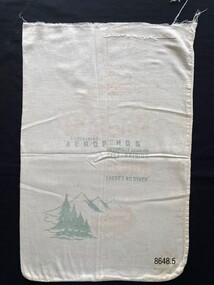 Flagstaff Hill Maritime Museum and Village
Textile - Flour bag - McAlpin's Flour containing Aerophos'
... ...food storage...Flagstaff Hill Maritime Museum and Village Great Ocean Road Shipwreck Coast calico domestic object textile food storage flour bag McAlpin's Self-raising flour McAlpin’s (faded red) CONTAINING AEROPHOS’, PHOSPHATE AERATOR, SELF-RAISING, FLOUR (faded red), “THERE’S NO OTHER” Faded red square with writing …. ...Flour bags were used when purchasing flour from the late 19th century to the mid 20th century. In Melbourne, McAlpin's were one of the best known suppliers of self-raising flour. The business first began as a bakery in 1879 and was taken over in 1959. This is a good example of a flour bag from a well know Victorian supplier prominent in the early twentieth century.Calico flour bag for McAlpin’s self-raising flour. The stencil on the bag is very faded especially where red ink has been used. It includes an image of mountains and fir trees in green ink and a stalk of wheat sweeping up from bottom right to top / middle left in red ink.McAlpin’s (faded red) CONTAINING AEROPHOS’, PHOSPHATE AERATOR, SELF-RAISING, FLOUR (faded red), “THERE’S NO OTHER” Faded red square with writing …. CALCIUM …. Faded red triangle with T inside it to the far right of the trees Faded red writing at the bottom of the bag: PREPARED WITH PHOSPHATE AERATOR, AEROPHOS 25 LBS NET flagstaff hill maritime museum and village, great ocean road, shipwreck coast, calico, domestic object, textile, food storage, flour bag, mcalpin's, self-raising flour -
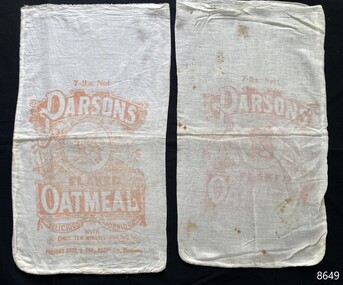 Flagstaff Hill Maritime Museum and Village
Textile - Parsons' Oatmeal Bags
... ...food storage...Flagstaff Hill Maritime Museum and Village Great Ocean Road Shipwreck Coast Warrnambool Calico Domestic object textile food storage Parsons' Bros Oatmeal Porridge Front (both): 7-lbs. ...Dry foods such as oats were packaged in cloth bags from the late 19th century to the mid 20th century. Parsons' Brothers and Company were involved in packaging a variety of produce for the Australian market including oatmeal for porridge.The oat bags provide a snapshot of a well-known Australian food company and how the bags were used to advertise other items available from the business.A set of two Oatmeal Bags from the Parsons' company. Each bag is made from calico with ornate writing and images on the front that relate to the product and company. The back of each bag is used to advertise a different product from the company – Saline Powder (8649.1) and Mustard (8649.2).Front (both): 7-lbs. Net, PARSONS', TRADE MARK, THE ORIGINAL FLAKED OATMEAL, DELICIOUS PORRIDGE, WITH ONLY TEN MINUTES BOILING, PARSONS BROS & COY., PROPY. LTD., MELBOURNE Back 8649.1 : TRY Parsons', PARSONS' SALINE POWDER, NET ? LB, SALINE POWDER, A COOL, REFRESHING AND HEALTHFUL DRINK Back 8649.2 : UNSURPASSED in Quality and Price, PARSONS' MUSTARD, (further writing is faded)flagstaff hill maritime museum and village, great ocean road, shipwreck coast, warrnambool, calico, domestic object, textile, food storage, parsons' bros, oatmeal, porridge -
 Flagstaff Hill Maritime Museum and Village
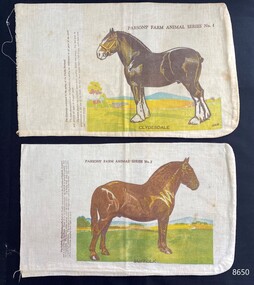
Textile - Parsons' Farm Animal Series Oat Bags
... ...food storage...Flagstaff Hill Maritime Museum and Village Great Ocean Road Shipwreck Coast Warrnambool Calico Domestic object textile food storage Parsons' Farm Animal Series oats Clydesdale Suffolk 8650.1 PARSONS' FARM ANIMAL SERIES No. 1, CLYDESDALE, The Clydesdale originated in the valley of the Clyde, Scotland. ...Dry foods for domestic use were packaged in cloth bags from the late 19th century to the mid 20th century. As the bags contain the name Parsons' it could be presumed that they were oat bags as the Parsons Company packaged a variety of groceries for the Australian market including oats. The bags provide an example of calico bags used to store dry goods. Being presented as a ‘Farm Animal Series’ gives them added value as a collectable item and may have been an advertising ploy used by the company.A set of two calico bags from the Parsons' company - most likely bought as oat bags. The two are: No 1. (Clydesdale) and No 3. (Suffolk) from the Parsons' Farm Animal Series. Each bag has a multicoloured ink picture and written information about the horse described on the bag.8650.1 PARSONS' FARM ANIMAL SERIES No. 1, CLYDESDALE, The Clydesdale originated in the valley of the Clyde, Scotland. The main characteristics of the Clydesdale are ability to acclimatise in all parts of the world and perform all types of draught work. Clydesdale breeders lay emphasis upon bone, quality, weight, and action. The feet must be proportionate to the size of the horse, the hoof-head should have a full crown, with heels wide and quarters strong. 8650.2 PARSONS' FARM ANIMAL SERIES No. 3, SUFFOLK, The Suffolk, often known as the Suffolk Punch, originated in the County of Suffolk, England and is noted for its hardiness. From 15 to 16 hands in height, the Suffolk in general is smaller than the Clydesdale. The head is rather coarse, with the neck short. The body long, deep and wide with a round full appearance. The croup is straight, the legs short and free from feather. The invariable colour is chestnut, varying from light to dark.flagstaff hill maritime museum and village, great ocean road, shipwreck coast, warrnambool, calico, domestic object, textile, food storage, parsons' farm animal series, oats, clydesdale, suffolk -
 Flagstaff Hill Maritime Museum and Village
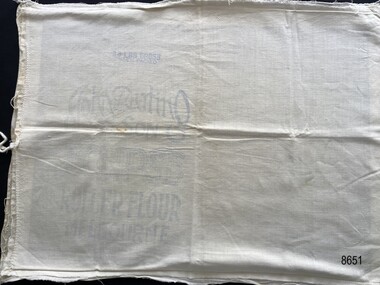
Textile - Flour Bag Pillowcase
... ...food storage...Flagstaff Hill Maritime Museum and Village Great Ocean Road Shipwreck Coast Warrnambool Calico Domestic object textile food storage John Darling & Son Eclipse Roller Flour O-SO-LITE Flour pillowcase flour bag Side 1 25LBS GROSS WHEN PACKED, John Darling & Son, ECLIPSE, ROLLER FLOUR, MELBOURNE Side 2 O-SO-LITE, Self-raising, FLOUR, Creamy & Delicious, O-SO-LITE PRODUCTS, 412 COLLINS ST MELBOURNE, C.I. ...Flour bags were a useful source of material to be repurposed into domestic objects in the early 20th century. This object, fashioned from two well-known brands of flour bag, was most likely used as a pillowcase.The pillowcase provides an example of how flour bags were recycled and repurposed into useful domestic objects in the early 20th century.Two flour bags opened out and sewn together to create a possible pillowcase. The open end has a tie sewn to each side to enable the pillowcase to be closed. The bags have been sewn with the inscriptions on the inside of the pillowcase.Side 1 25LBS GROSS WHEN PACKED, John Darling & Son, ECLIPSE, ROLLER FLOUR, MELBOURNE Side 2 O-SO-LITE, Self-raising, FLOUR, Creamy & Delicious, O-SO-LITE PRODUCTS, 412 COLLINS ST MELBOURNE, C.I. Decoration of wheat stalks surround the inscription.flagstaff hill maritime museum and village, great ocean road, shipwreck coast, warrnambool, calico, domestic object, textile, food storage, john darling & son, eclipse roller flour, o-so-lite flour, pillowcase, flour bag -
 Flagstaff Hill Maritime Museum and Village
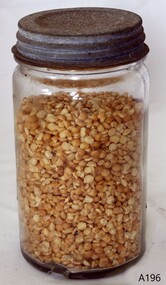
Container - Preserving Jar, 1932-1948
... ...food storage...Item at this time cannot be associated with an historical event, person or place, provenance is unknown, item assessed as a collection asset. flagstaff hill warrnambool flagstaff hill maritime museum shipwreck coast flagstaff hill maritime village great ocean road jar glass jar preserving jar food preserving food storage agee mason agee mason jar john landis mason Agee Special "AGEE Special MASON / JAR" imprinted into side of glass Clear glass preserving jar "Agee Special" with metal screw lid grooved base for lid clip Container Preserving Jar Agee Mason ...The Mason jar, named after American tinsmith John Landis Mason, who patented it in 1858, is a molded glass jar used in home canning to preserve food. The jar's mouth has a screw thread on its outer perimeter to accept a metal ring or "band". The band, when screwed down, presses a separate stamped steel disc-shaped lid against the jar's rim. An integral rubber ring on the underside of the lid creates a hermetic seal. The bands and lids usually come with new jars, but they are also sold separately. While the bands are reusable, the lids are intended for single-use when canning. Glass jars and metal lids are still commonly used in home canning while they have been largely supplanted by other methods for commercial canning (such as tin cans and plastic containers). Item at this time cannot be associated with an historical event, person or place, provenance is unknown, item assessed as a collection asset.Clear glass preserving jar "Agee Special" with metal screw lid grooved base for lid clip "AGEE Special MASON / JAR" imprinted into side of glassflagstaff hill, warrnambool, flagstaff hill maritime museum, shipwreck coast, flagstaff hill maritime village, great ocean road, jar, glass jar, preserving jar, food preserving, food storage, agee mason, agee mason jar, john landis mason, agee special -
 Flagstaff Hill Maritime Museum and Village
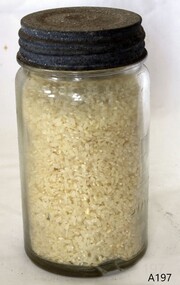
Container - Preserving Jar, 1932-1948
... ...food storage...Item at this time cannot be associated with an historical event, person or place, provenance is unknown, item assessed as a collection asset. flagstaff hill warrnambool flagstaff hill maritime museum shipwreck coast flagstaff hill maritime village great ocean road jar glass jar preserving jar food preserving food storage agee mason agee mason jar john landis mason agee special "AGEE Special imprinted into side of glass Clear glass preserving jar "Agee Special" with metal screw lid grooved base for lid clip Container Preserving Jar Agee Mason ...The Mason jar, named after American tinsmith John Landis Mason, who patented it in 1858, is a molded glass jar used in home canning to preserve food. The jar's mouth has a screw thread on its outer perimeter to accept a metal ring or "band". The band, when screwed down, presses a separate stamped steel disc-shaped lid against the jar's rim. An integral rubber ring on the underside of the lid creates a hermetic seal. The bands and lids usually come with new jars, but they are also sold separately. While the bands are reusable, the lids are intended for single-use when canning. Glass jars and metal lids are still commonly used in home canning while they have been largely supplanted by other methods for commercial canning (such as tin cans and plastic containers). Item at this time cannot be associated with an historical event, person or place, provenance is unknown, item assessed as a collection asset.Clear glass preserving jar "Agee Special" with metal screw lid grooved base for lid clip "AGEE Special imprinted into side of glassflagstaff hill, warrnambool, flagstaff hill maritime museum, shipwreck coast, flagstaff hill maritime village, great ocean road, jar, glass jar, preserving jar, food preserving, food storage, agee mason, agee mason jar, john landis mason, agee special -
 Glenelg Shire Council Cultural Collection
Container - Tin - flying duck over a pond, n.d
... food storage...Displayed in History House. food storage container tin Front: (no inscriptions) Metal tin and lid. ...Displayed in History House.Metal tin and lid. Green paint with design of a flying duck above an orange pond, with a pink decorative roundel.Front: (no inscriptions)food storage, container, tin -
 Orbost & District Historical Society
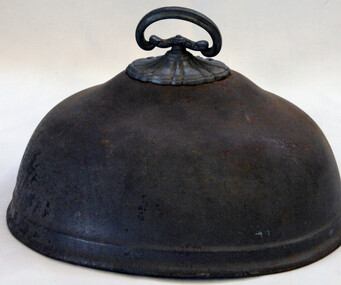
food cover, late 19th - early 20th century
... food-storage domestic kitchen...This food cover is an example of a simple kitchen item used in the late 19th-mid 20th century. food-storage domestic kitchen Small black metal meat cover with small handle. food cover. ...Food covers were used to cover food and protect it from insects. This food cover is a simple shape and would be a domestic utensil.This food cover is an example of a simple kitchen item used in the late 19th-mid 20th century.Small black metal meat cover with small handle.food-storage domestic kitchen -
 Orbost & District Historical Society
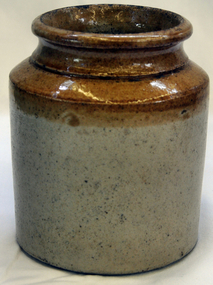
jar, Early 20th century
... jar container ceramics stoneware domestic food-storage preservation...This is an example of an early 20th century ceramic container. jar container ceramics stoneware domestic food-storage preservation Small stoneware dripping jar. ...This is an example of an early 20th century ceramic container.Small stoneware dripping jar. Wide lip. Top half of jar is beige, bottom cream coloured.jar container ceramics stoneware domestic food-storage preservation -
 Orbost & District Historical Society
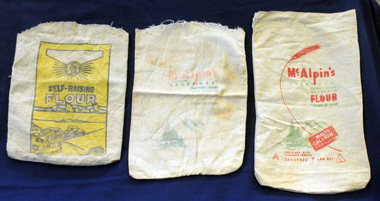
flour bags, mid 20th century
... flour-bags warren-helena mcalpin mcvitty food-storage...The flour bags are good examples of packaging and design for Australian produce which sold across Australia and overseas in the mid 20th century. flour-bags warren-helena mcalpin mcvitty food-storage Three rectangular, open calico flour bags. 2491.1 is faded and has red and green print sketch of a fir tree with mountains in the background- "McAlpin's, Containing "Aerophos", Self-Raising Flour; "There's No Other". 2491.2 has similar print with a red stalk of wheat and "7lbs Net" and a C inside a triangle. 2491.3 has yellow background inside a rectangular frame with black print - "Tested ; Self-Raising Flour"; a drawing of a wheat field; "Medallion Brand ; Groves McVitty & Co Pty Ltd' 8 Market Street Melbourne. flour bags J.McAlpin & Sons, ...These three flour bags belonged to Helena Warren (nee McKeown) who was a self-taught photographer who became the local press correspondent and producer of postcard images. She was married to William John warren and lived in Newmerella. Flour bags were used for bulk purchases of flour in early to mid 20th century. They would have been laundered and re-used for storage. In earlier times empty flour bags were washed and boiled and then made into tea towels or children’s bloomers, or underwear. The flour bags are good examples of packaging and design for Australian produce which sold across Australia and overseas in the mid 20th century. Three rectangular, open calico flour bags. 2491.1 is faded and has red and green print sketch of a fir tree with mountains in the background- "McAlpin's, Containing "Aerophos", Self-Raising Flour; "There's No Other". 2491.2 has similar print with a red stalk of wheat and "7lbs Net" and a C inside a triangle. 2491.3 has yellow background inside a rectangular frame with black print - "Tested ; Self-Raising Flour"; a drawing of a wheat field; "Medallion Brand ; Groves McVitty & Co Pty Ltd' 8 Market Street Melbourne.flour-bags warren-helena mcalpin mcvitty food-storage -
 Orbost & District Historical Society
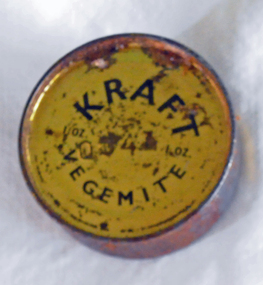
tin, C 1939-1945
... tin food-storage kraft-vegemite ww11...This item is an example of a food ration item used by Australian troops overseas. tin food-storage kraft-vegemite ww11 on lid -"KRAFT VEGEMITE 1 0z No. 3? ...Possibly used as part of the ration pack for Australian troops during WW 1. This item was found in Kevin Cousin's shed in Orbost. Exact origins are unknown.This item is an example of a food ration item used by Australian troops overseas.A round gold/yellow tin with "KRAFT VEGEMITE 1 oz" on the lid. on lid -"KRAFT VEGEMITE 1 0z No. 3?5?0043"tin food-storage kraft-vegemite ww11
