
Showing 8 items matching " fuel storage tanks"
-
 Glenelg Shire Council Cultural Collection
Photograph - Photograph - Portland and the harbour, n.d
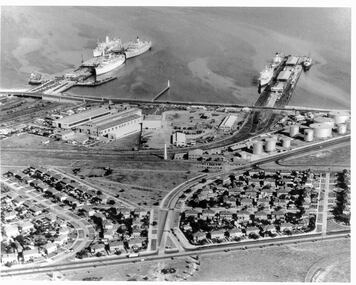
... ... Fuel storage tanks...Aerial black and white photo of Portland and the harbour. Fuel storage tanks in foreground. Photo attached to brown cardboard....Fuel storage tanks in foreground. Photo attached to brown cardboard. ...Port of Portland Authorityport of portland archives, portland harbour, fuel storage tanks -
 Port Melbourne Historical & Preservation Society
Photograph - Aerial view of West Gate Bridge under construction, c1979
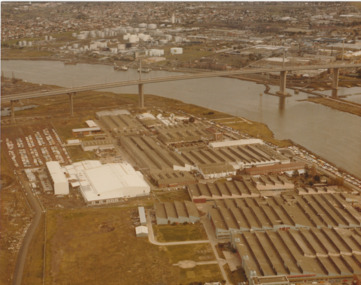
... Spotswood and Newport and fuel storage tanks in background....Spotswood and Newport and fuel storage tanks in background. Photograph Aerial view of West Gate Bridge under construction ...The wharf part of "Rotten Row" can be seen along the river bank in this photograph however the finger jetties visible in earlier photographs (3662.01 and 3662.02) have been removed.Colour aerial photograph of West Gate Bridge completed. Aircraft factory and other industry in foreground. Spotswood and Newport and fuel storage tanks in background."Gov't A/C Factories Photographic Section Neg No N2841/3" stamped on backengineering - bridges, fishermans bend, built environment - industrial, west gate bridge, yarra river, transport - roads, piers and wharves - mht timber wharves, rotten row, demolitions, commonwealth aircraft corporation, government aircraft factory -
 Port Melbourne Historical & Preservation Society
Photograph - Beach Street Port Melbourne, c 1980
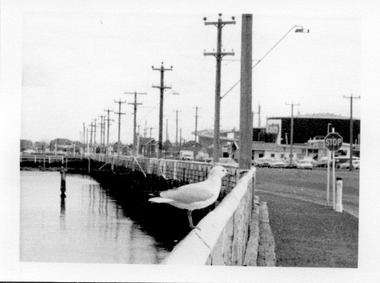
... Also visible is the BP fuel storage tank (which was removed in c 1988) and the Westgate Bridge (opened in 1978)....Also visible is the BP fuel storage tank (which was removed in c 1988) and the Westgate Bridge (opened in 1978). ...A view of Beach Street Port Melbourne looking west towards Princes Pier. Also visible is the BP fuel storage tank (which was removed in c 1988) and the Westgate Bridge (opened in 1978).Digital photograph, black and white.beach street, piers and wharves - princes pier, bp australia, westgate bridge, built environment - industrial, engineering - roads streets lanes and footpaths, transport - roads -
 Port Melbourne Historical & Preservation Society
Photograph - Aerial view 1960s of Piers and surrounds
... Identifiable objects are Station and Princes piers; Centenary Bridge; Commonwealth Government Marine Engine works; Beacons; Bank Houses; Commonwealth Oil fuel storage tanks; Missions to Seamen; Trugo club; Railway yards; Beacon Rad, Williamstown Road...Identifiable objects are Station and Princes piers; Centenary Bridge; Commonwealth Government Marine Engine works; Beacons; Bank Houses; Commonwealth Oil fuel storage tanks; Missions to Seamen; Trugo club; Railway yards; Beacon Rad, Williamstown Road PIers and wharves Built Environment mission to seamen Beacon Port Melbourne piers and surrounds. ...Gives a good overview of this area of Port Melbourne at a point in time. Identifiable objects are Station and Princes piers; Centenary Bridge; Commonwealth Government Marine Engine works; Beacons; Bank Houses; Commonwealth Oil fuel storage tanks; Missions to Seamen; Trugo club; Railway yards; Beacon Rad, Williamstown RoadPort Melbourne piers and surrounds. Aerial photo from the 1960spiers and wharves, built environment, mission to seamen, beacon -
 Sunshine and District Historical Society Incorporated
Administrative record - City of Sunshine Council Meetings 1986 - 1994 - Notice of Ordinary Meeting 14th July 1987 Part 2, City of Sunshine, 10th July 1987
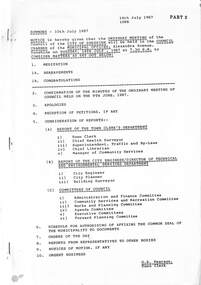
... Albans Planning Permit Application Buildings & Works Burwood Avenue Sunshine North Planning Permit Application Extended Trading Hours Planning Permit Application Highpoint West Shopping Centre Rosamond Road Maribyrnong Planning Permit Application Underground Fuel Storage Tank Ampol Petroleum 22 Sun Crescent Sunshine Planning Permit Application Four Flats 28 Forrest Street Sunshine Planning Permit Application Buildings & Works The Sunshine City Club 22 - 24 Talmage Street Albion Planning Permit Application Subdivision of Land Grantham Parade St. ...Albans Planning Permit Application Buildings & Works Burwood Avenue Sunshine North Planning Permit Application Extended Trading Hours Planning Permit Application Highpoint West Shopping Centre Rosamond Road Maribyrnong Planning Permit Application Underground Fuel Storage Tank Ampol Petroleum 22 Sun Crescent Sunshine Planning Permit Application Four Flats 28 Forrest Street Sunshine Planning Permit Application Buildings & Works The Sunshine City Club 22 - 24 Talmage Street Albion Planning Permit Application Subdivision of Land Grantham Parade St. ...Notice of Ordinary Meeting 14th July 1987 Part 2 Report of the City Planner Planning Permit Application Additions to Nonconforming Use (SCI Meat & Paper Pty Ltd) 433 Somerville Road Tottenham Planning Permit Application Buildings and Works Over 7.0M in Height (Four Storage Silos) Ballarat Road Deer Park Planning Permit Application Panel Beating 76 Cromer Avenue Sunshine North Planning Permit Application Factory & Office Reid Street Ardeer Planning Permit Application Seven Flats Cary Street Sunshine North Planning Permit Application Office Princess Street Corner St. Albans Road St. Albans Planning Permit Application Alterations to Nonconforming Use (Extended Trading Hours) Deer Park Hotel 760 Ballarat Road Deer Park Town Planning Proposed Temporary Car Park Railway Leased Land (Lot 104) Anderson Road Sunshine Planning Permit Application Shark-Fin Drying Factory 17 Ormond Avenue Sunshine Planning Permit Application Cas Wash 277 Ballarat Road Bounded by Dodd Street and Vine Street Braybrook Planning Permit Application Entertainment Complex & Restaurant Highpoint West Shopping Centre Rosamond Road Maribyrnong Town Planning Proposed Renovations / Restoration The Hunt Club Community Centre (The Hunt Club Hotel) 775 Ballarat Road Deer Park Rezoning Application 140 Forrest Street Bounded by Yallorn Street, Suspension Street & North Street Ardeer Planning Permit Application Livestock Saleyard 690 Geelong Road North East Corner Old Geelong Road Brooklyn Planning Permit Application Restaurant 177A Main Road West St. Albans Planning Permit Application Buildings & Works Burwood Avenue Sunshine North Planning Permit Application Extended Trading Hours Planning Permit Application Highpoint West Shopping Centre Rosamond Road Maribyrnong Planning Permit Application Underground Fuel Storage Tank Ampol Petroleum 22 Sun Crescent Sunshine Planning Permit Application Four Flats 28 Forrest Street Sunshine Planning Permit Application Buildings & Works The Sunshine City Club 22 - 24 Talmage Street Albion Planning Permit Application Subdivision of Land Grantham Parade St. Albans Planning Permit Application Health Centre 119 - 121 Durham Road Sunshine Sunshine Planning for the 21st Century Maribyrnong River Bicentennial Committee Afton Street Bridge Maribyrnong / Aberfeldie Planning Permit Application Brothel 741 Geelong Road Service Road Brooklyn Plan of Consolidation Lots 27 & 28 Carrington Drive Albion Plan of Consolidation Furlong Road (Maribyrnong Medical Centre) St. Albans Sunshine Hospitals and Health Services Society Plan of Strata Subdivision 257 Main Road West St. Albans Plan of Strata Subdivision 85 Devonshire Road Sunshine Plan of Strata Subdivision 8 Burnewang Street Albion Plan of Strata Subdivision 179 St. Albans Road St. Albans Plan of Strata Subdivision 29 Yarmouth Avenue St. Albans Plan of Strata Subdivision 59 The Esplanade Maribyrnong Plan of Consolidation 11 Babb Street Maidstone Plan of Transfer and Consolidation land Between 8 - 10 Forrest Street and 9 Ridley Street Albion Plan of Subdivision Sunshine Uniting Church 28 - 36 Withers Street South East Corner Devonshire Road Sunshine Plan of Subdivision Grantham Parade St. Albans Plan of Strata Subdivision 2 Millers Road Brooklyn Plan of Subdivision Sunshine Gardens Estate Stage 2 Sunshine Road Tottenham Dangerous Building 20 Hesser Street Albion Dangerous Building 639 Ballarat Road South West Corner Hesser Street Albion Dangerous Building 621 Ballarat Road Albion Dangerous Building 4 Comley Street Sunshine North Dangerous Building (Brick Warehouse) 140 Forrest Street Ardeer Dangerous Building (Corrugated Iron Clad Warehouse) 140 Forrest Street Ardeer Dangerous Building (Brick & Asbestos Cement Sheeted Factory) 140 Forrest Street Ardeer Underground Tank Ampol Petroleum 22 Suns Crescent Sunshine Seminar Law Enforcement for Building Control Officers 5th - 6th August 1987 Fire Damaged Warehouse 81 - 85 Ashley Street Braybrook Dangerous Building 81 - 85 Ashley Street Braybrook Schedule for Authorising of Affixing the Common Seal of the Municipality to Documents Orders of the Day Planning Permit Application Hotel McIntyre Road Sunshine North Planning Permit Application Motor Repair Station Omar Street Maidstone Show Cause Notice 19 Second Avenue Sunshine Proposal to Construct Fairbairn Road Private Street Scheme Under the Provisions of Division 10 of Part XIX of the Local Government Act 1958 Notice of Motions Presentation of Plaques to Retiring Councilors Alan Solomano and Gwen Goedecke Castley Hall Redevelopment Project Funding Car Park Sunshine Police Station Sun Crescent Sunshine Tarmac Surface Repair Leisure Centre Multipurpose Community Centre North Ward (Deer Park / Albanvale) Provision of Rubbish Receptacle River Street Maidstone Toilet Facilities Robert Barrett Reserve Use of Sports Grounds Sunshine George Cross Soccer Club & Sunshine Baseball Club Council Fleet Additional of 12 Seater Bus Deer Park Child Care Centre Rezoning of Land ICI Oval Ballarat Road Deer Park Sunshine Shopping Centre Scale Model Display Meetings Sunshine International Women's Committee Use of Community Bus by Deer Park Scoutssci meat & paper, somerville road, tottenham, ici, ballarat road, deer park, cromer avenue, sunshine north, reid street, ardeer, cary street, princess street, st. albans road, st. albans, deer park hotel, anderson road, sunshine, ormond avenue, dodd street, vine street, braybrook, highpoint west shopping centre, rosamond road, maribyrnong, the hunt club community centre, the hunt club hotel, forrest street, yallorn street, suspension street, north street, geelong road, old geelong road, main road west, burwood avenue, sun crescent, the sunshine city club, talmage street, albion, grantham parade, durham road, maribyrnong river, afton street bridge, afton street, aberfeldie, carrington drive, furlong road, devonshire road, burnewang street, yarmouth avenue, the esplanade, babb street, maidstone, ridley street, withers street, sunshine uniting church, millers road, sunshine road, hesser street, comley street, ashley street, mcintyre road, omar street, second avenue, fairbairn road, castley hall, simmie street, sunshine west, sunshine police station, river street, robert barrett reserve, sunshine george cross soccer, sunshine baseball club, deer park child care centre, ici oval ballarat, international women's committee -
 Flagstaff Hill Maritime Museum and Village
Container - Ship Tank, Early 20th century
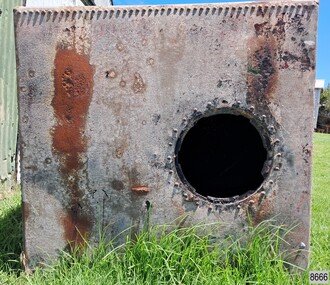
... tanks, and this invention was instrumental in replacing the wooden casks formerly used for storage on ships. He was involved with mining technology, iron foundry and ship equipment. Ship tanks changed the way that cargo was transported on ships and other vehicles from the 1830s and were used into the mid-20th century. The ship tanks’ advantages were that they could store more content, lasted longer, were waterproof and airtight, stackable and could be repurposed for many uses other than water, such as fuel ...Cubed iron ship tanks were invented by Richard Trevithich in 1808, in partnership with Robert Dickson, and the design was patented that year. The invention eventually replaced the wooden casks or barrels used at the time, as the ship tanks were more secure and their shape was much more economical in storage space. The robust metal tanks were originally made to transport water, but their preserving quality enabled them to transport perishable dry goods such as grain on long voyages, as well as other forms of liquid and solid cargo. The first ship tanks were made from sheets of iron, and later mild steel sheets, with double riveted edges and corners. A round cast iron lid with handle grips was fitted snugly into the top opening, providing an air-tight and water-tight seal. Brass taps were often fitted into the base, which could have been the case with this tank, but it now has a wooden bung in the hole. Sailing ships began using the new ship tanks on Australian voyages from around the 1830s, storing food and water for those on board, and filling them with other cargo. A large number of the ship tanks were repurposed in 1838 for the Victoria Settlement at Port Essington, N.T., as they were able to protect the food, clothing and other stores from termite and insect damage. Other ‘recycled’ ship tanks were cut in half and used as washing tubs or cookers. A 1929 catalogue from Hudson’s Tank Stores advertised square tanks that contained around 600 litres – 160 gallons – which equals an internal measurement of 33.25 inches – 84.5 centimetres – per side ship tanks are still made and sold in 1952 by the Globe Tank and Foundry in Wolverhampton, England, which was incorporated in 1922. Today, ship tanks can be seen around Australia. Wilsonson’s Promontory Lightstation has the lid from a ship tank that was used on site for the storage of water. Some have been repurposed as domestic water tanks and dog kennels, others for eucalyptus distilleries. Flagstaff Hill has two ship tanks. The Campaspe Port at Echuca, once a bustling river port, has a ship tank beside the locomotive yard. The lids of ship tanks are collectible items. Richard Trevithick (1771-1833): - Trevithick was born in 1771 in Cornwall, England. He was a famous British engineer and inventor during the Industrial Revolution, known for his invention of the first full-scale working railway, the high-pressure steam locomotive, which he demonstrated hauling a railway train in 1804. He set up a small workshop in 1808 at 72 Fore Street, Limehouse, London, to make iron ship tanks, and this invention was instrumental in replacing the wooden casks formerly used for storage on ships. He was involved with mining technology, iron foundry and ship equipment. Ship tanks changed the way that cargo was transported on ships and other vehicles from the 1830s and were used into the mid-20th century. The ship tanks’ advantages were that they could store more content, lasted longer, were waterproof and airtight, stackable and could be repurposed for many uses other than water, such as fuel, dry goods and domestic cargo. They have even been used aa dog kennels and cookers. Ship tanks were part of the evolving methos to transport water, food and cargo, which changed in 1956 when Malcolm McLean invented the large, rectangular shipping containers that are in use today; they speed up the process of loading on and off the ships, saving time and money. Ship tank: a cubed iron container with an offset hole on one side. The hole has cutouts for securely attaching a lid. This tank is on its side on the ground with the opening facing sideways. The side facing upwards has a wooden bung in a round hole. The ship tank is made from six square, thick iron sheets, rolled and riveted along the edges. The inside has a black sticky coating, possibly bitumen, and a strong creosote odour. There are small remnants of green paint on the outer surface.flagstaff hill, flagstaff hill maritime museum and village, warrnambool, maritime museum, maritime village, great ocean road, shipwreck coast, iron cube, water tank, shipping container, ship tank, ship's tank, ship tanks, marine container, richard trevithich, 1808, robert dickson, water transport, water storage, iron foundry, steel sheets, iron sheets, revets, victoria settlement, port essington, globe tank and foundry, wolverhampton, british engineer, british inventor, wooden casks -
 Southern Sherbrooke Historical Society Inc.
Photograph - The Hermons at the Pakenham Show, c.1965, with their fuel tanker
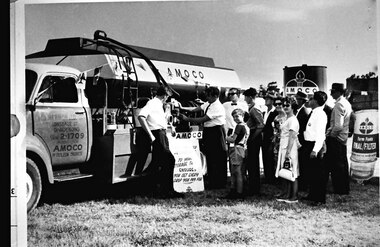
... fuel tanker parked on grass. On the passenger side door is written “W.J. HERMON/71 LONSDALE ST./DANDENONG/Phone 2-1709/AGENT FOR/AMOCO/PETROLEUM PRODUCTS”. John Hermon, in shirtsleeves and trousers, is leaning against the truck, watching his father, Bill, similarly dressed and with a tie, demonstrating what appears to be a gauge on the truck. “AMOCO” is painted twice on the truck. Between the two men is a sign on the ground and leaning against the truck. It reads “[illegible] deliveries to your/storage tank...fuel tanker parked on grass. On the passenger side door is written “W.J. HERMON/71 LONSDALE ST./DANDENONG/Phone 2-1709/AGENT FOR/AMOCO/PETROLEUM PRODUCTS”. John Hermon, in shirtsleeves and trousers, is leaning against the truck, watching his father, Bill, similarly dressed and with a tie, demonstrating what appears to be a gauge on the truck. “AMOCO” is painted twice on the truck. Between the two men is a sign on the ground and leaning against the truck. It reads “[illegible] deliveries to your/storage tank ...B&W photo showing a group of people watching John and Bill Hermon displaying their fuel tanker at Pakenham Show, c.1965. Photo shows a fuel tanker parked on grass. On the passenger side door is written “W.J. HERMON/71 LONSDALE ST./DANDENONG/Phone 2-1709/AGENT FOR/AMOCO/PETROLEUM PRODUCTS”. John Hermon, in shirtsleeves and trousers, is leaning against the truck, watching his father, Bill, similarly dressed and with a tie, demonstrating what appears to be a gauge on the truck. “AMOCO” is painted twice on the truck. Between the two men is a sign on the ground and leaning against the truck. It reads “[illegible] deliveries to your/storage tank/ensures/you get every/drop you pay for”. A group of approximately seven men, two women and a boy about 10yo are watching. The women and two of the men are wearing sunglasses. A tank with “AMOCO” is behind the truck and on the right of the photo, behind the crowd, is a sign which says “AMOCO/Farm Fuels/FINAL/FILTER” -
 Flagstaff Hill Maritime Museum and Village
Equipment - Navigation Lamp, Port, George Bocock & Co. Ltd, Trading As Seahorse Lamps, 1930s
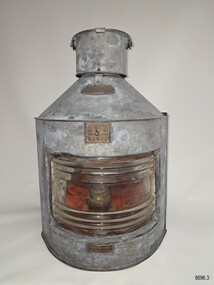
... storage area in a South Melbourne factory where he worked. He asked about the lamp, but nobody there knew anything about its origin, and he was told that he could have it. This is a complete ship navigation lamp with its original oil burner. The internal red colour and shape indicate that the lamp was used for the port side of a vessel. The burner assembly is fixed to a removable tray, and the burner disconnects from the tank to allow fuel...storage area in a South Melbourne factory where he worked. He asked about the lamp, but nobody there knew anything about its origin, and he was told that he could have it. This is a complete ship navigation lamp with its original oil burner. The internal red colour and shape indicate that the lamp was used for the port side of a vessel. The burner assembly is fixed to a removable tray, and the burner disconnects from the tank to allow fuel ...The donor recovered this navigation lamp before the 1980s from an old storage area in a South Melbourne factory where he worked. He asked about the lamp, but nobody there knew anything about its origin, and he was told that he could have it. This is a complete ship navigation lamp with its original oil burner. The internal red colour and shape indicate that the lamp was used for the port side of a vessel. The burner assembly is fixed to a removable tray, and the burner disconnects from the tank to allow fuel to be added. Light showing from the lamp is magnified by the polished brass reflector behind it, and the painted internal surfaces give the light its red colour. The lid on the chimney unclips for inspection purposes. The wedge shape of the lamp is intentional. It allows the light to be visible horizontally from up to a 112.5-degree angle, and to be invisible past that angle. The light's colour and position are part of the code of signals that inform viewers of the vessel’s position, direction of travel and status. The red lights indicate the port side of a vessel, green lights indicate the starboard side, and white lights are used on the masthead. From 1972, lights and signals on marine vessels are required to be fitted according to the International Regulations for Preventing Collisions at Sea. SEAHORSE lamp, made in Britain: The firm Bocock & Wilkinson was established in Birmingham in 1890 as an electroplate manufacturer. In 1900, Kelly’s Directory lists the firm as a ship lamp manufacturer. In 1910, the firm was listed Trading As “Seahorse” at 17 & 18 Mott Street, Birmingham. The firm later became Bocock & Son, and in 1932 was listed as George Bocock & Co. Ltd, and in 1973, it was still at that address. Ship’s navigation lamp: an original, galvanised metal, Port bow-side lamp. The wedge-shaped case has an arc front and two flat side panels that meet at the back, with a metal chimney and a swinging ‘C’ shaped handle on top. The curved, clear glass Fresnel has moulded ribs, top and bottom. The chimney has a hinged cap with a clip closure. One flat panel has a firmly attached, hollow rectangular channel for mounting onto a post or bracket. The other flat panel has a ‘D’ shaped, swinging handle, and slides upwards to access the burner assembly with its original brass burner. Concentric rings of ventilation holes are in the base. A removable tray, with ventilation holes on two edges, holds the round fuel tank and burner and the short post with the curved brass reflector. All internal metal surfaces, apart from the brass burner and reflector, were painted red sometime after the lamp’s manufacture. Inscriptions are embossed on the three brass plaques on the front; one has a rope design border and a seahorse emblem. Branded Seahorse, made in Great Britain, Ca. 1930s. Plaque on top, crescent shape: “PORT” Plaque in centre, square logo: “[rope design border] [Seahorse logo] “SEAHORSE / G B / TRADE / MARK / P55933” Plaque on base, rectangular: “PATENT NO. 546575 / AND OTHERS PENDING” flagstaff hill maritime museum and village, great ocean road, shipwreck coast, ship lamp, navigation lamp, masthead light, masthead lamp, port lamp, port light, bow side lamp, lighting device, navigation, marine light, marine lamp, marine equipment, marine technology, marine safety, running light, position light, code of lights, international regulations for preventing collisions at sea, antique, galvanised, seahorse, great britain, gb, patent 546575, seahorse logo, trade mark p55933, oil burner, bocock & wilkinson, bocock & sons, george bocock & co. ltd
