
Showing 13 items matching " how fragile"
-
 Women's Art Register
Archive (Series) - How Fragile. Subject File 1
... How Fragile. Subject File 1...Firstdraft Gallery Sydney Astra Howard Rika Oakley Una Rey Deborah West Veronica Clare Painting Performance Photography Printmaking Foolscap white archival 4 flap folder or document wallet Archive How Fragile. Subject File 1 ...firstdraft gallery, sydney, astra howard, rika oakley, una rey, deborah west, veronica clare, painting, performance, photography, printmakingfirstdraft gallery, sydney, astra howard, rika oakley, una rey, deborah west, veronica clare, painting, performance, photography, printmaking -
Women's Art Register
Archive (Collection) - How Fragile Exhibition Archive
... How Fragile Exhibition Archive...2003 Firstdraft Gallery Sydney Astra Howard Rika Oakley Una Rey Deborah West Veronica Clare Painting Performance Photography Printmaking Archive How Fragile Exhibition Archive ...firstdraft gallery, sydney, astra howard, rika oakley, una rey, deborah west, veronica clare, painting, performance, photography, printmakingfirstdraft gallery, sydney, astra howard, rika oakley, una rey, deborah west, veronica clare, painting, performance, photography, printmaking -
Women's Art Register
Archive (Series) - Firstdraft. Subject File 1
... ... How Fragile...NSW Twenty Love How Fragile Foolscap white archival 4 flap folder or document wallet Archive Firstdraft. ...nsw, twenty love, how fragilensw, twenty love, how fragile -
Women's Art Register
Archive (Collection) - Firstdraft Gallery Archive
... ... How Fragile...NSW Twenty Love How Fragile Archive Firstdraft Gallery Archive ...nsw, twenty love, how fragilensw, twenty love, how fragile -
 Victorian Aboriginal Corporation for Languages
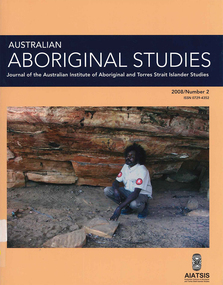
Periodical, Australian Institute of Aboriginal and Torres Strait Islander Studies, Australian Aboriginal studies : journal of the Australian Institute of Aboriginal and Torres Strait Islander Studies, 2008
... The research also shows that many Aboriginal people, no matter what their material and personal resources, are conscious of how fragile and unpredictable their economic lives can be, and that involvement in the customary economy is a kind of mutual insurance to guarantee survival if times get tough. ...The research also shows that many Aboriginal people, no matter what their material and personal resources, are conscious of how fragile and unpredictable their economic lives can be, and that involvement in the customary economy is a kind of mutual insurance to guarantee survival if times get tough. ...Mawul Rom Project: Openness, obligation and reconciliation Morgan Brigg (Universtiy of Queensland) and Anke Tonnaer (University of Aarhus, Denmark) Aboriginal Australian initiatives to restore balanced relationships with White Australians have recently become part of reconciliation efforts. This paper provides a contextualised report on one such initiative, the Mawul Rom crosscultural mediation project. Viewing Mawul Rom as a diplomatic venture in the lineage of adjustment and earlier Rom rituals raises questions about receptiveness, individual responsibility and the role of Indigenous ceremony in reconciliation efforts. Yolngu ceremonial leaders successfully draw participants into relationship and personally commit them to the tasks of cross-cultural advocacy and reconciliation. But Mawul Rom must also negotiate a paradox because emphasis on the cultural difference of ceremony risks increasing the very social distance that the ritual attempts to confront. Managing this tension will be a key challenge if Mawul Rom is to become an effective diplomatic mechanism for cross-cultural conflict resolution and reconciliation. Living in two camps: the strategies Goldfields Aboriginal people use to manage in the customary economy and the mainstream economy at the same time Howard Sercombe (Strathclyde University, Glasgow) The economic sustainability of Aboriginal households has been a matter of public concern across a range of contexts. This research, conducted in the Eastern Goldfields of Western Australia, shows how economically successful Aboriginal persons manage ?dual economic engagement?, or involvement in the customary economy and the mainstream economy at the same time. The two economies sometimes reinforce each other but are more often in conflict, and management of conflicting obligations requires high degrees of skill and innovation. As well as creating financially sustainable households, the participants contributed significantly to the health of their extended families and communities. The research also shows that many Aboriginal people, no matter what their material and personal resources, are conscious of how fragile and unpredictable their economic lives can be, and that involvement in the customary economy is a kind of mutual insurance to guarantee survival if times get tough. Indigenous population data for evaluation and performance measurement: A cautionary note Gaminiratne Wijesekere (Dept. of Families, Housing, Community Services and Indigenous Affairs, Canberra) I outline the status of population census counts for Indigenous peoples, identifying information on Indigenous births and deaths, and internal migration estimates. I comment on the ?experimental? Indigenous population projections and question the rationale for having two sets of projections. Program managers and evaluators need to be mindful of limitations of the data when using these projections for monitoring, evaluating and measuring Indigenous programs. Reaching out to a younger generation using a 3D computer game for storytelling: Vincent Serico?s legacy Theodor G Wyeld (Flinders University, Adeliade) and Brett Leavy (CyberDreaming Australia) Sadly, Vincent Serico (1949?2008), artist, activist and humanist, recently passed away. Born in southern Queensland in Wakka Wakka/Kabi Kabi Country (Carnarvon Gorge region) in 1949, Vincent was a member of the Stolen Generations. He was separated from his family by White administration at four years of age. He grew up on the Cherbourg Aboriginal Reserve in the 1950s, when the policies of segregation and assimilation were at their peak. Only returning to his Country in his early forties, Vincent started painting his stories and the stories that had been passed on to him about the region. These paintings manifest Vincent?s sanctity for tradition, storytelling, language, spirit and beliefs. A team of researchers was honoured and fortunate to have worked closely with Vincent to develop a 3D simulation of his Country using a 3D computer game toolkit. Embedded in this simulation of his Country, in the locations that their stories speak to, are some of Vincent?s important contemporary art works. They are accompanied by a narration of Vincent?s oral history about the places, people and events depicted. Vincent was deeply concerned about members of the younger generation around him ?losing their way? in modern times. In a similar vein, Brett Leavy (Kooma) sees the 3D game engine as an opportunity to engage the younger generation in its own cultural heritage in an activity that capitalises on a common pastime. Vincent was an enthusiastic advocate of this approach. Working in consultation with Vincent and the research team, CyberDreaming developed a simulation of Vincent?s Country for young Aboriginal and non-Aboriginal persons from the Carnarvon Gorge region to explore Vincent?s life stories of the region. The use of Vincent?s contemporary paintings as storyboards provides a traditional medium for the local people to interactively re-engage with traditional values. Called Serico?s World, it represents a legacy to his life?s works, joys and regrets. Here we discuss the background to this project and Vincent?s contribution. A singular beeswax representation of Namarrkon, the Lightning Man, from western Arnhem Land RG Gunn (La Trobe University) and RL Whear (Jawoyn Association) Samples from a beeswax representation of Namarrkon, the Lightning Man, from western Arnhem Land were analysed for radiocarbon and dated to be about 150 years old. An underlying beeswax figure was found to be approximately 1100 years old. The Dreaming Being Namarrkon is well known throughout Arnhem Land, although his sphere of activity is concentrated around the northern half of the Arnhem Land plateau. Namarrkon is well represented in rock-paintings in this area and continues to be well represented in contemporary canvas-paintings by artists from the broader plateau region. We conclude that representations of Namarrkon in both painted and beeswax forms appear to be parallel manifestations of the late Holocene regionalisation of Arnhem Land. ?Missing the point? or ?what to believe ? the theory or the data?: Rationales for the production of Kimberley points Kim Akerman (Moonah) In a recent article, Rodney Harrison presented an interesting view on the role glass Kimberley points played in the lives of the Aborigines who made and used them. Harrison employed ethnographic and historical data to argue that glass Kimberley points were not part of the normal suite of post-contact artefacts used primarily for hunting and fighting or Indigenous exchange purposes, but primarily were created to service a non-Indigenous market for aesthetically pleasing artefacts. Harrison asserted that this market determined the form that these points took. A critical analysis of the data does not substantiate either of these claims. Here I do not deal with Harrison?s theoretical material or arguments; I focus on the ethnographic and historical material that he has either omitted or failed to appreciate in developing his thesis and which, in turn, renders it invalid. The intensity of raw material utilisation as an indication of occupational history in surface stone artefact assemblages from the Strathbogie Ranges, central Victoria Justin Ian Shiner (La Trobe University, Bundoora) Stone artefact assemblages are a major source of information on past human?landscape relationships throughout much of Australia. These relationships are not well understood in the Strathbogie Ranges of central Victoria, where few detailed analyses of stone artefact assemblages have been undertaken. The purpose of this paper is to redress this situation through the analysis of two surface stone artefact assemblages recorded in early 2000 during a wider investigation of the region?s potential for postgraduate archaeological fieldwork. Analysis of raw material utilisation is used to assess the characteristics of the occupational histories of two locations with similar landscape settings. The analysis indicates variability in the intensity of raw material use between the assemblages, which suggests subtle differences in the occupational history of each location. The results of this work provide a direction for future stone artefact studies within this poorly understood region.document reproductions, maps, b&w photographs, colour photographskimberley, mawul rom project, 3d computer game, storytelling, vincent serico, beeswax, namarrkon, artefact assemblages, strathbogie ranges, groote eylandt, budd billy ii -
 Flagstaff Hill Maritime Museum and Village
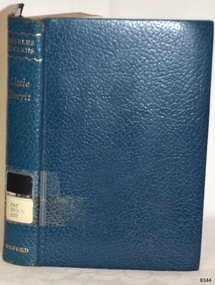
Book - A Fictional story, Chapman & Hall Ltd, Little Dorrit, 1890s
... fragile genteel pretensions. Arthur Clennam, disillusioned after years in China, becomes involved with the Dorrits and uncovers a web of secrets involving his own mother, a hidden inheritance, and shady business dealings. William Dorrit suddenly inherits a fortune and is able to lift the family out of poverty and into fashion conscious society.The novel shows how money distorts their characters and relationships, while Amy remains the moral centre. ...Charles Dickens (1812–1870) was one of the great English novelists of the Victorian era, famous for vivid characters, social criticism, and stories that were first published in serial form. He began as a journalist, rose to enormous popularity during his lifetime, and wrote major works such as Oliver Twist, David Copperfield, and Great Expectations. Little Dorrit is about Amy “Little” Dorrit, a gentle, selfless woman born and raised in the Marshalsea debtors’ prison where her father, William Dorrit, has been imprisoned for unpaid debts. The story follows her as she works as a seamstress outside the prison, gradually becoming entangled with Arthur Clennam, a businessman returning from abroad. Dickens interweaves a sharp critique of Victorian bureaucracy, finance, and class throughout the story. The theme centres around Amy Dorrit who lives her whole early life in Marshalsea, supporting her family with quiet dignity while her father clings to fragile genteel pretensions. Arthur Clennam, disillusioned after years in China, becomes involved with the Dorrits and uncovers a web of secrets involving his own mother, a hidden inheritance, and shady business dealings. William Dorrit suddenly inherits a fortune and is able to lift the family out of poverty and into fashion conscious society.The novel shows how money distorts their characters and relationships, while Amy remains the moral centre.Little Dorrit. Author: Charles Dickens. Publisher: Chapman & Hall Ltd, London. Date: 1890s. (See note section this document for more information on Edition). Green cloth hardcover with Authors name to front cover in gold. Spine has gold title lettering. The spine has a Library label.fictionCharles Dickens (1812–1870) was one of the great English novelists of the Victorian era, famous for vivid characters, social criticism, and stories that were first published in serial form. He began as a journalist, rose to enormous popularity during his lifetime, and wrote major works such as Oliver Twist, David Copperfield, and Great Expectations. Little Dorrit is about Amy “Little” Dorrit, a gentle, selfless woman born and raised in the Marshalsea debtors’ prison where her father, William Dorrit, has been imprisoned for unpaid debts. The story follows her as she works as a seamstress outside the prison, gradually becoming entangled with Arthur Clennam, a businessman returning from abroad. Dickens interweaves a sharp critique of Victorian bureaucracy, finance, and class throughout the story. The theme centres around Amy Dorrit who lives her whole early life in Marshalsea, supporting her family with quiet dignity while her father clings to fragile genteel pretensions. Arthur Clennam, disillusioned after years in China, becomes involved with the Dorrits and uncovers a web of secrets involving his own mother, a hidden inheritance, and shady business dealings. William Dorrit suddenly inherits a fortune and is able to lift the family out of poverty and into fashion conscious society.The novel shows how money distorts their characters and relationships, while Amy remains the moral centre. flagstaff hill, warrnambool, shipwrecked coast, flagstaff hill maritime museum, maritime museum, shipwreck coast, flagstaff hill maritime village, great ocean road, book, pattison collection, warrnambool library, warrnambool mechanics’ institute, ralph eric pattison, corangamite regional library service, warrnambool city librarian, mechanics’ institute library, victorian library board, warrnambool books and records, warrnambool children’s library, little dorrit, charles dickens -
 Flagstaff Hill Maritime Museum and Village
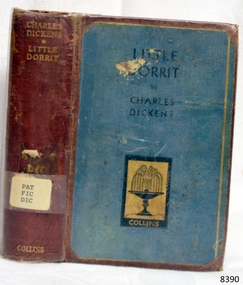
Book - A Fictional Story, Charles Dickens, Little Dorrit, 1968
... fragile genteel pretensions. Arthur Clennam, disillusioned after years in China, becomes involved with the Dorrits and uncovers a web of secrets involving his own mother, a hidden inheritance, and shady business dealings. William Dorrit suddenly inherits a fortune and is able to lift the family out of poverty and into fashion conscious society.The novel shows how money distorts their characters and relationships, while Amy remains the moral centre. ...Charles Dickens (1812–1870) was one of the great English novelists of the Victorian era, famous for vivid characters, social criticism, and stories that were first published in serial form. He began as a journalist, rose to enormous popularity during his lifetime, and wrote major works such as Oliver Twist, David Copperfield, and Great Expectations. Little Dorrit is about Amy “Little” Dorrit, a gentle, selfless woman born and raised in the Marshalsea debtors’ prison where her father, William Dorrit, has been imprisoned for unpaid debts. The story follows her as she works as a seamstress outside the prison, gradually becoming entangled with Arthur Clennam, a businessman returning from abroad. Dickens interweaves a sharp critique of Victorian bureaucracy, finance, and class throughout the story. The theme centres around Amy Dorrit who lives her whole early life in Marshalsea, supporting her family with quiet dignity while her father clings to fragile genteel pretensions. Arthur Clennam, disillusioned after years in China, becomes involved with the Dorrits and uncovers a web of secrets involving his own mother, a hidden inheritance, and shady business dealings. William Dorrit suddenly inherits a fortune and is able to lift the family out of poverty and into fashion conscious society.The novel shows how money distorts their characters and relationships, while Amy remains the moral centre.Little Dorrit Author: Charles Dickens Publisher: Collins Further Information: We do have 2 more copies of this same book. All have been published by different companies. ( R.N. 8159 and R.N. 8344)fictionCharles Dickens (1812–1870) was one of the great English novelists of the Victorian era, famous for vivid characters, social criticism, and stories that were first published in serial form. He began as a journalist, rose to enormous popularity during his lifetime, and wrote major works such as Oliver Twist, David Copperfield, and Great Expectations. Little Dorrit is about Amy “Little” Dorrit, a gentle, selfless woman born and raised in the Marshalsea debtors’ prison where her father, William Dorrit, has been imprisoned for unpaid debts. The story follows her as she works as a seamstress outside the prison, gradually becoming entangled with Arthur Clennam, a businessman returning from abroad. Dickens interweaves a sharp critique of Victorian bureaucracy, finance, and class throughout the story. The theme centres around Amy Dorrit who lives her whole early life in Marshalsea, supporting her family with quiet dignity while her father clings to fragile genteel pretensions. Arthur Clennam, disillusioned after years in China, becomes involved with the Dorrits and uncovers a web of secrets involving his own mother, a hidden inheritance, and shady business dealings. William Dorrit suddenly inherits a fortune and is able to lift the family out of poverty and into fashion conscious society.The novel shows how money distorts their characters and relationships, while Amy remains the moral centre. flagstaff hil, warrnambool, flagstaff hill maritime museum, maritime museum, shipwreck coast, flagstaff hill maritime village, great ocean road, book, pattison collection, warrnambool library, warrnambool mechanics’ institute, ralph eric pattison, corangamite regional library service, warrnambool city librarian, mechanics’ institute library, victorian library board, warrnambool books and records, warrnambool children’s library, little dorrit, charles dickens -
 Flagstaff Hill Maritime Museum and Village
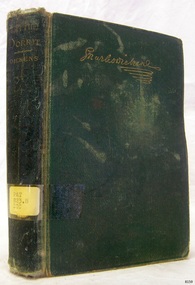
Book - A Fictional Story, Charles Dickens, Little Dorrit, 1890s
... fragile genteel pretensions. Arthur Clennam, disillusioned after years in China, becomes involved with the Dorrits and uncovers a web of secrets involving his own mother, a hidden inheritance, and shady business dealings. William Dorrit suddenly inherits a fortune and is able to lift the family out of poverty and into fashion conscious society.The novel shows how money distorts their characters and relationships, while Amy remains the moral centre. ...Charles Dickens (1812–1870) was one of the great English novelists of the Victorian era, famous for vivid characters, social criticism, and stories that were first published in serial form. He began as a journalist, rose to enormous popularity during his lifetime, and wrote major works such as Oliver Twist, David Copperfield, and Great Expectations. Little Dorrit is about Amy “Little” Dorrit, a gentle, selfless woman born and raised in the Marshalsea debtors’ prison where her father, William Dorrit, has been imprisoned for unpaid debts. The story follows her as she works as a seamstress outside the prison, gradually becoming entangled with Arthur Clennam, a businessman returning from abroad. Dickens interweaves a sharp critique of Victorian bureaucracy, finance, and class throughout the story. The theme centers around Amy Dorrit who lives her whole early life in Marshalsea, supporting her family with quiet dignity while her father clings to fragile genteel pretensions. Arthur Clennam, disillusioned after years in China, becomes involved with the Dorrits and uncovers a web of secrets involving his own mother, a hidden inheritance, and shady business dealings. William Dorrit suddenly inherits a fortune and is able to lift the family out of poverty and into fashion conscious society.The novel shows how money distorts their characters and relationships, while Amy remains the moral centre.Little Dorrit. Author: Charles Dickens. Publisher: Chapman & Hall Ltd, London. Date: 1890s. (See note section this document for more information on Edition). Green cloth hardcover with Authors name to front cover in gold. Spine has gold title lettering. The spine has a Library label.fictionCharles Dickens (1812–1870) was one of the great English novelists of the Victorian era, famous for vivid characters, social criticism, and stories that were first published in serial form. He began as a journalist, rose to enormous popularity during his lifetime, and wrote major works such as Oliver Twist, David Copperfield, and Great Expectations. Little Dorrit is about Amy “Little” Dorrit, a gentle, selfless woman born and raised in the Marshalsea debtors’ prison where her father, William Dorrit, has been imprisoned for unpaid debts. The story follows her as she works as a seamstress outside the prison, gradually becoming entangled with Arthur Clennam, a businessman returning from abroad. Dickens interweaves a sharp critique of Victorian bureaucracy, finance, and class throughout the story. The theme centers around Amy Dorrit who lives her whole early life in Marshalsea, supporting her family with quiet dignity while her father clings to fragile genteel pretensions. Arthur Clennam, disillusioned after years in China, becomes involved with the Dorrits and uncovers a web of secrets involving his own mother, a hidden inheritance, and shady business dealings. William Dorrit suddenly inherits a fortune and is able to lift the family out of poverty and into fashion conscious society.The novel shows how money distorts their characters and relationships, while Amy remains the moral centre. book, the old curiosity shop, charles dickens, shipwrecked-coast, flagstaff-hill, flagstaff-hill-maritime-museum, warrnambool, maritime-museum, flagstaff-hill-maritime-village, pattison collection, warrnambool library, warrnambool mechanics’ institute, ralph eric pattison, corangamite regional library service, warrnambool city librarian, mechanics’ institute library, victorian library board, warrnambool books and records, warrnambool children’s library, great ocean road -
 Waverley RSL Sub Branch
Table Tops Newspaper, Table Tops Balikpapan Tuesday 6th August 1945
... (past member of RSL Waverley sub branch) Records the end of hostilities in the Pacific Region WWII and give an insight into how the news was communicated, as well as into other issues important at the time. balikpapan pacific war victory charles harold dix japan surrenders newspaper newsletter 6th august 1945 table tops tabletops aif news wwii Table Tops 4 page A4 Newspaper, pages brownish due to deterioration and fragile due to folds and rips.Print is still clear and readable Table Tops Balikpapan Tuesday 6th August 1945 Table Tops Newspaper ...This Edition, Published by AIF News, was printed to celebrate the end of WWII in the Pacific Region. It was kept by L.A.C. Charles Harold Dix 119700 R.A.A.F. No. 2 Squadron Stationed at Balikpapan at the time. (past member of RSL Waverley sub branch)Records the end of hostilities in the Pacific Region WWII and give an insight into how the news was communicated, as well as into other issues important at the time.4 page A4 Newspaper, pages brownish due to deterioration and fragile due to folds and rips.Print is still clear and readable Table Topsbalikpapan, pacific war, victory, charles harold dix, japan surrenders, newspaper, newsletter, 6th august 1945, table tops, tabletops, aif news, wwii -
 Nillumbik Shire Council
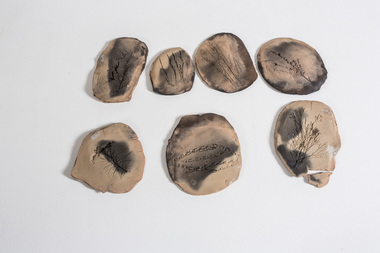
Clay: Leanne Mooney, Leanne Mooney, Tiles from the Boomerang Studio, 2002
... She also noticed how humans “invade” land, changing the surrounding environment and causing irreversible damage. This work is an interpretation of the fragility and value of Nillumbik’s indigenous flora and of its conflict with introduced species. ...'Tiles from the Boomerang Studio' is a prototype of the work 'Year 2052', created while Mooney was an Artist in Resident at Laughing Waters in the Boomerang studio in 2002. Records of flora were collected in and around the Gordon Ford garden in Laughing Waters Road. The work 'Year 2052' is made up of '77' tiles and was acquired by Geelong (Regional) Art Gallery in 2003. Whilst working at the Boomerang studio, local based artist Mooney noticed that “a battle raged in the bush between non-indigenous plants and indigenous plants”. She also noticed how humans “invade” land, changing the surrounding environment and causing irreversible damage. This work is an interpretation of the fragility and value of Nillumbik’s indigenous flora and of its conflict with introduced species. The title of the work (Year 2052) and look of these ‘fossilised specimens’ asks viewers to cast themselves into the future and to look back at today. “These tiles have been found; an incomplete record of flora collected in and around the Gordon Ford garden in Laughing Waters Road. The tiles appear to have been made at the beginning of the millennium. The viewer is asked to contemplate which species are missing”. Mooney works with collected indigenous items to emphasis the beauty of their natural shapes, while at the same time introducing selected materials of contrast or sympathy. Her work creates a great sense of “stillness and peace, of simplicity and connection with the natural world as well at the vanishing Australian bush.”This work is made up of seven handbuilt earthenware oval/round clay 'tiles' - (eight pieces - with one tile intentionally broken), brown in colour and bisque and blackware fired, giving a matt black ash coating on each of the tiles' surface. Each tile has an imprint of a floral specimen indigenous to the Laughing Waters area in Eltham. Each tile has an imprint of the following specimens: tiles, earthenware, flora, indigenous, bisque, boomerang, ford, laughing waters -
 Ararat Gallery TAMA
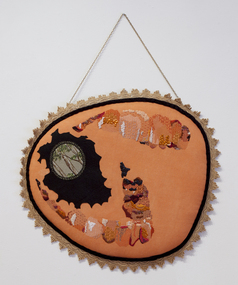
Sera Waters, The Great Australian Bite: Cavernous, 2011
... how textile traditions can help navigate a future affected by climate change. These two works by Sera Waters draw on myths, histories, and narratives of the Australian bush and interior, weaving together research into explorers, family stories, popular culture, and folklore. Teeth and wild mouths become portals into different times and experiences: our colonial past, fictional bush tales, and lived encounters with a harsh, unpredictable land. Hand-embroidered and embellished with time-intensive techniques once linked to domestic craft, the works embody both fragility...how textile traditions can help navigate a future affected by climate change. These two works by Sera Waters draw on myths, histories, and narratives of the Australian bush and interior, weaving together research into explorers, family stories, popular culture, and folklore. Teeth and wild mouths become portals into different times and experiences: our colonial past, fictional bush tales, and lived encounters with a harsh, unpredictable land. Hand-embroidered and embellished with time-intensive techniques once linked to domestic craft, the works embody both fragility ...Sera Waters is an artist, arts writer and academic living on Kaurna land, South Australia. Since being awarded a Ruth Tuck Scholarship in 2006 to study hand embroidery at the Royal School of Needlework in the UK, Waters’ art practice has been characterised by a darkly stitched meticulousness. Her embroideries and hand-crafted sculptures dwell within the gaps of Australian histories to examine settler-colonial home-making patterns and practices, especially her own genealogical ghostscapes. More recently Waters has been exploring how textile traditions can help navigate a future affected by climate change. These two works by Sera Waters draw on myths, histories, and narratives of the Australian bush and interior, weaving together research into explorers, family stories, popular culture, and folklore. Teeth and wild mouths become portals into different times and experiences: our colonial past, fictional bush tales, and lived encounters with a harsh, unpredictable land. Hand-embroidered and embellished with time-intensive techniques once linked to domestic craft, the works embody both fragility and ferocity. Delicate yet unsettling, these works reflect on survival, risk, and endurance, transforming personal and collective histories into strange offerings that are humorous, dark, and deeply human. -
 Ararat Gallery TAMA
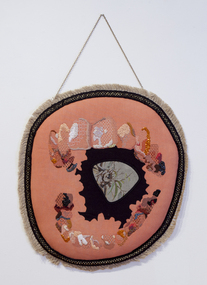
Sera Waters, The Great Australian Bite: Gums, 2011
... how textile traditions can help navigate a future affected by climate change. These two works by Sera Waters draw on myths, histories, and narratives of the Australian bush and interior, weaving together research into explorers, family stories, popular culture, and folklore. Teeth and wild mouths become portals into different times and experiences: our colonial past, fictional bush tales, and lived encounters with a harsh, unpredictable land. Hand-embroidered and embellished with time-intensive techniques once linked to domestic craft, the works embody both fragility...how textile traditions can help navigate a future affected by climate change. These two works by Sera Waters draw on myths, histories, and narratives of the Australian bush and interior, weaving together research into explorers, family stories, popular culture, and folklore. Teeth and wild mouths become portals into different times and experiences: our colonial past, fictional bush tales, and lived encounters with a harsh, unpredictable land. Hand-embroidered and embellished with time-intensive techniques once linked to domestic craft, the works embody both fragility ...Sera Waters is an artist, arts writer and academic living on Kaurna land, South Australia. Since being awarded a Ruth Tuck Scholarship in 2006 to study hand embroidery at the Royal School of Needlework in the UK, Waters’ art practice has been characterised by a darkly stitched meticulousness. Her embroideries and hand-crafted sculptures dwell within the gaps of Australian histories to examine settler-colonial home-making patterns and practices, especially her own genealogical ghostscapes. More recently Waters has been exploring how textile traditions can help navigate a future affected by climate change. These two works by Sera Waters draw on myths, histories, and narratives of the Australian bush and interior, weaving together research into explorers, family stories, popular culture, and folklore. Teeth and wild mouths become portals into different times and experiences: our colonial past, fictional bush tales, and lived encounters with a harsh, unpredictable land. Hand-embroidered and embellished with time-intensive techniques once linked to domestic craft, the works embody both fragility and ferocity. Delicate yet unsettling, these works reflect on survival, risk, and endurance, transforming personal and collective histories into strange offerings that are humorous, dark, and deeply human. -
 Clayton RSL Sub Branch
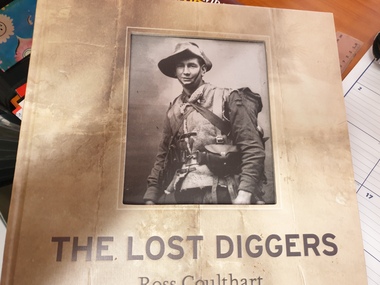
hard cover non-fiction book, The Lost Diggers, 2012
... Remember me: the lost diggers of Vignacourt tells the story of how one enterprising photographer took the opportunity of this passing traffic to establish a business taking portrait photographs. Captured on glass, printed into postcards and posted home, the photographs made by the Thuillier family enabled Australian soldiers to maintain a fragile link with loved ones in Australia. ...Remember me: the lost diggers of Vignacourt tells the story of how one enterprising photographer took the opportunity of this passing traffic to establish a business taking portrait photographs. Captured on glass, printed into postcards and posted home, the photographs made by the Thuillier family enabled Australian soldiers to maintain a fragile link with loved ones in Australia. ...The small French village of Vignacourt was always behind the front lines. For much of the First World War it was a staging point, casualty clearing station and recreation area for troops of all nationalities moving up to and then back from the battlefields on the Somme. Remember me: the lost diggers of Vignacourt tells the story of how one enterprising photographer took the opportunity of this passing traffic to establish a business taking portrait photographs. Captured on glass, printed into postcards and posted home, the photographs made by the Thuillier family enabled Australian soldiers to maintain a fragile link with loved ones in Australia. The Thuillier collection covers many of the significant aspects of Australian involvement on the Western Front, from military life to the friendships and bonds formed between the soldiers and civilians. The exhibition showcases a selection of the photographs as handmade traditional darkroom prints and draws on the Memorial's own collections to tell the story of these men in their own voicesapprox 4000 images were discovered in the attic of a barn Vignacourt, of soldiers and other life in WW1.An exciting story about the discovery of the plates of Vignacourt
