
Showing 27 items matching " impressionist"
-
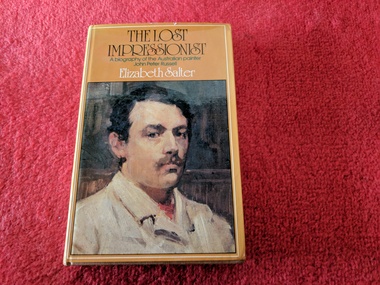 Robin Boyd Foundation
Book, Elizabeth Salter, The Lost Impressionist: A biography of John Peter Russell, 1976
... The Lost Impressionist: A biography of John Peter Russell...John Peter Russell Walsh St library Hardcover The Lost Impressionist: A biography of John Peter Russell Book Elizabeth Salter Angus and Robertson ...Hardcoverjohn peter russell, walsh st library -
 Whitehorse Historical Society Inc.
Pamphlet, Australian tonal impressionist painter, n.d
... Australian tonal impressionist painter...Australian tonal impressionist painter Pamphlet Pamphlet ...Barbara Rogalski began painting when 35 and has since travelled widely concentrating on landscapes. Paintings are widely distributed.rogalski, barbara, moore, david, dudley, john -
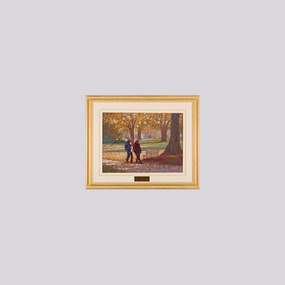 Wangaratta Art Gallery
Painting, Do Noble, Autumn Lovers, c. 2004
... A landscape scene of an elderly couple walking through a park in Autumn painted in a post-impressionist style....wangaratta art gallery do noble painting autumn landscape Obverse: DO NOBLE/ (bottom right corner) 2004 Art Show/ - Grand Winner - / 'Autumn Lovers' - By Do Noble/ Judge Ramon Horsfield/ (plaque on mounting board) A landscape scene of an elderly couple walking through a park in Autumn painted in a post-impressionist style. Autumn Lovers Painting Do Noble ...Rural City of Wangaratta Collection, Wangaratta Art Show 2004.A landscape scene of an elderly couple walking through a park in Autumn painted in a post-impressionist style.Obverse: DO NOBLE/ (bottom right corner) 2004 Art Show/ - Grand Winner - / 'Autumn Lovers' - By Do Noble/ Judge Ramon Horsfield/ (plaque on mounting board)wangaratta art gallery, do noble, painting, autumn, landscape -
Whitehorse Historical Society Inc.
Article, Thereby hangs a tale, 2009
... City of Whitehorse's art collection includes works by Australian impressionists, sculptures, wall hangings, photographs, etchings and jewellery. ...City of Whitehorse's art collection includes works by Australian impressionists, sculptures, wall hangings, photographs, etchings and jewellery. ...City of Whitehorse's art collection includes works by Australian impressionists, sculptures, wall hangings, photographs, etchings and jewellery.City of Whitehorse's art collection includes works by Australian impressionists, sculptures, wall hangings, photographs, etchings and jewellery. The gallery will open once a monthCity of Whitehorse's art collection includes works by Australian impressionists, sculptures, wall hangings, photographs, etchings and jewellery. city of whitehorse, art exhibitions, art galleries -
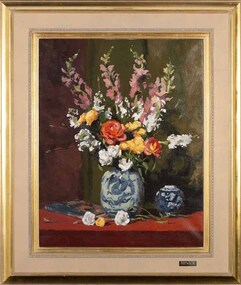 Wangaratta Art Gallery
Painting, Paul McDonald Smith, Flower Study, 1997
... This influence of the European Impressionist art style is clearly seen in his artwork Flower Study. ...This influence of the European Impressionist art style is clearly seen in his artwork Flower Study. ...McDonald Smith is famous for paining in the tradition of tonal impressionism, with most of his works painted in oil. This influence of the European Impressionist art style is clearly seen in his artwork Flower Study. The notion of light, an impressionist theme, is depicted by the use of a tonal colour palette and varied brushstrokes. The depiction of a Japanese dragon vase hints at the art aesthetic of Japonisme in the European Impressionist movement, a possible nod of respect to the movement by McDonald Smith.Rural City of Wangaratta Collection, Wangaratta Art Prize 1997.A rectangular still life painting of a bunch of flowers in a vase painted in oil using shades of white, red, green, blue, and yellow.Obverse: P McDONALD SMITH (bottom right corner)wangaratta art gallery, painting, still life, paul mcdonald smith -
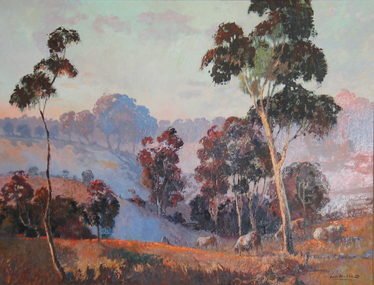 Brimbank City Council Art Collection
Painting, Ian Hassall, Cattle in the Landscape
... ...impressionist...landscape impressionist Australian bush / rural landscape painting - Impressionistic with four cows under tree in the bottom left of the picture Cattle in the Landscape Painting Ian Hassall ...Australian bush / rural landscape painting - Impressionistic with four cows under tree in the bottom left of the picturelandscape, impressionist -
Whitehorse Historical Society Inc.
Article, Art lover snaps up 'Feeding Time' for $552,000, 1995
... Impressionist painting formerly held in Alan Bond's collection reached top auction price at Christie's Art Auction in Melbourne - Frederick McCubbin's 'Feeding Time' - other paintings by Australian artists also sold for top prices....McCubbin Frederick Whiteley Brett Boyd Arthur Gould John Impressionist painting formerly held in Alan Bond's collection reached top auction price at Christie's Art Auction in Melbourne - Frederick McCubbin's 'Feeding Time' - other paintings by Australian artists also sold for top prices. ...Impressionist painting formerly held in Alan Bond's collection reached top auction price at Christie's Art Auction in Melbourne - Frederick McCubbin's 'Feeding Time' - other paintings by Australian artists also sold for top prices.mccubbin, frederick, whiteley, brett, boyd, arthur, gould, john -
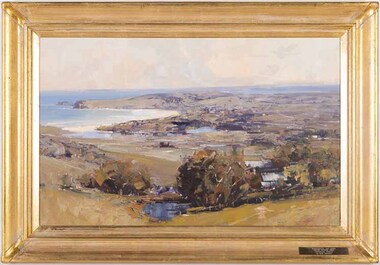 Wangaratta Art Gallery
Painting, Ken Knight, Coastal Vista, c. 1992
... Knight’s art style is heavily influenced by the Australian Impressionist movement of the late 19th century and he paints his work in outdoor settings, which is known as plein-air painting. ...Knight’s art style is heavily influenced by the Australian Impressionist movement of the late 19th century and he paints his work in outdoor settings, which is known as plein-air painting. wangaratta art gallery ken knight landscape painting costal plein-air plein air Obverse: KEN KNIGHT/ (bottom right corner) WANGARATTA ART SHOW/ GRAND WINNER 1992/ 'COASTAL VISTA'/ By KEN KNIGHT/ (plaque mounted on frame) An aerial landscape of a costal view painted in oil using a tonal colour palette of browns, blues, greens, oranges, and whites. ...Knight’s art style is heavily influenced by the Australian Impressionist movement of the late 19th century and he paints his work in outdoor settings, which is known as plein-air painting. Rural City of Wangaratta Collection, Wangaratta Art Prize Grand Winner 1992.An aerial landscape of a costal view painted in oil using a tonal colour palette of browns, blues, greens, oranges, and whites.Obverse: KEN KNIGHT/ (bottom right corner) WANGARATTA ART SHOW/ GRAND WINNER 1992/ 'COASTAL VISTA'/ By KEN KNIGHT/ (plaque mounted on frame)wangaratta art gallery, ken knight, landscape, painting, costal, plein-air, plein air -
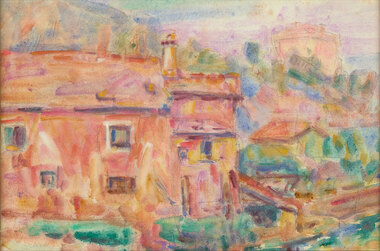 Benalla Art Gallery
Watercolour, John RUSSELL, Morning light, Liguria, 1920
... ... Impressionist...Impressionism Watercolour Buildings Chimney Impressionist Recto: Not signed, not dated, not titled Expressive brightly coloured brushstrokes of rural farm houses and trees. ...Born: Darlinghurst, New South Wales, Australia 1858; Lived and worked: England, Spain, France, Italy, New Zealand 1881-1923; Died: Randwick, New South Wales, Australia 1930ImpressionismLedger Gift, 1985Expressive brightly coloured brushstrokes of rural farm houses and trees. Gold brushed timber frame.Recto: Not signed, not dated, not titledwatercolour, buildings, chimney, impressionist -
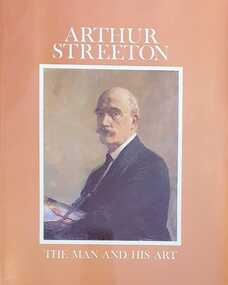 Greensborough Historical Society
Book, Okko Boer et al, Arthur Streeton: the man and his art, 1981
... Streeton was an Australian Impressionist painter and this book is full of his better known works with each chapter dealing with a differnt location....Streeton was an Australian Impressionist painter and this book is full of his better known works with each chapter dealing with a differnt location. ...An outline of the work of Australian artist Arthur Streeton from his earliest work to his death. Streeton was an Australian Impressionist painter and this book is full of his better known works with each chapter dealing with a differnt location.A member of the Heidelberg School of painting.52 pages, colour plates and text.arthur streeton, painters, australian impressionists, heidelberg school of painting -
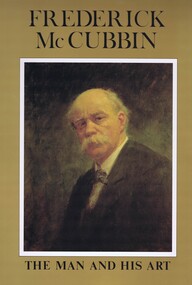 Greensborough Historical Society
Book, Okko Boer et al, Frederick McCubbin: the man and his art, 1981
... McCubbin was an Australian Impressionist painter and this book is full of his better known works with each chapter dealing with a different location....McCubbin was an Australian Impressionist painter and this book is full of his better known works with each chapter dealing with a different location. ...An outline of the work of Australian artist Frederick McCubbin from his earliest work to his death. McCubbin was an Australian Impressionist painter and this book is full of his better known works with each chapter dealing with a different location.A member of the Heidelberg School of painting.52 pages, colour plates and text.painters, australian impressionists, heidelberg school of painting, frederick mccubbin -
 Bendigo Historical Society Inc.
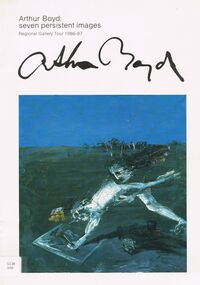
Booklet - ARTHUR BOYD: "seven persistent images"
... He painted in the impressionist and expressionist styles. Known for his Australian landscapes, often featuring social and moral themes. ...He painted in the impressionist and expressionist styles. Known for his Australian landscapes, often featuring social and moral themes. ...Arthur Boyd (1920-1999) was a member of the Antipodean School of Artists. He painted in the impressionist and expressionist styles. Known for his Australian landscapes, often featuring social and moral themes. He also produced pottery and sculptures.A catalogue titled ' Arthur Boyd: seven persistent images. Regional Gallery Tour 1986-87. Published by the Australian National Gallery 1985. 16 pgs. Ill.person, individual, arthur boyd, aurthur boyd, person, individual, male, artwork, australian art, artist, australian national gallery, exhibition, regional gallery tour, arthur boyd gift, paintings, drawings, landscapes, painter, painting -
 Benalla Art Gallery
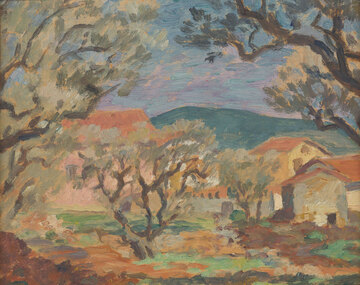
Painting, Rupert BUNNY, (Landscape, France), Not dated
... ... Impressionist...Impressionism Painting Landscape Buildings Tree Impressionist Hills Recto: Not signed, not dated, not titled Oil painting on board depicting rural landscape with trees and farmhouses. ...Born: St Kilda, Victoria, Australia 1864; Lived and worked: England and France 1884 - 1933; Died: Melbourne, Victoria, Australia 1947ImpressionismGift of Mr Alan Harris in memory of his wife Lynette Harris (née Burnell), 2004Oil painting on board depicting rural landscape with trees and farmhouses. Gold brushed timber frame with decorative gesso corners.Recto: Not signed, not dated, not titled painting, landscape, buildings, tree, impressionist, hills -
 Brimbank City Council Art Collection
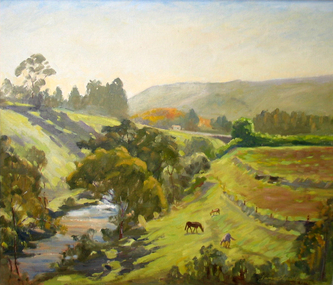
Painting, Maribyrnong River from Horseshoe Bend Road, Keilor, 1977
... ...impressionist...Local Scene keilor maribyrnong river painting impressionist landscape Information about the artist on the back. ...Local SceneImpressionistic view of valley with a creek running through it. Three horses in the foreground - AR0064Information about the artist on the back. "James Farrell is a member of the Victorian Artists Society" and "is represented at the Australian War Memorial, Canberra".keilor, maribyrnong, river, painting, impressionist, landscape -
 Eltham District Historical Society Inc
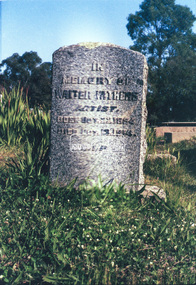
Negative - Photograph, Grave of Walter Withers at St Helena Cemetery
... In Memory of Walter Withers Artist Born October, 22, 1884 Died October, 13, 1914 Walter Herbert Withers (22 October 1854 — 13 October 1914) was an Australian landscape artist and a member of the Heidelberg School of Australian impressionists. He lived the later stages of his life in Eltham and died there....In Memory of Walter Withers Artist Born October, 22, 1884 Died October, 13, 1914 Walter Herbert Withers (22 October 1854 — 13 October 1914) was an Australian landscape artist and a member of the Heidelberg School of Australian impressionists. He lived the later stages of his life in Eltham and died there. st helena st katherine's church walter withers artist Cemeteries st katherines Kodak CP 100 5094 Roll of 35mm colour negative film, 2 strips Grave of Walter Withers at St Helena Cemetery Negative Photograph ...Grave of Walter Withers at St Katherine's Churchyard, St. Helena, Victoria. In Memory of Walter Withers Artist Born October, 22, 1884 Died October, 13, 1914 Walter Herbert Withers (22 October 1854 — 13 October 1914) was an Australian landscape artist and a member of the Heidelberg School of Australian impressionists. He lived the later stages of his life in Eltham and died there.Roll of 35mm colour negative film, 2 stripsKodak CP 100 5094st helena, st katherine's church, walter withers, artist, cemeteries, st katherines -
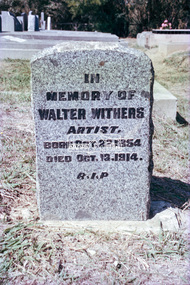 Eltham District Historical Society Inc
Negative - Photograph, Grave of Walter Withers at St Helena Cemetery, c.1989
... In Memory of Walter Withers Artist Born October, 22, 1884 Died October, 13, 1914 Walter Herbert Withers (22 October 1854 — 13 October 1914) was an Australian landscape artist and a member of the Heidelberg School of Australian impressionists. He lived the later stages of his life in Eltham and died there....In Memory of Walter Withers Artist Born October, 22, 1884 Died October, 13, 1914 Walter Herbert Withers (22 October 1854 — 13 October 1914) was an Australian landscape artist and a member of the Heidelberg School of Australian impressionists. He lived the later stages of his life in Eltham and died there. walter withers artist Cemeteries St Helena st katherines St katherine's Church Fuji HR100 Roll of 35mm colour negative film, 4 of 7 strips Grave of Walter Withers at St Helena Cemetery Negative Photograph ...Grave of Walter Withers at St Katherine's Churchyard, St. Helena, Victoria. In Memory of Walter Withers Artist Born October, 22, 1884 Died October, 13, 1914 Walter Herbert Withers (22 October 1854 — 13 October 1914) was an Australian landscape artist and a member of the Heidelberg School of Australian impressionists. He lived the later stages of his life in Eltham and died there.Roll of 35mm colour negative film, 4 of 7 stripsFuji HR100walter withers, artist, cemeteries, st helena, st katherines, st katherine's church -
 Benalla Art Gallery
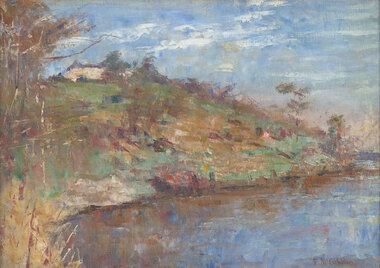
Painting, Frederick MCCUBBIN, The artist's home, South Yarra, Not dated
... ... Impressionist...Heidelberg School Painting Waterscape Hills House Landscape Water Impressionist Recto: Signed "F. McCubbin" in brown oil in l.r.c of composition; Not dated; Not titled House on top of hill in rural landscape with sloping hill to a pond and trees and grasses in foreground. ...Born: Melbourne, Victoria, Australia 1855; Died: Melbourne, Victoria, Australia 1917Heidelberg SchoolLedger Gift, 1987House on top of hill in rural landscape with sloping hill to a pond and trees and grasses in foreground. Copper brushed timber frame.Recto: Signed "F. McCubbin" in brown oil in l.r.c of composition; Not dated; Not titledpainting, waterscape, hills, house, landscape, water, impressionist -
 Benalla Art Gallery
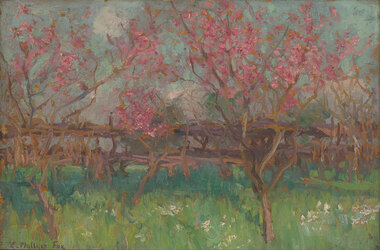
Painting, E. Phillips FOX, Spring blossoms, Not dated
... ... Impressionist...Impressionism Paiting Landscape Garden Trees Cherry blossom Fence Impressionist Recto: Signed "E. Phillips Fox" in purple oil in l.l.c of composition; Not dated; Not titled Oil on wood panel depicting pink spring blossoms in a field. ...Born: Fitzroy, Victoria, Australia 1865; Lived and worked: France and England 1887-1892, France 1901-1913; Died: Melbourne, Victoria, Australia 1915ImpressionismMajor Basil MacNay Bequest, Gift of Arts Victoria, 1998Oil on wood panel depicting pink spring blossoms in a field. Carved gold brushed timber frameRecto: Signed "E. Phillips Fox" in purple oil in l.l.c of composition; Not dated; Not titledpaiting, landscape, garden, trees, cherry blossom, fence, impressionist -
 Benalla Art Gallery
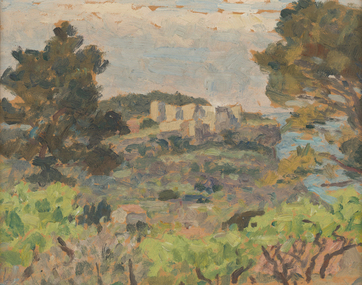
Painting, Rupert BUNNY, (Coastal landscape), Not dated
... ... Impressionist...Impressionism Painting Landscape Sea Trees Impressionist Buildings Cliff Recto: Not signed, not dated, not titled Oil painting depicting coastal landscape with buildings and cliffs in background. ...Born: St Kilda, Victoria, Australia 1864; Lived and worked: England and France 1884 - 1933; Died: Melbourne, Victoria, Australia 1947ImpressionismGift of Mr Alan Harris in memory of his wife Lynette Harris (née Burnell), 2004Oil painting depicting coastal landscape with buildings and cliffs in background. Gold brushed timber frame with decorative gesso cornersRecto: Not signed, not dated, not titled painting, landscape, sea, trees, impressionist, buildings, cliff -
 Wangaratta Art Gallery
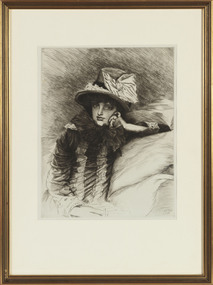
Print, James Jacques Joseph Tissot, Berthe, 1883
... Tissot’s art style of Realism also put him at odds with his fellow artists and friends such as Degas and Manet who were greats of the European Impressionist movement. This print was made using the printmaking technique of etching, which allowed Tissot to make multiply prints of a particular artwork to sell on mass at a more affordable price to the general population who wished to emulate the bourgeoisie lifestyle of the wealthy....Tissot’s art style of Realism also put him at odds with his fellow artists and friends such as Degas and Manet who were greats of the European Impressionist movement. This print was made using the printmaking technique of etching, which allowed Tissot to make multiply prints of a particular artwork to sell on mass at a more affordable price to the general population who wished to emulate the bourgeoisie lifestyle of the wealthy. james tissot 19th century print etching portrait tissot wangaratta art gallery Obverse: J J Tissot/ 1883 (Artist's signature and date - located in the bottom right corner of the print) A rectangular portrait etching of a 19th century European young lady dressed in her best attire seated in a fashionable manner, printed in black ink on white paper. ...James Tissot is most famous for his artwork that depicts the European bourgeois society of the late 19th century. This societal period is often referred to as La Belle Époque, where affluent bourgeoisie living created a complicated mode of manners and dress. This subject matter used in his art made Tissot popular with the bourgeois society, however it made him unpopular with critics who deemed his works as of loose morals due to his subject matter. Tissot’s art style of Realism also put him at odds with his fellow artists and friends such as Degas and Manet who were greats of the European Impressionist movement. This print was made using the printmaking technique of etching, which allowed Tissot to make multiply prints of a particular artwork to sell on mass at a more affordable price to the general population who wished to emulate the bourgeoisie lifestyle of the wealthy.RealismRural City of Wangaratta Collection, Purchased with funds from the Wangaratta Art CouncilA rectangular portrait etching of a 19th century European young lady dressed in her best attire seated in a fashionable manner, printed in black ink on white paper. Obverse: J J Tissot/ 1883 (Artist's signature and date - located in the bottom right corner of the print)james tissot, 19th century, print, etching, portrait, tissot, wangaratta art gallery -
 Nillumbik Shire Council
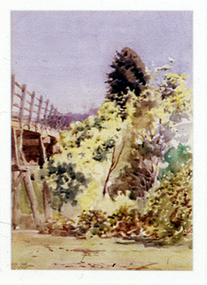
Painting: Walter WITHERS (b.1854 Warwickshire, UK — d.1914 Eltham, Aus), Trestle Bridge, Eltham, c.1903-10
... Walter Withers was a significant Australian landscape artist and a member of the Heidelberg School of Australian Impressionists. In 1903 Withers bought 'Southernwood', a house on 2½ acres (1 ha) at Eltham, to which he added a studio. ...Walter Withers was a significant Australian landscape artist and a member of the Heidelberg School of Australian Impressionists. In 1903 Withers bought 'Southernwood', a house on 2½ acres (1 ha) at Eltham, to which he added a studio. ...Walter Withers was a significant Australian landscape artist and a member of the Heidelberg School of Australian Impressionists. In 1903 Withers bought 'Southernwood', a house on 2½ acres (1 ha) at Eltham, to which he added a studio. Because of ill health, he lived during the week at his studio in Oxford Chambers, Melbourne, and on weekends and holidays with his family at Eltham until his death in 1914. The Eltham rail bridge is a unique and valuable historic relic of an earlier steam locomotive transport era in the Diamond Creek Valley and has long formed an important part of a magnificent Eltham landscape. When built in 1902 it was close to the terminus point of the Heidelberg-Eltham rail extension, on the route of the proposed Diamond Valley Railway that was then planned to continue much further up the valley towards Kinglake. This bridge is situated in attractive river-valley parkland amidst the tall and spreading manna gums and candlebarks of the Diamond Creek Valley. The Alistair Knox Park river-valley landscape, of which the timber trestle bridge is an important visual component, has been classified by the National Trust. Large manna gum and candlebark trees adorn the adjacent creek banks, and historic Shillinglaw Cottage is also part of this much-prized Eltham landscape. Eltham is home to a historic wooden railway trestle bridge. Mainly of timber-pier and timber-beam construction, but varied by a few longer steel-joists spans on timber piers at the main stream channel, this substantial bridge has almost two hundred metres of timber deck. Built in 1902, it is the only railway bridge of predominantly timber construction that is still in regular use as an integral part of Melbourne's metropolitan electric railway network and one of extremely few timber rail bridges in the State that still carry trains. Apart from its important continuing social function as a carrier of rail transport for the Hurstbridge line, this impressive bridge and its beautiful parkland environs contribute much to the character of Eltham township and that town's special reputation as an historic centre of environmental and conservation concerns. This section of the Diamond Creek Valley was the subject of a Walter Withers painting in the earliest years of the twentieth century and has strong historic links with our Heidelberg School of painters. Watercolour painting on paper of Eltham's Trestle Bridge in the middle of the day. A small section of the wooden bridge is located to the left of the painting. The focus is predominately on the wattle, manna gum and candlebark trees that is to the right of the bridge. The golden hues typically represent the australian sunlight and landscape. "W.W" in gothic script on the lower right side of the painting. Not dated. withers, eltham, trestle bridge, railway, watercolour -
 Federation University Art Collection
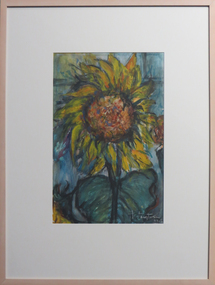
Painting, Isabel Huntington, 'Sunflower' by Isabel Huntington, c1956
... The critics of the day described Isobel Huntington's work as Post Impressionist and Expressionist. 'Her enjoyment of the use of colour and her sense of vitality is obvious in her most original conception of the relationship of art to flowers.' ...The critics of the day described Isobel Huntington's work as Post Impressionist and Expressionist. 'Her enjoyment of the use of colour and her sense of vitality is obvious in her most original conception of the relationship of art to flowers.' ...Isabel HUNTINGTON (1905 - 04 December 1971) Isabel McCausland was educated at Ballarat and married Robert Keith Huntington in 1931, and which time Isabel was living in the Melbourne suburb of Preston. Isabel Huntington was a painter, craft officer and craft worker. She studied at Ballarat High School, Ballarat Technical Art School (a division of the School of Mines) and RMIT, and was a member of the Victorian Artists' Society and the Contemporary Art Society. In 1945 she was appointed Director of Handcrafts for the Victorian Division of the Red Cross Society. Isabel Huntington had previously held the position of Supervisor of Handcrafts at Heidelberg Military Hospital for three and a half years. She was a member or the Arts and Crafts Society. Isabel Huntington had five 'one-man" shows, three in Melbourne, one in Ballarat and one in Hamilton, Victoria. The critics of the day described Isobel Huntington's work as Post Impressionist and Expressionist. 'Her enjoyment of the use of colour and her sense of vitality is obvious in her most original conception of the relationship of art to flowers.' Ursula Hoff judged the 1965 Albury awards for watercolour, and religious paintings in oils, awarding the prize to Isabel Huntington. In the same year Isabel Huntington travelled to Europe. In Ballarat's Crouch Prize Isabel Huntington was commended three times. After returning from overseas she taught at Rosanna High School, Victoria. Isabel Huntington lived at Montmorency, Victoria, and was there at the time of her death. Her studio was located at 10 Nokes Court, Montmorency, 3094. This item is part of the Federation University Art Collection. The Art Collection features over 2000 works and was listed as a 'Ballarat Treasure' in 2007 in 1971.Framed painting of a sunflower. The signature at the lower right has been oversigned in white 'Huntington 1962". A note on the back of the work suggests it was more like to have been created in 1956, and it was first purchased between 1956 and 1958. If you can share information on this artist or artwork please use the email link below.A note on the back says "Sunflower 1962 Oil/Pastel Insurance Isobel Huntington Gouache 1956 Black Box. Huntingdon (sic) Isobel. Acquired between 1956 - 1958"art, artwork, gouache, painting, sunflower, isabel huntington, handcraft, arts and crafts society, crouch prize, ursula hoff, alumni, flora, ballarat teachers' college art collection, isobel huntington, isabel mccausland -
Surrey Hills Historical Society Collection
Work on paper - Vertical File, Edward Alexander Vidler
... In 1927 ‘Songs of the bush for children’ by Isobel Langlands, with music. (1 page). 7. ‘Impressionist exhibition gets scathing review’ by Keith Dunstan, The Age, 18.8.1988 (1 page). 8. ...In 1927 ‘Songs of the bush for children’ by Isobel Langlands, with music. (1 page). 7. ‘Impressionist exhibition gets scathing review’ by Keith Dunstan, The Age, 18.8.1988 (1 page). 8. ...Edward Alexander VIDLER 1. E.A. Vidler (1863-1942) by Lurline Stuart, Australian Dictionary of Biography, Volume 12, 1990, MUP (2 copies) (1 page + 2 pages). 2. As per No. 1 with notes by Jocelyn Hall c. 1980s (1 page). 3. Edward Vidler, ‘man of contradictions’, written for Warrnambool Historical Society 1983 by Bruce Morris (10 x A3 pages). 4. A.E. Vidler (sic). Notes from New Bohemia, 1.12.1957 (1 x A3 page). 5. E.A. Vidler, bookman and naturalist, Victorian Naturalist, 3.3.1943 (1 page). 6. Edward Alexander Vidler 1863-1942, notes by John . . . . . . . . . In 1927 ‘Songs of the bush for children’ by Isobel Langlands, with music. (1 page). 7. ‘Impressionist exhibition gets scathing review’ by Keith Dunstan, The Age, 18.8.1988 (1 page). 8. Mr. Edward A. Vidler notes by Alan Holt (undated) (1 page). 9. Notes on E.A. Vidler’s publications (no source, undated) (1 page). 10. ‘Our own trees’, E.A. Vidler, published by W.A. Hamer, North Melbourne, 1930 (1 page). 11. The Australian Institute of the Arts and Literature List of Executive Council, E.A. Vidler General Secretary (undated) (1 A3 page). 12. Spencer Scott Sandilands sale catalogue including A.E. Vidler paintings (undated) (1 A3 page). 13. Mr. Edward A. Vidler photocopy of photo from Table Talk, March, 1990 (1 page). 14. ‘A piece of Balwyn history destroyed’, (re ‘Mafeking’, Banool Road) Progress Press, 26.4.1994 (1 page). edward alexander vidler -
 Eltham District Historical Society Inc
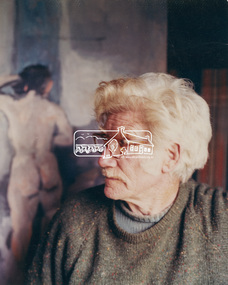
Photograph, Mark Strizic, William (Jock) Frater, Artist, c.1971
... His contribution to art in Australia was, however, as a painter who introduced Post-Impressionist principles and challenged the notion that art was an imitation of nature. ...His contribution to art in Australia was, however, as a painter who introduced Post-Impressionist principles and challenged the notion that art was an imitation of nature. ...William (Jock) Frater (1890-1974) was an an artist and stained-glass designer who had some associations with Eltham. Frater was born in 1890 in Linlithglow Scotland. In 1910 he arrived in Melbourne. With a passion for painting, he hadn’t been in Melbourne very long before he met Percy Leason and Richard McGann, who were both working as lithographers with Sands and McDougall who produced Melbourne Directories. Jock Frater asked them where, near Melbourne, he should go to paint, and they both replied ‘Eltham’. Frater and Percy Leason became firm friends; and with others they spent their weekends painting, at Eltham and other places. Many times, during those weekends Frater and Leason would camp the night near Bible and Pitt streets. Another favourite spot for their weekend sketching was along the Diamond Creek where Judge Book Memorial Village was later built. In 1916 Jock Frater married his wife Winifred Dow, a tailoress. They bought a house and small property on the corner of Arthur and Bible streets. They lived in Eltham for about a year, then moved to Alphington. Jock also became a stained-glass designer. The west window of Wesley Church, Lonsdale Street, Melbourne, he regarded as his most significant design. His contribution to art in Australia was, however, as a painter who introduced Post-Impressionist principles and challenged the notion that art was an imitation of nature. He visited Central Australia in 1950 and Port Douglas, North Queensland, in 1952. His later major exhibitions were at the Australian Galleries, Melbourne, in 1958, the Victorian Artists’ Society in 1963, and a retrospective at the National Gallery of Victoria in 1966. Frater was a revered president of the Victorian Artists’ Society from 1963 until 1972, exhibiting annually with the society during the last decade of his career and filling three galleries at his final exhibition in July 1973. In 1974 Frater was appointed O.B.E. for his services to art. His work is represented in galleries and private collections throughout Australia as well as the Glasgow Art Gallery. He died at his home at Alphington on 28 November 1974 and was buried in Arthurs Creek cemetery. He was survived by four sons and a daughter. Reproduced Page 113 of "Pioneers and Painters: 100 years of the Shire of Eltham by Alan Marshall, 1971. This photo forms part of a collection of photographs gathered by the Shire of Eltham for their centenary project book,"Pioneers and Painters: 100 years of the Shire of Eltham" by Alan Marshall (1971). The collection of over 500 images is held in partnership between Eltham District Historical Society and Yarra Plenty Regional Library (Eltham Library) and is now formally known as the 'The Shire of Eltham Pioneers Photograph Collection.' It is significant in being the first community sourced collection representing the places and people of the Shire's first one hundred years.Digital image of colour print 12 x 9.5 cm. Also black and white printeltham local characters, sepp, shire of eltham pioneers photograph collection, "pioneers and painters", william frater, jock frater, artist, stained glass designer, immigrant, o.b.e. -
 City of Melbourne Libraries
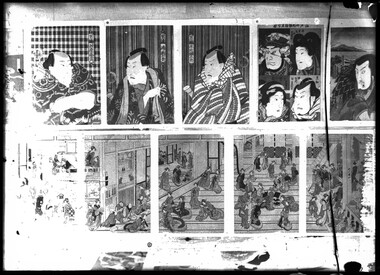
Photograph, Bull, Hugh Jones, 1897-1993, Japanese woodblock prints
... 'Wikipedia: Ukiyo-e' states: “Japanese art, and particularly ukiyo-e prints, came to influence Western art from the time of the early Impressionists. Early painter-collectors incorporated Japanese themes and compositional techniques into their works as early as the 1860s: the patterned wallpapers and rugs in Manet's paintings were inspired by the patterned kimono found in ukiyo-e pictures, and Whistler focused his attention on ephemeral elements of nature as in ukiyo-e landscapes. ...'Wikipedia: Ukiyo-e' states: “Japanese art, and particularly ukiyo-e prints, came to influence Western art from the time of the early Impressionists. Early painter-collectors incorporated Japanese themes and compositional techniques into their works as early as the 1860s: the patterned wallpapers and rugs in Manet's paintings were inspired by the patterned kimono found in ukiyo-e pictures, and Whistler focused his attention on ephemeral elements of nature as in ukiyo-e landscapes. ...A DECK GALLERY FOR JAPANESE PRINTS. A unique exhibition of Japanese Prints was opened yesterday on Japanese ship Kamo Maru.These pictures are the property of the captain of the Kamo Maru Captain T. Takahata, and are displayed in a specially arranged gallery on the deck of the ship now berthed at No. 13 Victoria Dock. A picture on board yesterday after noon. (Inset) - One of many fine works by Utaguard Toyokuni who died in 1825. Photographer notations on slide: "B21" Published: 23 February 1934 Published title: A DECK GALLERY FOR JAPANESE PRINTS. Published caption: A unique exhibition of Japanese Prints was opened yesterday on Japanese ship Kamo Maru.These pictures are the property of the captain of the Kamo Maru Captain T. Takahata, and are displayed in a specially arranged gallery on the deck of the ship now berthed at No. 13 Victoria Dock. A picture on board yesterday after noon. (Inset) - One of many fine works by Utaguard Toyokuni who died in 1825. Trove article identifier: http://nla.gov.au/nla.news-article203376863 Description: Japanese woodblock prints, probably belonging to Captain Takahata of the Japanese passenger and cargo ship Kamo Maru, who displayed his Japanese Woodblock prints in a special on-board gallery when it visited Melbourne during 1933 and 1934. Research by project volunteer, Louise McKenzie: Plate MCK025 shows a number of Japanese woodblock prints. Three are of traditional “samurai” or Kabuki-style Japanese men in traditional dress and hairstyle; one is a composite of four different prints: two men and two women (samurai/geisha) in traditional dress. There are also several prints appearing to depict traditional scenes of indoor and outdoor life in Japan in the Edo period. An article appeared in The Age in February 1934, covering the visit to Melbourne of Captain T Takahata on the Japanese ship the Kamo Maru. An accompanying photo shows several women, in coats and hats, and a man, closely inspecting a gallery hang of Japanese woodblocks. Inset is a single image of a Kabuki theatre performer, a detail from the full photograph as shown in our slide. This work is attributed to Utagawa Toyokuni (1769-1823), who was mostly known for his prints relating to kabuki theatre and the actors’ dramatic postures. Japanese Kabuki theatre features heavily stylised performances, glamorous, highly decorated costumes and elaborate make-up worn by its performers. It was particularly popular in the Edo period (1615-1868), as was woodblock printing, after its earlier introduction from China around 150 years earlier. Woodblock printing in Japan is a technique best known for its use in the ukiyo-e artistic genre of single sheet images (although books were also created) which flourished from the 17th through 19th centuries. Its artists produced woodblock prints and paintings of such subjects as female beauties; kabuki actors and sumo wrestlers; scenes from history and folk tales; travel scenes and landscapes; flora and fauna, and erotica. The term ukiyo-e translates as 'picture[s] of the floating world'. This expression could be confusingly translated as meaning ‘a world of sorrow and grief’, 'erotic’ or ‘stylish’, and later came to describe the hedonistic spirit of the lower classes of the 17th century. Asai Ryōi celebrated this spirit in the novel Ukiyo Monogatari (Tales of the Floating World), c. 1661: “[L]iving only for the moment, savouring the moon, the snow, the cherry blossoms, and the maple leaves, singing songs, drinking sake, and diverting oneself just in floating, unconcerned by the prospect of imminent poverty, buoyant and carefree, like a gourd carried along with the river current: this is what we call ukiyo.” (Wikipedia: 'Ukiyo-e') Mass production of woodblocks during the Edo period was due to high literacy rates: 100% for samurai and 50-60% for farmers. Consequently, cheaper books were produced in large numbers. In the 18th century, Suzuki Harunobu established the technique of multicolor woodblock printing called nishiki-e and greatly developed Japanese woodblock printing culture such as ukiyo-e. Ukiyo-e influenced European Japonisme and Impressionism. Yoshitoshi was called the last great ukiyo-e master, and his cruel depictions and fantastic expressions influenced later Japanese literature and anime. However today the best known exponents from the period are probably Hokusai and Hiroshige.The price of one ukiyo-e at that time was about 20 mon, and the price of a bowl of soba noodles was 16 mon, so the price of one ukiyo-e was several hundred yen to 1000 yen in today's currency. 'Wikipedia: Ukiyo-e' states: “Japanese art, and particularly ukiyo-e prints, came to influence Western art from the time of the early Impressionists. Early painter-collectors incorporated Japanese themes and compositional techniques into their works as early as the 1860s: the patterned wallpapers and rugs in Manet's paintings were inspired by the patterned kimono found in ukiyo-e pictures, and Whistler focused his attention on ephemeral elements of nature as in ukiyo-e landscapes. Van Gogh was an avid collector, and painted copies in oil of prints by Hiroshige and Eisen. Degas and Cassatt depicted fleeting, everyday moments in Japanese-influenced compositions and perspectives. ukiyo-e's flat perspective and unmodulated colours were a particular influence on graphic designers and poster makers. Toulouse-Lautrec's lithographs displayed his interest not only in ukiyo-e's flat colours and outlined forms, but also in their subject matter: performers and prostitutes. He signed much of this work with his initials in a circle, imitating the seals on Japanese prints. Other artists of the time who drew influence from ukiyo-e include Monet, La Farge, Gauguin, and Les Nabis members such as Bonnard and Vuillard. French composer Claude Debussy drew inspiration for his music from the prints of Hokusai and Hiroshige, most prominently in La mer (1905). Imagist poets such as Amy Lowell and Ezra Pound found inspiration in ukiyo-e prints; Lowell published a book of poetry called Pictures of the Floating World (1919) on oriental themes or in an oriental style.” An awareness of and interest in this style of art seems to have been well established by the time Captain Takahata brought his sailing gallery to Australia in the 1930s. The Age article “Colour Prints from Japan” on 22 February 1934 p. 13, consists predominantly of a sophisticated curatorial assessment of the woodblock style and detailed artist and style information, which is remarkable for its in-depth analysis. The writer even draws attention to the existence of female woodprint artists. It has been difficult to verify those noted in this article, but worth drawing attention to the work produced by the daughter of Hokusai, Katsushika Oi, which is documented and has gained attention within Japan and elsewhere. Captain Takahata may have been quite the ambassador: adverts in Australian quarterly magazine, The Home, promoted regular cruises out of Melbourne and Sydney via Queensland, Thursday Island, Phillippines and Hong Kong to Japan at a cost of £90 for a round trip via Yokohama.(The Home, 1 August 1936, pages 76 and 79). It is reported in one of the many newspapers articles printed during 1933/1934 about Captain Takahata and his collection, that he inherited it, and it was not for sale even at an offered £10,000. However, one article makes mention of him scouring antique shops in rural Japan to add to the collection! And even enlisting the help of his children in the hunt. The collection totalled 11,000 prints and apparently 1,500 travelled with him when he sailed. These numbers do differ between reports, but his collection was undoubtedly large, and Captain Takahata enjoyed lecturing on the subject, explaining that each print was handmade. It took painstaking work over months to create the delicate colour tones, with a block being created for each colour used, and transferred onto specially prepared paper. Many of the designs are symbolic, and even those representing figures and scenes have a narrative basis, or represent traditional incidents in the life and history of Japan. (See Japanese Prints, The Sydney Morning Herald, 14 July 1934). In Brisbane in October 1934, The Courier Mail noted that Captain Takahata, now on the Yusen Kaisha steamer ‘Atsuta Mam’ (a sister ship to Kamo Maru) arrived with another 100 prints in his possession, and that he spent his spare time mounting and cataloguing his treasures. One of his new additions dated from 1787 and Captain Takahata “said that it was the only woodcut to depict eyelashes, and with the aid of a magnifying glass, he showed the extremely fine lines around the eyes of the three Japanese ladies on the print.” References: COLOR PRINTS FROM JAPAN. (1934, February 22). The Age (Melbourne, Vic. : 1854 - 1954), p. 13. Retrieved February 29, 2024, from http://nla.gov.au/nla.news-article20338088 A DECK GALLERY FOR JAPANESE PRINTS. (1934, February 23). The Age (Melbourne, Vic. : 1854 - 1954), p. 11. Retrieved February 29, 2024, from http://nla.gov.au/nla.news-article203376863 JAPANESE WOOD-CUTS. (1934, July 14). Daily Commercial News and Shipping List (Sydney, NSW : 1891 - 1954), p. 4. Retrieved February 29, 2024, from http://nla.gov.au/nla.news-article161150580 JAPANESE PRINTS. (1934, July 14). The Sydney Morning Herald (NSW : 1842 - 1954), p. 12. Retrieved February 29, 2024, from http://nla.gov.au/nla.news-article28024038 RARE WOOD-PRINTS FROM JAPAN (1934, July 16). The Herald (Melbourne, Vic. : 1861 - 1954), p. 20. Retrieved March 2, 2024, from http://nla.gov.au/nla.news-article243171208 JAPANESE WOODPRINTS. (1934, July 14). The Sydney Morning Herald (NSW : 1842 - 1954), p. 16. Retrieved March 2, 2024, from http://nla.gov.au/nla.news-article28023902 11,000 RARE WOODCUTS (1934, October 11). The Courier-Mail (Brisbane, Qld. : 1933 - 1954), p. 18. Retrieved March 2, 2024, from http://nla.gov.au/nla.news-article35647690 A DECK GALLERY FOR JAPANESE PRINTS. (1934, February 23). The Age (Melbourne, Vic. : 1854 - 1954), p. 11. Retrieved March 2, 2024, from http://nla.gov.au/nla.news-article203376863 RARE JAPANESE PRINTS (1934, July 11). The Courier-Mail (Brisbane, Qld. : 1933 - 1954), p. 10. Retrieved March 2, 2024, from http://nla.gov.au/nla.news-article36723139 Wikipedia: 'Ukiyo-e', https://en.wikipedia.org/wiki/Ukiyo-e Wikipedia: 'Woodblock printing in Japan', https://en.wikipedia.org/wiki/Woodblock_printing_in_Japan Wikipedia: 'Utagawa Toyokuni', https://en.wikipedia.org/wiki/Utagawa_Toyokuni Wikipedia: 'Kabuki', https://en.wikipedia.org/wiki/Kabuki 'Digital Humanities and Japanese History',https://dh.japanese-history.org/2020-spring-women-in-japanese-history/japanese-women-artists-of-the-edo-period/ '25 Famous Painters in Japanese Art', https://dh.japanese-history.org/2020-spring-women-in-japanese-history/japanese-women-artists-of-the-edo-period/ 'Nyk Kamo Maru', https://blog.shipwatcher.com/index.php/nyk-kamo-maru/ The Home : an Australian quarterly Retrieved March 4, 2024, from http://nla.gov.au/nla.obj-386036987 : Volume 17, No. 8, 1 August 1936.Photographer notations on slide: "B21".japan, prints, ships, art -
 City of Melbourne Libraries
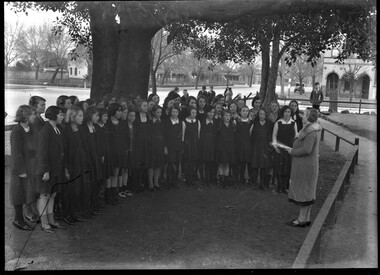
Photograph (item), Bull, Hugh Jones, 1897-1993, Miss Ida Park conducts the North Fitzroy State School Choir
... -Internationally recognised female impersonator, Sydneysider Tracey Lee, (Maxwell Richie) billed as "controversial impressionist and singing personality from the famous Carousel Nightspot in Paris". ...-Internationally recognised female impersonator, Sydneysider Tracey Lee, (Maxwell Richie) billed as "controversial impressionist and singing personality from the famous Carousel Nightspot in Paris". ...The pupils of Falconer Street Central School No.3918 in North Fitzroy rehearse with conductress Miss Ida Park for their performance at the Temperance Hall, Russell Street Melbourne with proceeds going to the Lord Mayor’s Fund. The house on the right of the photograph is Jubilee House, 126 Michael Street North Fitzroy and is extant. Photographer notations on slide: Choir At Fitzroy State School 1933 B5 While this photograph appears not to have been published, a photograph taken from a different angle of the same event was published in The Age 21 July 1933. SCHOOL CHILDREN SING IN THE OPEN AIR. “A choir of children at North Fitzroy practise their songs for a Pantomime, to be given in the Temperance Hall for the Lord Mayor's Fund on Wednesday next. On the extreme left is the conductress of the Choir (Miss Ida Park).” Reference: http://nla.gov.au/nla.news-article204368572 Research by project volunteer, Fiona Collyer: Children of The Falconer Street Central School Choral Society, trained by conductress Miss Ida Park, along with dance and gymnastics pupils of Misses Dorothy Gibb and Inez Ellis, performed in the “Cinderella” pantomime at the Temperance Hall in Russell Street, Melbourne on 26 July, 1933. The proceeds went to the Lord Mayor’s Fund. Conductress Miss Ida Park (1904- 1952) lived in the North Fitzroy and Clifton Hill area all her life. She was immersed in the music world of Melbourne and was a member of the Musical Society of Victoria. Ida graduated from Melbourne University Conservatorium with a Bachelor of Music degree in 1929 before departing for London where she studied piano and organ at the Royal Academy of Music. Ida returned to Melbourne in 1931, and billed as “The Gifted Young Australian Pianist”, held pianoforte recitals of classical music at Assembly Hall, Collins Street. She also played the organ for services at St Paul’s Independent Church in Delbridge Street, North Fitzroy and later St Luke’s, North Fitzroy. Ida conducted the children of the Falconer Street Central School Choral Society as they competed in the State School Choral Championships and the 85 children of the Fitzroy City Centenary Choir who sang at Melbourne’s Centenary celebrations of 1934/35. In 1945, Ida married Charles Hazeldine, a tenor and returned digger who had served in two world wars. The pair performed together in many concerts over the years. Tragically, both Ida and Charles were badly injured when struck by a car while crossing Queens Parade Clifton Hill in June 1952, with Ida dying from head injuries at St Vincent’s Hospital soon after. She was 48 years old. Charles wrote on Ida’s death notice - “Called home.” The choir were pupils of Falconer Street Central School No. 3918 in North Fitzroy which was built in 1915 to provide upper primary education for grades 5 to 8 for the area. In 1957 it became Fitzroy High School. In 1992, the Kennett Government swept to power, embarking on a program of fiscal austerity and privatisation of government services. 390 government schools were closed, with the land proposed to be sold to developers. 7000 teachers were sacked: 10% of Victoria’s public school teachers. Auxiliary school staff also lost their jobs. Amongst the first to close was Fitzroy High School. Fearful that the land would be sold, hundreds of students, parents, teachers and local residents occupied the building around-the-clock in four hour shifts and overnight for 14 months, sleeping on gym mats in the principal’s office and administrators’ wing. The blockade was lifted when a arrangement was reached to allow Kangan Batman TAFE to use the school from 1993 until 1998. With the election of the Bracks Government in 1999, and construction of new buildings, Fitzroy High School was reopened in 2004 after a 12 year battle. Temperance Hall, at 172 Russell Street, where the children performed “Cinderella”, was built in 1872 by the Melbourne Total Abstinence Society as a venue for lectures, meetings and alcohol-free community concerts and events. From 1934, Temperance Hall was fitted out as a cinema and renamed the Imperial Theatre, showing popular Hollywood films, before closing in 1939 for renovations and reopening as the Savoy Theatre, Melbourne’s first “Continental” talkies cinema. At this time, Australian cinema programming was dominated by American and British films. The lessees, Continental Film Art Theatre began negotiating for theatre properties in Melbourne, Sydney, Adelaide, Brisbane, Perth and Auckland to screen foreign language films, hoping to present the finest productions from France, Germany, Holland and Italy. At the cost of £6000, the theatre was fitted with the latest Mirrophonic sound and projection system and enlarged to seat 800 patrons with luxurious, ultra modern fittings and furnishings in a colour palette of rust and beige. Instead of usherettes, General Manager Peter Dawson, hoping to bring a sophisticated European atmosphere to the theatre, employed attractive, multilingual “Continental hostesses” to assist guests (not patrons) and answer queries relating to the films. Collectively the hostesses spoke English, French, Dutch, German, Russian and Italian. The Age 20 May 1939- “Atmosphere is a very important part of the theatre's scheme. Ushers in the ordinary sense will not be employed; hostesses will look upon patrons as guests. They will be dressed in full evening dress, and the only indication that they are not guests is the little medallion pinned to their evening dress, on which their names are inscribed.” The hostesses were dressed in evening gowns of olive-green velvet, the full skirts embroidered with gold loops, wine velvet bolero jackets and long white kid gloves with silvery tiaras in their hair. For guests worried that they may not understand the plot, the management assured patrons that- “By means of superimposed English translations on the bottom of the screen, the dialogue is perfectly understandable and the whole witty story can be followed with ease.” The Gala opening of the Savoy Theatre, on 31 May 1939 was attended by a “who’s who” of Melbourne Society, the women wearing beautiful gowns, headdresses and furs. Amongst the guests were former premier Sir Stanley Argyle and Lady Argyle, former Lord Mayor Sir Harold Gengoult-Smith and his wife Cynthia, Field Marshall Thomas Blamey and Lady Blamey and Miss Jessie Brookes. The Vice Consul for France, Monsieur Frank Puaux and his wife attended, Madame Puaux dressed in a black satin gown and a musquash fur cape. She was presented with a beautiful bouquet of scarlet carnations and lily of the valley tied with the tricolour of France. In his speech Monsieur Puaux stated that “from the cultural, linguistic and artistic points of view it was excellent that the Australian public should have an opportunity to see foreign film in the original language.” “Letty” writing in Table Talk magazine described the atmosphere of “Continental” gaiety that had permeated Melbourne - “The Letters of Letty”, Table Talk 8 June 1939 “The “foreign influence” is definitely obtruding itself into the even tenor of Melbourne life these days…. but in the pleasantest manner possible! Included in the great number of Continental people who have recently made their homes here, we have stars of the Russian ballet settling in our midst…. and now… we have been presented with our own Continental picture theatre in the attractive shape of The Savoy, which opened its doors on Wednesday night for the exclusive release of foreign films. One could hardly recognise the old Temperance Hall in its adaptation to the smart, comfortable and thoroughly-intriguing Savoy Theatre. Where once this rather draughty old building stood in Russell Street there now greets us an unmistakable “Continental” edifice, living up to its exterior by sustaining within its walls its overseas’ atmosphere. Indeed, one feels as though one has crossed the threshold into a European city, stepping out of the unmistakably Australian street that is Russell into The Savoy lounge to be greeted by polite “messieurs” from the attractive, Continental-looking usherettes and to gaze upon a film as delightfully French in story and presentation as “La Kermesse Heroique.” But successful though “La Kermesse Heroique” proved on its initial presentation inside the theatre, the debut was no more triumphal than that made by the winning and pretty little French lass who had charge of the booking office outside in the foyer. With her attractive accent and Continental flair for making one “feel at home” she was undoubtedly one of the hits of the night-especially with the susceptible males, who spent very much longer in the lounge than is customary, racking their brains for excuses for making conversation with the attractive Parisienne! Those French girls certainly have a way with them!” The opening film, the 1935 French comedy “La Kermesse Heroique”, (The Heroic Sex) starring Francoise Rosay and Jean Murat (film now called “Carnival in Flanders”) was the winner of the Grand Prix du Cinema Francais as the finest picture of 1936 and described in the advertisement as “The Gay French Comedy of Laughter and Romance” The film is set during the 17th century Spanish occupation of Flanders in the Flemish town of Boom at the time of their annual festival. Hearing news of a pending visit to Boom by the commander, the Duke of Olivares and his army, and fearing rape and pillage, the boorish burgomaster feigns his own death, hoping the Spaniards will bypass the grieving town out of respect. The army arrives and the cowardly men of the town flee. The womenfolk decide on a different approach. Lead by the burgomaster’s beautiful wife Cornelia, they set out to to preserve the peace with grace and hospitality only to find the Spaniards attractive and virile, unlike their own husbands. The Sun newspaper described the film as “Mellow as a Stilton cheese, and as ripely suited to adult taste.” Preceding “La Kermesse Heroique” was a Gaumont British newsreel of King George VI and Queen Elizabeth departing for a tour of Canada and the Soviet documentary “Nine Months on a Drifting Ice Floe” During the war “Continental” films became difficult to source, so the Savoy screened Hollywood movies and held fund raisers for the war effort. After World War Two, the Savoy continued to screen “Continental” films, catering to post-war immigrants from Europe and bohemian Melburnians. In 1953, the Savoy had a wildly popular season with queues winding around the block to see Swedish summer romance “One Summer of Happiness” (Hon dansade en sommar) with its nude swimming scenes. The Chief Commonwealth Censor declined to cut the film on the grounds that although it displayed nudity, it was genuinely artistic. According to Wikipedia, film director Fred Schepisi was first exposed to European films such as “Bicycle Thieves”, “Rocco and His Brothers” and “The Wages of Fear” at the Savoy as a teenager, leading to his long career in filmmaking. In 1955, in response to the massive rise in car ownership, the Melbourne City Council recommended that parking stations be built on every block. The Savoy Theatre and adjacent buildings, which included the Golden Fleece Hotel were demolished in 1963 and replaced with Total House, a Brutalist commercial building consisting of a seven storey car park crowned by a four storey office block, shops at street level, and a basement theatre which housed the Lido Theatre Restaurant-Cabaret from 1965. The building was designed by architectural firm Bogle & Banfield Associates and named for the original tenant of the offices, French oil company, Total Oil Products P/L. The Lido Theatre Restaurant was managed by former Tivoli dancer and promoter David Hamilton McIlwraith, presenting dinner and a glamorous cabaret floor show of showgirls, (some topless) to accompany variety acts by local and international actors, singers, comedians and magicians. The interior of the Lido was opulently decorated in deep, lush green with old world gold trim and chandeliers. Handily, patrons could enter and leave via an elevator, straight from the building’s own car park! A four course gourmet dinner with show and dancing cost $8.00 in 1968. The Lido advertised in 1966 that “Every visitor to Melbourne soon discovers the brightest entertainment spot in the Southern Hemisphere with its million dollar decor, dining delights and spectacular stage productions.” Australian Jewish News - 21 April 1967 - “Superb decor and atmosphere, cuisine and service have been readily recognised as the contributing factors to the excellence of stage presentations, staging, costumes, decor and, of course, the actual choice of artists.” The bedazzling ensemble of 40 high-kicking, feathered and sequinned showgirls were advertised as the “Fabulous Lido girls and the controversial Baretop Lido Goddesses” who were described as “Statuesque Beauty as Nature intended” and “…a host of glamorous gals whose favourite shade is flesh pink.” Some of the acts who performed at the Lido were- -Broken Hill’s own - opera singer June Bronhill -1967. -Versatile singer Lovelace Watkins known as “Black Sinatra - 1967. -“Queen of the five-fingered boogie", honky-tonk and rollicking rag-time pianist, Winifred Atwell - 1967. -New Zealand pop duo, Bill and Boyd -1968. -American actress and soprano Kathryn Grayson -1968. -Denise Drysdale in “Say It With Music” -1968. -“Catwoman” Eartha Kitt -1969. -Internationally recognised female impersonator, Sydneysider Tracey Lee, (Maxwell Richie) billed as "controversial impressionist and singing personality from the famous Carousel Nightspot in Paris". -Frances Faye, American comedienne and show-tune singer and pianist-1969. -“Cry Guy” histrionic singer Johnnie Ray -1970. -Risqué revue “Oh Calcutta!” with some segments and the “four letter” words removed-1970. In 1970, under new management, the Lido was renovated with claret and gold wallpaper, midnight blue ceiling and a computerised fountain with fairy lights and relaunched by “The Tigress from Tiger Bay”, Shirley Bassey. The relaunch was short lived however, as later that year the venue became El Toro Espana, a Spanish restaurant and nightclub offering a four course meal for $4.50 while you watched the floorshow. The venue then briefly became the Red Garter Music Hall Theatre from 1972, then in 1974 the site became the 600 seat Total Theatre comprising of a cinema with a stage for live acts. There were also three bars to choose from - the Crush Bar, the Bleachers and the Snake Pit. Total Theatre had the unusual concept of a live music act, or plays, musicals and magicians followed by a film. In 1975 soprano Suzanne Steele featured, followed by the film “The Voyage” starring Sophia Loren and Richard Burton. In 1975, the Total held a rock film festival showing a Jimi Hendrix documentary, “Monterey Pop Festival”, “Pink Floyd in Pompeii” and more. In 1976, 17 year old Chrissy Amphlett, later of rock band Divinyls, played the role of Linda Lips for nine months in the Australian stage production of R-rated “sexual musical”, “Let My People Come” at the Total Theatre. The Total Theatre closed in 1979 and from 1980 to 2014 the venue became Billboard Nightclub, hosting local and international acts, including INXS, Tina Turner and John Farnham, and in 2009, 18 year old Taylor Swift. The venue is now called 170 Russell and presents hundreds of live local and international acts every year. In 2014, after being under threat of demolition, Total House was listed on the Victorian Heritage Register as “a landmark of post-World War II modernist design and…one of the earliest and best expressions of Brutalist architecture in Victoria”. References: RICHARD CROOKS ARRIVES SCHOOL AGAIN VENUE OF ROYAL VISIT (1939, May 31). The Age (Melbourne, Vic. : 1854 - 1954), p. 17. Retrieved November 21, 2025, from http://nla.gov.au/nla.news-article205629696 AMUSEMENTS. (1933, July 27). The Age (Melbourne, Vic. : 1854 - 1954), p. 12. Retrieved September 19, 2025, from http://nla.gov.au/nla.news-article204378853 https://larzra.wordpress.com/origins/ CONTINENTAL HOSTESSES, (1939, May 31). The Sun News-Pictorial (Melbourne, Vic. : 1922 - 1954; 1956), p. 27. Retrieved November 21, 2025, from http://nla.gov.au/nla.news-article278189387 The Letters of Letty (1939, June 8). Table Talk (Melbourne, Vic. : 1885 - 1939), p. 12. Retrieved October 29, 2025, from http://nla.gov.au/nla.news-article149320966 SAVOY THEATRE (1939, June 1). The Age (Melbourne, Vic. : 1854 - 1954), p. 7. Retrieved September 19, 2025, from http://nla.gov.au/nla.news-article205639035 NEW THEATRE OPENED (1939, June 1). The Argus (Melbourne, Vic. : 1848 - 1957), p. 8. Retrieved September 21, 2025, from http://nla.gov.au/nla.news-article12134234 https://en.wikipedia.org/wiki/Total_House Page [?] TOUCH OF SPAIN (1970, December 18). The Australian Jewish News (Melbourne, Vic. : 1935 - 1999), p. 35. Retrieved September 23, 2025, from http://nla.gov.au/nla.news-article262493757 No title (1935, June 11). The Herald (Melbourne, Vic. : 1861 - 1954), p. 27. Retrieved September 29, 2025, from http://nla.gov.au/nla.news-article244840169 Dine, wine, and watch a stage show (1966, November 16). The Australian Women's Weekly (1933 - 1982), p. 6. Retrieved November 9, 2025, from http://nla.gov.au/nla.news-article44025050 http://jonathanbollen.net/2011/02/26/tracey-lee/ LIDO ‘ART’ (1967, April 21). The Australian Jewish News (Melbourne, Vic. : 1935 - 1999), p. 8. Retrieved November 9, 2025, from http://nla.gov.au/nla.news-article263003136 THE FABULOUS LIDO (1965, October 22). The Australian Jewish News (Melbourne, Vic. : 1935 - 1999), p. 17. Retrieved November 9, 2025, from http://nla.gov.au/nla.news-article262983995 No title (1939, May 31). The Argus (Melbourne, Vic. : 1848 - 1957), p. 6. Retrieved November 21, 2025, from http://nla.gov.au/nla.news-article12134144 #NEW THEATRE OPENED (1939, June 1). The Argus (Melbourne, Vic. : 1848 - 1957), p. 8. Retrieved September 29, 2025, from http://nla.gov.au/nla.news-article12134234 https://en.wikipedia.org/wiki/Tracey_Lee_(female_impersonator) https://citycollection.melbourne.vic.gov.au/35b-40h-image-of-a-model-for-the-total-house-offices-and-car-park-on-russell-street/ https://www.theage.com.au/national/victoria/from-the-archives-1990-s-hundreds-of-school-closures-hit-victoria-20190801-p52cwj.html http://jonathanbollen.net/2011/05/29/the-lido-melbourne/Photographer notations on slide: primary schools, schools, music, education, choirs, fitzroy, cars, theatre restaurants, venues, films -
 Robin Boyd Foundation
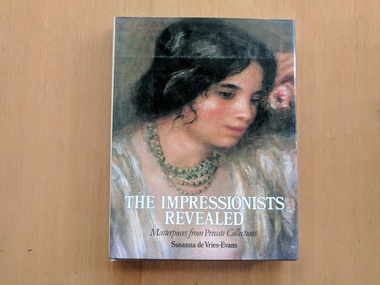
Book, Susanna de Vries-Evans, The Impressionists Revealed, 1992
... Walsh St library Hardcover w/ Dust Jacket The Impressionists Revealed Book Susanna de Vries-Evans Random House ...Hardcover w/ Dust Jacketwalsh st library
