
Showing 19 items matching " incense"
-
 Donald History and Natural History Group operating the Donald Court House Museum
Incense
... Incense...Incense...Four bundles of incense sticks held together with paper decorated at the top with Chinese characters....Incense Georgie Ah Ling Market Gardener Donald. ...Four bundles of incense sticks held together with paper decorated at the top with Chinese characters.incense, georgie ah ling, market gardener, donald. vic., chinese -
 Bendigo Art Gallery
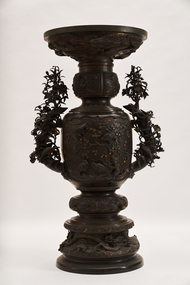
Sculpture, UNKNOWN, Pair of Censers (incense burners), 1860-1880
... Pair of Censers (incense burners)...... incense...decorative arts incense sculptural birds asian burner No marks Pair of Censers (incense burners) Sculpture UNKNOWN ...No marksdecorative arts, incense, sculptural, birds, asian, burner -
 Emerald Museum & Nobelius Heritage Park
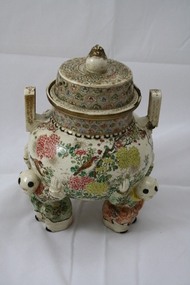
Incense Burner, Early 19th century
... Japanese Incense Burner Circa early 19th century...She was very involved with the recovery after Ash Wednesday 1983 fires japanese insense burner Floral Bowl with Figured Legs and Top Japanese Incense Burner Circa early 19th century Incense Burner ...Nancy Hawley requested one of a pair come to the Emerald Museum . It was brought back from Japan by a friend of Noni Smith after World War 2. Noni Smith was Mr Murphy's nurse for many years Noni died at the age of 90 years . She was principal of Emerald Primary School. She was very involved with the recovery after Ash Wednesday 1983 firesJapanese Incense Burner Circa early 19th centuryFloral Bowl with Figured Legs and Topjapanese insense burner -
 Whitehorse Historical Society Inc.
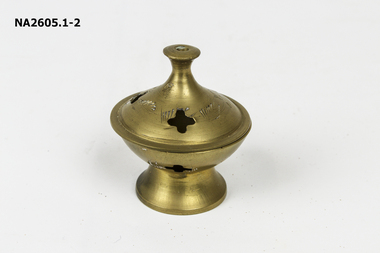
Decorative object - Incense burner
... Small brass incense burner with lid. Lid and bowl have decorative holes and an etched decoration....Decorative object Incense burner ...Small brass incense burner with lid. Lid and bowl have decorative holes and an etched decoration.ornaments, metal -
 Bendigo Historical Society Inc.
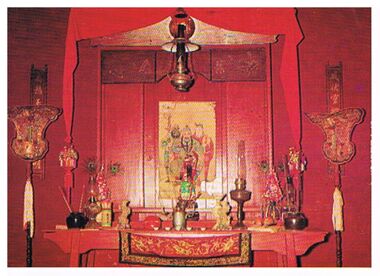
Postcard - CHINESE JOSS HOUSE
... Altar with artefacts, including lamp, incense sticks....Altar with artefacts, including lamp, incense sticks. Postcard CHINESE JOSS HOUSE ...Postcard, color. Image shows interior of Joss House, Bendigo. Altar with artefacts, including lamp, incense sticks.Rose Series Colorview No 835, Copyrightbendigo, buildings, chinese joss house, bendigo, chinese joss house -
 National Vietnam Veterans Museum (NVVM)
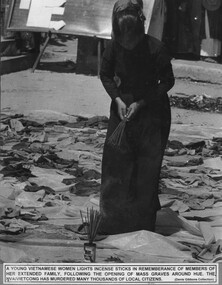
Photograph, Gibbons, Denis, Hue Mass Graves
... A black and white photograph of a young Vietnamese woman lighting incense in remembrance of members of her extended family following the opening of mass graves around Hue...Photograph Hue Mass Graves Gibbons Collection Catalogue Vietnamese Woman Denis Gibbons A black and white photograph of a young Vietnamese woman lighting incense in remembrance of members of her extended family following the opening of mass graves around Hue Hue Mass Graves Photograph Gibbons, Denis ...Denis Gibbons (1937 – 2011) Trained with the Australian Army, before travelling to Vietnam in January 1966, Denis stayed with the 1st Australian Task Force in Nui Dat working as a photographer. For almost five years Gibbons toured with nine Australian infantry battalions, posting compelling war images from within many combat zones before being flown out in late November 1970 after sustaining injuries. The images held within the National Vietnam Veterans Museum make up the Gibbons Collection. A black and white photograph of a young Vietnamese woman lighting incense in remembrance of members of her extended family following the opening of mass graves around Huephotograph, hue, mass graves, gibbons collection catalogue, vietnamese woman, denis gibbons -
Clunes Museum
Functional object - INCENSE BURNER
... INCENSE BURNER, TOP AND CENTRE PIECE.,BASE IS MISSING. ...METAL ART INCENSE BURNER INCENSE BURNER, TOP AND CENTRE PIECE.,BASE IS MISSING. ...INCENSE BURNER, TOP AND CENTRE PIECE.,BASE IS MISSING. THE ITEMS ARE BEND CIRCULAR KNOBS ON EACH SIDE OF BOTH PIECES OVAL ORNATE PIECE ON TOP AS HANDLEmetal art, incense burner -
 Mission to Seafarers Victoria
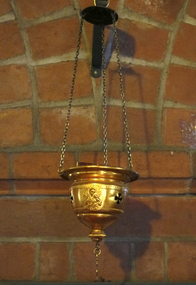
Ceremonial object - Thurible, 1940-1990
... Cone shaped brass incense burner with relief religious motif of madonna and child and cut-out cross-shaped holes, suspended from chains at three points from the top rim. ...This is one of the many objects used for religious services in the chapel of the Mission. religious objects incense burner religious icons thurible mission to seafarers st peter chapel sanctuary lamp Cone shaped brass incense burner with relief religious motif of madonna and child and cut-out cross-shaped holes, suspended from chains at three points from the top rim. ...Thurible located in the Anglican chapel of St Peter of the Mission to Seafarers.This is one of the many objects used for religious services in the chapel of the Mission.Cone shaped brass incense burner with relief religious motif of madonna and child and cut-out cross-shaped holes, suspended from chains at three points from the top rim. Suspended by rings underneath is swinging brass cross.religious objects, incense burner, religious icons, thurible, mission to seafarers, st peter chapel, sanctuary lamp -
 Bendigo Historical Society Inc.
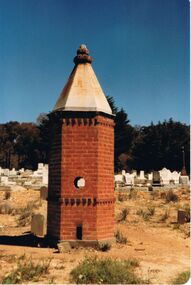
Postcard - CHINESE BURNING TOWER, WHITE HILLS CEMETERY, BENDIGO
... These structures were used for ceremonies for the dead were conducted, and candles, incense and paper offerings were offered....These structures were used for ceremonies for the dead were conducted, and candles, incense and paper offerings were offered. Postcard CHINESE BURNING TOWER, WHITE HILLS CEMETERY, BENDIGO ...Colour photo: image shows hexagonalCeremonial Chinese Funeral Tower brick structure, with iron roof. Small circular inset on front. Headstones in background. These structures were used for ceremonies for the dead were conducted, and candles, incense and paper offerings were offered.bendigo, buildings, chinese burning tower, bendigo, white hills cemetery, chinese, burial, burning tower -
 National Vietnam Veterans Museum (NVVM)
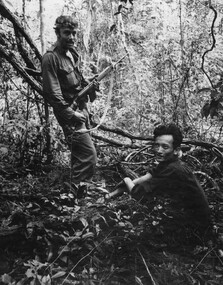
Photograph, Gibbons, Denis, Incensed Patient
... The VietCong prisoner was so incensed at being left behind that he led 6 RAR diggers to caches on the mountain....Incensed Patient Photograph Gibbons, Denis ...Denis Gibbons (1937 – 2011) Trained with the Australian Army, before travelling to Vietnam in January 1966, Denis stayed with the 1st Australian Task Force in Nui Dat working as a photographer. For almost five years Gibbons toured with nine Australian infantry battalions, posting compelling war images from within many combat zones before being flown out in late November 1970 after sustaining injuries. The images held within the National Vietnam Veterans Museum make up the Gibbons Collection. A black and white photograph of Digger from 6 RAR/NZ (ANZAC) guards a VietCong prisoner captured in one of the wards at theNVA/VietCong K76A Hospital on the Nui May Tao Mountain during Operation Marsden. The VietCong prisoner was so incensed at being left behind that he led 6 RAR diggers to caches on the mountain.photograph, 6 rar/nz, k76a hospital, operation marsden, nui may tao mountain, gibbons collection catalogue, vc prisoner, digger, nva/vc, 6 rar/nz (anzac), viet cong prisoner, nva/vietcong, 6 rar, denis gibbons -
 Bendigo Historical Society Inc.
Photograph - FORTUNA COLLECTION: FOYER, FORTUNA VILLA
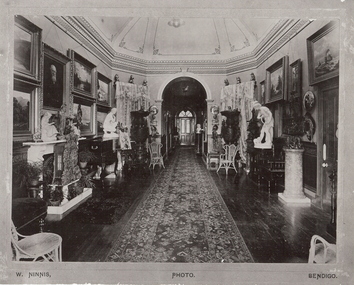
... History of object: James Lerk 2000 'Quartz King George Lansell's portrait hangs over the marble overmantle of the fire place in the foyer of 'Fortuna Villa'The bronze incense urns are now in the Bendigo Art Gallery collection'. ...History of object: James Lerk 2000 'Quartz King George Lansell's portrait hangs over the marble overmantle of the fire place in the foyer of 'Fortuna Villa'The bronze incense urns are now in the Bendigo Art Gallery collection'. ...Black and white photograph of hallway decorated with many paintings, statures, chairs, etc. Decorated ceiling. History of object: James Lerk 2000 'Quartz King George Lansell's portrait hangs over the marble overmantle of the fire place in the foyer of 'Fortuna Villa'The bronze incense urns are now in the Bendigo Art Gallery collection'. Photographed for Bendigo Advertiser 11.1.2001W Ninnisbuildings, residential, fortuna villa -
 Ballarat Diocesan Historical Commission
Chasuble, Vietnamese silk chasuble
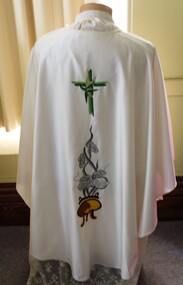
... The vestments feature Vietnamese Christian motifs such as this with a bamboo cross with an Asian incense burner....The vestments feature Vietnamese Christian motifs such as this with a bamboo cross with an Asian incense burner. Vietnam, Nolan, chasuble, gothic, embroidery, Asian, incense, Cross. ...Vietnamese gothic cut silk chasuble. These vestments were purchased by Monsignor Henry Nolan and re-sold to his fellow priests in the diocese to raise money for Vietnamese orphanage children following the Vietnam conflict. Monsignor Nolan served as a military chaplain in Vietnam. The vestments feature Vietnamese Christian motifs such as this with a bamboo cross with an Asian incense burner.vietnam, nolan, chasuble, gothic, embroidery, asian, incense, cross. -
 Coal Creek Community Park & Museum
Medical dressing
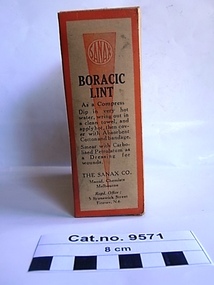
... "SANAX" Fragrant Pastille; ignite easily and burn steadily, emitting delightful fumes of fragrant incense. Every home should have them. All Chemists, or BURROWS PHARMACY, 5 Brunswick St., FITZROY. ..."SANAX" Fragrant Pastille; ignite easily and burn steadily, emitting delightful fumes of fragrant incense. Every home should have them. All Chemists, or BURROWS PHARMACY, 5 Brunswick St., FITZROY. ...TROVE : Advocate (Melbourne, Vic. : 1868 - 1954), Saturday 29 March 1919, page 6. For Perfuming the Living or Sick Rooms, for Special Services, High, Mass, Requiem Service, and Benediction. "SANAX" Fragrant Pastille; ignite easily and burn steadily, emitting delightful fumes of fragrant incense. Every home should have them. All Chemists, or BURROWS PHARMACY, 5 Brunswick St., FITZROY. TROVE : Age (Melbourne, Vic. : 1854 - 1954), Saturday 16 August 1941, page 4 SITUATIONS VACANT. ADVERTISERS …………Girl Packer, about 18 yrs. The Sanax Co., 5 Brunswick-street, Fitzroy. City…….. Manila coloured cardboard box printed in dark brown and orange containing a pink coloured lint cloth.Box. Side 1. 'SANAX (logo) BORACIC LINT. As a compress. Dip in very hot water, wring out in a clean towel, and apply hot, then cover with Absorbent Cotton and bandage. Smear with Carbolised Petrolatum as a Dressing for wounds. THE SANAX CO. Manuf. Chemists Melbourne Reg'd Office : 5 Brunswick Street, Fitzroy, N.6.' Side 2. 'THERE'S A "SANAX" FIRST AID CASE for every purpose 27 Distinct Patterns to choose from. No. 1 "Sanax" First Aid For Factories, Home etc. No. 1a "Sanax" First Aid For the Home, Farm, School No. 2 "Sanax" First Aid For Factories, Mines, Quarries No. 4 "Sanax" First Aid (Portable) For Sports Clubs, Scouts, Guides No. 5 "Sanax" First Aid For Mines, Racing & Football Clubs No. 7 "Sanax" First Aid (Portable) For the Farm, Home or Sports Field No. 9 "Sanax" First Aid (Portable) For the Motor Car No. 11 "Sanax" First Aid (Pocket Size) For Boy Scouts, Girl Guides No. 20 & 25 "Sanax" First Aid (Portable) For the Motorist. Side 3. USE "SANAX" ACHE TABLETS for ALL PAINS ACHES and FEVERS - SAFE and EFFECTIVE. Side 4 Keep "Sanax" First Aid Dressing handy , for small wounds, cuts, cracked hands, and abrasions. It forms an antiseptic healing skin over the damaged part. Sole Makers The SANAX Co. Melbourne. Side 5. TRADE "SANAX" MARKwound dressing, lint cloth -
 Coal Creek Community Park & Museum
Box of Dressings, mid 20th Century
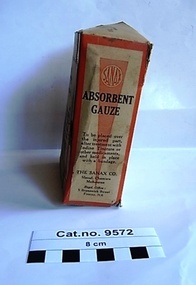
... "SANAX" Fragrant Pastille; ignite easily and burn steadily, emitting delightful fumes of fragrant incense. Every home should have them. All Chemists, or BURROWS PHARMACY, 5 Brunswick St., FITZROY. ..."SANAX" Fragrant Pastille; ignite easily and burn steadily, emitting delightful fumes of fragrant incense. Every home should have them. All Chemists, or BURROWS PHARMACY, 5 Brunswick St., FITZROY. ...TROVE : Advocate (Melbourne, Vic. : 1868 - 1954), Saturday 29 March 1919, page 6. For Perfuming the Living or Sick Rooms, for Special Services, High, Mass, Requiem Service, and Benediction. "SANAX" Fragrant Pastille; ignite easily and burn steadily, emitting delightful fumes of fragrant incense. Every home should have them. All Chemists, or BURROWS PHARMACY, 5 Brunswick St., FITZROY. TROVE : Age (Melbourne, Vic. : 1854 - 1954), Saturday 16 August 1941, page 4 SITUATIONS VACANT. ADVERTISERS …………Girl Packer, about 18 yrs. The Sanax Co., 5 Brunswick-street, Fitzroy. City…….. Manila coloured cardboard box printed in dark brown and orange containing cotton gauze.Box. Side 1. 'SANAX (logo) ABSRORBENT GAUZE. To be placed over the injured part, after treatment with Iodine Tincture or other medicaments, and held in place with a bandage. THE SANAX CO. Manuf. Chemists Melbourne Reg'd Office : 5 Brunswick Street, Fitzroy, N.6.' Side 2. 'THERE'S A "SANAX" FIRST AID CASE for every purpose 27 Distinct Patterns to choose from. No. 1 "Sanax" First Aid For Factories, Home etc. No. 1a "Sanax" First Aid For the Home, Farm, School No. 2 "Sanax" First Aid For Factories, Mines, Quarries No. 4 "Sanax" First Aid (Portable) For Sports Clubs, Scouts, Guides No. 5 "Sanax" First Aid For Mines, Racing & Football Clubs No. 7 "Sanax" First Aid (Portable) For the Farm, Home or Sports Field No. 9 "Sanax" First Aid (Portable) For the Motor Car No. 11 "Sanax" First Aid (Pocket Size) For Boy Scouts, Girl Guides No. 20 & 25 "Sanax" First Aid (Portable) For the Motorist. Side 3. ‘USE "SANAX" ACHE TABLETS for ALL PAINS ACHES and FEVERS - SAFE and EFFECTIVE’. Side 4 ‘Keep "Sanax" First Aid Dressing handy , for small wounds, cuts, cracked hands, and abrasions. It forms an antiseptic healing skin over the damaged part. Sole Makers The SANAX Co. Melbourne’. Side 5. ‘TRADE "SANAX" MARK’.wound dressing, cotton, gauze -
 Coal Creek Community Park & Museum
Box of Cottonwool, mid 20th century
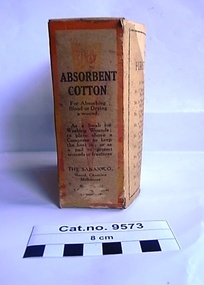
... "SANAX" Fragrant Pastille; ignite easily and burn steadily, emitting delightful fumes of fragrant incense. Every home should have them. All Chemists, or BURROWS PHARMACY, 5 Brunswick St., FITZROY. ..."SANAX" Fragrant Pastille; ignite easily and burn steadily, emitting delightful fumes of fragrant incense. Every home should have them. All Chemists, or BURROWS PHARMACY, 5 Brunswick St., FITZROY. ...TROVE : Advocate (Melbourne, Vic. : 1868 - 1954), Saturday 29 March 1919, page 6. For Perfuming the Living or Sick Rooms, for Special Services, High, Mass, Requiem Service, and Benediction. "SANAX" Fragrant Pastille; ignite easily and burn steadily, emitting delightful fumes of fragrant incense. Every home should have them. All Chemists, or BURROWS PHARMACY, 5 Brunswick St., FITZROY. TROVE : Age (Melbourne, Vic. : 1854 - 1954), Saturday 16 August 1941, page 4 SITUATIONS VACANT. ADVERTISERS …………Girl Packer, about 18 yrs. The Sanax Co., 5 Brunswick-street, Fitzroy. City…….. Manila coloured cardboard box printed in dark brown and orange containing a wad of cotton wool wrapped in blue paper.Box. Side 1. 'SANAX (logo) ABSORBANT COTTON. For Absorbing Blood or Drying a wound. As a Swab for Washing Wounds; to place above a Compress to keep the heat in; or as a pad to protect wounds or fractures. THE SANAX CO. Manuf. Chemists Melbourne Reg'd Office : 5 Brunswick Street, Fitzroy, N.6.' Side 2. 'THERE'S A "SANAX" FIRST AID CASE for every purpose 27 Distinct Patterns to choose from. No. 1 "Sanax" First Aid For Factories, Home etc. No. 1a "Sanax" First Aid For the Home, Farm, School No. 2 "Sanax" First Aid For Factories, Mines, Quarries No. 4 "Sanax" First Aid (Portable) For Sports Clubs, Scouts, Guides No. 5 "Sanax" First Aid For Mines, Racing & Football Clubs No. 7 "Sanax" First Aid (Portable) For the Farm, Home or Sports Field No. 9 "Sanax" First Aid (Portable) For the Motor Car No. 11 "Sanax" First Aid (Pocket Size) For Boy Scouts, Girl Guides No. 20 & 25 "Sanax" First Aid (Portable) For the Motorist. Side 3. USE "SANAX" ACHE TABLETS for ALL PAINS ACHES and FEVERS - SAFE and EFFECTIVE. Side 4 Keep "Sanax" First Aid Dressing handy , for small wounds, cuts, cracked hands, and abrasions. It forms an antiseptic healing skin over the damaged part. Sole Makers The SANAX Co. Melbourne. Side 5. TRADE "SANAX" MARK cotton wool, wound dressing -
Bendigo Historical Society Inc.
Document - Fortuna Article - Auction Notice, Mon to Sat 18-23 June 1934
... Special lots include valuable furniture, art, statuary, and unique items such as a Louis Quatorze writing table, Carrara marble statue, and a large bronze incense burner. Oil paintings and watercolours will be viewed at 'Fortuna' and later auctioned in Melbourne Town Hall (August 20–21, 1934). ...Special lots include valuable furniture, art, statuary, and unique items such as a Louis Quatorze writing table, Carrara marble statue, and a large bronze incense burner. Oil paintings and watercolours will be viewed at 'Fortuna' and later auctioned in Melbourne Town Hall (August 20–21, 1934). ...This document is an auction catalog detailing the sale of the 'Fortuna' mansion and its contents, including terms, schedule, and highlights: The auction is for the estate of George and Edith Lansell, including the 'Fortuna' mansion in Bendigo, Victoria, and its extensive contents. The mansion features 8 reception rooms, a ballroom, multiple bedrooms and bathrooms, gymnasium, staff quarters, conservatories, swimming pool, and extensive grounds (18 acres). The property is described as suitable for a large institution and in excellent repair. The sale is spread over six days (June 18–23, 1934), with each day dedicated to specific rooms or types of items (e.g., statuary, furniture, bedrooms, ballroom, art). Special lots include valuable furniture, art, statuary, and unique items such as a Louis Quatorze writing table, Carrara marble statue, and a large bronze incense burner. Oil paintings and watercolours will be viewed at 'Fortuna' and later auctioned in Melbourne Town Hall (August 20–21, 1934). Highest bidder wins; disputes resolved by re-auctioning the lot.Immediate part payment required (five shillings per pound or more), with forfeiture and resale if terms are not met. All items sold 'as is', with no warranties on authenticity or condition; risk passes to buyer at the fall of the hammer. No removal of lots during the sale; all items must be paid for and collected by a set deadline. Private and public viewing days are scheduled before the auction, with admittance by special card or catalogue. Special motor transport is arranged from Melbourne to Bendigo for prospective buyers. The auction is conducted by K. Gardner & Lang Pty. Ltd., Leonard Joel Pty. Ltd., and J. H. Curnow & Son, in conjunction. Catalogues are required for entry and are available for purchase. All items are the property of the Lansell Estates.Fortuna Article - Auction Notice This item contains the following document: 11217.63a Twelve pages listing contents of the Fortuna Villa that are to be auctioned non-fictionbendigo, fortuna, george lansell, edith lansell -
 City of Melbourne Libraries
Photograph, Bull, Hugh Jones, 1897-1993, Eucharistic Congress Procession, Collins Street, Melbourne
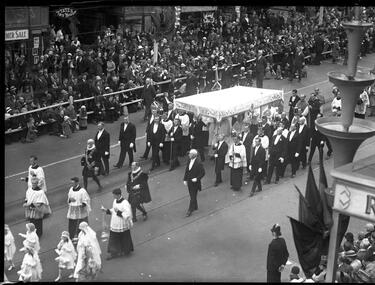
... Patrick's Cathedral and below, the Papal Legate carrying the Host under a canopy borne by a guard of laymen and preceded by white-clad girls scattering rose leaves, incense bearers and the Papal Chamberlains in their Spanish uniforms. ...Patrick's Cathedral and below, the Papal Legate carrying the Host under a canopy borne by a guard of laymen and preceded by white-clad girls scattering rose leaves, incense bearers and the Papal Chamberlains in their Spanish uniforms. ...Published: The Age 10 December 1934 Published title: RELIGIOUS PAGEANTRY AND FERVOR MARKED CLOSE OF EUCHARISTIC CONGRESS. Published caption: Thousands of men and women marched in the Eucharistic procession yesterday which brought the Congress to a close. The picture above shows the procession headed by the Children of Mary in Bourke-street and turning into Spring-street, in front of Parlia ment House. Right (top) — The procession leaving the starting point at St. Patrick's Cathedral and below, the Papal Legate carrying the Host under a canopy borne by a guard of laymen and preceded by white-clad girls scattering rose leaves, incense bearers and the Papal Chamberlains in their Spanish uniforms. The end of the procession in front of Mount St. Evin’s Hospital from which the final benediction was given by Cardi nal MacRory from an altar on the bal cony. The Papal Legate carrying the Host is passing through the assemblage of surpliced priests. On the left is an aerial picture taken just as the Children of Mary at the head of the procession are taking up their places for the final assembling. In the left top corner of the picture is St Patrick's Cathedral, from which the procession started, and in the right lower corner is Mount St. Evin’s Hospital. The space immediately in front of the hospital was reserved for the processionists while on either side is the crowd that assembled to take part in the final service. Trove article identifier: http://nla.gov.au/nla.news-article205067634 Religious pageantry and fervour The National Eucharistic Congress took place from Sunday 2 to Sunday 9 December 1934. An initiative of the Roman Catholic Church, it was their contribution to Melbourne’s Centenary Celebrations. 200,000 Catholics resided in Melbourne at this time – one quarter of the city’s population. While the Congress was aimed at Catholics, and acted as an opportunity to reinforce their living faith and homage, it contained a variety of events of splendour, solemnity and significance designed to appeal to Melbournians, and would additionally provide incentive for people to travel to Victoria, thereby creating an economic benefit to the state. The Procession of the Blessed Sacrament concluded the week-long Congress. Commencing at St Patrick’s Cathedral, it covered a two-mile route via Gisborne, Collins, Elizabeth and Bourke streets, then to Victoria Parade, where a final benediction was pronounced by Cardinal MacRory from the balcony of Mount St. Evin’s Hospital (today the site of St Vincent’s Private Hospital). An estimated 100,000 took part. Onlookers line Swanston Street, some standing at the entrance to Tate’s Tea House – a well-known Melbourne landmark located in the basement of the Manchester Unity Building. The white-veiled Children of Mary Sodalists strew rose petals in the path of the canopy, covering the jewelled Monstrance containing the Blessed Sacrament of consecrated Host (bread) and carried by the Cardinal. Church hierarchy in scarlet robes walk alongside, followed by incense bearers, the Papal Chamberlains in their Spanish uniforms, and a guard of honour of laymen of the city and country parishes. In the foreground is a tiered pole. This is one of 800 “Venetian Lights” specifically installed for the Centenary along all principal thoroughfares. “The poles are painted white, the superstructure resembling three trumpet lilies are made of durable fibro-cement, and their colour scheme deepens from clear yellow on the top cone to orange on the lowest, with slender rims of vermilion and white. Each cone is flooded with light externally from three lamps concealed in the one below it. There is also a painted coat of arms from which spring a trophy of flags.” – Australian Home Beautiful Featured in "Newsworthy: Melbourne in photographs 1933-1936" exhibition at East Melbourne Library, October to December 2023. Exhibition caption by project volunteer, Louise McKenzie. Research by project volunteer, Louise McKenzie: This photo was taken on Sunday 9 December 1934, looking from the Melbourne Town Hall (corner of Swanston and Collins streets) across the road to the Manchester Unity Building. This is the afternoon procession concluding the Catholic Church’s National Eucharistic Congress in Melbourne - a procession of the Blessed Eucharist through the Melbourne city. It commenced at St Patrick’s Cathedral, and covered a two mile route via Gisborne, Collins, Elizabeth and Bourke streets, then to Victoria Parade where a final benediction was pronounced by the Cardinal from the balcony of Mount St. Evin’s Hospital (present day St Vincent’s Private Hospital). An estimated 100,000 took part in the march. The people lining the streets a men in suits and hats, women in coats and hats, and children in their “Sunday best”, kneeling beside the road, many with their hands clasped in front of them. The small girls ahead of the canopy covering the Host are pale-blue clad, white veiled Children of Mary Sodalists, who strew rose petals to pave the way of the Cardinal carrying the jewelled Monstrance (Blessed Sacrament of consecrated Host (bread)), together with church heirarchy wearing scarlet robes. Behind came incense bearers and the Papal Chamberlains in their Spanish uniforms, followed by a guard of honour of laymen of the city and country parishes. The Children of Mary Sodalities was a religious body which aimed at fostering in its members an ardent devotion, reverence, and filial love towards the Blessed Virgin Mary, initially embracing the pupils and orphans of the schools and institutions of the Sisters of Charity of St Vincent de Paul. In 1847, Blessed Pius IX affiliated them to the Jesuit Roman Sodality. They were distinguished by a medal suspended from a blue ribbon, and once a fully-fledged a Child of Mary wore a distinctive blue cape. On the extreme right foreground of the photo can be seen an intriguing piece of artistic design – a tiered pole. This is one of the 800 “Venetian Lights” specifically installed for Melbourne’s Centenary along all principal thoroughfares. “The poles are painted white, the superstructure resembling three trumpet lilies are made of durable fibro-cement, and their colour scheme deepens from clear yellow on the top cone to orange on the lowest, with slender rims of vermilion and white. Each cone is flooded with light externally from three lamps concealed in the one below it. There is also a painted coat of arms from which spring a trophy of flags.” Note the sign for Tates Tea House - a well-known Melbourne landmark, located in the basement of the Manchester Unity Building. References: RELIGIOUS PAGEANTRY AND FERVOR MARKED CLOSE OF EUCHARISTIC CONGRESS. (1934, December 10). The Age (Melbourne, Vic. : 1854 - 1954), p. 11. Retrieved September 14, 2023, from http://nla.gov.au/nla.news-article205067634 Eucharistic Congress (1934, December 1). The Argus (Melbourne, Vic. : 1848 - 1957), p. 11. Retrieved January 23, 2024, from http://nla.gov.au/nla.news-article10997817 National Eucharistic Congress, Melbourne. (1934, December 6). The Catholic Press (Sydney, NSW : 1895 - 1942), p. 28. Retrieved January 23, 2024, from http://nla.gov.au/nla.news-article104371824 'The year of the Melbourne Eucharistic Congress: 1934.' The Campion Society, https://campion.australiancardijninstitute.org/ch-7-the-year-of-the-melbourne-eucharistic-congress-1934/ 'Melbourne Eucharistic Congress 1934.' Panoramic photograph, https://emhs.org.au/catalogue/emdf0123 The National Eucharistic Congress, Melbourne, Australia December 2nd-9th, 1934. Edited by Rev. J.M. Murphy and Rev. F. Moynihan, The Advocate Press, Melbourne. 'Children of Mary Sodalists', Wikipedia, https://en.wikipedia.org/wiki/Sodality_of_Our_Lady 'Dressing Melbourne for the Duke' (1934, October 1). The Australian home beautiful : a journal for the home builder, p. 21, 58. Retrieved September 14, 2023, from http://nla.gov.au/nla.obj-2950922209 Photographer notations on slide: "Eucharistic Congress Procession on Swanston St B61" [sic - actually Collins Street].events, religion, parades, catholic church -
 City of Melbourne Libraries
Photograph, Bull, Hugh Jones, 1897-1993, RMS Orford departing from Station Pier, Port Melbourne
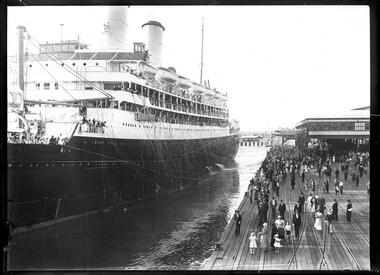
... From the hot oil of the engines, from those overheated, bottomless pits below the water-line, from new paint and food, from people perspiring at work, from rope and tar and grease and fruit and wet clothes and tobacco, rises a deplorable incense that lingers unsettlingly in the nostril long after one has left the ship. ...From the hot oil of the engines, from those overheated, bottomless pits below the water-line, from new paint and food, from people perspiring at work, from rope and tar and grease and fruit and wet clothes and tobacco, rises a deplorable incense that lingers unsettlingly in the nostril long after one has left the ship. ...Published: 21 March 1934 The Age p11 Published title: CROWDED TOURIST SHIP WILL CARRY TEST AND DAVIS CUP TEAMS. Published caption: Carrying an exceptionally large number of tourists, business men and prominent sporting personalities, R.M.S. Orford sailed for London yesterday. Over two hundred passengers embarked at Melbourne, and on leaving the Australian coast there will be two thousand persons on board. The Australian Test team will join the vessel at Fremantle and the remaining two Davis Cup representatives will embark at Adelaide. A picture of the Orford taken just as she moved out from Station Pier, Port Melbourne, under her own steam. Trove article identifier: http://nla.gov.au/nla.news-article203826897 Description: Passenger ship about to depart Station Pier, Port Melbourne. Research by project volunteer, Fiona Collyer: The RMS Orford was built by Vickers-Armstrong Shipyard Barrow-in-Furness, Cumbria, England and launched in 1927 by Lady Ryrie, the wife of Sir Granville Ryrie, the Australian Ambassador to the UK. The Orford was owned by the Orient Steam Navigation Ltd and was designed for the mail and passenger service between England and Australia. She was 20,000 tons, 658 ft long, 75 ft across and 80 ft high from water-line to deck. She had eight decks, a swimming pool and cost more than £1,000,000. She could travel at 20 knots – 480 miles a day, a 5 week voyage between Australia and England. There were enough lifeboats to accommodate every person on board. Promoted as a ship of comfort, luxury, speed and grace with spacious, beautifully decorated lounges, smoking-rooms and writing rooms, the SMH 23/11/1928 review said “sitting-rooms where the furniture recreates the air of quiet, exquisite, safe luxury; suites where you may retire from other people, and on a sea voyage other people, even the most charming other people, often begin to resemble one’s worst enemies towards the end of several weeks sea voyaging together”. “Travel like a human being. This is what the great liners give you today. The Orford dining room is enormous (it seated 350 people) the walls sweep up to a white, cool roof supported on decorative pillars. Panels of grey scagliola and carved designs remove the bleak, comfortless air which used to cling to dining-rooms of ships. Everything about them was so wretchedly temporary that you could not enter them without wishing that you stayed at home. They gave you the creeps and indigestion. This room is gay, bright, sunlit, like a luxurious café overlooking the sea.” “You really feel in here that you are a human being and not a piece of cargo endowed with sensation.” The Orford had the punkah louvre system of ventilation which forced draughts through every part of the ship, ensuring “No Ship Smells!!” and avoiding - “… a mayonnaise of all the unpleasant odours generated under heaven. From the hot oil of the engines, from those overheated, bottomless pits below the water-line, from new paint and food, from people perspiring at work, from rope and tar and grease and fruit and wet clothes and tobacco, rises a deplorable incense that lingers unsettlingly in the nostril long after one has left the ship. Those dreadful odours will never rise to torture the senses of passengers who feel that all is over with them.” The modern electric kitchen had a roll making machine capable of producing 2000 rolls for the table an hour and a bread and butter machine which cut the bread into slices and spread the butter in one operation. (The Week – Brisbane 30/11/1928) On 13/10/1928, the Orford made its first voyage to Australia with 520 first class and 1100 3rd class passengers. The name of the passengers embarking and disembarking and their reason for visiting were published in newspapers and the number of migrants for the New Settlers Scheme and the Dreadnought Boys Co program to promote and assist the migration of British youths willing to become farm workers in Australia 1911-1939 were noted too. On the 19th March 1932, RMS Orford featured in the “Parade of Ships” celebrating the official opening of the Sydney Harbour Bridge. Only country people were allowed to book a ticket as a guest on board. The Post Office issued commemorative postage stamps showing the Orford sailing under the bridge. In March 1934, the Orford sailed from Australia to London, via Colombo, Aden, Port Said, Naples, Villefranche, Toulon, Parma, Gibraltar and Channel Port. Amongst the 2000 passengers on board was the Davis Cup Tennis team, tennis champions Joan Hartigan and Nell Hopman, the Australian Test cricket team and British champion swimmer Joyce Cooper. Every day tennis player Harry Hopman and an Australian Press Association reporter radioed through reports on their activities, which included – - Test cricket batsman Len Darling having spend 4 days in his cabin after straining his groin when he slipped over while playing ball tennis in his slippers. - Batsman Bill Brown dancing the fox-trot, displaying footwork similar to the grace he showed at the wicket. - Alluding to the seasickness of Don Bradman and Stan McCabe and how they were making up for meals lost on the Great (very choppy) Australian Bight. - Miss Joan Hartigan discarding her bright blue shorts for brighter blue bathers and being first into the pool. - Bowler Bill O’Reilly being tripped by a passenger on the deck and spending the voyage with bandaged wrists with daily updates of his progress in the press. - Wicketkeeper Ben Barnett’s conjuring tricks and constant whirring movie camera. - Results of the quoits, ball tennis and bridge tournaments. A fancy dress ball was held one night and the cricketers dressed as sheiks and sang “The Riff Song” from the pre-code 1929 operetta film “The Desert Song” starring John Bates as the Red Shadow and Myrna Lay as a native dancing girl. Alan Kippax’s beard blew overboard! Joan Hartigan dressed as Burlington Bertie from the music hall song and Nell Hopman a doll in a box wearing a crinkled paper dress. On arrival at Southampton, while they waited for the gangway to be lowered, Bradman entertained the team at the piano playing popular tunes while the cricketers sang. . In 1935, RMS Orford’s third class accommodation was converted to tourist class. Her passenger capacity was now 468 First Class, 515 tourist class and 440 crew. First saloon from Sydney fares cost for single £76, £82, £88 and Third Class fares were £21, £23, £25. Less than a penny a mile. . In 1936, the Orford embarked the exiled Emperor of Ethiopia, Haile Selassie at Gibraltar on his way to the UK. In 1939, she was requisitioned for Australian government service and on 7/1/1940 she conveyed the first Australian troops to Egypt and was then used to carry French troops from Tamatave, Madagascar to Marseilles. On 1/6/1940 RMS Orford was bombed and set on fire at Marseilles by German aircraft. 14 crew were killed, 25 wounded. In 1947, the wreck was re-floated and broken up at Savona. . . References: R.M.S. ORFORD. (1928, November 23). The Sydney Morning Herald (NSW : 1842 - 1954), p. 14. Retrieved September 15, 2023, from http://nla.gov.au/nla.news-article16511535 ARRIVAL OF THE ORFORD (1928, November 30). The Week (Brisbane, Qld. : 1876 - 1934), p. 21. Retrieved September 15, 2023, from http://nla.gov.au/nla.news-article181126802 CROWDED TOURIST SHIP WILL CARRY TEST AND DAVIS CUP TEAMS. (1934, March 21). The Age (Melbourne, Vic. : 1854 - 1954), p. 11. Retrieved October 5, 2023, from http://nla.gov.au/nla.news-article203826897 Photographer notations on slide: "B19".tennis, ships -
 Victorian Interpretive Projects Inc.
Photograph - colour, Clare Gervasoni, St Peter's Catholic Church, Daylesford, 2015, 14/06/2015
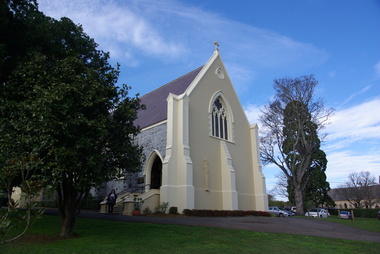
... The swelling of the voices in complete harmony, and the pealing of the organ in the midst of incense and prayer, produced a most marked effect upon the congregation. ...The swelling of the voices in complete harmony, and the pealing of the organ in the midst of incense and prayer, produced a most marked effect upon the congregation. ..."The fine structure of St. Peter's, with its prettily-decorated interior, which holds crowded congregations at Holy Mass on Sundays, is alone an eloquent testimony of the piety and devotion which permeates the whole parish. Attached to the church is a circulating library, and Catholic papers and other literature are distributed at the church door. Branches of the H.A.C.B. Society and Catholic Federation are doing much good work. (Melbourne Advocate, 17 January 1914) "OPENING AND CONSECRATION OF THE NEW CATHOLIC CHURCH OF ST. PETER’S, DAYLESFORD Cross on St. Peter'sNotwithstanding the inclemency of the weather, the opening of the new Catholic Church of St. Peter’s, yesterday (Sunday), attracted a crowded congregation. Although the rain, which has poured almost incessantly for some days past, had left our roads and streets in the condition for which Daylesford is celebrated in winter weather, and although he storm and rain seemed to increase as the hour announced for the ceremonies approached, the church was filled by a large congregation, comprising all sects and denominations of Christians in and around the district. The beautiful edifice, erected mainly through the zeal, liberality and energy of the respected pastor, presented a most imposing appearance, and reflects infinite credit upon the Rev. Mr. Slattery, and the flock committed to his charge. The church was commenced in November 1863 and has been in the hands of the workmen up to the present time, work being uninterruptedly carried on. On commencing the foundations, it was necessary to excavate until solid clay was reached, which in consequence of the deep rich chocolate soil on the site of the building, had to be carried down to an average depth of 6 feet 6 inches. The foundations were laid with massive stones in courses of 12-inch, and four feet thick, reducing to 3 feet below the floor line. The style of the building is decorated Gothic, and consists of a nave, 80 feet by 30 feet in the clear, and a chancel 18 feet high; from floor line to apex of roof, 47 feet, which is elegantly constructed, consisting of six spans or frames with puncheons resting on carved corbels, low down between the windows. The north side consists of a handsome entrance, near the north-west angle, approached by nine steps of cut stone, and four bays of windows on nave, and a small door on side of chancel, intended as an entry from the sacristy. The south side presents a very handsome view to Victoria street, a beautiful porch entrance giving access to the building on the south-east end of nave; and on the south-west angle a handsome octagonal spire, terminating in an iron cross, with gilt floriations; the height of top of cross, from floor line, is 88 feet. A stone stairs gives access to the organ gallery and the belfry. The whole of the windows are of a handsome geometrical design, and carved in stone, with mullions and tracery, and glazed with amber-tinted glass, the chancel window being 15 feet high, and 8 feet wide. The chancel arch is unusually large, 27 feet St. Peter's interiorhigh and 18 feet wide, and handsomely moulded, and presents a fine appearance from the body of the church. The roof is stained a rich oak, with heavy cornice, and all the walls are smoothly plastered, and colored peach color, giving the amber-tinted glass a beautiful soft cathedral appearance to the interior. The altar is of a very chaste design, the panels being moulded with Gothic heads, and finished in white and gold; the altar rail was not completed, but is intended to be of polished cedar, with carved pillars. The interior fittings will be proceeded with immediately, and to complete the design, an organ gallery, with sittings for about 100 persons besides the choir, will be constructed on the west end. It is intended also to place pillar gaslights on each side of the main entrance, for lighting during vespers in winter. The style of architecture has been strictly carried out, and in the best and most substantial manner. The building has been erected under the superintendence of the architect Mr. John Townsend Brophy, a member of the congregation, and who has discharged his duty with great ability and care. The hour of half-past eleven has scarcely passed when from the sacristy entered His Lordship the Right Rev. Dr. Gould, Bishop of Melbourne, preceded by the Very Rev. Dean Hayes (Sandhurst), the Rev. P. J. Slattery, and a number of boys dressed in white surplices. The Right Reverend Prelate proceeded to the foot of the altar, the Very Rev. the Dean on his right, and the Rev. P. J. Slattery on the left. The prayers usual upon the occasion were read by the Bishop. A procession was then formed, and went around the church in the following order. Several youths bearing wax candles first, next the Very Rev. the Dean, then the Bishop and his train bearers, and following were the Rev. Mr. Slattery and acolytes. Having returned to the altar in the same order, the Deacon (Dean Hayes) and Sub-Deacon (Rev. P. J. Slattery) proceeded to robe his Lordship, who had taken his seat at the epistle side of the altar, for the solemn High Mass, at appropriate times wearing his mitre and bearing his crozier. The mass, which was chanted by the Bishop with touching simplicity and earnestness, was then commenced. The choir, under the direction of Mr. Meunsch, organist, was full and most effective. Mrs. Testar, of Melbourne, having generously offered her valuable services, took the leading soprano solos, and it is scarcely necessary to add, rendered them with exquisite taste and feeling – her beautiful voice being heard with great effect throughout the entire building. The choir consisted of the following ladies and gentlemen who volunteered to aid in the ceremonies upon this most interesting occasion. Ladies: Mrs. Tresar, soprano; Mrs. J.J. McCormick, alto; Miss Julia Conry, soprano; Mrs. Vincent, soprano; Mrs. Aitken, soprano. Gentlemen: H. Guthiel, tenor; Master John Murphy, tenor; James Knox, bass; J. M. Murphy, bass; Mr. Staunton, baritone; Mr. Sourby, alto; Mr. Short, bass. The chant, “Let us adore,” during the procession, was given by Mrs. Vincent with considerable power. The selection of the “Imperial Mass” (Haydn’s No. 3) was felicitous, and the highly artistic and finished manner in which the different parts were sustained, demonstrated that great and persevering care must have been bestowed on the preparation for “the opening day.” The “Kyrie” was given with the full strength and power of the choir. The swelling of the voices in complete harmony, and the pealing of the organ in the midst of incense and prayer, produced a most marked effect upon the congregation. In the “Gloria,” the solos of Mrs. Testar were really beautiful and Mrs. McCormick rendered the alto solos with considerable merit. Mr. Knox sang the part commencing with the words “Qui tolles” with much taste and power. The “Credo” than which we believe there is not a more magnificent piece of sacred music extant, was most successful in its rendering, nor do we ever remember to have heard anything more touching than the manner in which the line “Vetam Venturi in Seculi,” was given by Mrs. Testar. The offertory hymn “Come unto Me all ye that labor,” was given by Mrs. Testar with the most thrilling effect. The “Sanctus” having been sung, in which Mr. Sourby ably rendered an alto solo, the “Agnus Dei” was commenced with a solo by Mrs. McCormick and was given with great taste and feeling, Mrs. Testar, at the conclusion of the “Agnus,” taking up the soprano part. Mass being concluded, the Very Reverend Dean Hayes ascended the altar and proceeded to preach the opening sermon, taking as his text Second Paralipomenon [Chronicles II], 7th chapter and 16th verse – “For I have chosen and have sanctified this place that My hand may be there for ever, and My eyes and My heart may remain there perpetually.” St Peter's manseAt the close of the sermon a collection was made by the very reverend preacher, assisted by John Egan, Esq., Corinella, on behalf of the church, and about fifty pounds were contributed. When it is remembered that 500 tickets had been issues at 10s each, and the inclemency of the weather taken into consideration, the collection may be regarded as a large one. Benediction was sung by the Rev. P. J. Slattery, assisted by Dean Hayes, the choir singing the “O! Salutaris Hostia” and “Laudate.” Handel’s Hallelujah Chorus was sung at the termination of the ceremonies. The vestments issued at Benediction, as well as at the Mass, were of the most gorgeous and beautiful character. When the Benediction was over, the Rev. P. J. Slattery, standing at the front of the altar said– “I wish to say one or two words before the congregation leave. I feel most deeply indebted to all of you who have attended here today for the honor and glory of God, not withstanding the difficulties you had to encounter from this most inclement season. I am truly delighted at such a manifestation of feeling, and will not easily forget it.” The rev. gentleman having disrobed, thanked the members of the choir for their kindness in assisting at the ceremonies, and more especially Mrs. Testar, who had braved all the storm and rain to be present at, and give the advantage of her great musical abilities on, the “opening day.” (Daylesford Mercury, 15 May 1865.)A number of photographs of St Peter's Catholic Church, Daylesford, taken at the 150th anniversary celebration. st peter's catholic church daylesford, decoration, altar decoration, anniversary, daylesford, religion, painting, interior, slattery, gough, d'alton, mcmahon
