
Showing 139 items matching " international (japan"
-
 National Wool Museum
Sample, Cloth
... Fabric samples produced by Aoki International, Japan and sent to Keith Jackson at Victorian Producers' Co-operative Limited....Fabric samples produced by Aoki International, Japan and sent to Keith Jackson at Victorian Producers' Co-operative Limited....Migutani Vivo Textile Fabric samples produced by Aoki International, Japan and sent to Keith Jackson at Victorian Producers' Co-operative Limited. ...Fabric samples produced by Aoki International, Japan and sent to Keith Jackson at Victorian Producers' Co-operative Limited.Fabric samples produced by Aoki International, Japan and sent to Keith Jackson at Victorian Producers' Co-operative Limited.Geoff, This is for Keith Jackson fron Aoki International (Vivo textil) Regards, Paul FINE WOOL 152 AOKI INTERNATIONA Vivo Textile Co. Ltd. C. Migutani Vivo Textileweaving textile design, aoki international limited, jackson, mr keith - victorian producers' co-operative limited, weaving, textile design -
 Women's Art Register
Archive (Collection) - Yuko Fujita Artist Archive
... ... International (Japan)...Silversmith Recycled International (Japan) Jewellery Archive Yuko Fujita Artist Archive ...silversmith, recycled, international (japan), jewellerysilversmith, recycled, international (japan), jewellery -
Women's Art Register
Archive (Collection) - Mari Funaki Artist Archive
... International (Japan)...1950-2010 International (Japan) Sculpture Jewellery Design Archive Mari Funaki Artist Archive ...international (japan), sculpture, jewellery, designinternational (japan), sculpture, jewellery, design -
Women's Art Register
Archive (Collection) - Isabelle Kawai Vincent Artist Archive
... ... International (Japan)...Mixed Media International (Japan) Archive Isabelle Kawai Vincent Artist Archive ...mixed media, international (japan)mixed media, international (japan) -
Women's Art Register
Archive (Series) - Fujita, Yuko. Artist File 1
... ... International (Japan)...Silversmith Recycled International (Japan) Jewellery Foolscap white archival 4 flap folder or document wallet Archive Fujita, Yuko. ...CV, Promotional Materialsilversmith, recycled, international (japan), jewellerysilversmith, recycled, international (japan), jewellery -
Women's Art Register
Archive (Series) - Funaki, Mari. Artist File 1
... International (Japan)...International (Japan) Sculpture Jewellery Design Foolscap white archival 4 flap folder or document wallet Archive Funaki, Mari. ...Newspaper Clippingsinternational (japan), sculpture, jewellery, designinternational (japan), sculpture, jewellery, design -
Women's Art Register
Archive (Collection) - Heja Chong Artist Archive
... ... International (Japan...1950- Pottery Japanese Bizenware Stoneware International (Japan Korea) Ceramics Archive Heja Chong Artist Archive ...pottery, japanese bizenware, stoneware, international (japan, korea), ceramicspottery, japanese bizenware, stoneware, international (japan, korea), ceramics -
Women's Art Register
Archive (Series) - Vincent, Isabelle Kawai. Artist File 1
... ... International (Japan)...Mixed Media International (Japan) Foolscap white archival 4 flap folder or document wallet Archive Vincent, Isabelle Kawai. ...List of Imagesmixed media, international (japan)mixed media, international (japan) -
Women's Art Register
Archive (Series) - Chong, Heja. Artist File 1
... ... International (Japan...Pottery Japanese Bizenware Stoneware International (Japan Korea) Ceramics Foolscap white archival 4 flap folder or document wallet Archive Chong, Heja. ...Newspaper Clippings, Interviewpottery, japanese bizenware, stoneware, international (japan, korea), ceramicspottery, japanese bizenware, stoneware, international (japan, korea), ceramics -
Women's Art Register
Archive (Series) - Heja Chong. Duplicate File 1
... ... International (Japan...Ceramics Pottery Japanese Bizenware Stoneware International (Japan Korea) Foolscap manilla file Archive Heja Chong. ...Newspaper Clippings, Interviewceramics, pottery, japanese bizenware, stoneware, international (japan, korea)ceramics, pottery, japanese bizenware, stoneware, international (japan, korea) -
Women's Art Register
Archive (Series) - Yuko Fujita. Duplicate File 1
... ... International (Japan)...Jewellery Silversmith Recycled International (Japan) Foolscap manilla file Archive Yuko Fujita. ...CV, Promotional Materialjewellery, silversmith, recycled, international (japan)jewellery, silversmith, recycled, international (japan) -
Women's Art Register
Archive (Series) - Mari Funaki. Duplicate File 1
... ... International (Japan)...Sculpture Jewellery Design International (Japan) Foolscap manilla file Archive Mari Funaki. ...Newspaper Clippingssculpture, jewellery, design, international (japan)sculpture, jewellery, design, international (japan) -
 Whitehorse Historical Society Inc.
Domestic object - Razor
... Charmant International Made in Japan...A 21st birthday gift to Donor's husband in 1959 personal effects-toilet requisites shaving Charmant International Made in Japan Men's razor - Gilt Domestic object Razor ...A 21st birthday gift to Donor's husband in 1959Men's razor - GiltCharmant International Made in Japanpersonal effects-toilet requisites, shaving -
Broadmeadows Historical Society & Museum
Document - Letter, Roby, 9 June 1964
... ...international travel plans...Japan...Personal correspondence family relationships engagement announcements social customs mid 20th century daily life suburban Australia international travel plans Japan travel Hong Kong travel civic roles mayoral identity handwritten letters 1960s Australia Envelope Front / Address side: PLEASE POST EARLY AUSTRALIA BEFORE LUNCH BEFORE FOUR O'CLOCK/9 JUN 1964/Miss Kath Fletcher/14 Wembley Road/Fawkner / Vic Letter text: 64 Fisher Drive/Mile End/South Australia/9-6-1964/Dear Kath/Many thanks for your kind/ thoughts and the Ticket for my Birthday I/think Kath this ticket should show results/as the whole thing seems to be wrapped up/in such great occasions/ Vally & I was / terribly thrilled with the great news of your/engagement to Keith (ARC) I am sure that it/will mean great happiness to you both because/what we saw of ARC he is a very fine/gentleman and yourself you Know our/Thoughts so once again luck to you both/ also Mum:/ As you know we have our name down/for Japan & Hong Kong next July 1965 and passing/through Melbourne we will certainly look up the/ Mayor & Mayoress/ Will Vally is scribbling something/so will conclude this note with our Deepest & Sincere/wishes to you both and may God Grant you all the/happiness that is due to you/(A Kiss for / Kiss for Mum/ Roby)/Yours sweetly/Roby Single page handwritten letter, ink on paper. ...The letter was written from Mile End, South Australia, and references anticipated overseas travel to Japan and Hong Kong in July 1965, as well as civic roles (“Mayor & Mayoress”), situating the item in mid 20th century Australian social and family networks.This item is a well documented example of everyday Australian correspondence in the 1960s, notable for its clear geographic origin, personal engagement announcement, and references to international travel and civic identity, enhancing its social and historic interpretive value.Single page handwritten letter, ink on paper. Envelope Front / Address side: PLEASE POST EARLY AUSTRALIA BEFORE LUNCH BEFORE FOUR O'CLOCK/9 JUN 1964/Miss Kath Fletcher/14 Wembley Road/Fawkner / Vic Letter text: 64 Fisher Drive/Mile End/South Australia/9-6-1964/Dear Kath/Many thanks for your kind/ thoughts and the Ticket for my Birthday I/think Kath this ticket should show results/as the whole thing seems to be wrapped up/in such great occasions/ Vally & I was / terribly thrilled with the great news of your/engagement to Keith (ARC) I am sure that it/will mean great happiness to you both because/what we saw of ARC he is a very fine/gentleman and yourself you Know our/Thoughts so once again luck to you both/ also Mum:/ As you know we have our name down/for Japan & Hong Kong next July 1965 and passing/through Melbourne we will certainly look up the/ Mayor & Mayoress/ Will Vally is scribbling something/so will conclude this note with our Deepest & Sincere/wishes to you both and may God Grant you all the/happiness that is due to you/(A Kiss for / Kiss for Mum/ Roby)/Yours sweetly/Roby personal correspondence, family relationships, engagement announcements, social customs, mid 20th century daily life, suburban australia, international travel plans, japan travel, hong kong travel, civic roles, mayoral identity, handwritten letters, 1960s australia -
 Robin Boyd Foundation
Slide, Robin Boyd, 1970
... Kyoto International Convention Center, Kyoto, Japan, 1966. (Architect: Sachio Otani.)...Japanese-Australian relations. Expo 70 Osaka robin boyd slide Made in Australia / 24 / APR 70M2 Colour slide in a mount. Kyoto International ...Robin Boyd was appointed Exhibits Architect for the Australian Pavilion at Expo ‘70 in Osaka and travelled to Osaka several times in 1969-1970. Boyd designed the innovative Space Tube, which had over 25 exhibition boxes, projecting from it. Amongst the topics covered were Australian scientific innovation (including brain research, immunology, Antarctic research, Snowy Mountains Hydro-Electric Power Scheme, rainmaking, and the night sky), Australian sport, house interiors, car manufacturing, Australian music and art, and Japanese-Australian relations.Colour slide in a mount. Kyoto International Convention Center, Kyoto, Japan, 1966. (Architect: Sachio Otani.)Made in Australia / 24 / APR 70M2expo 70, osaka, robin boyd, slide -
 Robin Boyd Foundation
Slide, Robin Boyd, 1970
... Kyoto International Convention Center, Kyoto, Japan, 1966. (Architect: Sachio Otani.)...Japanese-Australian relations. Expo 70 Osaka robin boyd slide Made in Australia / 23 / APR 70M2 Colour slide in a mount. Kyoto International ...Robin Boyd was appointed Exhibits Architect for the Australian Pavilion at Expo ‘70 in Osaka and travelled to Osaka several times in 1969-1970. Boyd designed the innovative Space Tube, which had over 25 exhibition boxes, projecting from it. Amongst the topics covered were Australian scientific innovation (including brain research, immunology, Antarctic research, Snowy Mountains Hydro-Electric Power Scheme, rainmaking, and the night sky), Australian sport, house interiors, car manufacturing, Australian music and art, and Japanese-Australian relations.Colour slide in a mount. Kyoto International Convention Center, Kyoto, Japan, 1966. (Architect: Sachio Otani.)Made in Australia / 23 / APR 70M2expo 70, osaka, robin boyd, slide -
Tatura Irrigation & Wartime Camps Museum
Banner
... Small navy blue and white banner from Kanda Lions Club, Tokyo, Japan. Has international Lions logo. Back of banner is white with red circle. ...Lions International banner Small navy blue and white banner from Kanda Lions Club, Tokyo, Japan. ...Small navy blue and white banner from Kanda Lions Club, Tokyo, Japan. Has international Lions logo. Back of banner is white with red circle. Hangs from a brass rod at the top and a yellow cord with a tassel.lions international banner -
 Federation University Historical Collection
Photograph - Colour photograph, Sean Fennessy, Bridget Bodenham, Ceramicist, 2015
... Bridget has exhibited extensively both within Australia and overseas, and was a finalist in the Bombay Sapphire Design Discovery Award and received an Honourable Mention in the Mino International Ceramic Award, Japan. The work depicted was commissioned by the National Gallery of Victoria Design Shop...Bridget has exhibited extensively both within Australia and overseas, and was a finalist in the Bombay Sapphire Design Discovery Award and received an Honourable Mention in the Mino International Ceramic Award, Japan. The work depicted was commissioned by the National Gallery of Victoria Design Shop Bridget bodenham ceramics alumni .1) Portrait of Bridget Bodenham standing in front of shelves of ceramics in her Hepburn Springs studio. .2) Bridget Bodenham's ceramics Bridget Bodenham, Ceramicist Photograph Colour photograph Sean Fennessy ...Bridget Bodenham lives and works in her studio in Hepburn Springs, Australia. An Alumni of Federation University Bridget studied TAFE Ceramics under Neville French. Bridget has exhibited extensively both within Australia and overseas, and was a finalist in the Bombay Sapphire Design Discovery Award and received an Honourable Mention in the Mino International Ceramic Award, Japan. The work depicted was commissioned by the National Gallery of Victoria Design Shop.1) Portrait of Bridget Bodenham standing in front of shelves of ceramics in her Hepburn Springs studio. .2) Bridget Bodenham's ceramicsbridget bodenham, ceramics, alumni -
 Wangaratta High School
WHS International Exchange Partner School Gift, 1994-2008
... Red brochures from Duango Foreign Language Teachers College and Jiangsu Foreign Language School; two Japanese international exchange program partner schools. ...Red brochures from Duango Foreign Language Teachers College and Jiangsu Foreign Language School; two Japanese international exchange program partner schools. ...Red brochures from Duango Foreign Language Teachers College and Jiangsu Foreign Language School; two Japanese international exchange program partner schools. These schools have donated a number of gifts including a metal war elephant artwork (1999, Miss Nuttakarn Witoon), a wooden box with stamp collection, a stone carving (2008), a photograph and decorative box, a commemorative coin in specialty case (1994-2004), photographs and a kimono, and the heraldic shield (1997). -
 Melbourne Tram Museum
Photograph - W2 class 567 Transporting art tram - Peter Corrigan
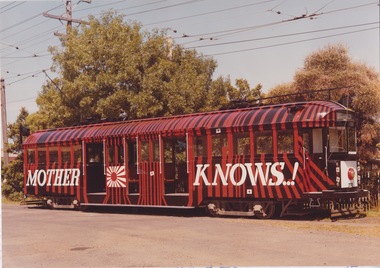
... Japanese flag created controversy at the time. The second and third photos show the flag covered over. The tram was subsequently repainted during 1978. From the Museum's webpage on Transporting Art: "Peter Corrigan’s cheeky No. 567 created an international incident – the Japanese Embassy lodged a diplomatic protest over his use of their naval ensign with the enigmatic slogan ‘Mother Knows’. ...Japanese flag created controversy at the time. The second and third photos show the flag covered over. The tram was subsequently repainted during 1978. From the Museum's webpage on Transporting Art: "Peter Corrigan’s cheeky No. 567 created an international incident – the Japanese Embassy lodged a diplomatic protest over his use of their naval ensign with the enigmatic slogan ‘Mother Knows’. ...Photograph shows W2 class tram 567 in Art Tram livery possibly at the Simpson St sidings. Large wording on one side reads "Mother Knows" with a Japanese naval ensign or flag painted between the words, possibly cover a third word. The artist was Peter Corrigan, the work using the Japanese flag created controversy at the time. The second and third photos show the flag covered over. The tram was subsequently repainted during 1978. From the Museum's webpage on Transporting Art: "Peter Corrigan’s cheeky No. 567 created an international incident – the Japanese Embassy lodged a diplomatic protest over his use of their naval ensign with the enigmatic slogan ‘Mother Knows’. The tram was hurriedly withdrawn, and the offending flags were quickly overpainted before No. 567 re-entered traffic. By report, Corrigan was less than impressed by this act of official censorship. Even in its adulterated form, No. 567 did not last, as it was overpainted in 1982". See item 8685.Yields information about Art Tram W2 567.Colour print some with notes on the rear - set of 3.On the smaller prints in pencil "567, Peter Corrigan withdrawn"w2 class, tram 567, art tram, preston workshops, peter corrigan, transporting art -
 Federation University Art Collection
Ceramic, 'Shino Milk Jug' by Bridget Bodenham, 2007
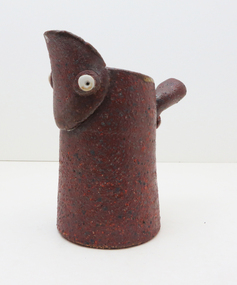
... Bridget Bodenham was a finalist in the Bombay Sapphire Design Discovery Award (2008) for a series of ceramic mortars and pestles, and received an Honourable Mention in the Mino International Ceramic Award, Japan. Bridget aims to create a sense of curiosity and reflection in form and function. ...Bridget Bodenham was a finalist in the Bombay Sapphire Design Discovery Award (2008) for a series of ceramic mortars and pestles, and received an Honourable Mention in the Mino International Ceramic Award, Japan. Bridget aims to create a sense of curiosity and reflection in form and function. ...Bridget BODENHAM Bridget Bodenham has a Diploma of Arts (Ceramics) from the University of Ballarat (now Federation University. In 2006 she received an Emerging Artist grant from the Australia Council for the Arts and was also part of Craft’s annual graduate survey exhibition, Fresh!. She works full time making ceramic serving ware, tableware, utensils and jewellery as well as planter pots and flower vases. The majority of her work is designed to be used and enjoyed. Bridget feels a connection to her surrounding bushland landscape and interprets the tones and textures in her work. She takes great care in creating each piece by hand and firing them up to three times in her large gas kiln. Each firing is totally unique resulting in one off pieces. Bridget Bodenham was a finalist in the Bombay Sapphire Design Discovery Award (2008) for a series of ceramic mortars and pestles, and received an Honourable Mention in the Mino International Ceramic Award, Japan. Bridget aims to create a sense of curiosity and reflection in form and function. She hopes her work delights and engages the owners hands and heart into everyday activities. The Federation University Art Collection features over 2000 works and was listed as a 'Ballarat Treasure' in 2007.Small, thrown ceramic vessel / jug with handle and lip. art, artwork, bridget bodenham, ceramics, alumni -
 Federation University Art Collection
Ceramic - Artwork - Ceramics, Bridget Bodenham, [Dining Setting] by Bridget Bodenham, 2006
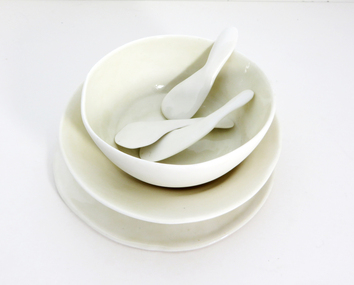
... Bridget Bodenham was a finalist in the Bombay Sapphire Design Discovery Award (2008) for a series of ceramic mortars and pestles, and received an Honourable Mention in the Mino International Ceramic Award, Japan. Bridget aims to create a sense of curiosity and reflection in form and function. ...Bridget Bodenham was a finalist in the Bombay Sapphire Design Discovery Award (2008) for a series of ceramic mortars and pestles, and received an Honourable Mention in the Mino International Ceramic Award, Japan. Bridget aims to create a sense of curiosity and reflection in form and function. ...Bridget BODENHAM Bridget Bodenham has a Diploma of Arts (Ceramics) from the University of Ballarat (now Federation University. In 2006 she received an Emerging Artist grant from the Australia Council for the Arts and was also part of Craft’s annual graduate survey exhibition, Fresh!. She works full time making ceramic serving ware, tableware, utensils and jewellery as well as planter pots and flower vases. The majority of her work is designed to be used and enjoyed. Bridget feels a connection to her surrounding bushland landscape and interprets the tones and textures in her work. She takes great care in creating each piece by hand and firing them up to three times in her large gas kiln. Each firing is totally unique resulting in one off pieces. Bridget Bodenham was a finalist in the Bombay Sapphire Design Discovery Award (2008) for a series of ceramic mortars and pestles, and received an Honourable Mention in the Mino International Ceramic Award, Japan. Bridget aims to create a sense of curiosity and reflection in form and function. She hopes her work delights and engages the owners hands and heart into everyday activities. This piece won the SMB DVC Visual Arts Acquisition Award, 2006Mould made dining setting consisting of plate, two bowls and three eating utensils. Makers mark on versoceramics, bridget bodenham, artwork, alumni, dvc aquisition award -
 National Wool Museum
Million Dollar Bale Wool Sample, 1995
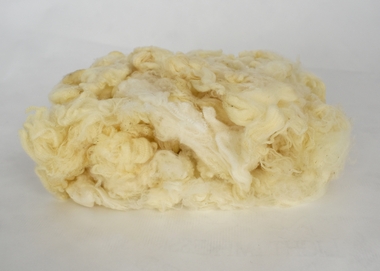
... The clean wool was hand-packed into cardboard cartons and freighted to Japan. Aoki International, based in Yokohama Japan, cut three suit lengths from the cloth, then blended the remaining wool into an exclusive line of commercially-available suits. ...The clean wool was hand-packed into cardboard cartons and freighted to Japan. Aoki International, based in Yokohama Japan, cut three suit lengths from the cloth, then blended the remaining wool into an exclusive line of commercially-available suits. ...The wool was shorn from sheep of the Wyndarra and Rockbank bloodlines. A flock of 290 sheep were kept undercover at Kadinia, the property of the Appledore family from Brim in the Wimmera district of Victoria. Their record-breaking wool was produced by giving the sheep a special diet and providing each one with a UV-protective coat. Around 180 fleeces were selected for the million dollar bale. The sale of the first bale of wool measuring below 14 microns was held in the Auction Room here at the National Wool Museum. Bidding began at $600/kg and steadily increased until there were only two bidders left. The bidders represented the Japanese firm Aoki International and Loro Piana of Italy. The hammer fell at $10,300/kg, with Aoki International paying $1,194,800 for the 116kg bale. The fleece was scoured (cleaned) at the Goulburn Wool Scour, New South Wales. The degree of preparation and care taken with the task was extreme. The Scour closed production three days before and was extensively cleaned. On the day of scouring 12 tonnes of 17 micron wool was washed to condition the water, then nine bales of extra super fine wool, worth over $300,000 was washed as a trial run. Toabo Agaki Japan was employed to process the scoured wool into suit cloth. Taobo required the scoured wool to contain 0.5% residual grease, 12% moisture and a yield of 83kg. These requirements were met. The entire staff of the Scour wanted to be part of washing the best wool in the world. Without asking for payment both the night shift and afternoon shift crews assisted the day shift in the task. The bale was fed into the scour in seven minutes and fitted into three bowls, half the scour. It completely disappeared into the dryer and the last wool was fed before the first wool was out. The clean wool was hand-packed into cardboard cartons and freighted to Japan. Aoki International, based in Yokohama Japan, cut three suit lengths from the cloth, then blended the remaining wool into an exclusive line of commercially-available suits. These suits are labeled Kadinia.Wool sample from the Million Dollar Balewool sales, million dollar bale -
 Bacchus Marsh & District Historical Society
Banner, KEIO Hawks Football Club Pennant
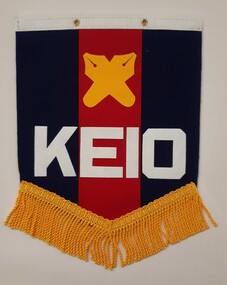
... They then played Japan's first international match against the Sunbury Football Club's under-19 team.The following year they returned to Australia and during this visit played a match in Bacchus Marsh in September 1989. ...They then played Japan's first international match against the Sunbury Football Club's under-19 team.The following year they returned to Australia and during this visit played a match in Bacchus Marsh in September 1989. ...The Keio University Hawks were one of the first two Aussie rules teams in Japan, along with the Waseda University Bombers. Those teams were formed to play a warm-up game at Yokohama baseball stadium before an exhibition match between VFL teams Essendon and Hawthorn. The first visit by the Keio Hawks to Australia was in September 1988, About 20 students from Keio and two or three from other universities made the trip. Their visit included training sessions at the Hawthorn and North Melbourne clubs. They then played Japan's first international match against the Sunbury Football Club's under-19 team.The following year they returned to Australia and during this visit played a match in Bacchus Marsh in September 1989. The Keio Hawks returned to Australia over subsequent years in the 1990s included some visits to Bacchus Marsh. During one of these visit a Keio Hawks pennant was presented to the Shire of Bacchus Marsh.Football club banner. Three vertical felt stripes in red and blue with the team name KEIO written in white felt block letters across the width of the banner. Along the top of the banner, a narrow strip of white felt with two metal eyelets to allow for display. Gold coloured textile fringe along the V-shaped bottom of the banner. In a whimsical reference to the university origin of the club, there are two gold felt crossed pen-nibs on the central red section. KEIOkeio university australian rules football club, australian rules football teams japan, australian rules football bacchus marsh -
 National Wool Museum
Functional object - Auctioneer's Gavel, c. 1950s
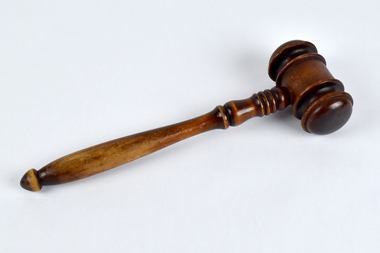
... The clean wool was hand-packed into cardboard cartons and freighted to Japan. Aoki International, based in Yokohama Japan, cut three suit lengths from the cloth, then blended the remaining wool into an exclusive line of commercially-available suits. ...The clean wool was hand-packed into cardboard cartons and freighted to Japan. Aoki International, based in Yokohama Japan, cut three suit lengths from the cloth, then blended the remaining wool into an exclusive line of commercially-available suits. ...Michael Crooks was the auctioneer responsible for selling Australia's million dollar wool bale on the 11th January, 1995 in Geelong, using this gavel. The wool was shorn from sheep of the Wyndarra and Rockbank bloodlines. A flock of 290 sheep were kept undercover at Kadinia, the property of the Appledore family from Brim in the Wimmera district of Victoria. Their record-breaking wool was produced by giving the sheep a special diet and providing each one with a UV-protective coat. Around 180 fleeces were selected for the million dollar bale. The sale of the first bale of wool measuring below 14 microns was held in the Auction Room here at the National Wool Museum. Bidding began at 40,000 (cents a kilogram) and steadily increased until there were only two bidders left. The bidders represented the Japanese firm Aoki International and Loro Piana of Italy. The hammer fell at 1,030,000 cents per kilogram, with Aoki International paying $1,194,800 for the 116kg bale. The fleece was scoured (cleaned) at the Goulburn Wool Scour, New South Wales. The degree of preparation and care taken with the task was extreme. The Scour closed production three days before and was extensively cleaned. On the day of scouring 12 tonnes of 17 micron wool was washed to condition the water, then nine bales of extra super fine wool, worth over $300,000 was washed as a trial run. Toabo Agaki Japan was employed to process the scoured wool into suit cloth. Taobo required the scoured wool to contain 0.5% residual grease, 12% moisture and a yield of 83kg. These requirements were met. The entire staff of the Scour wanted to be part of washing the best wool in the world. Without asking for payment both the night shift and afternoon shift crews assisted the day shift in the task. The bale was fed into the scour in seven minutes and fitted into three bowls, half the scour. It completely disappeared into the dryer and the last wool was fed before the first wool was out. The clean wool was hand-packed into cardboard cartons and freighted to Japan. Aoki International, based in Yokohama Japan, cut three suit lengths from the cloth, then blended the remaining wool into an exclusive line of commercially-available suits. These suits are labelled Kadinia.Small wooden hammer, with handle and double sided face.gavel, michael crooks, auctioneer, wool industry, million dollar bale, geelong, auction, kadinia, appledore -
 National Wool Museum
Photograph - Armed Guards with Million Dollar Bale, 11 January 1995
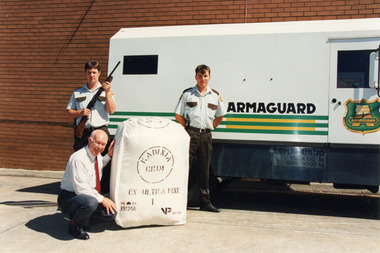
... The clean wool was hand-packed into cardboard cartons and freighted to Japan. Aoki International, based in Yokohama Japan, cut three suit lengths from the cloth, then blended the remaining wool into an exclusive line of commercially-available suits. ...The clean wool was hand-packed into cardboard cartons and freighted to Japan. Aoki International, based in Yokohama Japan, cut three suit lengths from the cloth, then blended the remaining wool into an exclusive line of commercially-available suits. ...This photograph shows armed guards and Wool Manager Keith Jackson posing with the million dollar wool bale after it was sold by auctioneer Michael Crooks on the 11th January, 1995 in Geelong. The wool was shorn from sheep of the Wyndarra and Rockbank bloodlines. A flock of 290 sheep were kept undercover at Kadinia, the property of the Appledore family from Brim in the Wimmera district of Victoria. Their record-breaking wool was produced by giving the sheep a special diet and providing each one with a UV-protective coat. Around 180 fleeces were selected for the million dollar bale. The sale of the first bale of wool measuring below 14 microns was held in the Auction Room here at the National Wool Museum. Bidding began at 40,000 (cents a kilogram) and steadily increased until there were only two bidders left. The bidders represented the Japanese firm Aoki International and Loro Piana of Italy. The hammer fell at 1,030,000 cents per kilogram, with Aoki International paying $1,194,800 for the 116kg bale. The fleece was scoured (cleaned) at the Goulburn Wool Scour, New South Wales. The degree of preparation and care taken with the task was extreme. The Scour closed production three days before and was extensively cleaned. On the day of scouring 12 tonnes of 17 micron wool was washed to condition the water, then nine bales of extra super fine wool, worth over $300,000 was washed as a trial run. Toabo Agaki Japan was employed to process the scoured wool into suit cloth. Taobo required the scoured wool to contain 0.5% residual grease, 12% moisture and a yield of 83kg. These requirements were met. The entire staff of the Scour wanted to be part of washing the best wool in the world. Without asking for payment both the night shift and afternoon shift crews assisted the day shift in the task. The bale was fed into the scour in seven minutes and fitted into three bowls, half the scour. It completely disappeared into the dryer and the last wool was fed before the first wool was out. The clean wool was hand-packed into cardboard cartons and freighted to Japan. Aoki International, based in Yokohama Japan, cut three suit lengths from the cloth, then blended the remaining wool into an exclusive line of commercially-available suits. These suits are labelled Kadinia.Colour photograph showing three men with a bale of wool in front of an armaguard truck. Two of the men are armed guards standing either side of the wool bale, one is holding a shotgun. Another man in a suit and tie is crouching near the bale.gavel, michael crooks, auctioneer, wool industry, million dollar bale, geelong, auction, kadinia, appledore, keith jackson, armed guards, armaguard -
 National Wool Museum
Photograph - Appledore Family, Growers Gallery, National Wool Centre, Geelong, 11 January 1995
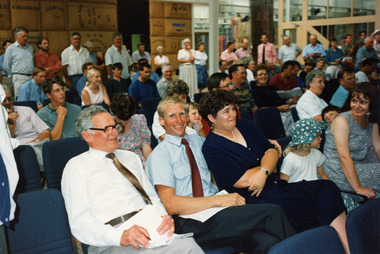
... The clean wool was hand-packed into cardboard cartons and freighted to Japan. Aoki International, based in Yokohama Japan, cut three suit lengths from the cloth, then blended the remaining wool into an exclusive line of commercially-available suits. ...The clean wool was hand-packed into cardboard cartons and freighted to Japan. Aoki International, based in Yokohama Japan, cut three suit lengths from the cloth, then blended the remaining wool into an exclusive line of commercially-available suits. ...This photograph depicts people gathered in the Growers Gallery on the 11th January, 1995 at the National Wool Centre, Geelong. It shows the emotions of Murray, Ian and Kaye Appledore while bidding took place for the million dollar bale. The wool was shorn from sheep of the Wyndarra and Rockbank bloodlines. A flock of 290 sheep were kept undercover at Kadinia, the property of the Appledore family from Brim in the Wimmera district of Victoria. Their record-breaking wool was produced by giving the sheep a special diet and providing each one with a UV-protective coat. Around 180 fleeces were selected for the million dollar bale. The sale of the first bale of wool measuring below 14 microns was held in the Auction Room here at the National Wool Museum. Bidding began at 40,000 (cents a kilogram) and steadily increased until there were only two bidders left. The bidders represented the Japanese firm Aoki International and Loro Piana of Italy. The hammer fell at 1,030,000 cents per kilogram, with Aoki International paying $1,194,800 for the 116kg bale. The fleece was scoured (cleaned) at the Goulburn Wool Scour, New South Wales. The degree of preparation and care taken with the task was extreme. The Scour closed production three days before and was extensively cleaned. On the day of scouring 12 tonnes of 17 micron wool was washed to condition the water, then nine bales of extra super fine wool, worth over $300,000 was washed as a trial run. Toabo Agaki Japan was employed to process the scoured wool into suit cloth. Taobo required the scoured wool to contain 0.5% residual grease, 12% moisture and a yield of 83kg. These requirements were met. The entire staff of the Scour wanted to be part of washing the best wool in the world. Without asking for payment both the night shift and afternoon shift crews assisted the day shift in the task. The bale was fed into the scour in seven minutes and fitted into three bowls, half the scour. It completely disappeared into the dryer and the last wool was fed before the first wool was out. The clean wool was hand-packed into cardboard cartons and freighted to Japan. Aoki International, based in Yokohama Japan, cut three suit lengths from the cloth, then blended the remaining wool into an exclusive line of commercially-available suits. These suits are labelled Kadinia.Colour photograph showing an interior view of rows of people seated and standing in room.michael crooks, auctioneer, wool industry, million dollar bale, geelong, auction, kadinia, appledore, keith jackson, sale room -
 National Wool Museum
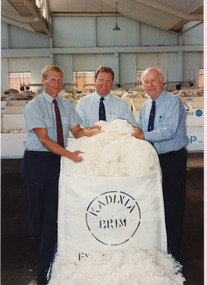
Photograph - Million Dollar Bale, National Wool Centre, Geelong, 11 January 1995
... The clean wool was hand-packed into cardboard cartons and freighted to Japan. Aoki International, based in Yokohama Japan, cut three suit lengths from the cloth, then blended the remaining wool into an exclusive line of commercially-available suits. ...The clean wool was hand-packed into cardboard cartons and freighted to Japan. Aoki International, based in Yokohama Japan, cut three suit lengths from the cloth, then blended the remaining wool into an exclusive line of commercially-available suits. ...This photograph shows Grower Ian Appledore, Auctioneer Michael Crooks and Wool Manager Keith Jackson posing with the million dollar bale after it was sold on 11th January 1995 in Geelong. The wool was shorn from sheep of the Wyndarra and Rockbank bloodlines. A flock of 290 sheep were kept undercover at Kadinia, the property of the Appledore family from Brim in the Wimmera district of Victoria. Their record-breaking wool was produced by giving the sheep a special diet and providing each one with a UV-protective coat. Around 180 fleeces were selected for the million dollar bale. The sale of the first bale of wool measuring below 14 microns was held in the Auction Room here at the National Wool Museum. Bidding began at 40,000 (cents a kilogram) and steadily increased until there were only two bidders left. The bidders represented the Japanese firm Aoki International and Loro Piana of Italy. The hammer fell at 1,030,000 cents per kilogram, with Aoki International paying $1,194,800 for the 116kg bale. The fleece was scoured (cleaned) at the Goulburn Wool Scour, New South Wales. The degree of preparation and care taken with the task was extreme. The Scour closed production three days before and was extensively cleaned. On the day of scouring 12 tonnes of 17 micron wool was washed to condition the water, then nine bales of extra super fine wool, worth over $300,000 was washed as a trial run. Toabo Agaki Japan was employed to process the scoured wool into suit cloth. Taobo required the scoured wool to contain 0.5% residual grease, 12% moisture and a yield of 83kg. These requirements were met. The entire staff of the Scour wanted to be part of washing the best wool in the world. Without asking for payment both the night shift and afternoon shift crews assisted the day shift in the task. The bale was fed into the scour in seven minutes and fitted into three bowls, half the scour. It completely disappeared into the dryer and the last wool was fed before the first wool was out. The clean wool was hand-packed into cardboard cartons and freighted to Japan. Aoki International, based in Yokohama Japan, cut three suit lengths from the cloth, then blended the remaining wool into an exclusive line of commercially-available suits. These suits are labelled Kadinia.Colour photograph showing three men standing around a bale of wool.michael crooks, auctioneer, wool industry, million dollar bale, geelong, auction, kadinia, appledore, keith jackson, sale room, geelong wool centre -
 National Wool Museum
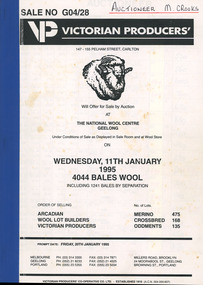
Document - Victorian Producers' Sale Catalogue, National Wool Centre, Geelong, Victorian Producers' Co-operative Limited, 11 January 1995
... The clean wool was hand-packed into cardboard cartons and freighted to Japan. Aoki International, based in Yokohama Japan, cut three suit lengths from the cloth, then blended the remaining wool into an exclusive line of commercially-available suits. ...The clean wool was hand-packed into cardboard cartons and freighted to Japan. Aoki International, based in Yokohama Japan, cut three suit lengths from the cloth, then blended the remaining wool into an exclusive line of commercially-available suits. ...This sales catalogue was the one used by Auctioneer Michael Crooks on 11th January 1995 when the million dollar bale was sold at the National Wool Centre, Geelong. The wool was shorn from sheep of the Wyndarra and Rockbank bloodlines. A flock of 290 sheep were kept undercover at Kadinia, the property of the Appledore family from Brim in the Wimmera district of Victoria. Their record-breaking wool was produced by giving the sheep a special diet and providing each one with a UV-protective coat. Around 180 fleeces were selected for the million dollar bale. The sale of the first bale of wool measuring below 14 microns was held in the Auction Room here at the National Wool Museum. Bidding began at 40,000 (cents a kilogram) and steadily increased until there were only two bidders left. The bidders represented the Japanese firm Aoki International and Loro Piana of Italy. The hammer fell at 1,030,000 cents per kilogram, with Aoki International paying $1,194,800 for the 116kg bale. The fleece was scoured (cleaned) at the Goulburn Wool Scour, New South Wales. The degree of preparation and care taken with the task was extreme. The Scour closed production three days before and was extensively cleaned. On the day of scouring 12 tonnes of 17 micron wool was washed to condition the water, then nine bales of extra super fine wool, worth over $300,000 was washed as a trial run. Toabo Agaki Japan was employed to process the scoured wool into suit cloth. Taobo required the scoured wool to contain 0.5% residual grease, 12% moisture and a yield of 83kg. These requirements were met. The entire staff of the Scour wanted to be part of washing the best wool in the world. Without asking for payment both the night shift and afternoon shift crews assisted the day shift in the task. The bale was fed into the scour in seven minutes and fitted into three bowls, half the scour. It completely disappeared into the dryer and the last wool was fed before the first wool was out. The clean wool was hand-packed into cardboard cartons and freighted to Japan. Aoki International, based in Yokohama Japan, cut three suit lengths from the cloth, then blended the remaining wool into an exclusive line of commercially-available suits. These suits are labelled Kadinia.Bound paper booklet, approximately 35 pages, with printed and handwritten text.Front: [handwritten] AUCTIONEER M. CROOKS Front: [printed] SALE NO G04/28 / VICTORIAN PRODUCERS' / 147-155 PELHAM STREET, CARLTON / Will Offer for Sale by Auction / AT / THE NATIONAL WOOL CENTRE / GEELONG / Under Conditions of Sale as Displayed in Sale Room and at Wool Store / ON / WEDNESDAY, 11TH JANUARY / 1995 / 4044 BALES WOOL / INCLUDING 1241 BALES BY SEPARATIONmichael crooks, auctioneer, wool industry, million dollar bale, geelong, auction, kadinia, appledore, keith jackson, sale room, geelong wool centre -
 National Wool Museum
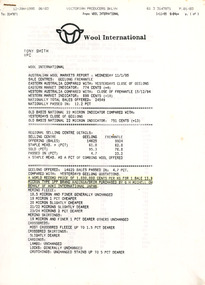
Document - Australian Wool Markets Report, Wool International, 11 January 1995
... The clean wool was hand-packed into cardboard cartons and freighted to Japan. Aoki International, based in Yokohama Japan, cut three suit lengths from the cloth, then blended the remaining wool into an exclusive line of commercially-available suits. ...The clean wool was hand-packed into cardboard cartons and freighted to Japan. Aoki International, based in Yokohama Japan, cut three suit lengths from the cloth, then blended the remaining wool into an exclusive line of commercially-available suits. ...Australian Wool Markets Report, featuring details of the sale of the million dollar bale on Wednesday 11th January, 1995 in Geelong. The wool was shorn from sheep of the Wyndarra and Rockbank bloodlines. A flock of 290 sheep were kept undercover at Kadinia, the property of the Appledore family from Brim in the Wimmera district of Victoria. Their record-breaking wool was produced by giving the sheep a special diet and providing each one with a UV-protective coat. Around 180 fleeces were selected for the million dollar bale. The sale of the first bale of wool measuring below 14 microns was held in the Auction Room here at the National Wool Museum. Bidding began at 40,000 (cents a kilogram) and steadily increased until there were only two bidders left. The bidders represented the Japanese firm Aoki International and Loro Piana of Italy. The hammer fell at 1,030,000 cents per kilogram, with Aoki International paying $1,194,800 for the 116kg bale. The fleece was scoured (cleaned) at the Goulburn Wool Scour, New South Wales. The degree of preparation and care taken with the task was extreme. The Scour closed production three days before and was extensively cleaned. On the day of scouring 12 tonnes of 17 micron wool was washed to condition the water, then nine bales of extra super fine wool, worth over $300,000 was washed as a trial run. Toabo Agaki Japan was employed to process the scoured wool into suit cloth. Taobo required the scoured wool to contain 0.5% residual grease, 12% moisture and a yield of 83kg. These requirements were met. The entire staff of the Scour wanted to be part of washing the best wool in the world. Without asking for payment both the night shift and afternoon shift crews assisted the day shift in the task. The bale was fed into the scour in seven minutes and fitted into three bowls, half the scour. It completely disappeared into the dryer and the last wool was fed before the first wool was out. The clean wool was hand-packed into cardboard cartons and freighted to Japan. Aoki International, based in Yokohama Japan, cut three suit lengths from the cloth, then blended the remaining wool into an exclusive line of commercially-available suits. These suits are labelled Kadinia.Three pages held with staple in top left corner with printed black text.Front: [printed] Wool International / TONY SMITH / VPC / WOOL INTERNATIONAL / AUSTRALIAN WOOL MARKETS REPORT: WEDNESDAY 11/1/95michael crooks, auctioneer, wool industry, million dollar bale, geelong, auction, kadinia, appledore, keith jackson, sale room, geelong wool centre
