
Showing 18 items matching " kinetic"
-
 Dandenong & District Historical Society
Document - KINETIC Elements, Articles Concerning KINETIC Elements
... Articles Concerning KINETIC Elements...KINETIC Elements, Newspaper Article, History...Articles concerning KINETIC Elements...KINETIC Elements, Newspaper Article, History Articles concerning KINETIC Elements Articles Concerning KINETIC Elements Document KINETIC Elements ...KINETIC Elements, Newspaper Article, History -
 Queenscliffe Maritime Museum
Equipment - Personal EPIRB
... Kinetic Technology Int Pty Ltd...EPIRB Safety at Sea Kinetic Technology Int Pty Ltd Pains Wessex Mini Resqsat RB3 Personal 121.5 / 243 MHz EPIRB Equipment Personal EPIRB ...Pains Wessex Mini Resqsat RB3 Personal 121.5 / 243 MHz EPIRBKinetic Technology Int Pty Ltdepirb, safety at sea -
 Nillumbik Shire Council
Sculpture: Deborah HALPERN (b.1957 Melb., AUS), Deborah Halpern, Wayfarer, 2010
... Sculpture - Kinetic Ceramic, Glass, Fibreglass, Aluminium ...A cubist inspired kinetic work in three parts, the artwork depicts a semi abstract figure, a ‘traveller’ made out of reflective mirror and colourful ceramic tiles. ...Local resident Deborah Halpern is a highly recognised and respected contemporary artist with an acclaimed national and international reputation in the arts community. She has a strong artistic connection to the area as her parents were founding members of Potters Cottage - a group of local ceramicists who were influential in the development of ceramics in Australia. Deborah Halpern donated Wayfarer through the Australian Government Cultural Gift Program. A cubist inspired kinetic work in three parts, the artwork depicts a semi abstract figure, a ‘traveller’ made out of reflective mirror and colourful ceramic tiles. Wayfarer is an excellent example of Halpern’s tile construction technique and playful style that she is renowned for. Wayfarer is one of Halpern’s first works exploring kinetics as well as combining mirror with painted ceramic tiles. Sculpture - Kinetic Ceramic, Glass, Fibreglass, Aluminium deborah halpern, wayfarer, nillumbik shire council -
 Moorabbin Air Museum
Weapon (item) - Lazy Dog Bomb - " CONTAINS NO EXPLOSIVE"
... Lazy Dog Bomb - " CONTAINS NO EXPLOSIVE", a small unguided kinetic projectile. These were solid-steel slugs not technically bombs as the contained no explosives, but were lethal due to their high kinetic energy when dropped from aircraft....Lazy Dog Bomb - " CONTAINS NO EXPLOSIVE", a small unguided kinetic projectile. These were solid-steel slugs not technically bombs as the contained no explosives, but were lethal due to their high kinetic energy when dropped from aircraft. ... -
 City of Ballarat
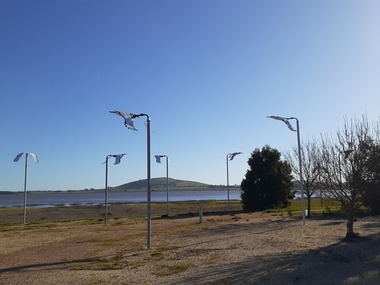
Artwork, other - Public Artwork, Friends of Learmonth, Flock by The Friends of Learmonth
... The Flock is a kinetic sculpture made up of 11 parts. It celebrates a local migratory bird, the ibis. ...The Flock is a kinetic sculpture made up of 11 parts. It celebrates a local migratory bird, the ibis. ...The Flock is a kinetic sculpture made up of 11 parts. It celebrates a local migratory bird, the ibis. The sculpture comprises tall steel poles with a steel ibis balanced on the top of each pole by its beak. Balanced on a spherical joint to allow fluid movement in all directions, each element of the Flock is designed to look like a bird in flight. The kinetic wind-powered elements of the artwork were inspired by the nearby Waubra Wind Farm.The artwork is of aesthetic and social significance to the people of BallaratEleven white and black birds on poles with moving partsibis, friends of learmonth, learmonth -
Women's Art Register
Archive (Collection) - Hannah Gartside Artist Archive
... ... Kinetic...Clothing Gender Feminism Assemblage Kinetic Textiles Installation Sculpture Archive Hannah Gartside Artist Archive ...clothing, gender, feminism, assemblage, kinetic, textiles, installation, sculptureclothing, gender, feminism, assemblage, kinetic, textiles, installation, sculpture -
Women's Art Register
Archive (Series) - Gartside, Hannah. Artist File 1
... ... Kinetic...Clothing Gender Feminism Assemblage Kinetic Textiles Installation Sculpture Foolscap white archival 4 flap folder or document wallet Archive Gartside, Hannah. ...List of Images, CV, Catalogues, Promotional Materialclothing, gender, feminism, assemblage, kinetic, textiles, installation, sculptureclothing, gender, feminism, assemblage, kinetic, textiles, installation, sculpture -
Women's Art Register
Archive (Series) - Hannah Gartside. Duplicate File 1
... ... Kinetic...Textiles Installation Sculpture Clothing Gender Feminism Assemblage Kinetic Foolscap manilla file Archive Hannah Gartside. ...List of Images, CV, Catalogues, Promotional Materialtextiles, installation, sculpture, clothing, gender, feminism, assemblage, kinetictextiles, installation, sculpture, clothing, gender, feminism, assemblage, kinetic -
 National Vietnam Veterans Museum (NVVM)
Weapon, Bomb
... Lazy Dog "bombs" (sometimes called Red Dot Bombs or Yellow Dog Bombs) projectiles were small, unguided kinetic missiles, each measuring 1.75 inches in length, 0.5 inches in diameter, and weighing 207 grams, or about 0.03 pounds or 0.7 oz. ...Lazy Dog (bomb) projectiles Mark 44 Lazy Dog "bombs" (sometimes called Red Dot Bombs or Yellow Dog Bombs) projectiles were small, unguided kinetic missiles, each measuring 1.75 inches in length, 0.5 inches in diameter, and weighing 207 grams, or about 0.03 pounds or 0.7 oz. ...Lazy Dog "bombs" (sometimes called Red Dot Bombs or Yellow Dog Bombs) projectiles were small, unguided kinetic missiles, each measuring 1.75 inches in length, 0.5 inches in diameter, and weighing 207 grams, or about 0.03 pounds or 0.7 oz. Lazy Dog Bombs were designed to be dispersed over the battlefield with mark 44 cluster adapters. Lazy Dog Bonbs were technically not bombs because they used no explosive, but were in many ways equally destructive. Mark 44 cluster adapters were one of many possible means to deliver "Lazy Dog" projectiles.lazy dog (bomb), projectiles, mark 44 -
 City of Ballarat
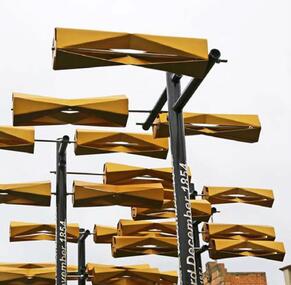
Artwork, other - Public Artwork, Aaron Robinson et al, Flow by Holly Grace and Aaron Robinson, 2014
... Flowing over the site a series of kinetic turbines flutter in the wind creating a contemporary water race. ...Flowing over the site a series of kinetic turbines flutter in the wind creating a contemporary water race. ...Water is key to a thriving community and it is through the representation of water Flow enlivens the space at Bakery Hill. Historically ‘water races’ ran through the valleys of the Greater Ballarat area unearthing the minerals that forged prosperity and wealth. This water still flows today unearthing new possibilities for the community. Possibilities focusing on sustainability, ecology, health and prosperity. Flowing over the site a series of kinetic turbines flutter in the wind creating a contemporary water race. The interactive elements offer visual stimulation enticing people to connect with the artwork and in turn the surrounding spaces. Bakery Hill has great historical significance. It’s connection to the Eureka Stockade and the series of events that were to unfold during the 1850’s was to become the turning point in Australian political history. The placement of each turbine is to mirror a point of history in the timeline of events that occurred during the Eureka Stockade. The Water Race is a symbol of possibilities, the ones created by history and those of modern society. It is a visual timeline that can be read by traversing the site. The connecting turbines that flow and turn in sync are a representation of time passing and the interconnectedness of history with the community that surrounds it. The gateway to Bridge Mall is framed through the placement of each turbine allowing the sense of prosperity and wealth to flow through to the surrounding community. This gateway also references the significance of Bakery Hill reinvigorating the historical site by reconnecting it back to its town centre. The artwork is of aesthetic and historical significance to the people of BallaratTwelve steel turbines set on poles with dates attached and a large bronze 'timeline' plaqueFLOW/ Plotting the motion of Wind, Water, History and Time/ by Holly Grace and Aaron Robinson/ This site has great historical significance. It’s connection to the Eureka Stockade and the series of events that unfolded in the 1850’s was to become the turning point in Australian history. The placement of each turbine within this artwork mirrors a point of history in the events that led up to the Eureka Stockade. It is a visual timeline that can be read by traversing the site. The connecting turbines that flow and turn in sync are a representation of time passing. They are a symbol of the community’s connection to their history. 1851 June James Esmond makes the first discovery of gold in Victoria at Clunes./ 1st July The Port Phillip District separates from New South Wales and becomes the Colony of Victoria. It is still subject to British rule./ August Gold is discovered at Buninyong and at Golden Point, Ballarat. Lt-Governor La Trobe introduces the Gold Licence system in an attempt to reduce the colony’s debt./ 20th September First gold licences issued in Ballarat. / 1852 August/ Eureka Lead discovered on the Ballarat goldfields. December Charles La Trobe resigns as Lt-Governor but he is not relieved until 1854/ July – December/ Unrest builds on the various goldfields with protest meetings held in Bendigo and Castlemaine. Bendigo’s Red Ribbon Movement is active on the goldfields and the Bendigo Petition is presented to Lt-Governor./ December/ Charles Hotham is appointed Lt-Governor/ 1854 March/ A bill to extend the Elective Franchise is passed by the Legislative Council and sent to London for the assent of the British Parliament. 22nd June/ Lt-Governor Sir Charles Hotham arrives in Victoria. The colony faces mounting debt and Hotham orders weekly licence hunts in an attempt to increase income./ August/ Hotham is acclaimed during his visit to the Ballarat goldfield./ 13th September? Hotham orders twice-weekly licence hunts to further increase revenue./ September – October/ Miners are experiencing problems – no shafts bottomed on the Eureka Lead for five weeks./ 7th October/ James Scobie is murdered outside the Eureka Hotel. Many diggers believe that publican James Bentley is responsible./ 9th October/ At Scobie’s inquest, Bentley is acquitted, despite strong evidence of his guilt./ 10th October/ Father Smythe’s servant is beaten up by authorities and falsely arrested for not holding a licence./ 15th October/ Mass meeting of miners on Bakery Hill. Catholic miners meet after Mass. // 17th October/ A meeting of up to 10,000 Diggers is held near the Eureka Hotel to protest against Bentley’s acquittal. The meeting results in the burning of the hotel. Three diggers, Westerby, Fletcher and McIntyre, are arrested. Hotham dispatches 400 soldiers to Ballarat. 22nd October/ Another large meeting is held to address grievances. The Catholics send their leaders, Hayes, Kennedy and Manning to meet Rede. The Government Camp is under siege 11th November/ A public meeting on Bakery Hill results in the formal establishment of the Ballarat Reform League and adoption of the League’s proposals./ 21st November/ The enquiry into the Bentley affair is published. It recommends the dismissal of the judge and the establishment of a Royal Commission. 23rd November/ Westerby, Fletcher and McIntyre are convicted of burning the hotel. The Ballarat Reform League demands their release. 27th November/ A deputation from The Ballarat Reform League, including Humffray, Black and Kennedy, meet with Hotham to demand the release of the three prisoners. Hotham does not believe the diggers have the right to “demand anything”, Rede requests reinforcements in Ballarat. 28th November/ Miners attack the troop reinforcements and wagons passing near the Eureka diggings. A drummer boy is seriously wounded. 29th November/ A “Monster Meeting” attended by more than 10,000 diggers is held on Bakery Hill. The Southern Cross flag is flown for the first time. Peter Lalor addresses the miners and a number of diggers burn their licences. 30th November/ A licence hunt occurs in the morning at the order of Commissioner Rede. Another meeting of radical miners is held on Bakery Hill. Peter Lalor becomes leader of the diggers and calls for volunteers. Many diggers wear an oath to defend their rights and liberties under the Southern Cross flag. A number of diggers move to the Eureka Lead and start to erect a stockade. 3rd December In the early hours of Sunday morning 296 soldiers and police led by Captain Thomas proceed from the Government Camp to the Eureka Lead and attack the Stockade. 22 diggers and 7 military are officially listed as being killed. Many others are wounded. Approximately 120 diggers are arrested and marched to the Government Camp. 4th December/ Funeral of some of the fallen diggers and soldiers. Martial Law is proclaimed in Ballarat. Henry Seekamp, editor of the Ballarat Times is charged with seditious libel. 6th December/ Major General Sir Robert Nickle, commander-in-chief of the military forces in the Australian colonies, arrives in Ballarat. 9th December/ General Nickle repeals martial law. 14th December/ The Gold Fields Commission sits for the first time. 18th December/ The first Ballarat sitting of the Gold Fields Commission is held at Bath’s Hotel. 1855 23rd January/ Henry Seekamp is found guilt of sedition and sentenced to three months in prison. 22nd February/ The Eureka trials starts in Melbourne. February to March/ 13 prisoners are tried and acquitted amid great public rejoicing. 27th March Report of the Royal Commission recommends miners’ rights and significant reforms. 10th November/ Peter Lalor and John Basson Humffray are nominated for seats in the legislative Council. 31st December Sir Charles Hotham dies before his resignation takes effect. flow, aaron robinson, holly grace, public art, eureka stockade, bakery hill -
 Nillumbik Shire Council
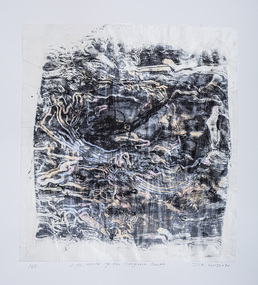
Print (woodcut and etching on chine-colle): John WOLSELEY (b.1938 Somerset, UK; arrived 1976 Melb., AUS), John Wolseley, 'Life world of the Longicorn beetle' from the 'Baldessin & Friends commemorative folio', 2016
... Using techniques of watercolour, collage, frottage, nature printing and other methods of direct physical or kinetic contact Wolseley finds ways of collaborating with the actual plants, birds, trees, rocks and earth of a particular place. ...Using techniques of watercolour, collage, frottage, nature printing and other methods of direct physical or kinetic contact Wolseley finds ways of collaborating with the actual plants, birds, trees, rocks and earth of a particular place. ...Painter, printmaker and installation artist John Wolseley was born in Somerset, England. He lived and worked throughout Europe before relocating to Australia in 1976. His work explores how people dwell and move within landscape. Wolseley see's himself as a hybrid mix of artist and scientist; one who tries to relate the minutiae of the natural world - leaf, feather and beetle wing - to the abstract dimensions of the earth's dynamic systems. Using techniques of watercolour, collage, frottage, nature printing and other methods of direct physical or kinetic contact Wolseley finds ways of collaborating with the actual plants, birds, trees, rocks and earth of a particular place. George Baldessin was one of the first artists John Wolseley met when he arrived in Australia in 1976. Both immigrated to Australia and connected through this shared experience. They were both at 'Realities Gallery' with Marianne Baillieu in the 1970s and 80s. George Baldessin (1939-1978) was born in San Biagio di Callalta, in the Veneto in Northern Italy and arrived in Australia ten years later. A printmaker and sculptor he built his bluestone studio at St Andrews (Nillumbik) in 1971 with his partner Tess and the three Hails brothers, Rob, Doug and Don. Made of recycled materials the studio today contains all of George’s equipment including the large press, which he modelled himself with the help of Neil Jeffrey (Enjay Presses). George won many prizes throughout his career and is represented in many of Australia's public art collections including his famous 'Pears' sculpture in front of the National Gallery of Australia, Canberra. In 1975 he represented Australia in the Sao Paulo Biennale, before living and working in Paris until his return to St Andrews in 1977. In 1978 George was killed in a car accident aged 39 years. In 2001 Tess returned to St Andrews to reclaim the run-down studio and reconstitute it as The Baldessin Press & Studio - a printmaking retreat. It operates in George’s memory, so that artists may continue to create, perpetuating the generous spirit of George. 'Life world of the Longicorn beetle' is one of eight prints in the 'Baldessin & Friends commemorative folio. The folio was conceived by Tess Edwards as a fundraising initiative in celebration of the The Baldessin Press & Studio's fifteen year anniversary, and as a way to honour George Baldessin's memory. The Baldessin Press & Studio is a not-for-profit organisation created in memory of the late George Baldessin (1939-1978), whose original studio is now open to the public for creative use and as a practical legacy to living artists. The Studio is located in St Andrews, Nillumbik. The folio is a unique coming together of seven very different and acclaimed artists who are connected by their friendship to the missing eighth member, George Baldessin. Communion and collaboration with nature are central to Wolseley's practice. He assembles different drawing methods to represent a kind of inventory or document about the state of the earth. His interest is to paint the processes and energy field of the living systems of this land. 'Life world of the Longicorn beetle' is his continued exploration of Australia's natural eco-systems. The beetle attacks the eucalypt and in the process of tunnelling into the wood of the tree leaves scribbly patterns. The work celebrates the cycle of life, and the wisdom and delicacy of these creatures. This three dimensional work consisting of three layers of paper is a varied edition, offering just the slightest difference between each print, reflective of variation in nature. The found log used as a woodcut acknowledges the interconnectedness of nature and living beings; the log is not apart from the art and the beetle has become an active artistic collaborator. An intimate and layered print of a tree log with line trails from the Longicorn beetle. Patches of pink, yellow and orange watercolour placed randomly. Woodcut from found log and etching on chine-colle with water colour on Gampi (top layer), Mulberry (middle layer) and Arches (bottom layer) paper. In pencil (handwritten): low plate: left '14/25' (edition); centre 'Life world of the Longicorn beetle' (title); right 'John Wolseley' (signature); low paper: right emboss 'GB' (Baldessin Press & Studio monogram)woodcut, etching, chine-colle, landscape, environment, longicorn beetle, print, baldessin, ekphrasis2018, eco, mixed media -
The Ed Muirhead Physics Museum
Coolidge X-ray Tube
... The anode has associated cooling fins due to the high temperatures attained by the release of kinetic energy by the electrons on colliding with the anode. ...The anode has associated cooling fins due to the high temperatures attained by the release of kinetic energy by the electrons on colliding with the anode. ...The investigation of the x-ray appears early on to have been a priority research topic at the University of Melbourne’s School of Physics. This interest was sparked by the appointment in 1889 of Professor T.R. Lyle. Lyle, who was head of the school until 1915, is thought to have been the first person in Australia to have taken an x-ray photograph. A copy of this photograph can be found in the School of Physics Archive. For this particular experiment Lyle actually made his own x-ray tube. His successor, Professor Laby, continued to work with x-rays. During the 1920s Laby worked on the x-ray spectra of atoms and in 1930 he co-published with Dr. C.E. Eddy, Quantitative Analysis by X-Ray Spectroscopy. Also with Eddy, Laby produced the landmark paper Sensitivity of Atomic Analysis by X-rays. Laby went on to have an x-ray spectrograph of his own design manufactured by Adam Hilger Ltd. (see cat. No. 38). School of Physics, the University of Melbourne Cat. No. 22. Jacqueline Eager Student Projects Placement, Cultural Collections 2005 In 1913 Coolidge overcame the limitation of the narrow operating range of the gas X-ray tubes with the invention of the vacuum X-ray tube. A filament heated by an electric current directly releases electrons by thermionic emission. In thermionic emission, electrons are emitted from a metal surface directly by the application of an electric current to heat a wire filament. The electrons accelerate to the anode and produce X-rays. The anode has associated cooling fins due to the high temperatures attained by the release of kinetic energy by the electrons on colliding with the anode. Internal Glass sleeve: “A941/L2593/2821” -
Federation University Historical Collection
Book, Alan J. Channon, Identification of Counter-Measures for the Control of Strain Injuries in a Public Utility, 12/1981
... viosh health and safety hazard management occupational health and safety strain injuries kinetic lifting training alan channon r. thompson Report presented for the Ballarat College of Advanced Education School of Engineering Graduate Diploma in Occupation Hazard Management. ...Report presented for the Ballarat College of Advanced Education School of Engineering Graduate Diploma in Occupation Hazard Management. The supervisor wasD.G. Greenwoodviosh, health and safety, hazard management, occupational health and safety, strain injuries, kinetic lifting training, alan channon, r. thompson -
Women's Art Register
Archive (Collection) - Margel Hinder Artist Archive
... 1906-1995 Modernism Abstraction AGNSW USA Kinetic Art Public Art Australian Reserve Bank Women's Industrial Art Society Constructivism David Jones Gallery Blake Prize Tate Gallery Captain James Cook Memorial Fountain Sculpture Stone Wood Steel Glass Archive Margel Hinder Artist Archive ...modernism, abstraction, agnsw, usa, kinetic art, public art, australian reserve bank, women's industrial art society, constructivism, david jones gallery, blake prize, tate gallery, captain james cook memorial fountain , sculpture, stone, wood, steel, glassmodernism, abstraction, agnsw, usa, kinetic art, public art, australian reserve bank, women's industrial art society, constructivism, david jones gallery, blake prize, tate gallery, captain james cook memorial fountain , sculpture, stone, wood, steel, glass -
Women's Art Register
Archive (Series) - Hinder, Margel. Artist File 1
... Modernism Abstraction AGNSW USA Kinetic Art Public Art Australian Reserve Bank Women's Industrial Art Society Constructivism David Jones Gallery Blake Prize Tate Gallery Captain James Cook Memorial Fountain Sculpture Stone Wood Steel Glass Foolscap white archival 4 flap folder or document wallet Archive Hinder, Margel. ...List of Images, CV, Biography, Newspaper Clippings, Catalogues, Promotional Material, Reviews, Artist Statements, Artwork Imagesmodernism, abstraction, agnsw, usa, kinetic art, public art, australian reserve bank, women's industrial art society, constructivism, david jones gallery, blake prize, tate gallery, captain james cook memorial fountain , sculpture, stone, wood, steel, glassmodernism, abstraction, agnsw, usa, kinetic art, public art, australian reserve bank, women's industrial art society, constructivism, david jones gallery, blake prize, tate gallery, captain james cook memorial fountain , sculpture, stone, wood, steel, glass -
Women's Art Register
Archive (Series) - Margel Hinder. Duplicate File 1
... Sculpture Stone Wood Steel Glass Modernism Abstraction AGNSW USA Kinetic Art Public Art Australian Reserve Bank Women's Industrial Art Society Constructivism David Jones Gallery Blake Prize Tate Gallery Captain James Cook Memorial Fountain Foolscap manilla file Archive Margel Hinder. ...List of Images, CV, Biography, Newspaper Clippings, Catalogues, Promotional Material, Reviews, Artist Statements, Artwork Imagessculpture, stone, wood, steel, glass, modernism, abstraction, agnsw, usa, kinetic art, public art, australian reserve bank, women's industrial art society, constructivism, david jones gallery, blake prize, tate gallery, captain james cook memorial fountainsculpture, stone, wood, steel, glass, modernism, abstraction, agnsw, usa, kinetic art, public art, australian reserve bank, women's industrial art society, constructivism, david jones gallery, blake prize, tate gallery, captain james cook memorial fountain -
Women's Art Register
Archive (Series) - Margel Hinder. Slide Kit
... Sculpture Stone Wood Steel Glass Modernism Abstraction AGNSW USA Kinetic Art Public Art Australian Reserve Bank Women's Industrial Art Society Constructivism David Jones Gallery Blake Prize Tate Gallery Captain James Cook Memorial Fountain Set of slides in Polypropylene sleeves, within a Polypropyline binder and slipcase. ...sculpture, stone, wood, steel, glass, modernism, abstraction, agnsw, usa, kinetic art, public art, australian reserve bank, women's industrial art society, constructivism, david jones gallery, blake prize, tate gallery, captain james cook memorial fountainsculpture, stone, wood, steel, glass, modernism, abstraction, agnsw, usa, kinetic art, public art, australian reserve bank, women's industrial art society, constructivism, david jones gallery, blake prize, tate gallery, captain james cook memorial fountain -
Women's Art Register
Archive (Series) - Margel Hinder, Digitised Slide Kit
... Sculpture Stone Wood Steel Glass Modernism Abstraction AGNSW USA Kinetic Art Public Art Australian Reserve Bank Women's Industrial Art Society Constructivism David Jones Gallery Blake Prize Tate Gallery Captain James Cook Memorial Fountain Archive Margel Hinder, Digitised Slide Kit ...sculpture, stone, wood, steel, glass, modernism, abstraction, agnsw, usa, kinetic art, public art, australian reserve bank, women's industrial art society, constructivism, david jones gallery, blake prize, tate gallery, captain james cook memorial fountainsculpture, stone, wood, steel, glass, modernism, abstraction, agnsw, usa, kinetic art, public art, australian reserve bank, women's industrial art society, constructivism, david jones gallery, blake prize, tate gallery, captain james cook memorial fountain
