
Showing 159 items matching " late 18th century"
-
 Embroiderers Guild, Victoria
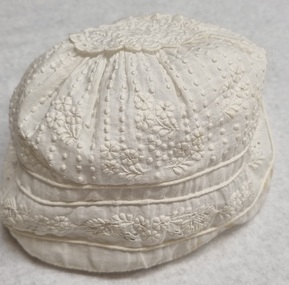
Headwear - Ayrshire Baby's Bonnet, Late 18th century
... ... Late 18th century...Late 18th century...Embroidery Bonnets Ayrshire work Late 18th century Scotland Fine linen Ayrshire Baby's Bonnet, classical style with floral design brim border in padded satin stitch and needle lace filling. ...Fine linen Ayrshire Baby's Bonnet, classical style with floral design brim border in padded satin stitch and needle lace filling. The design also includes a great number of small embroidered spots. The back has a decorated circle with a needle lace filled star in the centre surrounded by a buttonhole scallop border.embroidery, bonnets, ayrshire work, late 18th century, scotland -
 Embroiderers Guild, Victoria
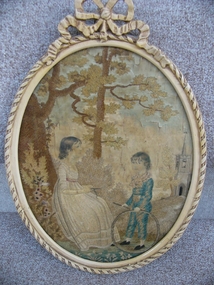
Artwork, other - 18th C Embroidered Picture, Late 18th century
... Classical small oval picture of late 18th century of early 19th century. Two children playing in a pastoral setting. ...Late 18th century...Embroidery Surface stitchery Picture 1800-20 England Classical small oval picture of late 18th century of early 19th century. Two children playing in a pastoral setting. ...Not known. The frame is not original.Classical small oval picture of late 18th century of early 19th century. Two children playing in a pastoral setting. Background is fine silk and has been painted. The faces and hair have been painted. The embroidery is in silk and chenille.embroidery, surface stitchery, picture, 1800-20, england -
 Trafalgar Holden Museum
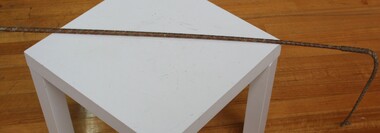
Accessory - Horse buggy whip
... As used in the late 18th century by Horse and Buggy drivers...As used in the late 18th century by Horse and Buggy drivers Manufactured by Holden and Frost Ca1900 Whip Buggy Long narrow leather bound shaft with thatched whip end Accessory Horse buggy whip ...As used in the late 18th century by Horse and Buggy driversManufactured by Holden and Frost Ca1900Long narrow leather bound shaft with thatched whip endwhip, buggy -
 Warrnambool and District Historical Society Inc.
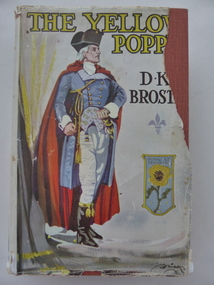
Book, The Yellow Poppy by D K Broster, 1937
... It also has a dust cover which has a colour image of a man in late 18th century attire and a shield containing a yellow poppy. ...It also has a dust cover which has a colour image of a man in late 18th century attire and a shield containing a yellow poppy. ...This book comes from the property of Lyndoch near the mouth of the Hopkins River. George Rolfe, a tea merchant from Melbourne, established Lyndoch in 1875 and Miss Florence Lake, daughter of Miss Annie Lake, later Mrs George Rolfe, inherited the property with her sister Annie. In 1920 Florence Lake built a large house called Lyndoch. She had a Rolls Royce car and a chauffeur and was a tireless worker for local charities. Florence Lake died in 1946 and the property became the site of an Aged Care Facility in Warrnambool. Florence Lake’s house now forms part of the hostel section of this facility. This book would have been in the Lyndoch library during Florence Lake’s time there. D K Broster ( Dorothy Kathleen) was a popular writer of historical novels in the early part of the 20th century. The Flight of the heron being her most acclaimed.This book is of interest as it came from the historically-important property and house known as Lyndoch and so it is connected to Miss Florence Lake, a prominent person in Warrnambool in the first half of the 20th century. This is a hard cover book of 439 pages. It has a red cover with black lettering on the front and spine. It also has a dust cover which has a colour image of a man in late 18th century attire and a shield containing a yellow poppy. The dust cover is partly torn away. The book has 46 chapters. The inscription is handwritten in black ink. ‘Lyndoch Xmas 1937’lyndoch, florence lake, history of warrnambool -
 Whitehorse Historical Society Inc.
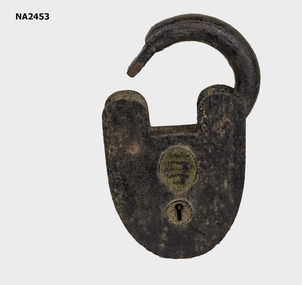
Functional object - Padlock, 1780 - 1820
... Large 'Horseshoe' or Horse Lock made in England late 17th early 18th century....Newsletter Series 2 - April 1999. security - locks Patented Leavers Lock Large 'Horseshoe' or Horse Lock made in England late 17th early 18th century. Functional object Padlock ...History is set out in N.H.S. Newsletter Series 2 - April 1999.Large 'Horseshoe' or Horse Lock made in England late 17th early 18th century.Patented Leavers Locksecurity - locks -
 Mont De Lancey
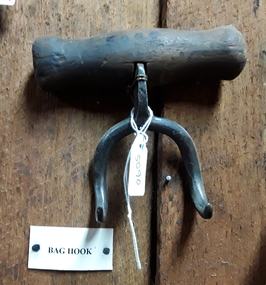
Tool - Bag Hook, Unknown
... Used in the late 18th or early 19th century....It was used to assist with lifting large bags of wheat, fertiliser and so on in the late 18th or early 19th century. ...Used in the late 18th or early 19th century. Agricultural equipment Farm equipment Bag hooks A small steel double curved pointy hooked bag hook with a turned wooden handle on the top. ...Used in the late 18th or early 19th century.A small steel double curved pointy hooked bag hook with a turned wooden handle on the top. The handle is attached through a hole in the steel and riveted to the the hook. It was used to assist with lifting large bags of wheat, fertiliser and so on in the late 18th or early 19th century. agricultural equipment, farm equipment, bag hooks -
 Streatham and District Historical Society
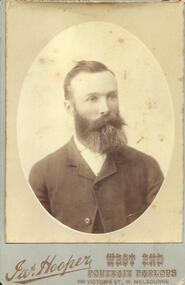
Picture, John Thompson Oman, Late 19th Century
... He has facual hair common to the era. Circa late 18th century....He has facual hair common to the era. Circa late 18th century. Typical dress of the period. Common portrait sitting and pose. portrait picture photography j t oman On back in grey pencil, " J T Oman" & $2-. ...John Oman sitting for portrait wearing a suit. He has facual hair common to the era. Circa late 18th century.Typical dress of the period. Common portrait sitting and pose.Rectangular in shape, sepia tones, studio portrait picture.On back in grey pencil, " J T Oman" & $2-. On the front in black ink the words, "Ja's Hooper, West End Portait Parlors 239 Victoria Street W. Melbourne. portrait picture photography j t oman -
 Embroiderers Guild, Victoria
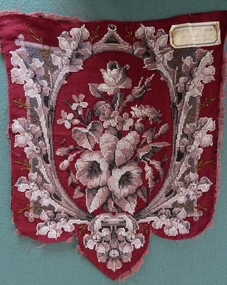
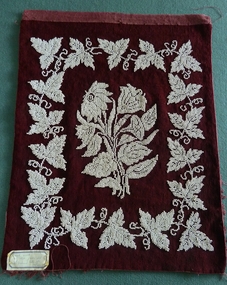
Textile - Late 18th C Canvas and Beadwork, 18th century
... Note attached "Beadwork over 150 years old North Ireland, Late 18th century"...Note attached "Beadwork over 150 years old North Ireland, Late 18th century" Embroidery Canvas Beadwork Ireland 18th Century Canvas work piece on red canvas. ...Piece originally belonged to donor's mother-in-law, Constance Simson. Note attached "Beadwork over 150 years old North Ireland, Late 18th century"Canvas work piece on red canvas. Background is worked in red silk with beautiful floral beadwork in shades of grey, black, white, bronze.embroidery, canvas, beadwork, ireland, 18th century -
 Bendigo Historical Society Inc.
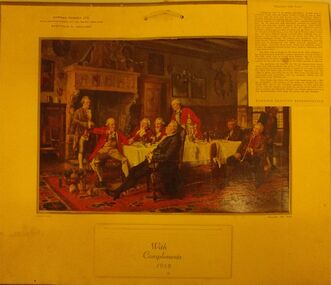
Document - LYDIA CHANCELLOR COLLECTION: 1959 'TELLING THE TALE' CALENDAR
... The print depicts 9 gentlemen enjoying a dinner in the late 18th century. The room has a carved stone fireplace, oak panelling and many shooting trophies. ...DRAWING Reproduction calendar Lydia Chancellor collection calander history print 18th century history 'Telling the Tale ' Vine Lerche art artworks 18th century clothing drawing A large 1959 calendar with a print titled 'Telling the Tale.' The print depicts 9 gentlemen enjoying a dinner in the late ...A large 1959 calendar with a print titled 'Telling the Tale.' The print depicts 9 gentlemen enjoying a dinner in the late 18th century. The room has a carved stone fireplace, oak panelling and many shooting trophies. The clothes being worn are typical of the 1770's Coats of velvet, elaborate waistcoats and lace ruffles at the throat and wrists. The artist is Vine Lerche. A Bemrose Gravure Reproduction. Morgan Fairest Ltd. Sole manufacturer of the 'Banks' Labellers. Sheffield 4 England.drawing, reproduction, calendar, lydia chancellor, collection, calander, history, print, 18th century history, 'telling the tale, ' vine lerche, art, artworks, 18th century clothing, drawing -
 Embroiderers Guild, Victoria
Textile - Late 18th C Canvas and Beadwork, 18 th C
... North Ireland. Late 18th century"....North Ireland. Late 18th century". Embroidery Beading Canvas work Cross sttich A piece of canvas work on red canvas - background in dark red cross stitch in wool. ...The piece belonged to the donor's mother-in-law Constance Simson. A note pinned to the piece says "Bead work over 150 years old. North Ireland. Late 18th century".A piece of canvas work on red canvas - background in dark red cross stitch in wool. A floral design in white beads.embroidery, beading, canvas work, cross sttich -
 Tennis Australia
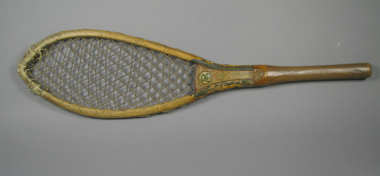
Racquet, Circa 1790
... An late 18th century court tennis racquet, made from two pieces of interlocked wood, secured with two screws. ...Tennis An late 18th century court tennis racquet, made from two pieces of interlocked wood, secured with two screws. ...An late 18th century court tennis racquet, made from two pieces of interlocked wood, secured with two screws. One is the handle/throat, the other is the shoulders/head. The latter unfortunately had, at some point in the past, split at the crown, and whipping was applied to reinforce it. The gut stringing is three-way. The throat and lower shoulders have been hand painted, with both linear and floral designs. Across the thoat on the obverse is the monogram which reads 'BWB'. Materials: Wood, Lacquer, Metal, Gut, Paint, Stringtennis -
 Geoffrey Kaye Museum of Anaesthetic History
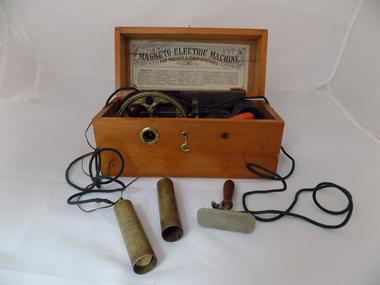
Equipment - Magneto Electric Machine
... Experimentation with electricity for medical purposes has its origins in the late 18th Century. Throughout the 19th Century it became more common, including as a proposed treatment for 'nervous' disorders. ...Experimentation with electricity for medical purposes has its origins in the late 18th Century. Throughout the 19th Century it became more common, including as a proposed treatment for 'nervous' disorders. ...Experimentation with electricity for medical purposes has its origins in the late 18th Century. Throughout the 19th Century it became more common, including as a proposed treatment for 'nervous' disorders. This device is a small, portable, 'at-home' device.Device for administering electric stimulation to patients. Consists of a wooden box containing a hand driven generator, with terminals for the attachment of electrodes that may be held by the patient or placed against the patient's skin. The directions for use include information about wetting the sponges and the patient's hands before cranking the machine to produce a small electric shock. electricity, medicine -
 Warrnambool and District Historical Society Inc.
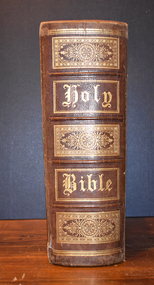
Book - Bible, Thomas Bankes, The Christian's New and Complete Family Bible, 1786
... This Bible, we believe, dates from 1786 and is the work of the Reverend Thomas Bankes a well known cleric and author of both secular and religious books in the late 18th century. He was a Vicar in a parish in Monmouthshire, England. ...This Bible, we believe, dates from 1786 and is the work of the Reverend Thomas Bankes a well known cleric and author of both secular and religious books in the late 18th century. He was a Vicar in a parish in Monmouthshire, England. ...This is a family bible circa late 1700'sThe book has a plain brown leather cover, the front of which is scuffed, stained and completely detached from the spine. On the spine is printed Bankes's Bible, an alternative title. The pages contain text, black and white plates, images and engravings. Some of the pages are torn, others have been repaired with paste. The dedication by Thomas Bankes, a clergyman, is to his Bishop Lord James Beauclerc. All the 's' letters are written as ' f'.non-fictionThis is a family bible circa late 1700's18th century literature, family bible, 1786 bible, warrnambool, bankes bible -
 Embroiderers Guild, Victoria
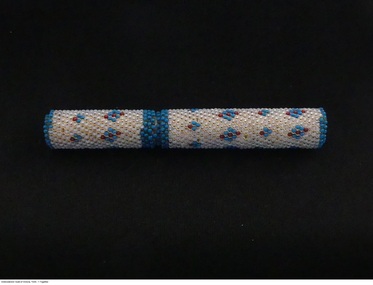
Tool - Beaded bodkin case, Bodkin case, late 18th to mid 19th century
... Beaded cases were popular from late 18th century through to Victorian times...late 18th to mid 19th century...Beaded cases were popular from late 18th century through to Victorian times When most clothes were laced, bodkins were essential tool for dressing. ...This is a case to hold bodkins. A Bodkin is shaped like an oversized sewing needle with a blunt point and large eye and is used to pull a drawstring through a fabric casing- an essential to clothes fastenings for centuries. Beaded cases were popular from late 18th century through to Victorian timesWhen most clothes were laced, bodkins were essential tool for dressing. This is a luxury item in which to store bodkins. Complex beadwork completely covers a bone frame.Cylindrical ivory bodkin case decorated with blue, white and red seed beads in diamond design on an opalescent seed bead background with blue beads banding join. Blue Beads top and bottombodkin case, beadwork -
 Brighton Historical Society
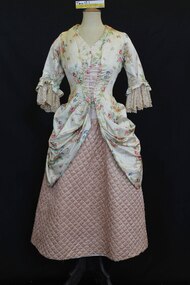
Clothing - Dress, Fancy dress, circa 1911
... The lower part of the bodice is modelled on a late 18th century polonaise design. The bodice is boned and features waist tapes. ...The lower part of the bodice is modelled on a late 18th century polonaise design. The bodice is boned and features waist tapes. ...This dress is a 'Dolly Varden' or 'shepherdess" style costume worn by Ida Annie Wallace (1890-1976) on a sea voyage to China accompanying her parents in 1911. The BHS has a photo of Ida wearing this dress when she was a guest at a dance for young people given by the Lord Mayor of Melbourne (possibly T. J. Davey). This party may have been held on the ship or it may have been a seperate event. This style dress was a popular choice for fancy dress in the late 1890s and early 1900s. The style is named after the character Dolly Varden in Charles Dickens, 'Barnaby Rudge' 1841. Around 1872, Dolly Varden-inspired costumes and paraphernalia were very a popular craze. Family information states that the silk for this dress was purchased by Ida and Marjorie's grandfather's sister (great aunt) in England circa 1840. The dress was donated by Marjorie Wallace (1901-1999), Ida's sister. Marjorie did not accompany the family to China, but stayed home with a governess. Marjorie lived in Brighton between 1923 and circa 1950 and attended Firbank Church of England Girls Grammar School.A dress consisting of bodice (.1) and skirt (.2). The bodice is made from beige silk with sprays of red and blue flowers and originally laced down the centre front with pink ribbon. The lower part of the bodice is modelled on a late 18th century polonaise design. The bodice is boned and features waist tapes. The elbow length sleeves are finished with beige hand made Maltese lace featuring Maltese crosses. The mid calf length skirt is made from pale pink silk which has been quilted and lined to create a stiffened form. Also with the dress is a piece of scrap floral fabric (.3) that is the same as the bodice fabric.dolly varden, marjorie wallace, barnaby rudge, charles dickens, fancy dress, ida annie wallace -
 Warrnambool and District Historical Society Inc.
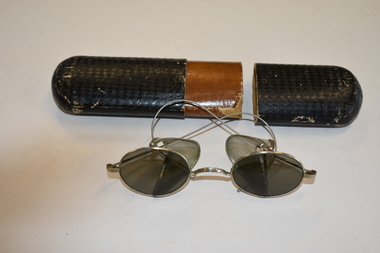
Functional object - Spectacles and case, Early 20th century
... Eye glasses were first used in the 13th century and bi-focals were invented in the late 18th century....Eye glasses were first used in the 13th century and bi-focals were invented in the late 18th century. These items have no known local significance and are kept as interesting souvenirs of eye glasses used in the past. household items history of warrnambool spectacles This is a pair of spectacles or glasses in a case. ...These glasses appear to be mainly sunglasses or ones for outdoors as the tinted glass and the shades indicate this. They would have been used commonly in the past (100 years ago or more) by those able to afford the cost of the item. Eye glasses were first used in the 13th century and bi-focals were invented in the late 18th century.These items have no known local significance and are kept as interesting souvenirs of eye glasses used in the past.This is a pair of spectacles or glasses in a case. The glasses are made of thin metal and contain dark tinted glass. The eye-glass pieces are oval in shape. On the outer rims of the eye-glass pieces are two curved metal mesh covers attached to the metal rims by two screws on each side. These act as shades for the sun and side protection for the eyes and fold down when not in use. One of the shades is detached from its metal rim. The glasses case is made of cardboard and has a black mottled outer covering and a light brown inside lining. The case is much scuffed. household items, history of warrnambool, spectacles -
 Embroiderers Guild, Victoria
Accessory - 18th C White Muslin Fichu, 18th - early 19th century
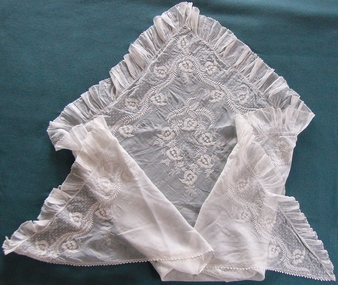
... An 18th-century fichu was a lightweight, typically white triangular or square neckerchief made of muslin, linen, or cotton, worn by women to cover the chest and neck. Popular from the early-to-late...An 18th-century fichu was a lightweight, typically white triangular or square neckerchief made of muslin, linen, or cotton, worn by women to cover the chest and neck. Popular from the early-to-late ...An 18th-century fichu was a lightweight, typically white triangular or square neckerchief made of muslin, linen, or cotton, worn by women to cover the chest and neck. Popular from the early-to-late 18th century, these versatile garments were often folded, draped, or pinned over low-cut bodices, acting both as a modest covering and a fashionable accessory. Muslin with embroidered frill - fichu has design of wheat scrolling above the frill and in the corner. Flowers in drawn thread.embroidery, whitework, drawn thread, fischu, early 19th century, france -
 Mont De Lancey
China - Ornament
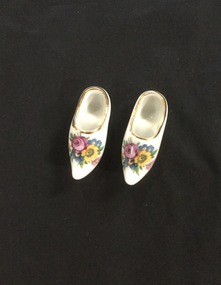
... Limoges porcelain is hard-paste porcelain produced by factories in and around the city of Limoges, France beginning in the late 18th century. Limoges had strong antecedents in the production of decorative objects. ...Limoges porcelain is hard-paste porcelain produced by factories in and around the city of Limoges, France beginning in the late 18th century. Limoges had strong antecedents in the production of decorative objects. ...Limoges porcelain is hard-paste porcelain produced by factories in and around the city of Limoges, France beginning in the late 18th century. Limoges had strong antecedents in the production of decorative objects. The city was the most famous European centre of vitreous enamel production in the 12th century. These shoes were bought by Mr. & Mrs. H. N. Lord in Paris in 1966.Pair of miniature porcelain Dutch shoes. White with floral design and gold trim.china, ornaments, clogs, footwear -
 Mont De Lancey
China - Ornament
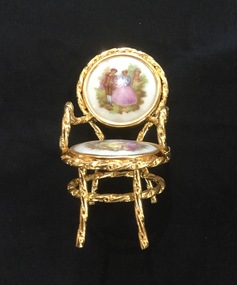
... Limoges porcelain is hard-paste porcelain produced by factories in and around the city of Limoges, France beginning in the late 18th century. Limoges had strong antecedents in the production of decorative objects. ...Limoges porcelain is hard-paste porcelain produced by factories in and around the city of Limoges, France beginning in the late 18th century. Limoges had strong antecedents in the production of decorative objects. ...Limoges porcelain is hard-paste porcelain produced by factories in and around the city of Limoges, France beginning in the late 18th century. Limoges had strong antecedents in the production of decorative objects. The city was the most famous European centre of vitreous enamel production in the 12th century. These shoes were bought by Mr. & Mrs. H. N. Lord in Paris in 1966.Small Limoges ornamental porcelain chair with scene of a man and woman in a garden on seat and back. Gold frame and edges.china, ornaments, chairs -
 National Wool Museum
Spinning Wheel
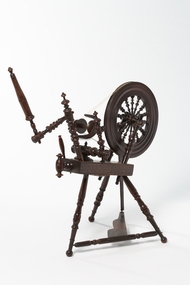
... This wheel is made from oak and is English, dating from the late 18th century. It was acquired from Margaret and Joan Mellor who had earlier acquired it from Kosminskis....This wheel is made from oak and is English, dating from the late 18th century. It was acquired from Margaret and Joan Mellor who had earlier acquired it from Kosminskis. handicrafts - history spinning wheels highlights of the national wool museum: the zakrzewski spinning wheel collection - exhibition (28/07/2001 - 02/12/2001) zakrzewski mr wlodzimierz Part of the Zakrzewski Spinning Wheel collection. ...Part of the Zakrzewski Collection of spinning wheels donated to the National Wool Museum by Mr Wlodzimierz Zakrzewski. For many years, Mr Zakrzewski collected, researched and repaired spinning wheels from all over the world. This wheel is made from oak and is English, dating from the late 18th century. It was acquired from Margaret and Joan Mellor who had earlier acquired it from Kosminskis.Part of the Zakrzewski Spinning Wheel collection.handicrafts - history, spinning wheels, highlights of the national wool museum: the zakrzewski spinning wheel collection - exhibition (28/07/2001 - 02/12/2001), zakrzewski, mr wlodzimierz -
 City of Moorabbin Historical Society (Operating the Box Cottage Museum)
Accessory - Personal Effects, Evening bag, c1900
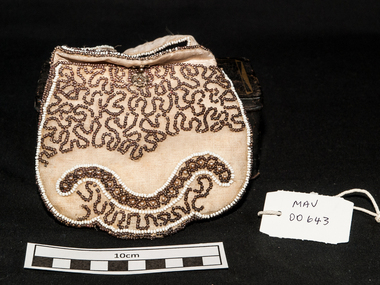
... In the 17th century young girls were taught embroidery as a necessary skill for marriage, this also helped them make very beautiful handbags. By the late 18th century, fashions in Europe were moving towards a slender shape and women wanted purses that would not be bulky or untidy in appearance, so reticules were designed. ...In the 17th century young girls were taught embroidery as a necessary skill for marriage, this also helped them make very beautiful handbags. By the late 18th century, fashions in Europe were moving towards a slender shape and women wanted purses that would not be bulky or untidy in appearance, so reticules were designed. ...In the 17th century young girls were taught embroidery as a necessary skill for marriage, this also helped them make very beautiful handbags. By the late 18th century, fashions in Europe were moving towards a slender shape and women wanted purses that would not be bulky or untidy in appearance, so reticules were designed. Reticules were made of fine fabrics like silk and velvet, with wrist strapA lady's beige, beaded, silk lined, evening bag with press stud fastenerevening wear, purses, personal effects, handbags, fashion, needlework, craftwork, dressmaking, moorabbin, brighton, early settlers, pioneers, cheltenham -
 Flagstaff Hill Maritime Museum and Village
Furniture - Cot, Late 19th to early 20th century
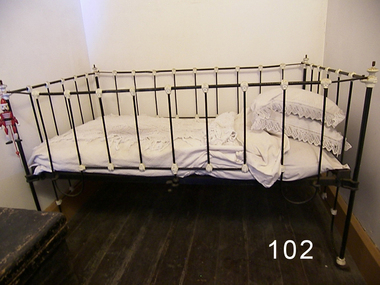
... Iron beds made from metal or wrought iron have been around since the late 18th century when they were hand made by craftsmen and artisans. ...Iron beds made from metal or wrought iron have been around since the late 18th century when they were hand made by craftsmen and artisans. ...Iron beds made from metal or wrought iron have been around since the late 18th century when they were hand made by craftsmen and artisans. The iron castings were always hand poured and originated from sand cast molds, more ornate beds are associated with the Victorian period. Later in the Edwardian era cast iron beds and cots had much less decoration and were quite plain .An relatively early domestic piece of furniture used as a babies cot giving a snapshot into domestic life around the end of the 19th century and beginning of the 20th. The item is not associated with a significant event, person or place and would have been common place in most homes of the time made by many different manufactures.Cot, metal, with chrome knobs and removable sides. Has wheelsNoneflagstaff hill, warrnambool, flagstaff hill maritime museum, maritime museum, shipwreck coast, flagstaff hill maritime village, great ocean road, cot, metal cot, iron bed -
 Orbost & District Historical Society
pocket scales, 1920's
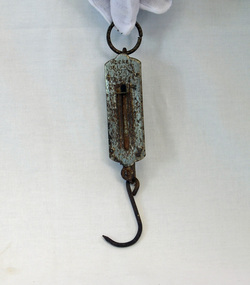
... The pocket balance was first created in 1770 by Richard Salter in the UK. From the late 18th century onwards these small scales were widely used in markets, grocers and farm shops – wherever people needed to be able to verify the weight of goods to be purchased in order to calculate the correct pricing. ...The pocket balance was first created in 1770 by Richard Salter in the UK. From the late 18th century onwards these small scales were widely used in markets, grocers and farm shops – wherever people needed to be able to verify the weight of goods to be purchased in order to calculate the correct pricing. ...The pocket balance was first created in 1770 by Richard Salter in the UK. From the late 18th century onwards these small scales were widely used in markets, grocers and farm shops – wherever people needed to be able to verify the weight of goods to be purchased in order to calculate the correct pricing. Because it was portable, and simple to use, the pocket balance was ideal for weighing goods where accuracy was not required. This balance appears to have been used for weighing fish.Pocket spring scales made of steel. There is a spring fixed at one end with a hook to which an object can be attached at the other. At the top of the scales there. is a metallic ring to fasten the object. This is attached to the main body which on one side has measurements inscribed into the metal surface. Inside the body is a spring loaded mechanism which moves along the scales when weight is added to a hook at the bottom of the shaft.At the top - POCKET BALANCE ARROW and the letters M P inside an oval.scales pocket-balance spring-balance measuring-instrument -
 City of Moorabbin Historical Society (Operating the Box Cottage Museum)
Personal Effects, evening bag, c1900
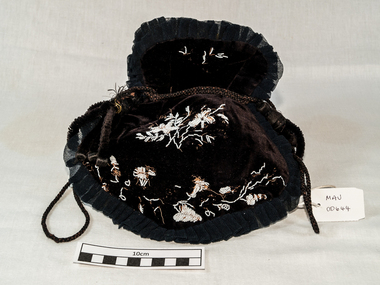
... In the 17th century young girls were taught embroidery as a necessary skill for marriage, this also helped them make very beautiful handbags. By the late 18th century, fashions in Europe were moving towards a slender shape and women wanted purses that would not be bulky or untidy in appearance, so reticules were designed. ...In the 17th century young girls were taught embroidery as a necessary skill for marriage, this also helped them make very beautiful handbags. By the late 18th century, fashions in Europe were moving towards a slender shape and women wanted purses that would not be bulky or untidy in appearance, so reticules were designed. ...In the 17th century young girls were taught embroidery as a necessary skill for marriage, this also helped them make very beautiful handbags. By the late 18th century, fashions in Europe were moving towards a slender shape and women wanted purses that would not be bulky or untidy in appearance, so reticules were designed. Reticules were made of fine fabrics like silk and velvet, with wrist strap often decorated with pearls, sequins, beads and embroidery. A lady's black velvet, silk lined, evening bag with draw-string and hand made tassels. The bag is decorated with beads in a floral designmoorabbin, brighton, early settlers, pioneers, cheltenham, craft work, dressmaking -
 Queenscliffe Maritime Museum
Leisure object - Model Blue Nose I, Clive Barnard, 1982
... The name Bluenose originated as a nickname for Nova Scotians from as early as the late 18th century....The name Bluenose originated as a nickname for Nova Scotians from as early as the late 18th century. Model Schooner Blue Nose I Nova Scotia Canada Scale model of Bluenose I Leisure object Model Blue Nose I Clive Barnard ...Bluenose I was a fishing and racing gaff rig schooner built in 1921 in Nova Scotia, Canada. A celebrated racing ship and fishing vessel, Bluenose under the command of Angus Walters, became a provincial icon for Nova Scotia and an important Canadian symbol in the 1930s, serving as a working vessel until she was wrecked in 1946. Nicknamed the "Queen of the North Atlantic", she was later commemorated by a replica, Bluenose II, built in 1963. The name Bluenose originated as a nickname for Nova Scotians from as early as the late 18th century.Scale model of Bluenose Imodel, schooner, blue nose i, nova scotia, canada -
 Dunkeld Museum Inc.
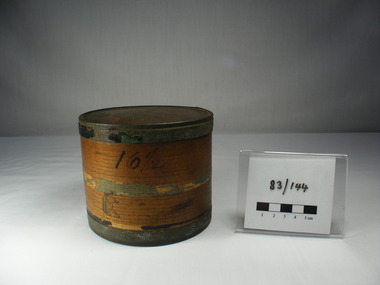
Box, Collar, Edward Henty's Collar Box, Late 18th century
... Late 18th century ...This collar box was purchased at a clearing sale at the Henty property to wind up his estate .Beleived to be Edward Henty's collar box.Wood veneer circular collar box with tin rims on base and lid. Veneer overlapped and glued. Part of a paper label glued on the lower half of the box.16 and 1/2 on the side in ink. -
 Royal Australian and New Zealand College of Obstetricians & Gynaecologists (RANZCOG)
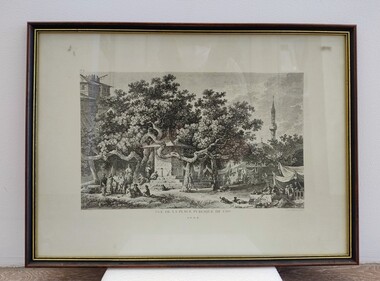
Print - Reproduction print, Carl William Weisbrod (active 1770s) et al, Vue de la Place Publique de Cos, c. late 18th century
... c. late 18th century ...This is an image of a public square on the island of Kos in Greece. Kos was the home of Hippocrates, and the tree in this image is reputedly the plane tree under which Hippocrates sat as he taught his pupils medicine. Hippocrates is known as the "Father of Medicine" for his revolutionary impact on the field of medicine. The letters 'A.P.D.R' printed below the title on this artwork refer to the copyright granted to engravers in France.Black and white engraving of a market square scene on the island of Kos in Greece. A large tree dominates the scene. Below the tree sits a roofed structure with a series of small steps. Water appears to be coming out of a channel of each of the visible sides of the structure, suggesting a fountain. To the left, an array of human figures, horses and a dog sit or stand beneath the tree and on the steps of the fountain. To the right, there are shaded platforms on which people are sitting in groups. There are three dogs in front of the group sitting on a platform at bottom right. Text printed below image reads 'VUE DE LA PLACE PUBLIQUE DE COS/A.P.D.R.' Small, printed text below bottom left corner of image is partially illegible, but it references the original creator of the artwork, Jean-Baptiste Hilair. Small printed text below bottom right corner of image reads ' Gravé à l'eau forte par C. Weisbrod/ el terminé au burin par J. Aliamet'. Small printed text above top left hand corner of image reads 'Pl. 59.' The print has been framed in a brown wooden frame with gold trim. An old display label is affixed to the back of the object. A card from Professor Franco Crainz is affixed to the back of the object, thanking the unnamed receiver for a reprint of their "interesting paper on D.D.Davis' Obstetric Atlas". The front of the card carries a print of the Temple of Esculapia, located in the Villa Borghese in Rome. A wire and two hooks have been attached to the rear of the work for hanging.There is black and white engraving of a market square scene on the island of Kos in Greece. Text printed below image reads 'VUE DE LA PLACE PUBLIQUE DE COS/A.P.D.R.' Small printed text below bottom left corner of image is partially illegible, but it references the original creator of the artwork, Jean-Baptiste Hilair. Small, printed text below bottom right corner of image reads ' Gravé à l'eau forte par C. Weisbrod/ el terminé au burin par J. Aliamet'. Small, printed text above top left-hand corner of image reads 'Pl. 59.' The print has been framed in a brown wooden frame with gold trim. An old display label is affixed to the back of the object. A card from Professor Franco Crainz is affixed to the back of the object, thanking the unnamed receiver for a reprint of their "interesting paper on D.D.Davis' Obstetric Atlas". The front of the card carries a print of the Temple of Esculapia, located in the Villa Borghese in Rome. A wire and two hooks have been attached to the rear of the work for hanging. The letters 'A.P.D.R' printed below the title on this artwork refer to the copyright granted to engravers in France.medicine -
 Embroiderers Guild, Victoria
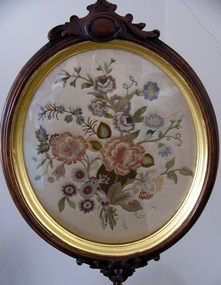
Textile - Rose Wood Pole Screen, Late 18th Century
... Late 18th Century ...Stand was damaged and repaired in 1979Rosewood stand with Ormolu decoration. A Louis XIV style oval panel has shaded coloured flowers in silk threads worked on a cream satin background. A green velvet backing to the panel.embroidery, silk embroidery, european -
 Embroiderers Guild, Victoria
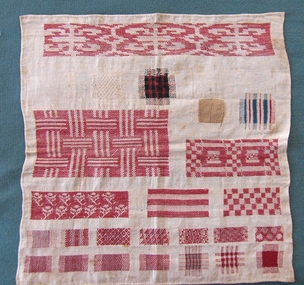
Textile - Late 18th C Darning Sampler, Late 18th century
... Late 18th century...Embroidery Darning Sampler England Early 19th century Darning sampler on natural linen in mainly red thread. It shows a large variety of darning patterns. Textile Late 18th ...Darning sampler on natural linen in mainly red thread. It shows a large variety of darning patterns.embroidery, darning, sampler, england, early 19th century -
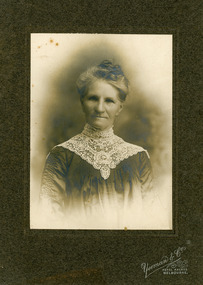 Mt Dandenong & District Historical Society Inc.
Photograph, Mrs Emma Dorey nee Biggin, Late 18th century
... Late 18th century ...Studio photograph from Yeoman & Co. Royal Arcade, Melbourne. Portrait shows Emma Dorey (nee Biggin), grandmother of Iris Woolrich (nee Dorey) and mother to her father Edwin Charles Dorey. Emma is wearing a very intricate lace collar in the photograph. The photograph is framed in thick cardboard.Handwritten on back: Emma Biggin Pitts. Dad's Mother. Granma Dorey.emma dorey, emma biggins, iris dorey, iris woolrich, iris woolrich, edwin dorey
