
Showing 11 items matching " liz coats"
-
 Women's Art Register
Archive (Collection) - Elizabeth (Liz) Coats Artist Archive
... Elizabeth (Liz) Coats Artist Archive...1946- Abstraction Colour Painting Painting Archive Elizabeth (Liz) Coats Artist Archive ...abstraction, colour, painting, paintingabstraction, colour, painting, painting -
Women's Art Register
Archive (Series) - Elizabeth (Liz) Coats. Duplicate File 1
... Elizabeth (Liz) Coats. Duplicate File 1...Painting Abstraction Colour Painting Foolscap manilla file Archive Elizabeth (Liz) Coats. Duplicate File 1 ...List of Images, CV, Biography, Newspaper Clippings, Invitations, Catalogues, Correspondence, Promotional Material, Reviews, Artist Statement, Artwork Images, Interviewspainting, abstraction, colour, paintingpainting, abstraction, colour, painting -
Women's Art Register
Archive (Series) - Elizabeth (Liz) Coats. Slide Kit
... Elizabeth (Liz) Coats. Slide Kit...Archive Elizabeth (Liz) Coats. Slide Kit ...painting, abstraction, colour, paintingpainting, abstraction, colour, painting -
Women's Art Register
Archive (Series) - Elizabeth (Liz) Coats, Digitised Slide Kit
... Elizabeth (Liz) Coats, Digitised Slide Kit...Painting Abstraction Colour Painting Archive Elizabeth (Liz) Coats, Digitised Slide Kit ...painting, abstraction, colour, paintingpainting, abstraction, colour, painting -
Women's Art Register
Archive (Series) - Coats, Elizabeth (Liz). Artist File 1
... Coats, Elizabeth (Liz). Artist File 1...Abstraction Colour Painting Painting Foolscap white archival 4 flap folder or document wallet Archive Coats, Elizabeth (Liz). Artist File 1 ...List of Images, CV, Biography, Newspaper Clippings, Invitations, Catalogues, Correspondence, Promotional Material, Reviews, Artist Statement, Artwork Images, Interviewsabstraction, colour, painting, paintingabstraction, colour, painting, painting -
Women's Art Register
Archive (Series) - Golden Age Gallery Exhibition. Subject File 1
... ... Liz Coats...Erica McGilchrist Bonita Ely Christina Berkman Isabel Davies Liz Coats Foolscap white archival 4 flap folder or document wallet Archive Golden Age Gallery Exhibition. ...erica mcgilchrist, bonita ely, christina berkman, isabel davies, liz coatserica mcgilchrist, bonita ely, christina berkman, isabel davies, liz coats -
Women's Art Register
Archive (Collection) - Golden Age Gallery Exhibition Archive
... ... Liz Coats...1983 Erica McGilchrist Bonita Ely Christina Berkman Isabel Davies Liz Coats Archive Golden Age Gallery Exhibition Archive ...erica mcgilchrist, bonita ely, christina berkman, isabel davies, liz coatserica mcgilchrist, bonita ely, christina berkman, isabel davies, liz coats -
 Nillumbik Shire Council
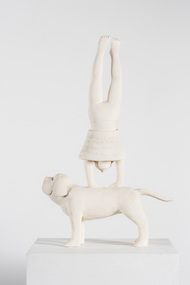
Sculpture: Liz Williams, Liz Williams, In Love, c.1996
... coated with a wash of gesso) of a girl doing a hand stand on the back of a dog (retriever?) / Her face/head is partially covered by her skirt which has come down / Her skirt is inscribed in the round with the poem "The Lady's First Song" (1938) by W.B. Yeats (see inscriptions and markings) / The dog is looking straight ahead and upwards towards the sky and his tail is pointing straight out. In Love Sculpture: Liz ...Williams' use of the dog and poem was inspired by a print by the late Barbara Hanrahan (an artist friend) in which a women was holding a cat accompanied by a dog and in which words from a William Blake poem were included / After her mother died Williams made a work of her mother with the dog, holding the cat and using the same words in the Hanrahan print / The dog is a family pet; Dolcie, that Williams fell in love with / The dog as a symbol has been used in fifteenth and sixteenth century painting to represent fidelity in marriage / The use of the dog is also a contradiction to the themes in this work by Williams / Williams found that many of her women friends were having emotional and romantic difficulties, suffering from the same malady again and again, feeling rejected, destroyed and having unfulfilled desires / The female figure standing on her hands is not seeing things realistically / The figure is head over heels, vulnerable, with her skirt around her head revealing more than normal / The text enhances the meaning of the work and draws the viewer into experiencing the foolishness of love, demanding the viewer travel around and around to read it / Overall the dog provides structure to the work and a reliable object on which all else balances / Balance has been one of the recurring or repetitive themes within William's work / It references the physicality of clay, the difficulties in creating balance with the clay and balance in the work / Williams' work is about form rather than colour / Sometimes she uses a coloured clay like a pale terracotta / Williams likes the flatness of the surface in relationship to the marks of the text / She describes herself as a Minimalist, paring down the form to the bare essentials. 'In Love' was a finalist in the 1997 Nillumbik Art Award held at the Eltham Community and Reception Centre, Pitt Street, Eltham. A ceramic sculpture made of white stoneware clay (coated with a wash of gesso) of a girl doing a hand stand on the back of a dog (retriever?) / Her face/head is partially covered by her skirt which has come down / Her skirt is inscribed in the round with the poem "The Lady's First Song" (1938) by W.B. Yeats (see inscriptions and markings) / The dog is looking straight ahead and upwards towards the sky and his tail is pointing straight out. The dog is covered with cross-hatch incised lines to give the illusion of fur and texture / Hand written inscription of W.B. Yeats poem "The Lady's First Song" (1938) on girl's skirt / I turn round / Like a dumb beast in a show. / Neither know what I am / Nor where I go, / My language beaten / Into one name; / I am in love / And that is my shame. / What hurts the soul / My soul adores, / No better than a beast / Upon all fours.williams / yeats / love / ceramic / stoneware / dog -
 Royal District Nursing Service (now known as Bolton Clarke)
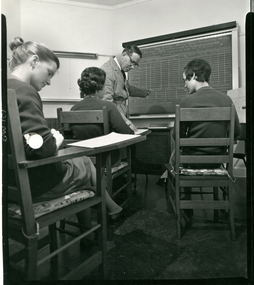
Photograph - Photograph, black and white, c.1967
... Liz Thomson who has her dark hair drawn back, is looking down at a piece of white paper resting on the arm of the wooden chair on which she is sitting. In front of her are the back views of Sr. Betty McDonald with curled dark hair and to her right is Sister Joanne Wilkinson. Mr. Bralsford, who has short dark hair; is wearing glasses, and wearing a grey coat...Liz Thomson who has her dark hair drawn back, is looking down at a piece of white paper resting on the arm of the wooden chair on which she is sitting. In front of her are the back views of Sr. Betty McDonald with curled dark hair and to her right is Sister Joanne Wilkinson. Mr. Bralsford, who has short dark hair; is wearing glasses, and wearing a grey coat ...Mr. Bralsford,the Transport Manager at Royal District Nursing Service (RDNS), is instructing RDNS staff in the responsibilities of driving an RDNS vehicle. The Sisters were undergoing a Post Basic Course given by RDNS Educators, Car maintenance was necessary from 1937 when a car was donated by the Rotary Club to Melbourne District Nursing Society, (MDNS). Another car was donated, by General Motors-Holden, via the Duchess of Gloucester, in 1947, and the fleet began to grow from 1950 with seven Ford Prefects being provided by the Hospital and Charities Commission. For many years Melford Motors in South Melbourne maintained the MDNS fleet, until the fleet grew to the point of, the now named, Royal District Nursing Service (RDNS) providing its own Car Maintenance Division to service the cars regularly. The Royal Automobile Club of Victoria, (RACV), attended any breakdowns which occurred when nursing staff were on the road. Each new Sister employed by the Service was taken out for a driving test before she drove a District car. Royal District Nursing Service (RDNS) has had various modes of transport over the last 130 plus years. At first, from 1885 as Melbourne District Nursing Society (MDNS), their Trained nurses (Nurses) walked the streets and lane ways amid the slums of central Melbourne. As the Society expanded public transport was used; bicycles were bought by the Society in 1903 and used in inner areas until 1945. During the Spanish flu epidemic, in 1919, MDNS appealed for assistance to procure Motor vehicles so the Nurses could visit an influx of cases. Through trusts, grants and donations four 'Ford T Model' cars were procured which enabled the Nurses to triple their visits. Through constant use the cars were in such a poor state they were sold in 1927. A Motor Auxiliary was formed in 1929 to take Sisters to patients, and some Sisters used their own cars; even a motorcycle was used by one Sister in 1933. All these forms of transport were intermingled until, having received Royal patronage; the now Royal District Nursing Service (RDNS) had its own full fleet of vehicles by the mid 1960s. In many areas there were unsealed roads, in various conditions, which the Sisters negotiated to reach their patients to give care. Seat-belts had been introduced to Victoria in 1959 and District fitted them to their cars from 1962, even though they did not become compulsory until 1970. The Melways Directory of maps was introduced in 1966 which was a boon to the Sisters, though it was a few years before it went beyond Seville, so those that did the Warburton and Powelltown area worked off a large paper map. By 2009 there were 598 cars in the fleet and the Sisters travelled 9 million 200,000 kilometres – this is equivalent to 12 trips to the moon and back. Black and white photograph showing Mr. Bralsford instructing RDNS staff. In the left foreground is Sister (Sr) Liz Thomson who has her dark hair drawn back, is looking down at a piece of white paper resting on the arm of the wooden chair on which she is sitting. In front of her are the back views of Sr. Betty McDonald with curled dark hair and to her right is Sister Joanne Wilkinson. Mr. Bralsford, who has short dark hair; is wearing glasses, and wearing a grey coat, is standing in front of them pointing to a blackboard with his extended left arm and hand. He is looking down, and has his right hand on a piece of white paper on a desk. A strip heater is high on the left hand wall.Photographers stamp and Quote No. GW 101royal district nursing service, rdns, rdns transport, rdns education, melford motors, racv, sister liz thomson, sister betty mcdonald, sister joanne wilkinson, mr bralsford -
 Royal District Nursing Service (now known as Bolton Clarke)
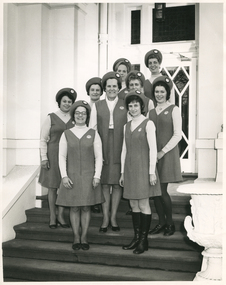
Photograph - Photograph, black and white, Barry Sutton, 25.07.1972
... It was not long before the uniform changed to a shorter length grey frock, red cardigan, grey coat and grey brimmed hat; later changed to a peaked grey hat. In 1966 MDNS were granted Royal patronage. Now as Royal District Nursing Service (RDNS), Sisters Liz Thomson and Bev Armstrong, in 1971, designed a new uniform and the colour was changed. ...Miss Mary Evans is the Director of Nursing of Royal District Nursing Service (RDNS). RDNS changed its uniform style and colour some time in 1971 and this 1972 photograph of the Sisters shows them wearing the new winter uniform of a blue/grey skivvie under a V neck tunic style frock made of blue/grey herringbone winter material, with the RDNS insignia on the upper left, and a beret style hat of the same material. The hat was worn on official occasions. Miss Evans is wearing her uniform of a grey blouse and a skirt and long V neck jacket made of the same blue/grey herringbone winter material worn by the Sisters. The photograph is taken on the steps of RDNS Headquarters, 452 St. Kilda Rd, Melbourne. Part of the white building is seen either side of the steps, and behind the Sisters the wooden and glass panel door is seen.From its earliest years when Melbourne District Nursing Society (MDNS) began to wear uniforms the chosen colour was grey, though the style changed throughout the years as fashions changed from the late 1800s through to the 1970s. Their Trained nurses (Nurses) firstly wore long grey frocks and later a white collar, cuffs and white belt was added, and on their head they wore a white cap with a long white tail hanging from the centre back. When bicycles were introduced the headgear changed to a white pith helmet adorned with a red Maltese cross in the centre front. This was held on with a veil going over the hat and tied under the chin. Over the years there were complaints that the veils became wet in the rain and they asked for a change of uniform, but this did not happen until 1921. Twelve years later the Trained nurses (Sisters) complained their skirts became wet when riding their bicycles in the rain and asked, when raining, to be able to wear breeches and gaiters. This was granted provided they wore aprons when attending patients. It was not long before the uniform changed to a shorter length grey frock, red cardigan, grey coat and grey brimmed hat; later changed to a peaked grey hat. In 1966 MDNS were granted Royal patronage. Now as Royal District Nursing Service (RDNS), Sisters Liz Thomson and Bev Armstrong, in 1971, designed a new uniform and the colour was changed. By 1972 the Sisters were wearing the new winter uniform of a blue/grey skivvie under a V neck tunic style frock made of blue/grey herringbone winter material with the RDNS insignia on the upper left, and a beret style hat of the same material. In summer the uniform became a royal blue V neck tunic style frock, with the RDNS insignia on the upper left, worn over a short sleeve white blouse. A royal blue peaked hat with the RDNS insignia in the centre front was worn at first and then only worn on official occasions. This uniform was worn until changed to a corporate style in the mid 1980s,Black and white photograph of Miss Mary Evans of the Royal District Nursing Service (RDNS), with a group of RDNS Sisters standing, in twos, down the steps outside part of a white painted.building. They are wearing their winter uniforms of a grey V neck tunic style frock worn over a lighter grey skivvie. They are all wearing the matching grey beret style hat. The RDNS insignia is seen on the upper left of their uniforms and in the centre front of their hats. Some of the Sisters are partly hidden. L-R Back row - Sisters: Barbara Watson, who has blonde hair and Judy Peter who has darker hair. The next row down is - Betty McDonald, who has short dark hair and Fonce Hoey, who has curled hair. The next row down is V. Sheehan with dark curly hair, Miss Mary Evans, with dark curled hair and M. Lambert with dark curled hair. Front row - A. Tyler, who is wearing glasses and has short dark hair and Mary Gawith with short dark curled hair. She is wearing below the knee black boots.Photographer stamp. Quote No. LA 3melbourne district nursing society, mdns, royal district nursing service, rdns, rdns uniform, miss mary evans, sister barbara watson, sister judy peter, sister betty mcdonald, sister fonce hoey, sister v sheehan, sister h. lambert, sister a. tyler, sister mary gawith -
 Royal District Nursing Service (now known as Bolton Clarke)
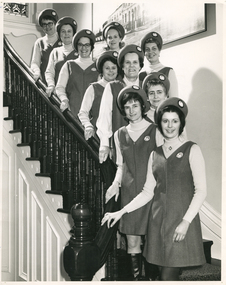
Photograph - Photograph, black and white, Barry Sutton, 25.07.1972
... It was not long before the uniform changed to a shorter length grey frock, red cardigan, grey coat and grey brimmed hat; later changed to a peaked grey hat. In 1966 MDNS were granted Royal patronage. Now as Royal District Nursing Service (RDNS), Sisters Liz Thomson and Bev Armstrong, in 1971, designed a new uniform and the colour was changed. ...Miss Evans is the Director of Nursing of Royal District Nursing Service (RDNS). She and the group of RDNS Sisters are standing on the staircase inside RDNS Headquarters, 452 St. Kilda Road, Melbourne.The photograph on the right rear is of a full view of 452. They are wearing the new winter uniform of a blue/grey skivvie worn under a V neck tunic style herringbone winter material dress with the RDNS insignia on the upper left. Their beret style hats are made of the same herringbone material. Miss Evans is wearing her uniform of a grey blouse, and a skirt and long jacket made of the blue/grey herringbone winter material.From its earliest years when Melbourne District Nursing Society (MDNS) began to wear uniforms the chosen colour was grey, though the style changed throughout the years as fashions changed from the late 1800s through to the 1970s. Their Trained nurses (Nurses) firstly wore long grey frocks, and later a white collar, cuffs and white belt was added, and on their heads they wore a white cap with a long white tail hanging from the centre back. When bicycles were introduced in 1903 the headgear changed to a white pith helmet adorned with a red Maltese cross in the centre front. This was held on with a veil going over the hat and tied under the chin. Over the years there were complaints that the veils became wet in the rain and they asked for a change of uniform, but this did not happen until 1921. Twelve years later the Trained nurses (Sisters) complained their skirts became wet when riding their bicycles in the rain and asked, when raining, to be able to wear breeches and gaiters. This was granted provided they wore aprons when attending patients. It was not long before the uniform changed to a shorter length grey frock, red cardigan, grey coat and grey brimmed hat; later changed to a peaked grey hat. In 1966 MDNS were granted Royal patronage. Now as Royal District Nursing Service (RDNS), Sisters Liz Thomson and Bev Armstrong, in 1971, designed a new uniform and the colour was changed. By 1972 the Sisters were wearing the new winter uniform of a blue/grey skivvie under a V neck tunic style frock made of blue/grey herringbone winter material with the RDNS insignia on the upper left, and a beret style hat of the same material. In summer the uniform became a royal blue V neck tunic style frock, with the RDNS insignia on the upper left, worn over a short sleeve white blouse. A royal blue peaked hat with the RDNS insignia in the centre front was worn at first and then only worn on official occasions. This uniform was worn until changed to a corporate style in the mid 1980s,Black and white photograph showing Royal District Nursing Service (RDNS) Miss Mary Evans amid a group of RDNS Sisters standing down the steps of an internal staircase. They are wearing their new winter RDNS uniforms of a light grey skivvy under a V neck tunic style grey frock with the RDNS insignia on the upper left, and a beret style hat of the same material. Sisters from top to bottom:- P. Rowley, who is wearing glasses and has short dark hair, next down is F. Hoey, who has short dark hair and then in pairs L-R A. Tyler, wearing glasses and with dark curled hair and B. Watson, who has shoulder length blonde curled hair. Next down is B. McDonald with short dark hair and J. Peter, with curly dark hair. Next down is Miss Evans, who has short curled hair, On the next step down is V. Sheehan, who has short wavy blonde hair, down further is M. Gawith, who has short dark hair and is wearing below the knee black boots. and in front is M. Lambert who has short dark hair and has her hospital badge attached under the centre neck of her skivvy. The staircase has dark wooden turned balustrades topped with a matching curved handrail and below this is white woodwork. In the rear of the photograph part of a stained glass window can be seen and on the right is part of a large photograph. Photographer stamp. Quote No. LA 4melbourne district nursing society, mdns, royal district nursing service, rdns, rdns uniform, miss mary evans, sister pat (paddy) rowley, sister fonce hoey, sister a. tyler, sister barbara watson, sister betty mcdonald, sister judy peter, sister mary gawith, sister v. sheehan, sister m. lambert
