
Showing 266 items matching " male clothing"
-
 Glenelg Shire Council Cultural Collection
Clothing - Trousers, Nov-84
... ... male clothing...clothing male clothing velvet trouusers Trousers, long, beige, polyester with narrow strip of dark brown velvet sewn to outside seam of each leg. ...Trousers, long, beige, polyester with narrow strip of dark brown velvet sewn to outside seam of each leg.clothing, male clothing, velvet, trouusers -
Glenelg Shire Council Cultural Collection
Clothing - Tie, c. 1996
... ... male clothing...PArt of the Glenelg Shire Council uniform uniform civilian tie male clothing Men's tie, woven and manufactured in Australia with original Glenelg Shire Logo. ...PArt of the Glenelg Shire Council uniformMen's tie, woven and manufactured in Australia with original Glenelg Shire Logo. Tie is navy blue with red, blue green diagonal stripes and GSC logo embroidered in red and green at the wider point end. In original plastic packaginguniform, civilian, tie, male clothing -
Glenelg Shire Council Cultural Collection
Functional object - Trouser Hanger, n.d
... ... male clothing...clothing accessory male clothing Wooden trouser hanger branded with G.M. ...Wooden trouser hanger branded with G.M. Osbourne, Hatter and Mercer, P.P. Box 14 Portland, made in Germanyclothing, accessory, male clothing -
 Bendigo Historical Society Inc.
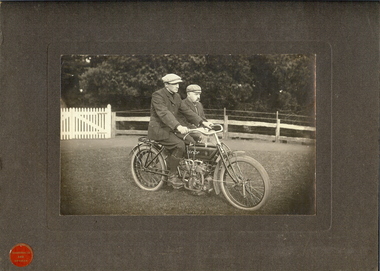
Photograph - TWO MEN ON A MOTORCYCLE
... Motorcycle with side chair, Rider And Passenger (Two Males) Clothing - Suits, Cloth Caps. Inscription: Brand on Motorcycle '...öricke'. ...Motorcycle with side chair, Rider And Passenger (Two Males) Clothing - Suits, Cloth Caps. Inscription: Brand on Motorcycle '...öricke'. ...B+W photo mounted on grey board. Motorcycle with side chair, Rider And Passenger (Two Males) Clothing - Suits, Cloth Caps. Inscription: Brand on Motorcycle '...öricke'. On mounted board - circular red sticker. 'CASSINELLO/AND/BOWMAN'cottage, miners -
Glenelg Shire Council Cultural Collection
Accessory - Tie Clip - belonging to Len Millard, n.d
... male accessory... clothing...male accessory clothing Millard Tie clip, metal, cream plastic name tag (Len Millard) on clip Accessory Tie Clip - belonging to Len Millard ...Tie clip, metal, cream plastic name tag (Len Millard) on clipmale accessory, clothing, millard -
Clunes Museum
Clothing - MAN'S SWIMMING COSTUME
... MALE...MEN'S CLOTHING...LOCAL HISTORY COSTUME MALE MEN'S CLOTHING MAN'S NAVY BLUE SWIMMING COSTUME, WITH WHITE, MADE FROM COTTON INTERLOCK MATERIAL Clothing MAN'S SWIMMING COSTUME ...COSTUME BELONGED TO HAROLD STEART AND THOUGHT TO HAVE BEEN MADE FOR A FANCY DRESS OR CONCERT.MAN'S NAVY BLUE SWIMMING COSTUME, WITH WHITE, MADE FROM COTTON INTERLOCK MATERIALlocal history, costume, male, men's clothing -
 Bendigo Historical Society Inc.
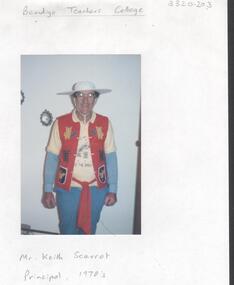
Photograph - LA TROBE UNIVERSITY BENDIGO COLLECTION: MR. KEITH SCARROTT
... male... fancy dress... clothing...Keith Scarrott person male fancy dress clothing Miss J.C. Burnett Mr. Geoff Pryor photo photograph photos photographs history Bendigo A coloured photograph of Principal Mr. ...A coloured photograph of Principal Mr. Keith Scarrott in fancy dress in the 1970's. He has blue trousers and a blue jumper over which is a white short sleeved jumper and a red waistcoat/vest. He has a red sash around his waist and a white sun hat. The red waistcoat has Chinese symbols over it. See 3320.100bendigo, education, mr. keith scarrott, latrobe university bendigo collection, collection, education, tertiary education, teacher training, mr. keith scarrott, person, male, fancy dress, clothing, miss j.c. burnett, mr. geoff pryor, photo, photograph, photos, photographs, history, bendigo -
 Clunes Museum
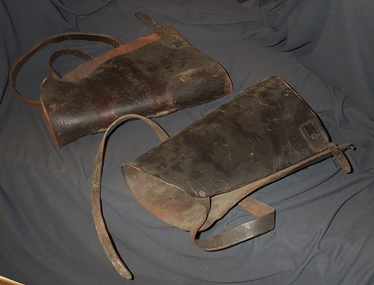
Accessory - GAITERS
... male...accessories...military clothing accessories...local history costume military male accessories military clothing accessories AUSTRALIA JH LEATHER GUARDS FOR THE LEGS WITH LEATHER STRAPS TO FASTEN. ...LEATHER GUARDS FOR THE LEGS WITH LEATHER STRAPS TO FASTEN. PLACED OVER PANT LEG IN BETWEEN SHIN AND BOOT TOP.AUSTRALIA JHlocal history, costume, military, male, accessories, military clothing accessories -
 Whitehorse Historical Society Inc.
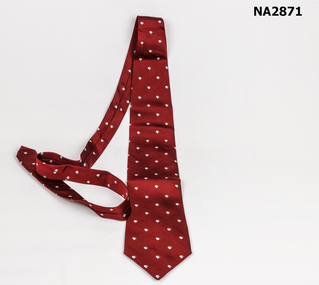
Memorabilia - Tie Whitehorse City Council
... male...civic mementoes...clothing...costume male civic mementoes clothing souvenirs Dark red patterned tie with small dark horses - the motif of the Whitehorse Council. ...Dark red patterned tie with small dark horses - the motif of the Whitehorse Council. Made of 100% silk.costume, male, civic mementoes, clothing, souvenirs -
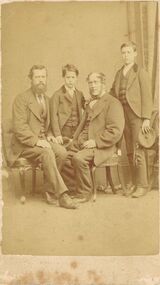 Bendigo Historical Society Inc.
Photograph - BLACK AND WHITE PHOTOGRAPH OF FOUR MALES
... black and white PHOTOGRAPH OF four males wearing Victorian style clothing - rear of card show two logos for Turbull & Sons Artists , 75 Jamaica St Glasgow - Licencees of Vander Weyde's Patent Process....PHOTOGRAPH Person male Turbull & Sons Artists 75 Jamaica St Glasgow - Licencees of Vander Weyde's Patent Process black and white PHOTOGRAPH OF four males wearing Victorian style clothing - rear of card show two logos for Turbull & Sons Artists , 75 Jamaica St Glasgow - Licencees of Vander Weyde's Patent Process. ...black and white PHOTOGRAPH OF four males wearing Victorian style clothing - rear of card show two logos for Turbull & Sons Artists , 75 Jamaica St Glasgow - Licencees of Vander Weyde's Patent Process.photograph, person, male, turbull & sons artists , 75 jamaica st glasgow - licencees of vander weyde's patent process -
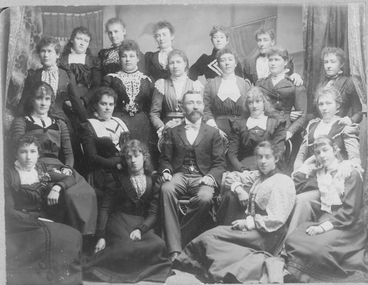 Stawell Historical Society Inc
Photograph, 1 Male & 19 Females (named) Mr S Trend was head teacher at Stawell State School Number 502 1895-1899
... Male & 19 Females (named) Mr. S. Trend was head teacher at, SS 502 1895-1899. Group are dressed in formal clothing. ...Male & 19 Females (named) Mr. S. Trend was head teacher at, SS 502 1895-1899. Group are dressed in formal clothing. ...Portrait of a Group of People. 1 Male & 19 Females (named) Mr. S. Trend was head teacher at, SS 502 1895-1899. Group are dressed in formal clothing. The male in three piece suit with bow tie. Women in long dresses with lace around the collars. No history of this photo was provided.Group of people 20 people, one male seated in the middle with 19 females seated and standing in the photo.Row from left 1st row. L. Parry, J. Mathers, F. McGregor, N. McCann, E. Lemon. 2nd row. C. McGregor, O. Butcher, A. Henderson, F. Nicholson, S. McPherson, S. Lemon. 3rd row. M. Henderson, C. Thomas, Mr. S. Trend, O. Stout. L. Trend. 4th row. A. Parry, R. McMullin, M. Crerar, M. McLean.stawell -
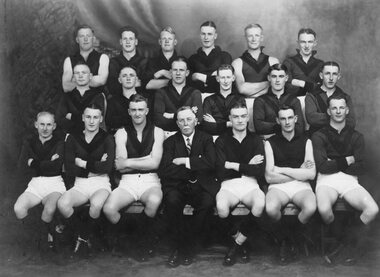 Stawell Historical Society Inc
Photograph, Stawell Football Team c1938 – 1939 -- Premiers
... Group of males in football clothing. Stawell Football Club Premiers 1938 – 1939 23.09.1939 Stawell Team Backs: L. ...Group of males in football clothing. Stawell Football Club Premiers 1938 – 1939 23.09.1939 Stawell Team Backs: L. ...Group of males in football clothing. Stawell Football Club Premiers 1938 – 1939 23.09.1939 Stawell Team Backs: L. Maddocks, L. Reeves, A. Neal Half Back: K. Robson, W. Gilchrist, A. Grainger, Centre: O. Friend, W. Earle, H. Oliver Half Forward: W. Roberts, D. Brilliant, D. McKey Forward: T. Tiddy, R. McKey, W. Pickering Ruck: L. Hughson and C. Faulkner Roving: G. Gilchrist Emergencies: E. Maddocks, P. Jamieson and R. Mason.Black and white Team photo of football players in jumpers and shorts. Older man possibly coach at center front seated.W.J. Chapman Photo Arist Stawell In handwriting Wimmera Football League Stawell Football Club Premiers 1938 and 1939stawell sport -
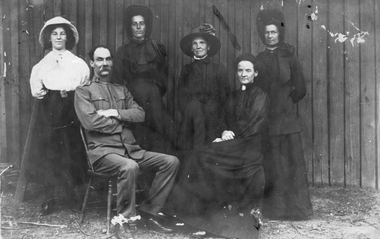 Stawell Historical Society Inc
Photograph, Salvation Army Group
... One of the women has a white shirt & white hat where the other women are in dark clothing. The male in the photograph is dressed in a uniform....One of the women has a white shirt & white hat where the other women are in dark clothing. The male in the photograph is dressed in a uniform. ...Salvation Army Group, four standing two seated in front of a paling fence. Adjutant John Perry seated next to this wife Mrs. Perry was the leader of the Stawell Salvation Army at this time in 1911. The post card was donated to the society by Mrs. Ruth Pickering from Dadswell's Bridge and the daughter of John Perry. A black & white Post card with four people standing and two seated in front of a paling fence. The five woman have long dresses and four have hats on. One of the women has a white shirt & white hat where the other women are in dark clothing. The male in the photograph is dressed in a uniform.Post Empire Card. Handwritten - Standing from left Jean Chandler, Sadie Mathews, Mrs. Moy. adj. John Perry & Mrs. Perry, Stawell 1911.stawell religion -
 Bacchus Marsh & District Historical Society
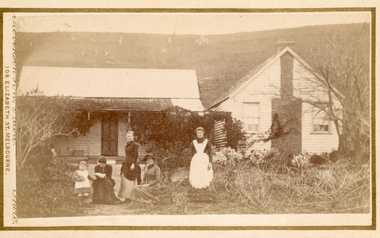
Photograph, Group of women at a farmhouse near Bacchus Marsh 1883
... It is unclear if the child is a boy or a girl, due to the custom of clothing young male children in dresses. The women are sitting or standing in two groups. ...It is unclear if the child is a boy or a girl, due to the custom of clothing young male children in dresses. The women are sitting or standing in two groups. ...This image is one of several family group portraits taken by Stevenson and McNicoll on rural properties. This property has been identified as that of John Tilley at Parwan’s Creek. The people depicted are presumably members of the Tilley family. The dwelling has since been demolished. Tilleys Road in Maddingley is probably named for this family farm.Small sepia unframed photograph on card with gold border framing photograph. Housed in the Jeremeas Family Album which contains photographs of Bacchus Marsh and District in 1883 by Stevenson and McNicoll. The property has been identified as that of John Tilley at Parwan’s Creek. This property has since been demolished. Presumably, the photo is of members of the Tilley family. The image shows a family group of four women and one young child. It is unclear if the child is a boy or a girl, due to the custom of clothing young male children in dresses. The women are sitting or standing in two groups. To the right stands an older woman in a starched white apron, perhaps indicating that she is the housekeeper. The group on the left is of one woman standing and two women seated, one reading a newspaper or magazine. The young child reaches out one arm to her, perhaps for reassurance. The dwelling consists of two structures, one single storeyed cottage, which is perhaps the older part, and an adjoining weatherboard house with a steeply pitched roof and a prominent chimney at the front. The cottage has a shingled verandah partially covered by corrugated iron, which also covers the roof. Trees, a climbing vine and shrubs form a rather unkempt garden. On the hill rising behind the farmhouse there can be seen animals, possibly sheep, grazing.On the front: Stevenson & McNicoll. Photo. 108 Elizabeth St. Melbourne. COPIES CAN BE OBTAINED AT ANY TIME. On the back: LIGHT & TRUTH inscribed on a banner surmounted by a representation of the rising sun. Copies of this Portrait can be had at any time by sending the Name and Post Office Money Order or Stamps for the amount of order to STEVENSON & McNICOLL LATE BENSON & STEVENSON, Photographers. 108 Elizabeth Street, MELBOURNE. stevenson and mcnicoll 1883 photographs of bacchus marsh and district, farmhouses, families, women bacchus marsh -
 Greensborough Historical Society
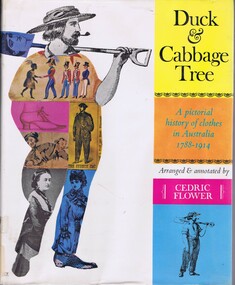
Book, Cedric Flower, Duck & cabbage tree: a pictorial history of clothes in Australia 1788-1914, 1968
... History of clothing in Australia 1788-1914, including that of male and female settlers and Australian aborigines....History of clothing in Australia 1788-1914, including that of male and female settlers and Australian aborigines. clothing australia social conditions Clothing in the Australian colonies is discussed with illustrations 157 p., black & white and colour illustrations, dust jacket Duck & cabbage tree: a pictorial history of clothes in Australia 1788-1914 Book Book Cedric Flower Angus and Robertson ...Clothing in the Australian colonies is discussed with illustrations157 p., black & white and colour illustrations, dust jacketnon-fictionClothing in the Australian colonies is discussed with illustrationsclothing, australia social conditions -
 Flagstaff Hill Maritime Museum and Village
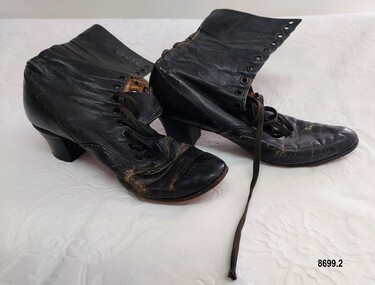
Footwear - Leather boots, Adler Boots and Shoes, circa 1920
... clothing collection) after Lila died in 1977. Starting in around 1850, women began wearing boots that resembled the ones already worn by men in high society. Victorian women's boots were slightly more feminine in nature, however, than those worn by their male counterparts. ...clothing collection) after Lila died in 1977. Starting in around 1850, women began wearing boots that resembled the ones already worn by men in high society. Victorian women's boots were slightly more feminine in nature, however, than those worn by their male counterparts. ...This item is one of a collection of clothing items that belonged to the Stephenson family who lived at 22 McCracken Street, Kensington, Melbourne. Matthew Stephenson (1861 – 1943) who had grown up on the Bendigo goldfields and shifted to Melbourne in the early 1900’s was a train driver and later, a fireman with the railways. His wife Elizabeth Jane (Betsy) Wigley (1865 – 1953) also grew up on the goldfields around Majorca and Bendigo. They married in 1885 in Bendigo. They had two daughters – Ethel Evelyn Stephenson (1886 – 1956) and Lillian or Lila (1891 – 1977) who were milliners and dressmakers and who continued to live in the family home after the death of their parents. The family are recorded as living at 22 McCracken Street, Kensington, as early as 1914. It is not known who made or owned the clothing that makes up this collection but as it appears to be from the late Victorian and early Edwardian era, the different pieces were probably made and worn by any of the three ladies of the house – Betsy, Ethel and/or Lila. During W.W.2, a local Warrnambool couple (Meryl and Tony Everard) boarded with them – Tony was in the airforce training paratroopers to jump into (and survive) enemy territory and his wife Meryl worked in the Methodist baby Home. The Everards developed a close friendship with the Stephensons and were responsible for clearing out the house (and finding this clothing collection) after Lila died in 1977. Starting in around 1850, women began wearing boots that resembled the ones already worn by men in high society. Victorian women's boots were slightly more feminine in nature, however, than those worn by their male counterparts. The boots first worn by women extended to the middle of the calf so that her ankle would stay properly covered underneath her many skirts. These boots often featured laces or a row of buttons to keep them secure to the foot and ankle. Although usually made from durable materials like rubber and leather, boots that were worn purely for fashion were sometimes made of more elegant materials like patent leather or dyed suede. Edwardian boots were lace up or button up. The most remarkable thing about women's shoes in the 1920's was that they were visible! This led to an increase in demand for new styles every season which made ordering custom fit shoes a thing of the past. New shoes were made in standard sizes, ready to buy from local clothing stores or mail order catalogues. Working women, however, tended to wear sensible, lace up shoes and boots. These boots appear to be of a practical nature, designed for comfort, warmth, and proof against the rain and mud, rather than high fashion. They feature the brand name "adler" printed on the inner sole and have stamped letters and numbers suggesting ready-made sizes.This pair of boots are a significant example of a working woman's footwear dating around the early 20th century.Pair of lady's black leather, lace up boots featuring 3.75 cm heels, 14 pairs of lacing eyelets, a black leather tongue and black shoelaces. The leather soles have tacks on the heels and near the instep. The boots have a black leather inner sole and the inner shaft and upper part of the boots are lined with a durable cotton type fabric. Both boots have ink markings (handwritten and stamped) at the top of the shaft lining and the inner sole of the left hand boot is labelled "adler".Both boots - "0/128 /X" (handwritten) and "6MC200" (stamped). Left boot inner sole - "adler" left boot upper shaft lining - "X/8FH?" (handwritten)flagstaff hill maritime museum and village, great ocean road, shipwreck coast, warrnambool, boots, lady's boots, footwear, leather boots, lace up boots, adler, stephenson family -
 Flagstaff Hill Maritime Museum and Village
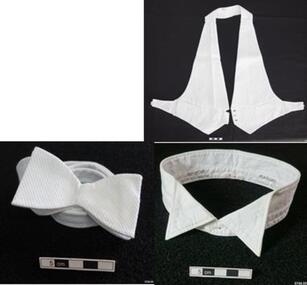
Shirt and Accessories, 1920's
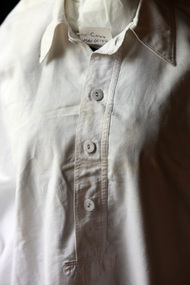
... clothing from late 19th to mid-20th century. Dr Angus assisted Dr Tom Ryan, a pioneer in the use of X-rays and in ocular surgery. flagstaff hill warrnambool shipwrecked coast flagstaff hill maritime museum maritime museum shipwreck coast flagstaff hill maritime village great ocean road dr w r angus dr ryan t.s.s. largs bay warrnambool base hospital nhill base hospital mira hospital flying doctor formal wear, male dress shirt 1920’s bow tie 1920’s waist coat, formal, 1920’s collar, formal, 1920’s Shirt: Label "HENRY BUCKS PTY LTD / ACTUAL MAKERS / MELBOURNE", hand written on label "1.2.724". ...This white cotton formal Dress Shirt and accessories were worn by Dr Angus for his wedding. They are from the W.R. Angus Collection was donated to Flagstaff Hill Maritime Village by the family of Doctor William Roy Angus, Surgeon and Oculist. It is part of the “W.R. Angus Collection” that includes historical medical equipment, surgical instruments and material once belonging to Dr Edward Ryan and Dr Thomas Francis Ryan, (both of Nhill, Victoria) as well as Dr Angus’ own belongings. The Collection’s history spans the medical practices of the two Doctors Ryan, from 1885-1926 plus that of Dr Angus, up until 1969. ABOUT THE “W.R.ANGUS COLLECTION” Doctor William Roy Angus M.B., B.S., Adel., 1923, F.R.C.S. Edin.,1928 (also known as Dr Roy Angus) was born in Murrumbeena, Victoria in 1901 and lived until 1970. He qualified as a doctor in 1923 at University of Adelaide, was Resident Medical Officer at the Royal Adelaide Hospital in 1924 and for a period was house surgeon to Sir (then Mr.) Henry Simpson Newland. Dr Angus was briefly an Assistant to Dr Riddell of Kapunda, then commenced private practice at Curramulka, Yorke Peninsula, SA, where he was physician, surgeon and chemist. In 1926, he was appointed as new Medical Assistant to Dr Thomas Francis Ryan (T.F. Ryan, or Tom), in Nhill, Victoria, where his experiences included radiology and pharmacy. In 1927 he was Acting House Surgeon in Dr Tom Ryan’s absence. Dr Angus had become engaged to Gladys Forsyth and they decided he further his studies overseas in the UK in 1927. He studied at London University College Hospital and at Edinburgh Royal Infirmary and in 1928, was awarded FRCS (Fellow from the Royal College of Surgeons), Edinburgh. He worked his passage back to Australia as a Ship’s Surgeon on the on the Australian Commonwealth Line’s T.S.S. Largs Bay. Dr Angus married Gladys in 1929, in Ballarat. (They went on to have one son (Graham 1932, born in SA) and two daughters (Helen (died 12/07/1996) and Berenice (Berry), both born at Mira, Nhill ) According to Berry, her mother Gladys made a lot of their clothes. She was very talented and did some lovely embroidery including lingerie for her trousseau and beautifully handmade baby clothes. Dr Angus was a ‘flying doctor’ for the A.I.M. (Australian Inland Ministry) Aerial Medical Service in 1928 . Its first station was in the remote town of Oodnadatta, where Dr Angus was stationed. He was locum tenens there on North-South Railway at 21 Mile Camp. He took up this ‘flying doctor’ position in response to a call from Dr John Flynn; the organisation was later known as the Flying Doctor Service, then the Royal Flying Doctor Service. A lot of his work during this time involved dental surgery also. Between 1928-1932 he was surgeon at the Curramulka Hospital, Yorke Peninsula, South Australia. In 1933 Dr Angus returned to Nhill and purchased a share of the Nelson Street practice and Mira hospital (a 2 bed ward at the Nelson Street Practice) from Dr Les Middleton one of the Middleton Brothers, the current owners of what previously once Dr Tom Ryan’s practice. Dr Tom and his brother had worked as surgeons included eye surgery. Dr Tom Ryan performed many of his operations in the Mira private hospital on his premises. He had been House Surgeon at the Nhill Hospital 1902-1926. Dr Tom Ryan had one of the only two pieces of radiology equipment in Victoria during his practicing years – The Royal Melbourne Hospital had the other one. Over the years Dr Tom Ryan had gradually set up what was effectively a training school for country general-practitioner-surgeons. Each patient was carefully examined, including using the X-ray machine, and any surgery was discussed and planned with Dr Ryan’s assistants several days in advance. Dr Angus gained experience in using the X-ray machine there during his time as assistant to Dr Ryan. When Dr Angus bought into the Nelson Street premises in Nhill he was also appointed as the Nhill Hospital’s Honorary House Surgeon 1933-1938. His practitioner’s plate from his Nhill surgery is now mounted on the doorway to the Port Medical Office at Flagstaff Hill Maritime Village, Warrnambool. When Dr Angus took up practice in the Dr Edward and Dr Tom Ryan’s old premises he obtained their extensive collection of historical medical equipment and materials spanning 1884-1926. A large part of this collection is now on display at the Port Medical Office at Flagstaff Hill Maritime Village in Warrnambool. In 1939 Dr Angus and his family moved to Warrnambool where he purchased “Birchwood,” the 1852 home and medical practice of Dr John Hunter Henderson, at 214 Koroit Street. (This property was sold in1965 to the State Government and is now the site of the Warrnambool Police Station. and an ALDI store is on the land that was once their tennis court). The Angus family was able to afford gardeners, cooks and maids; their home was a popular place for visiting dignitaries to stay whilst visiting Warrnambool. Dr Angus had his own silk worm farm at home in a Mulberry tree. His young daughter used his centrifuge for spinning the silk. Dr Angus was appointed on a part-time basis as Port Medical Officer (Health Officer) in Warrnambool and held this position until the 1940’s when the government no longer required the service of a Port Medical Officer in Warrnambool; he was thus Warrnambool’s last serving Port Medical Officer. (Masters of immigrant ships arriving in port reported incidents of diseases, illness and death and the Port Medical Officer made a decision on whether the ship required Quarantine and for how long, in this way preventing contagious illness from spreading from new immigrants to the residents already in the colony.) Dr Angus was a member of the Australian Medical Association, for 35 years and surgeon at the Warrnambool Base Hospital 1939-1942, He served with the Australian Department of Defence as a Surgeon Captain during WWII 1942-45, in Ballarat, Victoria, and in Bonegilla, N.S.W., completing his service just before the end of the war due to suffering from a heart attack. During his convalescence he carved an intricate and ‘most artistic’ chess set from the material that dentures were made from. He then studied ophthalmology at the Royal Melbourne Eye and Ear Hospital and created cosmetically superior artificial eyes by pioneering using the intrascleral cartilage. Angus received accolades from the Ophthalmological Society of Australasia for this work. He returned to Warrnambool to commence practice as an ophthalmologist, pioneering in artificial eye improvements. He was Honorary Consultant Ophthalmologist to Warrnambool Base Hospital for 31 years. He made monthly visits to Portland as a visiting surgeon, to perform eye surgery. He represented the Victorian South-West subdivision of the Australian Medical Association as its secretary between 1949 and 1956 and as chairman from 1956 to 1958. In 1968 Dr Angus was elected member of Spain’s Barraquer Institute of Barcelona after his research work in Intrasclearal cartilage grafting, becoming one of the few Australian ophthalmologists to receive this honour, and in the following year presented his final paper on Living Intrasclearal Cartilage Implants at the Inaugural Meeting of the Australian College of Ophthalmologists in Melbourne In his personal life Dr Angus was a Presbyterian and treated Sunday as a Sabbath, a day of rest. He would visit 3 or 4 country patients on a Sunday, taking his children along ‘for the ride’ and to visit with him. Sunday evenings he would play the pianola and sing Scottish songs to his family. One of Dr Angus’ patients was Margaret MacKenzie, author of a book on local shipwrecks that she’d seen as an eye witness from the late 1880’s in Peterborough, Victoria. In the early 1950’s Dr Angus, painted a picture of a shipwreck for the cover jacket of Margaret’s book, Shipwrecks and More Shipwrecks. She was blind in later life and her daughter wrote the actual book for her. Dr Angus and his wife Gladys were very involved in Warrnambool’s society with a strong interest in civic affairs. He had an interest in people and the community They were both involved in the creation of Flagstaff Hill, including the layout of the gardens. After his death (28th March 1970) his family requested his practitioner’s plate, medical instruments and some personal belongings be displayed in the Port Medical Office surgery at Flagstaff Hill Maritime Village, and be called the “W. R. Angus Collection”. The clothing is representative of men’s formal wear in the 1920’s in Victoria, Australia. The W.R. Angus Collection is significant for still being located at the site it is connected with, Doctor Angus being the last Port Medical Officer in Warrnambool. The collection of medical instruments and other equipment is culturally significant, being an historical example of medicine, administration, household equipment and clothing from late 19th to mid-20th century. Dr Angus assisted Dr Tom Ryan, a pioneer in the use of X-rays and in ocular surgery. White cotton formal Dress-Shirt and accessories from the W.R. Angus Collection. (.01) Long sleeved shirt, round neck, button front, button back opening, textured bib front. Made by Henry Bucks Pty Ltd of Melbourne and makred as property of Dr Angus. (.02) Collar white cotton, button on, point finish, printed label Made in Ireland by Radiac, Embassy. (.03) Bow Tie, white cotton, with attached. Made by Henry Bucks of London and Melbourne. (04) Waist coat, white cotton, button front, adjustable width, fob pockets. Made in England and tailored in London. Shirt: Label "HENRY BUCKS PTY LTD / ACTUAL MAKERS / MELBOURNE", hand written on label "1.2.724". Hand written on collar "W.R. Angus" Collar: "ALL COTTON / MADE IN N. IRELAND" and "RADIAC / EMBASSY 1 3/4 X 17" Bow tie: label "HENRY BUCKS / LONDON & MELBOURNE" Waist Coat: "ALL COTTON / MADE IN ENGLAND" and "Beaucaire / tailored in London" and "CF 2210" flagstaff hill, warrnambool, shipwrecked coast, flagstaff hill maritime museum, maritime museum, shipwreck coast, flagstaff hill maritime village, great ocean road, dr w r angus, dr ryan, t.s.s. largs bay, warrnambool base hospital, nhill base hospital, mira hospital, flying doctor, formal wear, male, dress shirt 1920’s, bow tie 1920’s, waist coat, formal, 1920’s, collar, formal, 1920’s -
 City of Moorabbin Historical Society (Operating the Box Cottage Museum)
Clothing - Clothing, man's nightshirt, c1920
... Unfortunately few articles of male clothing survive because the men were working in hard, dirty conditions that caused great wear. ...This is a long, heavy cotton, man's nightshirt, typical of those worn c1920. Mr Edward Harrad's family lived in Moorabbin Shire.Early settlers and market gardeners established their families in Moorabbin Shire . Unfortunately few articles of male clothing survive because the men were working in hard, dirty conditions that caused great wear. Usually the worn out clothing was used as rags for cleaning etc.A long, heavy cotton, man’s nightshirtLabel ' Foy & Gibson / Shirtmakers / MELBOURNE'clothing, moorabbin, pioneers, ormond, bentleigh, dressmaking, cheltenham, early settlers, harrad edward -
 City of Moorabbin Historical Society (Operating the Box Cottage Museum)
Accessory - Clothing, bow tie, black , spring clip, 20thC
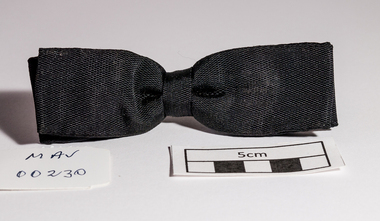
... clothing...bow ties...cheltenham...moorabbin...bentleigh...early settlers...pioneers...market gardeners...male...Most men only wear Bow ties with formal dress. menswear clothing bow ties cheltenham moorabbin bentleigh early settlers pioneers market gardeners male neckwear on spring clip MADE IN AUSTRALIA SPRING A man's pre-tied black bow tie with a metal spring clip to attach to the shirt collar. ...The Bow Tie is a type of men's necktie that consists of a ribbon of fabric tied around the collar in a symmetrical manner such that the two opposite ends form loops. Ready-tied Bow ties are available, in which the distinctive Bow is sewn and a band goes around the neck and clips to secure. Bow ties may be made of any fabric material, but most are made from silk, polyester, cotton, or a mixture of fabrics. The Bow tie originated among Croatian mercenaries during the Prussian wars of the 17th century when the Croat mercenaries used a scarf around the neck to hold together the opening of their shirts. This was soon adopted under the name cravat, derived from the French for "Croat", by the upper classes in France, then a leader in fashion, and flourished in the 18th and 19th centuries. The most traditional Bow ties are usually of a fixed length and are made for a specific size neck. Sizes can vary between approximately 14 and 20 inches just like a comparable shirt collar. Fixed-length Bow ties are preferred when worn with the most formal wing-collar shirts, so as not to expose the buckle or clasp of an adjustable Bow tie. Bow ties are worn by magicians, country doctors, paediatricians, lawyers, professors musicians and by people hoping to look like the above and clowns also wear oversized ones. In the 1980’s fashionable and professional women wore a type of Bow tie. Most men only wear Bow ties with formal dress. A man's pre-tied black bow tie with a metal spring clip to attach to the shirt collar. The 2 spring clips have 'alligator teeth' to grip the collaron spring clip MADE IN AUSTRALIA SPRINGmenswear, clothing, bow ties, cheltenham, moorabbin, bentleigh, early settlers, pioneers, market gardeners, male neckwear -
 City of Moorabbin Historical Society (Operating the Box Cottage Museum)
Clothing - Clothing, bow tie, white , elastic clip, 20thC
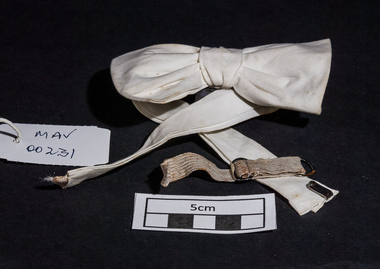
... clothing...bow ties...cheltenham...moorabbin...bentleigh...early settlers...pioneers...market gardeners...male...Most men only wear Bow ties with formal dress. menswear clothing bow ties cheltenham moorabbin bentleigh early settlers pioneers market gardeners male neckwear A pre tied white Bow tie sewn on a neckband with an elastic clip fastener Clothing Clothing, bow tie, white , elastic clip Unrecorded menswear manufacturer ...The Bow Tie is a type of men's necktie that consists of a ribbon of fabric tied around the collar in a symmetrical manner such that the two opposite ends form loops. Ready-tied Bow ties are available, in which the distinctive Bow is sewn and a band goes around the neck and clips to secure. Bow ties may be made of any fabric material, but most are made from silk, polyester, cotton, or a mixture of fabrics. The Bow tie originated among Croatian mercenaries during the Prussian wars of the 17th century when the Croat mercenaries used a scarf around the neck to hold together the opening of their shirts. This was soon adopted under the name cravat, derived from the French for "Croat", by the upper classes in France, then a leader in fashion, and flourished in the 18th and 19th centuries. The most traditional Bow ties are usually of a fixed length and are made for a specific size neck. Sizes can vary between approximately 14 and 20 inches just like a comparable shirt collar. Fixed-length Bow ties are preferred when worn with the most formal wing-collar shirts, so as not to expose the buckle or clasp of an adjustable Bow tie. Bow ties are worn by magicians, country doctors, paediatricians, lawyers, professors musicians and by people hoping to look like the above and clowns also wear oversized ones. In the 1980’s fashionable and professional women wore a type of Bow tie. Most men only wear Bow ties with formal dress. A pre tied white Bow tie sewn on a neckband with an elastic clip fastenermenswear, clothing, bow ties, cheltenham, moorabbin, bentleigh, early settlers, pioneers, market gardeners, male neckwear -
Glenelg Shire Council Cultural Collection
Clothing - Frock Coat, Nov-84
... male dress coat overcoat outerwear Frock coat, brown uncut corduroy, lined with brown satin. Collar with long lapels, single button at waist, split back. Long sleeves, 3 buttons on each cuff Clothing ...Frock coat, brown uncut corduroy, lined with brown satin. Collar with long lapels, single button at waist, split back. Long sleeves, 3 buttons on each cuffmale dress, coat, overcoat, outerwear -
 The Beechworth Burke Museum
Photograph
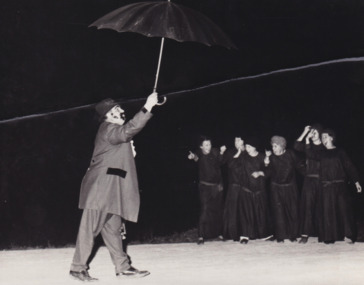
... The male in the foreground is dressed in formal clothing and holding a large, open umbrella. ...The male in the foreground is dressed in formal clothing and holding a large, open umbrella. ...Depicted are seven unidentified theatrical performers. The male in the foreground is dressed in formal clothing and holding a large, open umbrella. The remaining performers are dressed uniformly in long, dark cloaks.The photograph provides insight into entertainment, performance and recreation in Beechworth during the 1950s. The item's interpretive capacity is enhanced by its strong relationship to other photographs in the catalogue. Collectively, these records enrich the community's understanding of how the arts have developed in Beechworth since the mid-twentieth century.Black and white rectangular photograph printed on matte photographic paper.Reverse: 5658 /entertainment album, entertainment, performance, theatre, theatrical group, performers, arts, recreation -
 The Beechworth Burke Museum
Photograph
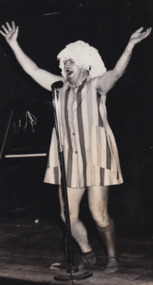
... Depicted is an unidentified male performer dressed in women's clothing. He is positioned on a stage and in front of a microphone. ...Depicted is an unidentified male performer dressed in women's clothing. He is positioned on a stage and in front of a microphone. ...Depicted is an unidentified male performer dressed in women's clothing. He is positioned on a stage and in front of a microphone. The photograph appears to have been taken by a reporter from the Ovens and Murray Advertiser; a weekly newspaper published in Beechworth.The photograph provides insight into entertainment, performance and recreation in Beechworth during the 1950s. The item's interpretive capacity is enhanced by its strong relationship to other photographs in the catalogue. Collectively, these records enrich the community's understanding of how the arts have developed in Beechworth since the mid-twentieth century.Black and white rectangular photograph printed on matte photographic paper.Reverse: THE OVENS AND MURRAY ADVERTISER /entertainment album, entertainment, 1950s, performance, theatre, theatrical group, arts, the ovens and murray advertiser, newspaper, beechworth, actor -
 Orbost & District Historical Society
collars, Cremorne Collar Company, c. 1920s-1940s Cremorne Collar Company . The Cremorne Collar Company was first registered in 1923 (info. from Rhyce Winterbourne)
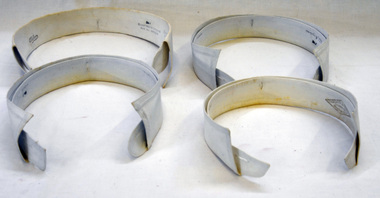
... These items are examples of men's clothing from the first decades of the 20th century when men wore more formal daily attire. men-collars male-apparel Cremorne Collar Company, Melbourne A set of four white men's collars of assorted sizes, made from stiffened fabric. collars Cremorne Collar Company ...A set of collars, possibly worn during the 1920s-1950s period, wearer unknown. A detachable collar is a shirt collar separate from the shirt, fastened to it by studs. The collar is usually made of a different fabric from the shirt, in which case it is almost always white, and, being unattached to the shirt, can be specially starched to a hard cardboard-like consistency. The popularity of detachable collars and starched collars in general began to fade in the 1920s and 30s as men’s clothes became more comfortable.These items are examples of men's clothing from the first decades of the 20th century when men wore more formal daily attire. A set of four white men's collars of assorted sizes, made from stiffened fabric.Cremorne Collar Company, Melbournemen-collars male-apparel -
 Bendigo Military Museum
Clothing - SASH/BELT, C.1930 - 45
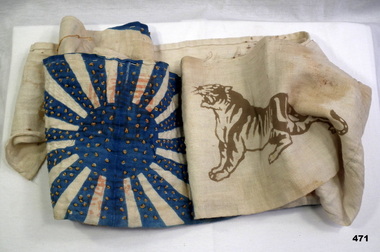
... costume accessories - male japan handcrafts - sewing/ embroidery centre section is double thickness with blue-rayed sun; blue sections are decorated with gold coloured cotton french knots symbolizing the district shire where the owner lived. A Khaki coloured tiger faces inwards each end of centre. Japanese characters in pink near centre sashiko quilting on white rays. Clothing ...centre section is double thickness with blue-rayed sun; blue sections are decorated with gold coloured cotton french knots symbolizing the district shire where the owner lived. A Khaki coloured tiger faces inwards each end of centre. Japanese characters in pink near centre sashiko quilting on white rays.costume accessories - male, japan, handcrafts - sewing/ embroidery -
 Bendigo Military Museum
Uniform - UNIFORM AIF WW1, 4) Hat - Akubra et al, c.2000
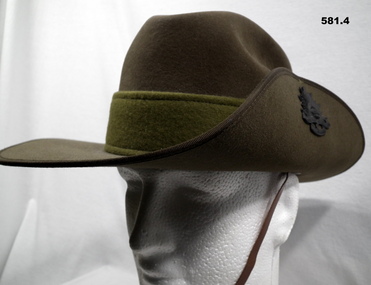
... A complete replica uniform set of clothing and all items that were or could be worn by a first AIF soldier. uniforms-army costume - male footwear costume - male headwear .1) & .2) Makers labels. .4) Hat: Akubra, Made in Australia; On badge: Australian Commonwealth Military Forces. ...A complete replica uniform set of clothing and all items that were or could be worn by a first AIF soldier.Light horse brigade .1) Jacket, 100% wool with cotton lining. 7th Battalion AIF colour patches with a brass A signifying original ANZAC on both sleeves. Right sleeve has sergeant's stripes & 5 blue & 1 red chevron stripes. Left sleeve has 3 brass bars re WIA 3 times. Rising Sun badges on each collar & Australia badges on shoulder straps. Belted at waist. .2) Jodphurs, khaki corded wool. Brass button up fly. .3) Braces, red, white & blue oblique striped. .4) Hat, size 57, khaki Akubra with felt pugaree, leather chin strap, & blackened brass Rising Sun badge on upturned rim. .5) & .6) Puttees, pair, khaki wool felt with khaki cotton tapes. .7) & .8) Boots, pair, size L, tan coloured leather with dark brown leather laces, leather soles with metal reinforcing on heels..1) & .2) Makers labels. .4) Hat: Akubra, Made in Australia; On badge: Australian Commonwealth Military Forces. on hat: "5.7 Akubra Made in Australia"uniforms-army, costume - male footwear, costume - male headwear -
 Bendigo Military Museum
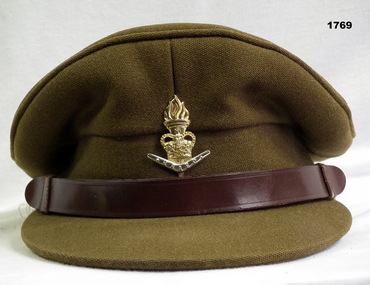
Headwear - CAP, PEAKED, Commonwealth Government Clothing Factory, 1967
... male headwear Peak cap Army peaked cap with Royal Australian Army Education Corps badge. Olive drab fabric with gold and silver badge and brown leather band held on with a brass button on each side. Headwear CAP, PEAKED Commonwealth Government Clothing ...Item issued to Murray Stanley Metherall. Refer Cat no 590.2Army peaked cap with Royal Australian Army Education Corps badge. Olive drab fabric with gold and silver badge and brown leather band held on with a brass button on each side.uniforms-army, costume-male headwear, peak cap -
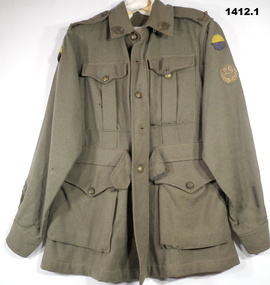 Bendigo Military Museum
Uniform - JACKET AND SLOUCH HAT - WW1, Dalter Lucas & Sons (1910) Ltd, 1918
... clothing...costume accessories - male...It appears to be of a similar style to those issued to Gurkha troops due to the thickness of the felt, the three rows of stitching around the brim and the use of a press stud to pin up the left hand side of the brim. uniforms military clothing costume accessories - male .2) Pressed into the hat band appears to be; “Dalter Lucas & sons (1910) Ltd, BURY 1918” .1) Coat, Battle Dress, Kahki, includes 2 x “Australia” shoulder badges, 2 x “Rising Sun” epaulette badges, 2 x “yellow over purple” colour patches, 3 x “service chevrons”, 1 x “Empire Wounded stripe”, 1 x “Lewis Gun” cloth badge, all metal buttons intact as well as waist belt. .2) Hat, Slouch, kahki fur felt, cotton pugaree, leather head band, Rising sun badge, no chin strap. ...Slouch hat and Uniform jacket belonging to Edwin James JONES No 3511 AIF. Refer 1367.5 for his service history. The hat was manufactured in 1918 by Dalter Lucas & Sons Bury, UK. It appears to be of a similar style to those issued to Gurkha troops due to the thickness of the felt, the three rows of stitching around the brim and the use of a press stud to pin up the left hand side of the brim..1) Coat, Battle Dress, Kahki, includes 2 x “Australia” shoulder badges, 2 x “Rising Sun” epaulette badges, 2 x “yellow over purple” colour patches, 3 x “service chevrons”, 1 x “Empire Wounded stripe”, 1 x “Lewis Gun” cloth badge, all metal buttons intact as well as waist belt. .2) Hat, Slouch, kahki fur felt, cotton pugaree, leather head band, Rising sun badge, no chin strap..2) Pressed into the hat band appears to be; “Dalter Lucas & sons (1910) Ltd, BURY 1918”uniforms, military clothing, costume accessories - male -
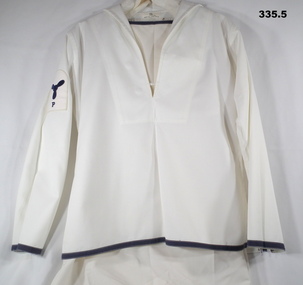 Bendigo Military Museum
Uniform - UNIFORM, NAVY, ADI Clothing Factory, 1990
... FORREST, RAN Technician Refer also Cat. 348.2 & 349.5 uniform - navy costume - male costume accessories - male .1) Jacket, polyester, white, service insignia blue P above a propeller on right sleeve, "AUSTRALIA" on upper sleeves. .2) Trousers, polyester, white, "AUSTRALIA" on upper sleeves. .3) Shirt, polyester, white. .4) Navy bib attachment, polyester, navy with white strips. .5) Lanyard and ribbon, white rope, navy ribbon. Uniform UNIFORM, NAVY ADI Clothing ...Uniform belonging to E.R. FORREST, RAN Technician Refer also Cat. 348.2 & 349.5.1) Jacket, polyester, white, service insignia blue P above a propeller on right sleeve, "AUSTRALIA" on upper sleeves. .2) Trousers, polyester, white, "AUSTRALIA" on upper sleeves. .3) Shirt, polyester, white. .4) Navy bib attachment, polyester, navy with white strips. .5) Lanyard and ribbon, white rope, navy ribbon.uniform - navy, costume - male, costume accessories - male -
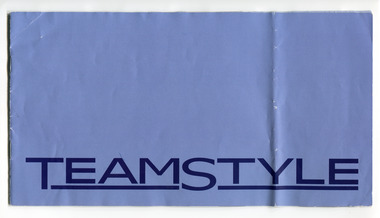 Sir Reginald Ansett Transport Museum
Booklet - Lookbook, Teamstyle
... male and female flight attendants uniforms designed by David Weiss for the period 1984-1986. It shows the different options and combinations of accessories, tops and bottoms presented on mannequin and also photographed on models. It also explains the presentation standards expected from the in flight staff in regards to grooming, jewellery, make-up, hairdo. This lookbook contains the vision of designer Peter Weiss for this collection. david weiss 1984-1986 uniform flight attendant stewardess steward hostess clothing ...This booklet is a lookbook of male and female flight attendants uniforms designed by David Weiss for the period 1984-1986. It shows the different options and combinations of accessories, tops and bottoms presented on mannequin and also photographed on models. It also explains the presentation standards expected from the in flight staff in regards to grooming, jewellery, make-up, hairdo.This lookbook contains the vision of designer Peter Weiss for this collection. Landscape format catalogue with light blue background and colour pictures of uniforms for male and female flight attendants. It contains david weiss, 1984-1986, uniform, flight attendant, stewardess, steward, hostess, clothing, accessory, hat, ansett, lookbook, ansett australia
