
Showing 12 items matching " mask making"
-
 Women's Art Register
Archive (Collection) - Mara-Venera Carmella Artist Archive
... ... Mask making...Cabaret Community Art Dance Mask making Theatre Archive Mara-Venera Carmella Artist Archive ...cabaret, community art, dance, mask making, theatrecabaret, community art, dance, mask making, theatre -
Women's Art Register
Archive (Collection) - Tricia Charalambous Artist Archive
... Mask Making...Mask Making Archive Tricia Charalambous Artist Archive ...mask makingmask making -
Women's Art Register
Archive (Series) - Carmella, Mara-Venera. Artist File 1
... ... Mask making...Cabaret Community Art Dance Mask making Theatre Foolscap white archival 4 flap folder or document wallet Archive Carmella, Mara-Venera. ...CV, Newspaper Clippings, Promotional Materialcabaret, community art, dance, mask making, theatrecabaret, community art, dance, mask making, theatre -
Women's Art Register
Archive (Series) - Charalambous, Tricia. Artist File 1
... Mask Making...Mask Making Foolscap white archival 4 flap folder or document wallet Archive Charalambous, Tricia. ...Newspaper Clippingsmask makingmask making -
Women's Art Register
Archive (Series) - Tricia Charalambous. Duplicate File 1
... Mask Making...Mask Making Foolscap manilla file Archive Tricia Charalambous. ...Newspaper Clippingsmask makingmask making -
Women's Art Register
Archive (Series) - Mara-Venera Carmella. Duplicate File 1
... Mask making...Mask making Theatre Cabaret Community Art Dance Foolscap manilla file Archive Mara-Venera Carmella. ...CV, Newspaper Clippings, Promotional Materialmask making, theatre, cabaret, community art, dancemask making, theatre, cabaret, community art, dance -
Women's Art Register
Archive (Series) - Mara-Venera Carmella. Slide Kit
... Mask making...Mask making Theatre Cabaret Community Art Dance Set of slides in Polypropylene sleeves, within a Polypropyline binder and slipcase. ...mask making, theatre, cabaret, community art, dancemask making, theatre, cabaret, community art, dance -
Women's Art Register
Archive (Series) - Mara-Venera Carmella, Digitised Slide Kit
... Mask making...Mask making Theatre Cabaret Community Art Dance Archive Mara-Venera Carmella, Digitised Slide Kit ...mask making, theatre, cabaret, community art, dancemask making, theatre, cabaret, community art, dance -
 Geoffrey Kaye Museum of Anaesthetic History
Equipment - Ormsby's Inhaler, 1877
... In thirty years of use, Ormsby's Inhaler underwent certain modifications, an exhalation valve was fitted to the mask and device for recharging the sponge with ether was later added. The Ormsby inhaler was modified by Carter Braine in 1898 with the aim of making it easier to clean. ...In thirty years of use, Ormsby's Inhaler underwent certain modifications, an exhalation valve was fitted to the mask and device for recharging the sponge with ether was later added. The Ormsby inhaler was modified by Carter Braine in 1898 with the aim of making it easier to clean. ...Lambert Ormsby was a New Zealand surgeon who migrated to Ireland. He described his inhaler in a letter to the Lancet in 1877.Ormsby listed the advantages of his inhaler as simple, inexpensive, small quantity required to produce sleep, prevents evaporation of ether, portable and small (can be carried in pocket), short time to complete anaesthesia (two minutes) and safe. Disadvantages of this apparatus were that it had to be removed in order to recharge the sponge with ether or when anaesthesia becomes too deep. Considerable carbon dioxide accumulation developed and there would also be some oxygen lack. In thirty years of use, Ormsby's Inhaler underwent certain modifications, an exhalation valve was fitted to the mask and device for recharging the sponge with ether was later added. The Ormsby inhaler was modified by Carter Braine in 1898 with the aim of making it easier to clean. Essentially it is very similar except there is no net around the bag.The inhaler consists of an india-rubber flexible bag enclosed within a net bag to limit expansion. There is a soft metallic mouthpiece with india-rubber tubing around the edge. The tubing had to be purchased separately from the manufacturer. The body contains a wire cage with a similarly shaped hollow sponge into which ether was poured.Maker's details inscribed into metal ring around the bore: Barth Co. London.ormsby, new zealand, carbon dioxide, carbon accumulation, carter braine, portable -
 Ararat Gallery TAMA
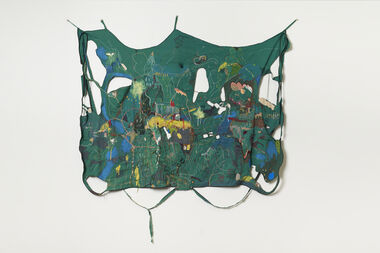
Kasia Töns, Beyond Homeostasis, 2021
... Hand embroidery and mask making are central to Töns’ practice, which sits at the intersection of art, fashion, and craft. ...Kasia Töns is a textile artist working and living on Peramangk Country (Adelaide Hills). Hand embroidery and mask making are central to Töns’ practice, which sits at the intersection of art, fashion, and craft. Her process is slow and intuitive, colourful, and expressive. Töns studied textile design studies at RMIT. The labour and time invested in creating Töns’ work acts as an antidote to the fast pace of the modern world and the addictive seeking of instant gratification through digital means. Recurring thematic interests include social impacts of digital technology use, the Anthropocene, and interpersonal/interspecies relationship dynamics. The artist says of this artwork: “Using an ex-house tent as a base, this work was my first attempt at making embroidery a more physical experience so it could match my feelings. Using larger stitches and threads I made this work outside in the Flinders Ranges and Lenswood. It is about what we do with our thoughts and bodies beyond the basic functions to keep us alive.” Töns exhibited her 2024 solo exhibition Panoply at Ararat Gallery TAMA, which explored how sculptural textiles can support mental well-being in emergency evacuation situations. A key work from that exhibition, Panoply II, was subsequently included in Art Gallery of South Australia’s major textile-focussed exhibition Radical Textiles, November 2024 – March 2025. Kasia Töns is represented by MARS Gallery. -
 Port Fairy Historical Society Museum and Archives
Functional object - Headlamp Masks, 1940's
... making them, hopefully, invisible from the air. These were used by Mr Claude Freckleton who lived on a farm outside of Port Fairy World war two headlights car headlight covers How to fit "G J C" approved headlamp mask Remove glass from car headlamp & mark mask to the size and shape of glass centering the glass slit and celluloid insert. ...Used during WWII to dim headlights making them, hopefully, invisible from the air. These were used by Mr Claude Freckleton who lived on a farm outside of Port Fairy Pair headlamp masks, with shaded glass slit - Painted blackHow to fit "G J C" approved headlamp mask Remove glass from car headlamp & mark mask to the size and shape of glass centering the glass slit and celluloid insert. Cut mask with tin snips to fit the headlamp instead of glass with this side inward towards the globe. Adjust the headlamp downward 2 degrees from the perpendicular so that the light beam strikes the road 10 feet from the front of the car. * Important - Do not alter the angle of slits over slits.world war two, headlights, car, headlight covers -
 The Beechworth Burke Museum
Photograph
... In addition, death masks were also created to aid effigy making, as tools for sculpture and as objects of veneration. ...In addition, death masks were also created to aid effigy making, as tools for sculpture and as objects of veneration. ...A death mask is a plaster or wax mould made of a human face shortly after death (around 30 minutes after the execution). The intention was to capture the likeness of the individual and maintain their facial expression and features before these became distorted in death. They differ from their counterparts the life masks which were made to preserve the likeness of an individual while alive. Death masks were often replicated and sold to various institutions and private buyers. Death masks were created for a variety of reasons. Organisations like museums and scientific institutes collected these masks to support the study of phrenology. Phrenology is the study of the conformation of a skull in an effort to understand the mental faculties and traits of an individual. This was undertaken in a period in which it was argued that the shape of a head could provide detailed knowledge into personality. In addition, death masks were also created to aid effigy making, as tools for sculpture and as objects of veneration. Death masks were often placed on display as objects of curiosity. Edward “Ned” Kelly was convicted of murder on the 29th of October 1880 and executed by hanging on the 11th of November that same year. In the 1800s it was common practice for authorities to make a death mask of an executed criminal. In Kelly’s case, there were multiple copies made of his death mask, one of which is in the collection of the Burke Museum. Copies of the official death Mask (attributed to Maximilian Kreitmayer) have been made by artists including Max Meldrum (1875-1955). It depicts the head, neck and partial right shoulder of Ned Kelly. Whilst generally considered to be a ‘pseudoscience’ today, phrenology and the study of the reception and use of artefacts like Ned Kelly’s death mask, can provide valuable insight into a past era’s views of personality and the human body. This mask presents a unique three-dimensional depiction of Ned Kelly shortly after his execution which is unlike any other depiction of him. It can provide vital information as to the use of death masks in Victoria and their popularity in the 1800s. These masks were mostly done of criminals and used for exhibition purposes alongside phrenological study. Phrenologist AS Hamilton used Kreitmayer’s replication of the mask (displayed in Kreitmayer’s Bourke Street waxworks the day after Kelly’s death) to report a detailed phrenological analysis on Ned Kelly and concluded from his research that the deceased had an “enormous self-esteem”. Portraits of living people represent the way they themselves and/or the artists wished themselves to be remembered. The death mask contrasts this and therefore, creates a likeness of a person in their entirety and not just an ideal representation. Therefore, the study of such artefacts and their history of use and disuse can provide interesting information valuable to understanding the past. Colour rectangular photograph printed on gloss photographic paper.Obverse: Reverse: AGFA kelly album, ned kelly, death mask, kreitmayer, old melbourne gaol, phrenology, craneology, 1800s, pseudoscience, burke musuem, max meldrum
