
Showing 6 items matching " mola - reverse applique"
-
 Embroiderers Guild, Victoria
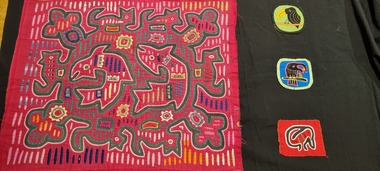
Accessory - San Blas Mola Panel
... Mola...Reverse applique...Black panel with rectangle of reverse applique in very bright colours - orange, blue, pink, black, with red fabric predominant. Depicting two dolphins/sharks. Three separate motifs depict birds. Part of Mola...Embroidery Mola Reverse applique Black panel with rectangle of reverse applique in very bright colours - orange, blue, pink, black, with red fabric predominant. ...traditional hand sewn crafted by indigenous Guna (Kuna) people of the San Blas Islands, panama and Colombia. Usually made in pairs to decorate the front and back of a Guna woman's blouse. Artists fill nearly all the spaces, traditionally believed to leave no room for evil spirits to settle. Evolving from ancestral geometric body painting. Following 1925 Guna Revolution, securing their autonomy, making and wearing Molas became a symbol of cultural identity and independence.Black panel with rectangle of reverse applique in very bright colours - orange, blue, pink, black, with red fabric predominant. Depicting two dolphins/sharks. Three separate motifs depict birds. Part of Mola - traditional garment.embroidery, mola, reverse applique -
 Embroiderers Guild, Victoria
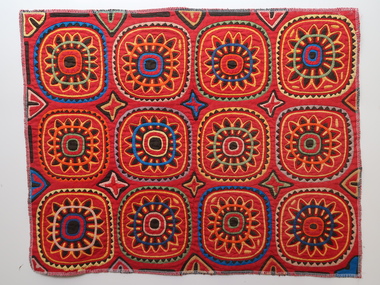
Textile - San Blas Mola Panel
... Mola - reverse applique...Mola - reverse applique San Blas Mola applique with cut back panels. ...Mola applique with cut back panels. Stylized flower motifs using applique, hand stitching and needle turning.. Red background with yellow, blue, orange, brown, black details.mola - reverse applique, san blas -
 Embroiderers Guild, Victoria
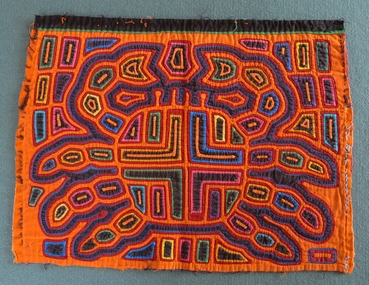
Accessory - San Blas Mola Panel
... Mola...Reverse applique...Rectangle of reverse applique in very bright colours - orange, blue, pink, black etc. Shows a crab motif. Part of Mola...Mola, which originally meant bird plumage, is the Kuna Indian word for clothing, specifically blouse, and the word Mola has come to mean the elaborate embroidered panels that make up the front and back of a Kuna woman’s traditional blouse. https://sanblas-islands.com/kuna-indians/art/ Embroidery Mola Reverse applique Rectangle of reverse applique in very bright colours - orange, blue, pink, black etc. ...The Kuna have been making their art works for many centuries. They were a nomadic tribe with their art being formed by decorating themselves with their artworks. This decoration is also called Mola or Molas, in Kuna this means shirt or clothing. Mola, which originally meant bird plumage, is the Kuna Indian word for clothing, specifically blouse, and the word Mola has come to mean the elaborate embroidered panels that make up the front and back of a Kuna woman’s traditional blouse. https://sanblas-islands.com/kuna-indians/art/Rectangle of reverse applique in very bright colours - orange, blue, pink, black etc. Shows a crab motif. Part of Mola - traditional garment.embroidery, mola, reverse applique -
 Embroiderers Guild, Victoria
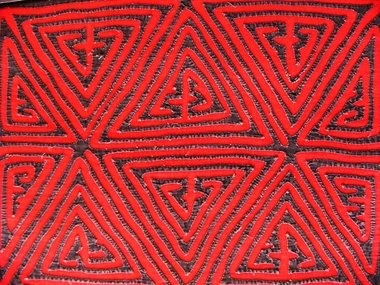
Textile - Panel, Mola Panel
... ... Mola - reverse applique...The mola originated with the tradition of Guna women painting their bodies with geometric designs, using available natural colors; at a certain point, after the arrival of the Spanish, these same designs were woven in cotton, and later still, sewn using cloth "acquired by trade from the ships that came to barter for coconuts during the 19th century". Applique Mola - reverse ...The Mola or Molas is a hand-made textile that forms part of the traditional women's clothing of the indigenous Guna people from Panama. Their clothing includes a patterned wrapped skirt (saburet), a red and yellow headscarf (musue), arm and leg beads (wini), a gold nose ring (olasu) and earrings in addition to the mola blouse (dulemor). Two groups, Choco and Guna lived side by side without intermarriage and without adopting a similar culture.In Dulegaya, the Guna's native language, "mola" means "shirt" or "clothing". The mola originated with the tradition of Guna women painting their bodies with geometric designs, using available natural colors; at a certain point, after the arrival of the Spanish, these same designs were woven in cotton, and later still, sewn using cloth "acquired by trade from the ships that came to barter for coconuts during the 19th century". Red cotton background with black reverse applique mounted on grey cotton. Design includes the serpent symbol.applique, mola - reverse applique, south america, panels -
 Embroiderers Guild, Victoria
Textile - Mola, c. mid 1990's
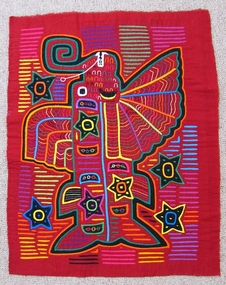
... ... Mola - reverse applique...Embroidery Mola - reverse applique Patchwork Central America Mid 1900's Red cotton background, with applique and reverse applique, and embroidery in bright colours Textile Mola ...Purchased in Panama by Betty Colman, Seattle, and later given to Edna Wark.Red cotton background, with applique and reverse applique, and embroidery in bright coloursembroidery, mola - reverse applique, patchwork, central america, mid 1900's -
 Embroiderers Guild, Victoria
Textile - Panel, Mola Panel, 1960-80 (1968)
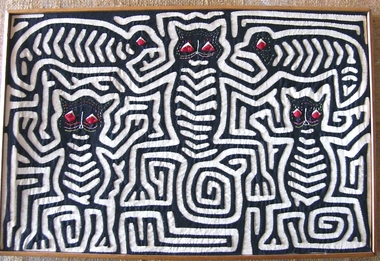
... Patchwork Panel Reverse applique 1960-80 San Blas South America A Mola panel from the San Blas Islands. ...Given to the donor by Mr R.H. Cochrane who worked in Panama for 2 years with the food and agricultural organisation mounted by Mc Cochrane himself.A Mola panel from the San Blas Islands. Design is black on white to represent five cats with red and white eyes and delicate running stitch and stem stitch on the cats' faces. Panel is framed in plain wood and then set on another wood frame with a hessian mount.patchwork, panel, reverse applique, 1960-80, san blas, south america
