
Showing 54 items matching " national portrait gallery"
-
 Stawell Historical Society Inc
Photograph, Mr Frederick John Cato Studio Portrait -- 2 Photos -- 1 B & W & 1 Coloured
... The coloured photo is an A4 print of a painting of Fred Cato in the Canberra National Portrait Gallery. In both photos Frederick is seated and dressed in a suit, vest and tie. ...One a black and white photo the other an A4 print of a painting of Fred Cato in the National Portrait Gallery in Canberra....Fred Cato-Photo in National Portrait Gallery-Canberra c. Early 1930s...The coloured photo is an A4 print of a painting of Fred Cato in the Canberra National Portrait Gallery. In both photos Frederick is seated and dressed in a suit, vest and tie. ...Black and white portrait of Frederick John Cato seated holding folded papers. The coloured photo is an A4 print of a painting of Fred Cato in the Canberra National Portrait Gallery. In both photos Frederick is seated and dressed in a suit, vest and tie. Frederick John Cato (1858 -1935) was a grocer, part of the Moran & Cato chain of some years ago. He was born in Stawell and went to 502 (Stawell State School) for many years eventually becoming an assistant teacher. He resigned in 1887 to go teaching in new Zealand. Frederick was a generous man and Cato prizes were presented to pupils attending 502. Stawell benefited in many ways from his generosity. Cato Park was named in his honor. Two photographs of Frederick John Cato. One a black and white photo the other an A4 print of a painting of Fred Cato in the National Portrait Gallery in Canberra.Fred Cato-Photo in National Portrait Gallery-Canberra c. Early 1930sstawell -
 Geelong Gallery
Photograph - National Portrait Gallery, London #1, ZAHALKA, Anne, 1992/2010
... National Portrait Gallery, London #1...C-type print Photograph National Portrait Gallery, London #1 ZAHALKA, Anne ...C-type print -
 Women's Art Register
Archive (Collection) - National Portrait Gallery Exhibition Archive
... National Portrait Gallery Exhibition Archive...Archive National Portrait Gallery Exhibition Archive ... -
Women's Art Register
Archive (Series) - National Portrait Gallery. Subject File 1
... National Portrait Gallery. Subject File 1...Foolscap white archival 4 flap folder or document wallet Archive National Portrait Gallery. Subject File 1 ...Newspaper Clippings -
Women's Art Register
Archive (Collection) - Kerrie Lester Artist Archive
... ... National Portrait Gallery...1953-2016 Figurative Portraiture Mosman Art Prize Archibald Prize National Portrait Gallery Painting Archive Kerrie Lester Artist Archive ...figurative, portraiture, mosman art prize, archibald prize, national portrait gallery, paintingfigurative, portraiture, mosman art prize, archibald prize, national portrait gallery, painting -
Women's Art Register
Archive (Series) - Kerrie Lester. Duplicate File 1
... ... National Portrait Gallery...Painting Figurative Portraiture Mosman Art Prize Archibald Prize National Portrait Gallery Foolscap manilla file Archive Kerrie Lester. ...Newspaper Clippings, Catalogues, Promotional Materialpainting, figurative, portraiture, mosman art prize, archibald prize, national portrait gallerypainting, figurative, portraiture, mosman art prize, archibald prize, national portrait gallery -
Women's Art Register
Archive (Series) - Lester, Kerrie. Artist File 1
... ... National Portrait Gallery...Figurative Portraiture Mosman Art Prize Archibald Prize National Portrait Gallery Painting Foolscap white archival 4 flap folder or document wallet Archive Lester, Kerrie. ...Newspaper Clippings, Catalogues, Promotional Materialfigurative, portraiture, mosman art prize, archibald prize, national portrait gallery, paintingfigurative, portraiture, mosman art prize, archibald prize, national portrait gallery, painting -
 Phillip Island and District Historical Society Inc.
Photograph, Bryant West
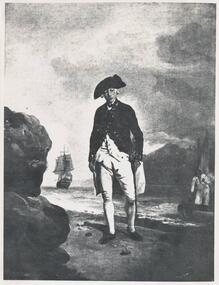
... Photograph of a painting by F Wheatley National Portrait Gallery, of Vice Admiral Arthur Phillip standing on beach between water and rocks. ...Photograph of a painting by F Wheatley National Portrait Gallery, of Vice Admiral Arthur Phillip standing on beach between water and rocks. ...One of a collection of over 400 photographs in an album commenced in 1960 and presented to the Phillip Island & Westernport Historical Society by the Shire of Phillip IslandPhotograph of a painting by F Wheatley National Portrait Gallery, of Vice Admiral Arthur Phillip standing on beach between water and rocks. Small boat with sailor nearby and ship under sail in background.Vice Admiral Arthur Phillip - first Governor of New South Wales. The man after whom Phillip Island was named.local history, photography, photographs, exploration, maritime, governor arthur phillip, arthur phillip, john jenner, bryant west -
 Uniting Church Archives - Synod of Victoria
Print, H Room, C. 1820
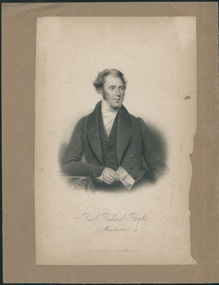
... The original of this engraving is in the Scottish National Portrait Gallery (Print Room)....The original of this engraving is in the Scottish National Portrait Gallery (Print Room). Colonial Missionary Society Rev Richard Fletcher Independent Minister "Revd. ...Rev. Richard Fletcher (1800 - 1861), born in Newcastle-upon-Tyne, was agent of the Colonial Missionary Society and came to Australia with his wife and five children after the discovery of gold in Australia. The original of this engraving is in the Scottish National Portrait Gallery (Print Room).Black and white portrait print of engraving of the head and shoulders of Rev. Richard Fletcher with an inscription. He is wearing Regency clothing, looking to his left and is holding a paper. The print appears to be taken from a book and tipped onto a piece of brown paper."Revd. Richard Fletcher Manchester"colonial missionary society, rev richard fletcher independent minister -
 Tarnagulla History Archive
Photographic copy of lithograph: Pierce's Southern Cross Store, Tarnagulla, Pierce's Southern Cross Store, Tarnagulla, circa 1850 to 1871
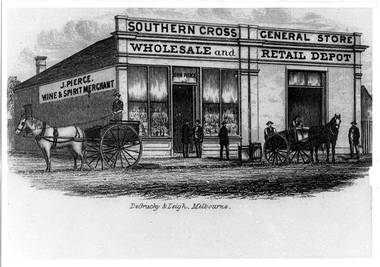
... The company published almanacs and guidebooks as well as prints (portraits, views and genre scenes), maps and architectural plans (Source: National Portrait Gallery, Canberra). This is a copy created from another item in the collection - a printed piece of paper which was either a packing label or receipt form used at the company or a brand label for bottles, perhaps for wine made by the proprietor. ...The company published almanacs and guidebooks as well as prints (portraits, views and genre scenes), maps and architectural plans (Source: National Portrait Gallery, Canberra). This is a copy created from another item in the collection - a printed piece of paper which was either a packing label or receipt form used at the company or a brand label for bottles, perhaps for wine made by the proprietor. ...Murray Comrie Collection. John Pierce's Southern Cross General Store, a wholesale grocer and spirit merchant was put up for sale after Pierce's death in 1871. It was later incorporated into the Flour Mill complex. De Gruchy & Leigh was a publishing and printing firm operating in Melbourne and regional Victoria from the late 1850s until the mid 1860s. The company published almanacs and guidebooks as well as prints (portraits, views and genre scenes), maps and architectural plans (Source: National Portrait Gallery, Canberra). This is a copy created from another item in the collection - a printed piece of paper which was either a packing label or receipt form used at the company or a brand label for bottles, perhaps for wine made by the proprietor. Copy probably made by Murray Comrie in the 1970s. Monochrome photographic copy of a lithograph. Depicts a building with glass front windows and signage stating 'J. Pierce Wine & Spirit Merchant' and 'Southern Cross General Store, Wholesale and Retail Depot'. In front of building on road are two horses hitched to carts and men standing on cart and in front of store. This store was located on the south-eastern corner of Commercial Road and King Street. The building was later incorporated into the flour mill complex.tarnagulla, commerce, shops, stores, shopping, food, alcohol, horses, transport, buildings, commercial road, main street, john pierce, southern cross general store -
 Royal Australian and New Zealand College of Obstetricians & Gynaecologists (RANZCOG)
Painting - Portrait of Dr P.M. Elliott, Frank Hodgkinson, 1988
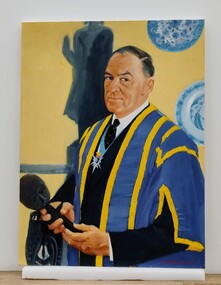
... (University of Sydney, National Portrait Gallery) Frank Hodgkinson AM (1919-2001) was a noted Australian printmaker, painter and graphic artist. ...(University of Sydney, National Portrait Gallery) Frank Hodgkinson AM (1919-2001) was a noted Australian printmaker, painter and graphic artist. ...Dr Peter Mervyn Elliott (1927-2014) was the President of the Royal Australian College of Obstetrics and Gynaecology from 1983-1986. He was gynaecologist and obstetrician at King George V Hospital from 1961 to 1979. He was a lecturer in Clinical Obstetrics and Gynaecology at the University of Sydney from 1964-1992 and was Head of the Department of Gynaecological Oncology at King George V Hospital at the time of his retirement from the Hospital in 1992. During his long clinical association with the University of Sydney and King George V Hospital, he brought great distinction to the institutions in respect of the clinical care of women with gynaecology cancers. He was a pioneer in the development and promotion of clinical trials in gynaecological cancer, and with his links in Asia he was able to create training and clinical trials opportunities for many gynaecologists and gynaecological oncologists from the region. Ellott was also a significant art collector and patron, amassing a sizeable private art collection. (University of Sydney, National Portrait Gallery) Frank Hodgkinson AM (1919-2001) was a noted Australian printmaker, painter and graphic artist. (Wikipedia) Oil on canvas painting. Colour head and shoulders portrait of a man. The subject is wearing a white shirt with a black suit and a dark tie - the tie is printed with a series of small, light-coloured crests. The subject is wearing a dark blue robe with yellow trim on front panels and at edges. The subject is wearing a medal in the shape of a nine-pointed star from a blue ribbon around his neck. The subject has dark coloured eyes, black hair and has his head turned to look at the artist, with his body facing to the left. The subject is holding an African fertility statue in his hands. The subject is depicted sitting in front of a yellow background, with blue and white china plates visible on the wall in top right background and a statue visible on a shelf behind his right shoulder. Signature painted at bottom right corner of portrait reads 'Frank Hodgkinson '88'. Brass plaque attached to back of frame is engraved with the text 'MR P.M. ELLIOTT/PRESIDENT/NOV 1983 - OCT 1986''. -
 Flagstaff Hill Maritime Museum and Village
Postcard - Vessel, Sailing Ship, B Matthews (photo printer), Cutty Sark, 20t century
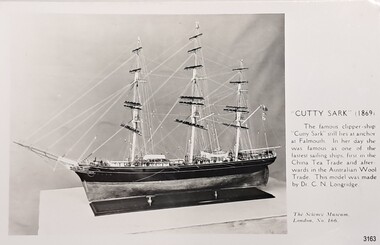
... Collections of B Matthews' photo prints of famous painted portraits are held at The National Portrait Gallery of London. Copies of B Matthews postcards are today sought after by collectors. ...Collections of B Matthews' photo prints of famous painted portraits are held at The National Portrait Gallery of London. Copies of B Matthews postcards are today sought after by collectors. ...The maker of the ship model on the postcard was Dr C Nelson Longridge (1876–1952), an English surgeon, maritime author, and builder of detailed ship models. Other models include the SS Marioness and the steam yacht Asia. He also wrote the books 'Cutty Sark' and 'The Anatomy of Nelson's Ships'. The postcard was printed by B Matthews, Bradford, England, incorporated in 1970 as B. Matthews (Photo Printers) Limited. Collections of B Matthews' photo prints of famous painted portraits are held at The National Portrait Gallery of London. Copies of B Matthews postcards are today sought after by collectors. THE CUTTY SARK: - The Cutty Sark was built in Britain in 1869 and was one of the last great sailing ships. At first, it carried tea from China. Later, it was used to transport wool from Australia. It became famous for its speed and held the record for the fastest voyage from Australia to Britain for ten years. Later, a Portuguese company bought the ship and renamed it Ferreira. After that, a retired sea captain purchased it to use as a training ship in Cornwall. When the captain died, the ship was given to a training college in Greenwich in 1938. In 1954, it was placed in dry dock at Greenwich, where it remains on display. This postcard features a photograph of a model of the sailing ship Cutty Sark, making it significant because of its connection to this well-known vessel. The famous tea clipper transported wool from Australia to markets around the world. Models such as this one help us understand what sea travel was like before steam-powered ships became widespread, while also illustrating how trade, travel and migration developed over time. Cutty Sark was also celebrated for its speed. It broke records on the voyage from Australia to Britain and held this distinction for ten years. Its importance is still recognised today, as the ship has been carefully preserved and is now displayed at the British Maritime Museum in Greenwich. Its remarkable history has also made it a popular subject for model ship enthusiasts. The postcard is also valuable because it shows a model of Cutty Sark built by the renowned C. N. Longridge, who was not only a respected surgeon but also a skilled model maker and author of detailed maritime works. A further connection is found in the printer, B Matthews, who photographed and printed collections featuring famous people, model ships and maritime scenes, adding another layer of historical interest to the postcard. Postcard, black and white, showing a model of the sailing ship Cutty Sark. Printed details are provided on both the front and back of the postcard. Inscriptions include a brief description of the Cutty Sark, the location and maker of the model, and the printer's contact information. The postcard was printed in Great Britain.FRONT: " "CUTTY SARK" (1869) The famous clipper ship "Cutty Sark" still lies at anchor at Falmouth. In her day, she was famous as one of the fastest sailing ships, first in the China Tea Trade, and afterwards in the Australian Wool Trade. This model was made by Dr C.N. Longridge." "The Science Museum, London. No. 166." REVERSE: "POSTCARD" "COMMUNICATION" "ADDRESS" "Printed by B Matthews, Bradford, England"flagstaff hill, warrnambool, flagstaff hill maritime museum, shipwreck coast, flagstaff hill maritime village, maritime museum, great ocean road, cutty sark, historic sailing ship, tea clipper, sail training vessel, cadet training ship, commercial trading vessel, cargo sail vessel, clipper races, scott and linton of dunbarton scottland, race record, ferreria, 1869, tea cargo, tea trade, china tea, wool export, australian export, australian wool export, china tea trade, cornwall, training ship, greenwich, british museum, ship model, craft, hobby, ship model cutty sark, model making, postcard, c nelson longridge, charles nelson longridge, b matthews, photo printer, b matthews bradford england, b matthews (photo printer ) ltd. -
 City of Melbourne Libraries
Photograph, Bull, Hugh Jones, 1897-1993, 3AW portable transmitter at Royal Melbourne Golf Links, 1933
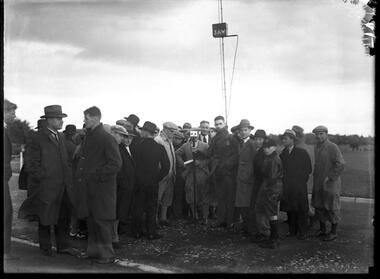
... There is a statue of Jim Ferrier in the National Portrait Gallery. 3AW is a talkback radio station based in Melbourne, which began transmission on 22 February 1932 as Melbourne’s fifth commercial radio station. ...There is a statue of Jim Ferrier in the National Portrait Gallery. 3AW is a talkback radio station based in Melbourne, which began transmission on 22 February 1932 as Melbourne’s fifth commercial radio station. ...The 3AW portable transmitter “Wirelessing from the Golf Links. An interesting test was made by 3AW yesterday when this portable transmitting set was successfully tried out at Royal Melbourne. Mr JB Ferrier, the father of the NSW champion, who is taking part in the Men’s Australian Open Championship meeting, is seen (on the left) speaking into the microphone and announcing the scores. The transmitter will be in action today to describe the play in the final rounds for the benefit of listeners.” – The Age Melbourne-based talkback radio station 3AW began transmission in February 1932 as Melbourne’s fifth commercial station. The 1930s were a time of rapid change and significant improvement in the development of microphones, supporting the shift from the visual world of newspapers to the auditory world of radio. MCK021 Inkjet print by John Gollings on Canson Platine Fibre Rag Published: The Age 9 September 1933 Featured in "Newsworthy: Melbourne in photographs 1933-1936" exhibition at East Melbourne Library, October to December 2023. Exhibition caption by project volunteer, Louise McKenzie. Photographer notations on slide: "3AW portable transmitter at R Melb Golf Links 1933 B5" Published: 9 September 1933 The Age p15 Published title: WIRELESSING FROM THE GOLF LINKS. Published caption: An interesting test was by 3AW yesterday when this portable transmitting set was successfully tried out at Royal Melbourne. Mr. J. B. Ferrier, the father of the New South Wales champion, who is, taking part in the Australian open championship meeting, is seen (on the left) speaking into the microphone and announcing the scores. The transmitter will be in action today to describe the play in the final rounds of the open championship for the benefit of listeners. Trove article identifier: http://nla.gov.au/nla.news-article205106453 Note: Interestingly, the published image is a composite of the two images in our collection. See related material, MCK077. Description: Group of men conducting outdoor radio broadcast at golf course. The 3AW sign is visible on a pole above the group. Research by project volunteer, Louise McKenzie: In this photo a group of men cluster around a tall bamboo pole with a 3AW sign. The male radio interviewer holds a pole topped with a square shaped microphone held in front of the face of another man. It is a bleak day and the men are wearing suits, coats and hats, or plus fours and caps. There is one schoolboy in the group. This was 3AW's first outside broadcast, undertaken at Royal Melbourne golf course on the occasion of the Australian Open. The 1933 Australian Open was held at the Royal Melbourne Golf Club (West Course), 8-9 September, and won by M L Kelly, from Goulburn, aged 20; J Ferrier (aged 19 from Sydney) came third equal with A W Jackson. The man being interviewed was Mr J B Ferrier, father of James (Jim) Ferrier, a professional golfer from Sydney. Encouraged by his father (who had a golfing background in Scotland) Jim Ferrier commenced playing at age four and a half, and was playing off scratch by his mid-teens. He was the NSW Amateur Champion in 1931, and was runner up in the Australian Open in 1931 and 1933. He won many Australian and overseas amateur and professional titles, moved to the US where he served in the army in WWII, and continued to prolifically compete and have significant golf victories into the 1950s. Sport Australia Hall of Fame says his “... may well be the best all round amateur professional record of any Australian golfer”. There is a statue of Jim Ferrier in the National Portrait Gallery. 3AW is a talkback radio station based in Melbourne, which began transmission on 22 February 1932 as Melbourne’s fifth commercial radio station. It was established when a company formed by Allans Music (established in Melbourne in 1850 and by 1877 was the largest musical warehouse in the southern hemisphere), JC Williamson’s (a theatrical management company and theatre owner) and David Syme (then publishers of The Age newspaper) was granted a radio broadcasting licence. 3AW originally broadcast from a makeshift studio in the front part of His Majesty’s Theatre, Exhibition Street, Melbourne, and is still in operation today. The 1930s were a time of rapid change and significant improvement in the development of microphones, accelerated by the move from the visual world of newspapers, to the auditory world of radio. The BBC had only been formed in May 1923, and their first outside broadcast was in May 1924. It is interesting to note that 3AW was owned by those intimately involved in the music, arts and newspaper world who had a good eye for future developments in these areas. The microphone in use in this photo may have been a USA-developed condenser microphone – still a fairly experimental concept, and whose design may have been influenced by the American film industry. References: WIRELESSING FROM THE GOLF LINKS. (1933, September 9). The Age (Melbourne, Vic. : 1854 - 1954), p. 15. Retrieved September 14, 2023, from http://nla.gov.au/nla.news-article205106453 J.C. Williamsons’s, Wikipedia, https://en.wikipedia.org/wiki/J._C._Williamson%27s Allans Music, Wikipedia, https://en.wikipedia.org/wiki/Allans_Music Jim Ferrier, Wikipedia, https://en.wikipedia.org/wiki/Jim_Ferrier Jim Ferrier sculpture by John Frith, National Portrait Gallery, https://www.portrait.gov.au/portraits/2013.79/jim-ferrier '3AW is 90 today (22/2/22)', 3AW, https://www.3aw.com.au/3aw-is-turning-90-take-a-look-back-through-the-decades-with-us1/ Her Majesty’s Theatre Melbourne, Wikipedia, https://en.wikipedia.org/wiki/Her_Majesty%27s_Theatre,_Melbourne Jim Ferrier, Sport Australia Hall of Fame, https://sahof.org.au/hall-of-fame-member/jim-ferrier/ 'From Nightingale to Narcissus: capturing the first ever live otudoor radio broadcast', Iain Baird, 2013, Science and Media Museum UK, https://blog.scienceandmediamuseum.org.uk/from-nightingale-to-narcissus/ 'The BBC-STC ‘Bomb' Condenser Microphone: a curatorial perspective', Ian Logie Baird, 2021, Baird Television, https://www.bairdtelevision.com/the-bbc-stc-bomb-condenser-microphone.htmlPhotographer notations on slide: "3AW portable transmitter at R Melb Golf Links 1933 B5".golf, radio -
 Flagstaff Hill Maritime Museum and Village
Photograph - Portrait, David Charles McArthur, Superintendent, Bank of Australasia 1867-1876
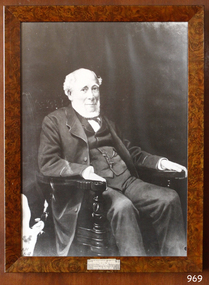
... National Gallery of Victoria in 1880-83. He was also on many other community organisations. He died in his home “Charterisville” in East Ivanhoe in 1887. He and Caroline had no children. The Melbourne branch of Australia and New Zealand Bank has a portrait...National Gallery of Victoria in 1880-83. He was also on many other community organisations. He died in his home “Charterisville” in East Ivanhoe in 1887. He and Caroline had no children. The Melbourne branch of Australia and New Zealand Bank has a portrait ...The subject of this photograph, David Charteris McArthur, was the founding manager of the Bank of Australasia in Port Phillip (Melbourne). McArthur was born in 1808 in Gloucester, England, and educated in Scotland. He worked for an insurance firm in Edinburgh, where in 1835 he married Caroline, nee Wright. McArthur and his family party sailed from the U.K. to arrive in Sydney in October 1835, where he joined the Bank of Australasia when it opened in Sydney in December. McArthur sailed to Melbourne in August 1838 with 3000 pounds in coins, protected by armed guards and two bulldogs, to open the Melbourne branch of the Bank of Australasia. The branch grew quickly, servicing both private and government customers. He opened many branches in the goldfields during the 1850s. In 1862, he was appointed as general inspector of branches. He spent time with the bank in New Zealand. On his return to Melbourne, at age 57, he was put in charge of the entire bank. McArthur lived in the hills of Heidelberg, Melbourne. He was the first chairman of Associated Banks and was an advisor to politicians and merchants. He was retired in October 1876 by the London directors and given a free trip to London, an annuity and a seat on the bank’s Advisory Board. McArthur was active in the community, being a member of the Mechanics’ Institute, on the committee that advised Governor Hotham on the Colony’s finances, chairman of the Heidelberg Road Board, one of the original trustees of the Library of Victoria in 1853 and president of the trustees of the Public Library, Museums and National Gallery of Victoria in 1880-83. He was also on many other community organisations. He died in his home “Charterisville” in East Ivanhoe in 1887. He and Caroline had no children. The Melbourne branch of Australia and New Zealand Bank has a portrait of McArthur in its boardroom. St John's Church, Heidelberg, commemorates him with a stained-glass window entitled 'King David'. The McArthur Gallery in the National Gallery of Victoria is also named after him. (David's brother, Donald, moved from Sydney to Melbourne in 1836 with the first government survey team.) ABOUT THE BANK OF AUSTRALASIA In 1836 the Bank of Australasia was established in London by Royal Charter. In 1951 the bank merged with the Union Bank of Australia, to form ANZ Bank Limited. In 1970 it merged with the English, Scottish and Australian Bank to become Australia and New Zealand Banking Group Limited. Since that time the ANZ has acquired other banks and introduced Internet banking and mobile banking. BANK OF AUSTRALASIA IN WARRNAMBOOL The Bank of Australasia first opened in Warrnambool in July 1854 in a building on Merri Street. The manager was Mr Samuel Hannaford. The bank then purchased and moved to a stone building on the corner of Timor and Gibson Streets, previously owned by Cramond and Dickson and almost opposite the Examiner’s office. In January 1957 Mr W.H. Palmer became the new manager and was there until November 1869. The bank then built its own building on the corner of Timor and Kepler Streets in 1859. Mr Basil Spence, the teller, was appointed acting manager in 1869 and Mr H.B. Chomley was the next appointed manager, in April 1873 and was still manager in 1886. The municipality of Warrnambool first banked with the Bank of Australasia from 1856 to April 1857. David Charteris McArthur served as the founding manager of the Bank of Australasia. His leadership marked a significant chapter in Warrnambool's early commercial development. The municipality of Warrnambool relied on the Bank of Australasia as its official bank from 1856 until April 1857. This period is symbolised by a photograph of McArthur, which represents the origins of Warrnambool's commercial history and its early financial infrastructure.Photograph; portrait of David Charteris McArthur. Heavily retouched black and white print in plain brown varnished frame, behind glass, with plaque on lower edge and inscription lower left corner.Lower left corner "A-H 1-9". Engraved on plaque "DAVID CHARTERS MCARTHUR \ SUPERINTENDENT \ BANK OF AUSTRALASIA \ 1867-1876"flagstaff hill, warrnambool, shipwrecked-coast, flagstaff-hill, flagstaff-hill-maritime-museum, maritime-museum, shipwreck-coast, flagstaff-hill-maritime-village, bank of australasia, david charteris mcarthur, superintendent bank of australasia, colonial commerce, manager bank of australasia melbourne, colonial bank, warrnambool bank of australasia, shipwrecked coast, flagstaff hill maritime museum, maritime museum, shipwreck coast, flagstaff hill maritime village, great ocean road, boa, union bank, australia & new zealand bank, anz bank, david charters mcarthur, d c mcarthur -
 Marysville & District Historical Society
Painting (Item) - Oil painting, William Beckwith McInnes, Near Marysville, Unknown
... William Beckwith McInnes (1889–1939) was an Australian portrait painter, winner of the Archibald Prize seven times for his traditional style paintings. He was acting-director at the National Gallery of Victoria and an instructor in its art school. william beckwith mcinnes archibald prize marysville victoria A copy of an oil painting titled "Near Marysville". ...A copy of an oil painting titled "Near Marysville".A copy of an oil painting titled "Near Marysville" by W.B. McInnes. William Beckwith McInnes (1889–1939) was an Australian portrait painter, winner of the Archibald Prize seven times for his traditional style paintings. He was acting-director at the National Gallery of Victoria and an instructor in its art school. william beckwith mcinnes, archibald prize, marysville, victoria -
 Federation University Historical Collection
Article - Article - Women, Ballarat Technical Art School: Women of Note; Nornie Gude, Artist, (1915 - 2002)
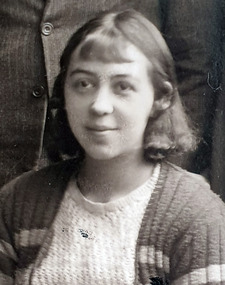
... Her work is represented in collections at the National Gallery of Victoria, Parliament House, and the Art Gallery of Western Australia, as well as regional collections in Ballarat, Geelong, Castlemaine Art Museum, and Bendigo. nornie gude ballarat technical art school 1931-1936 women of note artist macrobertson scholarship 100 pound per year national gallery school 1936-1939 sidney nolan charles bush first woman national gallery students travelling scholarship parliament house regional collections ballarat geelong castlemaine bendigo national gallery victoria eleanor constance gude Portrait of Nornie Gude while a student at the Ballarat Technical Art School Ballarat Technical Art School: Women of Note; Nornie Gude, Artist, (1915 - 2002) Article Article - Women ...Eleanor Constance (Nornie) Gude was born in 1915 in Ballarat, Victoria to Stella Rehfisch and Walter Gude, musician and violin teacher, and conductor of the St Patrick's Cathedral orchestra and choir in Ballarat. Her parents met when Stella was 27 and the 42-year old Walter was teaching her the violin. Nornie and her sister Gilda were both raised in Ballarat before moving to Melbourne on the eve of World War II. She was accepted into the Ballarat Technical Art School at 15 because of her advanced skill in painting, and trained there from 1931-1936. She won the esteemed MacRobertson Scholarship in art worth £100 a year. She later went on to the National Gallery School from 1936-1939, studying with Sidney Nolan and Charles Bush, and became the first woman to win the National Gallery Students Travelling Scholarship. Gude won many awards for her painting both while at school and throughout her career. Her work is represented in collections at the National Gallery of Victoria, Parliament House, and the Art Gallery of Western Australia, as well as regional collections in Ballarat, Geelong, Castlemaine Art Museum, and Bendigo.Portrait of Nornie Gude while a student at the Ballarat Technical Art Schoolnornie gude, ballarat technical art school, 1931-1936, women of note, artist, macrobertson scholarship, 100 pound per year, national gallery school, 1936-1939, sidney nolan, charles bush, first woman national gallery students travelling scholarship, parliament house, regional collections, ballarat, geelong, castlemaine, bendigo, national gallery victoria, eleanor constance gude -
 Federation University Historical Collection
Photograph - Colour photograph, Sean Fennessy, Bridget Bodenham, Ceramicist, 2015
... The work depicted was commissioned by the National Gallery of Victoria Design Shop Bridget bodenham ceramics alumni .1) Portrait of Bridget Bodenham standing in front of shelves of ceramics in her Hepburn Springs studio. .2) Bridget Bodenham's ceramics Bridget Bodenham, Ceramicist Photograph Colour photograph Sean Fennessy ...Bridget Bodenham lives and works in her studio in Hepburn Springs, Australia. An Alumni of Federation University Bridget studied TAFE Ceramics under Neville French. Bridget has exhibited extensively both within Australia and overseas, and was a finalist in the Bombay Sapphire Design Discovery Award and received an Honourable Mention in the Mino International Ceramic Award, Japan. The work depicted was commissioned by the National Gallery of Victoria Design Shop.1) Portrait of Bridget Bodenham standing in front of shelves of ceramics in her Hepburn Springs studio. .2) Bridget Bodenham's ceramicsbridget bodenham, ceramics, alumni -
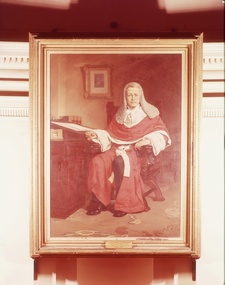 Supreme Court of Victoria Library
Portrait, George Higinbotham
... A committee was appointed to investigate the making of a portrait and they appointed Mr L Bernard Hall, instructor and later director of the National Gallery of Victoria. ...A committee was appointed to investigate the making of a portrait and they appointed Mr L Bernard Hall, instructor and later director of the National Gallery of Victoria. ...The portrait was commissioned after Higinbotham's death in 1893. A committee was appointed to investigate the making of a portrait and they appointed Mr L Bernard Hall, instructor and later director of the National Gallery of Victoria. George Higinbotham (1826-1892) had a distinguished career as a newspaper editor and politican before becoming a Judge of the Supreme Court in 1880 and the third Chief Justice in 1886. Higinbotham was a long serving attorney-general in the 1860s colonial administration. Higinbotham was active in the education, land and constitutional debates of his time. He played a prominent role through his chairmanship of the of the Royal Commission into Public Instruction with regard to the introduction of the free and secular primary school education.The portrait of George Higinbotham is of historic significance as the depiction of an important public figure in 19th Century Victoria. The painting is also of interest as an early example of L Bernard Hall's Australian works. Portrait in Oils of George Higinbotham. Higinbotham is seated at his desk, pen in hand. He is dressed in his judicial robes, ready for Court.Signed Lower right B Hall 95. Plaque on frame : The Hon. George Higinbotham Judge of the Supreme Court 1880-1886 Chief Justice of the Supreme Court 1866-1892supreme court, higinbotham george, hall bernard -
 Supreme Court of Victoria Library
Portrait, Sir Leo Cussen, 1930
... An almost identical portrait is held by both the Melbourne Cricket Club and the National Gallery of Victoria. ...An almost identical portrait is held by both the Melbourne Cricket Club and the National Gallery of Victoria. ...This painting was presented to the library in December 1930. The painting had been paid for through subscription from Judges of the High Court, the Supreme Court and the County Court as well as both branches of the legal profession. An almost identical portrait is held by both the Melbourne Cricket Club and the National Gallery of Victoria. This portrait is of interest for its subject and artist. Sir Leo Cussen (1859-1933) is probably best known for his role in two consolidations of the Victorian Statute books in 1915 and the mid 1920s. These were immense undertakings and included determining the application of English Law in Victoria. Sir Leo was appointed at Surpem Court Judge in 1906, he was at various times Acting Chief Justice of the Supreme Court of Victoria. In addition, he was trustee of both the Art Gallery (NGV) and the Melbourne Cricket Club, and held various positions with the Melbourne University Law Faculty and the Council of Legal Education. Sir Leo was regarded as one of the finest legal minds of his generation and at his death, Robert Menzies, at this time the Attorney General, said that Sir Leo was "one of the great lawyers of the english speaking world". Sir John Longstaff was one of Australia's best known and well regarded portraitist in the early 20th Century, he won the Archibald prize five times (1925, 1928, 1929, 1931 and 1935).3/4 Lenght portrait in Oils of Sir Leo Cussen, a judge of the Supreme Court, 1906-1933. Cusen is seated, a desk to the right of the picture with a few books. Sir Leo is in a 3 piece suit, his watch chain visible. Gold FrameSigned Longstaff in upper left corner. Plaque stating "the Hon Sir Leo Finn Bernard Cussen Kt Judge of the Supreme Court 1906-1933judges, cussen, longstaff -
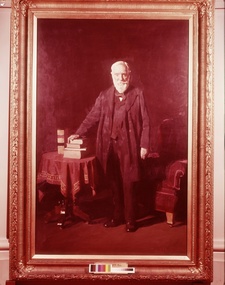 Supreme Court of Victoria Library
Portrait, John Schutt, Supreme Court Librarian, 1916/1917
... portrait was undertaken early in Meldrum’s career and before he had fully developed his theory of painting. Duncan Max Meldrum (1875-1955) was a controversial figure in his later years as he strongly opposed modernism and non-figurative art. His works are found in most of the state galleries, including a wide selection at the National...portrait was undertaken early in Meldrum’s career and before he had fully developed his theory of painting. Duncan Max Meldrum (1875-1955) was a controversial figure in his later years as he strongly opposed modernism and non-figurative art. His works are found in most of the state galleries, including a wide selection at the National ...This portrait was presented by the Victorian Bar to the Library in 1917 to commemorate Schutt’s fifty years as the Supreme Court Librarian. The portrait was presented at a ceremony presided over by Mr Mitchell KC who noted the “unanimity with which the members of the profession had adopted the suggestion that the eminent services of Mr Schutt should be recognised in this way.” Chief Justice Madden also spoke on this occasion and there were a number of judges and members of the legal profession present. John Schutt had been born in England in 1831 and migrated to Victoria as a young man, initially working as a school teacher he was appointed librarian, during Redmond Barry’s time in 1866. He started work in the Old Court in Russell street and would have supervised the move of the library to its new and greatly expanded premises in William Street in 1884. As well as secretary to the Library committee, he also acted as the Secretary of the Board of Examiners on occasion. After his death in 1919 in its obituary, the Williamstown Chronicle noted that Schutt was regarded as a Solon, an ancient greek law giver who gave wise advice. Away from the Court he was a councillor of many years standing in Williamstown, representing the Victoria Ward, what is now the suburb of Newport, it would appear Schutt street in Newport was named after him. His eldest son William Schutt was appointed a Supreme Court judge in 1919. The portrait of Schutt is a companion piece to the Sir Thomas a’Beckett picture painted shortly before the Schutt portrait and for the same client, they share the same frame design with gum leaf motif. This portrait was undertaken early in Meldrum’s career and before he had fully developed his theory of painting. Duncan Max Meldrum (1875-1955) was a controversial figure in his later years as he strongly opposed modernism and non-figurative art. His works are found in most of the state galleries, including a wide selection at the National Gallery of Victoria. This portrait is of interest for whom it portrays and as the work of a well known artistFull length portrait in oils of John Schutt. Schutt is standing up looking out the to the viewer. His hand rests on a small pile of books. He is dressed soberly in a three piece black suit. His white beard and hair all meticulously trimmed and realised. The props used in this painting provide the main colour as the background has become dark over the years. The books sit atop of a red and gold draped table. Behind Schutt is what appears to be a crimson velvet chair and he gives every appearence of having just arisen from the chair to engage with the viewer. The painting has an unusual light source at the foot of the painting with Schutt's legs providing shadows. Signed Meldrum lower right hand corner. Plaque inscription is John Schutt, Esq. Supreme Court Librarian -
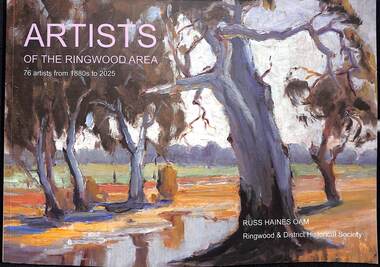 Ringwood and District Historical Society
Book, Russ Haines OAM, Artists of the Ringwood Area, 2025
... National Gallery of Victoria once ventured here to capture its beauty on canvas. As the neighbouring suburbs of Warrandyte and Eltham forged reputations as artistic hubs, Ringwood developed a creative character of its own, shaped by art groups, schools and talented individuals. This book celebrates that legacy through the lives of seventy-six artists who have connections with the Ringwood area. More than a history, this is a portrait...National Gallery of Victoria once ventured here to capture its beauty on canvas. As the neighbouring suburbs of Warrandyte and Eltham forged reputations as artistic hubs, Ringwood developed a creative character of its own, shaped by art groups, schools and talented individuals. This book celebrates that legacy through the lives of seventy-six artists who have connections with the Ringwood area. More than a history, this is a portrait ...Soft cover book profiling a selection of 76 artists local to the Ringwood area. Front cover "Rivergums" by Roger Webber. Back cover Ernest Buckmaster and Rober Webber painting en plein air.(Back cover) "Since the 1880s, Ringwood has quietly nurtured a vibrant artistic spirit. Drawn to its rolling landscapes, bushland reserves, and meandering streams, students from the National Gallery of Victoria once ventured here to capture its beauty on canvas. As the neighbouring suburbs of Warrandyte and Eltham forged reputations as artistic hubs, Ringwood developed a creative character of its own, shaped by art groups, schools and talented individuals. This book celebrates that legacy through the lives of seventy-six artists who have connections with the Ringwood area. More than a history, this is a portrait of a community alive with creativity." Acknowledgements: "Many artists provided material on their artistic career which was appreciated. In some profiles, it may have been possible to write a separate book on the artist's life, therefore condensing it down to a page or two was difficult. Specific credits are given after each chapter but a special thanks to Gareth Syvret and Mattie Young (Maroondah City Council), Liz Seaton, Linda Besser, Kay Scott and Les Baxter. Heathmont History Group provided documentation on their artists and must be thanked, especially Gerry Robinson." Author and Designer Russ Haines OAM, using Affinity Publisher software Published by Ringwood & District Historical Society in October 2025 Funded by Maroondah City Council Arts & Cultural Grant Program Copyright: RDHS. "Where possible, permission has been sought from both the artist and owner of each work. In some instances, an image has been used from public websites, yet the copyright was not provided nor readily available. In any case, this book is considered a non-commerical research study of artists in the Ringwood area and, therefore, comes under the fair dealing exceptions listed in the Copyright Act that allows copyright material to be used without permission." CONTENTS: Ringwood Art Society, Art Shows and Competitions, Heathmont Community Bollards, Ringwood Pottery, Ringwood's Public Art. ARTISTS: Chris Adnam, Theo Anderson, Brian Armstrong, Linda Besser, Janette Bird, Curt Bjerking, Pierce Boardman, Nan Bretel, Rosalie Briant, George Browning, Ernest Buckmaster, Nola Clark, Bertha Darbyshire, Robin Dawson, Michael Dillon, Sue Dodd, Julie Fenton, Leon Ferguson, Bruce Fletcher, David Freedman, Gavin Fry, Kelly Gellatly William Gleeson, Pauline Grayling, William "Weg" Green, Liz Gridley, Tracie Grimwood, George Haddon, Thomas Ham, Louise Hearman, Linda Hibbs, Ramon Horsfield, Harry Hudson, Patricia Hunt, Ruth Jackson, Ann James, David Jamieson, Norma Kett, Martin King, Robin Kittelty-Redman, Wim Kortland, Bela Kozak, Francis Little, Evan Mackley, Barbara McCallum, Ken McFadyen, Barbara McManus, Winifred Miles, David Miller, Sally Miller, Jack Montgomery, David Moore, Graham Moore, Simon Normand, Trevor Opray, John Ford Patterson, Peter Pavey, Barbara Peake, Herman Pekel, Diana Platt, Anne Randles, Wayne Rankin, Charles Robb, Margaret Robbie, Hal Rooney, Les Sands, Kay Scott, Gordon Speary, Simone Thomson, Jack Truscott, William Unsworth, Olive Walls, Deb Webb, Judy Webber, Roger Webber, Charles Wilton. -
Eltham District Historical Society Inc
Document - Folder, Wegner, Peter
... Gallery...Graham Doyle...Rita Wegner...Doug Moran National Portrait...Peter Wegner Myrtle Hooper Archibald Prize Guy Warren Gippsland Art Gallery Graham Doyle Rita Wegner Doug Moran National Portrait Prize Michael Brand Newspaper clippings, A4 photocopies, etc Wegner, Peter Document Folder ...Artist Peter Wegner lives and works in Diamond Creek. Contents Newspaper article: "Right before my eyes", Spectrum, The Age, 30 October 2021. Newspaper article: "Peter Wegner tells from Diaond Creek studio", Copperlinenews, edition 5, April 2023.Newspaper clippings, A4 photocopies, etcpeter wegner, myrtle hooper, archibald prize, guy warren, gippsland art gallery, graham doyle, rita wegner, doug moran national portrait prize, michael brand -
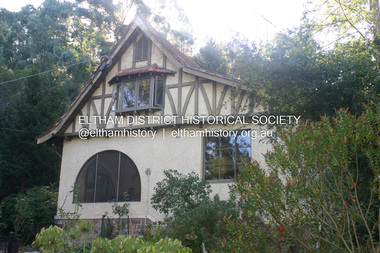 Eltham District Historical Society Inc
Photograph - Digital Photograph, Alan King, The Robins, 13 Kangaroo Ground-Warrandyte Road, North Warrandyte, 2 March 2008
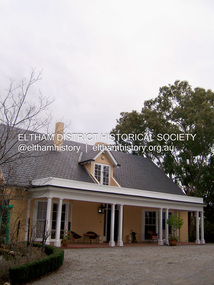
... galleries, the National Collection in Canberra as well as in regional galleries.7 His wife Edith was also an artist having studied at the Slade School, London, and in Paris with Phillips Fox. After her marriage she continued to paint and excelled in drawing. In later years she wrote several dramas, staged by repertory companies, and radio plays for the Australian Broadcasting Commission, in which she took part. She was the model for the beautiful red-haired woman in several of Phillips Fox’s paintings and the family hold three of his portraits...galleries, the National Collection in Canberra as well as in regional galleries.7 His wife Edith was also an artist having studied at the Slade School, London, and in Paris with Phillips Fox. After her marriage she continued to paint and excelled in drawing. In later years she wrote several dramas, staged by repertory companies, and radio plays for the Australian Broadcasting Commission, in which she took part. She was the model for the beautiful red-haired woman in several of Phillips Fox’s paintings and the family hold three of his portraits ...Built by noted artist Theodore Penleigh Boyd, father of architect Robin Boyd. Covered under National Estate, National Trust of Australia (Victoria) Local Significance and Heritage Overlay, Nillumbik Planning Scheme. Published: Nillumbik Now and Then / Marguerite Marshall 2008; photographs Alan King with Marguerite Marshall.; p111 The Robins at Warrandyte,* was once home to a member of a famous family and is also one of the first reinforced concrete houses in Victoria. The builder, Theodore Penleigh Boyd, born in 1890, was a talented painter1 noted for his works of the Warrandyte bush. He was the father of architect Robin Boyd, author of the Australian Ugliness and the uncle of painter, Arthur Boyd. Penleigh Boyd’s great grandfather was Sir William A’Beckett, Victoria’s first Chief Justice. Penleigh Boyd is considered by some to be an ‘unsung hero’ overshadowed by more famous members of his family. Mornington Gallery Director Andrea May said many believed Boyd ‘had never received the national acclaim that he deserved’.2 Classified by the National Trust3 and part of the Australian National Heritage,4 The Robins is set well back near the end of Kangaroo Ground – Warrandyte Road, unobserved by passers-by. Built in 1913, The Robins has some Art Nouveau influences and is a descendant of the Queen Anne style. It is covered in stucco and has a prominent attic, which Boyd used as a studio. Some parts of the house are up to 33 centimetres thick and built in part with pisé (rammed earth) and in part with reinforced concrete. Amazingly, Boyd built The Robins without an accessible driveway, and only a narrow track along which he had to cart building materials. The journey was uphill and Boyd terraced the land with Warrandyte rock5 without the aid of machinery. At only 33 years, Boyd was killed in a car accident in 1923. He was buried in Brighton near the home of his parents. Several people have since owned the house, including political journalist, Owen Webster. Boyd was born at Penleigh House, Wiltshire, and studied at Haileybury College, Melbourne and The Hutchins School, Hobart. He attended the Melbourne National Gallery School and in his final year exhibited at the Victorian Artists’ Society. He arrived in London in 1911 and his painting Springtime was hung at the Royal Academy. He painted in several studios in England and then worked in Paris.6 There he met painter Phillips Fox through whom he met artists of the French modern school and also his wife-to-be, Edith Anderson, whom he married in Paris in 1912. After touring France and Italy, the couple returned to Melbourne. In 1913 Boyd held an exhibition and won second prize in the Federal Capital site competition, then the Wynne Prize for landscape in 1914. In 1915 Boyd joined the Australian Imperial Force, and became a sergeant in the Electrical and Mechanical Mining Company. However he was severely gassed at Ypres and invalided to England. In 1918 in London Boyd published Salvage, writing the text and illustrating it with 20 black-and-white ink-sketches of army scenes. Later that year he returned to Melbourne, and, despite suffering from the effects of gas, he held several successful one-man shows, quickly selling his water-colour and oil paintings. In his short career Penleigh Boyd was recognized as one of Australia’s finest landscape painters. He loved colour, having been influenced early by Turner and McCubbin. His works are in all Australian state galleries, the National Collection in Canberra as well as in regional galleries.7 His wife Edith was also an artist having studied at the Slade School, London, and in Paris with Phillips Fox. After her marriage she continued to paint and excelled in drawing. In later years she wrote several dramas, staged by repertory companies, and radio plays for the Australian Broadcasting Commission, in which she took part. She was the model for the beautiful red-haired woman in several of Phillips Fox’s paintings and the family hold three of his portraits of her. *Possibly named after the Aboriginal words warran, meaning ‘object’ and dyte, meaning ‘thrown at’.This collection of almost 130 photos about places and people within the Shire of Nillumbik, an urban and rural municipality in Melbourne's north, contributes to an understanding of the history of the Shire. Published in 2008 immediately prior to the Black Saturday bushfires of February 7, 2009, it documents sites that were impacted, and in some cases destroyed by the fires. It includes photographs taken especially for the publication, creating a unique time capsule representing the Shire in the early 21st century. It remains the most recent comprehenesive publication devoted to the Shire's history connecting local residents to the past. nillumbik now and then (marshall-king) collection, kangaroo ground-warrandyte road, north warrandyte, the robins -
 Eltham District Historical Society Inc
Photograph - Digital Photograph, Marguerite Marshall, 'Landscape', 60 Lavender Park Road, Eltham South, 24 June 2008
... portraits of the last full-blooded aboriginals in Victoria at Lake Tyers in Gippsland, most of which are in a private collection. In Sydney Leason illustrated Henry Lawson’s Selected Poems and worked for The Bulletin. Leason had begun his career at 13 as an apprentice lithographic artist at Sands and MacDougall. He attended night classes at the National Gallery...portraits of the last full-blooded aboriginals in Victoria at Lake Tyers in Gippsland, most of which are in a private collection. In Sydney Leason illustrated Henry Lawson’s Selected Poems and worked for The Bulletin. Leason had begun his career at 13 as an apprentice lithographic artist at Sands and MacDougall. He attended night classes at the National Gallery ...Built by artist and cartoonist Percy Leason in 1927 in what was then New Street but renamed Lavender Park Road in the late 1950s/early 1960s. Covered under Heritage Overlay, Nillumbik Planning Scheme. Published: Nillumbik Now and Then / Marguerite Marshall 2008; photographs Alan King with Marguerite Marshall.; p121 Said to be a genius, cartoonist Percy Leason’s career was at its peak when in 1925 to 1926 he built his home at New Street (now Lavender Park Road) Eltham. The Herald newspaper owner, Sir Keith Murdoch, had hired Leason for his newly acquired Melbourne Punch magazine at a salary of £1750, making him ‘one of the highest paid cartoonists in the world’.1 With this salary and financial help from Murdoch, Leason was able to build his lovely home in Eltham. At the crest of a sweeping drive, the home now two-storey in white brick with a gabled grey slate roof and dormer windows is flanked by an extension built by another owner in the 1980s. Leason lived in the home with his wife, Isabel and children, until 1937, when he left for the United States of America, where he lived until his death in 1959. The four-bedroom house and garden would have been well-suited to bringing up his family and to entertaining their friends in style. Large airy rooms have high ceilings with moulded plaster, timber floors and several are brightened with bay windows. Leason made friends with many of the artists and personalities who gravitated to Eltham. Around 1931 Justus Jörgensen, founder of the Montsalvat Artists’ Colony, helped Leason build his large studio at the back of the house. Another friend was journalist Mervyn Skipper, father of jeweller and sculptor Matcham, and artists Helen and Sonia. Leason’s teacher, artist Max Meldrum, also visited and rented accommodation in Eltham, opposite Wingrove Park. Punch folded in 1925, but Leason continued as cartoonist for Table Talk. In 1926 Leason began the cartoons of a mythical Australian town Wiregrass, which were inspired by Kaniva, his home town. The art gallery in Main Road Eltham was named Wiregrass in Leason’s honour. Leason completed 1000 drawings from 1919 to 1937, which author Garrie Hutchinson claimed, were technically unsurpassed and had regional and universal interest. Leason’s acute observations of country life stemmed from his childhood in Kaniva in Victoria’s western Wimmera, where he was born, the son of a selector, in 1889. Meldrum claimed that Leason could name every plant and the habits of every animal.2 Leason also painted 28 portraits of the last full-blooded aboriginals in Victoria at Lake Tyers in Gippsland, most of which are in a private collection. In Sydney Leason illustrated Henry Lawson’s Selected Poems and worked for The Bulletin. Leason had begun his career at 13 as an apprentice lithographic artist at Sands and MacDougall. He attended night classes at the National Gallery and the Victorian Artists Society. Leason first visited Eltham in 1910 to paint with fellow artist William ‘Jock’ Frater. They camped near Bible and Pitt Streets and along the Diamond Creek on the site of the present Eltham Retirement Centre. Despite his success as a cartoonist, Leason wanted to be recognised as a serious painter and for his anthropological work.3 He was also conservative and felt uncomfortable with the modern art scene in Melbourne.4 So he left for the United States of America to work as a painter. Ironically his time in New York saw the burgeoning of modern art, notably by artists such as Jackson Pollock. But Leason found his niche by running an art school, painting society portraits and illustrating books and magazines.This collection of almost 130 photos about places and people within the Shire of Nillumbik, an urban and rural municipality in Melbourne's north, contributes to an understanding of the history of the Shire. Published in 2008 immediately prior to the Black Saturday bushfires of February 7, 2009, it documents sites that were impacted, and in some cases destroyed by the fires. It includes photographs taken especially for the publication, creating a unique time capsule representing the Shire in the early 21st century. It remains the most recent comprehenesive publication devoted to the Shire's history connecting local residents to the past. nillumbik now and then (marshall-king) collection, landscape, lavender park road, percy leason, new street -
 Eltham District Historical Society Inc
Photograph, Clifton Pugh - Dunmoochin, Cottles Bridge
... National Gallery School of Victoria 1948-52. Pugh is recognised as a one of Australia’s foremost painters. He is represented in major galleries throughout the country and overseas. He founded the “Dunmoochin” artists colony at Cottles Bridge. This front image from "Pioneers and Painters: 100 years of the Shire of Eltham" by Alan Marshall, page 128 shows Pugh working on his portrait...National Gallery School of Victoria 1948-52. Pugh is recognised as a one of Australia’s foremost painters. He is represented in major galleries throughout the country and overseas. He founded the “Dunmoochin” artists colony at Cottles Bridge. This front image from "Pioneers and Painters: 100 years of the Shire of Eltham" by Alan Marshall, page 128 shows Pugh working on his portrait ...A series of photos of Pugh at work. Clifton Pugh (1924-1990) was born at Richmond Victoria, and educated at various schools including Briar Hill Primary, Eltham Higher Elementary School and Ivanhoe Grammar. He studied art at the National Gallery School of Victoria 1948-52. Pugh is recognised as a one of Australia’s foremost painters. He is represented in major galleries throughout the country and overseas. He founded the “Dunmoochin” artists colony at Cottles Bridge. This front image from "Pioneers and Painters: 100 years of the Shire of Eltham" by Alan Marshall, page 128 shows Pugh working on his portrait of Dame Mabel Balcombe Brookes (1890-1975). According to an entry in the Australian Dictionary of Biography for Dame Brookes, this Pugh portrait remains in the family. This photo forms part of a collection of photographs gathered by the Shire of Eltham for their centenary project book, "Pioneers and Painters: 100 years of the Shire of Eltham" by Alan Marshall (1971). The collection of over 500 images is held in partnership between Eltham District Historical Society and Yarra Plenty Regional Library (Eltham Library) and is now formally known as the 'The Shire of Eltham Pioneers Photograph Collection.' It is significant in being the first community sourced collection representing the places and people of the Shire's first one hundred years.Digital image Various prints and colour reversal films artists, clifton pugh, cottles bridge, dunmoochin, eltham local characters, painters, "pioneers and painters", sepp, shire of eltham pioneers photograph collection, painting, dame mabel brookes -
Glen Eira Historical Society
Article - Watts, William Cowley
... Portrait... Gallery of Mayors... City Offices... Architects... Architecture... National...Watts William Cowley Watts Thomas Henry Shire president Councillors Caulfield Monuments Memorials Portrait Gallery of Mayors City Offices Architects Architecture National Trust Victorian Institute of Architects City Surveyor of Melbourne Drainage system Watts Charles George Caulfield Grammar School Fellow of the Federal Institute of Accountants City Treasurer of Melbourne Watts Geoffrey Glen Huntly Glenhuntly Glenhuntly Traders Association Caulfield City Council Huntly Street Grange Road Glenhuntly Road Watts John Watts Mary Thos. ...This file contains four items about William Cowley Watts, brother of Thomas Henry Watts:. 1/ Photocopy of two articles from newspapers on one page. One entitled "Portait for the Mayoral Gallery" (Caulfield Contact 01/09/1988) relates to a portrait of William Cowley Watts, who was the Shire President of Caulfield in 1876 and 1883, being added to Council's memorial gallery of Mayors. The other entitled "GLENHUNTLY-steeped in history" (Southern Cross 18/06/1986) states that the history of the suburb Glenhuntly is derived from the house Glen Huntly built in 1855 as the home of Thomas Watts. It was the first architect designed house in Caulfield. A black and white photograph of the house with Thomas Watts' family is included in the Southern Cross article. The house was named after the ship Glen Huntly which travelled from Scotland to Port Phillip Bay arriving 7 April 1840 2/ Research notes (2 pages) on the Watts family of Caulfield being one line of info (likely from rate books but unsourced and undated) giving 1874 details of a property in Orrong Road for William Cowley Watts on one page; plus a separate page with one line of information (unsourced and undated) giving 1910 Directory information for James S Watts architect at "Whybe" Murray St E. south side. 3/ An A4 typed article about William Cowley Watts which is similar but not the same as the Caulfield Contact article above. 4/ A photocopy combining a photo of a head and shoulders portrait of a man with handwritten notes identifying him as William Cowley Watts (1839-1883), Shire President of Caulfield, City Surveyor of Melbourne.watts william cowley, watts thomas henry, shire president, councillors, caulfield, monuments, memorials, portrait, gallery of mayors, city offices, architects, architecture, national trust, victorian institute of architects, city surveyor of melbourne, drainage system, watts charles george, caulfield grammar school, fellow of the federal institute of accountants, city treasurer of melbourne, watts geoffrey, glen huntly, glenhuntly, glenhuntly traders association, caulfield city council, huntly street, grange road, glenhuntly road, watts john, watts mary, thos. h. watts and sons, shire of caulfield, drainage, irrigation sewerage, sanitation, land surveys, royal society, mansion, retail trade, merchants, station place, watts james s, murray street, "whybe" -
 Eltham District Historical Society Inc
Painting, Lindsay Edward, The Malt House, 1942c
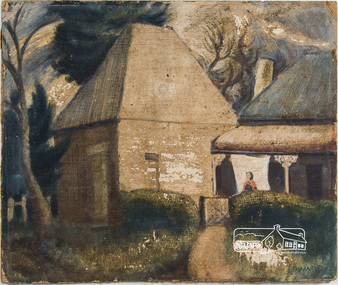
... National Gallery of Victoria 1940: 7-14 October Exhibition Heidelberg art exhibition. (SLV collection) 1941: November - Exhibition Heidelberg Art Exhibition 1942: Lindsay was an art student living at this 14 Park Cres. Fairfield. Occupation Art student. He most likely painted this painting around this time. c.1942 – 1944: Enlistment for military service in World War 2 in Casino, NSW. 1944: Rank of Sergeant. 1944: Exhibition Seddon Galleries (Melbourne) 1945: Exhibition Seddon Galleries 1946: Exhibition Exhibition of Past Students of the National Gallery of Victoria 1947: Submitted “Self- portrait in the Archibald Prize, Art Gallery of NSW 1948: Lived in London for a year and married a fellow artist ? ...National Gallery of Victoria 1940: 7-14 October Exhibition Heidelberg art exhibition. (SLV collection) 1941: November - Exhibition Heidelberg Art Exhibition 1942: Lindsay was an art student living at this 14 Park Cres. Fairfield. Occupation Art student. He most likely painted this painting around this time. c.1942 – 1944: Enlistment for military service in World War 2 in Casino, NSW. 1944: Rank of Sergeant. 1944: Exhibition Seddon Galleries (Melbourne) 1945: Exhibition Seddon Galleries 1946: Exhibition Exhibition of Past Students of the National Gallery of Victoria 1947: Submitted “Self- portrait in the Archibald Prize, Art Gallery of NSW 1948: Lived in London for a year and married a fellow artist ? ...Artist Lindsay Edward and wife Jan built a house designed by Alistair Knox at 151 Old Eltham Road, Lower Plenty. See article on home designed by Alistair Knox for Lindsay Edward, teacher, at 151 Old Eltham Road, Lower Plenty. The home was originally featured on the cover of the January 1953 issue of Home Beautiful magazine and was revisited in the March 1969 issue. See registration record No. 01649. Lindsay Edward Biography: 1919: 26 August Lindsay Maurice Edward was born in Melbourne. 1937: 4 – 9 May Exhibition - Heidelberg art exhibition (SLV collection) 1939: Art student at the National Gallery of Victoria 1940: 7-14 October Exhibition Heidelberg art exhibition. (SLV collection) 1941: November - Exhibition Heidelberg Art Exhibition 1942: Lindsay was an art student living at this 14 Park Cres. Fairfield. Occupation Art student. He most likely painted this painting around this time. c.1942 – 1944: Enlistment for military service in World War 2 in Casino, NSW. 1944: Rank of Sergeant. 1944: Exhibition Seddon Galleries (Melbourne) 1945: Exhibition Seddon Galleries 1946: Exhibition Exhibition of Past Students of the National Gallery of Victoria 1947: Submitted “Self- portrait in the Archibald Prize, Art Gallery of NSW 1948: Lived in London for a year and married a fellow artist ? Knox. 1949: Returned from London 1949: Electoral Roll Residence– 16 Mount Street, Ivanhoe 1950: October Exhibition Stanley Coe Galleries, 435 Bourke Street, Melbourne 1951: 19 Nov. - 9 Dec. Exhibition An exhibition of present day art of Victoria Victorian 1951 Commemoration Committee in conjunction with the Victorian Artists' Society, 1951: (SLV Collection) 1953: October Exhibition Melbourne Contemporary Artists Exhibiton 1954: Exhibition Melbourne Contemporary Artists Exhibition 1958: Victorian artist and educator Lindsay Edward won the £500 prize for the wall decoration of the Queensland Library - . Edward was born in 1919 and had studied at the National Gallery of Victoria. In 1958 he was head of the painting section of the Royal Melbourne Technical College (now RMIT) and had only recently begun experimenting with mosaic. The Centennial mosaic covers a wall 68 feet (20.72 metres) in length and 14 feet (4.26 metres) high. In a Melbourne Age article in July 1958 Edward described the mural as ‘not a literal subject’ rather as ‘a basic formation of organic forms indicating growth and development’. 1960: Exhibition Eltham Art Show (SLV collection) 1963: Exhibition October 28-November 17 - Argus Gallery, 290 Latrobe Street, Melbourne and at Hassall's Roadside Gallery, Eltham and at Gallery A and at Russell Davis Art Gallery. (SLV Collection) 1963, 1967, 1977 and 1980: Electoral Rolls – Residence Old Eltham Road, Lower Plenty. Occupation Teacher 1966: Exhibition Art Show -Austin Hospital Appeal (Heidelberg) (SLV collection) 1970s: Head of Art Department RMIT where he established a fine art collection. 1982: Exhibition Bolitho Gallery Canberra http://nla.gov.au/nla.news-article116467780 1988: 28 July – Exhibition Recent Paintings Darwin Performing Arts Centre (SLV Collection) 1993: Exhibition Solander Gallery, Canberra 2007: January Died and is buried in Eltham Cemetery 2007: Obituary in Age Jun 2, 2007 - LINDSAY Edward's retirement as head of the fine art department at RMIT in August 1979 signalled the end of an important chapter in the art Sources: ART CONTEST. (1939, March 2). The Argus (Melbourne, Vic. : 1848 - 1957), p. 8. Retrieved October 16, 2016, from http://nla.gov.au/nla.news-article12103185 ART EXHIBITION AT HEIDELBERG (1941, November 25). The Argus (Melbourne, Vic. : 1848 - 1957), p. 6. Retrieved October 16, 2016, from http://nla.gov.au/nla.news-article8218682 ART EXHIBITIONS (1945, October 3). The Age (Melbourne, Vic. : 1854 - 1954), p. 7. Retrieved October 16, 2016, from http://nla.gov.au/nla.news-article205639922 EX-GALLERY STUDENTS' SHOW (1946, October 15). The Argus (Melbourne, Vic. : 1848 - 1957), p. 3. Retrieved October 16, 2016, from http://nla.gov.au/nla.news-article22386440 https://www.artgallery.nsw.gov.au/prizes/archibald/1947/ Art World Busy (1949, February 26). The Argus (Melbourne, Vic. : 1848 - 1957), p. 12. Retrieved October 16, 2016, from http://nla.gov.au/nla.news-article22706197 http://nla.gov.au/nla.news-article22781141 ART NOTES (1953, October 13). The Age (Melbourne, Vic. : 1854 - 1954), p. 2. Retrieved October 16, 2016, from http://nla.gov.au/nla.news-article206462733 Design, color in art show (1954, October 5). The Argus (Melbourne, Vic. : 1848 - 1957), p. 9. Retrieved October 16, 2016, from http://nla.gov.au/nla.news-article23453359 https://artcollection.its.rmit.edu.au/?p=rmit-gallery-about Cinema (1993, October 7). The Canberra Times (ACT : 1926 - 1995), p. 7 (Good Times). Retrieved October 16, 2016, from http://nla.gov.au/nla.news-article127509819 Queensland Centenary Artwork (includes image) http://queenswharf.org/places/former-queensland-state-library-wall-decoration-and-sculpture/ Eltham Cemetery http://www.elthamcemetery.com/index.php/search oil on paper board 31.5 x 37.5 cm signed "Edward" lower rightInscribed on back "The Malt House Lindsay Edward 15 Park Cres Fairfield"fairfield, malt house, lindsay edward, home beautiful, home beautiful magazine, alistair knox -
 Creswick Museum
oil painting, Pompey, Circa 1930
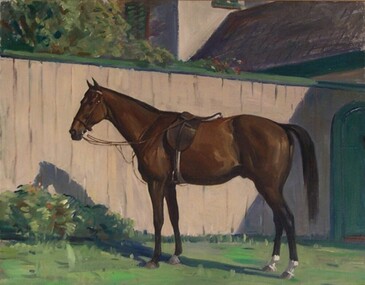
... portraits of horses for famous owners. Daryl Lindsay became a noted international artist and the Director of the National Gallery of Victoria. ...Daryl Lindsay was born and grew up in Creswick, one of the famous Lindsay family of artists. He had a love of horses and this was his favourite. He often did portraits of horses for famous owners.Daryl Lindsay became a noted international artist and the Director of the National Gallery of Victoria. He had a very considerable influence on Australian art, particularly from the 1940s to the 1970s.Oil painting on canvas by Daryl Lindsay of his favourite horse, "Pompey".Signed Daryl Lindsay on front. On the back is written "Daryl Lindsay painted his favourite horse Pompey c. 1930 at Mulberry Hill, Baxter. Presented to the Creswick Museum by Joan Lindsay May 1977.daryl lindsay, painting, horse, pompey, creswick, ngv -
Bendigo Historical Society Inc.
Document - SPECIMEN COTTAGE COLLECTION: VARIOUS DOCUMENTS
... Also, a photographs of a portrait of Joseph Panton. 4029.18 Photocopy of letter of Chinese storekeepers, miners and residents to Joseph Anderson Panton esquire, resident warden of Bendigo dated August 28th, 1858, with transcription and the reply from Esquire Panton dated 29 August, 1858. 4029.19 View street reborn, tours of inspection ''welcome to View Street'' view Street properties part of stage 1 of the project: National Trust Chambers, Temperance Hall, Art Gallery Annexe, Trades Hall, Bendigo Regional Arts Centre, Bendigo Regional Performing Arts Centre, Dudley House. 4029.20 View Street early 1900's in between and now. ...Also, a photographs of a portrait of Joseph Panton. 4029.18 Photocopy of letter of Chinese storekeepers, miners and residents to Joseph Anderson Panton esquire, resident warden of Bendigo dated August 28th, 1858, with transcription and the reply from Esquire Panton dated 29 August, 1858. 4029.19 View street reborn, tours of inspection ''welcome to View Street'' view Street properties part of stage 1 of the project: National Trust Chambers, Temperance Hall, Art Gallery Annexe, Trades Hall, Bendigo Regional Arts Centre, Bendigo Regional Performing Arts Centre, Dudley House. 4029.20 View Street early 1900's in between and now. ...In 1853, Bendigo Miners protested against the 30 shilling miners licence the had to pay the government. They wore red ribbons to show their protest and shopkeepers hung red ribbons outside their premises in support. Thousands of miners signed a petition to Governor LaTrobe to no avail. A protest gathering in Pall Mall marched to the Government camp on Camp Hill but this was a peaceful event again to no real avail.Various documents. The topics are: 4029.1 Public donations and organised charities in Bendigo (1850's to 1900's by Carol Holsworth. 4029.2 The spirit of Bendigo R711 and the loco driver on the return trip from Bendigo by Rod Giri, also several photographs of the train. 4029.3 Diary of a new chum - Johnny Greenfield Gill. 4029.4 Family history by Pat Hocking. 4029.5 The story of the Gaylards as told by Ella Gaylard. 4029.6 Journalism- History first draft by Wayne Gregson. 4029.7 List of residents of Thistle Street, Bendigo approx. 1950's compiled by Cynthia Stringer. 4029.8 Sandhurst club history by David Cotton. 4029.9 Sandhurst boys centre compiled by Brian Dillon. 4029.10 Lily Street Walk 24/04/2018 notes by Jim Evans. 4029.11 Document - All things Bendigo, wine food and music fest. 4029.12 White Hills Sandhurst copies of maps and two pages of district directory1908. 4029.13 Draft report of interview with Noel Smith of 5 Summit Drive, Kennington. 4029.14 Three brothers from Scotland by Rae Alexander Anderson. Also, seven newspaper articles by James Lerk on William, Alexander Rae and John Rae. 4029.15 St. John Presbyterian church, Bendigo. Historical record. 4029.16 Journal of Thomas Llewellyn Raston. 4029.17 Recollections of Sandhurst in the 1850's - Joseph Anderson Panton, 22 segments from Panton manuscript by Terry Davidson. Also, a photographs of a portrait of Joseph Panton. 4029.18 Photocopy of letter of Chinese storekeepers, miners and residents to Joseph Anderson Panton esquire, resident warden of Bendigo dated August 28th, 1858, with transcription and the reply from Esquire Panton dated 29 August, 1858. 4029.19 View street reborn, tours of inspection ''welcome to View Street'' view Street properties part of stage 1 of the project: National Trust Chambers, Temperance Hall, Art Gallery Annexe, Trades Hall, Bendigo Regional Arts Centre, Bendigo Regional Performing Arts Centre, Dudley House. 4029.20 View Street early 1900's in between and now. From handwritten notes by Mr. Bob Carr written in 1989. The handwriting has been transcribed by Beverly Ellis. 4029.21 Transcription of ''Diary of a voyage to the colony of Victoria and back'' June1856-September 1858 by Charles Groves. 4029.22 Adelaide Vale historic homestead built by Cr. John Harney. Tour notes prepared by the Central Victorian Branch of the National Trust. 4029.23 Four pages essay titled Spanish Tomato Growers. 2440.29. Eight pages of notes compiled by Leonard Henderson title: Trade token issuers of Bendigo district. The issuers mentioned are: Grieve, Hodgson, Stead and Williams. 4029.25 City of Bendigo tourist promotion Committee. Eight pages document describing the formation of committee for the promotion of tourism in the City of Bendigo. 4029.26 Article ''The Birdman of Bendigo'' Bendigo Advertiser 17th January 1968 detailing the life of Mr. Redvers James Eddy. 4029.27 Speech presented by Miss Margaret Brennan on the occasion of the Drechsler family reunion, Sunday 5th April 1987. 4029.28 Robert Gray Ford - A man before his time! Talk by James Lerk to the Bendigo Historical Society 3 February 2006. 4029.29 Copy of an article from The Bendigonian Annual from November 16, 1910. The demand for good music, how a Bendigo firm has met it. The article is about the life of Oscar Flight. 4029.30 Five photocopies of the Bendigonian masthead showing the changes through the years, plus the notice of the final issue on April 8th, 1920. 4029.31 The red ribbon rebellion & the Bendigo petition, a proposal to commemorate a significant event in Bendigo. Also three different sizes poster for the August 26, 2016 re-enactment and two invitations to join the red ribbon agitation memorial. 4029.32 Two handwritten pages of notes on the red ribbon rebellion. 4029.33 Three pages of typewritten notes on the Creeth and Howie families. 4029.34 An Australian Edward Medallist - Joseph Davies honoured by Paul Street. 4029.35 A. H. Chisholm obituary. 4029.36 Catalogue auction sale of the entire collection of antique furniture, objects d'art etc of Mr. and Mrs S. Cragg. 4029.37 Two coloured photographs of Cherry Tree Hotel in Melbourne Road just north of Tuckerman's lane, Big Hill. Photos taken March 2000 by Joan Paynter. bendigo, red ribbon rebellion -
 Bendigo Historical Society Inc.
Document - ART OF SIDNEY NOLAN, PROGRAM FOR EXHIBITION BENDIGO 1972, 07/08/1972
... Those associated with the exhibition are: City of Bendigo, The National Trust of Australia (Victoria) Central Victorian Branch, Mutual Permanent Building Society, Mrs D. I. Nolan and the Australian Galleries. The brochure names the twelve paintings, on exhibition by Sidney Nolan and Portrait of Sidney Nolan, by Christine Backhaus. ...Gallery Paris Paradise Gardens Her Majesty the Queen Arts Centre St Kilda Road Prince Phillip Lord Snowdon Rev. Fr. J P Stockdale Mr A J Watts Rosalind Landells Feargus Niall Mari Mullins Brian McGrath Bush Three copies of program for an art exhibition August 7 until August 11, 1972. Those associated with the exhibition are: City of Bendigo, The National Trust of Australia (Victoria) Central Victorian Branch, Mutual Permanent Building Society, Mrs D. I. Nolan and the Australian Galleries. The brochure names the twelve paintings, on exhibition by Sidney Nolan and Portrait ...Three copies of program for an art exhibition August 7 until August 11, 1972. Those associated with the exhibition are: City of Bendigo, The National Trust of Australia (Victoria) Central Victorian Branch, Mutual Permanent Building Society, Mrs D. I. Nolan and the Australian Galleries. The brochure names the twelve paintings, on exhibition by Sidney Nolan and Portrait of Sidney Nolan, by Christine Backhaus. There is also a short biography on Sidney Nolan. Handwritten in the top right corner of one copy is: Bush 1972.art, document, art of sidney nolan, city of bendigo, the national trust of australia (victoria) central victorian branch, mutual permanent building society, sidney nolan, cr d e elliott, colonel s r birch o b e, australian galleries, christine backhaus, the age, sidney henry nolan, dora irene nolan (sutherland), mrs l sweet, mrs m goslin, brighton technical school, raymond nolan, malcolm goslin, prahran technical school, national gallery art school, serge lifar, icarus, colonel de basil, kelly gang, unesco gallery paris, paradise gardens, her majesty the queen, arts centre st kilda road, prince phillip, lord snowdon, rev. fr. j p stockdale, mr a j watts, rosalind landells, feargus niall, mari mullins, brian mcgrath, bush
