
Showing 215 items matching " natural specimen"
-
 Glenelg Shire Council Cultural Collection
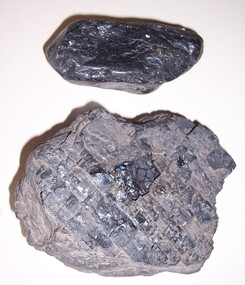
Geological specimen - Black Pitch, n.d
... ... natural specimen...Tar and pitch are often used interchangeably. natural history pitch natural specimen 5 pieces of black pitch. Geological specimen Black Pitch ...Pitch may be made from petroleum or plant sources. Petroleum derived pitch is also known as bitumen whereas plant derived pitch is known as resin. Pitch derived from plant resin however is known as rosin. Tar and pitch are often used interchangeably.5 pieces of black pitch.natural history, pitch, natural specimen -
 Glenelg Shire Council Cultural Collection
Animal specimen - Box of Shells, n.d
... ... natural specimen...Belonged to Marianna Trangmar, b.1820/1821 - later Mrs George Crouch. shells natural specimen trangmar Portland local families Box of shells. ...Belonged to Marianna Trangmar, b.1820/1821 - later Mrs George Crouch.Box of shells. Collection of Marianna Trangmarshells, natural specimen, trangmar, portland local families -
 Bendigo Historical Society Inc.
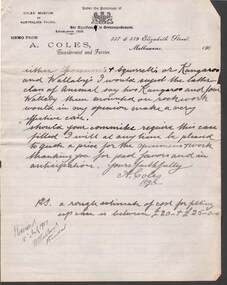
Document - SANDHURST SCHOOL OF MINES COLLECTION: LETTER FROM A.COLES TAXIDERMIST AND FURRIER MELBOURNE
... SANDHURST (Bendigo) SCHOOL OF MINES - letter from A.Coles Taxidermist and Furrier, Coles Museum of Australian Fauna, 337 & 339 Elizabeth St Melbourne dated 1.7.1907 to the president Committee & Registrar of the School of Mines Bendigo re Natural history specimens at the Museum...DOCUMENT A.Coles Taxidermist and Furrier Coles Museum of Australian Fauna SANDHURST (Bendigo) SCHOOL OF MINES - letter from A.Coles Taxidermist and Furrier, Coles Museum of Australian Fauna, 337 & 339 Elizabeth St Melbourne dated 1.7.1907 to the president Committee & Registrar of the School of Mines Bendigo re Natural history specimens at the Museum Document SANDHURST SCHOOL OF MINES COLLECTION: LETTER FROM A.COLES TAXIDERMIST AND FURRIER MELBOURNE ...SANDHURST (Bendigo) SCHOOL OF MINES - letter from A.Coles Taxidermist and Furrier, Coles Museum of Australian Fauna, 337 & 339 Elizabeth St Melbourne dated 1.7.1907 to the president Committee & Registrar of the School of Mines Bendigo re Natural history specimens at the Museumdocument, a.coles taxidermist and furrier , coles museum of australian fauna -
 Flagstaff Hill Maritime Museum and Village
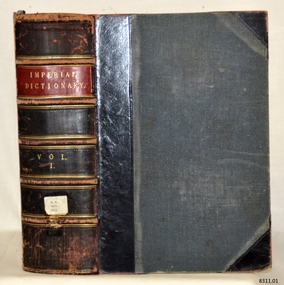
Book - Reference Dictionary/Scientific/Technological, John Ogilvie, The Imperial Dictionary English Technological and Scientific Vol 1, 1861
... Jewitt was one of the preeminent architectural and scientific wood-engravers of the Victorian era, highly celebrated for his precise, clean, and beautiful depictions of Gothic architecture, structural components, and natural history specimens....Jewitt was one of the preeminent architectural and scientific wood-engravers of the Victorian era, highly celebrated for his precise, clean, and beautiful depictions of Gothic architecture, structural components, and natural history specimens. This work was the first major English dictionary to heavily incorporate integrated woodcut illustrations directly into the columns of text to help define complex mechanical and scientific objects making the work highly significant. ...The Imperial Dictionary was a massive, progressive undertaking designed to be a bridge between a traditional language dictionary and a comprehensive technical encyclopedia. John Ogilvie built the text upon the foundation of Noah Webster’s famous American Dictionary. However, Ogilvie dramatically expanded it to include thousands of new terms born from the Industrial Revolution. It heavily prioritized the vocabulary of engineering, medicine, manufacturing, chemistry, and the arts, alongside a vast array of distinct Scottish and provincial British terms that Webster had omitted.The Imperial Dictionary English Technological and Scientific Vol 1 Author: John Ogilvie Publisher: Blackie & Son Ltd Date: 1861 Further Information: Black cloth hardcover with a brown leather spine, title lettering in gold. The spine has a Library label with an inscription.non-fictionThe Imperial Dictionary was a massive, progressive undertaking designed to be a bridge between a traditional language dictionary and a comprehensive technical encyclopedia. John Ogilvie built the text upon the foundation of Noah Webster’s famous American Dictionary. However, Ogilvie dramatically expanded it to include thousands of new terms born from the Industrial Revolution. It heavily prioritized the vocabulary of engineering, medicine, manufacturing, chemistry, and the arts, alongside a vast array of distinct Scottish and provincial British terms that Webster had omitted.flagstaff hill, warrnambool, shipwrecked coast, flagstaff hill maritime museum, maritime museum, shipwreck coast, flagstaff hill maritime village, great ocean road, book, pattison collection, warrnambool library, warrnambool mechanics’ institute, ralph eric pattison, corangamite regional library service, warrnambool city librarian, mechanics’ institute library, victorian library board, warrnambool books and records, warrnambool children’s library -
 Flagstaff Hill Maritime Museum and Village
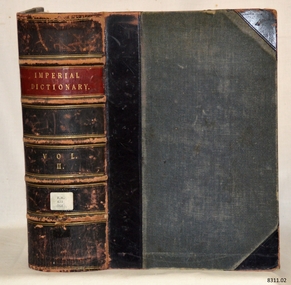
Book - Reference Dictionary/Scientific/Technological, John Ogilvie, The Imperial Dictionary English Technological and Scientific Vol 2, 1861
... Jewitt was one of the preeminent architectural and scientific wood-engravers of the Victorian era, highly celebrated for his precise, clean, and beautiful depictions of Gothic architecture, structural components, and natural history specimens....Jewitt was one of the preeminent architectural and scientific wood-engravers of the Victorian era, highly celebrated for his precise, clean, and beautiful depictions of Gothic architecture, structural components, and natural history specimens. This work was the first major English dictionary to heavily incorporate integrated woodcut illustrations directly into the columns of text to help define complex mechanical and scientific objects making the work highly significant. ...The Imperial Dictionary was a massive, progressive undertaking designed to be a bridge between a traditional language dictionary and a comprehensive technical encyclopedia. John Ogilvie built the text upon the foundation of Noah Webster’s famous American Dictionary. However, Ogilvie dramatically expanded it to include thousands of new terms born from the Industrial Revolution. It heavily prioritized the vocabulary of engineering, medicine, manufacturing, chemistry, and the arts, alongside a vast array of distinct Scottish and provincial British terms that Webster had omitted.The Imperial Dictionary English Technological and Scientific Vol 2 Author: John Ogilvie Publisher: Blackie & Son Ltd Date: 1861 Further Information: Black cloth hardcover with a brown leather spine, title lettering in gold. The spine has a Library label with an inscription.non-fictionThe Imperial Dictionary was a massive, progressive undertaking designed to be a bridge between a traditional language dictionary and a comprehensive technical encyclopedia. John Ogilvie built the text upon the foundation of Noah Webster’s famous American Dictionary. However, Ogilvie dramatically expanded it to include thousands of new terms born from the Industrial Revolution. It heavily prioritized the vocabulary of engineering, medicine, manufacturing, chemistry, and the arts, alongside a vast array of distinct Scottish and provincial British terms that Webster had omitted.flagstaff hill, warrnambool, shipwrecked coast, flagstaff hill maritime museum, maritime museum, shipwreck coast, flagstaff hill maritime village, great ocean road, book, pattison collection, warrnambool library, warrnambool mechanics’ institute, ralph eric pattison, corangamite regional library service, warrnambool city librarian, mechanics’ institute library, victorian library board, warrnambool books and records, warrnambool children’s library -
 The Beechworth Burke Museum
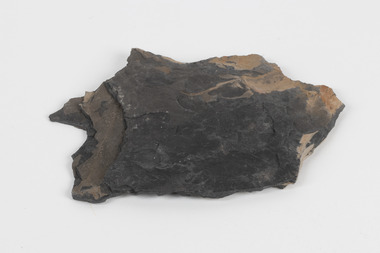
Geological specimen - Oil shale
... It reflects Australia's rich natural resources as well as connection to the Australia's engineering and oil industry. The booming oil shale extraction businesses can be traced as far back as 1920s. This specimen ...This particular specimen is found in Wolgan Valley, New South Wales. It could be linked to the abandoned oil shale mining sites in Wolgan Valley such as Newnes. Newnes was an industrial complex operational in the early 20th century is now partly surrounded by Wollemi National Park. It produced motor spirit, kerosene, and gas oil. Newnes's Torbanite oil shale rock contained around 350 litres of oil shale per tonne. The Torbanite was mined by the Commonwealth Oil Corporation Ltd. Oil shale is a sedimentary rock and also a form of fossil fuel. It is often formed millions of years ago and usually contain fossilised remains of plants and/or animals. Oil shale is rich in kerogen that releases hydrocarbon when heated. These hydrocarbon can be used as an alternative petroleum or natural gas. The oil-shale rock was converted into oil by "destructive distillation"; the rock being heated until it broke down to form an oily vapour and an ash residue. Oil bearing shale is one of Australia's national assets. There are many oil companies established in Australia. It reflects Australia's rich natural resources as well as connection to the Australia's engineering and oil industry. The booming oil shale extraction businesses can be traced as far back as 1920s. This specimen is part of a larger collection of geological and mineral specimens collected from around Australia (and some parts of the world) and donated to the Burke Museum between 1868-1880. A large percentage of these specimens were collected in Victoria as part of the Geological Survey of Victoria that begun in 1852 (in response to the Gold Rush) to study and map the geology of Victoria. Collecting geological specimens was an important part of mapping and understanding the scientific makeup of the earth. Many of these specimens were sent to research and collecting organisations across Australia, including the Burke Museum, to educate and encourage further study.Piece of dark gray oil bearing shale with shades of light brown and fossilised leavesExisting label: OIL BEARING SHALE with / FOSSILISED LEAVES / Locality: Wongan Valley, NSW / Donor: Miss M. Cambell geological specimen, geology, geology collection, burke museum, beechworth, oil shale, shale, fossil fuels, alfred selwyn, wolgen valley, 1868 geological survey of victoria, rocks, sedimentary rocks, newnes, torbanite, commonwealth oil corporation ltd -
 The Beechworth Burke Museum
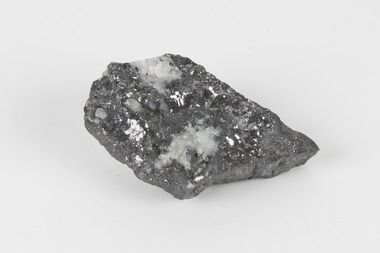
Geological specimen - Galena (with quartz), unknown
... Galena is the natural compound of lead and classed as a sulphide, it crystallises in a cubic pattern and its chemical formula is PbS. Galena is a primary source of both lead and silver. This specimen...A flat, hand-sized, grey sulphide specimen that is the natural compound of lead with a quartz formation on the top surface. ...Galena is the natural compound of lead and classed as a sulphide, it crystallises in a cubic pattern and its chemical formula is PbS. Galena is a primary source of both lead and silver. This specimen ...Galena is the natural compound of lead and classed as a sulphide, it crystallises in a cubic pattern and its chemical formula is PbS. Galena is a primary source of both lead and silver. This specimen of Galena comes from Broken Hill. Broken Hill has one of the world’s largest and most significant deposit of ore for the production of lead. Mining of Galena at Broken Hill began with the staking of land by Charles Rasp in 1883. By the following year, in 1884, Rasp and six others had formed Broken Hill Mining Company. Broken Hill Mining Company eventually evolved into BHP group limited and is currently the largest mining company in the world and the largest company in Australia. There is archaeological evidence from artefacts discovered in Turkey that humans have been extracting lead from galena by the process of smelting since at least 6500 BCE. This specimen also has quartz on the top surface which is frequently discovered alongside Galena. This mineral specimen is of historic significance as a sample of Galena extracted from Broken Hill during the 19th century. Mining for Galena in Broken Hill begin in 1883 by Charles Rasp and evolved into the world’s largest mining company – BHP Group Limited. Broken Hill is one of the world’s most significant deposits of ore for the production of lead. This specimen is part of a larger collection of geological and mineral specimens collected from around Australia (and some parts of the world) and donated to the Burke Museum between 1868-1880. A large percentage of these specimens were collected in Victoria as part of the Geological Survey of Victoria that begun in 1852 (in response to the Gold Rush) to study and map the geology of Victoria. Collecting geological specimens was an important part of mapping and understanding the scientific makeup of the earth. Many of these specimens were sent to research and collecting organisations across Australia, including the Burke Museum, to educate and encourage further study.A flat, hand-sized, grey sulphide specimen that is the natural compound of lead with a quartz formation on the top surface. Existing Label: GALENA / (with quartz) / Locality: Broken Hill / N.S.W 120 x 70 x 29geological specimen, geology, geology collection, burke museum, beechworth, galena, galena quartz, quartz, charles rasp, broken hill mining company, bhp group limited, bhp, lead, ore, lead sulphide, sulphide, silver, broken hill -
 The Beechworth Burke Museum
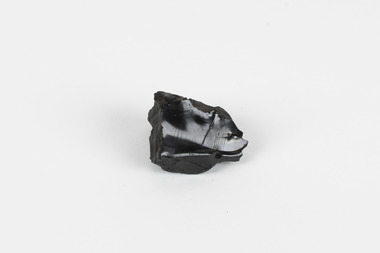
Geological specimen - Anthracite crystal, Unknown
... specimen was recovered from Tasmania and is 85-95% carbon. Anthracite is the mineral name for hard coal and is the least plentiful of all coal types. It is clean to the touch and, when polished, is used for decorative purposes. Before natural ...Anthracite typically occurs in geologically deformed areas due to extreme heating – with temperatures ranging from 170 to 250 °C – caused by igneous intrusions or high geothermal gradients. It is most commonly found in northeastern Pennsylvania in the United States; however, smaller amounts are also found in Australia, China, eastern Ukraine, South Africa, western Canada, and other countries. This specimen was recovered from Tasmania and is 85-95% carbon.Anthracite is the mineral name for hard coal and is the least plentiful of all coal types. It is clean to the touch and, when polished, is used for decorative purposes. Before natural gas and electricity, anthracite was used for domestic heating as it produces little dust, burns slowly, and gives off a minor amount of smoke. However, it is also limited in abundance and expensive. This specimen is part of a larger collection of geological and mineral specimens collected from around Australia (and some parts of the world) and donated to the Burke Museum between 1868-1880. A large percentage of these specimens were collected in Victoria as part of the Geological Survey of Victoria that begun in 1852 (in response to the Gold Rush) to study and map the geology of Victoria. Collecting geological specimens was an important part of mapping and understanding the scientific makeup of the earth. Many of these specimens were sent to research and collecting organisations across Australia, including the Burke Museum, to educate and encourage further study.A hand-sized highly metamorphosed coal mineral with a black/steel-grey shiny metallic lustre.geological specimen, geology, geology collection, burke museum, beechworth, indigo shire, geological, mineralogy, victoria, alfred selwyn, anthracite -
 The Beechworth Burke Museum
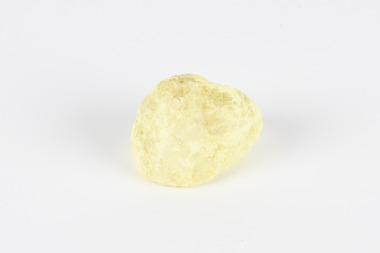
Geological specimen - Native Sulphur, unknown
... natural gases, and is key to the make-up of a range of other minerals. It is essential to continuing life on earth and was used in ancient societies as part of medical care, religious rites, and entertainment, and was key to the invention of gunpowder by the Chinese. The exact site of extraction for this specimen...natural gases, and is key to the make-up of a range of other minerals. It is essential to continuing life on earth and was used in ancient societies as part of medical care, religious rites, and entertainment, and was key to the invention of gunpowder by the Chinese. The exact site of extraction for this specimen ...Native Sulphur in its solid form is a yellow crystalline mineral that forms near volcanic vents and fumaroles where it is the solid form of hot gases. It is also frequently found in the subsurface as a by-product of sulphide ore mineralization. In all its forms, sulphur is one of the most commonly occurring minerals on the planet, especially in natural gases, and is key to the make-up of a range of other minerals. It is essential to continuing life on earth, and was used in ancient societies as part of medical care, religious rites, and entertainment, and was key to the invention of gunpowder by the Chinese. Native Sulphur in its solid form is a yellow crystalline mineral that forms near volcanic vents and fumaroles where it is the solid form of hot gases. It is also frequently found in the subsurface as a by-product of sulphide ore mineralization. In all its forms, sulphur is one of the most commonly occurring minerals on the planet, especially in natural gases, and is key to the make-up of a range of other minerals. It is essential to continuing life on earth and was used in ancient societies as part of medical care, religious rites, and entertainment, and was key to the invention of gunpowder by the Chinese. The exact site of extraction for this specimen is unknown, but it was probably collected in New Zealand in the 1850s. Sulphur is significant both for its historical and current uses, and for its nature as one of the most abundant minerals on the planet. Sulphur's importance comes both from its abundance and its role in ensuring survival, creating other minerals, and daily human life. This specimen is significant as representative of sulphur's solid properties. This specimen is part of a larger collection of geological and mineral specimens collected from around Australia (and some parts of the world) and donated to the Burke Museum between 1868-1880. A large percentage of these specimens were collected in Victoria as part of the Geological Survey of Victoria that begun in 1852 (in response to the Gold Rush) to study and map the geology of Victoria. Collecting geological specimens was an important part of mapping and understanding the scientific makeup of the earth. Many of these specimens were sent to research and collecting organisations across Australia, including the Burke Museum, to educate and encourage further study.A solid, small, crystalline mineral specimen that is largely bright yellow, with some darker spotting. geological specimen, geology, geology collection, burke museum, beechworth, sulphur, native sulphur, new zealand, native sulphur specimen, sulphur specimen -
 The Beechworth Burke Museum
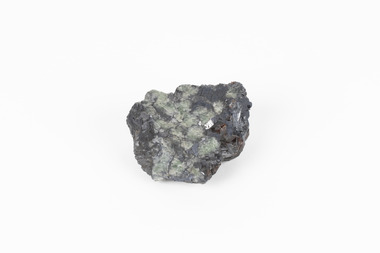
Geological specimen - Garnet (red crystals) in galena (silvery metallic) and green feldspar, Unknown
... The garnets visible in this specimen are likely Pyrope. Galnea is the natural mineral form of lead sulphide and has had various uses throughout history; from makeup to car batteries. ...The garnets visible in this specimen are likely Pyrope. Galnea is the natural mineral form of lead sulphide and has had various uses throughout history; from makeup to car batteries. ...Garnet is a popular gemstone used in jewellery due to its hardness and durability. There are about 5 varieties of Garnet, which distinguish the colour of each stone. In Australia mostly Pyrope and Aimandine varieties are found; Pyrope, which is blood-red to black and Aimadine, which is brownish-red to black. Other varieties are rarely found in Australia. The garnets visible in this specimen are likely Pyrope. Galnea is the natural mineral form of lead sulphide and has had various uses throughout history; from makeup to car batteries. It was first mined in South Australia in 1841. Green feldspar is an amazonite mineral, a variety of the potassium feldspar called microcline. This particular mineral is considered uncommon. It has been used in jewellery throughout history. It is likely that this specimen was found in Broken Hill, NSW, presumed due to findings of specimens with similar combinations. Broken Hill is Australia’s longest-lived mining city. The city’s fortunes have come and gone against an extreme economic background of boom and bust which continues today.This geological specimen is a rarity, given that is formed of three distinct minerals and the richness of colour that remains visible in this item attests to the strength of each structure. As we cannot pinpoint exactly where this specimen was found further research can only strengthen what is known about mining within Australia. As such the item is significant due to its scientific rarity and its ability to represent three specimens in one. A solid palm-sized mineral that features shades of grey, red and green. garnet, galnea, green feldspar, minerals, mining, rare specimen -
 The Beechworth Burke Museum
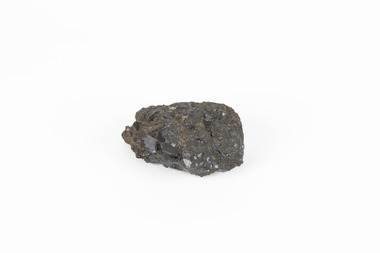
Geological specimen - Garnet crystals in galena, Unknown
... natural mineral form of lead sulfaide. It occurs generally as fine to large crystals due to syntectonic remobilization at low temperatures and moves to a suitable location. The colour is a shining lead and silvery gray with high specific gravity between 7.2 and 7.6 gms/cm3 and contains 86.6 lead sulfaide in its purest form. Its cyrstal system is cubic with perfect cleavages, and contract penetration and lamellar twinning. This particular specimen...natural mineral form of lead sulfaide. It occurs generally as fine to large crystals due to syntectonic remobilization at low temperatures and moves to a suitable location. The colour is a shining lead and silvery gray with high specific gravity between 7.2 and 7.6 gms/cm3 and contains 86.6 lead sulfaide in its purest form. Its cyrstal system is cubic with perfect cleavages, and contract penetration and lamellar twinning. This particular specimen ...Majority of Galena in Australia is found in hydrothermal deposits emplaced around 1680 million years ago which have been heavily metamorphosed. Galena is the natural mineral form of lead sulfaide. It occurs generally as fine to large crystals due to syntectonic remobilization at low temperatures and moves to a suitable location. The colour is a shining lead and silvery gray with high specific gravity between 7.2 and 7.6 gms/cm3 and contains 86.6 lead sulfaide in its purest form. Its cyrstal system is cubic with perfect cleavages, and contract penetration and lamellar twinning. This particular specimen is from the Broken Hill mine, it is one of the largest lead mines located in Western New South Wales and still has ore reserves amounting to 20.9 million tonnes of ore grading of 7.4% lead, 9.4% zinc, and 61.5 million oz of Silver. Throughout its history, it has produced over 200 million tonnes of ore throughout its 127 years of mining history dating back to 1885. Galena mineral ore found in Australia is considered rare, as it is only currently found in the Broken Hill Mine of Western New South Wales. It represents heritage value through the systematic collecting of the geological surveyers in Victoria and Australia during the early to late 19th Century. The fact that it is only found in one mining area of Australia, shows that this specimen is rare for examples of Australian Galena. This mineral specimen is one part to a larger collection, aquistion, and distribution of Garnet in Galena around Australia and parts of the world and donated to the Burke Museum between 1860-1880. While this specimen was not found by the Victorian Geological Survey, it shows the historical need for mapping geological areas around the Gold Rush region to further identify areas of precious metal and gem aquisition. Additionally, collecting these specimens was an important part of mapping the scientific make up of the earth's surface. Many were sent to institutions for further contribution to research and scientific knowledge of the specimens. A solid coin-sized lead and zinc sulphaide and zinc silicate ore mineral in shades of black and red with shiny black points. GARNET CRYSTALS in / GALENA (lead sulphide), / SPALERITE (zinc sulphide), / WILLEMITE (zinc silicate) ore. / Locality: Broken Hill, NSWburke museum, #beechworth, indigo shire, beechworth museum, geological, geological specimen, mineral, galena, galena quartz, broken hill mine, broken hill, nsw -
 The Beechworth Burke Museum
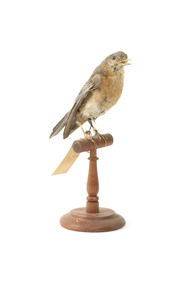
Animal specimen - Bluebird
... This specimen is part of a collection of almost 200 animal specimens that were originally acquired as skins from various institutions across Australia, including the Australian Museum in Sydney and the National Museum of Victoria (known as Museums Victoria since 1983), as well as individuals such as amateur anthropologist Reynell Eveleigh Johns between 1860-1880. These skins were then mounted by members of the Burke Museum Committee and put-on display in the formal space of the Museum’s original exhibition hall where they continue to be on display. This display of taxidermy mounts initially served to instruct visitors to the Burke Museum of the natural...This specimen is part of a collection of almost 200 animal specimens that were originally acquired as skins from various institutions across Australia, including the Australian Museum in Sydney and the National Museum of Victoria (known as Museums Victoria since 1983), as well as individuals such as amateur anthropologist Reynell Eveleigh Johns between 1860-1880. These skins were then mounted by members of the Burke Museum Committee and put-on display in the formal space of the Museum’s original exhibition hall where they continue to be on display. This display of taxidermy mounts initially served to instruct visitors to the Burke Museum of the natural ...Eastern bluebirds are well-known song birds that live in eastern North America. They are sexually dimorphic, easily recognised by the male's bright royal blue upper plumage, chest of reddish brown and white abdomen. The females is duller in colour than the male, with greyer upperparts and blue tinges to her wings. These Bluebirds, the European variety, are the most common of the three Bluebird species. When not nesting, these birds fly in small flocks around the countryside. Bluebirds feed on small insects including moths, termites and mosquitoes. They also eat grasshoppers, crickets and caterpillars. The Bluebird can spot caterpillars and other insects in tall grass from a distance of over 45 meters. The Bluebird is commonly identified in numerous cultures as being symbolic as a harbinger of happiness. Often in Russian fairytales, the Bluebird is used as a symbol of hope. This specimen is part of a collection of almost 200 animal specimens that were originally acquired as skins from various institutions across Australia, including the Australian Museum in Sydney and the National Museum of Victoria (known as Museums Victoria since 1983), as well as individuals such as amateur anthropologist Reynell Eveleigh Johns between 1860-1880. These skins were then mounted by members of the Burke Museum Committee and put-on display in the formal space of the Museum’s original exhibition hall where they continue to be on display. This display of taxidermy mounts initially served to instruct visitors to the Burke Museum of the natural world around them, today it serves as an insight into the collecting habits of the 19th century.This specimen is part of a significant and rare taxidermy mount collection in the Burke Museum. This collection is scientifically and culturally important for reminding us of how science continues to shape our understanding of the modern world. They demonstrate a capacity to hold evidence of how Australia’s fauna history existed in the past and are potentially important for future environmental research. This collection continues to be on display in the Museum and has become a key part to interpreting the collecting habits of the 19th century.This female bluebird (likely Eastern) has a medium brown head and back, a rufous breast, and a cream belly. The bird has blue-tinged wing and tail feathers. The bill is short and has been stylized with the bill partly open to provide the illusion that the bird is making a call. This specimen stands upon a wooden mount and has an identification tag tied around its leg. The bird's plumage has faded since it was first preserved; females generally have duller colouring than their male counterparts but the colour of this particular specimen is paler than it would have been.Label: 122a. Blue-Bird / Catalogue Page 29. / Metal tag: 107taxidermy mount, taxidermy, animalia, burke museum, beechworth, australian museum, skin, reynell eveleigh johns, bird, american birds, bluebird -
 The Beechworth Burke Museum
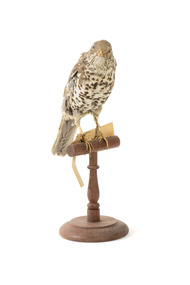
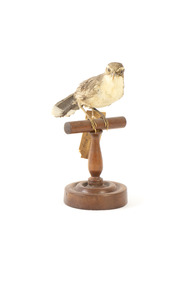
Animal specimen - Mistle Thrush, Trustees of the Australian Museum, 1860-1880
... This specimen is part of a collection of almost 200 animal specimens that were originally acquired as skins from various institutions across Australia, including the Australian Museum in Sydney and the National Museum of Victoria (known as Museums Victoria since 1983), as well as individuals such as amateur anthropologist Reynell Eveleigh Johns between 1860-1880. These skins were then mounted by members of the Burke Museum Committee and put-on display in the formal space of the Museum’s original exhibition hall where they continue to be on display. This display of taxidermy mounts initially served to instruct visitors to the Burke Museum of the natural...This specimen is part of a collection of almost 200 animal specimens that were originally acquired as skins from various institutions across Australia, including the Australian Museum in Sydney and the National Museum of Victoria (known as Museums Victoria since 1983), as well as individuals such as amateur anthropologist Reynell Eveleigh Johns between 1860-1880. These skins were then mounted by members of the Burke Museum Committee and put-on display in the formal space of the Museum’s original exhibition hall where they continue to be on display. This display of taxidermy mounts initially served to instruct visitors to the Burke Museum of the natural ...The Mistle Thrush is native to Ireland and Scotland, North Africa and parts of Asia. It is known as a large, aggressive and powerful bird. They have several different calls: the main call, given by both sexes, is a dry chattering 'krrrr', louder when the birds are alarmed or excited. There is also a squeaky 'tuk' contact call. This specimen is part of a collection of almost 200 animal specimens that were originally acquired as skins from various institutions across Australia, including the Australian Museum in Sydney and the National Museum of Victoria (known as Museums Victoria since 1983), as well as individuals such as amateur anthropologist Reynell Eveleigh Johns between 1860-1880. These skins were then mounted by members of the Burke Museum Committee and put-on display in the formal space of the Museum’s original exhibition hall where they continue to be on display. This display of taxidermy mounts initially served to instruct visitors to the Burke Museum of the natural world around them, today it serves as an insight into the collecting habits of the 19th century.This specimen is part of a significant and rare taxidermy mount collection in the Burke Museum. This collection is scientifically and culturally important for reminding us of how science continues to shape our understanding of the modern world. They demonstrate a capacity to hold evidence of how Australia’s fauna history existed in the past and are potentially important for future environmental research. This collection continues to be on display in the Museum and has become a key part to interpreting the collecting habits of the 19th century. The Mistle Thrush has a pale grey-brown upperpart and a greyish-white chin. The yellow/buff breast and off-white belly are marked with round black spots. The long tail has white tips on the outer feathers, and the underwing coverts are white. The glass eyes are dark brown and the bill is blackish with a yellow base to the lower mandible. The legs and feet are yellow/brown. There is no plumage differences between the male and the female Mistle Thrush. This particular specimen stands upon a wooden platform and has an identification tag tied around its leg.Label: 111a. / Mistle Thrush / Catalogue, Page 28. / Other Label: 57. / Turdus viscivorus /taxidermy mount, cancel, taxidermy, burke museum, beechworth, australian museum, bird, mistle thrush -
 The Beechworth Burke Museum
Animal specimen - White-Browed Babbler, Trustees of the Australian Museum, 1860-1880
... This specimen is part of a collection of almost 200 animal specimens that were originally acquired as skins from various institutions across Australia, including the Australian Museum in Sydney and the National Museum of Victoria (known as Museums Victoria since 1983), as well as individuals such as amateur anthropologist Reynell Eveleigh Johns between 1860-1880. These skins were then mounted by members of the Burke Museum Committee and put-on display in the formal space of the Museum’s original exhibition hall where they continue to be on display. This display of taxidermy mounts initially served to instruct visitors to the Burke Museum of the natural...This specimen is part of a collection of almost 200 animal specimens that were originally acquired as skins from various institutions across Australia, including the Australian Museum in Sydney and the National Museum of Victoria (known as Museums Victoria since 1983), as well as individuals such as amateur anthropologist Reynell Eveleigh Johns between 1860-1880. These skins were then mounted by members of the Burke Museum Committee and put-on display in the formal space of the Museum’s original exhibition hall where they continue to be on display. This display of taxidermy mounts initially served to instruct visitors to the Burke Museum of the natural ...The white-browed babbler is a a very active bird and is often found in noisy social groups. It lays two nests: one to lay its eggs in, and a separate nest to roost in. The Babbler is located in dry sclerophyll woodlands throughout mainland Australia. The diet of this species is varied: including insects, spiders and other invertebrates, small amphibians, crustaceans and reptiles. These birds will also eat fruits and seeds. This specimen is part of a collection of almost 200 animal specimens that were originally acquired as skins from various institutions across Australia, including the Australian Museum in Sydney and the National Museum of Victoria (known as Museums Victoria since 1983), as well as individuals such as amateur anthropologist Reynell Eveleigh Johns between 1860-1880. These skins were then mounted by members of the Burke Museum Committee and put-on display in the formal space of the Museum’s original exhibition hall where they continue to be on display. This display of taxidermy mounts initially served to instruct visitors to the Burke Museum of the natural world around them, today it serves as an insight into the collecting habits of the 19th century.This specimen is part of a significant and rare taxidermy mount collection in the Burke Museum. This collection is scientifically and culturally important for reminding us of how science continues to shape our understanding of the modern world. They demonstrate a capacity to hold evidence of how Australia’s fauna history existed in the past and are potentially important for future environmental research. This collection continues to be on display in the Museum and has become a key part to interpreting the collecting habits of the 19th century. The White-browed Babbler is a small bird with dark brown/grey plumage. It has a white throat, a white tipped tail and a long, pointed curved bill. This species have a distinct white brow and dark eye stripe which inspired its name. The specimen stands upon a wooden mount and has an identification tag tied around its leg.Label: 68a. / White-[illegible] Pomatostomus superciliosus /See Catalogue, page 20 /taxidermy mount, cancel, taxidermy, burke museum, beechworth, australian museum, bird, white browed babbler -
 The Beechworth Burke Museum
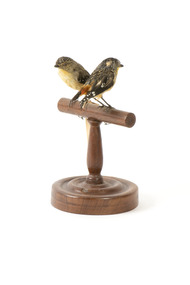
Animal specimen - Spotted Pardalote, Trustees of the Australian Museum, 1860-1880
... This specimen is part of a collection of almost 200 animal specimens that were originally acquired as skins from various institutions across Australia, including the Australian Museum in Sydney and the National Museum of Victoria (known as Museums Victoria since 1983), as well as individuals such as amateur anthropologist Reynell Eveleigh Johns between 1860-1880. These skins were then mounted by members of the Burke Museum Committee and put-on display in the formal space of the Museum’s original exhibition hall where they continue to be on display. This display of taxidermy mounts initially served to instruct visitors to the Burke Museum of the natural...This specimen is part of a collection of almost 200 animal specimens that were originally acquired as skins from various institutions across Australia, including the Australian Museum in Sydney and the National Museum of Victoria (known as Museums Victoria since 1983), as well as individuals such as amateur anthropologist Reynell Eveleigh Johns between 1860-1880. These skins were then mounted by members of the Burke Museum Committee and put-on display in the formal space of the Museum’s original exhibition hall where they continue to be on display. This display of taxidermy mounts initially served to instruct visitors to the Burke Museum of the natural ...The spotted pardalote is the smallest of all Australian birds. It has a tendency to nest in a long horizontal tunnel, often dug into the soil of creek banks, the embankments of railway cuttings, and quarries. Its call is characterised by a very clear and repetitive double "ding". The spotted pardalote is common in woodlands and eucalypt forest areas in Australia. This specimen is part of a collection of almost 200 animal specimens that were originally acquired as skins from various institutions across Australia, including the Australian Museum in Sydney and the National Museum of Victoria (known as Museums Victoria since 1983), as well as individuals such as amateur anthropologist Reynell Eveleigh Johns between 1860-1880. These skins were then mounted by members of the Burke Museum Committee and put-on display in the formal space of the Museum’s original exhibition hall where they continue to be on display. This display of taxidermy mounts initially served to instruct visitors to the Burke Museum of the natural world around them, today it serves as an insight into the collecting habits of the 19th century.This specimen is part of a significant and rare taxidermy mount collection in the Burke Museum. This collection is scientifically and culturally important for reminding us of how science continues to shape our understanding of the modern world. They demonstrate a capacity to hold evidence of how Australia’s fauna history existed in the past and are potentially important for future environmental research. This collection continues to be on display in the Museum and has become a key part to interpreting the collecting habits of the 19th century. One of Australia's smallest native birds, the male spotted pardalotte is covered with small, distinct white spots. Males have a pale eyebrow, a yellow throat and a red rump. Females are similar but have less-distinct markings. 10060 comprises of one male and one female. This specimen stands upon a wooden platform and has an identification tag tied around its legLabel: 14a. / Spotted Diamond Bird / See Catalogue, page 9. /taxidermy mount, cancel, taxidermy, burke museum, beechworth, australian museum, bird, spotted pardalote -
 The Beechworth Burke Museum
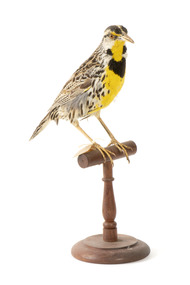
Animal specimen - Eastern Meadowlark, Trustees of the Australian Museum, 1860-1880
... This specimen is part of a collection of almost 200 animal specimens that were originally acquired as skins from various institutions across Australia, including the Australian Museum in Sydney and the National Museum of Victoria (known as Museums Victoria since 1983), as well as individuals such as amateur anthropologist Reynell Eveleigh Johns between 1860-1880. These skins were then mounted by members of the Burke Museum Committee and put-on display in the formal space of the Museum’s original exhibition hall where they continue to be on display. This display of taxidermy mounts initially served to instruct visitors to the Burke Museum of the natural...This specimen is part of a collection of almost 200 animal specimens that were originally acquired as skins from various institutions across Australia, including the Australian Museum in Sydney and the National Museum of Victoria (known as Museums Victoria since 1983), as well as individuals such as amateur anthropologist Reynell Eveleigh Johns between 1860-1880. These skins were then mounted by members of the Burke Museum Committee and put-on display in the formal space of the Museum’s original exhibition hall where they continue to be on display. This display of taxidermy mounts initially served to instruct visitors to the Burke Museum of the natural ...Eastern Meadowlarks live throughout the grasslands and farms in eastern North America. On the ground, their brown-and-black dappled upperparts camouflage the birds among dirt clods and dry grasses. When in flight or perching, they reveal bright-yellow breasts and bellies, and a striking black chevron across the chest. The Eastern Meadowlark has a diet which consists of mainly insects and seeds. These birds forage by walking on the ground and taking insects and seeds from the ground and from low plants. In winter, these birds may choose to forage in flocks. This specimen is part of a collection of almost 200 animal specimens that were originally acquired as skins from various institutions across Australia, including the Australian Museum in Sydney and the National Museum of Victoria (known as Museums Victoria since 1983), as well as individuals such as amateur anthropologist Reynell Eveleigh Johns between 1860-1880. These skins were then mounted by members of the Burke Museum Committee and put-on display in the formal space of the Museum’s original exhibition hall where they continue to be on display. This display of taxidermy mounts initially served to instruct visitors to the Burke Museum of the natural world around them, today it serves as an insight into the collecting habits of the 19th century.This specimen is part of a significant and rare taxidermy mount collection in the Burke Museum. This collection is scientifically and culturally important for reminding us of how science continues to shape our understanding of the modern world. They demonstrate a capacity to hold evidence of how Australia’s fauna history existed in the past and are potentially important for future environmental research. This collection continues to be on display in the Museum and has become a key part to interpreting the collecting habits of the 19th century. This Eastern Meadowlark has a yellow breast and throat with black plumage in the shape of a 'V' on it's throat. This particular specimen has a long pointed bill which is in the shape of a spear. The crown of the bird is a dark brown and it also has lighter brown/yellow stripes on the brow. The back, wings, and tail are light brown with dark brown mottling. This specimen stands upon a wooden platform and has an identification tag tied around its leg. The legs are long and the specimen has been styalised in an upright position.Label: [illegible] Ant-Eating Thrush / Catalogue, Page 66. /taxidermy mount, taxidermy, animalia, burke museum, beechworth, australian museum, skin, reynell eveleigh johns, bird, american birds, eastern meadowlark, meadowlark -
 The Beechworth Burke Museum
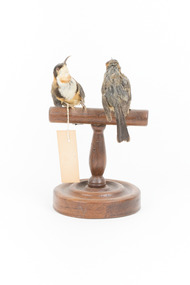
Animal specimen - Eastern Spinebill, Trustees of the Australian Museum, 1860-1880
... This specimen is part of a collection of almost 200 animal specimens that were originally acquired as skins from various institutions across Australia, including the Australian Museum in Sydney and the National Museum of Victoria (known as Museums Victoria since 1983), as well as individuals such as amateur anthropologist Reynell Eveleigh Johns between 1860-1880. These skins were then mounted by members of the Burke Museum Committee and put-on display in the formal space of the Museum’s original exhibition hall where they continue to be on display. This display of taxidermy mounts initially served to instruct visitors to the Burke Museum of the natural...This specimen is part of a collection of almost 200 animal specimens that were originally acquired as skins from various institutions across Australia, including the Australian Museum in Sydney and the National Museum of Victoria (known as Museums Victoria since 1983), as well as individuals such as amateur anthropologist Reynell Eveleigh Johns between 1860-1880. These skins were then mounted by members of the Burke Museum Committee and put-on display in the formal space of the Museum’s original exhibition hall where they continue to be on display. This display of taxidermy mounts initially served to instruct visitors to the Burke Museum of the natural ...The Eastern Spinebill is found along the eastern coast of Australia, from Queensland to South Australia. It lives in wooded areas. It is an insectivore and also eats nectar, which is why its beak is a long slender shape. Females and males have slight aesthetic differences; the males have more distinct markings on the head. The female birds build nests and incubate eggs, but both parent birds will feed the young. The Eastern Spinebill has a bright rust coloured belly and throat, with black wings, crown and tail. Its back is light brown. There is a white stripe on its chest which stretches up underneath its eyes. The eyes are red. This taxidermy specimen is not a good representation of the live bird because it is considerably faded and their feathers are very ruffled. This specimen is part of a collection of almost 200 animal specimens that were originally acquired as skins from various institutions across Australia, including the Australian Museum in Sydney and the National Museum of Victoria (known as Museums Victoria since 1983), as well as individuals such as amateur anthropologist Reynell Eveleigh Johns between 1860-1880. These skins were then mounted by members of the Burke Museum Committee and put-on display in the formal space of the Museum’s original exhibition hall where they continue to be on display. This display of taxidermy mounts initially served to instruct visitors to the Burke Museum of the natural world around them, today it serves as an insight into the collecting habits of the 19th century.This specimen is part of a significant and rare taxidermy mount collection in the Burke Museum. This collection is scientifically and culturally important for reminding us of how science continues to shape our understanding of the modern world. They demonstrate a capacity to hold evidence of how Australia’s fauna history existed in the past and are potentially important for future environmental research. This collection continues to be on display in the Museum and has become a key part to interpreting the collecting habits of the 19th century.There are two birds on a wooden stand. One has its beak in the air and the catalogue tag attached to its foot (main bird). It has some minor pest damage around its eye. The opposite bird looks straight ahead. The birds are placed next to each other, facing opposite directions. They are faded and have some ruffled feathers. 60a/ Spine Bill / See catalogue, page 18taxidermy mount, taxidermy, animalia, burke museum, beechworth, australian museum, skin, reynell eveleigh johns, bird, eastern spinebill -
 The Beechworth Burke Museum
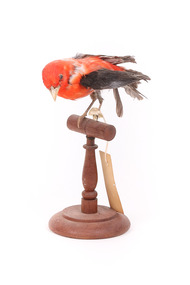
Animal specimen - Scarlet Tanager (male), Trustees of the Australian Museum, 1860-1880
... This specimen is part of a collection of almost 200 animal specimens that were originally acquired as skins from various institutions across Australia, including the Australian Museum in Sydney and the National Museum of Victoria (known as Museums Victoria since 1983), as well as individuals such as amateur anthropologist Reynell Eveleigh Johns between 1860-1880. These skins were then mounted by members of the Burke Museum Committee and put-on display in the formal space of the Museum’s original exhibition hall where they continue to be on display. This display of taxidermy mounts initially served to instruct visitors to the Burke Museum of the natural...This specimen is part of a collection of almost 200 animal specimens that were originally acquired as skins from various institutions across Australia, including the Australian Museum in Sydney and the National Museum of Victoria (known as Museums Victoria since 1983), as well as individuals such as amateur anthropologist Reynell Eveleigh Johns between 1860-1880. These skins were then mounted by members of the Burke Museum Committee and put-on display in the formal space of the Museum’s original exhibition hall where they continue to be on display. This display of taxidermy mounts initially served to instruct visitors to the Burke Museum of the natural ...The Scarlet Tanager is an American songbird of medium size with bright coloured plumage. They are commonly located in eastern North America and in northwestern South America. They can often be found within woodlands that have oaks. On occasion, the Tanager can be seen in suburban areas including parks and gardens. These birds are sociable and often join with other foraging flocks. They are carnivores (insectivores) and feed on insects including wasps, ants, moths, beetles, butterflies and grasshoppers. The numbers of these birds in America are declining due to exposure and starvation during the colder months. These birds can also die from collisions with man made objects which includes the TV and radio towers, buildings and cars. They also have high rates of predation and brood parasitism. However, at current the IUCN classifies this species as Least Concern and note that their numbers are stable. This specimen is part of a collection of almost 200 animal specimens that were originally acquired as skins from various institutions across Australia, including the Australian Museum in Sydney and the National Museum of Victoria (known as Museums Victoria since 1983), as well as individuals such as amateur anthropologist Reynell Eveleigh Johns between 1860-1880. These skins were then mounted by members of the Burke Museum Committee and put-on display in the formal space of the Museum’s original exhibition hall where they continue to be on display. This display of taxidermy mounts initially served to instruct visitors to the Burke Museum of the natural world around them, today it serves as an insight into the collecting habits of the 19th century.This specimen is part of a significant and rare taxidermy mount collection in the Burke Museum. This collection is scientifically and culturally important for reminding us of how science continues to shape our understanding of the modern world. They demonstrate a capacity to hold evidence of how Australia’s fauna history existed in the past and are potentially important for future environmental research. This collection continues to be on display in the Museum and has become a key part to interpreting the collecting habits of the 19th century.The Scarlet Tanager specimen stands perched on a wooden platform looking towards the ground. It has bright red/orange feathers on the main body and head with dark black feathers on the tail and wings. Overall, whilst retaining a bright appearance the bird has faded in contrast to it's original colouring This particular specimen has disheveled feathers and is missing one leg. The bill is short and pale and the specimen has been provided with glass eyes made in a dark colour. The specimen has two paper identification tags attached to the damaged leg.Swing tag: 114a / unnamed / catalogue, page 59 Cotton tag: A.4440 /taxidermy mount, taxidermy, animalia, burke museum, beechworth, australian museum, skin, reynell eveleigh johns, bird, australian birds, american, american birds, scarlet tanager, tanager, medium bird, small bird -
 The Beechworth Burke Museum
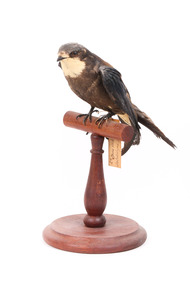
Animal specimen - White-Throated Needletail, Trustees of the Australian Museum, 1860-1880
... This specimen is part of a collection of almost 200 animal specimens that were originally acquired as skins from various institutions across Australia, including the Australian Museum in Sydney and the National Museum of Victoria (known as Museums Victoria since 1983), as well as individuals such as amateur anthropologist Reynell Eveleigh Johns between 1860-1880. These skins were then mounted by members of the Burke Museum Committee and put-on display in the formal space of the Museum’s original exhibition hall where they continue to be on display. This display of taxidermy mounts initially served to instruct visitors to the Burke Museum of the natural...This specimen is part of a collection of almost 200 animal specimens that were originally acquired as skins from various institutions across Australia, including the Australian Museum in Sydney and the National Museum of Victoria (known as Museums Victoria since 1983), as well as individuals such as amateur anthropologist Reynell Eveleigh Johns between 1860-1880. These skins were then mounted by members of the Burke Museum Committee and put-on display in the formal space of the Museum’s original exhibition hall where they continue to be on display. This display of taxidermy mounts initially served to instruct visitors to the Burke Museum of the natural ...The White-Throated Needletail is a highly sociable bird commonly seen in large flocks containing a hundred plus birds. This species is also known to mingle with birds of different species. They have a distinctive white throat and undertail. This species is mainly airborne, however they are known to reside in trees when on land. They can mainly be spotted along the north and east parts of Australia. This species is listed as vulnerable and threatened in the Australian Capital Territory, Queensland and Victoria. Since this is a taxidermy mount, it is not an accurate depiction of the White-Throated Needletail. The species should have a predominantly grey-brown plumage, with the exception of the throat and undertail which are white. There should also be a green tint to the species feathers. This specimen is part of a collection of almost 200 animal specimens that were originally acquired as skins from various institutions across Australia, including the Australian Museum in Sydney and the National Museum of Victoria (known as Museums Victoria since 1983), as well as individuals such as amateur anthropologist Reynell Eveleigh Johns between 1860-1880. These skins were then mounted by members of the Burke Museum Committee and put-on display in the formal space of the Museum’s original exhibition hall where they continue to be on display. This display of taxidermy mounts initially served to instruct visitors to the Burke Museum of the natural world around them, today it serves as an insight into the collecting habits of the 19th century.This specimen is part of a significant and rare taxidermy mount collection in the Burke Museum. This collection is scientifically and culturally important for reminding us of how science continues to shape our understanding of the modern world. They demonstrate a capacity to hold evidence of how Australia’s fauna history existed in the past and are potentially important for future environmental research. This collection continues to be on display in the Museum and has become a key part to interpreting the collecting habits of the 19th century.This White-Throated Needletail had grey-brown feathers. It has distinctive white patches on its throat and under the tail. The back of the bird is a light brown with a white patch in the center of the back. This specimen stands upon a wooden mount and has an identification tag tied around its leg. The bill is short and the wings are long and pointed. The bird's tail is short and square in shape with protruding feather shafts which give a spiky appearance.2a / Spine-Tailed Swift / See catalogue, page 7taxidermy mount, taxidermy, burke museum, beechworth, australian museum, skin, reynell eveleigh johns, bird, white-throated needletail, australian birds -
 The Beechworth Burke Museum
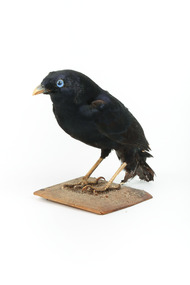
Animal specimen - Satin Bowerbird (male), 1860-1880
... This specimen is part of a collection of almost 200 animal specimens that were originally acquired as skins from various institutions across Australia, including the Australian Museum in Sydney and the National Museum of Victoria (known as Museums Victoria since 1983), as well as individuals such as amateur anthropologist Reynell Eveleigh Johns between 1860-1880. These skins were then mounted by members of the Burke Museum Committee and put-on display in the formal space of the Museum’s original exhibition hall where they continue to be on display. This display of taxidermy mounts initially served to instruct visitors to the Burke Museum of the natural...This specimen is part of a collection of almost 200 animal specimens that were originally acquired as skins from various institutions across Australia, including the Australian Museum in Sydney and the National Museum of Victoria (known as Museums Victoria since 1983), as well as individuals such as amateur anthropologist Reynell Eveleigh Johns between 1860-1880. These skins were then mounted by members of the Burke Museum Committee and put-on display in the formal space of the Museum’s original exhibition hall where they continue to be on display. This display of taxidermy mounts initially served to instruct visitors to the Burke Museum of the natural ...The Satin Bowerbird is commonly located around the eastern and south-eastern coast of Australia. They reside in wetter forests and woodlands, and nearby open areas. They feed mostly on fruits throughout the year but in summer will supplement their food supply with insects and in winter with leaves. The Satin Bowerbird is most commonly known for it's practice of building and decorating it's bower. They will often collect objects of bright blue to decorate the bower including straws, clothes peg, parrot feathers, pens, marble, string, glass and bottle tops. This decoration is done by a male Bowerbird in the effort to attract females. This specimen is part of a collection of almost 200 animal specimens that were originally acquired as skins from various institutions across Australia, including the Australian Museum in Sydney and the National Museum of Victoria (known as Museums Victoria since 1983), as well as individuals such as amateur anthropologist Reynell Eveleigh Johns between 1860-1880. These skins were then mounted by members of the Burke Museum Committee and put-on display in the formal space of the Museum’s original exhibition hall where they continue to be on display. This display of taxidermy mounts initially served to instruct visitors to the Burke Museum of the natural world around them, today it serves as an insight into the collecting habits of the 19th century.This specimen is part of a significant and rare taxidermy mount collection in the Burke Museum. This collection is scientifically and culturally important for reminding us of how science continues to shape our understanding of the modern world. They demonstrate a capacity to hold evidence of how Australia’s fauna history existed in the past and are potentially important for future environmental research. This collection continues to be on display in the Museum and has become a key part to interpreting the collecting habits of the 19th century.This taxidermy Satin Bowerbird specimen has dark black/blue glossy plumage and a pale coloured bill of small size. The bird is of a medium size compared to other species of birds and has pale legs with short talons. The eyes are made of strikingly blue coloured glass which represents the violet-blue iris of this bird while living. The bird has a short tale and has been stylized in a leaning/crouched position with it's back arched upwards and head out long. This specimen stands on a small platform and there is some deterioration to the tail feathers which protrude beyond the platform which may have otherwise provided some protection. Donor - Mr. E.T. / BH. RO. /taxidermy mount, taxidermy, animalia, burke museum, beechworth, australian museum, skin, reynell eveleigh johns, bird, australian birds, bower, bowerbird, satin bowerbird -
 The Beechworth Burke Museum
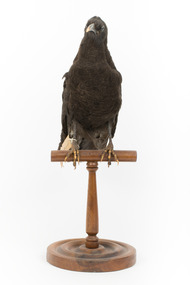
Animal specimen - American Crow, Trustees of the Australian Museum, 1860-1880
... This specimen is part of a collection of almost 200 animal specimens that were originally acquired as skins from various institutions across Australia, including the Australian Museum in Sydney and the National Museum of Victoria (known as Museums Victoria since 1983), as well as individuals such as amateur anthropologist Reynell Eveleigh Johns between 1860-1880. These skins were then mounted by members of the Burke Museum Committee and put-on display in the formal space of the Museum’s original exhibition hall where they continue to be on display. This display of taxidermy mounts initially served to instruct visitors to the Burke Museum of the natural...This specimen is part of a collection of almost 200 animal specimens that were originally acquired as skins from various institutions across Australia, including the Australian Museum in Sydney and the National Museum of Victoria (known as Museums Victoria since 1983), as well as individuals such as amateur anthropologist Reynell Eveleigh Johns between 1860-1880. These skins were then mounted by members of the Burke Museum Committee and put-on display in the formal space of the Museum’s original exhibition hall where they continue to be on display. This display of taxidermy mounts initially served to instruct visitors to the Burke Museum of the natural ...The American Crow is common throughout North America. They reside in areas with open view and trees but can often frequent city parks, suburbs of large cities and along the seashore. The Crow is a robber and therefore, find living in locations which they can raid for food perfect. These birds are sociable animals and are often found in small groups made up of family members. All their lives they reside in the one location; however, they do migrate south during the autumn. They usually find their food by walking along the ground and eat both plant and animal foods. This includes worms, larvae, insects and fruits and nuts. Crows are also known to feed on small rabbits, frogs and mice. They are also identified as nest predators because they feed on eggs. In areas occupied by humans, the Crow will find their food source from trash and also road kill. The American Crow is not considered to be an endangered species and list them on the IUCN Red List as Least Concern. However, large amounts of crows are killed for sporting and during campaigns (having a desire to reduce the population of the Crow in America). This specimen is part of a collection of almost 200 animal specimens that were originally acquired as skins from various institutions across Australia, including the Australian Museum in Sydney and the National Museum of Victoria (known as Museums Victoria since 1983), as well as individuals such as amateur anthropologist Reynell Eveleigh Johns between 1860-1880. These skins were then mounted by members of the Burke Museum Committee and put-on display in the formal space of the Museum’s original exhibition hall where they continue to be on display. This display of taxidermy mounts initially served to instruct visitors to the Burke Museum of the natural world around them, today it serves as an insight into the collecting habits of the 19th century.This specimen is part of a significant and rare taxidermy mount collection in the Burke Museum. This collection is scientifically and culturally important for reminding us of how science continues to shape our understanding of the modern world. They demonstrate a capacity to hold evidence of how Australia’s fauna history existed in the past and are potentially important for future environmental research. This collection continues to be on display in the Museum and has become a key part to interpreting the collecting habits of the 19th century.This American Crow has black plumage which has slightly faded in colour. This colour fading could also indicate that the bird was molting because the feathers of the American Crow appear brownish when the are about to molt and these feathers give way to new glossy black feathers. The specimen has two black glass eyes, a dark bill and dark legs with talons. Both the edges of the bill and the talons are faded into a pale buff colour. It is likely that the legs and talons were painted a dark black by the taxidermist and the paint has either worn off or faded over the years. The bird is standing tall on a wooden mount and looking forwards. It has a paper identification tag attached to the right leg. The tail is short and the feathers are rounded at the ends.153a. / See catalogue page 61taxidermy mount, taxidermy, animalia, burke museum, beechworth, australian museum, skin, reynell eveleigh johns, bird, america, crow, american crow -
 The Beechworth Burke Museum
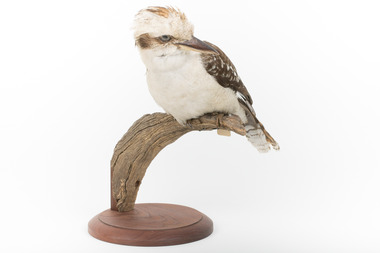
Animal specimen - Kookaburra, Trustees of the Australian Museum, 1860-1880
... This specimen is part of a collection of almost 200 animal specimens that were originally acquired as skins from various institutions across Australia, including the Australian Museum in Sydney and the National Museum of Victoria (known as Museums Victoria since 1983), as well as individuals such as amateur anthropologist Reynell Eveleigh Johns between 1860-1880. These skins were then mounted by members of the Burke Museum Committee and put-on display in the formal space of the Museum’s original exhibition hall where they continue to be on display. This display of taxidermy mounts initially served to instruct visitors to the Burke Museum of the natural...This specimen is part of a collection of almost 200 animal specimens that were originally acquired as skins from various institutions across Australia, including the Australian Museum in Sydney and the National Museum of Victoria (known as Museums Victoria since 1983), as well as individuals such as amateur anthropologist Reynell Eveleigh Johns between 1860-1880. These skins were then mounted by members of the Burke Museum Committee and put-on display in the formal space of the Museum’s original exhibition hall where they continue to be on display. This display of taxidermy mounts initially served to instruct visitors to the Burke Museum of the natural ...The Kookaburra is a sociable bird commonly seen in small flocks. These flocks mainly consist of family members. If not in flocks, these birds are commonly seen in pairs. They have a distinct appearance with brown wings, back and brown around the eyes, with majority of the plumage being white. This species reside in woodlands and open forests, however they can be seen in parks, wetlands, farms and any other space that is open with grass. This native Australian bird can mainly be found across the eastern Australia, however they have been introduced Tasmania, South-west Western Australia and New Zealand. Although this is a taxidermy mount, it looks exactly like a Kookaburra in real life. This specimen is part of a collection of almost 200 animal specimens that were originally acquired as skins from various institutions across Australia, including the Australian Museum in Sydney and the National Museum of Victoria (known as Museums Victoria since 1983), as well as individuals such as amateur anthropologist Reynell Eveleigh Johns between 1860-1880. These skins were then mounted by members of the Burke Museum Committee and put-on display in the formal space of the Museum’s original exhibition hall where they continue to be on display. This display of taxidermy mounts initially served to instruct visitors to the Burke Museum of the natural world around them, today it serves as an insight into the collecting habits of the 19th century.This specimen is part of a significant and rare taxidermy mount collection in the Burke Museum. This collection is scientifically and culturally important for reminding us of how science continues to shape our understanding of the modern world. They demonstrate a capacity to hold evidence of how Australia’s fauna history existed in the past and are potentially important for future environmental research. This collection continues to be on display in the Museum and has become a key part to interpreting the collecting habits of the 19th century.This Kookaburra has a predominantly white body. The back, wings and tail are a light shade of brown. There is a strip of brown going across the eyes. This specimen stands upon a wooden branch and has an identification tag ties around its leg. This bird is stout in shape and has a medium length tail and a broad bill. This bill is darker on top and lighter in colour on the bottom.W8083 / taxidermy mount, taxidermy, animalia, burke museum, beechworth, australian museum, skin, reynell eveleigh johns, bird, kookaburra, australian birds, laughing kookaburra -
 The Beechworth Burke Museum
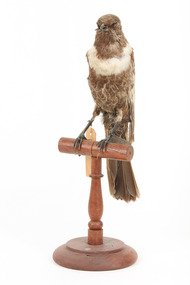
Animal specimen - Ring Ouzel, Trustees of the Australian Museum, 1860-1880
... This specimen is part of a collection of almost 200 animal specimens that were originally acquired as skins from various institutions across Australia, including the Australian Museum in Sydney and the National Museum of Victoria (known as Museums Victoria since 1983), as well as individuals such as amateur anthropologist Reynell Eveleigh Johns between 1860-1880. These skins were then mounted by members of the Burke Museum Committee and put-on display in the formal space of the Museum’s original exhibition hall where they continue to be on display. This display of taxidermy mounts initially served to instruct visitors to the Burke Museum of the natural...This specimen is part of a collection of almost 200 animal specimens that were originally acquired as skins from various institutions across Australia, including the Australian Museum in Sydney and the National Museum of Victoria (known as Museums Victoria since 1983), as well as individuals such as amateur anthropologist Reynell Eveleigh Johns between 1860-1880. These skins were then mounted by members of the Burke Museum Committee and put-on display in the formal space of the Museum’s original exhibition hall where they continue to be on display. This display of taxidermy mounts initially served to instruct visitors to the Burke Museum of the natural ...The Ring Ouzel can commonly be found in small flocks or pairs. They have a distinctive white strip across their chest which helps to identify this species. They generally reside in large open grassy spaces such as farmlands, and can be found in mountainous areas with large boulders and slopes. They are located across Western Europe, the Mediterranean and Northern Africa. In some countries such as Ireland, England and Wales, the Ring Ouzel is endangered due to human disturbances, however elsewhere the species thrives. Although this is a taxidermy mount, it is highly similar to the real female Ring Ouzel. This specimen is part of a collection of almost 200 animal specimens that were originally acquired as skins from various institutions across Australia, including the Australian Museum in Sydney and the National Museum of Victoria (known as Museums Victoria since 1983), as well as individuals such as amateur anthropologist Reynell Eveleigh Johns between 1860-1880. These skins were then mounted by members of the Burke Museum Committee and put-on display in the formal space of the Museum’s original exhibition hall where they continue to be on display. This display of taxidermy mounts initially served to instruct visitors to the Burke Museum of the natural world around them, today it serves as an insight into the collecting habits of the 19th century.This specimen is part of a significant and rare taxidermy mount collection in the Burke Museum. This collection is scientifically and culturally important for reminding us of how science continues to shape our understanding of the modern world. They demonstrate a capacity to hold evidence of how Australia’s fauna history existed in the past and are potentially important for future environmental research. This collection continues to be on display in the Museum and has become a key part to interpreting the collecting habits of the 19th century.This female Ring Ouzel is a predominantly brown in color. It has a white strip across its chest. The torso is a lighter shade of brown. The tale of the Ring Ouzel is long and a darker shade of brown when compared to the red colouring of the body. This specimen stands upon a wooden perch and has an identification tag tied around its leg. The bill is thin and has a pointed appearance. It has been styalised by the taxidermist in an open position which conveys the idea that this bird is mid call.Swing tag: 109a / Ring Thrush / Catalogue Page 27 / Metal tag: 4139 /taxidermy, taxidermy mount, animalia, burke museum, beechworth, australian museum, skin, reynell eveleigh johns, bird, ring ouzel, ouzel, european birds, african birds, mediterranean birds -
 The Beechworth Burke Museum
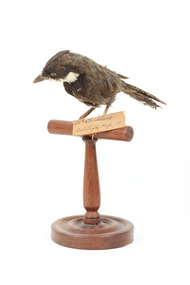
Animal specimen - Eastern Whipbird, Trustees of the Australian Museum, 1860-1880
... This specimen is part of a collection of almost 200 animal specimens that were originally acquired as skins from various institutions across Australia, including the Australian Museum in Sydney and the National Museum of Victoria (known as Museums Victoria since 1983), as well as individuals such as amateur anthropologist Reynell Eveleigh Johns between 1860-1880. These skins were then mounted by members of the Burke Museum Committee and put-on display in the formal space of the Museum’s original exhibition hall where they continue to be on display. This display of taxidermy mounts initially served to instruct visitors to the Burke Museum of the natural...This specimen is part of a collection of almost 200 animal specimens that were originally acquired as skins from various institutions across Australia, including the Australian Museum in Sydney and the National Museum of Victoria (known as Museums Victoria since 1983), as well as individuals such as amateur anthropologist Reynell Eveleigh Johns between 1860-1880. These skins were then mounted by members of the Burke Museum Committee and put-on display in the formal space of the Museum’s original exhibition hall where they continue to be on display. This display of taxidermy mounts initially served to instruct visitors to the Burke Museum of the natural ...The Eastern Whipbird isusually be found in pairs. They have a distinct white stripe on either side of the beak which helps to identify this bird. This species generally resides in wet habitats such as wetlands and rainforests, where there is dense vegetation. The Eastern Whipbird can be commonly found along the east coast of Australia. Since this is a taxidermy mount, there are a few inconsistencies. The main inconsistency is the colour of the specimen, the plumage should be an olive-green colour. This particular colouring has likely faded due to the taxidermy process and also the age of the specimen. There should also be black plume on top of the head which is missing from this specimen. This specimen is part of a collection of almost 200 animal specimens that were originally acquired as skins from various institutions across Australia, including the Australian Museum in Sydney and the National Museum of Victoria (known as Museums Victoria since 1983), as well as individuals such as amateur anthropologist Reynell Eveleigh Johns between 1860-1880. These skins were then mounted by members of the Burke Museum Committee and put-on display in the formal space of the Museum’s original exhibition hall where they continue to be on display. This display of taxidermy mounts initially served to instruct visitors to the Burke Museum of the natural world around them, today it serves as an insight into the collecting habits of the 19th century.This specimen is part of a significant and rare taxidermy mount collection in the Burke Museum. This collection is scientifically and culturally important for reminding us of how science continues to shape our understanding of the modern world. They demonstrate a capacity to hold evidence of how Australia’s fauna history existed in the past and are potentially important for future environmental research. This collection continues to be on display in the Museum and has become a key part to interpreting the collecting habits of the 19th century.This Eastern Whipbird is a small species of bird which has a dramatic stripe of white colouring on either side of the small bill and the crest is black. The belly and throat are black while the back, wings and tail are dark brown. This specimen stands upon a wooden perch and has an identification tag tied around its leg.25a / Thickhead / catalogue page 11taxidermy mount, taxidermy, animalia, burke museum, beechworth, australian museum, skin, reynell eveleigh johns, bird, eastern whipbird, australian birds -
 The Beechworth Burke Museum
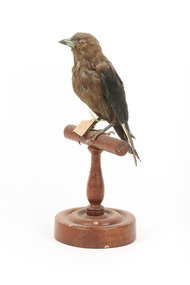
Animal specimen - Dusky Woodswallow, Trustees of the Australian Museum, 1860-1880
... This specimen is part of a collection of almost 200 animal specimens that were originally acquired as skins from various institutions across Australia, including the Australian Museum in Sydney and the National Museum of Victoria (known as Museums Victoria since 1983), as well as individuals such as amateur anthropologist Reynell Eveleigh Johns between 1860-1880. These skins were then mounted by members of the Burke Museum Committee and put-on display in the formal space of the Museum’s original exhibition hall where they continue to be on display. This display of taxidermy mounts initially served to instruct visitors to the Burke Museum of the natural...This specimen is part of a collection of almost 200 animal specimens that were originally acquired as skins from various institutions across Australia, including the Australian Museum in Sydney and the National Museum of Victoria (known as Museums Victoria since 1983), as well as individuals such as amateur anthropologist Reynell Eveleigh Johns between 1860-1880. These skins were then mounted by members of the Burke Museum Committee and put-on display in the formal space of the Museum’s original exhibition hall where they continue to be on display. This display of taxidermy mounts initially served to instruct visitors to the Burke Museum of the natural ...The Dusky Woodswallow is often found in flocks which can be located in two separate populations. The Eastern population if located in Atherton Tableland in Queensland south to Tasmania and west to Eyre Peninsula in South Australia. The other population is found in south-west Western Australia. They reside in open forests and woodlands. This species is surprisingly aggressive and may fight with other Woodswallows for territory and nest sights. They will even chase raptors away from their homes. This species flies in flocks of around 10 to 30 birds which cluster together. In terms of diet, these birds eat insects and nectar from flowers. This specimen is part of a collection of almost 200 animal specimens that were originally acquired as skins from various institutions across Australia, including the Australian Museum in Sydney and the National Museum of Victoria (known as Museums Victoria since 1983), as well as individuals such as amateur anthropologist Reynell Eveleigh Johns between 1860-1880. These skins were then mounted by members of the Burke Museum Committee and put-on display in the formal space of the Museum’s original exhibition hall where they continue to be on display. This display of taxidermy mounts initially served to instruct visitors to the Burke Museum of the natural world around them, today it serves as an insight into the collecting habits of the 19th century.This specimen is part of a significant and rare taxidermy mount collection in the Burke Museum. This collection is scientifically and culturally important for reminding us of how science continues to shape our understanding of the modern world. They demonstrate a capacity to hold evidence of how Australia’s fauna history existed in the past and are potentially important for future environmental research. This collection continues to be on display in the Museum and has become a key part to interpreting the collecting habits of the 19th century.The Dusky Woodswallow has largely deep brown colouring with some areas of grey on the head, neck and chest. There is a deeper brown colouring between the wings on the back of the specimen and the wings are black. This bird has a small curved bill which is grey and white. The legs are dark grey and the bird has long talons with an extra long toe in the centre. The eyes are made of brown glass with a back pupil. The bird is styalised standing on a wooden mount and has a paper identification tag attached to its right leg.[torn] / 9 /taxidermy mount, taxidermy, animalia, burke museum, beechworth, australian museum, skin, reynell eveleigh johns, bird, australian birds, swallow, woodswallow, dusky woodswallow -
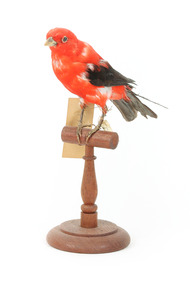 The Beechworth Burke Museum
Animal specimen - Scarlet Tanager (male), Trustees of the Australian Museum, 1860-1880
... This specimen is part of a collection of almost 200 animal specimens that were originally acquired as skins from various institutions across Australia, including the Australian Museum in Sydney and the National Museum of Victoria (known as Museums Victoria since 1983), as well as individuals such as amateur anthropologist Reynell Eveleigh Johns between 1860-1880. These skins were then mounted by members of the Burke Museum Committee and put-on display in the formal space of the Museum’s original exhibition hall where they continue to be on display. This display of taxidermy mounts initially served to instruct visitors to the Burke Museum of the natural...This specimen is part of a collection of almost 200 animal specimens that were originally acquired as skins from various institutions across Australia, including the Australian Museum in Sydney and the National Museum of Victoria (known as Museums Victoria since 1983), as well as individuals such as amateur anthropologist Reynell Eveleigh Johns between 1860-1880. These skins were then mounted by members of the Burke Museum Committee and put-on display in the formal space of the Museum’s original exhibition hall where they continue to be on display. This display of taxidermy mounts initially served to instruct visitors to the Burke Museum of the natural ...The Scarlet Tanager is an American songbird of medium size with bright coloured plumage. They are commonly located in eastern North America and in northwestern South America. They can often be found within woodlands that have oaks. On occasion, the Tanager can be seen in suburban areas including parks and gardens. These birds are sociable and often join with other foraging flocks. They are carnivores (insectivores) and feed on insects including wasps, ants, moths, beetles, butterflies and grasshoppers. The numbers of these birds in America are declining due to exposure and starvation during the colder months. These birds can also die from collisions with man made objects which includes the TV and radio towers, buildings and cars. They also have high rates of predation and brood parasitism. However, at current the IUCN classifies this species as Least Concern and note that their numbers are stable. This specimen is part of a collection of almost 200 animal specimens that were originally acquired as skins from various institutions across Australia, including the Australian Museum in Sydney and the National Museum of Victoria (known as Museums Victoria since 1983), as well as individuals such as amateur anthropologist Reynell Eveleigh Johns between 1860-1880. These skins were then mounted by members of the Burke Museum Committee and put-on display in the formal space of the Museum’s original exhibition hall where they continue to be on display. This display of taxidermy mounts initially served to instruct visitors to the Burke Museum of the natural world around them, today it serves as an insight into the collecting habits of the 19th century.This specimen is part of a significant and rare taxidermy mount collection in the Burke Museum. This collection is scientifically and culturally important for reminding us of how science continues to shape our understanding of the modern world. They demonstrate a capacity to hold evidence of how Australia’s fauna history existed in the past and are potentially important for future environmental research. This collection continues to be on display in the Museum and has become a key part to interpreting the collecting habits of the 19th century.The Scarlet Tanager specimen stands perched on a wooden platform looking forwards in a raised position. It has bright red/orange feathers on the main body and head with dark black feathers on the tail and wings. Overall, whilst retaining a bright appearance the bird has faded in contrast to it's original colouring. The bill is short and pale and the specimen has been provided with glass eyes made in a dark colour. The specimen has two paper identification tags attached to the right leg.Swing tag: 143a / unnamed / catalogue page 59 Metal tag: A4439 /taxidermy mount, taxidermy, animalia, burke museum, beechworth, australian museum, skin, reynell eveleigh johns, bird, australian birds, american, american birds, scarlet tanager, tanager, medium bird, small bird -
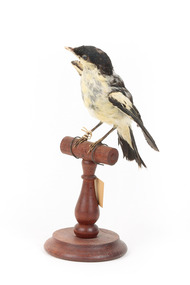 The Beechworth Burke Museum
Animal specimen - White Winged Triller, 1860-1880
... This specimen is part of a collection of almost 200 animal specimens that were originally acquired as skins from various institutions across Australia, including the Australian Museum in Sydney and the National Museum of Victoria (known as Museums Victoria since 1983), as well as individuals such as amateur anthropologist Reynell Eveleigh Johns between 1860-1880. These skins were then mounted by members of the Burke Museum Committee and put-on display in the formal space of the Museum’s original exhibition hall where they continue to be on display. This display of taxidermy mounts initially served to instruct visitors to the Burke Museum of the natural...This specimen is part of a collection of almost 200 animal specimens that were originally acquired as skins from various institutions across Australia, including the Australian Museum in Sydney and the National Museum of Victoria (known as Museums Victoria since 1983), as well as individuals such as amateur anthropologist Reynell Eveleigh Johns between 1860-1880. These skins were then mounted by members of the Burke Museum Committee and put-on display in the formal space of the Museum’s original exhibition hall where they continue to be on display. This display of taxidermy mounts initially served to instruct visitors to the Burke Museum of the natural ...The White Winged Triller is a small member of the Campephagidae family. They can be found all over the Australian mainland, but there have also been sightings in Tasmania, Papua New Guinea and Indonesia. Their breeding season is from September to December, when they migrate to southern Australia for the warmer months. The males can be very noisy during this time, when they 'trill' all day, granting them their name. Throughout the winter they can be found in northern Australia. This species can be found in open areas with shrub and lots of ground cover, in woodlands, forests, scrub and waterways. The males and females are noticeably different, particularly when breeding. Breeding males are the most conspicuous, with black on their heads, bodies and wing coverts, with a white body, lower face and lower wings. Females are brown, with a light body, a faint brow and a dark line through their eyes. When not in the breeding season, males are similar to females, though they have a greyer rump. These birds have a netted pattern on their wings. When in flight they undulate, and when they land they often shuffle and re-fold their wings. This species predominantly forage for insects on the ground or tree foliage, but also 'hawks' insects from higher perches. They build nests on horizontal branches or forks, and can be found sometimes using empty nests of other birds. Many of these birds can be found nesting in the same tree as a colony, and both parents incubate and brood their two to three nestlings. This specimen is a male White Winger Triller, which is apparent from his black and white colouring. While missing some plumage, the distinction between black wings, tail, cap and wing covert are still clear against his white body and under-wings. This specimen is part of a collection of almost 200 animal specimens that were originally acquired as skins from various institutions across Australia, including the Australian Museum in Sydney and the National Museum of Victoria (known as Museums Victoria since 1983), as well as individuals such as amateur anthropologist Reynell Eveleigh Johns between 1860-1880. These skins were then mounted by members of the Burke Museum Committee and put-on display in the formal space of the Museum’s original exhibition hall where they continue to be on display. This display of taxidermy mounts initially served to instruct visitors to the Burke Museum of the natural world around them, today it serves as an insight into the collecting habits of the 19th century.This specimen is part of a significant and rare taxidermy mount collection in the Burke Museum. This collection is scientifically and culturally important for reminding us of how science continues to shape our understanding of the modern world. They demonstrate a capacity to hold evidence of how Australia’s fauna history existed in the past and are potentially important for future environmental research. This collection continues to be on display in the Museum and has become a key part to interpreting the collecting habits of the 19th century.This male White Winged Triller has a black cap on its head. It has black wings with black wing coverts, and a black tail. It has a white lower face and body, a white shoulder bar and white under-wings. This specimen stands upon a wooden post, attached to a wooden post and has an identification tag tied around its leg. Swing-tag: 22a / White shouldered Campephagidae/ See catalogue, page 11. /taxidermy mount, taxidermy, animalia, burke museum, beechworth, australian museum, skin, reynell eveleigh johns, bird, triller, white winged triller, campephagidae, australian birds -
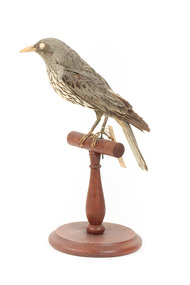 The Beechworth Burke Museum
Animal specimen - Olive-Backed Oriole, Trustees of the Australian Museum, 1860-1880
... This specimen is part of a collection of almost 200 animal specimens that were originally acquired as skins from various institutions across Australia, including the Australian Museum in Sydney and the National Museum of Victoria (known as Museums Victoria since 1983), as well as individuals such as amateur anthropologist Reynell Eveleigh Johns between 1860-1880. These skins were then mounted by members of the Burke Museum Committee and put-on display in the formal space of the Museum’s original exhibition hall where they continue to be on display. This display of taxidermy mounts initially served to instruct visitors to the Burke Museum of the natural...This specimen is part of a collection of almost 200 animal specimens that were originally acquired as skins from various institutions across Australia, including the Australian Museum in Sydney and the National Museum of Victoria (known as Museums Victoria since 1983), as well as individuals such as amateur anthropologist Reynell Eveleigh Johns between 1860-1880. These skins were then mounted by members of the Burke Museum Committee and put-on display in the formal space of the Museum’s original exhibition hall where they continue to be on display. This display of taxidermy mounts initially served to instruct visitors to the Burke Museum of the natural ...The Olive-Backed Oriole are very common birds for northern and eastern Australia, as well as New Guinea. Similar to the Yellow Oriole, this species is more versatile yet less distinctive in colouring. The streaked underparts and red bill and eyes are easy identification features of this bird. Both sexes look very similar, with female colouring being slightly duller than males. This species frequents open forests and woodlands, and can tolerate dry climates. Most of this species breeds from September to January during the tropical wet season in northern Australia, but some are known to migrate south to breed in the summer. This species eats mainly native fruit, berries, and insects. This specimen is a good example of this species, but the colouring is very dull compared to living birds. This specimen has one red eye, which is a good example of a distinctive feature of this species. This specimen is part of a collection of almost 200 animal specimens that were originally acquired as skins from various institutions across Australia, including the Australian Museum in Sydney and the National Museum of Victoria (known as Museums Victoria since 1983), as well as individuals such as amateur anthropologist Reynell Eveleigh Johns between 1860-1880. These skins were then mounted by members of the Burke Museum Committee and put-on display in the formal space of the Museum’s original exhibition hall where they continue to be on display. This display of taxidermy mounts initially served to instruct visitors to the Burke Museum of the natural world around them, today it serves as an insight into the collecting habits of the 19th century.This specimen is part of a significant and rare taxidermy mount collection in the Burke Museum. This collection is scientifically and culturally important for reminding us of how science continues to shape our understanding of the modern world. They demonstrate a capacity to hold evidence of how Australia’s fauna history existed in the past and are potentially important for future environmental research. This collection continues to be on display in the Museum and has become a key part to interpreting the collecting habits of the 19th century.This Olive-Backed Oriole has a faint olive-green head and back, and a faint red-tinged beak. Its body is cream coloured with brown streaks. It has one red eye. This specimen appears to be immature and/or female, as it has a pale pill and a duller-olive green back, with streaks quite high up on it's chin, which is indicative of an immature female of this species. This specimen stands upon a wooden platform and has an identification tag tied around its leg.Swing-tag: 52a / Australian Oriole / See catalogue page 17. taxidermy mount, taxidermy, animalia, burke museum, beechworth, australian museum, skin, reynell eveleigh johns, bird, oriole, olive-backed oriole, yellow oriole, australian birds -
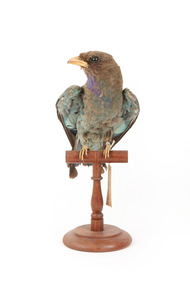 The Beechworth Burke Museum
Animal specimen - Dollarbird, Trustees of the Australian Museum, 1860-1880
... This specimen is part of a collection of almost 200 animal specimens that were originally acquired as skins from various institutions across Australia, including the Australian Museum in Sydney and the National Museum of Victoria (known as Museums Victoria since 1983), as well as individuals such as amateur anthropologist Reynell Eveleigh Johns between 1860-1880. These skins were then mounted by members of the Burke Museum Committee and put-on display in the formal space of the Museum’s original exhibition hall where they continue to be on display. This display of taxidermy mounts initially served to instruct visitors to the Burke Museum of the natural...This specimen is part of a collection of almost 200 animal specimens that were originally acquired as skins from various institutions across Australia, including the Australian Museum in Sydney and the National Museum of Victoria (known as Museums Victoria since 1983), as well as individuals such as amateur anthropologist Reynell Eveleigh Johns between 1860-1880. These skins were then mounted by members of the Burke Museum Committee and put-on display in the formal space of the Museum’s original exhibition hall where they continue to be on display. This display of taxidermy mounts initially served to instruct visitors to the Burke Museum of the natural ...The Dollarbird is so-named because of the coin-shaped patches on the tips of their wings, which is clear when in flight. They have distinctive blue-green colouring on their backs and wings, and a bright blue throat. This species migrates to northern and eastern Australia for breeding, between the months of September and April. These birds migrate to New Guinea and nearby islands in the Winter, but can be found in Japan and India also. This species resides in open wooded areas, preferring hollow-bearing trees for nesting. They can be found spending most of their time perched on high branches in search of insects, and will often 'hawk' at dusk above the tree-tops, hovering on the wing for lengthy periods. This specimen is a good example of this species, however the distinctive coin-patches on the tips of the wings are partially hidden by the tuck of the wing. This specimen is part of a collection of almost 200 animal specimens that were originally acquired as skins from various institutions across Australia, including the Australian Museum in Sydney and the National Museum of Victoria (known as Museums Victoria since 1983), as well as individuals such as amateur anthropologist Reynell Eveleigh Johns between 1860-1880. These skins were then mounted by members of the Burke Museum Committee and put-on display in the formal space of the Museum’s original exhibition hall where they continue to be on display. This display of taxidermy mounts initially served to instruct visitors to the Burke Museum of the natural world around them, today it serves as an insight into the collecting habits of the 19th century.This specimen is part of a significant and rare taxidermy mount collection in the Burke Museum. This collection is scientifically and culturally important for reminding us of how science continues to shape our understanding of the modern world. They demonstrate a capacity to hold evidence of how Australia’s fauna history existed in the past and are potentially important for future environmental research. This collection continues to be on display in the Museum and has become a key part to interpreting the collecting habits of the 19th century.This adult Dollarbird has a brown body and head, blue-green back and wings. It has a distinctive bright blue or purple plumage around its throat. The tips of the wings are brown. The pale-blue coin shaped patches on the tips of the wings are just visible. This specimen stands upon a wooden platform and has an identification tag tied around its leg.Swing-tag: 96a / Australian Roller / Catalogue, page, 25. taxidermy mount, taxidermy, animalia, burke museum, beechworth, australian museum, skin, reynell eveleigh johns, bird, dollarbird, australian birds, broad-billed roller -
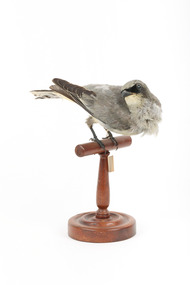 The Beechworth Burke Museum
Animal specimen - White-bellied Cuckooshrike, Trustees of the Australian Museum, 1860-1880
... This specimen is part of a collection of almost 200 animal specimens that were originally acquired as skins from various institutions across Australia, including the Australian Museum in Sydney and the National Museum of Victoria (known as Museums Victoria since 1983), as well as individuals such as amateur anthropologist Reynell Eveleigh Johns between 1860-1880. These skins were then mounted by members of the Burke Museum Committee and put-on display in the formal space of the Museum’s original exhibition hall where they continue to be on display. This display of taxidermy mounts initially served to instruct visitors to the Burke Museum of the natural...This specimen is part of a collection of almost 200 animal specimens that were originally acquired as skins from various institutions across Australia, including the Australian Museum in Sydney and the National Museum of Victoria (known as Museums Victoria since 1983), as well as individuals such as amateur anthropologist Reynell Eveleigh Johns between 1860-1880. These skins were then mounted by members of the Burke Museum Committee and put-on display in the formal space of the Museum’s original exhibition hall where they continue to be on display. This display of taxidermy mounts initially served to instruct visitors to the Burke Museum of the natural ...The white-bellied cuckooshrike inhabits regions across Australia, Indonesia, Papua New Guinea, and the Solomon Islands. In Australia, it is distributed widely, occurring in tropical northern areas as well as in the eastern parts of the country, including northern Western Australia, the Northern Territory, Queensland, New South Wales, Victoria, and southeastern South Australia. The species is prevalent throughout Papua New Guinea and the Solomon Islands, but less frequently observed in Indonesia. Within Indonesia, it is most commonly found in the northern Moluccas, with occasional sightings in Eastern Wallacea. This specimen was originally identified as a young Black-Cuckoo-shrike and catalogued as such in the Burke Museum original catalogue. Analysis conducted as part of a conservation treatment in 2024 reclassified the specimen as a white-bellied cuckooshrike. This specimen is part of a collection of almost 200 animal specimens that were originally acquired as skins from various institutions across Australia, including the Australian Museum in Sydney and the National Museum of Victoria (known as Museums Victoria since 1983), as well as individuals such as amateur anthropologist Reynell Eveleigh Johns between 1860-1880. These skins were then mounted by members of the Burke Museum Committee and put-on display in the formal space of the Museum’s original exhibition hall where they continue to be on display. This display of taxidermy mounts initially served to instruct visitors to the Burke Museum of the natural world around them, today it serves as an insight into the collecting habits of the 19th century.This specimen is part of a significant and rare taxidermy mount collection in the Burke Museum. This collection is scientifically and culturally important for reminding us of how science continues to shape our understanding of the modern world. They demonstrate a capacity to hold evidence of how Australia’s fauna history existed in the past and are potentially important for future environmental research. This collection continues to be on display in the Museum and has become a key part to interpreting the collecting habits of the 19th century.This specimen is a young White-bellied cuckooshrike which stands perched on a wooden mount. It has pale grey colouring which is darker on the rear. The wings are tipped with grey-brown feathers and the same colour feathers also appear on the bird's tale. The specimen has dark limbs and bill and this specimen is provided with two glass eyes which are dark in colouring. The bird has a more creamy pale grey on the throat and stomach. It has a black facial mask which is restricted to an eye stripe. 21a / Black Faced Graculus / See catalogue page 11taxidermy mount, taxidermy, animalia, burke museum, beechworth, australian museum, skin, reynell eveleigh johns, bird, cuckoo, shrike, common birds, australian birds, australian bird, white-bellied cuckooshrike
