
Showing 6 items matching " needle-run lace"
-
 Kew Historical Society Inc
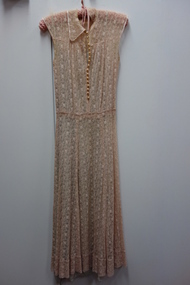
Clothing - Pink Ecru Needle-Run Lace Dress, 1930s
... Pink Ecru Needle-Run Lace Dress...Three quarter length dress of ecru needle-run lace with pearl buttons at front to waist and green under slip....Clothing Pink Ecru Needle-Run Lace Dress ...The Fashion & Design collection of the Kew Historical Society includes examples of women’s, men’s, children’s and infants’ clothing from the 18th, 19th and 20th centuries. Items in the collection were largely produced for, or purchased by women in Melbourne, and includes examples of outerwear, protective wear, nightwear, underwear and costume accessories.Three quarter length dress of ecru needle-run lace with pearl buttons at front to waist and green under slip.women's clothing, australian fashion - 1930s, cocktail dresses, lace dresses -
 Embroiderers Guild, Victoria
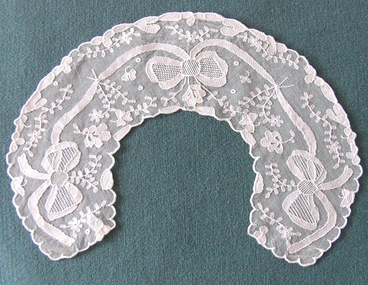
Accessory - Collar, Late 19th centurty
... ... Needle-run lace...Crofts of Malvery (Victoria) previously owned by Mr Croft's mother, Ethel Williams of Manchester, England. Embroidery Needle-run lace Collars England Net darning Late 19th century Cream collar with needle-run, net darning with floral and bow motifs. ...Donated by Mr & Mrs L.B. Crofts of Malvery (Victoria) previously owned by Mr Croft's mother, Ethel Williams of Manchester, England.Cream collar with needle-run, net darning with floral and bow motifs.embroidery, needle-run lace, collars, england, net darning, late 19th century -
 Coal Creek Community Park & Museum
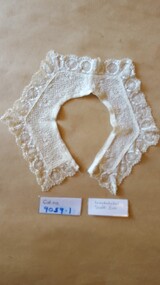
Lace collars
... 9059.1 Victorian handmade needle run lace collar 9059.2 Lace collar with two press studs 9059.3 9059.4 9059.5 Light blue crocheted silk collar and cuffs. c1920s. 9059.6 Cream silk crocheted collar 9059.7 Hand crocheted Picot collar, c.1930s 9059.8 Cream silk crocheted collar, 1920s to 1930s 9059.9 French needle run lace collar 9059.10 Black silk faille collar, c. 1920s...9059.1 Victorian handmade needle run lace collar 9059.2 Lace collar with two press studs 9059.3 9059.4 9059.5 Light blue crocheted silk collar and cuffs. c1920s. 9059.6 Cream silk crocheted collar 9059.7 Hand crocheted Picot collar, c.1930s 9059.8 Cream silk crocheted collar, 1920s to 1930s 9059.9 French needle run lace collar 9059.10 Black silk faille collar, c. 1920s Lace collars ...9059.1 Victorian handmade needle run lace collar 9059.2 Lace collar with two press studs 9059.3 9059.4 9059.5 Light blue crocheted silk collar and cuffs. c1920s. 9059.6 Cream silk crocheted collar 9059.7 Hand crocheted Picot collar, c.1930s 9059.8 Cream silk crocheted collar, 1920s to 1930s 9059.9 French needle run lace collar 9059.10 Black silk faille collar, c. 1920s -
 Flagstaff Hill Maritime Museum and Village
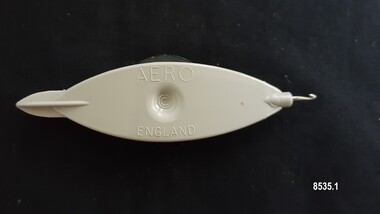
Domestic object - Tatting Shuttle, Aero Needles Group Ltd, Mid to late 20th century
... lace. One type of tatting shuttle produced by "Aero" from the 1930's to the late 1960's was an anodized grey coated aluminium shuttle with a sharp pick at one end. In the 1970's it was superseded by the grey plastic "Aero" which has a removeable bobbin which you can put on the end of the shuttle to make thread winding easier and an embedded crochet hook for joining picots. The "Aero" company developed in Redditch, England - a town renowned as a centre for manufacturing needles. Firms run...lace. One type of tatting shuttle produced by "Aero" from the 1930's to the late 1960's was an anodized grey coated aluminium shuttle with a sharp pick at one end. In the 1970's it was superseded by the grey plastic "Aero" which has a removeable bobbin which you can put on the end of the shuttle to make thread winding easier and an embedded crochet hook for joining picots. The "Aero" company developed in Redditch, England - a town renowned as a centre for manufacturing needles. Firms run ...Tatting is a form of knotted lace making using thread and a small shuttle. Twisted threads are tied around or through small, pointed shuttles that can be made of bone, mother of pearl, tortoise shell, steel or plastic. This produces a stable, strong lace using simple knots of two half hitches to make rings and chains embellished with picots.The origins of tatting are not clear but early versions of decorative knotting were used by the Egyptians on their ceremonial dress. Tatting also has elements of fishermen's net making techniques and the decorative knotting that was practiced by aristocratic women from the 15th century.Tatting, as we know it today, emerged in the first half of the 19th century. The new availability of mercerised thread from 1835 encouraged a burgeoning of lace crafts of all sorts. It was known in Italy as "occhi" and in France as "la frivolite". Tatting looks fragile but is both strong and durable. An article in a column named "Wives and Daughters" published in the Star newspaper in May 1910 describes the durability of tatting lace - "there is edging and insertion still in existence that have outworn two sets of pillow slips." In the 19th century and well into the 20th century, tatting was used like crochet and knitted lace for decorative edgings, collars, doylies, tray cloths etc. At first, different tatting patterns were passed along by word of mouth from person to person, however in time, patterns regularly appeared in newspapers and magazines well into the 1950's. A shuttle is a small tool that looks like a small boat "sailing" in and out of the thread. Tatting is called "schiffchenarbeit" in German, which means "the work of a little boat". There are two popular types of shuttles. The first has closed ends and a removable bobbin where the thread is wound around - often made from metal or plastic (as is item 8535.1). The second type has a post in the center where the thread is wound (e.g. item 8535.2). The ends of this bobbin are open but snug. Because it is constructed in two pieces, it can be made from materials like bone, ivory or mother of pearl. Shuttles hold a larger amount of thread (as compared with needles) which means fewer ends to weave in. Fishermen in the past are thought to have used large shuttles to weave cord into certain knots whilst making their fishing nets. Their methods were copied by weavers, who innovated by using threads and smaller shuttles to make lace. One type of tatting shuttle produced by "Aero" from the 1930's to the late 1960's was an anodized grey coated aluminium shuttle with a sharp pick at one end. In the 1970's it was superseded by the grey plastic "Aero" which has a removeable bobbin which you can put on the end of the shuttle to make thread winding easier and an embedded crochet hook for joining picots. The "Aero" company developed in Redditch, England - a town renowned as a centre for manufacturing needles. Firms run by Henry Milward and Abel Morrall were based in Redditch and by the 18th century Redditch was manufacturing one million sewing needles per year. Abel Morrall Ltd launched the "Aero" brand in 1936 and greatly expanded the firm's product line to include tatting shuttles and knitting needles. The classic plastic "Aero" tatting shuttle was manufactured in England from the early 1970's until the 1990's. These items are significant as examples of easily accessible handiwork tools that enabled women in the 1930s -1960s to be able to decorate and personalize their household linen and clothing.Shuttle no. 8535.1 is a beige, boat shaped plastic shuttle with enclosed ends, small round central indentations on both sides and an enclosed black removeable bobbin. The shuttle has a grooved point at one end to hold a bobbin and a small metal crochet hook at the other end. Shuttle no. 8535.2 is a beige, boat shaped metal shuttle with pointed ends that are open but snug, small round central indentations and two smaller circular markings (on both sides) and two internal posts with cream thread wound around.Shuttle no. 8535.1 - "AERO" / "ENGLAND" Shuttle no. 8535.2 - "AERO' / "ENGLAND" "39c" (written in ball point pen)flagstaff hill maritime museum and village, flagstaff hill, warrnambool, shipwreck coast, great ocean road, tatting shuttle, aero company, handwork, handwork tool, craft, handcraft, needlework, tatting -
 Embroiderers Guild, Victoria
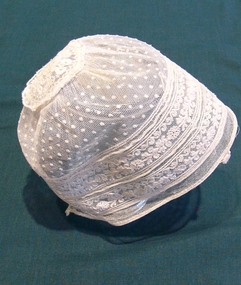
Headwear - Baby's Bonnet, 1880
... Embroidery Lace Bonnets Late 19th century France? Silk Embroidery European Fine cream coloured lawn trimmed with needle-run net in a very simple style. ...Donor was given this set (see 691 - christening gown) by Mrs Lilly Louch and was shown at the Paris Exhibition of 1880.Fine cream coloured lawn trimmed with needle-run net in a very simple style. A circular floral disk has been added to the crown.embroidery, lace, bonnets, late 19th century, france?, silk embroidery, european -
 Embroiderers Guild, Victoria
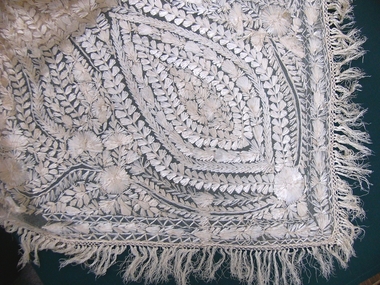
Accessory - Stole (Blonde work) Limerick Lace, Early 20th century
... It is a mixed lace, combining tambour or needle-run embroidery on a machine-made net. ...Limerick Museum item: DESCRIPTION: Limerick lace. Blonde work. Designed and made by Eileen O’Donohue of the Limerick Lace School. PATTERN: Eastern style pattern with diamond zigzag border followed by flower and leaf border at the two ends. The centre has a scattering of single flowers with leaves. Crochet edges and fringed at both ends. STITCHES AND TECHNIQUES: Limerick Lace & crocheted fringe. FIBRE: Raw Silk threads, possibly silk net. SIZE: Height 284 cm cm x Width 58 cm. DATE: 1900 – 1915.Limerick lace – By the Poor For the Rich: Lace in Context Blonde Limerick lace refers to a specific style of Limerick lace—an Irish embroidered net—that adopts the aesthetic of 18th/19th-century French "blonde" lace, often featuring fine silk or cream-colored thread on a net base. It is a mixed lace, combining tambour or needle-run embroidery on a machine-made net. Characteristics and Context: Definition: Limerick lace is a "mixed" lace created by decorating machine-made net with hand embroidery, specifically tambour work (using a hook) or needle-run work. "Blonde" Aspect: Traditionally, blonde lace was a French silk lace known for its natural cream/pale gold color. When applied to Limerick lace, this refers to the use of fine cream or écru threads to create intricate patterns. Types of Limerick Lace: Tambour: A hook is used to create chain stitches. Needle-run: Embroidery is applied using a needle. Design and History: Patterns often feature floral, foliate, and nature-inspired motifs, such as shamrocks, ferns, or butterflies. While the industry began in 1829, styles evolved to include varied fillings. Production: The Limerick Lace School has produced modern interpretations, including stoles and veils featuring this technique.Cream net with an all over design in cream floss silk embroidery in a bold floral design. 5 cm silk fringe. Similar piece is in the Limerick Museum Ireland - described as Limerick Lace and crochet edges.embroidery, silk embroidery, shawls, early 20th century, india
