
Showing 222 items matching " nutting"
-
 Emerald Museum & Nobelius Heritage Park
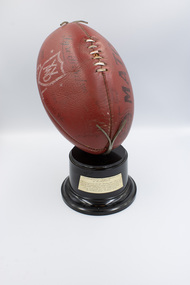
Award - Football Trophy, Nutting & Young, 1977
... The football was manufactured by historic Victorian sports equipment makers, Nutting & Young, who ceased operations in 1977....'DIGGER' DOLAN / CLUB RECORD OF 15 GOALS IN A MATCH / AGAINST WOORI YALLOCK JULY 1977 / 102 GOALS IN 12 MATCHES / 16 APRIL 1977 - 5 JULY 1977' On the football, printed: 'Football made by Nutting & Young, Vic/ NFL APPROVED' Also on the football handwritten signatures of (presumably) other team members...Nutting & Young...Award Football Trophy Nutting & Young ...The Emerald Football club history dates from 1904, and like many local clubs and organisations, has always played an important role in the community. This trophy was awarded to Geoff "Digger" Dolan of the Emerald Football Club for scoring 15 goals in a single match against the Woori Yallock Club on the 9th of July 1977. The match broke the club record at the time, resulting in 120 goals being scored in 12 matches from the 16th of April to 9th of July 1977. The trophy consisting of an Australian Rules football mounted on a stand was probably the same football that was used in the match. The football was manufactured by historic Victorian sports equipment makers, Nutting & Young, who ceased operations in 1977.This is an example of a creative sporting trophy which recognised an Emerald Football Club player's outstanding achievement. Local football and other sporting teams are often integral to the economic and social development of an area.A trophy consisting of an actual Australian Rules football secured onto a hard plastic stand with a metal clasp. A metal plaque on the stand is inscribed with the award details. The football is mounted in an upward and forward position as though ready to be kicked.On metal plaque inscribed: 'PRESENTED TO G. 'DIGGER' DOLAN / CLUB RECORD OF 15 GOALS IN A MATCH / AGAINST WOORI YALLOCK JULY 1977 / 102 GOALS IN 12 MATCHES / 16 APRIL 1977 - 5 JULY 1977' On the football, printed: 'Football made by Nutting & Young, Vic/ NFL APPROVED' Also on the football handwritten signatures of (presumably) other team membersemerald football club -
 Sunshine and District Historical Society Incorporated
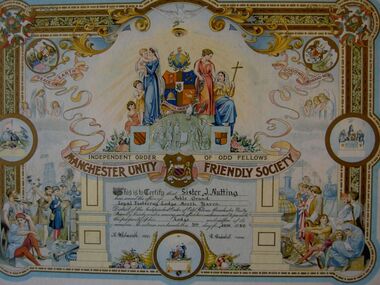
Certificate - Manchester Unity Friendly Society Sister J. Nutting Certificate, 1950
... ... Nutting...Presented to Sister J. Nutting in June 1950. Donated to Sunshine & District Historical Society Inc....Framed certificate of Manchester Unity Independent Order of Odd Fellows certifying that Sister J. Nutting has served the office of Noble Grand Ornate....Presented to Sister J. Nutting in June 1950. Donated to Sunshine & District Historical Society Inc. ...Presented to Sister J. Nutting in June 1950. Donated to Sunshine & District Historical Society Inc."Royal Footscray Lodge. North Yarra" Signatures of H.Witworth (Sec.) and R. Underhill (Treas.) "5th June, 1950"manchester unity friendly society, nutting -
 Gippsland Vehicle Collection
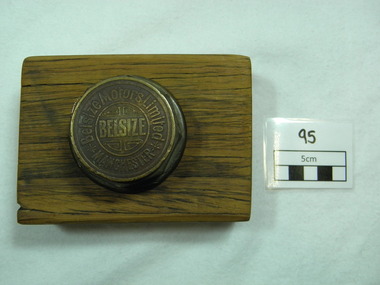
Belsize Wheel Nut, Belsize Motors Limited, Early twentieth century
... A then local man, Frank Straw who found the wheel nut (in 1968) is the grandson of John Hughes. ...Old gold coloured Belsize Wheel Nut (metal) and mounted on a rectangular block of wood....Wheel nut is inscribed as follows: BELSIZE in middle of nut surrounded by four (one in each corner) decoration emblems (as seen in photo) surrounded by a gold circle. ...Belsize Wheel Nut Belsize Motors Limited ...This wheel nut was found in a long abandoned car yard (Gino's) located in Maffra, Gippsland, and it belonged to a car from the Belsize Motorcar Company (England). A then local man, Frank Straw who found the wheel nut (in 1968) is the grandson of John Hughes. The latter did an apprenticeship as a coachbuilder with the Belsize Company of Manchester, England. He then emigrated (with his wife) to Australia in 1910 and settling in Maffra opened a coachbuilder's shop . He told his grandson that seven Belsize cars came to Australia and that one made its' way to Maffra where John Hughes worked on it at his shop. John Hughes). Old gold coloured Belsize Wheel Nut (metal) and mounted on a rectangular block of wood.Wheel nut is inscribed as follows: BELSIZE in middle of nut surrounded by four (one in each corner) decoration emblems (as seen in photo) surrounded by a gold circle. Around the outside of the circle are the words Belsize Motors Limited -an asterisk at the beginning and end of the company name. Outside the circle at the bottom is the word MANCHESTER. Around the edge of the top of the wheel nut are two gold line circles. -
 Southern Sherbrooke Historical Society Inc.
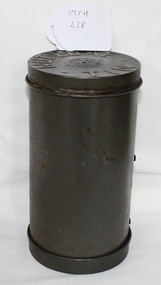
Nut loaf tin, Circa 1965
... Bought by Susan Heywood-Downard in the 1960's and used to make nut loafs for decades. Donated to Southern Sherbrooke Historical Society....Cylindrical tin made from aluminum. Used for cooking nut loaf. Made up of 2 lids and circular rolled central piece. ...'Nut loaf tin' and 'Made in Australia' on other lid....Hole on one lid to let steam out. Nut loaf tin ...Bought by Susan Heywood-Downard in the 1960's and used to make nut loafs for decades. Donated to Southern Sherbrooke Historical Society.Cylindrical tin made from aluminum. Used for cooking nut loaf. Made up of 2 lids and circular rolled central piece. Hole on one lid to let steam out.'Nut Loaf 170 m/m X 80 m/m' and 'Willow Australia' on one lid. 'Nut loaf tin' and 'Made in Australia' on other lid. -
 Greensborough Historical Society
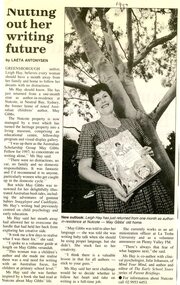
Article - Newspaper Clipping, Laeta Antonysen, Nutting out her writing future, 2007
... Nutting out her writing future...[likely to be 2007] Newspaper clipping, illustrated Nutting out her writing future Article Newspaper Clipping Laeta Antonysen Diamond Valley News ...An account of Leigh Hay's period as author-in-residence at Nutcote, formerly the home of May Gibbs. Leigh is a local author.Newspaper clipping, illustratedHandwritten date 1997, questionable? [likely to be 2007]authorship, leigh hay, nutcote, may gibbs -
 Kiewa Valley Historical Society
Tin Nut Loaf, early 1900's
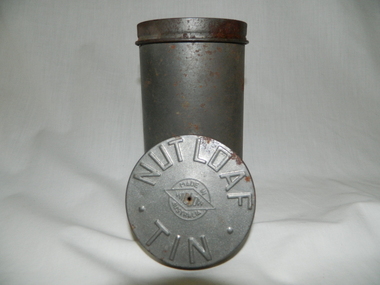
... This nut roll tin was used in a period before 1959(when plastic containers started being used). ...This cylindrical nut loaf tin(mild steel) has a removable lid and base. ...On the outside edge of each lid "NUT LOAF" and the opposite side "TIN"...This nut roll tin was used in a period before 1959(when plastic containers started being used). ...This nut roll tin was used in a period before 1959(when plastic containers started being used). It was a period when "home" cooking(desert & cakes) was the only method of having cakes and other pastry dishes in rural areas. The utensils available for this home cooking had to be strong and reliable and low maintenance. This nut roll can is very significant(in rural Australia) because it highlights a period in time when the majority of cakes and other pastry dishes were cooked in the family kitchen and not purchased from a shop. This was a period of self sufficiency especially in semi remote rural areas such as the Kiewa Valley. This was a time when cooking utensils were either made in Australia or imported from England or Europe. After World War II imports from the USA increased significantly and then followed by cheaper products from Asia.This cylindrical nut loaf tin(mild steel) has a removable lid and base. There are three retaining hooks which stop the spring steel "main body" from being condensed beyond the circumference of both top and bottom "lids" The tin is pliable enough to "open" up and allow the baked nut loaf to be removed.On the outside edge of each lid "NUT LOAF" and the opposite side "TIN"baking tins, kitchen utensils, tins -
![Illustrated hardcover book. This volume covers the history of nursing from the earliest times to [ca.1840].](/media/collectors/50187a8f023fd7201471f198/items/67bd391dc43f03811ef823f3/item-media/67be90e6ac2704e0db9538ef/item-fit-380x285.jpg?cb=6) Alfred Hospital Nurses League - Nursing History Collection
Alfred Hospital Nurses League - Nursing History CollectionBook - Illustrated Book, Lavinia Llyod Dock 1858-1956 et al, A History of nursing: the evolution of nursing systems from the earliest times to the foundation of the first English and American training schools for nurses Volume One, 1937
... ...Mary Adelaide Nutting 1858-1948...A History of nursing: the evolution of nursing systems from the earliest times to the foundation of the first English and American training schools for nurses Volume One Book Illustrated Book Lavinia Llyod Dock 1858-1956 Mary Adelaide Nutting 1858-1948 G.P.Putnam's Sons ...This volume covers the history of nursing from the earliest times to [ca.1840].Illustrated book with dark blue cover. Publisher's initials imprinted on front cover. Abbreviated title, one authors surname, one small five-pointed star and abbreviated publisher's name embossed in gold on spine. Alfred Hospital Melbourne".non-fictionThis volume covers the history of nursing from the earliest times to [ca.1840].nursing-history, nurses -
 Mont De Lancey
Functional object - Nut Loaf Tin, Willow, c early 1900's
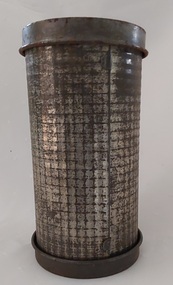
... This nut roll tin was used in a period before 1959(when plastic containers started being used). ...A cylindrical nut loaf tin with removable lids at each end. ...Around the edges of each lid is stamped 'NUT LOAF TIN'. In the middle of each lid is a circular shape with 'Made in Australia' around the edge. ...This is a rare tin. Functional object Nut Loaf Tin Willow ...This nut roll tin was used in a period before 1959(when plastic containers started being used). It was a period when "home" cooking(desserts and cakes) was the only method of having cakes and other pastry dishes in rural areas as there were no local shops. The utensils available for this home cooking had to be strong and reliable and low maintenance. This was a period of self sufficiency especially in semi remote rural areas. Sadly, the Willow Company no longer has a nut loaf tin among their many cooking tins. A cylindrical nut loaf tin with removable lids at each end. The metal body of the tin has tiny patterned indented squares with only two of the three clips to ensure the tin stays closed. The lids at each end add to this tightening. On the lids there is rusty difficult to read stamping for the Willow brand. The cooked cake can be easily removed when the two lids are taken off. This is a rare tin.Around the edges of each lid is stamped 'NUT LOAF TIN'. In the middle of each lid is a circular shape with 'Made in Australia' around the edge. Inside this is a diamond shape with 'WILLOW'. There is a tiny square shaped pattern indented all over the body of the tin.baking tins, kitchenware, baking, cooking -
 Kyneton RSL Sub Branch
P E Nuttal
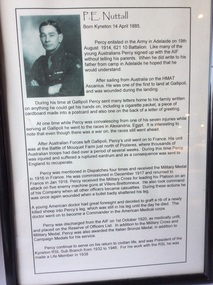
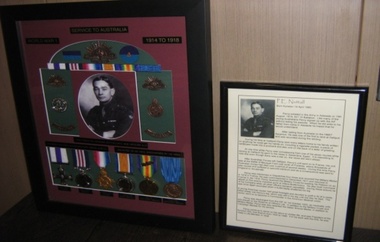
... P E Nuttal enlisted in August 1914. He was with the first landing on Gallipoli. ...Black framed photo and discription of Percy Nuttal’s enlistment and war-service....KYNRSL 024A Black framed photo and discription of Percy Nuttal’s enlistment and war-service. P E Nuttal ...P E Nuttal enlisted in August 1914. He was with the first landing on Gallipoli. He continued to serve in France, was injured and returned to the front, In 1918 he lead his platoon on an attack which finally saw the liberation of the village of Villers Brettoneux. He was awarded the Military Cross for his actions. He was awarded the Military Medal for action in France in 1916. Nuttal was discharged from the Army in 1920 and in civilian life became President of the Kyneton Returned Services League. P E Nuttal was born Kyneton, April 1885. He returned to Kyneton after the War.Black framed photo and discription of Percy Nuttal’s enlistment and war-service.Original cataloguing information on back. KYNRSL 024Aww1, nuttal, military cross, military medal, pozieres, villers brettoneux -
 Kyneton RSL Sub Branch
Framed medals,badges and photograph, Percy Nuttal
... Percy Nuttal was born in Kyneton....A second item associated with this is a framed written history of Nuttals war service. ...A second item associated with this is a framed written history of Nuttals war service. Percy Nuttal Framed medals,badges and photograph ...Percy Nuttal was born in Kyneton.Framed picture Lieut Percival Edward Nuttall M.C, M.M 50th Btn AIF Including his medals and uniform badges. A second item associated with this is a framed written history of Nuttals war service. Military Colours & badges with replica medals - Military cross, Military Medal, 1914-15 Star, 1914-18 War medal, M.I.D. Victory medal, Italian bronze medalnuttal, ww1, military medal, military cross -
 Kiewa Valley Historical Society
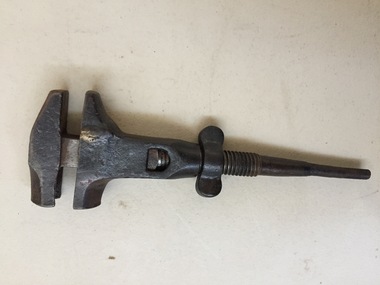
Woodworking Tool - Adjustable Wrench
... This one has a screw/nut that moves the moving jaw towards the fixed jaw....This wrench is adjustable - by turning the 'nut' in the middle of the tool it allows the 'jaws' of the wrench to open to the required size....This one has a screw/nut that moves the moving jaw towards the fixed jaw. ...Very old. The design of wrenches has varied over the years. This one has a screw/nut that moves the moving jaw towards the fixed jaw.Used by residents of the Kiewa ValleySolid steel. This wrench is a tool used to provide grip and mechanical advantage in applying torque to turn objects eg. nuts and bolts. This wrench is adjustable - by turning the 'nut' in the middle of the tool it allows the 'jaws' of the wrench to open to the required size.adjustable wrench, tool -
 Whitehorse Historical Society Inc.
Article, Tops in quality, 1992
... The company produces nuts for car manufacturing and is believed to be the last remaining nut manufacturing plant in Australia....The company produces nuts for car manufacturing and is believed to be the last remaining nut manufacturing plant in Australia....The company produces nuts for car manufacturing and is believed to be the last remaining nut manufacturing plant in Australia. Tops in quality Article Article ...Nunawading company, Ajax Spurway Fasteners, have won Ford Motor Company's Q1 preferred quality award.Nunawading company, Ajax Spurway Fasteners, have won Ford Motor Company's Q1 preferred quality award. The company produces nuts for car manufacturing and is believed to be the last remaining nut manufacturing plant in Australia.Nunawading company, Ajax Spurway Fasteners, have won Ford Motor Company's Q1 preferred quality award.cars, ajax spurway fasteners, hatton, peter, mckellar, ian -
 Sunshine and District Historical Society Incorporated
Memorabilia - Ray Nutting Collection, Circa 1914 -1918
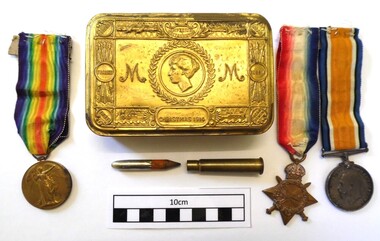
... After World War 1 George Nutting sailed for Melbourne on June 1, 1922 aboard the S.S. ...MEDALS: 2080 Pte G. Nutting 2 - Lond.R ...Allied Victory Medal. Memorabilia Ray Nutting Collection ...A 'Sailors & Soldiers Christmas Fund' created by Princess Mary had overwhelming response and so it was decided to give every person 'wearing the King's uniform on Christmas Day 1914' the brass tin along with a Christmas card and a picture of the princess, and items such as pipe, lighter, tobacco, and 20 cigarettes. Non-smokers and boys received a bullet pencil and a packet of sweets. Indian troops often received sweets and spices, and nurses received chocolates. Many of the items were sent separately from the boxes because of lack of space. Not all the tins could be sent out by Christmas and so those sent in January 1915 contained a New Year card. Shortage of brass meant that many did not received their tins until summer 1916, however by January 1919 some still did not receive them. After using up the contents many service people then used the tins to store small items. The brass tin, bullet pencil, and medals belonged to Pte George Nutting of the 2nd London regiment, and regimental number 2080/230442. After World War 1 George Nutting sailed for Melbourne on June 1, 1922 aboard the S.S. Borda. He then lived at several addresses in the Sunshine/Albion area including Dawson St, 32 King Edward Ave, and 15 Kamarooka St. At one stage he was involved in a window cleaning and gardening business, and both he and his wife Janet were very good dancers. George Nutting was also involved in the Loyal Sunshine Lodge and was presented with a Past Grand's Collar in 1943. He lived at 15 Kamarooka St until he passed away on March 20th 1979 at the age of 85. The above information was sourced from http://www.kinnethmont.co.uk/1914-1918_files/xmas-box-1914.htm (accessed 1/3/2014), and from http://museumvictoria.com.au/collections/items/1329146/tin-princess-mary-s-Christmas-gift-1914 (accessed 1/3/2014), and from research work done by Eva and Marie of S&DHS.The tin and medals provide a visible historical record of the Christmas gift, and the awards that the average WW1 British service person received about 100 years ago. The bullet pencil may indicate that Pte G. Nutting was probably a non-smoker, at least around circa 1914.Brass rectangular box with an embossed and hinged lid. The lid features the profile of Princess Mary with an 'M' on each side, and the names of Britain's allies in 1914. The pencil fits into the brass bullet casing to give the appearance of a bullet. The WW1 British medals are: 1. 1914 - 1915 Star, 2. British War Medal 1914 - 1918 (Silver), 3. Allied Victory Medal.TIN: Imperium Brittanicum, Christmas 1914, Belgium, France, Servia, Japan, Russia, Montenegro. MEDALS: 2080 Pte G. Nutting 2 - Lond.R bullet pencil, g nutting, princess mary tin, christmas 1914, british ww1 medals, 1914-1915 star, allied victory medal, british war medal 1914 -1918 -
 Flagstaff Hill Maritime Museum and Village
Functional object - Hub Cap Nut, Circa 1870's
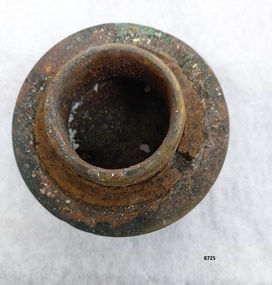
... This hub cap nut was recovered from the wreck of the Loch Ard and donated by a friend of the diver. ...A round brass hub cap nut consisting of a flat, octagonal, hollow nut (with concave sides and green verdigis), a 2cm wide flange and a 2 cm deep threaded shank with brown corrosion. ...Functional object Hub Cap Nut ...This hub cap nut was recovered from the wreck of the Loch Ard and donated by a friend of the diver. The ship Loch Ard was built on the River Clyde in Scotland in 1873 for the prestigious Loch Line of colonial clipper ships, designed for the Australian run. It sailed from Gravesend, England on 1st March 1878 carrying 37 crew, 17 passengers and a load of cargo. The manifest listed an array of manufactured goods being exported to the Colony of Victoria reflecting the affluence of Melbourne at the time. Included in the cargo manifest were straw hats, umbrellas, perfumes, clay pipes, pianos, clocks, confectionary, linen and candles, as well as one timber carriage, 29 chaff cutters and thirty-four pairs of metal axle components for horse drawn wagons and carriages. It is not known if this brass hub nut cap was part of this cargo manifest or was a fitting on the Loch Ard. There were also items included that were intended for display in the Melbourne International Exhibition in 1880 - a diverse general cargo ranging from luxury items to bulk railway iron. On 1 June 1878, emerging from fog and hearing too late the sound of breakers against the tall limestone cliffs, the vessel struck the southern foot of Mutton Bird Island and sank in 23 metres of water. Of the fifty-four people on board only two survived, one young male crewman, Tom Pearce, and one young female passenger, Eva Carmichael. Ten days after the Loch Ard tragedy, salvage rights to the wreck were sold at auction for £2,120. Cargo valued at £3,000 was salvaged and placed on the beach, but most washed back into the sea when another storm developed. The wreck of Loch Ard still lies at the base of Mutton Bird Island. Much of the cargo has now been salvaged and some was washed up into what is now known as Loch Ard Gorge. Cargo and artefacts have also been illegally salvaged over many years before protective legislation was introduced in 1976. One of the most unlikely pieces of cargo to have survived the shipwreck was a Minton porcelain peacock - one of only seven in the world. The peacock was destined for the Melbourne International Exhibition in 1880. It had been well packed, which gave it adequate protection during the violent storm. Today, the Minton peacock can be seen at the Flagstaff Hill Maritime Museum in Warrnambool. From Australia's most dramatic shipwreck it has now become Australia's most valuable shipwreck artefact and is one of very few 'objects' on the Victorian State Heritage Register.Flagstaff Hill’s collection of artefacts from LOCH ARD is significant for being one of the largest collections of artefacts from this shipwreck in Victoria. It is significant for its association with the shipwreck, which is on the Victorian Heritage Register (VHR S417). The collection is significant because of the relationship between the objects, as together they have a high potential to interpret the story of the LOCH ARD. The LOCH ARD collection is archaeologically significant as the remains of a large international passenger and cargo ship. The LOCH ARD collection is historically significant for representing aspects of Victoria’s shipping history and its potential to interpret sub-theme 1.5 of Victoria’s Framework of Historical Themes (living with natural processes). The collection is also historically significant for its association with the LOCH ARD, which was one of the worst and best known shipwrecks in Victoria’s history.A round brass hub cap nut consisting of a flat, octagonal, hollow nut (with concave sides and green verdigis), a 2cm wide flange and a 2 cm deep threaded shank with brown corrosion. It has a rusty washer corroded onto the flange.flagstaff hill maritime museum and village, warrnambool, great ocean road, shipwreck coast, loch ard, loch ard wreck, loch ard salvage, loch ard artifacts, hub cap nut, hub cap, wagon hub cap -
 Flagstaff Hill Maritime Museum and Village
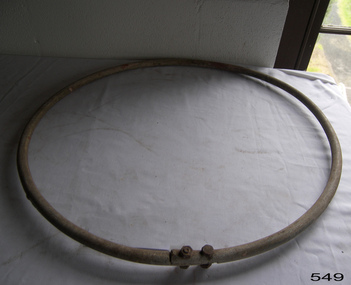
Mast Hoop
... Mast Hoop, ring metal with 2 nut & bolt holes, one bolt & nut missing...flagstaff hill warrnambool shipwrecked-coast flagstaff-hill flagstaff-hill-maritime-museum maritime-museum shipwreck-coast flagstaff-hill-maritime-village Mast Hoop, ring metal with 2 nut & bolt holes, one bolt & nut missing Mast Hoop ...Mast Hoop, ring metal with 2 nut & bolt holes, one bolt & nut missingflagstaff hill, warrnambool, shipwrecked-coast, flagstaff-hill, flagstaff-hill-maritime-museum, maritime-museum, shipwreck-coast, flagstaff-hill-maritime-village -
 Flagstaff Hill Maritime Museum and Village
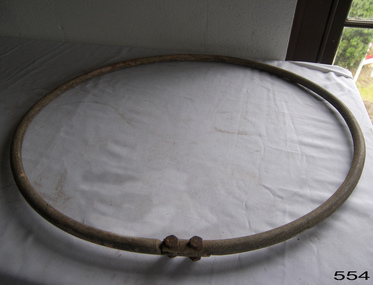
Mast Hoop
... Mast Hoop, ring metal with 2 nut & bolt holes, one bolt & nut missing...flagstaff hill warrnambool shipwrecked-coast flagstaff-hill flagstaff-hill-maritime-museum maritime-museum shipwreck-coast flagstaff-hill-maritime-village Mast Hoop, ring metal with 2 nut & bolt holes, one bolt & nut missing Mast Hoop ...Mast Hoop, ring metal with 2 nut & bolt holes, one bolt & nut missingflagstaff hill, warrnambool, shipwrecked-coast, flagstaff-hill, flagstaff-hill-maritime-museum, maritime-museum, shipwreck-coast, flagstaff-hill-maritime-village -
 National Wool Museum
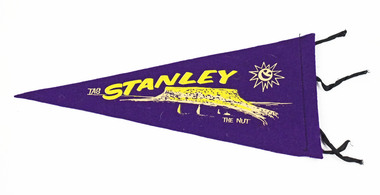
Pennant
... STANLEY TAS. TAS STANLEY THE NUT...Stanley Tasmania STANLEY TAS. TAS STANLEY THE NUT Pennant ...STANLEY TAS. TAS STANLEY THE NUTstanley, tasmania -
 Flagstaff Hill Maritime Museum and Village
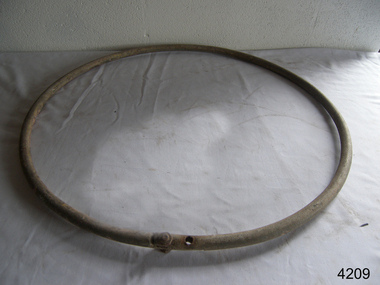
Mast Hoop
... Mast Hoop, ring metal hoop like with 2 nut & bolt holes, one bolt & nut missing...flagstaff hill warrnambool shipwrecked-coast flagstaff-hill flagstaff-hill-maritime-museum maritime-museum shipwreck-coast flagstaff-hill-maritime-village Mast Hoop, ring metal hoop like with 2 nut & bolt holes, one bolt & nut missing Mast Hoop ...Mast Hoop, ring metal hoop like with 2 nut & bolt holes, one bolt & nut missingflagstaff hill, warrnambool, shipwrecked-coast, flagstaff-hill, flagstaff-hill-maritime-museum, maritime-museum, shipwreck-coast, flagstaff-hill-maritime-village -
 Flagstaff Hill Maritime Museum and Village
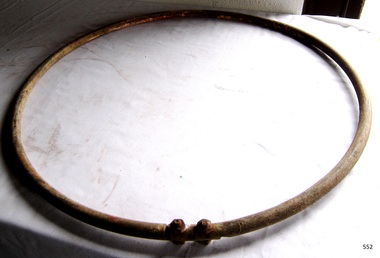
Mast Hoop
... Mast Hoop, ring metal with 2 nut & bolt holes, one bolt & nut missing. ...flagstaff hill warrnambool shipwrecked-coast flagstaff-hill flagstaff-hill-maritime-museum maritime-museum shipwreck-coast flagstaff-hill-maritime-village Mast Hoop, ring metal with 2 nut & bolt holes, one bolt & nut missing. ...Mast Hoop, ring metal with 2 nut & bolt holes, one bolt & nut missing. Diameter 545mmflagstaff hill, warrnambool, shipwrecked-coast, flagstaff-hill, flagstaff-hill-maritime-museum, maritime-museum, shipwreck-coast, flagstaff-hill-maritime-village -
 Whitehorse Historical Society Inc.
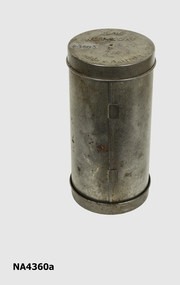
Domestic object - Nut Loaf Tin
... KANDA NUT LOAF TIN MADE IN AUSTRALIA...domestic items cooking KANDA NUT LOAF TIN MADE IN AUSTRALIA Cylindrical cooking tin with open ends and two lids. ...Cylindrical cooking tin with open ends and two lids. The lids each have a small hole in the centre. There are clips on the side of the tin to be opened when the loaf is cooked.KANDA NUT LOAF TIN MADE IN AUSTRALIAdomestic items, cooking -
 Greensborough Historical Society
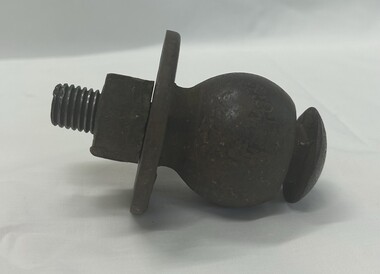
Functional object - Tow Ball, Tow Ball - 2 1/4 inch
... Cast Iron tow ball with nut...Used by the Petts family of Greenhills. tow ball motor vehicle accessory petts family Cast Iron tow ball with nut Tow Ball - 2 1/4 inch Functional object Tow Ball ...Old Style Tow Ball used to attach to car for towing. Used by the Petts family of Greenhills.Cast Iron tow ball with nuttow ball, motor vehicle accessory, petts family -
Gippsland Vehicle Collection
Wheels, Overland Hub Nut
... Overland Hub Nut......nut...Overland Hub Nut (1 only)...hub overland nut hub nut Overland Hub Nut (1 only) Overland Hub Nut Wheels ...Overland Hub Nut (1 only)hub, overland, nut, hub nut -
Robin Boyd Foundation
Magazine - Clipping, Woman's Day with Woman, Cheese and Nut Puff, 6-Oct-58
... Cheese and Nut Puff...Recipe for Cheese and nut puff, p60...Walsh St library Recipe for Cheese and nut puff, p60 Cheese and Nut Puff Magazine Clipping Woman's Day with Woman ...Recipe for Cheese and nut puff, p60walsh st library -
 Flagstaff Hill Maritime Museum and Village
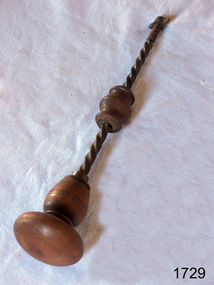
Tool - Archimedean drill, Mid to late 1800s
... Archimedean drill with wooden grip and butterfly nut on chuck....Tools from this time are today regarded as collectable items eagerly sought by collectors of antique tools. flagstaff hill warrnambool flagstaff-hill flagstaff-hill-maritime-museum maritime-museum shipwreck-coast flagstaff-hill-maritime-village Archimedean drill drill Fretwork Tools Wood Working Tools None Archimedean drill with wooden grip and butterfly nut on chuck. Tool Archimedean drill ...The Archimedes drill, also known as a fretwork drill, is an old type of drill which works on the Archimedian principle; the drill rotates quickly as the barrel on the stem is worked up and down. This tool provides a quick and easy way to bore holes through ordinary fret wood and other substances, smaller versions are used in jewellery making where precision drilling is required. There were numerous different sized Archimedes drills made from various materials, usually a combination of wood and steel, some being all steel and some including brass parts. The fancier versions of these drills included parts made from Rosewood, Ebony, Ivory and decorative brass parts. Some of the later Archimedes drills had technological improvements such as a ratchet device and the inclusion of fly-weights. The ratchet device allows the drill to revolve continuously in the cutting direction. The fly-weights give momentum to maintain the speed of the drill during the upward stroke of the hand. Most old examples such as the subject item have no makers names.A vintage drilling tool that gives a snapshot into how holes were drilled by hand into small or delicate objects during the Victorian era. Tools from this time are today regarded as collectable items eagerly sought by collectors of antique tools.Archimedean drill with wooden grip and butterfly nut on chuck.Noneflagstaff hill, warrnambool, flagstaff-hill, flagstaff-hill-maritime-museum, maritime-museum, shipwreck-coast, flagstaff-hill-maritime-village, archimedean drill, drill, fretwork tools, wood working tools -
 Whitehorse Historical Society Inc.
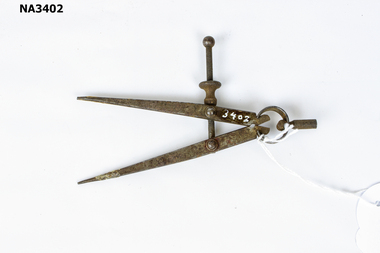
Instrument - Divider
... A pair of metal compass divider with a knurled nut on thread...trades mechanics tools A pair of metal compass divider with a knurled nut on thread Instrument Divider ...A pair of metal compass divider with a knurled nut on threadtrades, mechanics, tools -
 Flagstaff Hill Maritime Museum and Village
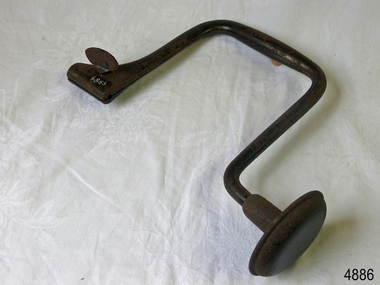
Tool - Brace & Bit, John S Fray, 1883 - 1906
... Spofford Carpenter's Bit Brace metal has bit attached. Wing nut holds bit in place but nut missing. holds bit in place. 285mm long x 160mm ...His design for a boring brace attachment and later a specific handle is still in use today and his original brace and bit is now sought after by collectors of antique tools. flagstaff hill warrnambool shipwrecked-coast flagstaff-hill flagstaff-hill-maritime-museum maritime-museum shipwreck-coast flagstaff-hill-maritime-village None Spofford Carpenter's Bit Brace metal has bit attached. Wing nut holds bit in place but nut missing. holds bit in place. 285mm long x 160mm Tool Brace & Bit John S Fray ...Context: A brace is a hand tool used with a bit (drill bit or auger) to drill holes, usually in wood. The pressure is applied to the top and the tool is rotated with a U-shaped grip. Bits used to come in a variety of types but today the more commonly used Ridgeway and Irwin pattern bits also rely on a snail point (called the snail), which is a tapered screw point shaped the same as a wood screw thread, which helps to pull the bit into the wood as the user turns the brace handle and applies pressure. The designs used today come from an original idea and pattern invented by John S Fray. Company History: John S. Fray (1833 ) immigrated to Bridgeport Connecticut USA from England in the 1850s and established a working relationship with Nelson Spofford, who held an 1858 patent for a bit brace (the tool could be augured in a continuous circular motion by hand). He established the John S. Fray Co. around the same time and immediately began producing the Spofford bit brace. Fray himself held at least two patents: one awarded in 1869 for a boring brace attachment, and another awarded in 1883 for a tool handle. By 1889, the firm was located at the industrial complex that sits between the former International Silver Company and the former Bridgeport Chain Company on Crescent Avenue and is identified on the Sanborn Insurance Atlas as a manufacturer of Spofford bit braces, hollow handle awl, and toolsets. The company was in competition with Peck Stow and Wilcox Co. of Southington, and in 1898 was enjoined from making a ratchet bit brace for which the latter company held a patent. By the 1920s, the factory had been purchased by the Stanley Company of New Britain and leased to the American Tube and Stamping Company, a manufacturer of brass, copper, seamless, and bicycle tubing, which also ran a rolling mill to the south on Stafford Avenue (now demolished). The Stanley Company bought both mills in 1926, perhaps as a strategic move to be located along the Bridgeport Harbour, through which much of the raw material used in its operations throughout the state came. By the 1950s, the Crescent Avenue operations had been moved to other sites in Connecticut, and Stanley again leased the building to a company called Cornwall and Patterson, a manufacturer of piano hardware. Today the building appears to be vacant. An early carpenters tool made by a well known early manufacturer from America who instigated many innovations to the making of tools. His early pattern for the improvement of a tool that could be used for the boring of holes in wood was a significant step forward. His design for a boring brace attachment and later a specific handle is still in use today and his original brace and bit is now sought after by collectors of antique tools. Spofford Carpenter's Bit Brace metal has bit attached. Wing nut holds bit in place but nut missing. holds bit in place. 285mm long x 160mm Noneflagstaff hill, warrnambool, shipwrecked-coast, flagstaff-hill, flagstaff-hill-maritime-museum, maritime-museum, shipwreck-coast, flagstaff-hill-maritime-village -
 Flagstaff Hill Maritime Museum and Village
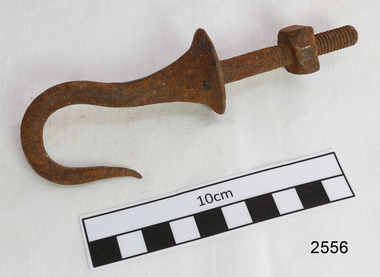
Equipment - Hook
... Hook from a rope-making machine, with nut and bolt ending...This hook is part of a rope machine. flagstaff hill warrnambool shipwrecked-coast flagstaff-hill flagstaff-hill-maritime-museum maritime-museum shipwreck-coast flagstaff-hill-maritime-village hook rope machine ropework rope-making machine Hook from a rope-making machine, with nut and bolt ending Equipment Hook ...This hook is part of a rope machine.Hook from a rope-making machine, with nut and bolt endingflagstaff hill, warrnambool, shipwrecked-coast, flagstaff-hill, flagstaff-hill-maritime-museum, maritime-museum, shipwreck-coast, flagstaff-hill-maritime-village, hook, rope machine, ropework, rope-making machine -
 Flagstaff Hill Maritime Museum and Village
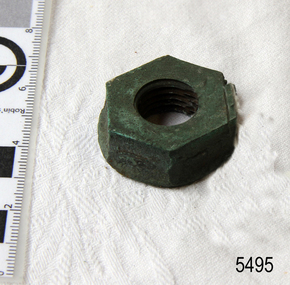
Nut
... Nut...Brass Hex nut 9/16". Retrieved from the Schomberg...It is historically significant for representing aspects of Victoria’s shipping history and for its association with the shipwreck and the ship, which was designed to be fastest and most luxurious of its day flagstaff hill warrnambool shipwrecked-coast flagstaff-hill flagstaff-hill-maritime-museum maritime-museum shipwreck-coast flagstaff-hill-maritime-village Shipwrecked-artefact Schomberg Clipper ship Black Ball line 1855 shipwreck Aberdeen clipper ship Captain Forbes Peterborough shipwreck SS Queen Brass Hex nut 9/16". Retrieved from the Schomberg Nut ...When the ship Schomberg was launched in 1855, she was considered the most perfect clipper ship ever to be built. James Blaine’s Black Ball Line had commissioned her to be built for their fleet of passenger liners. At a cost of £43,103, the Aberdeen builders designed her to sail faster than the quick clippers designed by North American Donald McKay. She was a three masted wooden clipper ship, built with diagonal planking of British oak with layers of Scottish larch. This luxury vessel was designed to transport emigrants to Melbourne in superior comfort. She had ventilation ducts to provide air to the lower decks and a dining saloon, smoking room, library and bathrooms for the first class passengers. At the launch of Schomberg’s maiden voyage, her master Captain ‘Bully’ Forbes, drunkenly predicted that he would make the journey between Liverpool and Melbourne in 60 days. Schomberg departed Liverpool on 6 October 1855 with 430 passengers and 3000 tons cargo including iron rails and equipment intended the build the Geelong Railway and a bridge over the Yarra from Melbourne to Hawthorn. The winds were poor as Schomberg sailed across the equator, slowing her journey considerably. She was 78 days out of Liverpool when she ran aground on a sand-spit near Peterborough, Victoria, on 27 December; the sand spit and the currents were not marked on Forbes’s map. Overnight, the crew launched a lifeboat to find a safe place to land the ship’s passengers. The scouting party returned to Schomberg and advised Forbes that it was best to wait until morning because the rough seas could easily overturn the small lifeboats. The ship’s Chief Officer spotted SS Queen at dawn and signalled the steamer. The master of the SS Queen approached the stranded vessel and all of Schomberg’s passengers were able to disembark safely. The Black Ball Line’s Melbourne agent sent a steamer to retrieve the passengers’ baggage from the Schomberg. Other steamers helped unload her cargo until the weather changed and prevented the salvage teams from accessing the ship. Local merchants Manifold & Bostock bought the wreck and cargo, but did not attempt to salvage the cargo still on board the ship. They eventually sold it on to a Melbourne businessman and two seafarers. After two of the men drowned when they tried to reach Schomberg, salvage efforts were abandoned. In 1975, divers from Flagstaff Hill, including Peter Ronald, found an ornate communion set at the wreck. The set comprised a jug, two chalices, a plate and a lid. The lid did not fit any of the other objects and in 1978 a piece of the lid broke off, revealing a glint of gold. As museum staff carefully examined the lid and removed marine growth, they found a diamond ring, which is currently on display in the Great Circle Gallery. Flagstaff Hill also holds ship fittings and equipment, personal effects, a lithograph, tickets and photograph from the Schomberg. Most of the artefacts were salvaged from the wreck by Peter Ronald, former director of Flagstaff Hill. The Schomberg, which is on the Victorian Heritage Register (VHR S612), has great historical significance as a rare example of a large, fast clipper ship on the England to Australia run, carrying emigrants at the time of the Victorian gold rush. She represents the technical advances made to break sailing records between Europe and Australia. Flagstaff Hill’s collection of artefacts from the Schomberg is significant for its association with the shipwreck, The collection is primarily significant because of the relationship between the objects, as together they have a high potential to interpret the story of the Schomberg. It is archaeologically significant as the remains of an international passenger Ship. It is historically significant for representing aspects of Victoria’s shipping history and for its association with the shipwreck and the ship, which was designed to be fastest and most luxurious of its day Brass Hex nut 9/16". Retrieved from the Schombergflagstaff hill, warrnambool, shipwrecked-coast, flagstaff-hill, flagstaff-hill-maritime-museum, maritime-museum, shipwreck-coast, flagstaff-hill-maritime-village, shipwrecked-artefact, schomberg, clipper ship, black ball line, 1855 shipwreck, aberdeen clipper ship, captain forbes, peterborough shipwreck, ss queen -
 Flagstaff Hill Maritime Museum and Village
Functional object - Hub Nut
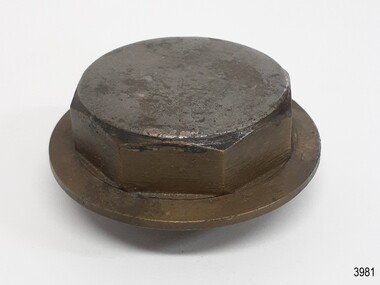
... This hub nut was amongst the items recovered from the Schomberg over one hundred years after it was wrecked. ...Hub nut, brass, with octagonal head on round disc, on hollow threaded shank. ...Functional object Hub Nut ...This hub nut was amongst the items recovered from the Schomberg over one hundred years after it was wrecked. ABOUT THE SCHOMBERG (October 6 to December 27, 1855)- When the ship Schomberg was launched in 1855, she was considered the most perfect clipper ship ever to be built. James Baine’s Black Ball Line had commissioned her for their fleet of passenger liners. The Aberdeen builders designed her to sail faster than the clippers designed the three-masted wooden clipper ship to be fast. The timber used for the diagonal planking was British oak with layers of Scottish larch. This luxury emigrant vessel was designed for superior comfort. She had ventilation ducts to provide air to the lower decks and a dining saloon, smoking room, library and bathrooms for the first-class passengers. The master for Schomberg’s maiden voyage was Captain ‘Bully’ Forbes. He drunkenly predicted at her launch that he would make the journey between Liverpool and Melbourne in 60 days. Schomberg departed Liverpool on 6 October 1855 with 430 passengers and 3000 tons of cargo including iron rails and equipment intended the build the Geelong Railway and a bridge over the Yarra from Melbourne to Hawthorn. The poor winds slowed Schomberg’s sail across the equator. She was 78 days out of Liverpool when she ran aground on a sand spit near Peterborough, Victoria, on 27 December; the sand spit and currents were not marked on Forbes’s map. The ship’s Chief Officer spotted the coastal steamer SS Queen at dawn and sent a signal. The master of the SS Queen approached the stranded vessel and all of Schomberg’s passengers safely disembarked. In 1975, 120 years after the Schomberg was wrecked, divers from Flagstaff Hill found an ornate communion set at the wreck site along with many other artefacts. In 1978 a diamond ring was discovered under the concretion in the lid of the communion set, which is currently on display. Former Director of Flagstaff Hill, Peter Ronald, had salvaged most of the artefacts from the wreck. This object is significant as an example of an item in common use in the mid-19th century. The Schomberg collection as a whole is of historical and archaeological significance at a State level. Flagstaff Hill’s collection of artefacts from the Schomberg is also significant for its association with the Victorian Heritage Registered shipwreck (VHR S 612). The collection is of prime significance because of the relationship between the objects salvaged, as together they help us to interpret the story of the Schomberg. The collection as a whole is historically significant for representing aspects of Victoria's maritime history and its potential to interpret social and historical themes. Hub nut, brass, with octagonal head on round disc, on hollow threaded shank. Surface has some lacquer. It was recovered from the wreck of the Schomberg.flagstaff hill, flagstaff hill maritime museum and village, warrnambool, maritime museum, maritime village, great ocean road, shipwreck coast, schomberg, 1855, clipper ship, james baines & co, black ball line, luxury ship, emigrant ship, captain forbes, bully forbes, ss queen, peterborough shipwreck, brass fitting, hub net, wheel fitting, hardware -
 Flagstaff Hill Maritime Museum and Village
Hub Nut
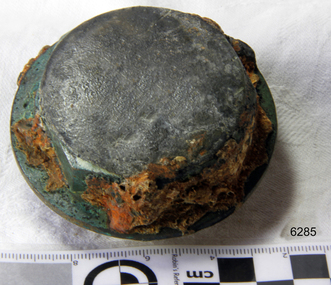
... Hub Nut, brass, wagon wheel hub nut, heavily encrusted, 2¾" Dia, Octagonal shaped top, threaded underneath. ...Recovered from the wreck of the Schomberg. Hub Nut ...When the ship Schomberg was launched in 1855, she was considered the most perfect clipper ship ever to be built. James Blaine’s Black Ball Line had commissioned her to be built for their fleet of passenger liners. At a cost of £43,103, the Aberdeen builders designed her to sail faster than the quick clippers designed by North American Donald McKay. She was a three masted wooden clipper ship, built with diagonal planking of British oat with layers of Scottish larch. This luxury vessel was designed to transport emigrants to Melbourne in superior comfort. She had ventilation ducts to provide air to the lower decks and a dining saloon, smoking room, library and bathrooms for the first class passengers. At the launch of Schomberg’s maiden voyage, her master Captain ‘Bully’ Forbes, drunkenly predicted that he would make the journey between Liverpool and Melbourne in 60 days. Schomberg departed Liverpool on 6 October 1855 with 430 passengers and 3000 tons cargo including iron rails and equipment intended the build the Geelong Railway and a bridge over the Yarra from Melbourne to Hawthorn. The winds were poor as Schomberg sailed across the equator, slowing her journey considerably. She was 78 days out of Liverpool when she ran aground on a sand-spit near Peterborough, Victoria, on 27 December; the sand spit and the currents were not marked on Forbes’s map. Overnight, the crew launched a lifeboat to find a safe place to land the ship’s passengers. The scouting party returned to Schomberg and advised Forbes that it was best to wait until morning because the rough seas could easily overturn the small lifeboats. The ship’s Chief Officer spotted SS Queen at dawn and signalled the steamer. The master of the SS Queen approached the stranded vessel and all of Schomberg’s passengers were able to disembark safely. The Black Ball Line’s Melbourne agent sent a steamer to retrieve the passengers’ baggage from the Schomberg. Other steamers helped unload her cargo until the weather changed and prevented the salvage teams from accessing the ship. Local merchants Manifold & Bostock bought the wreck and cargo, but did not attempt to salvage the cargo still on board the ship. They eventually sold it on to a Melbourne businessman and two seafarers. After two of the men drowned when they tried to reach Schomberg, salvage efforts were abandoned.32 In 1975, divers from Flagstaff Hill, including Peter Ronald, found an ornate communion set at the wreck. The set comprised a jug, two chalices, a plate and a lid. The lid did not fit any of the other objects and in 1978 a piece of the lid broke off, revealing a glint of gold. As museum staff carefully examined the lid and removed marine growth, they found a diamond ring, which is currently on display in the Great Circle Gallery.33 Flagstaff Hill also holds ship fittings and equipment, personal effects, a lithograph, tickets and photograph from the Schomberg. Most of the artefacts were salvaged from the wreck by Peter Ronald, former director of Flagstaff Hill. The Schomberg, which is on the Victorian Heritage Register (VHR S612), has great historical significance as a rare example of a large, fast clipper ship on the England to Australia run, carrying emigrants at the time of the Victorian gold rush. She represents the technical advances made to break sailing records between Europe and Australia. Flagstaff Hill’s collection of artefacts from the Schomberg is significant for its association with the shipwreck. The collection is primarily significant because of the relationship between the objects, as together they have a high potential to interpret the story of the Schomberg. It is archaeologically significant as the remains of an international passenger Ship. It is historically significant for representing aspects of Victoria’s shipping history and for its association with the shipwreck and the ship, which was designed to be fastest and most luxurious of its day Hub Nut, brass, wagon wheel hub nut, heavily encrusted, 2¾" Dia, Octagonal shaped top, threaded underneath. Artefact Reg No S/98. Recovered from the wreck of the Schomberg.warrnambool, shipwrecked-coast, flagstaff-hill, flagstaff-hill-maritime-museum, maritime-museum, shipwreck-coast, flagstaff-hill-maritime-village, schomberg, shipwrecked-artefact, clipper ship, black ball line, 1855 shipwreck, aberdeen clipper ship, captain forbes, peterborough shipwreck, ss queen, hub nut, brass hub nut
