
Showing 10 items matching " potato merchants"
-
 Bendigo Historical Society Inc.
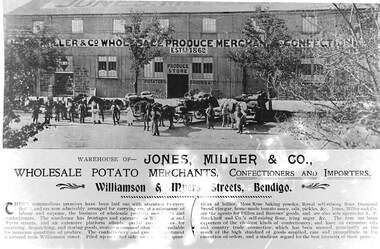
Photograph - JONES MILLER & CO, WHOLESALE POTATO MERCHANTS, c. 1900
... JONES MILLER & CO, WHOLESALE POTATO MERCHANTS...... Potato Merchants...Black and White Photo, Large Warehouse with the title 'Jones, Miller and Co, Wholesale Potato Merchants' ESTed 1862, Staff with Horse and Wagons are pictured in the foreground of the photograph. ...Photograph JONES MILLER & CO, WHOLESALE POTATO MERCHANTS ...Black and White Photo, Large Warehouse with the title 'Jones, Miller and Co, Wholesale Potato Merchants' ESTed 1862, Staff with Horse and Wagons are pictured in the foreground of the photograph. Produce Store. Potatoes 7 Onions.buildings, commercial, jones, miller & co, jones miller & co, jones, miller, potato merchants, wholesale merchants -
 Clunes Museum
Document - RECEIPTED INVOICE
... WHOLESALE FRUIT AND POTATO MERCHANTS PEEL STREET, BALLARAT. T. STANTON OF CLUNES TO SUPPLY VEGETABLES MARCH 25st,1924....WHOLESALE FRUIT AND POTATO MERCHANTS PEEL STREET, BALLARAT. T. STANTON OF CLUNES TO SUPPLY VEGETABLES MARCH 25st,1924. ...DOCKET [INVOICE] AND RECEIPT VEGETABLE PURCHASED FROM T. STANTON CLUNES. BY A. LEVY & CO. PEEL STREET, BALLARAT.RECEIPTED INVOICE. A. LEVY & CO. WHOLESALE FRUIT AND POTATO MERCHANTS PEEL STREET, BALLARAT. T. STANTON OF CLUNES TO SUPPLY VEGETABLES MARCH 25st,1924.local history, commerce, book keeping, a levy & co -
 City of Ballarat Libraries
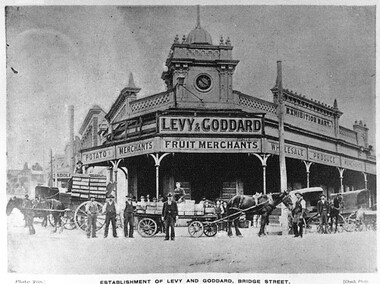
Postcard - Card Box Photographs, Establishment of Levy and Goddard, Bridge Street. Ballarat
... Fruit Merchant. Potato Merchant. Wholesale Produce. Exhibition Mart. ...Fruit Merchant. Potato Merchant. Wholesale Produce. Exhibition Mart. ...Fruit Merchant. Potato Merchant. Wholesale Produce. Exhibition Mart. Plate 267 Chuck Photo Series.levy & goddard, bridge street, building, shop, persons -
 Flagstaff Hill Maritime Museum and Village
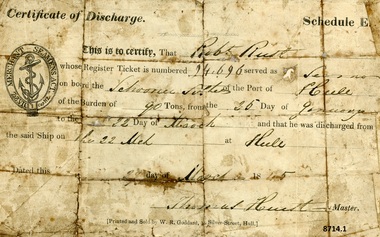
Certificate - Certificate of Discharge, 1845 - 1852
... He doesn't appear to have ever worked as a seafarer once he arrived in Warrnambool but is only recorded as working as a labourer and chimney sweep and (in the 1880's) operating as a "General Storekeeper" and "Produce Merchant" (frequently advertising in the Warrnambool Standard for items such as potatoes, oats and dairy produce from his Henna Street premises). ...He doesn't appear to have ever worked as a seafarer once he arrived in Warrnambool but is only recorded as working as a labourer and chimney sweep and (in the 1880's) operating as a "General Storekeeper" and "Produce Merchant" (frequently advertising in the Warrnambool Standard for items such as potatoes, oats and dairy produce from his Henna Street premises). ...Bob Rust was born in Poplar, London in 1823. He became a merchant seaman and all of his "Certificates of Discharge" (except the first one) show him working out of the London docks. The certificates document his career as an "Able Seaman" between the years 1845 to 1852. He worked on the following ships - Jan 25th - March 22nd, 1845 - schooner "Sisters" out of Hull. 14th July - 30th Nov 1845 - "Caleb Angus" - Port of London to West India Dock, London. 12th Dec 1845 - 14th June 1846 - "Caleb Angus" - Port of London to West India Dock, London. April - 16th Oct 1847 - barque "James Turcan" - discharged at Antwerp. It was noted by Mr Mills (Master) "his conduct was to my entire satisfaction. He is a sober, steady man" 25th Oct - 18th Dec 1847 - Brig "Eclipse" - Port of London. Dec 1847 - Nov 1848 - "Cecrops" - London to Cardiff to Cuba and discharged at West India Dock, London. 2nd Dec 1848 - 9th Feb 1850 (15 months) - "Enterprise" - discharged London. Nb - this was not the "Enterprise" used by John Pascoe Fawkner to enter the Yarra in 1835 or the "Enterprise" that sank in Lady Bay, Warrnambool in 1850 and it was not the "Enterprise" belonging to the British Navy which was used to search for Sir John Franklin's lost expedition and later made two Arctic voyages. It is not noted where Bob Rust sailed to on this voyage, but his Master noted on his certificate that "the bearer is an excellent seaman and a good sail maker". 3rd April - 20th Oct 1850 - brig "Thames" - London to London via Trieste. 30th Oct 1850 - 10th May 1851 - "Elizabeth". 9th June - 10th Nov 1851 - "Lady Rowena" - to Alexandria. 23rd Nov 1851 - 17th May 1852 - "Thames" - Mediterranean voyage to Trieste. Bob Rust was an early settler in Warrnambool. He came to Warrnambool, Australia sometime between May 1852 and 1856 where he was recorded in the Electoral Roll, as a labourer, living in Henna Street. According to family history, he "jumped ship" at Port Fairy (then Belfast) as there are no records of him officially arriving in Australia. His picture and details are recorded in "The Pioneers' Register, Warrnambool Township and Shire 1839-1900 Volume Two". He married Sarah Ann Twaits in 1865 and they had seven children. His wife died in 1876 following the birth of their last child. He doesn't appear to have ever worked as a seafarer once he arrived in Warrnambool but is only recorded as working as a labourer and chimney sweep and (in the 1880's) operating as a "General Storekeeper" and "Produce Merchant" (frequently advertising in the Warrnambool Standard for items such as potatoes, oats and dairy produce from his Henna Street premises). He continued to live in Henna Street until his death on 15th January 1906 aged 82 years. English maritime discharge certificates evolved from simple proof of release in the 1700's to become official service records in the mid 1800's. They were issued at the end of a voyage to confirm a sailor had been released from duty and paid. The Merchant Shipping Act of 1835 introduced the formal registration of British seamen, to allow the Government (Board of Trade) to identify individual seamen for the Royal Naval Reserve. Seafarers who registered were issued with tickets which contained some personal details including name, date and place of birth. As the registration system evolved over time, each merchant seafarer was allocated a unique number which would be retained during their time of service at sea. Bob Rust's number was 27914. It also documented the name of the ship (for each voyage), its tonnage, master and date and place of discharge. Early certificates had separate notes re the seaman's conduct or character but after the early 1850's, these became part of the discharge certificate. This collection of "Certificates of Discharge" include those from the late 1840's (which were smaller in size), several handwritten character references as well as some examples of the newer forms of the early 1850's.Theses certificates are significant examples of the legal paperwork generated by the British government in the day-to-day regulation of working seamen in the late 19th century. They are also significant as they document the career of a working seaman at that time.This is a set of twelve "Certificates of Discharge", two handwritten character descriptions and two "Certificates of Character" issued to Able Seaman Bob Rust primarily between the years 1845 and 1852. They have been issued by the Masters of the ships Bob Rust had sailed on, at the completion of each voyage. They differ slightly in size and layout but most follow a similar format in documenting the name of the seaman (Bob Rust), his ticket number (24696), the name of the ship and its tonnage, the port of departure and discharge (e.g. West India Docks London) and the date of the voyage. Some later certificates also describe the destination of the voyage (e.g. Mediterranean). Two of the documents are handwritten notes by the master of the ship certifying as to the conduct of the seaman and two later documents (from 1851 and 1852) are "Certificates of Character" - completed and signed by the Master on the termination of the voyage. Example of Certificate from 1845 - 1850 - "Certificate of Discharge. Schedule E, 7 & 8 Victoria, c.112. This is to certify, that Robert Rust/ whose Register Ticket is numbered 24696 served as Able Seaman/ on Board the Caleb Angus of the Port of London / of the Burden of 303 Tons, from the 14th day of July to the 30th / day of Nov 1845 and that he was discharged from the said ship on 30th /Nov 1845 at West India Docks London Dated this 3 day of December 1845" Mr Whittle MASTER. Example of handwritten character note - "This is to certify that the/ bearer Robert Rust sailor in the barque/ James Turcan, under my command as able / seaman six months during which time / his conduct was to my entire satisfaction / he is a sober steady man. W B. Mills Antwerp 20th October 1847"flagstaff hill maritime museum and village, shipwreck coast, warrnambool, certificate of discharge, certificate of character, robert rust, bob rust, seaman's certificate of discharge, sisters, caleb angus, james turcan, eclipse, cecrops, enterprise, brig thames, elizabeth, lady rowena, warrnambool pioneer, sarah ann twaits -
 Flagstaff Hill Maritime Museum and Village
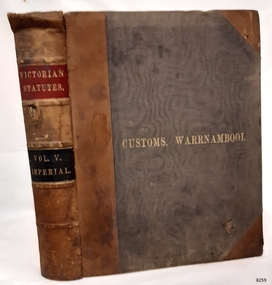
Book - Reference/Legal Statutes, John Ferres, Government Printer, The Victorian Imperial Statutes Vol 5 Customs Warrnambool, 1868
... potatoes. Because it was an official port of entry, it had its own Customs House and local Sub-Collector of Customs. A copy of Volume 5 kept in Warrnambool would have been the literal rulebook used by local customs officers to enforce imperial maritime laws, collect duties on incoming British and international merchant ships, and regulate the harbour. ...This volume is part of the first comprehensive consolidation of laws for the Colony of Victoria after it separated from New South Wales and established its own parliament. Specifically, Volume 5 (published in 1868) is dedicated to "A selection of the imperial statutes apparently in force in Victoria". Because Victoria was still a British colony, laws passed by the British (Imperial) Parliament in Westminster still applied locally if they hadn't been superseded by local Victorian colonial acts. Volume 5 was the legal handbook used by lawyers, judges, and government officials to determine exactly which British laws still governed colonial matters, ranging from shipping and trade to criminal law and merchant customs.The Victorian Statutes Vol 5 Customs Warrnambool Publisher: John Ferres Government Printer Melbourne Date: 1868 Further Information: Three quarter leather. Junction between front board and spine slightly exposed. Top section of leather on spine damaged. non-fictionThis volume is part of the first comprehensive consolidation of laws for the Colony of Victoria after it separated from New South Wales and established its own parliament. Specifically, Volume 5 (published in 1868) is dedicated to "A selection of the imperial statutes apparently in force in Victoria". Because Victoria was still a British colony, laws passed by the British (Imperial) Parliament in Westminster still applied locally if they hadn't been superseded by local Victorian colonial acts. Volume 5 was the legal handbook used by lawyers, judges, and government officials to determine exactly which British laws still governed colonial matters, ranging from shipping and trade to criminal law and merchant customs.flagstaff hill, warrnambool, shipwrecked coast, flagstaff hill maritime museum, maritime museum, shipwreck coast, flagstaff hill maritime village, great ocean road, book, pattison collection, warrnambool library, warrnambool mechanics’ institute, ralph eric pattison, corangamite regional library service, warrnambool city librarian, mechanics’ institute library, victorian library board, warrnambool books and records, warrnambool children’s library -
 Flagstaff Hill Maritime Museum and Village
Equipment - Weight
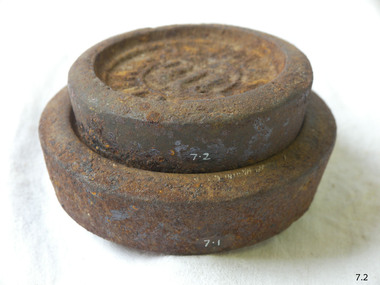
... potatoes. They could have been used in retail or wholesale businesses like a general store or a grain merchant’s premises. ...potatoes. They could have been used in retail or wholesale businesses like a general store or a grain merchant’s premises. ...The disc-shaped design of these 1LB and 2 LB metal weights enables them to be stacked one on top of the other. The weights are used with a balance scale to accurately weigh the mass of items such as grain, sugar, meat or potatoes. They could have been used in retail or wholesale businesses like a general store or a grain merchant’s premises. The user would place either one or both of these weights on one side of a balance scale. Goods would then be placed onto the other side of the scale until the beam between both sides of the scale was level, showing that the weight of the goods was as heavy as the weight or weights on the other side. These two weights are marked in Imperial units. An Imperial Standard 1LB is equal to 453.592grams. The British Weights and Measures Act of 1824 defined official standards for weights and measurements. This ensured that uniform measurements would be used for trade throughout the Empire. Towns and districts would have an official set of Imperial Standard Weights and Measures. Inspectors periodically used this official set to check the accuracy of traders’ own weights and measures. There would be penalties such as fines or imprisonment for people who broke these laws. The State of Victoria had its own Weight and Measures Act in 1862 and a decade later the inspectors in local councils used their local set of weights and measures to test the local businesses measuring equipment. In the nineteenth century the Victorian Customs Department carried out this role but this was handed over to the Melbourne Observatory at the beginning of the twentieth century. The Measures Branch then followed on with this task from the 1940s until 1995. Australia began converting to the metric system in the 1960s, beginning with its money. The conversion from imperial to metric units of measurement in Australia took place from 1970 and was completed in 1988 when metric units became the only legal unit of measurement. Imperial Standard weights; set of two disc-shaped weights designed to stack one upon the other. Inscriptions are marked in relief. "IMPERIAL STANDARD 1LB" [weight 1], "IMPERIAL STANDARD 2LB" [weight 2]warrnambool, shipwrecked-coast, flagstaff-hill, flagstaff-hill-maritime-museum, maritime-museum, shipwreck-coast, flagstaff-hill-maritime-village, shipwrecked-artefact, wieght, weights and measures, imperial standard weight -
 Flagstaff Hill Maritime Museum and Village
Equipment - Weight
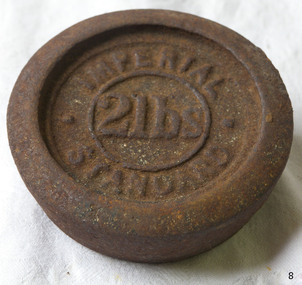
... potatoes. It could have been used in retail or wholesale businesses like a general store or a grain merchant’s premises. ...potatoes. It could have been used in retail or wholesale businesses like a general store or a grain merchant’s premises. ...The disc-shaped design of this 2 LB metal weight enables it to be stacked on top of another similarly shaped weight. The weight is used with a balance scale to accurately weigh the mass of items such as grain, sugar, meat or potatoes. It could have been used in retail or wholesale businesses like a general store or a grain merchant’s premises. The user would place the weight on one side of a balance scale. Goods would then be placed onto the other side of the scale until the beam between both sides of the scale was level, showing that the weight of the goods was as heavy as the weight on the other side. This weight is marked in Imperial units. An Imperial Standard 1LB, or one pound, is equal to 453.592grams. The British Weights and Measures Act of 1824 defined official standards for weights and measurements. This ensured that uniform measurements would be used for trade throughout the Empire. Towns and districts would have an official set of Imperial Standard Weights and Measures. Inspectors periodically used this official set to check the accuracy of traders’ own weights and measures. There would be penalties such as fines or imprisonment for people who broke these laws. The State of Victoria had its own Weight and Measures Act in 1862 and a decade later the inspectors in local councils used their local set of weights and measures to test the local businesses measuring equipment. In the nineteenth century the Victorian Customs Department carried out this role but this was handed over to the Melbourne Observatory at the beginning of the twentieth century. The Measures Branch then followed on with this task from the 1940s until 1995. Australia began converting to the metric system in the 1960s, beginning with its money. The conversion from imperial to metric units of measurement in Australia took place from 1970 and was completed in 1988 when metric units became the only legal unit of measurement.Weight; 2 lbs. Metal disc designed for stacking. Inscription marked in relief. Imperial Standard weight, 2 pounds weight."IMPERIAL STANDARD", "2lbs"flagstaff hill, warrnambool, shipwrecked coast, flagstaff hill maritime museum, maritime museum, shipwreck coast, flagstaff hill maritime village, great ocean road, standard measure, imperial standard, weight, 2lb weight, imperial standard weight -
 Bendigo Historical Society Inc.
Document - PIEPER COLLECTION: INVOICE H. MCCARTHY BOTTLE MERCHANT
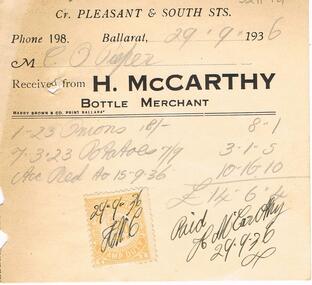
... McCarthy, bottle merchant, Pleasant and South Sts, Ballarat. to Mr. C.O. Pieper, on 29.9.36, for onions and potatoes. ...McCarthy, bottle merchant, Pleasant and South Sts, Ballarat. to Mr. C.O. Pieper, on 29.9.36, for onions and potatoes. ...Invoice issued by H. McCarthy, bottle merchant, Pleasant and South Sts, Ballarat. to Mr. C.O. Pieper, on 29.9.36, for onions and potatoes. Receipt attached on bottom of invoice.business, retail, h. mccarthy bottlemerchant -
 Narre Warren and District Family History Group
Document, Nick Vine Hall, Manly cemetery transcripts 1845 - 1993, 2005
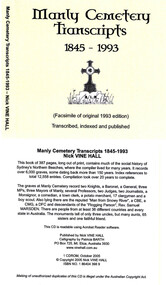
... The graves at Manly Cemetery record two Knights, a Baronet, a General, three MPs, three Mayors of Manly, several Professors, two Judges, two Journalists, a Monsignor, a comedian, a town clerk, a potato merchant, 17 clergymen and a boy scout. Also lying there are the reputed "Man from Snowy River", a CBE, a CMG, a DFC and descendants of the "Flogging Parson", Rev. ...Manly Cemetery Transcripts 1845-1993 This book of 387 pages, long out of print, contains much of the social history of Sydney's Northern Beaches, where the compiler lived for many years. It records over 6,000 graves, some dating back more than 150 years. Index references to total 12,558 entries. Compilation took over 20 years to complete. The graves at Manly Cemetery record two Knights, a Baronet, a General, three MPs, three Mayors of Manly, several Professors, two Judges, two Journalists, a Monsignor, a comedian, a town clerk, a potato merchant, 17 clergymen and a boy scout. Also lying there are the reputed "Man from Snowy River", a CBE, a CMG, a DFC and descendants of the "Flogging Parson", Rev. Samuel MARSDEN. There are people from at least 38 different countries and every state in Australia. The monuments tell of only three uncles, but many aunts, 65 sisters and one faithful friend.1 optical discnon-fictionManly Cemetery Transcripts 1845-1993 This book of 387 pages, long out of print, contains much of the social history of Sydney's Northern Beaches, where the compiler lived for many years. It records over 6,000 graves, some dating back more than 150 years. Index references to total 12,558 entries. Compilation took over 20 years to complete. The graves at Manly Cemetery record two Knights, a Baronet, a General, three MPs, three Mayors of Manly, several Professors, two Judges, two Journalists, a Monsignor, a comedian, a town clerk, a potato merchant, 17 clergymen and a boy scout. Also lying there are the reputed "Man from Snowy River", a CBE, a CMG, a DFC and descendants of the "Flogging Parson", Rev. Samuel MARSDEN. There are people from at least 38 different countries and every state in Australia. The monuments tell of only three uncles, but many aunts, 65 sisters and one faithful friend.new south wales, manly (nsw) cemetery -
Box Hill Historical Society
Photograph - P Bird's timber merchant
... potatoes in Victoria. Very pretty hilly country" Sepia photo mounted on cardboard Photograph P Bird's timber merchant ...P Bird's timber merchant brick premises established 1918 and original building with staff lined on the street.Sepia photo mounted on cardboardHandwritten family history of original donor "Ruby Sweetland daughter of Frederick & Emma Sweetland Hay N.S.W./ granddaughter James & Mary Ann Adelaide Collier, Box Hill./ now wife of Alexander Thomas Gunn of Hepburn Springs Vic 1976/Mary Ann Adelaide Collier nee Britnell, was born on way out/to Australia in the St. Vincent Gulf in a sailing boat near Adelaide/ Sth Australia, hence the name of Adelaide/ Alexander Thomas Gunn's grandfather owned the No 1 Country Hotel Licence at Kangaroo Flat "The Glasgow Arms/Hotel. near Bendigo Victoria, about 1840./ They had a family of 6 boys & 5 girls/4 boys Tom, Dan, Jack & Alexander took up land in Thorpedale/ Victoria about 1860 & paid 1 [pound] an acre for it. This land was covered/ in dense forest fern tree & fern gullies & would rain for 6 months/ in this district was the tallest tree in the world height 365 feet./ Palling splitting was main source of living for many years after being/ cleared now produces the best potatoes in Victoria. Very pretty hilly country"bird's timber yard, businesses, bird> p., timber yards, timber merchants, employees
