
Showing 5 items matching " prince george (later king george v)"
-
 Bendigo Historical Society Inc.
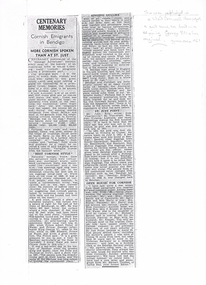
Newspaper - LONG GULLY HISTORY GROUP COLLECTION: CENTENARY MEMORIES - CORNISH EMIGRANTS IN BENDIGO
... ... Prince George (later King George V)...BENDIGO History long gully history group The Long Gully History Group - Centenary Memories - Cornsih Emigrants in Bendigo Bendigo Advertiser Mrs Kennedy Duke of Edinburgh 1867 Prince Albert Victor of Wales Prince George (later King George V) Edward Prince of Wales The Duke and Duchess of York French's Corner Long Gully Old Cornwall Society Mr John Ellis Bendigo Hospital Mr Harry Perak Malaya Mr and Mrs Charles Harry Mrs Boyns Hon Mrs J Keppel Lord St Levan Mr Keppel Victorian Railways Bendigo Railway Station Mr Herbert Thomas Copy of a newspaper article titled Centenary Memories, Cornish Emigrants in Bendigo, More Cornish spoken than at St. ...Copy of a newspaper article titled Centenary Memories, Cornish Emigrants in Bendigo, More Cornish spoken than at St. Just. Written on the side is - This was published in a West Cornwell Newspaper & sent back to Aust in a clipping George Ellis has original. Approx circa 1951. Items mentioned are: More Cornish spoken than at St Just, Best Cornsih Style, Singing Gullies particularly where Cornishmen and Welshmen were as they were fond of singing, Royal visits, St Just point and Open House for Cornish.bendigo, history, long gully history group, the long gully history group - centenary memories - cornsih emigrants in bendigo, bendigo advertiser, mrs kennedy, duke of edinburgh 1867, prince albert victor of wales, prince george (later king george v), edward prince of wales, the duke and duchess of york, french's corner long gully, old cornwall society, mr john ellis, bendigo hospital, mr harry perak malaya, mr and mrs charles harry, mrs boyns, hon mrs j keppel, lord st levan, mr keppel, victorian railways, bendigo railway station, mr herbert thomas -
 Federation University Historical Collection
Image, Robert Malachy Serjeant
... Robert Serjeant showed Prince Albert and Prince George (later King George V) around the Band and Albion Mine. ...Robert Serjeant showed Prince Albert and Prince George (later King George V) around the Band and Albion Mine. ...ROBERT MALACHY SERJEANT (1828-1902) Robert Malachy Serjeant was born on 21 December 1828 at Callington, Cornwall. He was the son of Philip Davey Serjeant, a surgeon in the Royal Marines, and Eliza Malachy. Philip Serjeant died in 1834. His mother, Eliza, remarried John Burgh in 1836. He died in 1837. In September 1848 Eliza, Robert and his two sisters, Caroline and Susan, departed Plymouth on the William Moneya for Port Adelaide and arrived in January 1849. Once gold was discovered in Victoria, Serjeant made his way to Forest Creek (near Castlemaine) and he and his mate Mr Victor, were the first party to sink through the basalt in search of a deep lead. In 1854 he moved to Ballarat to work as a miner and enjoyed some success. In 1855 he was with a group that discovered a 500 ounce nugget. With his share of the sale he set himself up with the latest mining equipment, as well as beginning a lifelong interest in the share market. He became the Manager of the Chryseis, Isis and Garibaldi claims and then the Manager of the Band and Albion Consol Company. He held the position for thirty years and only resigned when the company amalgamated with the Sir Henry Loch Mine. Robert Malachy Serjeant became interested in Politics. The first election for Parliament Representatives for Ballarat was in 1855. Robert stood for election for the first time in 1859, representing Ballarat West. He was also elected to represent Ballarat West in 1874 and 1880. Robert Serjeant’s community involvement extended to Education. Years of discussion eventually saw the development of the Ballarat School of Mines, the first school of mines in Australia. The inaugural School Council was formed in 1870 with Sir Redmond Barry, the Chief Justice, as President and Robert Malachy Serjeant as a member of the council. He held a position on the council until illness forced him to retire in 1889. He was elected a Life Governor in 1889. He was also a Life Governor of the Ballarat Hospital. Robert Serjeant showed Prince Albert and Prince George (later King George V) around the Band and Albion Mine. At the age of 42, Robert enrolled as a student at the School of Mines in 1871. He obtained a Certificate of Competency in Assaying (including Metallurgy) in 1875. The first certificate in “Geology as Applied to Mining” was awarded to Robert Serjeant in 1876. Robert Serjeant was an active and generous supporter of the School of Mines. As well as being a financial contributor, he lectured and examined in the Principles and Practice of Mining. He was regarded as an authority on alluvial and quartz mining and was a member of the Ballarat Local Court and mining board. In 1977 Robert, Joseph Flude and Henry Caselli donated the patent rights of a novel Pyrites furnace to the school. The R.M. Serjeant Scholarship at the Ballarat School of Mines resulted after a reward was offered for the first to produce the best method of treating auriferous ores – other than the smelting method. The offer was open for two years but not awarded. The money for this was donated by Robert Serjeant to the amount of 256 Pounds. It was then used to fund the School of Mines Scholarship in Engineering (1889). It was first awarded in 1922. Robert Malachy Serjeant died on 25 October 1902 and was buried at the Ballaarat Old Cemetery. (Sometimes Malachy is incorrectly written as Malachi)Two photographic portraits of mine manager Robert Malachy Serjeant. Both portraits were purchased by the donor from the State Library of Victoria. robert malachy serjeant, r.m. sergeant, robert malachi serjeant, band of hope and albion consols -
Federation University Historical Collection
Photograph - Image, Yarrowee Hall, Redan, c1883
...
Robert Serjeant showed Prince Albert and Prince George (later King George V) around the Band and Albion Mine. ...
Robert Serjeant showed Prince Albert and Prince George (later King George V) around the Band and Albion Mine. ...ROBERT MALACHY SERJEANT (1828-1902) Robert Malachy Serjeant was born on 21 December 1828 at Callington, Cornwall. He was the son of Philip Davey Serjeant, a surgeon in the Royal Marines, and Eliza Malachy. Philip Serjeant died in 1834. His mother, Eliza, remarried John Burgh in 1836. He died in 1837. In September 1848 Eliza, Robert and his two sisters, Caroline and Susan, departed Plymouth on the William Moneya for Port Adelaide and arrived in January 1849. Once gold was discovered in Victoria, Serjeant made his way to Forest Creek (near Castlemaine) and he and his mate Mr Victor, were the first party to sink through the basalt in search of a deep lead. In 1854 he moved to Ballarat to work as a miner and enjoyed some success. In 1855 he was with a group that discovered a 500 ounce nugget. With his share of the sale he set himself up with the latest mining equipment, as well as beginning a lifelong interest in the share market. He became the Manager of the Chryseis, Isis and Garibaldi claims and then the Manager of the Band and Albion Consol Company. He held the position for thirty years and only resigned when the company amalgamated with the Sir Henry Loch Mine. Robert Malachy Serjeant became interested in Politics. The first election for Parliament Representatives for Ballarat was in 1855. Robert stood for election for the first time in 1859, representing Ballarat West. He was also elected to represent Ballarat West in 1874 and 1880. Robert Serjeant’s community involvement extended to Education. Years of discussion eventually saw the development of the Ballarat School of Mines, the first school of mines in Australia. The inaugural School Council was formed in 1870 with Sir Redmond Barry, the Chief Justice, as President and Robert Malachy Serjeant as a member of the council. He held a position on the council until illness forced him to retire in 1889. He was elected a Life Governor in 1889. He was also a Life Governor of the Ballarat Hospital. Robert Serjeant showed Prince Albert and Prince George (later King George V) around the Band and Albion Mine. At the age of 42, Robert enrolled as a student at the School of Mines in 1871. He obtained a Certificate of Competency in Assaying (including Metallurgy) in 1875. The first certificate in “Geology as Applied to Mining” was awarded to Robert Serjeant in 1876. Robert Serjeant was an active and generous supporter of the School of Mines. As well as being a financial contributor, he lectured and examined in the Principles and Practice of Mining. He was regarded as an authority on alluvial and quartz mining and was a member of the Ballarat Local Court and mining board. In 1977 Robert, Joseph Flude and Henry Caselli donated the patent rights of a novel Pyrites furnace to the school. The R.M. Serjeant Scholarship at the Ballarat School of Mines resulted after a reward was offered for the first to produce the best method of treating auriferous ores – other than the smelting method. The offer was open for two years but not awarded. The money for this was donated by Robert Serjeant to the amount of 256 Pounds. It was then used to fund the School of Mines Scholarship in Engineering (1889). It was first awarded in 1922. Robert Malachy Serjeant died on 25 October 1902 and was buried at the Ballaarat Old Cemetery. (Sometimes Malachy is incorrectly written as Malachi)An copy of a photo of Yarrowee Hall, the home of of mine manager Robert Malachy Serjeant. robert malachy serjeant, r.m. sergeant, robert malachi serjeant, band of hope and albion consols, yarrowee hall, redan -
 Orbost & District Historical Society
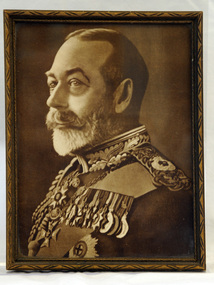
framed photograph, circa 1920's
... George V was the first king of the House of Windsor. George V (George Frederick Ernest Albert; 3 June 1865 – 20 January 1936) was King of the United Kingdom and the British Dominions, and Emperor of India, from 6 May 1910 until his death in 1936. He was the second son of Albert Edward, Prince of Wales (later...George V was the first king of the House of Windsor. George V (George Frederick Ernest Albert; 3 June 1865 – 20 January 1936) was King of the United Kingdom and the British Dominions, and Emperor of India, from 6 May 1910 until his death in 1936. He was the second son of Albert Edward, Prince of Wales (later ...George V was the first king of the House of Windsor. George V (George Frederick Ernest Albert; 3 June 1865 – 20 January 1936) was King of the United Kingdom and the British Dominions, and Emperor of India, from 6 May 1910 until his death in 1936. He was the second son of Albert Edward, Prince of Wales (later King Edward VII), and the grandson of the British monarch, Queen Victoria Saving an item dedicated to the royal family is typical of the general feeling of respect and admiration felt by the rural communities towards the British Royal Family.A framed sepia head and shoulders photograph of King George V in military uniform and wearing medals. It is in a wooden frame with decorated edging and has a cardboard stand.monarchy royal-family george-v photograph -
 City of Greater Bendigo - Civic Collection
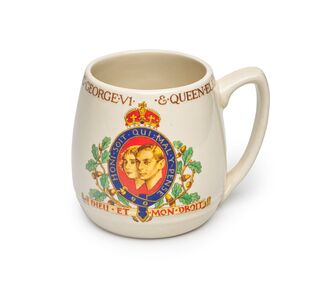
Souvenir - Mug, Burleigh Pottery, Coronation of King George VI & Queen Elizabeth, 1937
... George VI and his wife, Elizabeth, as king and queen of the United Kingdom and the Dominions of the British Commonwealth took place at Westminster Abbey, London, on Wednesday 12 May 1937. On 26th April 1923 (as Duke of York) Prince Albert married in Westminster Abbey to Lady Elizabeth Bowes-Lyon (later to become The Queen Mother). Prince Albert, Duke of York, was the second son of King George V and Queen Mary and was born on 14th December 1895 on the Sandringham estate. On the abdication of his brother Edward VIII in December 1936 he was proclaimed King and took one of his middle name, George...George VI and his wife, Elizabeth, as king and queen of the United Kingdom and the Dominions of the British Commonwealth took place at Westminster Abbey, London, on Wednesday 12 May 1937. On 26th April 1923 (as Duke of York) Prince Albert married in Westminster Abbey to Lady Elizabeth Bowes-Lyon (later to become The Queen Mother). Prince Albert, Duke of York, was the second son of King George V and Queen Mary and was born on 14th December 1895 on the Sandringham estate. On the abdication of his brother Edward VIII in December 1936 he was proclaimed King and took one of his middle name, George ...This mug was produced to commemorate the coronation of George VI and his wife, Elizabeth, as king and queen of the United Kingdom and the Dominions of the British Commonwealth took place at Westminster Abbey, London, on Wednesday 12 May 1937. On 26th April 1923 (as Duke of York) Prince Albert married in Westminster Abbey to Lady Elizabeth Bowes-Lyon (later to become The Queen Mother). Prince Albert, Duke of York, was the second son of King George V and Queen Mary and was born on 14th December 1895 on the Sandringham estate. On the abdication of his brother Edward VIII in December 1936 he was proclaimed King and took one of his middle name, George, on succeeding to the throne. Born 14th December 1895 King George died on the 6th February, 1937. Cream coloured ceramic mug with printed text and images. Outside of mug; Coronation of King George VI & Queen Elizabeth / May 1937 base; Burleigh / Made / in / England / Official design / Made in Englandmaking a nation exhibition
