
Showing 13 items matching " puns"
-
 Embroiderers Guild, Victoria
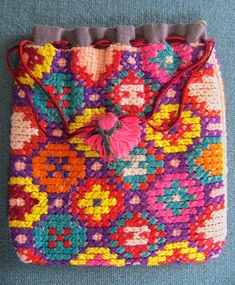
Accessory - Indian Drawstring Bag
... Given to the donor by the daughter of the Rajah of Punal, when she was 9 years old....Given to the donor by the daughter of the Rajah of Punal, when she was 9 years old. Embroidery Bag Cross stitch Small drawstring bag in large cross stitch in bright colours (Card and two photos inside bag). ...Given to the donor by the daughter of the Rajah of Punal, when she was 9 years old. Small drawstring bag in large cross stitch in bright colours (Card and two photos inside bag). embroidery, bag, cross stitch -
 City of Greater Bendigo - Civic Collection
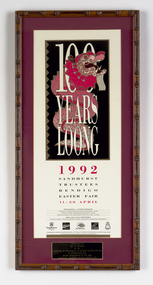
Poster - Advertising, 100 Years Loong / 1992 / Sandhurst Trustees Bendigo Easter Fair / 11 - 20 April, 1992
... This poster plays on a pun of Loong being 100 years old. Bamboo look molded frame. ...This poster plays on a pun of Loong being 100 years old. Bamboo look molded frame. 100 Years Loong / 1992 / Sandhurst Trustees Bendigo Easter Fair / 11 - 20 April Poster Advertising Bendigo Easter Fair ...Chinese participation in the Bendigo Easter Fair is a rare surviving cultural practice of Chinese involvement in similar events, which also took place in Melbourne, Beechworth, Ararat, Ballarat and other gold mining towns in the nineteenth century. According to Chinese tradition the dragon is a mythical creature with the attributes of a number of animals. The dragon has associated regalia in the form of a pearl (or teaser) and a flame. In procession, dancers carrying Loong's pearl and flame preceded the dragon. The pearl was intended to entice the dragon to join the procession and encourage him to play while the flame symbolised the power of the dragon. The pearl and flame were imported from China, possibly in the nineteenth century. The Easter Fair has since 1871 raised money for the Bendigo Benevolent Home and Asylum and the Bendigo Hospital. The Chinese took part in the annual Easter Fair celebrations from 1879, providing traditionally dressed actors and dancers for the procession in the streets of Bendigo. From 1892, a dragon provided a focus for the Chinese contribution to the festivities and was extremely popular with the whole community. Two large dragons and one small dragon participated in the Federation celebrations held in Melbourne in May 1901. It appears that one of the large dragons was Loong and the other large dragon may be the one now held at the See Yup temple in South Melbourne. There is slight doubt as to the date the present Loong was made and imported from China as there were a number of dragons in use in Bendigo and Melbourne at the time, and there are contemporary newspaper reports from Bendigo and Melbourne of dragons and regalia being imported in 1892, 1901 and 1906. Ceremonial dragons are fragile items made of organic materials and some of the dragons described in contemporary sources no longer exist. However the State Library of Victoria holds a photograph of a dragon in front of Parliament House at the Federation celebrations. This photo is securely dated to May 1901 and was definitely taken during the Federation celebration. The details of the dragon's decoration and regalia are almost identical to the existing Loong. The only minor differences seem to be loss of ornament on the chin and sides of the face which are likely the result of later restorations. Therefore Loong almost definitely dates from 1901 at least and may be earlier. Whether Loong dates from 1892 or 1901 does not diminish his significance as a rare surviving artefact relating to the Chinese in Victoria.(source Victorian Heritage Listing) Commercially printed poster mounted on foam core and framed. Engraved plaque lower centre. Poster includes an image of Loong, believed to be the oldest complete imperial dragon in the world. This poster plays on a pun of Loong being 100 years old. Bamboo look molded frame. Engraved plaque centre lower edge of glass: Presented to / City of Bendigo / By the / Committee of Management of Bendigo Easter Fair Inc / In appreciation for / Mayor sponsorship of the 1992 / Sandhurst Trustees Bendigo Easter Fair bendigo easter fair, bendigo golden dragon museum, sun loong -
 Embroiderers Guild, Victoria
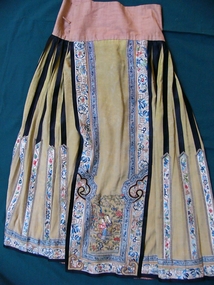
Clothing - Chinese Embroidered Skirt, 19th century
... Symbolism: Woman with a fan (shan) - a symbol of longevity and a pun for goodness. Gourds: fertility and good fortune. ...Symbolism: Woman with a fan (shan) - a symbol of longevity and a pun for goodness. Gourds: fertility and good fortune. ...Symbolism: Woman with a fan (shan) - a symbol of longevity and a pun for goodness. Gourds: fertility and good fortune. Peony: wealth and honour (fugui). Blossoms: bring forth fruit and therefore bring forth prosperity. Meander pattern: represents longevity. Lemon silk skirt lined with coral coloured silk. There is a broad cotton waist band with loops at each end, through which a tie would have been used to fasten the skirt. The reason for the cotton at the top was so that it didn't slip, as silk would have done. There is a central front panel bordered in black satin. within this is an embroidered floral and 'meander' or Greek key pattern. The 'meander' pattern is done in couched goldwork. Within this is another border of embroidered, machine made braid. The central motif of two women in a garden setting is embroidered on silk mesh and appliqued onto the background fabric. One of the women holds a fan, the other has her arms raised up and she bends slightly forward. Behind the woman with the fan there a is a little fence/bridge. To the left of the other woman is what appears to be a vase with a flower, next to what may be a gourd shaped vase. Worked in Pekin knot stitch and couched gold. embroidery, garment, silk embroidery, oriental, 19th century, china -
 Robin Boyd Foundation
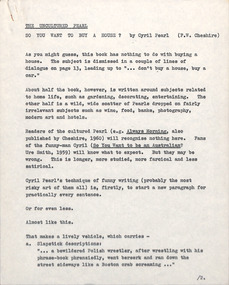
Document - Manuscript, Robin Boyd, The Uncultured Pearl, c. 1961
... ... puns...Cyril Pearl caricature puns comedy writing Robin Boyd manuscript Typewritten (c copy), quarto, 6 pages The Uncultured Pearl Document Manuscript Robin Boyd ...In this book review, Boyd critiques Cyril Pearl's book, "So You Want to Buy a House" (published by F.W. Cheshire). Boyd discusses Pearl's style of writing on home life and a scatter of other subjects and gives a negative review on the type of humour and lack of research. Original manuscript of a book review of a book by Cyril Pearl titled 'So you want to buy a house ... and live in it' in 1961. The piece was published as 'Book review: So you want to buy a house'. Typewritten (c copy), quarto, 6 pages cyril pearl, caricature, puns, comedy writing, robin boyd, manuscript -
 Embroiderers Guild, Victoria
Accessory - Pair of Chinese Sleeve Bands, Late 19th century
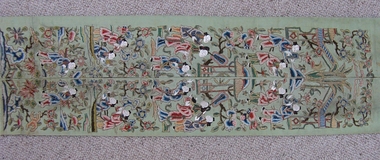
... Lotus flower - (he) is a pun for harmony. Vase - (ping) a pun for peace (ping'an) therefore a vase with lotus - peace and harmony. ...Lotus flower - (he) is a pun for harmony. Vase - (ping) a pun for peace (ping'an) therefore a vase with lotus - peace and harmony. ...Chinese sleeve embroidery bands, or wanxiu became popular in the late 19th century during the Qing Dynasty, evolving from the traditional Han cuff embroidery and Manchu styles. These detachable, decorated bands were added to women's informal jackets and robes, often featuring symbolic motifs like landscapes, flowers, and auspicious symbols. They served both a decorative function, displaying artistic skill and personal wishes, and a practical one by covering the sleeves when hands were folded at the waist. History and evolution: Origins: The practice of embroidering cuffs on robes existed during the previous Ming Dynasty for Han women, and this was adopted by the Manchu rulers who founded the Qing Dynasty. Qing Dynasty (1644-1911): The practice was popularized and elaborated upon during this era, with detachable bands becoming a fashionable element for informal wear. Symbolism: The embroidery included a complex visual vocabulary of wishes for a long life, many offspring, and a happy marriage, derived from nature, mythology, and classical literature. Functionality: Women would fold their arms, often with their hands inside the sleeves, so the embroidered bands, which were sewn to hang down the back of the jacket, would be displayed prominently down the front. 19th century peak: The late 19th century was the peak of their popularity, with intricate designs becoming fashionable and even influenced by court tastes, such as those favoured by the Empress Dowager Cixi. Later developments: The late 19th century saw the introduction of chemical 'aniline' dyes from Europe, leading to brighter, bolder colours in embroidery. Motifs and their Meanings: Auspicious symbols: Designs often included symbols for good fortune, wealth, and longevity. Natural imagery: Birds, flowers, and landscapes were common motifs that could represent natural beauty or convey specific symbolic meanings. Figurative scenes: Bands could also feature narrative scenes from classical stories or legends. The choice of motifs allowed women to express personal desires, cultural values, and aesthetic preferences, reflecting a more personal and informal style than official court attire. Looking at the cuffs from bottom to top: there is a rock formation, a zig zag fence and flowers (chrysanthemums and a branch with Buddha's hand citron). Next is a male figure carrying a halberd over his shoulder and surrounded by flowers, foliage and hillocks. Above are two more males in a boat. One is standing, the other kneeling. The one kneeling holds a bamboo pipe, while the one standing holds a branch with pomegranates. The men are surrounded by more flowers, foliage, rocks and bats . Three more figures come next. A male holding a fan, a woman holding a dish and another male. The woman on the left cuff holds a dish which appears to hold fruit, whereas the woman on the right cuff holds a dish containing a ? hat. Further up is a pagoda with a pomegranate tree and two more male figures. One holds the sacred fungus, the other a vase with a lotus flower. Finally there are two pagodas, leaves, flowers and clouds. Symbolism: Buddha's (foshou) hand citron. This plant derives it's name from the shape of the fruit, which is said to resemble Buddha's hand. 'Foshou' is used as a pun from blessings (fu) and longevity (shou). Chrysanthemum - longevity. Halberd - a spear like object symbolizing rank and military achievement. Halberd (ji) is a pun for rank (ji) and represents rapid promotion and doing well in officialdom or politics. Bamboo pipe or mouth organ (skeng) is a pun for giving birth (skeng). The image of a boy with a mouth organ implies the wish for a son. Pomegranate- symbolizes many sons (or possibly children). Boat - may be travelling from or to. Fan (shan)- longevity, and also a pun for goodness (shan). Boy pointing upwards (?to the sun) - may you rise in rank (zhri goosheng). The act of pointing at the sun is a pun for 'soon' (zhri). Fungus - resembles the head of a wish granting wand (ruyi) and has the same meaning of 'as you wish'. Lotus flower - (he) is a pun for harmony. Vase - (ping) a pun for peace (ping'an) therefore a vase with lotus - peace and harmony. These sleeve bands are more generic but they do convey a wish for many sons who will become officials and bring fortune. Dr Rachel Silberstein, visiting Associate Professor at Rhode Island School of Design. Pair of Chinese Sleeve bands using Pekin knots, satin stitch. Depicts an outdoor scene with pagodas, people, zig zag fences, boats and plants embroidered on a pale green silk ground. Both cuffs have been joined at the bottom. embroidery, garments, silk embroidery, china, sleeve bands, late 19th century, garden, figures -
 Orbost & District Historical Society
book / colection, early 19th century
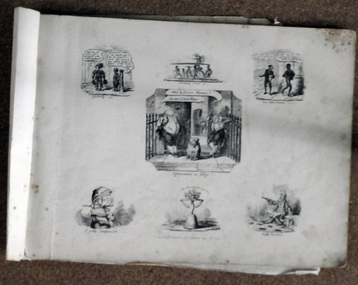
... George Cruikshank was inventive. In the 1800's, puns and other forms of word-play were loved by all. ...George Cruikshank was inventive. In the 1800's, puns and other forms of word-play were loved by all. ...George Cruikshank (27 September 1792 – 1 February 1878) was a British caricaturist and book illustrator.. His book illustrations for his friend Charles Dickens, and many other authors, reached an international audience. George Cruikshank was inventive. In the 1800's, puns and other forms of word-play were loved by all. Some of these illustrations come from his 'Scraps and Sketches' album, published for adults in 1832, though the drawings were done between 1828 and 1832. Volumes of George Cruikshank's Scraps and Sketches were intended to be cut and pasted in home-made albums and scrapbooks; George Cruikshank was a well-known British caricaturist and book illustrator. This item represents this popular art form of the early to mid 19th century. A collection of artworks (copies of etchings) of George Cruikshank. They are bound together with masking tape. The pages are dated 1828-1823. They are satirical cartoons printed in black ink. on front : "V BROOME with CANN RIVER crossed through ORBOST 78 PERRY ST 5154 2855" -
 City of Greater Bendigo - Civic Collection
Ceramic - Bendigo Pottery :: Australian Prime Minister Flask, Bendigo Pottery, Alfred Deakin, c 1975
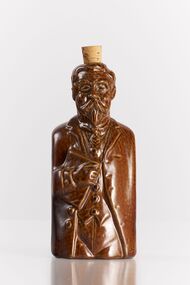
... The original reform flasks were English salt-glazed stoneware flasks produced in the early 19th century shaped into the form of figures connected with the Reform Bill of 1832. Much was made of puns like ‘the spirit of reform’ at the time. ...The original reform flasks were English salt-glazed stoneware flasks produced in the early 19th century shaped into the form of figures connected with the Reform Bill of 1832. Much was made of puns like ‘the spirit of reform’ at the time. ...Established by George Guthrie in 1857 (about 5km north of its current site) and then again seven years later in 1864 after it initially closed, Bendigo Pottery remains one of the most influential and longest running Pottery’s in Australia. Over the years the Pottery has contributed to the growth and development of the district through both its products including building products, table ware and decorative and commemorative war as well as artistically, being responsible for training and supporting many potters locally. The City of Greater Bendigo has had a long history of partnering with Bendigo Pottery and the Civic Collection holds a number of important items within its collection. This Alfred Deakin 'reform' flask was one of a limited edition character bottles produced by the Pottery to commemorate important figures in Australian politics. The original reform flasks were English salt-glazed stoneware flasks produced in the early 19th century shaped into the form of figures connected with the Reform Bill of 1832. Much was made of puns like ‘the spirit of reform’ at the time. Artist John Frith has taken the reform flask form as inspiration for a series of political ceramics of some Australian Prime Ministers. The series includes Edmund Barton, Alfred Deakin and Chris Watson. Glazed ceramic flask in the shape Alfred Deakin. Square shaped with most of the detail on the front facing side other than head which is more detailed. Cork still in place in top of head. On reverse of flask; Alfred Deakin / Prime Minister / of Australia / 1903 - 1904 / 1905 - 1908 / 1909 - 1910 Bendigo Pottery / LMTED / Edition Series / 101/200 /Australia Signed lower left; 'Frith' australian politics, bendigo pottery -
 Embroiderers Guild, Victoria
Accessory - Pair of Chinese Embroidered Sleeve Bands, 1880
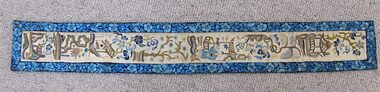
... Mouth organ (sheng): is a pun for giving birth or 'to rise' as in rising in rank....Mouth organ (sheng): is a pun for giving birth or 'to rise' as in rising in rank. ...Label attached to record card states "Chinese Embroidery from the Royal Palace, Pekin J.M.S." Chinese sleeve embroidery bands, or wanxiu became popular in the late 19th century during the Qing Dynasty, evolving from the traditional Han cuff embroidery and Manchu styles. These detachable, decorated bands were added to women's informal jackets and robes, often featuring symbolic motifs like landscapes, flowers, and auspicious symbols. They served both a decorative function, displaying artistic skill and personal wishes, and a practical one by covering the sleeves when hands were folded at the waist. History and evolution: Origins: The practice of embroidering cuffs on robes existed during the previous Ming Dynasty for Han women, and this was adopted by the Manchu rulers who founded the Qing Dynasty. Qing Dynasty (1644-1911): The practice was popularized and elaborated upon during this era, with detachable bands becoming a fashionable element for informal wear. Symbolism: The embroidery included a complex visual vocabulary of wishes for a long life, many offspring, and a happy marriage, derived from nature, mythology, and classical literature. Functionality: Women would fold their arms, often with their hands inside the sleeves, so the embroidered bands, which were sewn to hang down the back of the jacket, would be displayed prominently down the front. 19th century peak: The late 19th century was the peak of their popularity, with intricate designs becoming fashionable and even influenced by court tastes, such as those favoured by the Empress Dowager Cixi. Later developments: The late 19th century saw the introduction of chemical 'aniline' dyes from Europe, leading to brighter, bolder colours in embroidery. Motifs and their Meanings: Auspicious symbols: Designs often included symbols for good fortune, wealth, and longevity. Natural imagery: Birds, flowers, and landscapes were common motifs that could represent natural beauty or convey specific symbolic meanings. Figurative scenes: Bands could also feature narrative scenes from classical stories or legends. The choice of motifs allowed women to express personal desires, cultural values, and aesthetic preferences, reflecting a more personal and informal style than official court attire. Pagoda: an omen of good. Two birds (possibly swallows): an omen approaching spring and also of approaching success. Rooster: a symbol of high rank (it's comb/crown (jinguan) is a pun for 'official' guan). Peony: a symbol of wealth. Deer (lu): means wealth and prosperity. Willow: a symbol of spring (chun). Willows with apricot blossoms (xinghuo), willlows (liu) and swallows (yan) symbolizes 'may you attend the spring banquet in the apricot grove (xinglin chunyan), or may you become a successful candidate. Pine: longevity. Mouth organ (sheng): is a pun for giving birth or 'to rise' as in rising in rank. Meaning : this pair of sleeve bands may have been wishing the owner of them good luck, success in an upcoming exam and that he may rapidly rise in rank, live a long life and continue to receive an official salary. Information from 'Hidden Meaning in Chinese Art' Terese Tse Bartholomew Fine white satin edged in shades oft blue silk flower embroidery. A fine example of Pekin knot stitch outlined with gold thread showing traditional Chinese motifs and figures. From bottom to top there is an outdoor scene with water and a building. Above this are flowers, hills, a rock formation, a pine and an animal (? pig or deer). Another building, blossoms and pine trees and a pot containing a cypress tree. Above the tree there is a male figure holding a bamboo pipe in one hand and a bird in the other. Further buildings follow, with a willow tree and two swallows flying. embroidery, garments, silk embroidery, late 19th century, china, trees, animals, pagoda -
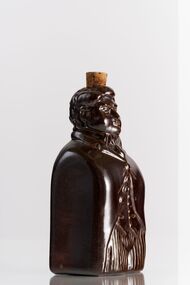 City of Greater Bendigo - Civic Collection
Ceramic - Bendigo Pottery :: Australian Prime Minister Flask, Bendigo Pottery, Sir Edmund Barton, c 1975
... Reform flasks were English salt-glazed stoneware flasks produced in the early 19th century shaped into the form of figures connected with the Reform Bill of 1832. Much was made of puns like ‘the spirit of reform’ at the time. ...Reform flasks were English salt-glazed stoneware flasks produced in the early 19th century shaped into the form of figures connected with the Reform Bill of 1832. Much was made of puns like ‘the spirit of reform’ at the time. ...Established by George Guthrie in 1857 (about 5km north of its current site) and then again seven years later in 1864 after it initially closed, Bendigo Pottery remains one of the most influential and longest running Pottery’s in Australia. Over the years the Pottery has contributed to the growth and development of the district through both its products including building products, table ware and decorative and commemorative war as well as artistically, being responsible for training and supporting many potters locally. The City of Greater Bendigo has had a long history of partnering with Bendigo Pottery and the Civic Collection holds a number of important items within its collection. This Sir Edmund Barton 'reform' flask was one of a limited edition character bottles produced by the Pottery to commemorate his contribution to Australian politics. Edmund Barton became Australia’s first Prime Minister on New Year’s Day 1901, at a huge public ceremony in Centennial Park in Sydney. Reform flasks were English salt-glazed stoneware flasks produced in the early 19th century shaped into the form of figures connected with the Reform Bill of 1832. Much was made of puns like ‘the spirit of reform’ at the time. Artist John Frith has taken the reform flask form as inspiration for a series of political ceramics of some Australian Prime Ministers. The series includes Edmund Barton, Alfred Deakin and Chris Watson. Glazed ceramic flask in the shape of Sir Edmund Barton. Square shaped with most of the detail on the front facing side other than head which is more detailed. Cork still in place in top of head. On reverse of flask; Sir Edmund / Barton / Prime Minister / of Australia / 1901 to 1908 Bendigo Pottery / LMTED / Edition Series / 110/1200 /Australia Signed lower centre; 'Frith' australian politics, bendigo pottery -
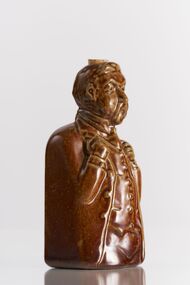 City of Greater Bendigo - Civic Collection
Ceramic - Bendigo Pottery :: Australian Prime Minister Flask, Bendigo Pottery, John C Watson, c 1975
... The original reform flasks were English salt-glazed stoneware flasks produced in the early 19th century shaped into the form of figures connected with the Reform Bill of 1832. Much was made of puns like ‘the spirit of reform’ at the time. ...The original reform flasks were English salt-glazed stoneware flasks produced in the early 19th century shaped into the form of figures connected with the Reform Bill of 1832. Much was made of puns like ‘the spirit of reform’ at the time. ...Established by George Guthrie in 1857 (about 5km north of its current site) and then again seven years later in 1864 after it initially closed, Bendigo Pottery remains one of the most influential and longest running Pottery’s in Australia. Over the years the Pottery has contributed to the growth and development of the district through both its products including building products, table ware and decorative and commemorative war as well as artistically, being responsible for training and supporting many potters locally. The City of Greater Bendigo has had a long history of partnering with Bendigo Pottery and the Civic Collection holds a number of important items within its collection. This John C Watson (Chris Watson) 'reform' flask was one of a limited edition character bottles produced by the Pottery to commemorate important figures in Australian politics. He was the first Labour Prime Minister elected forming a minority government in April 1904, aged 37, after the ALP withdrew its support from Deakin. He was one of the first socialists to head a government in a parliamentary system, attracting international attention, and remains Australia's youngest prime minister. After less than four months in office, the Watson government lost a confidence motion and Watson was succeeded as prime minister by anti-socialist George Reid. The original reform flasks were English salt-glazed stoneware flasks produced in the early 19th century shaped into the form of figures connected with the Reform Bill of 1832. Much was made of puns like ‘the spirit of reform’ at the time. Artist John Frith has taken the reform flask form as inspiration for a series of political ceramics of some Australian Prime Ministers. The series included Edmund Barton, Alfred Deakin and Watson. Glazed ceramic flask in the shape John Watson. Square shaped with most of the detail on the front facing side other than head which is more detailed. Cork still in place in top of head. On reverse of flask; John C Watson / Prime Minister / of Australia / 27.4.1904 / To / 18 .08. 1904 Bendigo Pottery / LMTED / Edition Series / 55/1200 /Australia Signed lower centre; 'Frith' australian politics, bendigo pottery -
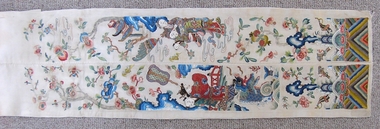 Embroiderers Guild, Victoria
Accessory - Pair of Chinese Embroidered Sleeve Bands, 19 th C
... Bats - the work for bat is 'fu' and is a visual pun for the word happiness 'fu'. Rhino horn - wealth and good fortune. ...Bats - the work for bat is 'fu' and is a visual pun for the word happiness 'fu'. Rhino horn - wealth and good fortune. ...Chinese sleeve embroidery bands, or wanxiu became popular in the late 19th century during the Qing Dynasty, evolving from the traditional Han cuff embroidery and Manchu styles. These detachable, decorated bands were added to women's informal jackets and robes, often featuring symbolic motifs like landscapes, flowers, and auspicious symbols. They served both a decorative function, displaying artistic skill and personal wishes, and a practical one by covering the sleeves when hands were folded at the waist. History and evolution: Origins: The practice of embroidering cuffs on robes existed during the previous Ming Dynasty for Han women, and this was adopted by the Manchu rulers who founded the Qing Dynasty. Qing Dynasty (1644-1911): The practice was popularized and elaborated upon during this era, with detachable bands becoming a fashionable element for informal wear. Symbolism: The embroidery included a complex visual vocabulary of wishes for a long life, many offspring, and a happy marriage, derived from nature, mythology, and classical literature. Functionality: Women would fold their arms, often with their hands inside the sleeves, so the embroidered bands, which were sewn to hang down the back of the jacket, would be displayed prominently down the front. 19th century peak: The late 19th century was the peak of their popularity, with intricate designs becoming fashionable and even influenced by court tastes, such as those favoured by the Empress Dowager Cixi. Later developments: The late 19th century saw the introduction of chemical 'aniline' dyes from Europe, leading to brighter, bolder colours in embroidery. Motifs and their Meanings: Auspicious symbols: Designs often included symbols for good fortune, wealth, and longevity. Natural imagery: Birds, flowers, and landscapes were common motifs that could represent natural beauty or convey specific symbolic meanings. Figurative scenes: Bands could also feature narrative scenes from classical stories or legends. The choice of motifs allowed women to express personal desires, cultural values, and aesthetic preferences, reflecting a more personal and informal style than official court attire. Symbolism: Mountains and sea, clouds and waves - Good luck. Dragon/fish tail/flaming pearl = Good fortune. This refers to the legend 'liyutiaolongmen' - a carp rising from the waves with the head already changed into a dragon implies the wish for success in the civil service examination. It is an allegory for the persistent effort needed to overcome obstacles. Male with black hat - Zhuang Yuan conferred. Among patterns with implied meanings , patterns related to the pursuits of scholarly honour and official rand include mainly the 'three number ones'. 'Zheng Yuan conferred' and 'carp jumping over the dragon gate'. In feudal society, examiners for the official positions had to go through three different levels of examinations. Bats - the work for bat is 'fu' and is a visual pun for the word happiness 'fu'. Rhino horn - wealth and good fortune. The ruyi sceptre - is a curved decorative Chinese object that symbolizes power, good fortune, and the wish that “things go as you desire.” The head of the sceptre resembles the 'lingzhi' of the 'longevity fungus'. Pomegranate - fertility ie; offspring, a virtue in China. Boy holding the flowering branch in the arms of the woman - in the selection of officials through imperial examinations in feudal society, the winner of an official position is described as ' having picked the crown'. 'Gui' (sweet scented osmanthus) and 'gui' (high rank or official) are very close in sound Chinese. In this design the boy in the woman's arms is seen waving a sweet scented osmanthus, thus an auspicious message is delivered. Information from Dr Rachel Silberstein, visiting Associate Professor at Rhode Island School of Design. "This pair of sleeve bands are two halves of a scene known as "tian xian song zi" or "Heavenly immortals deliver a son". The historical origins of this saying is a story from 'The History of the Wei Imperial records', involving the Emperor Sheng and an immortal maiden who presents him with a son. After this, the expression "tian xian song zi" came to be used as good wishes for marriage, closely associated with 'qilin song zi' (the qilin delivers a son), another popular topic in nianhua popular prints". Both cuffs show figures in an outdoor setting, done in colourful silk thread on a ivory satin. Reading from the bottom to the top of the cuff both have pointed mountains, clouds and sea with a rhino horn and a 'rui' coming out of the waves. Left cuff: above the sea there are a fish/dragon and a flaming pearl. Next two male figures standing on a bridge. One holds a fan and the other is wearing a black hat. More flowers, peonies and blossoms are above the figures. Right cuff: Above the water and mountains is a bat, peonies and pomegranates. Above these are three figures and another bat. The figure in there rear holds a feathered fan, while the front figure holds a child, who is holding a flowering branch. Above the trio is a low pagoda and blossoms. Silk satin stitch, Pekin knots and couched gold metal thread. embroidery, garments, silk embroidery, china, landscape, garden, figures -
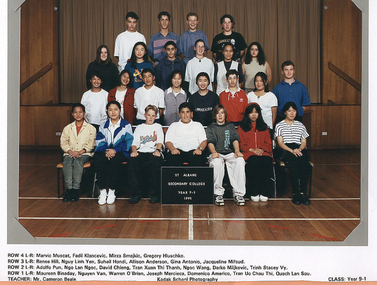 Sunshine and District Historical Society Incorporated
Photograph - St. Albans Secondary College 1995 Class Photographs
... Albans Secondary College 1995 Year 9-1.jpg Row 4: Marvic Muscat, Fadil Klancevis, Mirza Smajki, Gregory Hluschko Row 3: Renee Hill, Nguy Linh Yen, Suhail Hondi, Allison Anderson, Gina Antonio, Jacqueline Mifsud Row 2: Adolfo Pun, Ngo Lan Ngoc, David Chieng, Tran Xuan Thi Thanhm Ngoc Wang, Darko Miljkovic, Trinh Stacey Vy Row 1: Maureen Binadat, Nguyen Van, Warren O'Brien, Joseph Mercieca, Domenico Americo, Tran Uc Chau Thi, Quach lan Sou Teacher: Mr. ...Albans Secondary College 1995 Year 9-1.jpg Row 4: Marvic Muscat, Fadil Klancevis, Mirza Smajki, Gregory Hluschko Row 3: Renee Hill, Nguy Linh Yen, Suhail Hondi, Allison Anderson, Gina Antonio, Jacqueline Mifsud Row 2: Adolfo Pun, Ngo Lan Ngoc, David Chieng, Tran Xuan Thi Thanhm Ngoc Wang, Darko Miljkovic, Trinh Stacey Vy Row 1: Maureen Binadat, Nguyen Van, Warren O'Brien, Joseph Mercieca, Domenico Americo, Tran Uc Chau Thi, Quach lan Sou Teacher: Mr. ...The St. Albans High School opened in 1956 and changed its name to St. Albans Secondary College in 1990 5534.01 - St. Albans Secondary College 1995 Year 9-1.jpg Row 4: Marvic Muscat, Fadil Klancevis, Mirza Smajki, Gregory Hluschko Row 3: Renee Hill, Nguy Linh Yen, Suhail Hondi, Allison Anderson, Gina Antonio, Jacqueline Mifsud Row 2: Adolfo Pun, Ngo Lan Ngoc, David Chieng, Tran Xuan Thi Thanhm Ngoc Wang, Darko Miljkovic, Trinh Stacey Vy Row 1: Maureen Binadat, Nguyen Van, Warren O'Brien, Joseph Mercieca, Domenico Americo, Tran Uc Chau Thi, Quach lan Sou Teacher: Mr. Cameron Beale 5534.02 - St. Albans Secondary College 1995 Year 9-2.jpg Row 4: Paul Cachia, Ken Maynard, Troy Caldwell, Yusuf Belik, Jeffrey Lim Row 3: Sophie Xenos, Stella Balaban, Tania Briffa, Lucas Papacharalambous, Nada Karaman, Le Hang Tran, Sandy D'Silva Row 2: Resmije Demiri, Sandra Gatt, Stephanie Leung, Jesmond Psaila, Ninna Cikoja, Jasmin Winzar, Inaas Abdallah Row 1: Vilakone Saenghet, Rachel Klier, Paul Spiteri, Duy Ho, Thang Truong, Michelle Sciberras, Anna Abela Teacher: Mr. Robert Lai 5534.03 - St. Albans Secondary College 1995 Year 9-3.jpg Row 4: Amir Saad, Gezim Alimovski, Adis Kablar, Huseyin Yiahayia, Maurice Rivas-Sayes Row 3: Natalie Kolendowska, Son Thai Nguyen, Isaa Dias, Ranko Vujkovic, An Hoang Ho, Mira Mihajlov Row 2: Fiona Sculli, Urime Miftari, Paul Micallef, Can Tran, Melanie Kusznir, Thanh Vo, Hau Thanh Nguyen Row 1: Marijanco Petkowski, Belinda Wright, Becky Van, Nicolina Kondoska, ly lu, Oanh Lam, hung Minh Ngo Teacher: Ms. Simeon Absent: Ksana Kowanjko 5534.04 - St. Albans Secondary College 1995 Year 9-4.jpg Row 4: Peter Kolevski, Adam O'Flynn, Zani saliu, Dylon Brytcz, Josip Kasalo Row 3: Michelle Schreyer, Simone Winzar, Sandra Petokovic, Elena Pavicevic, Allison Bacchetti Row 2: Marlene Pace, Stephanie Koutroupis, Melissa Hardimann, Sanah Ovbian, Faustina Surrao, Kristina Zelko Row 1: David Kent, Marco Theodorou, Arzu Gunceler, Burim Rushanovski, Valentine Petrovska, Joe Hai Tran, Mathew Eberle Teacher: Surjeet Singh 5534.05 - St. Albans Secondary College 1995 Year 9-5.jpg Row 4: Sako Nikolic, Miguel Bobadilla, Michael Ilic, Leslie Kretzschmar, Vu Nguyen Row 3: Thuy Tran, Cuong Truong, Lan Tran, Diana Razmovska, Vashna Lai, Muc Nguyen, Melissa Pisani Row 2: Jenny Nguyen, Janette Jack, Cemaliye Ahmet, Fred Phillips, Ebru Osman, Samantha Renda, Kacey Nguyen Row 1: Loan Le, Kieu Le, Nhut Huynh, Shane Willie, Liem Tran, Michelle Mallia, Frances Sciberras Teacher: Ms. P. Kemohan 5534.06 - St. Albans Secondary College 1995 Year 9-6.jpg Row 4: Christopher Srokowoski, James Burt, Agime Eminovski, Arturo Rojas, David Modric Row 3: Tina Kuzmanovska, Kerime Gun, Sandra Milunovic, Elizabeth Marjanovic, Trang Tran, Lindita Rustemovska Row 2: Diana Srbinovski, Ann Tieu, Natasha Mancevska, Thien Nguyen, Yelly Meulenbrock, Tamara Chan, Betty Filipovska Row 1: Ngoc Truong, Phuong Pham, Hiew Nguyen, Christian Robas, Tuan Phan, Ruth Farrugia, Samantha Webb Teacher: Mr. V. Nguyen 5534.07 - St. Albans Secondary College 1995 Year 9-7.jpg Row 4: Jasmin Alisic, Brendan Turner, Laurence Garcia, Mirza Crnojevic, Bang Quach Row 3: Hong Vuong, Marina Kovacic, Maria Budimir, Mari Jankulovska, Gabriela Avram Row 2: Aaron Locke, Lidia Kostantinovic, Tu Dong Anh Le, Steven Veljanovski, Hussein Hussein, Anita Grasic Row 1: Be Tran, Bart Klek, Anil Mustafa, Phuoc Chi Phan, Trang Nguyen, Shain Spiteri, Kim Tran Teacher: Mr. Peter Sinclair 5534.08 - St. Albans Secondary College 1995 Year 10-4.jpg Row 4: Robert Gacovski, Anthony Johnstone, Paul Beska Row 3: Rachel Calleja, Thai Tao, Morris Siespinski, Ante gospic, Rebecca Lutze Row 2: Van Bui, Dafina Kojdovska, Jason Lai, Anh Vo, Vanessa Catania Row 1: Ronna Ramos, Michelle Gatt, Joanne Mac, Karolina Jovanoski, Svetlana Micevska, Trang Nguyen, Ngan Ngo Teacher: Ms. Laura Gough 5534.09 - St. Albans Secondary College 1995 Year 12.jpg Many of the names have been cropped out st. albans high school, main road east, st. albans, st. albans secondary college -
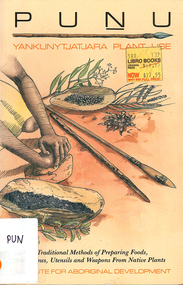 Victorian Aboriginal Corporation for Languages
Book, Pun?u : Yankunytjatjara plant use : traditional methods of preparing foods, medicines, utensils and weapons from native plants, 1988
... Pun?u : Yankunytjatjara plant use : traditional methods of preparing foods, medicines, utensils and weapons from native plants...Includes general and linguistic introduction, and extensive glossaries of botanical names, plant parts, processes etc, all Yankunytjatjara and English (and Latin as appropriate) Pun?u : Yankunytjatjara plant use : traditional methods of preparing foods, medicines, utensils and weapons from native plants Book Cliff Goddard Arpad Kalotas ...Encyclopedia style entries for 27 plants with standard scientific description plus description, science and stories in Yankunytjatjara with translations. Includes general and linguistic introduction, and extensive glossaries of botanical names, plant parts, processes etc, all Yankunytjatjara and English (and Latin as appropriate) B&w illustrations, colour illustrations, word lists climate, landforms, vegetation, vegetable food (mai), fruits, seeds, roots, greens, galls, fungi, nectars, sweet secretions, gums, medicinal plants (punu ngangkari), language, stories, plant use, trees, shrubs, subshrubs, grasses, vines, succulents, mistletoes, plant parts, habitat, plant processing, yankunytjatjara, central australia
