
Showing 15 items matching " puritans"
-
 Flagstaff Hill Maritime Museum and Village
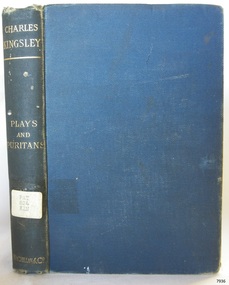
Book - Reference Book/Historical/Sociology/Research, Charles Kingsley, Plays and Puritans and other Historical Essays, 1873
... Plays and Puritans and other Historical Essays...London is regarded as the first edition of “Plays and Puritans and Other Historical Essays”, by Kingsley. ...Plays and Puritans and other Historical Essays Author: Charles Kingsley Publisher: MacMillan & Co Date: 1873, Light Blue to cloth cardboard covers darker Blue to the spine the spine has title embossed in gold lettering. ...London is regarded as the first edition of “Plays and Puritans and Other Historical Essays”, by Kingsley. ...Plays and Puritans and Other Historical Essays by Charles Kingsley is a collection of cultural and historical meditations, centred on the relationship between Puritanism and the English stage, especially in the 16th and 17th centuries, along with broader reflections on art, morality, and national identity in Victorian‑era Britain.Plays and Puritans and other Historical Essays Author: Charles Kingsley Publisher: MacMillan & Co Date: 1873, Light Blue to cloth cardboard covers darker Blue to the spine the spine has title embossed in gold lettering. non-fictionPlays and Puritans and Other Historical Essays by Charles Kingsley is a collection of cultural and historical meditations, centred on the relationship between Puritanism and the English stage, especially in the 16th and 17th centuries, along with broader reflections on art, morality, and national identity in Victorian‑era Britain. warrnambool, shipwrecked-coast, flagstaff-hill, flagstaff-hill-maritime-museum, maritime-museum, shipwreck-coast, flagstaff-hill-maritime-village, shipwrecked-artefact, book, pattison collection, warrnambool library, warrnambool mechanics’ institute, ralph eric pattison, corangamite regional library service, warrnambool city librarian, mechanics’ institute library, victorian library board, warrnambool books and records, warrnambool children’s library, great ocean road, plays and puritans and other historical essays, charles kingsley -
 Linton Mechanics Institute and Free Library Collection
Book - Novel, Bates, Arlo, The Puritans by Arlo Bates
... The Puritans by Arlo Bates...Text, front cover: ' The Puritans / Constable's Indian & Colonial Library...The Puritans by Arlo Bates Book Novel Bates, Arlo Archibald Constable & Co. ...Hardcover book with a red cover and black printed text. 425 pages.fictionarlo bates, fiction -
 Tennis Australia
Attire, Personal items, Circa 1975
... A Puritan 'Chrissie Evert' sleeveless tennis dress with original shop tags. ...Tennis A Puritan 'Chrissie Evert' sleeveless tennis dress with original shop tags. ...A Puritan 'Chrissie Evert' sleeveless tennis dress with original shop tags. Materials: Cotton, Plastictennis -
Glenelg Shire Council Cultural Collection
Book, Rose Hartwick Thorpe, Curfew Must Not Ring Tonight, 1867
... ... puritans...Thorpe was 16 yearls old when she wrote the poem. poem narrative puritans civil war The story involves Bessie, a young woman whose lover, Basil Underwood, has been arrested, thrown in prison by the Puritans and sentenced to die that night when the curfew bell rings. ...The story involves Bessie, a young woman whose lover, Basil Underwood, has been arrested, thrown in prison by the Puritans and sentenced to die that night when the curfew bell rings. Knowing that Oliver Cromwell will be late in arriving, the young woman begs the old sexton to prevent the ringing of the curfew bell. When he refuses, she climbs to the top of the bell tower and heroically risks her life by manually stopping the bell from ringing. Cromwell hears of her deed and is so moved that he issues a pardon for Underwood.Illustrated book with carboard cover. Front cover has a central colour illustration of a church, a bell and a fir tree bough. 28 pp. Gilt edges to pages.The story involves Bessie, a young woman whose lover, Basil Underwood, has been arrested, thrown in prison by the Puritans and sentenced to die that night when the curfew bell rings. Knowing that Oliver Cromwell will be late in arriving, the young woman begs the old sexton to prevent the ringing of the curfew bell. When he refuses, she climbs to the top of the bell tower and heroically risks her life by manually stopping the bell from ringing. Cromwell hears of her deed and is so moved that he issues a pardon for Underwood.poem, narrative, puritans, civil war -
 Wodonga & District Historical Society Inc
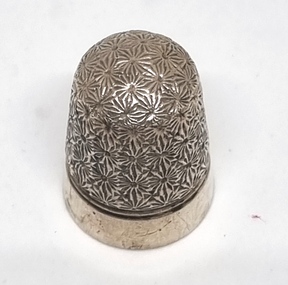
Domestic object - Silver Filigree Thimble
... Popular history also suggests that roots of the modern-day wedding ring in America had an interesting tie to a thimble. Puritans that colonized in early America did not believe in adornment. ...Popular history also suggests that roots of the modern-day wedding ring in America had an interesting tie to a thimble. Puritans that colonized in early America did not believe in adornment. ...This item is from a collection donated by descendants of John Francis Turner of Wodonga. Thimbles were used for both practical and decorative purposes and were created in a range of styles. Popular history also suggests that roots of the modern-day wedding ring in America had an interesting tie to a thimble. Puritans that colonized in early America did not believe in adornment. A common practice among these early Americans was for a man to present a thimble to his fiancée which was symbolic of his wish to marry her. These brides began to cut off the rim on these thimbles and making a simple band they would wear on their finger. Thus, the practice of wedding rings for women started.This item comes from a collection used by a prominent citizen of Wodonga. It is also representative of a domestic item common in the 1930s.A silver thimble decorated with filigree work above a solid bottom section.domestic items, filigree thimble, womens social history, women's work -
 Flagstaff Hill Maritime Museum and Village
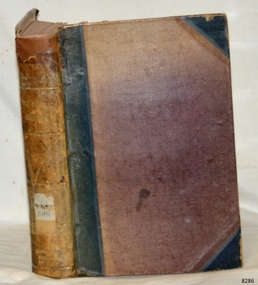
Book - Literary Work, John Bunyan, The Pilgrims Progress, 1850
... The author, John Bunyan (1628–1688), was an English writer and Puritan lay preacher born in Elstow, Bedfordshire. ...The author, John Bunyan (1628–1688), was an English writer and Puritan lay preacher born in Elstow, Bedfordshire. ...Written in 1678, The Pilgrim's Progress is a deeply influential Christian allegory that tracks the spiritual journey of a man named Christian. Weighed down by a crushing burden on his back (representing his sins), Christian flees his home in the "City of Destruction", after reading a holy book. Guided by the evangelist Evangelist, he embarks on a perilous trek toward the Celestial City (Heaven). Along the way, his journey brings him face-to-face with a cast of characters who personify spiritual triumphs and trials, such as Faithful, Hopeful, Mr Worldly Wiseman, and Giant Despair. He must navigate legendary, treacherous obstacles like the Slough of Despond, the temptations of Vanity Fair, and a terrifying battle with the demon Apollyon. The narrative is structured as a dream sequence experienced by the narrator. Because the second half follows Christian's wife, Christiana, and their children on the same path, it functions as both an adventure tale and a road map for the Puritan concept of salvation. It should be noted that the 1850 George Virtue printing is a classic example of a mid-Victorian luxury reprint. It is highly notable because it was curated by the popular non-conformist minister and author Rev. Robert Philip.The Pilgrims Progress Author: John Bunyan Curated By: Rev. Robert Philip Publisher: George Virtue Date: 1850 Further Information: Red hardcover with a red spine and reinforced corners, lettering in gilt. The spine has a Library label with an inscription.fictionWritten in 1678, The Pilgrim's Progress is a deeply influential Christian allegory that tracks the spiritual journey of a man named Christian. Weighed down by a crushing burden on his back (representing his sins), Christian flees his home in the "City of Destruction", after reading a holy book. Guided by the evangelist Evangelist, he embarks on a perilous trek toward the Celestial City (Heaven). Along the way, his journey brings him face-to-face with a cast of characters who personify spiritual triumphs and trials, such as Faithful, Hopeful, Mr Worldly Wiseman, and Giant Despair. He must navigate legendary, treacherous obstacles like the Slough of Despond, the temptations of Vanity Fair, and a terrifying battle with the demon Apollyon. The narrative is structured as a dream sequence experienced by the narrator. Because the second half follows Christian's wife, Christiana, and their children on the same path, it functions as both an adventure tale and a road map for the Puritan concept of salvation. It should be noted that the 1850 George Virtue printing is a classic example of a mid-Victorian luxury reprint. It is highly notable because it was curated by the popular non-conformist minister and author Rev. Robert Philip. flagstaff hill, warrnambool, shipwrecked coast, flagstaff hill maritime museum, maritime museum, shipwreck coast, flagstaff hill maritime village, great ocean road, book, pattison collection, warrnambool library, warrnambool mechanics’ institute, ralph eric pattison, corangamite regional library service, warrnambool city librarian, mechanics’ institute library, victorian library board, warrnambool books and records, warrnambool children’s library, the pilgrims progress, john bunyan -
 Federation University Historical Collection
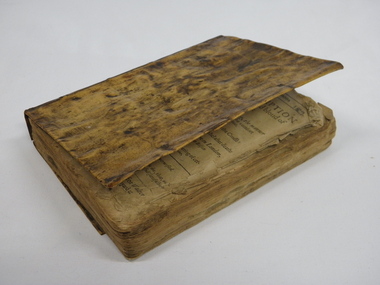
Book, Touching the Full Redemption of Mankind by the Death and Blood of Christ Jesus (human skin cover), 1599
... ...puritans...Findings prove the book is covered with human skin, increasing the rarity of the object. religion bible edward lowe edward lotos thomas bilson anthropodermic bibliopegy james hendy full redemption religious leather wilson winchester jesus puritanical puritans bungey bilson human skin skin human skin cover human skin binding Inside cover - James Hendy No 17 (Fu)gends Road Palmers Village Westminster. ...Anthropodermic Bibliopegy is the name given to the use of human leather to bind books. The name stems from the combination of the Greek root words, human (Anthropos), skin (derma), book (biblion), and fasten (pegia). The practice of creating anthropodermic books was popular throughout the 17th and 18th centuries. Most commonly, anthropodermic books are medical tomes, with the human leather taken from medical cadavers. Others were produced after criminal trials, with the criminal’s skin used to enclose the record of their own death sentences, creating a form of punishment that would surpass death. Other anthropodermic books contain poems or are religious texts. This book was written and printed in 1599 but most probably was rebound later when creation of anthropodermic books became more predominant. The book is a small tome of a religious nature containing the work of Bishop Thomas Bilson, who in a puritanical voice states that the primary argument articulated in this book is that “the metaphorical Calvinist interpretation of Hell as an exclusion from God was accurate then Christ's descent into hell after his crucifixion must refer to an actual existent hell as Christ was neither subject to sin nor able to be separated from the Divine.” The unusual cover of the book has led to many questions, the main being whether the book is covered with human skin. It was confirmed as such in 2014 with DNA testing undertaken by honours student Talanna Buckley at Federation University finding an 100% match to human DNA on the outside cover of the book. This is one of only two confirmed anthropodermic books in Australia, the other is housed at the National Library of Australia. Other forms of testing the leather of books have been found to be more accurate than DNA testing. For example, before DNA testing or PMF (Peptide Mass Fingerprinting) are undertaken many books have been identified as made from human skin through the close examination of the skins patterning. Hair follicles are the focus of the examination as certain patterns and sizes lend themselves to being human. However, many of these books have been proven to not be bound in human skin, the same can be said of books with inscriptions claiming them as anthropodermic. Peptide Mass Fingerprinting (PMF) testing has been found to be the most reliable way of confirming a leather bindings origin. This process involves the sampling of collagen-based materials, cutting the protein to gain specific amino acid combinations which form individual peptide sequences. Each mammal has an individual amino acid sequence in its collagen therefore its peptide mass combination is unique. This form of test can provide a more accurate outcome as collagen will be preserved for longer after the tanning process and will not be damaged in the same way DNA can be by the tanning process. DNA testing can also provide false positives as trace DNA from someone touching the book could be amplified and provide the reading instead of that of the leather itself. However, this book was tested with many controls as well as specific decontamination procedures in order to ensure that it was not trace DNA being tested. This book is historically and spiritually significant because it is a rare example of an early printed English Christian religious tract produced in Old English and Latin.. Its association with Thomas Bilson, who oversaw the final printing and publication of the King James Bible, is important. The covering of this book has been tested for human dna. Findings prove the book is covered with human skin, increasing the rarity of the object.420 page book with unusual leather cover. The book is written in Old English with passages in latin. There is a pressed petal between p.68 and 69. The covering of this book is made of human skin. The practice of binding books in human skin, also known as anthropodermic bibliopegy.Inside cover - James Hendy No 17 (Fu)gends Road Palmers Village Westminster. The gift of his mother Mrs Thomas Hendy. Some notes made through text eg p.112, and a passage written on the last page.religion, bible, edward lowe, edward lotos, thomas bilson, anthropodermic bibliopegy, james hendy, full redemption, religious, leather, wilson, winchester, jesus, puritanical, puritans, bungey, bilson, human skin, skin, human skin cover, human skin binding -
 Flagstaff Hill Maritime Museum and Village
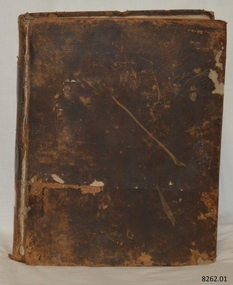
Book - Reference Bible, Matthew Henry, An Exposition of The Old and New Testament Vol 1, 1790
... It represents a major effort of pastoral exegesis in the late Puritan/early Evangelical era and has had a long-lasting impact on English-speaking biblical interpretation. ...The subject volume one is part of a six-volume set. It is a verse-by-verse or section-by-section commentary on the Bible, and the aim of the volumes is to explain the text of the Bible. In volume one, it concentrates on explaining Genesis through to Deuteronomy, with practical applications and theological reflections. Henry’s aim was to illuminate Scripture for lay readers and ministers, emphasising practical piety and sound doctrine. The work is characteristic for its devotional tone combined with doctrinal notes.An Exposition of The Old and New Testament Vol 1 Author: Matthew Henry Publisher: Bell and Bradfute, Dickson and M'Cleish Date: 1790 Further Information: Badly worn brown hardcover and spine. The spine has a Library label with an inscription. non-fictionThe subject volume one is part of a six-volume set. It is a verse-by-verse or section-by-section commentary on the Bible, and the aim of the volumes is to explain the text of the Bible. In volume one, it concentrates on explaining Genesis through to Deuteronomy, with practical applications and theological reflections. Henry’s aim was to illuminate Scripture for lay readers and ministers, emphasising practical piety and sound doctrine. The work is characteristic for its devotional tone combined with doctrinal notes.flagstaff hill, warrnambool, shipwrecked coast, flagstaff hill maritime museum, maritime museum, shipwreck coast, flagstaff hill maritime village, great ocean road, book, pattison collection, warrnambool library, warrnambool mechanics’ institute, ralph eric pattison, corangamite regional library service, warrnambool city librarian, mechanics’ institute library, victorian library board, warrnambool books and records, warrnambool children’s library, matthew henry, an exposition of the old and new testament vol 1, bell and bradfute, dickson and m'cleish -
 Warrnambool and District Historical Society Inc.
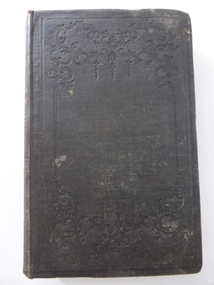
Book, Work of the English Puritan Divines - M Henry, Early 1840s
... Work of the English Puritan Divines - M Henry...Work of the English Puritan Divines - M Henry Book Thomas Nelson ...This book was given in 1847 to E. Callender by an unknown person (‘C.E –‘). There is a reference in the Warrnambool Examiner newspaper to an Adam Callander, a Port Fairy baker whose wife Alice committed suicide in 1870 and, more importantly, a reference to a Miss Callender arriving as a ship passenger to Warrnambool in July 1854. There is a record of Eliza Callender marrying Peter McFarlane in 1858. The book may have been a New Years’ Day present or a birthday present or a presentation to someone leaving England to migrate to Australia. This book is kept because of its inscription and its early date (1847 – some months before Warrnambool was founded). Further research may reveal the extent of the book’s significance. This is hard cover book of 320 pages. The cover is dark brown with embossed scrolls on the front cover and gold lettering on the spine. The book has eight chapters, including a biography of the author, Matthew Henry, and two black and white sketches. On the first page is the stamp of the Warrnambool and District Historical Society. The inscription is handwritten in black ink. The cover is slightly stained.‘To E. Callender with kind love from C.E- (the last letter is not clear – it could be an ‘E’ or a ‘D’ or merely a decorative flourish) ‘1st January 1847’ e. callender, warrnambool, work of the english puritans divine -
 Mrs Aeneas Gunn Memorial Library
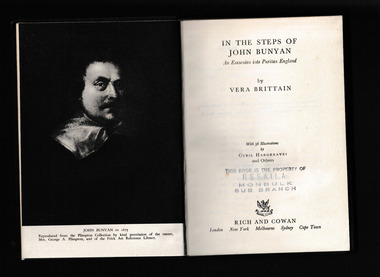
Book, Rich and Cowan et al, In the steps of John Bunyan : an excursion into Puritan England, 1950
... In the steps of John Bunyan : an excursion into Puritan England...Puritan England Pilgrims progress A biography of John Bunyan Ill, maps, p.440. ...A biography of John BunyanIll, maps, p.440.non-fictionA biography of John Bunyanpuritan england, pilgrims progress -
 Flagstaff Hill Maritime Museum and Village
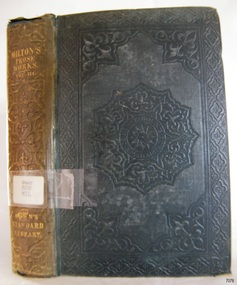
Book - Commentary Essays, John Milton, The Prose Works of John Milton Vol 3, 1848
... The contents include The Likeliest Means to Remove Hirelings out of the Church; Animadversions upon the Remonstrants' Defence against Smectymnuus; and Apology for Smectymnuus, Milton's final anti-prelatical tract (1642), defending the Puritan pamphleteers writing under the collective pen-name "Smectymnuus" against Bishop Joseph Hall, and defending his own personal integrity as a polemicist. ...The Prose Works of John Milton, Volume 3 is part of a five-volume set issued by London publisher Henry G. Bohn beginning in 1848, as part of his well-known "Bohn's Standard Library" series of affordable classics. Volume 3 is the volume centred on Milton's ecclesiastical, educational, and domestic-life tracts, quite distinct from Volume 1 and its regicide/republic defences and Volume 2's church-government and press-freedom writings. The contents include The Likeliest Means to Remove Hirelings out of the Church; Animadversions upon the Remonstrants' Defence against Smectymnuus; and Apology for Smectymnuus, Milton's final anti-prelatical tract (1642), defending the Puritan pamphleteers writing under the collective pen-name "Smectymnuus" against Bishop Joseph Hall, and defending his own personal integrity as a polemicist. Also included is The Doctrine and Discipline of Divorce, Milton's controversial 1643 tract arguing, on scriptural grounds, for the lawfulness of divorce on grounds of incompatibility, written not long after his own troubled first marriage. There are further divorce tracts within this volume, as it continues the argument of the Doctrine and Discipline. The volume also includes a Tractate on Education, Milton's short treatise on his ideas for educational reform, and A Declaration for the Election of John III, King of Poland. Therefore, Volume 3 collects Milton's writings on church reform, personal and religious controversy, divorce law, and education — the more personal and doctrinal side of his prose output, as opposed to the state-political defences in VolumeHard cover book: The Prose Works of John Milton Vol 3 Author: John Milton Editor: James Augustus St. John Publisher: Henry G Bohn Date: 1848 Further Information: Blue leather hardcover with brown spine covers and spine embossed lettering to spine in gilt, portrait frontispiece. The spine has a Library label with an inscription.non-fictionThe Prose Works of John Milton, Volume 3 is part of a five-volume set issued by London publisher Henry G. Bohn beginning in 1848, as part of his well-known "Bohn's Standard Library" series of affordable classics. Volume 3 is the volume centred on Milton's ecclesiastical, educational, and domestic-life tracts, quite distinct from Volume 1 and its regicide/republic defences and Volume 2's church-government and press-freedom writings. The contents include The Likeliest Means to Remove Hirelings out of the Church; Animadversions upon the Remonstrants' Defence against Smectymnuus; and Apology for Smectymnuus, Milton's final anti-prelatical tract (1642), defending the Puritan pamphleteers writing under the collective pen-name "Smectymnuus" against Bishop Joseph Hall, and defending his own personal integrity as a polemicist. Also included is The Doctrine and Discipline of Divorce, Milton's controversial 1643 tract arguing, on scriptural grounds, for the lawfulness of divorce on grounds of incompatibility, written not long after his own troubled first marriage. There are further divorce tracts within this volume, as it continues the argument of the Doctrine and Discipline. The volume also includes a Tractate on Education, Milton's short treatise on his ideas for educational reform, and A Declaration for the Election of John III, King of Poland. Therefore, Volume 3 collects Milton's writings on church reform, personal and religious controversy, divorce law, and education — the more personal and doctrinal side of his prose output, as opposed to the state-political defences in Volumeshipwrecked-coast, flagstaff-hill, flagstaff-hill-maritime-museum, warrnambool, maritime-museum, shipwreck-coast, flagstaff-hill-maritime-village, shipwrecked-artefact, book, pattison collection, warrnambool library, warrnambool mechanics’ institute, ralph eric pattison, corangamite regional library service, warrnambool city librarian, mechanics’ institute library, victorian library board, warrnambool books and records, warrnambool children’s library, the prose works of john milton vol 1, john milton -
 Flagstaff Hill Maritime Museum and Village
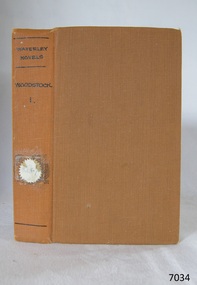
Book - Fictional stories, Sir Walter Scott, Waverley Novels Vol 39 Woodstock or The Cavalier, 1838
... The key themes to this novel are that it contrasts Cavalier loyalty and Puritan zeal, loyalty across divides, romance amid politics, and supernatural folklore masking intrigue. ...The subject volume of Waverley Novels Vol 39 published by Fisher Son & Co (1838) is part of a collected 48 volume set of Sir Walter Scott's works, containing various stories. Vol 39 in the 1836 Fisher edition reprints later entries from the fourth series, as these stories originally appeared in Scott's Magnum Opus 48 volume editions, the first from 1816. With the influential “Magnum Opus” editions from 1829–1833 by Robert Cadell, serving as the basis for later reprinted published sets like Fisher's. Scott's "Woodstock," or “The Cavalier” is a historical novel originally published in 1826 as the 22nd in the Waverley series. Set in 1651 at Woodstock Manor during the English Commonwealth after the Battle of Worcester, it dramatises Charles II's daring escape from Cromwell's forces. The story is about a royalist Sir Henry Lee and his daughter Alice, they lose their Woodstock home to Colonel Markham Everard, a sympathetic round head relative, who seeks protection for them from Cromwell, who suspects the site as a hideout for fugitive Charles II (disguised as a royal page "Louis Kerneguy"). Charles as the page courts Alice, sparking jealousy with Everard, amid duels, haunting in secret passages, and Cromwell's siege. Charles escapes with help from allies like Wildrake and Albert Lee, who impersonates him. The key themes to this novel are that it contrasts Cavalier loyalty and Puritan zeal, loyalty across divides, romance amid politics, and supernatural folklore masking intrigue. In the Fisher Son & Co edition, it reprints this story from Scott's revised collected original work in 1826.Waverley Novels Vol 39 Woodstock or the Cavalier, Light brown hardcover lettering in black text. Author: Sir Walter Scott Publisher: Fisher Son & Co Date: 1838fictionThe subject volume of Waverley Novels Vol 39 published by Fisher Son & Co (1838) is part of a collected 48 volume set of Sir Walter Scott's works, containing various stories. Vol 39 in the 1836 Fisher edition reprints later entries from the fourth series, as these stories originally appeared in Scott's Magnum Opus 48 volume editions, the first from 1816. With the influential “Magnum Opus” editions from 1829–1833 by Robert Cadell, serving as the basis for later reprinted published sets like Fisher's. Scott's "Woodstock," or “The Cavalier” is a historical novel originally published in 1826 as the 22nd in the Waverley series. Set in 1651 at Woodstock Manor during the English Commonwealth after the Battle of Worcester, it dramatises Charles II's daring escape from Cromwell's forces. The story is about a royalist Sir Henry Lee and his daughter Alice, they lose their Woodstock home to Colonel Markham Everard, a sympathetic round head relative, who seeks protection for them from Cromwell, who suspects the site as a hideout for fugitive Charles II (disguised as a royal page "Louis Kerneguy"). Charles as the page courts Alice, sparking jealousy with Everard, amid duels, haunting in secret passages, and Cromwell's siege. Charles escapes with help from allies like Wildrake and Albert Lee, who impersonates him. The key themes to this novel are that it contrasts Cavalier loyalty and Puritan zeal, loyalty across divides, romance amid politics, and supernatural folklore masking intrigue. In the Fisher Son & Co edition, it reprints this story from Scott's revised collected original work in 1826. warrnambool, shipwrecked-coast, flagstaff-hill, flagstaff-hill-maritime-museum, maritime-museum, shipwreck-coast, flagstaff-hill-maritime-village, shipwrecked-artefact, book, waverley novels vol 46 tales of my landlord, sir walter scott, pattison collection, warrnambool library, warrnambool mechanics’ institute, ralph eric pattison, corangamite regional library service, warrnambool city librarian, mechanics’ institute library, victorian library board, warrnambool books and records, warrnambool children’s library -
 Flagstaff Hill Maritime Museum and Village
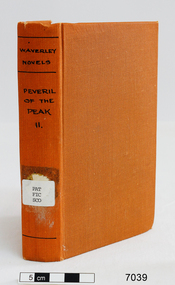
Book - Fictional stories, Sir Walter Scott, Waverley Novels Peveril of the Peak- 2 Vol 29, 1838
... Scott’s Peveril of the Peak is a historical novel set around the popish plot of 1678, and it follows tensions between Cavalier and Puritan families in Derbyshire, London intrigue, and a romance involving Sir Geoffrey Peveril’s son Julian, Alice Bridgenorth, and the mysterious Fenella Zara. ...The subject volume of Waverley Novels part 2 Vol 29 published by Fisher Son & Co (1838) is part of a collected 48 volume set of Sir Walter Scott's works, containing various stories. Vol 32 in the 1836 Fisher edition reprints later entries from the fourth series, as these stories originally appeared in Scott's Magnum Opus 48 volume editions, the first from 1816. With the influential “Magnum Opus” editions from 1829–1833 by Robert Cadell, serving as the basis for later reprinted published sets like Fisher's. Scott’s Peveril of the Peak is a historical novel set around the popish plot of 1678, and it follows tensions between Cavalier and Puritan families in Derbyshire, London intrigue, and a romance involving Sir Geoffrey Peveril’s son Julian, Alice Bridgenorth, and the mysterious Fenella Zara. In broad terms, it is about political suspicion, religious conflict, mistaken identities, and how private loyalties get entangled with public upheaval.Waverley Novels Peveril of the Peak- 2 Vol 29, Light brown hardcover lettering in black text. Author: Sir Walter Scott Publisher: Fisher Son & Co Date: 1838fictionThe subject volume of Waverley Novels part 2 Vol 29 published by Fisher Son & Co (1838) is part of a collected 48 volume set of Sir Walter Scott's works, containing various stories. Vol 32 in the 1836 Fisher edition reprints later entries from the fourth series, as these stories originally appeared in Scott's Magnum Opus 48 volume editions, the first from 1816. With the influential “Magnum Opus” editions from 1829–1833 by Robert Cadell, serving as the basis for later reprinted published sets like Fisher's. Scott’s Peveril of the Peak is a historical novel set around the popish plot of 1678, and it follows tensions between Cavalier and Puritan families in Derbyshire, London intrigue, and a romance involving Sir Geoffrey Peveril’s son Julian, Alice Bridgenorth, and the mysterious Fenella Zara. In broad terms, it is about political suspicion, religious conflict, mistaken identities, and how private loyalties get entangled with public upheaval. warrnambool, shipwrecked-coast, flagstaff-hill, flagstaff-hill-maritime-museum, maritime-museum, shipwreck-coast, flagstaff-hill-maritime-village, shipwrecked-artefact, book, waverley novels vol 46 tales of my landlord, sir walter scott, pattison collection, warrnambool library, warrnambool mechanics’ institute, ralph eric pattison, corangamite regional library service, warrnambool city librarian, mechanics’ institute library, victorian library board, warrnambool books and records, warrnambool children’s library, quentin durward, quinten durward -
 Flagstaff Hill Maritime Museum and Village
Book - Fictional stories, Sir Walter Scott, Waverley Novels Peveril of the Peak- 3 Vol 30, 1838
... The story continues on the Peveril family's royalist loyalties clashing with the Bridgenorths' Puritan resentment, fuelled by past Civil War grievances like the execution of William Christian. ...The subject volume “Waverley Novels Vol 30” published by Fisher Son & Co (1838) is part of a collected edition of Sir Walter Scott's works, containing stories from the "Tales of My Landlord" series. "Tales of My Landlord" forms a key subset of Scott's Waverley Novels, presented as fictional tales gathered by characters like Peter Pattieson from the landlord of the Wallace “Inn at Gandercleugh”. The series spans multiple books across four sub-series, including “The Black Dwarf” (1707 setting), “Old Mortality” (1679–1689), “The Heart of Midlothian” (1736), “The Bride of Lammermoor” (1709–1711), “A Legend of Montrose” (1644–1645), “Count Robert of Paris” (1097), and “Castle Dangerous” (1307). Vol 46 in the 1838 Fisher edition reprints later entries like “Count Robert of Paris” or “Castle Dangerous” from the fourth series, as these stories originally appeared in Scott's Magnum Opus collected volume editions, the first from 1816. With the influential 48-volume “Magnum Opus” edition from 1829–1833 by Robert Cadell, serving as the basis for later collected published sets like Fisher's. Peveril of the Peak is Walter Scott's longest novel, published in 1823 and set during the late 17th century amid the Popish plot hysteria under Charles II. It follows young Cavalier Julian Peveril's forbidden romance with Alice Bridgenorth a Puritan's daughter. The story covers political intrigue, family feuds, and conspiracies drawing the characters into events spanning Derbyshire's Peak District, the Isle of Man, and London. The story continues on the Peveril family's royalist loyalties clashing with the Bridgenorths' Puritan resentment, fuelled by past Civil War grievances like the execution of William Christian. Julian and Alice's love is tested when Julian's parents face Popish Plot accusations with subplots involving a scheming dwarf, the Countess of Derby, and court figures like the Duke of Buckingham. It resolves with royal intervention, exposing intrigues and eventually uniting the lovers.Waverley Novels Peveril of the Peak- 3 Vol 30, Light brown hardcover lettering in black text. Author: Sir Walter Scott Publisher: Fisher Son & Co Date: 1838fictionThe subject volume “Waverley Novels Vol 30” published by Fisher Son & Co (1838) is part of a collected edition of Sir Walter Scott's works, containing stories from the "Tales of My Landlord" series. "Tales of My Landlord" forms a key subset of Scott's Waverley Novels, presented as fictional tales gathered by characters like Peter Pattieson from the landlord of the Wallace “Inn at Gandercleugh”. The series spans multiple books across four sub-series, including “The Black Dwarf” (1707 setting), “Old Mortality” (1679–1689), “The Heart of Midlothian” (1736), “The Bride of Lammermoor” (1709–1711), “A Legend of Montrose” (1644–1645), “Count Robert of Paris” (1097), and “Castle Dangerous” (1307). Vol 46 in the 1838 Fisher edition reprints later entries like “Count Robert of Paris” or “Castle Dangerous” from the fourth series, as these stories originally appeared in Scott's Magnum Opus collected volume editions, the first from 1816. With the influential 48-volume “Magnum Opus” edition from 1829–1833 by Robert Cadell, serving as the basis for later collected published sets like Fisher's. Peveril of the Peak is Walter Scott's longest novel, published in 1823 and set during the late 17th century amid the Popish plot hysteria under Charles II. It follows young Cavalier Julian Peveril's forbidden romance with Alice Bridgenorth a Puritan's daughter. The story covers political intrigue, family feuds, and conspiracies drawing the characters into events spanning Derbyshire's Peak District, the Isle of Man, and London. The story continues on the Peveril family's royalist loyalties clashing with the Bridgenorths' Puritan resentment, fuelled by past Civil War grievances like the execution of William Christian. Julian and Alice's love is tested when Julian's parents face Popish Plot accusations with subplots involving a scheming dwarf, the Countess of Derby, and court figures like the Duke of Buckingham. It resolves with royal intervention, exposing intrigues and eventually uniting the lovers. warrnambool, shipwrecked-coast, flagstaff-hill, flagstaff-hill-maritime-museum, maritime-museum, shipwreck-coast, flagstaff-hill-maritime-village, shipwrecked-artefact, book, waverley novels vol 46 tales of my landlord, sir walter scott, pattison collection, warrnambool library, warrnambool mechanics’ institute, ralph eric pattison, corangamite regional library service, warrnambool city librarian, mechanics’ institute library, victorian library board, warrnambool books and records, warrnambool children’s library -
 Flagstaff Hill Maritime Museum and Village
Book - Fictional Stories, Sir Walter Scott, Waverley Novels 1 Vol 28 Peveril of the Peak, 1838
... Scott’s Peveril of the Peak is a historical novel set around the popish plot of 1678, and it follows tensions between Cavalier and Puritan families in Derbyshire, London intrigue, and a romance involving Sir Geoffrey Peverils son Julian, Alice Bridgenorth, and the mysterious Fenella Zara. ...The subject volume of Waverley Novels part 1 Vol 28 published by Fisher Son & Co (1838) is part of a collected 48 volume set of Sir Walter Scott's works, containing various stories. Vol 29 in the 1838 Fisher edition reprints later entries from the fourth series, as these stories originally appeared in Scott's Magnum Opus 48 volume editions, the first from 1816. With the influential “Magnum Opus” editions from 1829–1833 by Robert Cadell, serving as the basis for later reprinted published sets like Fisher's. Scott’s Peveril of the Peak is a historical novel set around the popish plot of 1678, and it follows tensions between Cavalier and Puritan families in Derbyshire, London intrigue, and a romance involving Sir Geoffrey Peverils son Julian, Alice Bridgenorth, and the mysterious Fenella Zara. In broad terms, it is about political suspicion, religious conflict, mistaken identities, and how private loyalties get entangled with public upheaval.Waverley Novels Vol 28 Peveril of the Peak 1 Author: Sir Walter Scott Publisher: Fisher & Son Date: 1838 Further Information: Light brown hardcover lettering in black text. fictionThe subject volume of Waverley Novels part 1 Vol 28 published by Fisher Son & Co (1838) is part of a collected 48 volume set of Sir Walter Scott's works, containing various stories. Vol 29 in the 1838 Fisher edition reprints later entries from the fourth series, as these stories originally appeared in Scott's Magnum Opus 48 volume editions, the first from 1816. With the influential “Magnum Opus” editions from 1829–1833 by Robert Cadell, serving as the basis for later reprinted published sets like Fisher's. Scott’s Peveril of the Peak is a historical novel set around the popish plot of 1678, and it follows tensions between Cavalier and Puritan families in Derbyshire, London intrigue, and a romance involving Sir Geoffrey Peverils son Julian, Alice Bridgenorth, and the mysterious Fenella Zara. In broad terms, it is about political suspicion, religious conflict, mistaken identities, and how private loyalties get entangled with public upheaval.shipwrecked-coast, flagstaff-hill, flagstaff-hill-maritime-museum, warrnambool, maritime-museum, shipwreck-coast, flagstaff-hill-maritime-village, shipwrecked-artefact, book, pattison collection, warrnambool library, warrnambool mechanics’ institute, ralph eric pattison, corangamite regional library service, warrnambool city librarian, mechanics’ institute library, victorian library board, warrnambool books and records, warrnambool children’s library, waverley novels vol 28 peveril of the peak 1, sir walter scott
