
Showing 10 items matching " pyjama case"
-
 Embroiderers Guild, Victoria
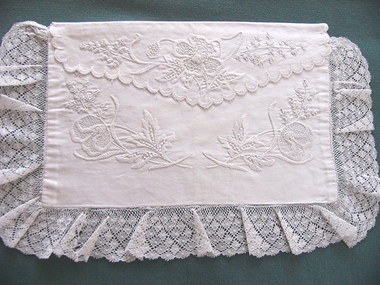
Textile - Pyjama Case, Late 19th century
... Pyjama Case...... Pyjama case...Heavily embroidered with flowers, wheat and leaves. Textile Pyjama Case ...Classic mount mellick on satin jean with decorative scalloped edges top and base and fringed. Heavily embroidered with flowers, wheat and leaves.embroidery, mountmellick, ireland, late 19th century, pyjama case -
 Emerald Museum & Nobelius Heritage Park
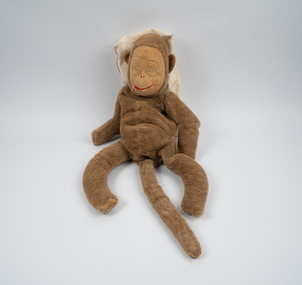
Container - Monkey Pyjama Case, Joy-Toys, c. 1937
... Monkey Pyjama Case...This pyjama case was produced in the 1930s by Joy-Toys, an Australian toy company founded in South Yarra in the early 1920s. ...This pyjama case was produced in the 1930s by Joy-Toys, an Australian toy company founded in South Yarra in the early 1920s. ...This pyjama case was produced in the 1930s by Joy-Toys, an Australian toy company founded in South Yarra in the early 1920s. It was gifted to Elaine Morris (then Nobelius - the granddaughter of Carl Axel Nobelius) at an early - perhaps 3rd - birthday. Elaine was born in 1934, so it would have been gifted around 1937. Several other Joy-Toys monkeys were made with hands and feet, which might either have fallen off or been removed over the past century or which may not have been included on this model. Some other models of Joy-Toys monkeys were based on the characters of British illustrator Lawson Wood, who used a wide cast of monkeys and other animals in his work. The zipper was made in Australia by Lightning, indicating that the monkey's components were also likely made locally.This pyjama case belonged to a member of the Nobelius family, and reflects a style of toymaking that today is far out of fashion from a distinctive company that is no longer in business.The monkey has a hollow body, with the interior lined with orange satin fabric and closed by a zipper. The shape of the monkey is filled out by the case's intended purpose - storing pyjamas. The head is stuffed, and features a face made of felt molded over buckram, with painted features in red (mouth and nostrils) and black (closed eyelids and eyelashes). Outside of the face, the monkey is covered in synthetic brown 'fur'. It is possible that the monkey once had hands and feet which have since been removed or lost. The monkey's limbs and tails are also stuffed and separated from the hollow body. The head and arms of the monkey are on joints allowing them to rotate 360 degrees. The monkey also has small furless fabric ears. There is damage separating fabric at the right shoulder and at several points in the interior.Zipper Obverse: "LIGHTNING" Zipper Reverse: "AUST MADE / PATENTED" Inside Tag: "JOY-TOYS / MADE IN AUSTRALIA"elaine morris, nobelius family, elaine nobelius, toys, children -
 Emerald Museum & Nobelius Heritage Park
Clothing - Cream Petticoat, Late 1940s
... It was found in a Monkey Pyjama Case (VEMU2288) along three other clothing items (VEMU2293, VEMU2295, and VEMU2296). ...It was found in a Monkey Pyjama Case (VEMU2288) along three other clothing items (VEMU2293, VEMU2295, and VEMU2296). ...This petticoat was likely owned by Elaine Morris (then Nobelius) sometime between the ages of 12 and 14; as she was born in 1934, this item was likely purchased in the mid-late 1940s. It was found in a Monkey Pyjama Case (VEMU2288) along three other clothing items (VEMU2293, VEMU2295, and VEMU2296). VEMU2293 and VEMU2296 have been identified as likely dating to the late 1940s, with advertisements for both from 1949; this item is likely to be roughly contemporaneous to them.This item belonged to a member of the Nobelius family and is a good, well-preserved example of 1940s casual/sleep clothing.This cream satin petticoat originally had two thin shoulder straps; however, the right strap has broken. The only tag we identified was only a size descriptor (size OS - Oversize), with no further writing to indicate brand or product name. The top of the petticoat has a narrow band of different material, while the bottom is hemmed.Tag: "OS."1940s, clothing, elaine nobelius, nobelius family -
Emerald Museum & Nobelius Heritage Park
Clothing - Cream Petticoat, c. late 1940s
... It was found in a Monkey Pyjama Case (VEMU2288) along three other clothing items (VEMU2293, VEMU2295, and VEMU2296). ...It was found in a Monkey Pyjama Case (VEMU2288) along three other clothing items (VEMU2293, VEMU2295, and VEMU2296). ...This petticoat was likely owned by Elaine Morris (then Nobelius) sometime between the ages of 12 and 14; as she was born in 1934, this item was likely purchased in the mid-late 1940s. It was found in a Monkey Pyjama Case (VEMU2288) along three other clothing items (VEMU2293, VEMU2295, and VEMU2296). VEMU2293 and VEMU2296 have been identified as likely dating to the late 1940s, with advertisements for both from 1949; this item is likely to be roughly contemporaneous to them.This item belonged to a member of the Nobelius family and is a good, well-preserved example of 1940s casual/sleep clothing.This is a cream petticoat with adjustable shoulder straps and a decorative mesh-fabric pattern below the neckline. This item is likely to share a size (OS - Oversize) with its related items, having been worn by the same owner contemporaneously.N/A1940s, elaine nobelius, nobelius family, clothing -
 Emerald Museum & Nobelius Heritage Park
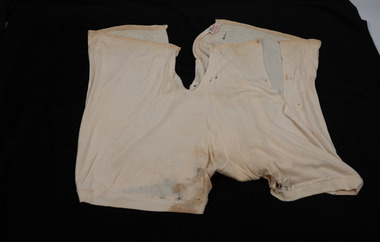
Clothing - 'Sutex Satinswade Pantees', Sutex, c. late 1940s
... It was found in a Monkey Pyjama Case (VEMU2288) that belonged to Elaine, alongside several other items of clothing (VEMU2293-5). ...It was found in a Monkey Pyjama Case (VEMU2288) that belonged to Elaine, alongside several other items of clothing (VEMU2293-5). ...This item was likely owned by Elaine Morris (then Nobelius) as a teenager, some time in the late 1940s. This is corroborated by the existence of advertising for this specific product from 1949, and its likely contemporaneity with VEMU2293 which has adverting from a similar time period. It was found in a Monkey Pyjama Case (VEMU2288) that belonged to Elaine, alongside several other items of clothing (VEMU2293-5). It was manufactured by the Sutex company, which had multiple manufacturing locations in Victoria - including Inglewood and Bendigo.This item belonged to a member of the Nobelius family and is a identifiable example of 1940s clothing.This item is a set of Sutex "Satinswade Pantees". The original advertisement describes them as follows: "Well cut, elastic at waist, cuff leg, in shades Peach and White. For excellent wearing." Seventy years later, this pair - the white version, though it now looks closer to cream - has suffered significant damage, with three large cuts from the waistline, significant staining, and holes from wear between the legs. It was size OS (Outsized).Tag: "Sutex / LUXURY LINGERIE / Satinswade / O.S"clothing, elaine nobelius, nobelius family, 1940s -
Emerald Museum & Nobelius Heritage Park
Clothing - Peach Underwear Vest, Exacto, c. Mid-Late 1940s
... It was stored in a Monkey Pyjama Case (VEMU2288) along three other clothing items (VEMU2294-6)....It was stored in a Monkey Pyjama Case (VEMU2288) along three other clothing items (VEMU2294-6). ...This vest was likely owned by Elaine Morris (then Nobelius) sometime between the ages of 12 and 14; as she was born in 1934, this item was likely purchased in the mid-late 1940s. This estimation aligns with the existence of advertisements for this item - an Exacto brand, Mellowbloom line peach underwear vest - as early as 1949; it's possible the item existed before then so I am reluctant to date it to 1949, but its absence from advertising records suggest it may not have predated 1948-9 by much. It was stored in a Monkey Pyjama Case (VEMU2288) along three other clothing items (VEMU2294-6).This item belonged to a member of the Nobelius family and is a very well-preserved example of 1940s sleepwear.This item is a peach-coloured, knitwear vest in size OS (Outsized). It has a round neckline, lined by a strip of different, textured fabric in a slightly lighter shade, accompanied by a decorative knot in the same fabric. It has a tag at the bottom of the item on the rear. Tag, Centre: "MELLOWBLOOM / AN Exacto PRODUCT" Tag, Right Edge: "OS"clothing, 1940s, elaine nobelius, nobelius family -
 Ithacan Historical Society
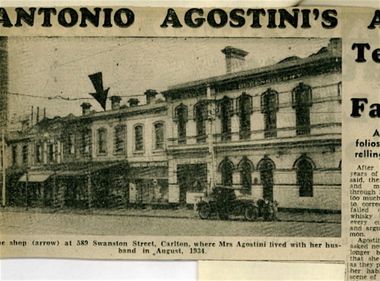
Photograph, Newspaper Photograph of Swanston Street businesses, 1944
... When Andrew Black took occupancy of the shop ate 589 Swanston Street, Carlton, he was unaware that a few years earlier it had been the scene of a murder and became known as the 'pyjama case murder'. On 1st September 1934, the body of an unidentified woman dressed only in pyjamas was found near Albury, NSW. ...When Andrew Black took occupancy of the shop ate 589 Swanston Street, Carlton, he was unaware that a few years earlier it had been the scene of a murder and became known as the 'pyjama case murder'. On 1st September 1934, the body of an unidentified woman dressed only in pyjamas was found near Albury, NSW. ...When Andrew Black took occupancy of the shop ate 589 Swanston Street, Carlton, he was unaware that a few years earlier it had been the scene of a murder and became known as the 'pyjama case murder'. On 1st September 1934, the body of an unidentified woman dressed only in pyjamas was found near Albury, NSW. For the following decade it remained an unsolved mystery until 1944 when Tony Agostini was arrested and confessed to killing his wife. At the time of the murder, the Agostinis were living in the building, where Andrew later ran his shoe repair business. While the case was newsworthy in 1944, the Carlton shop featured in Melbourne's newspapers.A photograph of a portion of a newspaper article about a 1944 cold case murder in Melbourne.carlton, swanston street, andrew black, shoe repairs -
 Embroiderers Guild, Victoria
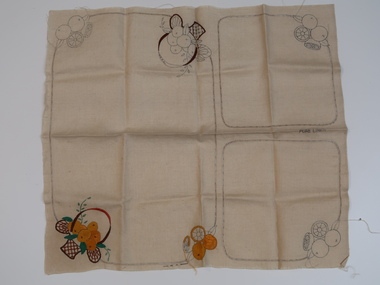
Unfinished Table Mat Set, 1937
... She started with the technique for linocuts and also wrote on pattern printing, embroidery, crafting cuddle toys, making evening gloves, and even a frog pyjama case for children. These crafts and designs were featured in The Sun and The Mercury. ..."Fruits of Your Handiwork" from the 'Woman's Needlework Feature" magazine article 26 July 1937 designed by Dorothy Ellsmore Paul.Dorothy Ellsmore Paul (née Dorothy May Ellsmore; 3 February 1902 – July 1973)[1] was an Australian artist and cartoonist. Paul was born Dorothy May Ellsmore in 1902 in Hertfordshire, England. She trained as an artist at Portsmouth Technical College. She left for Australia at just nineteen years old, arriving in Sydney on 18 March 1921. Once in Sydney she trained under Julian Ashton. She had ambitions of becoming a sculptor though this never eventuated. She was first published in The Sun with the cartoon We Do Believe in Fairies in their Sunbeams section. By 1924 she was drawing cartoons for the soldiers' magazine Aussie alongside fellow female cartoonists Mahdi McCrae, Betty and Esther Paterson, and Lillian Pedersen. The same year she exhibited her work in a black and white show at Anthony Hordern and Sons' Fine Art Gallery with such artists as Norman Lindsay, Percy Leason, and David Low. In 1926 she was illustrating short stories for The Australian Women's Mirror and the Sydney Mail. Her illustrations also featured in The Bulletin. In 1929 she edited a book The Etched Work of Sydney Long which included a sketch of hers of the artist. They were both associated with the Australian Painters-Etchers Society. Paul wrote the introduction for the Society's publication The Charm of the Etching. From 1931 to 1934 Paul wrote a feature section for The Australian Women's Mirror. She started with the technique for linocuts and also wrote on pattern printing, embroidery, crafting cuddle toys, making evening gloves, and even a frog pyjama case for children. These crafts and designs were featured in The Sun and The Mercury. She wrote and illustrated the stories Portrait of a Dark Girl and In Search of a Grandmother. She married fellow artist Oswald "Mick" Paul in 1925, son of artist and social reformer Emily Letitia Paul. His portrait of her was a finalist for the 1929 Archibald Prize. Paul has works in the collections of the National Library of Australia, the National Gallery of Australia, the State Library of New South Wales, and a bookplate of Sydney Long in the National Library of New Zealand. https://en.wikipedia.org/wiki/Dorothy_Ellsmore_Paul Stamped linen design with oranges and baskets. Partly embroidered.Pure Linen stamp. -
 Embroiderers Guild, Victoria
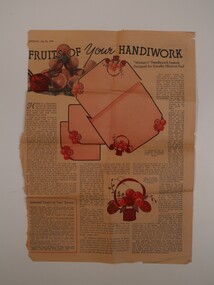
Table Mat Set Magazine Pattern, 1937
... She started with the technique for linocuts and also wrote on pattern printing, embroidery, crafting cuddle toys, making evening gloves, and even a frog pyjama case for children. These crafts and designs were featured in The Sun and The Mercury. ..."Fruits of Your Handiwork" from the 'Woman's Needlework Feature" magazine article 26 July 1937 designed by Dorothy Ellsmore Paul.Dorothy Ellsmore Paul (née Dorothy May Ellsmore; 3 February 1902 – July 1973)[1] was an Australian artist and cartoonist. Paul was born Dorothy May Ellsmore in 1902 in Hertfordshire, England. She trained as an artist at Portsmouth Technical College. She left for Australia at just nineteen years old, arriving in Sydney on 18 March 1921. Once in Sydney she trained under Julian Ashton. She had ambitions of becoming a sculptor though this never eventuated. She was first published in The Sun with the cartoon We Do Believe in Fairies in their Sunbeams section. By 1924 she was drawing cartoons for the soldiers' magazine Aussie alongside fellow female cartoonists Mahdi McCrae, Betty and Esther Paterson, and Lillian Pedersen. The same year she exhibited her work in a black and white show at Anthony Hordern and Sons' Fine Art Gallery with such artists as Norman Lindsay, Percy Leason, and David Low. In 1926 she was illustrating short stories for The Australian Women's Mirror and the Sydney Mail. Her illustrations also featured in The Bulletin. In 1929 she edited a book The Etched Work of Sydney Long which included a sketch of hers of the artist. They were both associated with the Australian Painters-Etchers Society. Paul wrote the introduction for the Society's publication The Charm of the Etching. From 1931 to 1934 Paul wrote a feature section for The Australian Women's Mirror. She started with the technique for linocuts and also wrote on pattern printing, embroidery, crafting cuddle toys, making evening gloves, and even a frog pyjama case for children. These crafts and designs were featured in The Sun and The Mercury. She wrote and illustrated the stories Portrait of a Dark Girl and In Search of a Grandmother. She married fellow artist Oswald "Mick" Paul in 1925, son of artist and social reformer Emily Letitia Paul. His portrait of her was a finalist for the 1929 Archibald Prize. Paul has works in the collections of the National Library of Australia, the National Gallery of Australia, the State Library of New South Wales, and a bookplate of Sydney Long in the National Library of New Zealand. https://en.wikipedia.org/wiki/Dorothy_Ellsmore_Paul "Fruits of Your Handiwork" from the 'Woman's Needlework Feature" magazine article 26 July 1937 designed by Dorothy Ellsmore Paul. Stamped linen design with oranges and baskets included. -
 Royal District Nursing Service (now known as Bolton Clarke)
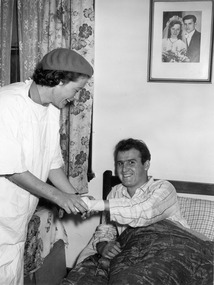
Photograph - Photograph, black and white, c.1958
... He is wearing a white and striped pyjama top and his lower body is covered by a patterned bed cover. Part of a pillow with check pillow case sits flat behind him and part of a wooden horizontal slat bedhead is seen. ...He is wearing a white and striped pyjama top and his lower body is covered by a patterned bed cover. Part of a pillow with check pillow case sits flat behind him and part of a wooden horizontal slat bedhead is seen. ...This photograph depicts a MDNS Sister visiting a male patient to give him nursing care. He is lying in bed in his home and the Sister is applying a bandage to his left wrist. Under her white gown the Sister is wearing the MDNS winter uniform of a grey dress with peaked collars and grey wool beret which has a central red Maltese cross attached. The Trained nurses (Nurses) of the Melbourne District Nursing Society (MDNS), from its inception in 1885, provided wound care to their patients who ranged in age from the very young to the elderly. The patients required their wounds to be dressed following various types of surgery, accidents, burns, cancer, leg ulcers etc. As research developed better products and dressing materials, the methods and medication applied to wounds changed. MDNS received Royal patronage in 1966 and as Royal District Nursing Service (RDNS), the Education department developed wound care programs, such as the Leg Ulcer Management Program to provide their Trained nurses (Sister) with methods of best quality care. They ran a program for Wound Care Specialists who made assessments and provided advice and support to the District Sisters working in the field as needed. The Sisters liaised with the patient’s Doctors and hospitals to provide information on the progress of patient’s wounds and to receive any change of wound care from the Doctors. Standing on the left of this photograph is a Melbourne District Nursing Service (MDNS) Sister who is wearing a white gown over her grey uniform, the collar of which can be seen. She is wearing her uniform grey wool beret over her short dark curly hair and is smiling as, with her outstretched left hand, she supports the partly bandaged extended left arm of a gentleman who is sitting up in bed to her right; his right arm is resting on the bed and supporting him as he is partly turned towards the Sister. She has part of a rolled bandage in her right hand. The male patient, who has short dark hair, is looking at the camera and smiling. He is wearing a white and striped pyjama top and his lower body is covered by a patterned bed cover. Part of a pillow with check pillow case sits flat behind him and part of a wooden horizontal slat bedhead is seen. On the wall behind the bed hangs a framed photograph of a couple on their wedding day. Patterned curtains cover the window in the left rear of the photograph.John Gallagher photography. 4 Benares Street, Mitcham Victoria WU 2568 No. 4-4melbourne district nursing service, mdns, mdns wound care, royal district nursing service, rdns
