
Showing 9 items matching " race course reserve"
-
 Bendigo Historical Society Inc.
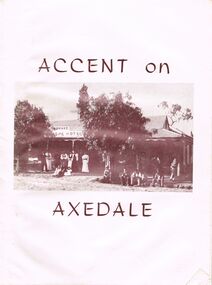
Document - BOOKLET: ACCENT ON AXEDALE
... ... Race Course Reserve...Chapters on: Early Settlement; Churches; Education; Police; Municipal Affairs; Commerce; Cemeteries; Race Course Reserve; The Railway (O'Keefe); Eppalock Weir; The Hall; The Wars; C.W.A; Camp Sites; C.F.A; Axedale Progress Association; Sport;...Country Fire Association.Eppalock Weir The Railway Race Course Reserve Cemeteries Axedale Farmers Club The Pitcher Dressers Poem by W. ...Booklet: ''Accent on Axedale'', published by the Centenary and Back to Axedale Committee 1970. 36 pages with photographs. Chapters on: Early Settlement; Churches; Education; Police; Municipal Affairs; Commerce; Cemeteries; Race Course Reserve; The Railway (O'Keefe); Eppalock Weir; The Hall; The Wars; C.W.A; Camp Sites; C.F.A; Axedale Progress Association; Sport;Alfred Ruskin Publications. Freelance Press, 61-63 City South Melbourne. 3205axedale, history, early settlement, axedale sporting club, indoor bowls, axedale progress association, c.w.a., country fire association.eppalock weir, the railway, race course reserve, cemeteries, axedale farmers club, the pitcher dressers poem by w. g. o'neill, bluestone quarries, threshing teams, hotels, general store and post office. education, churches, early settlement. -
 Bendigo Historical Society Inc.
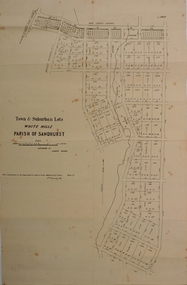
Document - MARKS COLLECTION: PARISH PLAN OF WHITE HILLS
... January 1865. Map shows Race Course Reserve at top of sheet, Municipal boundary is marked on LH side. ...January 1865. Map shows Race Course Reserve at top of sheet, Municipal boundary is marked on LH side. ...Sepia coloured map showing allotments in Parish of Sandhurst (White Hills) Written on LH side of map town and Suburban Lots White Hills Parish of Sandhurst. Scale is shown in chains. Surveyed by Horage Walker. Photo lithographed at the Department of Lands & Survey, Melbourne by J.Noone, Price 1/-. 6th. January 1865. Map shows Race Course Reserve at top of sheet, Municipal boundary is marked on LH side. Comments re vegetation throughout map. For example, poor soil timbered with Box scrub.on the back--Plan of Land White Hills Sandhurstbendigo, planning, white hills parish map, horage walker, j noone, department of lands and survey, -
 Phillip Island and District Historical Society Inc.
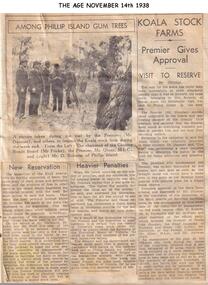
Newspaper clippings
... Article in The Age newspaper local history documents newspapers phillip island race track koalas wildlife reserves black & white newspaper clipping mr dunstan premier of victoria Article on new reservation are for Koalas at Phillip Island Race Course and also a suggestion by Mr Dunstan, Premier of Victoria, that the penalty for keeping Koalas in captivity should be raised from £5 to £50 Newspaper clippings ...Article in The Age newspaperArticle on new reservation are for Koalas at Phillip Island Race Course and also a suggestion by Mr Dunstan, Premier of Victoria, that the penalty for keeping Koalas in captivity should be raised from £5 to £50local history, documents, newspapers, phillip island race track, koalas, wildlife reserves, black & white newspaper clipping, mr dunstan premier of victoria -
 Warrnambool and District Historical Society Inc.
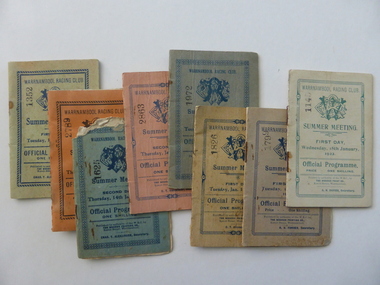
Document - Warrnambool. Woodford. Winslow. Purnim Race Books, Modern Print, W’Bool, Victoria, 1920's and 1930's
... reserve in August 1855. It is one of the finest racecourses in Australia, ringed by the gentle slopes of a huge basin.The first race meeting was held on the course in August 1858. ...reserve in August 1855. It is one of the finest racecourses in Australia, ringed by the gentle slopes of a huge basin.The first race meeting was held on the course in August 1858. ...The Warrnambool Amateur Turf Club was first formed in September 1859, but didn't become a properly constituted club until April 1873, when a meeting was held at the Commercial Hotel, now the Whaler's Inn, and a committee was elected.Part of the present racecourse of 100 acres was set aside as a racing and recreation reserve in August 1855. It is one of the finest racecourses in Australia, ringed by the gentle slopes of a huge basin.The first race meeting was held on the course in August 1858. The Warrnambool Racing Club has managed racing at Warrnambool since it was formed on 5 April 1873.Apart from a number of smaller meetings held throughout the year, the feature of racing in the district is the Grand Annual Steeplechase. The first steeplechase over the now famous cross-country course was run on 13th June 1872 then known as the Grand Annual Steeplechase. The paddocks now know as Brierly and Granters were first used on that date. The course, over four miles, was made up of different kinds of jumps including a stone wall, a log fence, a ditch and parapet, a paling fence and numerous post and rails. The name Grand Annual was first used for this steeplechase in May 1895. It is the longest horse race in Australia, and the thirty three fences of the course, the most of any steeplechase in the world is raced over 5,500 metres. The three day May racing carnival is the major racing event on the horseracing and social calendar. Many of these race booklets relate to those May meetings. The Warrnambool Racecourse has been the home of district racing clubs such as Woodford, Purnim and Koroit over the latter part of the 20th century. The Woodford Racing club holds their annual meeting after Christmas each year. The Winslow races were held from approximately mid-19th century to around 1946. It began as a small picnic race club in Tobin’s paddock to a splendid race course on the property, “Green Hills” owned by Mr. John O’Keefe about one mile north of the Winslow township.. The annual meetings held on New Year’s Day drew crowds of seven to eight thousand people. All of these books contains family names which in some cases are still strongly linked to horse racing in the district.These booklets are a tangible link to a great sporting and social event in the Western District. A collection of programmes for race meetings. They relate to Warrnambool, Woodford, Purnim, Winslow and Victoria Racing Club meetings in the period 1922 to 1931. All are soft card covers with approximately 16 pages in each in white paper. They are numbered as follows: 001250.1 WRC Soft green cover with blue text 01/05/1923 001250.2 WRC Mauve cover with blue text 03/05/1923 001250.3 WRC fawn cover with red text 06/05/1924 001250.4 WRC Orange cover with blue text 08/05/1924 001250.5 WRC Soft green cover with light brown text 05/05/1925 001250.6 WRC Soft green cover with red text 07/05/1925 001250.7 WRC fawn cover with brown text 04/05/1926 001250.8 Woodford racing Club soft pink cover, Blue text 01/04/1922 001250.9 Woodford racing Club green cover, Blue text 07/04/1923 001250.9 Woodford racing Club grey cover, Blue text 05/04/1924 001250.10 Woodford racing Club grey cover, Blue text 05/04/1924 001250.11 Woodford Racing Club green cover, Blue text 22/11/1924 001250.12 Woodford Racing Club green cover, brown text 04/04/1925 001250.13 Woodford Racing Club orange cover, blue text 10/04/1926 001250.14 Woodford Racing Club pink cover, green text 10/04/1926 001250.15 Warrnambool Racing Club pink cover, blue text 18/11/1922 001250.16 Warrnambool Racing Club pink cover, red text 13/11/1926 001250.17 Warrnambool Racing Club cream cover, brown text 15/11/1924 001250.18 Warrnambool Racing Club cream cover, green text 18/01/1922 001250.19 Warrnambool Racing Club grey cover, blue text 15/01/1924 001250.20 Warrnambool Racing Club cream cover, blue text 13/01/1925 001250.21 Warrnambool Racing Club pink cover, blue text 15/01/1925 001250.22 Warrnambool Racing Club olive green cover, blue text 12/01/1926 001250.23 Warrnambool Racing Club blue cover, blue text 14/01/1926 001250.24 Warrnambool Racing Club soft green cover, blue text 13/01/1931 001250.24 Warrnambool Racing Club orange cover, black text 16/01/1930 001250.25 Warrnambool Racing Club orange cover, black text 16/01/1930 001250.26 Purnim Racing Club green cover, blue text 19/05/1924 001250.27 Winslow Racing Club pink cover,black text 21/04/1923 001250.28 Winslow Racing Club green cover,black text 06/12/1924 001250.29 Victoria Racing Club cream cover,green text 11/07//1923 001250.30 Victoria Racing Club cream cover, red text 14/07//1923 Most of the booklets have markings with place getters and jockeys marked in pencil. Warrnambool Racing club books have R U Forbes, C T Alexander A H Davies and William White as secretaries. Woodford club has Thomas Gleeson as secretary, Winslow 's secretary is W Latta and Purnim is P J Kelly. The local booklets are printed by The Modern Print Co Koroit St Warrnambool.warrnambool, warrnambool racing club, winslow racing club, woodford racing club, purnim racing club, victoria racing club -
 Warrnambool and District Historical Society Inc.
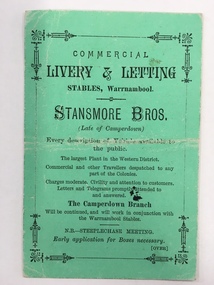
Document, Business Advertising Livery & Letting, 1882
... reserve in August 1855. It is one of the finest racecourses in Australia, ringed by the gentle slopes of a huge basin.The first race meeting was held on the course in August 1858. ...reserve in August 1855. It is one of the finest racecourses in Australia, ringed by the gentle slopes of a huge basin.The first race meeting was held on the course in August 1858. ...The Warrnambool Amateur Turf Club was first formed in September 1859, but didn't become a properly constituted club until April 1873, when a meeting was held at the Commercial Hotel, now the Whaler's Inn, and a committee was elected.Part of the present racecourse of 100 acres was set aside as a racing and recreation reserve in August 1855. It is one of the finest racecourses in Australia, ringed by the gentle slopes of a huge basin.The first race meeting was held on the course in August 1858. The Warrnambool Racing Club has managed racing at Warrnambool since it was formed on 5 April 1873.Apart from a number of smaller meetings held throughout the year, the feature of racing in the district is the Grand Annual Steeplechase. The first steeplechase over the now famous cross-country course was run on 13th June 1872 then known as the Grand Annual Steeplechase. The paddocks now know as Brierly and Granters were first used on that date. The course, over four miles, was made up of different kinds of jumps including a stone wall, a log fence, a ditch and parapet, a paling fence and numerous post and rails.This card has Warrnambool Racing Club acceptances on one side for the Winter steeplechase meeting for the June meeting in 1882. Stansmore Bros. operated livery stables near the Commercial Hotel in Liebig Street around this time having commenced their business in Camperdown.They later moved to Kepler Street. The Stansmore family had a long association with the racing and agricultural industry in the Camperdown and Heytesbury areas. This little card has links to one of Warrnambool's premier sporting events and a local business which has strong family connections in the district.Small green card with black text on front and back. Edged with small lined border. The back has a racing schedule.Commercial Livery & letting Stables Warrnambool.Stanmore Bros. Warrnambool Racing Club, J.A Archibald Secretary WRCwarrnambool,, commercial livery & letting stables, stansmore brothers stables, warrnambool racing club 1882 -
 Bendigo Historical Society Inc.
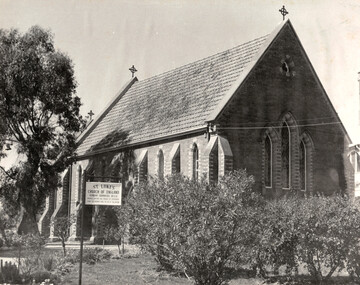
Document - National Trust Collection: Churches of Bendigo and Inglewood, Nov 7th 1965
... reserve’. St AUGUSTINE'S CHURCH MYERS FLAT Early diggers to this area were men named Myers and Nicholls, hence the name - Myers Flat and Myers Creek. 1857 saw the discovery of gold in the area and in less than one month 1000 ounces of gold per week resulted. The number of diggers in the Myers Creek or Burnt Gully totalled 4000 to 5000. Myers Creek consisted of several shops and buildings, two hotels, a race course...reserve’. St AUGUSTINE'S CHURCH MYERS FLAT Early diggers to this area were men named Myers and Nicholls, hence the name - Myers Flat and Myers Creek. 1857 saw the discovery of gold in the area and in less than one month 1000 ounces of gold per week resulted. The number of diggers in the Myers Creek or Burnt Gully totalled 4000 to 5000. Myers Creek consisted of several shops and buildings, two hotels, a race course ...St LUKES ANGLICAN CHURCH BENDIGO In 1852, a party of Cornish miners, refusing to give up and having dug, by hand, down nearly 70 feet ‘got their reward. Suddenly, their picks sank into soft pipe-clay, white, satin-smooth and seemingly depthless. The men began tunnelling. Presently, the roof forming above them showered gold at their feet – the secret of Bendigo’s famous White Hills lay revealed.’ In the ‘wild rush’ that followed, when ‘the White Hills yielded enormously and some pretty piles were made’, a young Anglican priest, John Herbert Gregory, held the first Anglican church service at White Hills in 1853. The Hamlet of White Hills was surveyed and mapped in 1854 and, by 1863, St Luke’s Church in White Hills was opened on ‘an elevated site’ in a generously sized ‘church reserve’. St AUGUSTINE'S CHURCH MYERS FLAT Early diggers to this area were men named Myers and Nicholls, hence the name - Myers Flat and Myers Creek. 1857 saw the discovery of gold in the area and in less than one month 1000 ounces of gold per week resulted. The number of diggers in the Myers Creek or Burnt Gully totalled 4000 to 5000. Myers Creek consisted of several shops and buildings, two hotels, a race course and a lock-up built of logs. On November 6th, 1864, the opening of the new church of St Augustine' took place. The first mass was celebrated by the Reverand Dean Hayes, of St Killian's Sandhurst. The church of gothic design was built by a local contractor, and with bricks made from local clay. The church also has a fire place and is widely known as "The church with the Chimney. For many years it was also a Catholic school. St AUGUSTINE'S CHURCH INGLEWOOD The church features an Early English design from 1864 and Decorated Gothic extensions from 1884.Notable elements include the sanctuary with the Catto Memorial window and interior cusped arcading of the wainscot. Architectural attribution is given to Vahland and Getzschmann for one or both sections. St JOHNS CHURCH (PRESBYTERIAN) BENDIGO The church's architect was W C Vahland VIA, and the builder was N Langstaff. It was built in April 1890, and opened in Feb 1891. The tender price was 2,481 pounds. The church style was gothic, built by the Congregational Church to replace an earlier building built in 1858. St Johns bought the church in 1949 and made additions in 1951. THE SACRED HEART CATHEDRAL BENDIGO Originally designed in 1895 by Reed, Smart and Tappin of Melbourne, the first stage opened in September 1901; the second stage began in January 1954 and was expected to finish in late 1976. Skilled stonemasons were brought from overseas for the completion. The Exterior built from Geelong sandstone and Harcourt granite, matching the original materials for color consistency. The cathedral is designed in the early English Gothic style. It Features a tower and spire weighing several thousand tons, with the spire rising 282 ft. from the floor and topped by a 10 ft. cross.Interior. The original stained glass window, made in Birmingham, England, is above the main entrance on the west side. Marble for the floor was imported from Vincenzo and Via Reggio, Italy; Sicilian Pearl marble is used in the four chapels. Ceilings in the chapels feature Western red cedar and yellow pine timbers.The transept includes Australian blackwood paneling and 12 carved shields representing the apostles. The internal height from floor to ceiling is 80 ft.Artistic Elements. Two large tapestries, specially designed and crafted by Mrs. Carrington, hang in the sanctuary as a symbolic link to Bendigo. ST PAULS BENDIGO The nave was built in 1868 and the tower in 1873. The nave is notable for unusual ceiling with metal and timber overlay members. The tower notable for early brick and bold Gothic influenced design. The church was opened on 12th Nov 1868 and a new chancel sanctuary and Transepts were added on 22 Oct 1927. The architect was Robert A Love. CONGREGATIONAL CHURCHES IN BENDIGO Three main Congregational church buildings existed in Bendigo: at the corner of Forest and Mackenzie Streets (the original site), on Quarry Hill (corner of Russell and Gladstone Streets), and on Calvin Street (later the Lutheran Church). The Calvin Street church was named in honor of John Calvin, a notable figure who lived in the area. In June 1858, 1.5 acres of land were purchased at the Forest and Mackenzie Streets corner for £1200.The first church was built on this site in November 1858 and later enlarged in May 1867 to seat 500 people. A prefabricated parsonage stood nearby until about 1920, serving as a caretaker's cottage for several years. In 1890, foundation stones for a new church designed by W.C. Vahland were laid, featuring a tall tower and two gable crossings (reduced from three to save costs). The new church opened on February 26, 1890, costing £2483. The contractor was N. Longstaff. Some architectural elements, such as the chancel, were added later when St. John's Presbyterian took over the building. Congregational attendance declined, leading to the purchase and alteration of a brick school complex in Olinda Street to serve as their headquarters.The timber church on Russell Street and the Calvin Street property were sold.The valuable Forest Street property was eventually sold to a London sect and later became an investment for the Methodist Church.Historical information on seven denominational churches in Bendigo and Inglewood. This item contains the following items: 3084.36a Black and white photo of St Lukes Bendigo Church of England, Napier Street, White Hills. 3084.36b St Augustine's Church Myers Flat 100 years newsletter 1965. The newsletter's purpose is for a Commemorative afternoon mass in memory of the pioneers of Myers Flat and district.Celebration of the 101st anniversary of the first mass at St. Augustine's Church; on Sunday, November 7th, 1965, at 2:00 PM.Location: St. Augustine's Church, Myers Flat. The invitation is extended to the recipient and their friends. This invitation serves both as a memorial and a community gathering to honour local history. Also included is some hand-written history notes of the church - See the notes in the Historical Section above. 3084.36c This document is a formal letter dated 9th November 1970 from the National Trust of Australia (Victoria) to Bishop Bernard Stewart. St. Augustine's Church in Bendigo has been awarded a "D" classification by the National Trust's expert committee. The church is now officially "recorded" by the National Trust. The letter is addressed to Bishop Bernard Stewart, with copies sent to Father Louis McDonnell (Eaglehawk), A. J. Watts (Town Clerk, Bendigo), and Mrs. R. R. Adams (Secretary, Central Victorian Branch). 3084.36d This document is a formal letter from the National Trust of Australia (Victoria) to Miss L. Doble, Registrar of the Bendigo Church of England Diocese, dated March 20, 1973. St. Augustine's Church of England in Inglewood has been officially placed on the National Trust's Classified List. This classification recognizes the church as essential to Australia's heritage and emphasizes its preservation. The church features an Early English design from 1864 and Decorated Gothic extensions from 1884.Notable elements include the sanctuary with the Catto Memorial window and interior cusped arcading of the wainscot. Architectural attribution is given to Vahland and Getzschmann for one or both sections. The church is about to celebrate the centenary of its consecration on May 13, with the Archbishop expected to attend. 3084.36e This document is a survey form used by the National Trust of Australia (Victoria) to collect detailed information about St Augustine's Church at Myers Flat. It records the original purpose, present use, and current name of the building.Requires a precise address or location description for site visits.It captures special features or points of interest not visible in photographs. It documents the present owner and occupant, including their addresses, the date of initial construction and supporting evidence for that date. 3084.36f Handwritten letter re history of St Johns Presbyterian Church Bendigo, 13th October 1980 - author unknown 3084.36g Typed notes - "Interesting information on the Sacred Heart Cathedral Bendigo", and hand-written notes on St Pauls Cathedral. 3084.36h Two pages of typed notes. Three main Congregational church buildings existed in Bendigo: at the corner of Forest and Mackenzie Streets (the original site), on Quarry Hill (corner of Russell and Gladstone Streets), and on Calvin Street (later the Lutheran Church). 3084.36i Hand-written notes on St Pauls Cathedral.history, church, national trust bendigo collection, sacred heart cathedral bendigo, st augustine's church myers flat, st pauls church bendigo, st johns presbyterian church bendigo, congregational church bendigo -
 Glen Eira Historical Society
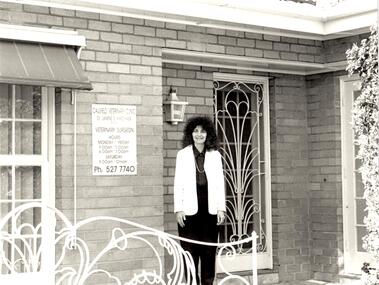
Document - Animals
... Reserve... Boyd Park... Neerim Road... Caulfield Park... Caulfield Race Course...Ormond Dixon Reg Animal Control Officer Horses Racehorses Racecourses Draught Horses Bailey Reserve Sporting Grounds Bentleigh/Hodgson Reserve Boyd Park Neerim Road Caulfield Park Caulfield Race Course Duncan MacKinnon Park EE Gunn Reserve Glen Huntly Park Joyce Park King George V1 Memorial Reserve Lords Park Marara Road Marlborough Street Reserve Moorleigh Victory Park Princes Park Packer Park Animal Enclosures Domestic Animals Dogs Horse Drawn Vehicles Cattle Birds Animals Trains Caulfield Contact Document Animals ...This file contains 2 items: 1/A black, white and green brochure titled ‘Leash Free Parks and Reserves’ concerning leashing regulations, conditions for non-leashing, summaries of legislation and penalties for owners of dogs, written by the City of Glen Eira. It includes six illustrations and a map of Glen Eira which labels all leash free parks as well as a depiction of all the train stations in the area. 2/A collection of 37 black and white photographs which have all appeared in Caulfield Contact at some time. These include photographs of the ‘Caulfield Veterinary Clinic, North Road Ormond dated 1982, Animal Control officer Reg Dixon dated 1982, draught horses pulling a horse drawn cart dated 1988 and general animals. Photographs unknown.allnutt park, murrumbeena park, veterinary clinics, professionals, veterinarians, kirschner jane s., north rd. ormond, dixon reg, animal control officer, horses, racehorses, racecourses, draught horses, bailey reserve, sporting grounds, bentleigh/hodgson reserve, boyd park, neerim road, caulfield park, caulfield race course, duncan mackinnon park, ee gunn reserve, glen huntly park, joyce park, king george v1 memorial reserve, lords park, marara road, marlborough street reserve, moorleigh, victory park, princes park, packer park, animal enclosures, domestic animals, dogs, horse drawn vehicles, cattle, birds, animals, trains, caulfield contact -
 Kiewa Valley Historical Society
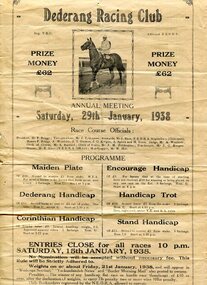
Programmes and Document - Dederang Racing Club, 1. January 1938 2. February 1924
... Reserve on the Kiewa Valley Highway. These races have been held annually since the mid 1850’s. The Dederang Picnic Race Club holds its one race meeting a year with the Dederang Cup in January. Thousands of dollars have been raised in that time for charity and the community through the effort of volunteers. The race club is made up of 100% volunteers and whilst not only organising the race meeting they voluntarily maintain the racecourse and facilities to a standard that allows local trainers to use the course...Reserve on the Kiewa Valley Highway. These races have been held annually since the mid 1850’s. The Dederang Picnic Race Club holds its one race meeting a year with the Dederang Cup in January. Thousands of dollars have been raised in that time for charity and the community through the effort of volunteers. The race club is made up of 100% volunteers and whilst not only organising the race meeting they voluntarily maintain the racecourse and facilities to a standard that allows local trainers to use the course ...The Dederang Race Club is a thoroughbred Race Club that manages a country racing venue in North East Victoria at the Dederang Recreation Reserve on the Kiewa Valley Highway. These races have been held annually since the mid 1850’s. The Dederang Picnic Race Club holds its one race meeting a year with the Dederang Cup in January. Thousands of dollars have been raised in that time for charity and the community through the effort of volunteers. The race club is made up of 100% volunteers and whilst not only organising the race meeting they voluntarily maintain the racecourse and facilities to a standard that allows local trainers to use the course throughout the year. Dederang Race Club celebrated its 150 year anniversary in January 2015 with spectators dressed in period race attire and the launch of a book commemorating the organisation "Rank Outsider-A non racegoers glance at 150 years of the Dederang Race Club2 Documents regarding Dederang Racing Club meetings 1. Original printed flyer for Dederang Race Club Annual meeting Jan 29, 1938. On buff paper 2. Official programme for Dederang Racing Club Annual meeting. February 6, 1924. Buff cardboard printed programme dederang racing club; programme; dederang cup; kiewa valley -
 City of Melbourne Libraries
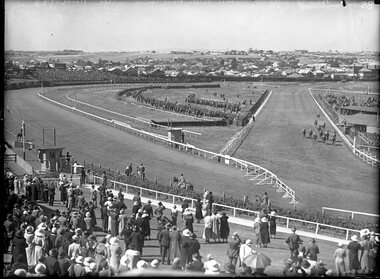
Photograph, Bull, Hugh Jones, 1897-1993, The new straight at Moonee Valley Race Course
... reserve, and a field of 12 horses approaches the winning post. On a slope at the rear of the photo is evidence of a fairly new housing development, evidenced by the small number of trees. Beyond this there is some vacant land to the left and then more dense housing is evidenced to the right. In the photo the white fencing delineating the course and spectator areas creates wonderful lines and curves. It is a very sharp and clear image. The race...reserve, and a field of 12 horses approaches the winning post. On a slope at the rear of the photo is evidence of a fairly new housing development, evidenced by the small number of trees. Beyond this there is some vacant land to the left and then more dense housing is evidenced to the right. In the photo the white fencing delineating the course and spectator areas creates wonderful lines and curves. It is a very sharp and clear image. The race ...Published: Age (Melbourne, Vic.: 1854- ), 11 December 1933 Published title: The New Straight Moonee Valley Published caption: Age (Melbourne, Vic. : 1854 - 1954), Monday 11 December 1933, page 6 The finish of the Koombahla Trial Handicap, the first race run on the new and longer straight across the flat at Moonee Valley racecourse. Magoot won, with Affability second and Great Bear third. This picture, taken from the members' reserve, shows the new straight in relation to the old one (the latter will continue to be used for races of less than seven furlongs), with the finishing post on the right and the new Judge's box in front of the old one. In the distance can be seen the starting points for races over nine furlongs and eight furlongs and a half on another course track. Trove article identifier: http://nla.gov.au/nla.news-article203362672 Research by Project Volunteer, Louise McKenzie: This photo, taken from the elevation of the stand in the Members’ Reserve at Moonee Valley Racecourse, has been framed in order to highlight the new straight, the finishing post, and a new Judge’s Box. In the foreground is a crowd of racegoers in the Members area, showing significantly more women in attendance than men. It is a bright, sunny Tuesday afternoon. The women are wearing small or large brimmed hats and are mostly swathed in generously cut coats with long sleeves that are mid calf length. Some women carry umbrellas to protect them from the sun. The men are wearing suits and hats. The women and men are mostly standing in discrete, rather than mixed groups. More spectators are standing on a banked area in the centre of the track, a large crowd is trackside on the left and another crowd is located to the right of the photo along the final straight. There are stewards on horses in front of the members reserve, and a field of 12 horses approaches the winning post. On a slope at the rear of the photo is evidence of a fairly new housing development, evidenced by the small number of trees. Beyond this there is some vacant land to the left and then more dense housing is evidenced to the right. In the photo the white fencing delineating the course and spectator areas creates wonderful lines and curves. It is a very sharp and clear image. The race underway is the Koombahla Trial Handicap, which was won by Magoot by a length from Affability, with half a length back to Great Bear. At this juncture, Magoot won 3 of 4 starts, and subsequently on Saturday 30 December 1933, with a new up and coming young Flemington trainer J M Murphy, and popular mount Harold Skidmore, Magoot was the favourite and winner of the day’s principal event at Moonee Valley. The Weekly Times that day reported that Magoot had been sold to Launceston sportsman Mr W C Learoyd. The winnings from this race, 400 Pounds , was apparently sufficient to offset the cost of the horse, and would be the equivalent of approximately $9,500 in today’s money. The same article describes Magoot as a “Magpie” gelding as his bloodline was Magpie Tullalah from New Zealand. Sadly, on 9 October 1935, the Examiner (Launceston) reported that Magoot had to be destroyed after falling and breaking her shoulder while running in the Grovedale Handicap in Geelong, but such was her reputation that she warranted an accompanying photograph. Moonee Valley Racecourse was established in 1883 on private land by its owner WS (Sam) Cox – after whom the prestigious horserace, the WS Cox Plate is named. It is located 6 km from the Melbourne CBD in the suburb of Moonee Ponds. It became a non-proprietary property in 1935, and today the Cox Plate, run over 2040 m. each October, is the richest weight-for-age race in Australia for 3 year old and over, under Weight for Age conditions.” According to the Austadiums website, Moonee Valley has a “unique amphitheatre track and was the first Australian metropolitan track to conduct night racing.” This amphitheatre style is evident in Hugh Bull’s photo. THE NEW STRAIGHT AT MOONEE VALLEY. (1933, December 11). The Age (Melbourne, Vic. : 1854 - 1954), p. 6. Retrieved July 23, 2025, from http://nla.gov.au/nla.news-article203362672 Age (Melbourne, Vic. : 1854 - 1954), Monday 11 December 1933, page 6 THE NEW MOONEE VALLEY TRACK (1933, December 11). The Argus (Melbourne, Vic. : 1848 - 1957), p. 7. Retrieved September 1, 2025, from http://nla.gov.au/nla.news-article11719604 Argus (Melbourne, Vic. : 1848 - 1957), Monday 11 December 1933, page 7 MAGOOT SOLD (1933, December 23). The Australasian (Melbourne, Vic. : 1864 - 1946), p. 22 (METROPOLITAN EDITION). Retrieved September 1, 2025, from http://nla.gov.au/nla.news-article141384672 Australasian (Melbourne, Vic. : 1864 - 1946), Saturday 23 December 1933, page 22 SMALL BUT GOOD (1933, December 30). Weekly Times (Melbourne, Vic. : 1869 - 1954), p. 48 (FIRST EDITION). Retrieved September 1, 2025, from http://nla.gov.au/nla.news-article223210074 Weekly Times (Melbourne, Vic. : 1869 - 1954), Saturday 30 December 1933, page 48 MOONEE VALLEY RACES. (1933, December 11). The Sydney Morning Herald (NSW : 1842 - 1954), p. 13. Retrieved September 1, 2025, from http://nla.gov.au/nla.news-article17031425 Sydney Morning Herald (NSW : 1842 - 1954), Monday 11 December 1933, p. 13 ACCIDENTS AT GEELONG MAGOOT DESTROYED (1935, October 10). Examiner (Launceston, Tas. : 1900 - 1954), p. 3 (DAILY). Retrieved September 1, 2025, from http://nla.gov.au/nla.news-article51958216 Examiner (Launceston, Tas. : 1900 - 1954), Thursday 10 October 1935, p. 3 Wikipedia, Moonee Valley Racecourse, https://en.wikipedia.org/wiki/Moonee_Valley_Racecourse eMelbourne, the city past and present, https://www.emelbourne.net.au/biogs/EM01003b.htm Wikipedia, Cox Plate, https://en.wikipedia.org/wiki/W._S._Cox_Plate Austadiums, Moonee Valley, https://www.austadiums.com/stadiums/moonee-valleyPhotographer notations on slide: "New straight at Moonee Valley Race Course - Age 11 Dec 1933 B8".horseracing, race courses, moonee valley, 1930-1939
