
Showing 8 items matching " raw studios"
-
 Women's Art Register
Archive (Collection) - Charlotte Clemens Artist Archive
... ... Raw Studios...Activism Figurative Trade Unionism Raw Studios Bad Mothers Community Art Workers Collage Printmaking Posters Archive Charlotte Clemens Artist Archive ...activism, figurative, trade unionism, raw studios, bad mothers, community art workers, collage, printmaking, postersactivism, figurative, trade unionism, raw studios, bad mothers, community art workers, collage, printmaking, posters -
Women's Art Register
Archive (Series) - Clemens, Charlotte. Artist File 1
... ... Raw Studios...Activism Figurative Trade Unionism Raw Studios Bad Mothers Community Art Workers Collage Printmaking Posters Foolscap white archival 4 flap folder or document wallet Archive Clemens, Charlotte. ...Newspaper Clippings, Invitationsactivism, figurative, trade unionism, raw studios, bad mothers, community art workers, collage, printmaking, postersactivism, figurative, trade unionism, raw studios, bad mothers, community art workers, collage, printmaking, posters -
Women's Art Register
Archive (Series) - Charlotte Clemens. Duplicate File 1
... ... Raw Studios...Collage Printmaking Posters Activism Figurative Trade Unionism Raw Studios Bad Mothers Community Art Workers Foolscap manilla file Archive Charlotte Clemens. ...Newspaper Clippings, Invitationscollage, printmaking, posters, activism, figurative, trade unionism, raw studios, bad mothers, community art workerscollage, printmaking, posters, activism, figurative, trade unionism, raw studios, bad mothers, community art workers -
 Nillumbik Shire Council
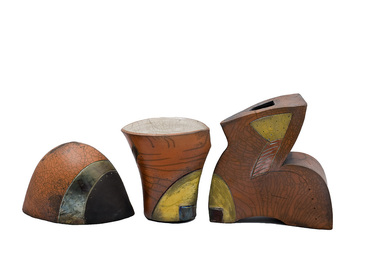
Sculpture: Jane ANNOIS, Jane Annois, Evolution, 2006
... studio, gallery shop and restaurant to experiment, make, promote and sell predominantly domestic wares of the time. These activities helped financially sustain each member’s individual creative practice. Potters Cottage was influential in the development of contemporary ceramics, building and developing practices that experimented with traditional ceramic processes, raw materials and locally sourced clay. ...studio, gallery shop and restaurant to experiment, make, promote and sell predominantly domestic wares of the time. These activities helped financially sustain each member’s individual creative practice. Potters Cottage was influential in the development of contemporary ceramics, building and developing practices that experimented with traditional ceramic processes, raw materials and locally sourced clay. ...Jane Annois had a long involvement with Potters Cottage in Warrandyte, where she taught for many years. Potters Cottage was established in the late 1950s in Warrandyte as an artist co-operative. Founding members included Reg Preston, Phyl Dunn, Gus McLaren, Artur Halpern, Sylvia Halpern and Elsa Ardern. These talented artists had the ingenuity and foresight to create a teaching studio, gallery shop and restaurant to experiment, make, promote and sell predominantly domestic wares of the time. These activities helped financially sustain each member’s individual creative practice. Potters Cottage was influential in the development of contemporary ceramics, building and developing practices that experimented with traditional ceramic processes, raw materials and locally sourced clay. The group mentored and nurtured many interested in the art of ceramics, producing alumni and teachers such as Peter Laycock, John Dermer, Greg Daly and Jane Annois. Jane Annois is a ceramic artist who has lived and worked locally in Warrandyte for many years. She focuses primarily on exploring the art of Japanese raku, adapting the technique to develop the typical characteristics of crackle glazes and lustres, with contrasting areas of black. Jane also applies a fine slip called terrasigillata which gives soft, warm ochre colours. This technique was once used by the Greeks over 2000 years ago to seal and decorate their pots. She is also strongly onfluenced by the French potters, particularly in the style of terre vernissee, a decorative form of terracotta tableware. Three piece stoneware and raku fired ceramic sculpture. The first piece is a hollow, dome shaped object. It is orange (terracotta slip) in colour with a copper metallic band and a black edge on one side with a small yellow glazed rounded triangle and metallic strip of colour on the otherside. The second piece is shaped like a traditional vase. It is orange (terracotta slip) in colour with white crackle on the inside. It has a yellow slip edge with a dark glazed square on one side and on the other side a black thick edge that mirrors the contour of this shape. The third piece is shaped loosley in the form of the letter 'z'. It compliments the second piece with a yellow slip edge and black glazed square to its lower left side and top right as well as on its' other side a black thick edge that mirrors the contour of this shape. This piece has a very small skewed square opening at its' top. All three pieces have elements of crazing and variations of colour and lustre, caused by the raku process. 2006.52.1VA has the artist name/signature 'J. Annois' inscriped small (with fine point ceramic tool?) on the front of the piece, bottom right; 2006.52.2VA has the artist name 'Jane'? inscribed (unlegible - with fine point ceramic tool?) underneath; 2006.52.3VA has the artist name/signature 'Jane Annois' inscriped (with fine point ceramic tool?) inside its hollow form. evolution, raku, stoneware, terrasigillata, terracotta, glazes, slip, terre vernissee -
 Federation University Art Collection
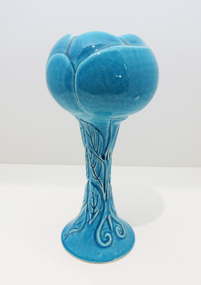
Ceramic - Artwork- Ceramic, Blue Goblet by John O'Loughlin
... The University provided a serious ceramic studio equipped with all the research tools for advanced ceramic exploration. Access to raw materials and a variety of kilns combined with excellent lecturers, mentors and technicians inspired, motivated and challenged him to push his accumulating knowledge to higher levels. ...The University provided a serious ceramic studio equipped with all the research tools for advanced ceramic exploration. Access to raw materials and a variety of kilns combined with excellent lecturers, mentors and technicians inspired, motivated and challenged him to push his accumulating knowledge to higher levels. ...John O'LOUGHLIN Born Snowtown, South Australia In 1980 John O'Loughlin's life changed when he started wheel throwing ceramic vessels. During this time he discarded the superfluous and unnecessary clutter collected on the journey of life, yet retaining the essence of what mattered to him. John O’Loughlin's later artworks engages with the way in which organised religion, specifically the Catholic Church, deals with the translation of the spiritual into the material. Informed by his extensive travels and studies, O’Loughlin’s ceramics reference the reliquaries and church artefacts that connect the life of this world with that of faith in another world. Completing undergeduate and post graduate works at Federation University John O'Loughlin's honours thesis was entitled "Ways and Means of Meaning, The Use of Symbol and Surface as Expressive Media in Ceramic Sculpture". The University provided a serious ceramic studio equipped with all the research tools for advanced ceramic exploration. Access to raw materials and a variety of kilns combined with excellent lecturers, mentors and technicians inspired, motivated and challenged him to push his accumulating knowledge to higher levels. O'Loughlin's working method in the studio is one of quiet, determined interaction with clay, idea and content. Experimentation with a variety of temperatures, firing methods and atmospheric conditions has produced a broad tonal and textural palette. He has worked with various clay bodies overlaid with coloured oxides, slips and engobes as the foundation for many of his works. O'Loughlin ufilised raised surfaces from old cemetery tombstones using the impressed forms and textures in his constructions. This research led him to the use of dry engobes to create a sense of antiquity, with crusty and distressed surfaces that resemble objects neglected in the oceans. These objects seem covered with the accretions and accumulations of history when re-discovered and brought to the surface as miraculous objects of mystery and magic. (https://www.thefreelibrary.com/John+O%27Loughlin%3A+a+man+re-invented.-a0216897107, accessed 12 September 2020) in 2007 John completer a Masters at the University of Ballarat. This item is part of the Federation University Art Collection. The Art Collection features over 2000 works and was listed as a 'Ballarat Treasure' in 2007.Botanical inspired wheel thrown goblet with decorative incised leaves on stem and flower head shaped cup. Glazed 'JOL' on bottom.art, artwork, goblet, botanical, ceramic, john o'loughlan, alumni -
 Federation University Art Collection
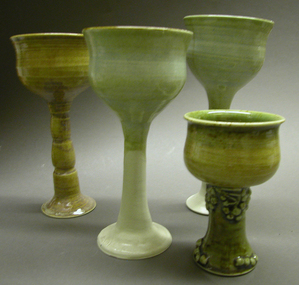
Ceramic - Artwork - Ceramics, Set of Four Goblets by John O'Loughlin
... The University provided a serious ceramic studio equipped with all the research tools for advanced ceramic exploration. Access to raw materials and a variety of kilns combined with excellent lecturers, mentors and technicians inspired, motivated and challenged him to push his accumulating knowledge to higher levels. ...The University provided a serious ceramic studio equipped with all the research tools for advanced ceramic exploration. Access to raw materials and a variety of kilns combined with excellent lecturers, mentors and technicians inspired, motivated and challenged him to push his accumulating knowledge to higher levels. ...John O'LOUGHLIN Born Snowtown, South Australia In 1980 John O'Loughlin's life changed when he started wheel throwing ceramic vessels. During this time he discarded the superfluous and unnecessary clutter collected on the journey of life, yet retaining the essence of what mattered to him. John O’Loughlin's later artworks, such as 'Reliquary No. 20' engages with the way in which organised religion, specifically the Catholic Church, deals with the translation of the spiritual into the material. Informed by his extensive travels and studies, O’Loughlin’s ceramics reference the reliquaries and church artefacts that connect the life of this world with that of faith in another world. Completing undergeduate and post graduate works at Federation University John O'Loughlin's honours thesis was entitled "Ways and Means of Meaning, The Use of Symbol and Surface as Expressive Media in Ceramic Sculpture". The University provided a serious ceramic studio equipped with all the research tools for advanced ceramic exploration. Access to raw materials and a variety of kilns combined with excellent lecturers, mentors and technicians inspired, motivated and challenged him to push his accumulating knowledge to higher levels. O'Loughlin's working method in the studio is one of quiet, determined interaction with clay, idea and content. Experimentation with a variety of temperatures, firing methods and atmospheric conditions has produced a broad tonal and textural palette. He has worked with various clay bodies overlaid with coloured oxides, slips and engobes as the foundation for many of his works. O'Loughlin ufilised raised surfaces from old cemetery tombstones using the impressed forms and textures in his constructions. This research led him to the use of dry engobes to create a sense of antiquity, with crusty and distressed surfaces that resemble objects neglected in the oceans. These objects seem covered with the accretions and accumulations of history when re-discovered and brought to the surface as miraculous objects of mystery and magic. (https://www.thefreelibrary.com/John+O%27Loughlin%3A+a+man+re-invented.-a0216897107, accessed 12 September 2020) This item is part of the Federation University Art Collection. The Art Collection features over 2000 works and was listed as a 'Ballarat Treasure' in 2007.Four wheel thrown goblets, two with decorative stems. art, artwork, john o'loughlin, ceramics, goblets -
 Federation University Art Collection
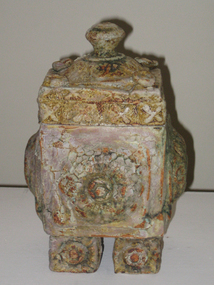
Ceramic - Artwork - Ceramics, 'Reliquary No. 20' by John O'Loughlin, 2007
... The University provided a serious ceramic studio equipped with all the research tools for advanced ceramic exploration. Access to raw materials and a variety of kilns combined with excellent lecturers, mentors and technicians inspired, motivated and challenged him to push his accumulating knowledge to higher levels. ...The University provided a serious ceramic studio equipped with all the research tools for advanced ceramic exploration. Access to raw materials and a variety of kilns combined with excellent lecturers, mentors and technicians inspired, motivated and challenged him to push his accumulating knowledge to higher levels. ...John O'LOUGHLIN Born Snowtown, South Australia In 1980 John O'Loughlin's life changed when he started wheel throwing ceramic vessels. During this time he discarded the superfluous and unnecessary clutter collected on the journey of life, yet retaining the essence of what mattered to him. John O’Loughlin's later artworks, such as 'Reliquary No. 20' engages with the way in which organised religion, specifically the Catholic Church, deals with the translation of the spiritual into the material. Informed by his extensive travels and studies, O’Loughlin’s ceramics reference the reliquaries and church artefacts that connect the life of this world with that of faith in another world. Completing undergeduate and post graduate works at Federation University John O'Loughlin's honours thesis was entitled "Ways and Means of Meaning, The Use of Symbol and Surface as Expressive Media in Ceramic Sculpture". The University provided a serious ceramic studio equipped with all the research tools for advanced ceramic exploration. Access to raw materials and a variety of kilns combined with excellent lecturers, mentors and technicians inspired, motivated and challenged him to push his accumulating knowledge to higher levels. O'Loughlin's working method in the studio is one of quiet, determined interaction with clay, idea and content. Experimentation with a variety of temperatures, firing methods and atmospheric conditions has produced a broad tonal and textural palette. He has worked with various clay bodies overlaid with coloured oxides, slips and engobes as the foundation for many of his works. O'Loughlin ufilised raised surfaces from old cemetery tombstones using the impressed forms and textures in his constructions. This research led him to the use of dry engobes to create a sense of antiquity, with crusty and distressed surfaces that resemble objects neglected in the oceans. These objects seem covered with the accretions and accumulations of history when re-discovered and brought to the surface as miraculous objects of mystery and magic. (https://www.thefreelibrary.com/John+O%27Loughlin%3A+a+man+re-invented.-a0216897107, accessed 12 September 2020) This item is part of the Federation University Art Collection. The Art Collection features over 2000 works and was listed as a 'Ballarat Treasure' in 2007.Lidded ceramic form.art, artwork, john o'loughlan, ceramics, available, available ceramics -
 Ballarat Heritage Services
Ceramic - Studio Pottery, John Gleeson, Ceramic Platter, 2007
... He mixed all his own glazes from commercially sourced raw materials, sometimes supplemented with ash from his fire and local red clay to get special effects. John Gleason studio ...John GLEESON Living at Campbell's Creek for over 30 years, John Gleeson makes a range of functional stoneware pottery. He fell in loved with pottery during a hobby class in Geelong in 1972. He worked for a year at Canny Ridge Pottery in Harcourt. John Gleeson uses white stoneware and porcelain clay from The Bendigo Pottery, and buff clay from Bennetts Pottery in Adelaide. He mixed all his own glazes from commercially sourced raw materials, sometimes supplemented with ash from his fire and local red clay to get special effects.Large celadon platter with incised fish design. john gleason, studio pottery, ceramics, australian studio pottery, platter, plate
