
Showing 84 items matching " religious group"
-
 Glen Eira Historical Society
Letter - Third Church Of Christ, Scientist, Elsternwick
... ... Religious Group...Architecture St Georges Road Overton A E Little Hazel Mrs Elsternwick Glen Huntly Road Wells Mr Ripon Grove Foundation Stones Riley David Eddy Mary Baker Church Of Christ Scientist Dispensary Hall Selwyn Street. Religious Group Church Third Church of Christ Scientist Elsternwick Third Church of Christ Scientist Melbourne. ...3 documents and a photograph photocopy of Third Church Of Christ, Scientist, Elsternwick. The first one is a document that provides a brief history of the Third Church Of Christ Scientist Melbourne. Includes notes on the building, principles and association with the mother church in Boston Massachusets. Second is a note of the inscription on the foundation stone of the church. Third is a letter from Mrs Hazel Little to Mr Wells concerning Mr Wells request for a brief history of the church. Attached in the letter is brief history and a photo of the church. The last one is a photograph photocopy of the Third Church Of Scientist which was opened in 1931.masonic hall, williams louis r., architecture, st georges road, overton a e, little hazel mrs, elsternwick, glen huntly road, wells mr, ripon grove, foundation stones, riley david, eddy mary baker, church of christ scientist, dispensary hall, selwyn street., religious group, church, third church of christ scientist elsternwick, third church of christ scientist melbourne. -
 Hume City Civic Collection
Photograph
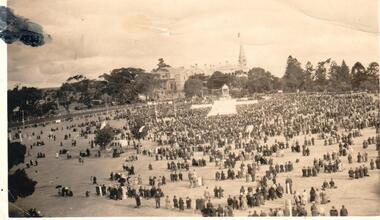
... A sepia photograph of a group at religious meeting at Rupertswood....mcmahon rupertswood religious services george evans collection Handwritten on back: McMahon A sepia photograph of a group at religious meeting at Rupertswood. ...A sepia photograph of a group at religious meeting at Rupertswood.Handwritten on back: McMahonmcmahon, rupertswood, religious services, george evans collection -
 Sunshine and District Historical Society Incorporated
Book - A Taste of Faith, Brimbank City Council, Stories of Hope and Inspiration, May, 2013
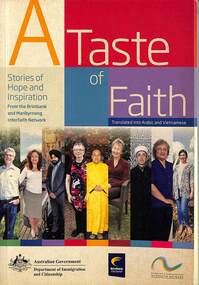
... The Brimbank and Maribyrnong Interfaith Network (BMIN) is a network open to all religious groups to promote interfaith and intercultural initiatives between different faith and cultural groups in the neighbouring municipalities of Brimbank and Maribyrnong....The Brimbank and Maribyrnong Interfaith Network (BMIN) is a network open to all religious groups to promote interfaith and intercultural initiatives between different faith and cultural groups in the neighbouring municipalities of Brimbank and Maribyrnong. ...Stories from Faith Leaders across the Brimbank and Maribyrnong areas.Paperback book with multicultural cover with title and photographsnon-fictionStories from Faith Leaders across the Brimbank and Maribyrnong areas.religion, brimbank and maribyrnong interfaith network -
 Uniting Church Archives - Synod of Victoria
Commemorative Plate, 1907
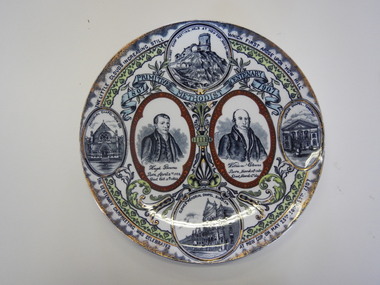
... Forty years later, in 1863, membership had grown to half a million making it the third largest religious group after Anglican and Wesleyan Methodist. ...Forty years later, in 1863, membership had grown to half a million making it the third largest religious group after Anglican and Wesleyan Methodist. ...In 1823 the membership of the Primitive Methodist church in the UK was 33,000. Forty years later, in 1863, membership had grown to half a million making it the third largest religious group after Anglican and Wesleyan Methodist. Primitive Methodism came to Australia in 1840. Source: https://www.movements.net/blog/2016/02/08/lessons-from-the-primitive-methodists-dave-price.htmlCH019.1 - Primitive Methodist white commemorative plate with grey, green, brown and gold illustrations and text. Images: Top: "First camp meeting, held at Mow Cop, May 31 1907". Right side: "Jubilee Chapel, Tunstall". Left side: "Memorial Chapel Mow Cop". Bottom:" Clowes Memorial Chapel, Burslem". Centre: "Hugh Bourne. Born April 3rd 1772. Died Oct 11th 1852" "William Cowes Born march 12th 1780 Died March 2nd 1858". The is text around the rim of the plate: "The little clouds increasing still which first arose upon Mow Hill" "The Centenary Camp Meeting was celebrated at Mow Cop on May 26th & 27th 1907". The back of the plate gives church statistics: "Truly What Hath God Wrought. Chapels & Preaching places 4,905. Ministers 1,153. Local Preachers 16,209. Church Members 210,173. Congregational ... 607,682. Sunday Schools 4,209. Teachers 61,275. Scholars 477,114. Value of Property 4,958,978 pounds. CH019.2 - Same as CH019.1 in white, blue and gold. CH019.3 - Same as CH019.1 with more gold and colour. The wording around the rim is the same but differently placed."1807 PRIMITIVE METHODIST CENTENARY 1907"primitive methodist, primitive methodist jubliee chapel tunstall, mow cop, bourne, hugh, clowes, william -
Federation University Historical Collection
Document - Document - Letter, Ballarat Junior Technical School: Letter advising the name of an accredited instructor in Christian Education, 1961
... Proposed to divide the school into two groups for religious instruction. Both groups would be supervised. ...Proposed to divide the school into two groups for religious instruction. Both groups would be supervised. ...Letter from Robert Watson providing the name of an accredited instructor in Christian Education. Proposed to divide the school into two groups for religious instruction. Both groups would be supervised. The instructor nominated by the Local Council for Christian Education is The Rev. Lloyd Phillips.1 page, typed.ballarat junior technical school, 1961, head master, robert watson, christian education, religious instruction, local council for christian education, rev lloyd phillips -
City of Moorabbin Historical Society (Operating the Box Cottage Museum)
Newsletter - City of Moorabbin Historical Society Jun 2011, June 2011
... Small paragraphs about early local Religious groups – Salvation Army, Methodist and Presbyterian Ministries – with 2 photocopied photographs. ...Small paragraphs about early local Religious groups – Salvation Army, Methodist and Presbyterian Ministries – with 2 photocopied photographs. ...The City of Moorabbin Historical Society was formed c 1960 by a group of Moorabbin residents who were concerned that the history of the area should be preserved. A good response to a call for items related to the historical area of Moorabbin Shire brought donations of a wide variety of artefacts which are now preserved by the current members of CMHS at Box Cottage Museum . Helen Stanley, Secretary of CMHS, began producing a Newsletter for members in April 2007 to provide current information and well researched items of historical interestHelen Stanley has produced a bi-monthly Newsletter, 2007 - 2013, for the members of the City of Moorabbin Historical Society that contains well researched interesting historical items, notification of upcoming events, current advice from Royal Australian Historical Society , Museums Australia Victoria and activities of Local Historical Societies. The Newsletter is an important record of the activities of the CMHS. Mrs Nance Blackman’s notes in 1978 for the Centenary of The Cheltenham Church of Christ.. The Blackman family were early settlers in Moorabbin Shire. 5 x A4 paper printed on 1 side Issue 22 of the bi-monthly, City of Moorabbin Historical Society Newsletter produced by Society member and Secretary, Mrs Helen Stanley in June 2011. Notice of meeting June 26th and CMHS members exhibited some artefacts at the ‘Fun4over50’s’ event at Kingston (Moorabbin ) Town Hall June 5th. Glen Eira City Council Building Dept. Officers inspected erosion along the North side of the Barn floor, members have planted seedlings in the garden and Helen and Joan are entering data about our ‘Collection’ onto the MAV website while Jim Dale has photographed some of the farm machinery. Small paragraphs about early local Religious groups – Salvation Army, Methodist and Presbyterian Ministries – with 2 photocopied photographs. Helen also provides the notes penned by Mrs Nance Blackman in 1978 for the Centenary of The Cheltenham Church of Christ. CITY of MOORABBIN HISTORICAL SOCIETY / JUNE 2011 NEWSLETTER city of moorabbin historical society, stanley helen, melbourne, moorabbin, brighton, cheltenham, ormond, bentleigh, mckinnon, market gardeners, pioneers, early settlers, moorabbin shire, box cottage museum, city of moorabbin, box william, glen eira city council, museums australia victoria, knott peta, church of christ cheltenham, baptist church, presbyterian church. salvation army, jasper road, point nepean road, brewer’s road, redmore rev. james, methodist mission to chinese market gardeners, blackman nance, lydia street bentleigh -
 Bendigo Military Museum
Accessory - IDENTITY DISCS
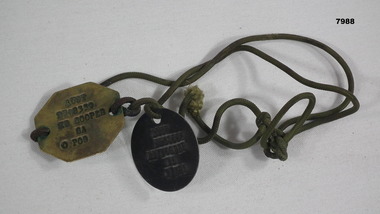
... Each is stamped with the owner's name, service number, religious denomination and blood group. Each is joined with a green coloured cord....Each is stamped with the owner's name, service number, religious denomination and blood group. Each is joined with a green coloured cord. ...Identity discs belonging to "Keith Cooper" No. 3798359. Part of the Cooper Collection.Two metal rust resistant metal discs, one brass octagonal and one black coloured circular. Each is stamped with the owner's name, service number, religious denomination and blood group. Each is joined with a green coloured cord.Stamped on each disc: “AUST 3798359, K.E. COOPER, S.A., O.POS”cooper collection, keith cooper, identity discs -
 The Beechworth Burke Museum
Photograph - Lantern Slide, c1900
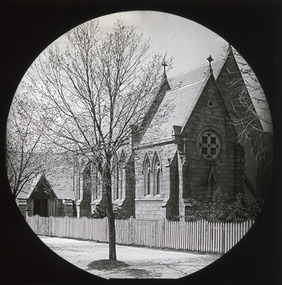
... Roman Catholicism quickly grew to be the second largest religious group in the area; this was primarily due to the work of Father William Tierney, a priest from Dublin who arrived in Beechworth in 1859. ...Roman Catholicism quickly grew to be the second largest religious group in the area; this was primarily due to the work of Father William Tierney, a priest from Dublin who arrived in Beechworth in 1859. ...Taken in the year 1900, this glass slide captures an image of St. Joseph's Church, a Roman Catholic Church that is still present today at 9 Church Street, Beechworth. This was one of many churches that was established in Beechworth during the second half of the nineteenth-century. This trend began with a focus on Anglican faith; however, in the early 1850s, Father Patrick Smyth, a priest from Maynooth, Ireland, advocated for the establishment of a Roman Catholic Church in the town. Roman Catholicism quickly grew to be the second largest religious group in the area; this was primarily due to the work of Father William Tierney, a priest from Dublin who arrived in Beechworth in 1859. Tierney personally fostered the growth of many Catholic schools and churches in Beechworth, as he viewed it to be a significant area for the prosperity of the religion. St. Josephs Church was officially established in 1866, with the Bishop of Melbourne, Dr Goold, laying the foundational stone of the building. The estimated cost of the building in its entirety was approximately twenty-thousand pounds. Further additions to the building - including a second aisle, tower and spire - were proposed for the church, but were ultimately never built. Lantern slides, sometimes called 'magic lantern' slides, are glass plates on which an image has been secured for the purpose of projection. Glass slides were etched or hand-painted for this purpose from the Eighteenth Century but the process became more popular and accessible to the public with the development of photographic-emulsion slides used with a 'Magic Lantern' device in the mid-Nineteenth Century. Photographic lantern slides comprise a double-negative emulsion layer (forming a positive image) between thin glass plates that are bound together. A number of processes existed to form and bind the emulsion layer to the base plate, including the albumen, wet plate collodion, gelatine dry plate and woodburytype techniques. Lantern slides and magic lantern technologies are seen as foundational precursors to the development of modern photography and film-making techniques.This glass slide captures social and historical significance as it represents the development of Beechworth as a prosperous and thriving town; a development that occurred during the second half of the nineteenth-century. It also shows the development of religious institutions in the area, specifically the growth of Catholicism. Thin translucent sheet of glass with a circular image printed on the front and framed in a black backing. It is held together by metal strips to secure the edges of the slide.burke museum, beechworth, lantern slide, slide, glass slide, plate, burke museum collection, photograph, monochrome, churches beechworth, st. joseph's church, catholicism beechworth, roman catholic churches beechworth, father patrick smyth, father william tierney -
 City of Melbourne Libraries
Photograph, Bull, Hugh Jones, 1897-1993, Vice-regal visit to zoo: Governor (Lord Huntingfield) and koala
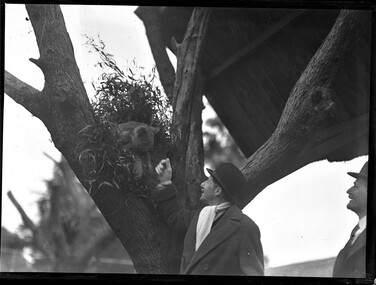
... There were widespread protests from many groups including the Nature Lovers League, Wild Life Preservation Society of Australia, Queensland Museum, C.W.A. Royal Australian Ornithologist Union, Boy Scouts, religious and women’s groups. ...There were widespread protests from many groups including the Nature Lovers League, Wild Life Preservation Society of Australia, Queensland Museum, C.W.A. Royal Australian Ornithologist Union, Boy Scouts, religious and women’s groups. ...Published: (1934, June 26). The Age (Melbourne, Vic. : 1854 - 1954), p. 11. Published title: VICE-ROYALTY GREETS THE KING OF THE BEASTS AT THE ZOO. Published caption: Lord Huntingfield experienced a pleasant “induction ceremony” as Patron of the Royal Zoological and Acclimatisation Society yesterday, when he made a tour of the Zoological Gardens. The picture shows the Governor, accompanied by Lady Huntingfield, inspecting the King of Beasts, who is submitting to a little playful treatment from the Director of the Gardens, Mr. Wilkie, while the Director whispers in his ear that a distinguished visitor has come to see him. (Inset), is a picture of Lord Huntingfield greeting one of the Koalas. Trove article identifier: http://nla.gov.au/nla.news-article204818472 Description: A man wearing a hat, scarf and overcoat reaches up to pat a koala in a tree watched by a man in a hat and suit. Research by project volunteer, Fiona Collyer: In 1932, the Zoo built an Australian native animal enclosure which visitors could enter and closely view koalas, wallabies, kookaburras and magpies all placed together. The branches of the trees in the enclosure were cut so that visitors could easily see and feed the koalas sitting in them. The cost to feed each koala fresh gum leaves was fifteen shillings per week. By 1924, Queensland was the last stronghold in Australia for the koala. They were functionally extinct in South Australia, only a few hundred in NSW, and an estimated population of 1000 animals remained in Victoria. There had been a six-month open season on koalas in Queensland in 1919 where over a million had been slaughtered, however with its vast, dense forests it was impossible to accurately know their numbers. Koala fur is tough, warm and waterproof and was in high demand from consumers in Canada, Britain and the US to make hats and gloves and for lining greatcoats. In 1927, with Queensland suffering a crippling drought and high unemployment, the cash-strapped McCormack Labor Government declared an “Open Season” on koalas and “opossums” for their skins, for the month of August. (Possums were often called “opossums” at this time but they are actually possums). There were widespread protests from many groups including the Nature Lovers League, Wild Life Preservation Society of Australia, Queensland Museum, C.W.A. Royal Australian Ornithologist Union, Boy Scouts, religious and women’s groups. There were letters to newspapers from ordinary people, editorials and pleas to women to refuse to wear or purchase koala fur. People questioned the masculinity of koala hunters as it was felt that no proper bushman or sportsman would kill such a defenceless creature. The Brisbane Courier newspaper led the campaign, devoting six columns a day to “Spare the Bear”. Author Vance Palmer sent an impassioned letter to the editor of the The Brisbane Courier, 19 July 1927: “Sir- It is be hoped that the disgust which all humane people have felt at the declaration of an open season for native bears in August will not be allowed to fade away until some protest... so overwhelming and effective that the question will never be raised again. For the shooting of our harmless and loveable native bear is nothing less than barbarous. His case is entirely different from that of other furred animals. No one has ever accused him of spoiling the farmers’ wheat, eating the squatters’ grass or even spreading the prickly pear. There is not a social vice that can be put down to his account. In addition, he is comparatively defenceless. He affords no sport to the gunman, and can be trusted to present a sitting target to the creature mean enough to aim at him. For this reason he has been almost blotted out already from some areas, in days when our fauna and flora were held in such little regard that the settlers’ first instinct was to shoot every strange animal and to sink his axe into every unfamiliar tree.” The Anglican Archbishop of Brisbane, Gerald Sharp, had his letter published in The Brisbane Courier on 16 July 1927: “Sir... The extermination of fauna so distinctive of our country, especially of such harmless and pretty creatures as our native bears, seems to me a shameful thing, and this is likely to mean their extermination.” But it was all to no avail. Known as “Black August”, the government was unmoved by the public’s outrage. 10,000 licences were issued to hunters and “the slaughter of the innocents” went ahead. The newspapers were full of stories of dreadful cruelty against the helpless, benign creatures by the heartless hunters who not only used guns and spotlights but wire snares and cyanide baits so that pelts wouldn’t be damaged. Infant koalas were left orphaned and unlikely to survive without their mothers. Top quality pelts were sold at an average price of 56 shillings and 9 pence per dozen, poor quality skins for as little as 2 1/2 pence each. In December 1927, the Minister for Agriculture and Stock, Mr W. Forgan Smith told the Parliament that during the August open season 597,985 koala pelts worth £139,595 had netted the state’s coffers £6000. 952,194 “opossum” pelts were sold and £9000 made for the State. The backlash that followed helped topple the Queensland Labor Government in 1929. The Wild Life Preservation Society of Australia lobbied the Prime Minister Mr Stanley Bruce to refuse to issue exportation permits for koala pelts and from 10 November 1927 the Commonwealth Government suspended the issuing of permits. In 1930, the Society made a direct appeal to USA President Herbert Hoover and he signed an order prohibiting the importation of koala and wombat fur to USA, eliminating a major market. Koala pelts were often deliberately mislabelled “wombat” to get around restrictions. The ban most likely saved the koala from probable extinction. Three years later the Australian Federal Government banned the export of koala products. This movement against koala killing was really the first conservation campaign in Australia. It raised awareness of the vulnerability of a beloved animal and eventually brought about national parks and national laws for their protection. By 1936, community opposition to possum open seasons was beginning. The koala was made a Protected Species in all states in 1937, meaning no one is allowed to harm a koala, however the laws protecting the gum trees they rely on for food and shelter are weak. The Australian Government estimates the wild koala population in Australia is between 225,000 and 500,000 in 2024. The Australian Koala Foundation estimates the national population at less than 60,000 in 2021 with a 30% decline in three years. Habitat loss from land clearing, dog attacks, road deaths, chlamydia, bushfires and drought exacerbated by climate change, continues to cause their decline. Over eight million koalas were killed for their pelts between 1888 and 1927. Any one of the annual harvests killed more koalas than are alive now. At this time, children were also being taught to appreciate Australian native animals. In 1933, “Blinky Bill: The Quaint Little Australian” book for children was published by Angus and Robertson. It was written and illustrated by New Zealand-born author Dorothy Wall and “Dedicated to my son Peter and all other Peters and Johns and Bobs and Toms and Marys and Bettys and Joans and Pats and all kind children.” The book tells the story of Blinky Bill - a mischievous, patched knickerbocker-wearing koala and his mother and father. The story has messages of conservation and instances of human unkindness and cruelty. Mr. and Mrs. Koala and young Blinky lead a mostly idyllic family life amongst a variety of other animals in the forest. However it all changes in chapter two, when Blinky Bill’s father is distressingly shot by a hunter. There is a harrowing description of Mr. Koala’s shooting and eventual death. “The Koala family lived so happily; never thinking of harm, or that anything could happen to disturb their little home, as all they asked for were plenty of fresh gum-leaves and the warm sun. They had no idea such things as guns were in the world or that a human being had a heart so cruel that he would take a pleasure in seeing a poor little body riddled with bullets hanging helplessly from the tree-top... That same being might just as well take his gun and shoot baby kookaburras, so helpless were they all and so trusting.” “Poor Mr. Koala one day was curled up asleep in his favourite corner, when the terrible thing happened. Bang! He opened his eyes in wonder. What was that? Did the limb of the tree snap where that young cub of his was skylarking? ... bang! again. This time he felt a stinging pain in his leg... Peering over the bough of the tree he saw a man on the ground with something long and black in his arms... Another bang and his ear began to hurt. Bang! again and now his little body was stinging all over. He grunted loudly and slowly climbed up the tree, calling Mrs. Koala and Blinky as he went. He managed to reach the topmost branch... Tears were pouring down his poor little face. He brushed them away with his front paws and cried just like a baby. Fortunately Mrs. Koala and Blinky Bill were hiding in the leaves quite motionless, and the shadows of the tree made them appear as part of it. The man with the gun stood and waited a long time, then walked away, whistling as he went - the only sound to be heard in the bush except the cries of the little bear far up in the tree.” Blinky and his mother quietly and fearfully wait for Mr. Koala to wake. In the morning, grunting and crying, they feel his lifeless body with their paws. Eventually Mrs. Koala realises that her husband is dead and that they need to move to a safe place. After travelling deeper into the forest, Mrs. Koala and Blinky meet koalas Mrs. Grunty and her son Snubby and she describes how she was captured as a baby by koala fur trappers to be a pet for a little girl. The trapper forgot to bring gum leaves for the koala so they try to feed her cake, milk and bananas, making her sick. The little girl’s father relays something he read in the paper: “During the year 1920 to 1921, two hundred and five thousand six hundred and seventy-nine koalas were killed and their skins sold to the fur market, under the name of wombat.” They place the koala in a box with a teddy bear for company. The baby koala’s health deteriorates and the alarmed trapper returns her to the bush. Mrs. Grunty tells Mrs. Koala that she and Blinky are the only bears that she has seen for ten years: “I remember well the little girl’s father telling her... that not so many years ago the bush was alive with us bears, from Queensland to the south of Victoria. Now, we are so rare that we have become a curiosity, something to put in zoos, for children to see; and actually in museums. I believe our grandparents sit there in glass cases, stuffed with something inside to make them appear alive, and, oh dear, glass eyes. In New South Wales, I think we could wander for miles from one corner to another and never meet a bear. I don’t know why we were all killed. As you know, we don’t eat the farmers’ crop or ruin their orchards. All we asked for were our own gum-trees.” At the end of the book, Dorothy tells her readers - “The kindest action of all would be to leave the koala baby in his own bushland, among his own playmates, with the sun, the sky, the birds, and the gum-trees, where he will grow to manhood and live for many years - happy as he should be.” In 1934, a “Wild Zoo”, the Sir Colin Mackenzie Sanctuary, opened on 32 hectares of land, formerly part of Coranderrk Aboriginal Reserve in the Yarra Valley, exclusively displaying Australian native animals, birds and reptiles. It was later renamed Healesville Sanctuary and is now managed by Melbourne Zoo and home to over 200 species of Australian native fauna. The Sanctuary is committed to rescuing, breeding, researching and raising awareness of the vulnerability of Australian animals. Andrew Arthur Wellesley Wilkie, 1853-1948, was Director of the Melbourne Zoo from 1923 to 1936 and was associated with the zoo for 70 years. He first worked as a horticultural assistant to Government botanist Baron Ferdinand von Mueller at the Botanical Gardens at the age of 13, along with his older brother David. One of Andrew’s jobs was to capture moths for the National Herbarium. In 1857, a group of prominent Melburnians assembled at St. Patrick’s Hall to form the Zoological Society of Victoria, with the aim of introducing animals and plants from overseas. It was conceived, “For the purposes of science and for that of affording the public the advantages of studying the habits of the animal creation in properly arranged zoological gardens.” The Victorian Government granted 32 acres (13 hectares) of land to the Zoological Society at the southern end of Richmond Paddock on the opposite bank to the Botanical Gardens. (This is where AAMI Stadium and Collingwood Football Club now stand.) In 1861, the Zoological Society of Victoria was renamed The Acclimatisation Society of Victoria. Unfortunately the Yarra River frontage was damp, swampy and subject to flooding, so the animals were briefly housed at the Botanical Gardens until in 1862, the City of Melbourne donated 55 acres (22 hectares) of land at Royal Park for the fledgling zoo. Baron von Mueller secured employment at Royal Park for Andrew and David and they helped to lay out the gardens, plant trees and take care of a collection of deer, pheasants, hares and partridges. Initially the zoo was used for the acclimatisation of animals recovering from the long voyage to Australia and for breeding them for sport. In 1872, the zoo bought two lions, a leopard and a cheetah that had been seized from circus showmen Keith and Phillips when they were unable to pay the bill of butcher Mr T K Bennet of Bourke Street. The first zoo director, Mr. Albert Le Souef, negotiated with captains of ships to buy animals at overseas ports they visited and soon a multitude of exotic species arrived, including a ten-year-old Indian elephant in 1878. In 1923, after being head keeper for some years, Andrew was appointed director of the zoo. By 1933, the zoo had 110 different species of animals, 200 species of birds and 72 species of reptiles under Andrew’s care. He had personally planted all but six trees and laid out the garden beds. As director he lobbied authorities for funds to build more humane enclosures for the animals. In June 1928, Table Talk magazine wrote of Andrew Wilkie: “Up at the Zoo there is a humble gentleman who is a lion among the lions, who knows the proper specific to employ when the boa constrictor has chilblains, and who is a friend and confidant of Queenie the elephant. His fount of zoological lore has never been plumbed. It is bottomless, like his good fellowship and geniality. Every day he may be seen somewhere in the grounds of that growing sanctuary for the strange and arresting fauna and creeping things of the world, and I assure you as one who is privy to his passion that that area and its inhabitants are rarely out of his thoughts.” Andrew retired from the zoo in 1936 at the age of 83 and in 1948 died at his home in Brunswick aged 94. He and his wife Josephine had six children. The Victorian Acclimatisation Society was founded in 1861 by Edward Wilson, 1813-1878, then owner and editor of The Argus newspaper. He said that Australian indigenous animals were practically useless, providing only “a little sport and an occasional meal”. The Society believed that Australia’s plants and animals were vastly inferior to those in Europe. They wanted to introduce and acclimatise to Victoria “all innoxious animals, birds, fishes, insects and vegetables, whether useful or ornamental” for sport and for the table, and to spread indigenous animals and plants from the colony around the world. Their motto was “if it lives, we want it”. The Society was primarily responsible for introducing sparrows, starlings, sambar and hog deer, ostriches, brown trout, blackberries, and carp to the Murray River. They released the European songbirds, thrush and blackbird to quell the homesickness of British settlers. The Society also sent Australian animals like platypus, echidnas, kangaroos and koalas to Europe for scientific and novelty purposes. Thomas Austin, a wealthy sheep farmer of Barwon Park, Winchelsea (property now owned by the National Trust) was a member and in 1859 he introduced hares, blackbirds, thrushes and partridges onto his property. He is probably best known for introducing 24 breeding rabbits onto his estate as game for shooting parties. Thomas quipped, “The introduction of a few rabbits could do little harm and might provide a touch of home, in addition to a spot of hunting." In 2022, genomic data confirmed that Australia’s feral rabbit population is entirely descended from these rabbits. Biological control has brought the rabbit population down from an estimated high of 10 billion rabbits in the 1920s to approximately 200 million today, inhabiting 70% of Australian landmass (5.3 million square kilometres). In 1872, the Acclimatisation Society was renamed The Zoological and Acclimatisation Society of Victoria and they focused on importing exotic animals for display purposes to the zoo. In 1937, the Royal Acclimatisation Society of Victoria was recreated as the Zoological Board of Victoria with a focus on research of native animals threatened with extinction. In an editorial for The Argus newspaper, 16 March 1856, Edward Wilson lamented: "...this country has been shamelessly stolen from the blacks. Had they been like the New Zealanders or the North American Indians, we should have bought their land, and supplied them with the means of living when we took it... In less than twenty years we have nearly swept them off the face of the earth. We have shot them down like dogs. In the guise of friendship we have issued corrosion sublimate in their damper, and consigned whole tribes to the agonies of an excruciating death. We have made them drunkards, and infected them with disease which has rotted the bones of their adults, and made such few children as are born amongst them a sorrow and a torture from the very instant of their birth. We have made them outcasts on their own land, and are rapidly consigning them to entire annihilation. There are but a few of them left, comparatively. This is what we would do for that few. We would feed and clothe every one of them.” [Note: this last sentence is italicized in the original newspaper article text]. Lord Huntingfield, (William Charles Arcedeckne Vanneck) 1883-1969, Governor of Victoria 1934-1939, was a British Conservative Party politician and the first ever Australian-born Governor of an Australian state (although he was always considered British). He was patron of the Royal Zoological and Acclimatisation Society of Victoria and was acting Governor-General for six months during the absence of Lord Gowie in 1938. Lady Huntingfield (née Margaret Eleanor Crosby) 1884-1943, his American-born wife showed great interest in social welfare and the advancement of women and children. She was president of the City Newsboys Society and Patroness of the Girls Friendly Society. In 1937, rose breeder Alister Clark named a yellow hybrid tea rose for her. In 1940, the City of Melbourne opened the Lady Huntingfield Free Kindergarten in North Melbourne, now the Lady Huntingfield Early Learning and Family Services Centre. Lady Huntingfield died in London in 1943 after her house was bombed during a German airstrike. The Lady Huntingfield Memorial Scholarship was established after the City of Melbourne raised £1000 in a public appeal conducted in her memory for students undertaking a Social Work degree at the University of Melbourne. It is awarded annually to this day. The Queen Victoria Hospital named a bed in her honour. References: VICE-ROYALTY GREETS THE KING OF BEASTS AT THE ZOO. (1934, June 26). The Age (Melbourne, Vic. : 1854 - 1954), p. 11. Retrieved August 23, 2024, from http://nla.gov.au/nla.news-article204818472 Prominent Personalities ANDREW WILKIE (1928, June 7). Table Talk (Melbourne, Vic. : 1885 - 1939), p. 15. Retrieved August 29, 2024, from http://nla.gov.au/nla.news-article146562949 'Edward Wilson (journalist)', Wikipedia, https://en.wikipedia.org/wiki/Edward_Wilson_(journalist) 'Thomas Austin (pastoralist)', Wikipedia, https://en.wikipedia.org/wiki/Thomas_Austin_(pastoralist) 'The Acclimatisation Society was driven by misguided ideals about 'fixing nature' in Australia', ABC News, https://www.abc.net.au/news/2022-11-04/acclimatisation-society-introduced-species-history-listen/101588262?utm_campaign=abc_news_web&utm_content=link&utm_medium=content_shared&utm_source=abc_news_web Blinky Bill: the quaint little Australian (eBook); by Dorothy Wall, 1933, 2023, Project Gutenberg Australia, https://gutenberg.net.au/ebooks04/0400571h.html "Black August": Queensland's Open Season on koalas in 1927 (thesis); Glenn Fowler, 1993, Australian National University, https://www.savethekoala.com/wp-content/uploads/2018/11/Black-August.pdf Unfair game: Queensland's Open Season on koalas in 1927; Jacqui Donegan, 2000, University of Queensland, https://mesto-ku.narod.ru/koalas.pdf OPEN SEASON CONDEMNED. (1927, July 19). The Brisbane Courier (Qld. : 1864 - 1933), p. 15. Retrieved September 5, 2024, from http://nla.gov.au/nla.news-article21863465 COUNTRY WOMEN'S ASSOCIATION. (1927, July 30). The Brisbane Courier (Qld. : 1864 - 1933), p. 25. Retrieved September 20, 2024, from http://nla.gov.au/nla.news-article21866965 AUSTRALIA: Barnardo's children at Melbourne Park Zoo (1929), British Pathé, YouTube, https://www.youtube.com/watch?v=_Wcrbo_cHpI 'Kodak Cinegraph Compilation No 8', ACMI Collection, https://www.youtube.com/watch?v=MCrBng5RwFI KOALA SKINS. EXPORT BAN SOUGHT. (1927, August 4). The Brisbane Courier (Qld. : 1864 - 1933), p. 10. Retrieved September 15, 2024, from http://nla.gov.au/nla.news-article21868746 THE ABORIGINES. (1856, March 16). The Argus (Melbourne, Vic. : 1848 - 1957), p. 5. Retrieved September 28, 2024, from http://nla.gov.au/nla.news-article4833244 Koala Bears (1937), British Pathé, YouTube, https://www.youtube.com/watch?v=XbqgMtyuzwE Australian Koala Bear (Earliest Archive Footage: 1929), Pond5, https://www.pond5.com/stock-footage/item/152767491-australian-koala-bear-earliest-archive-footage-1929Photographer notations on slide: "Vice Regal visit to zoo B42".1930-1939, zoos, governors, koalas, conservation, possums, botanic gardens -
 Flagstaff Hill Maritime Museum and Village
Book - Reference Book/History, Henry Smith Williams, The Historians History of the World Vol 16 set 1 - Edited by Henry Smith Williams L.L.D. Published by “The Times” 1908, 1908
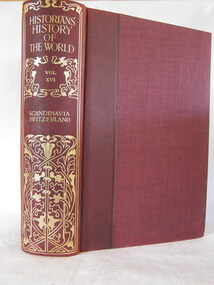
... religious and political movement that ran parallel to, but was distinct from, Martin Luther’s Reformation in Germany. It transformed Switzerland from a collection of Catholic territories into a religiously divided confederation and established the Reformed branch of Protestantism. Interestingly the movement began in the German-speaking cantons, led by Zwingli. With the "Affair of the Sausages 1522," serving as the spark. During Lent, a group...religious and political movement that ran parallel to, but was distinct from, Martin Luther’s Reformation in Germany. It transformed Switzerland from a collection of Catholic territories into a religiously divided confederation and established the Reformed branch of Protestantism. Interestingly the movement began in the German-speaking cantons, led by Zwingli. With the "Affair of the Sausages 1522," serving as the spark. During Lent, a group ...Henry Smith Williams’ “The Historians' History of the World” is a chronological and geographical "tapestry" of human events, these twenty five volumes occupy a very specific and prestigious place in historical research. The primary subjects of Volume 16 are Scandinavia (including the history of Norway, Sweden, and Denmark) and the history of Switzerland up to the year 1715.The Book is part of a 25 volume set with red cloth bindings and gold filigree design to rib.non-fictionHenry Smith Williams’ “The Historians' History of the World” is a chronological and geographical "tapestry" of human events, these twenty five volumes occupy a very specific and prestigious place in historical research. The primary subjects of Volume 16 are Scandinavia (including the history of Norway, Sweden, and Denmark) and the history of Switzerland up to the year 1715.flagstaff hill, warrnambool, shipwrecked-coast, flagstaff-hill, flagstaff-hill-maritime-museum, maritime-museum, shipwreck-coast, flagstaff-hill-maritime-village, book, the historians history of the world vol 16 set 1 -
 Flagstaff Hill Maritime Museum and Village
Book - Reference Religious Ideology, Charles Taze Russell, Millennial Dawn Vol 1 The Plan of the Ages, 1905
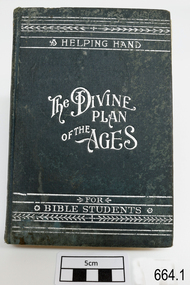
... His religious calling began in the early 1870s when, after attending an Adventist meeting, he started holding his own independent Bible study groups to re-examine scripture without denominational creeds. ...His religious calling began in the early 1870s when, after attending an Adventist meeting, he started holding his own independent Bible study groups to re-examine scripture without denominational creeds. ...Millennial Dawn, Vol. 1 (The Plan of the Ages) was published in 1905 by the Watch Tower Bible & Tract Society and is a central text in the history of modern American millenarianism. The subject book was originally published in 1886 under the title The Plan of the Ages, and later re-titled The Divine Plan of the Ages as part of the Studies in the Scriptures series. Volume 1 lays out the foundational theological framework of Charles Taze Russell's religious movement. The book argues that God operates through distinct chronological "dispensations" or ages, such as the Patriarchal Age, the Jewish Age, and the Gospel Age, leading up to the "Millennial Age". Its primary themes include the harmonising of the scriptures while attempting to systematically reconcile Old and New Testament prophecies.Millennial Dawn Vol 1 (The Plan of The Ages) Author: Charles Taze Russell Publisher: Watch Tower Bible & Tract Society. Allegheny, PA USA 1905 Date: 1905 Further Information: Blue hard cover book with white text to lettering and front board edge pattern designnon-fictionMillennial Dawn, Vol. 1 (The Plan of the Ages) was published in 1905 by the Watch Tower Bible & Tract Society and is a central text in the history of modern American millenarianism. The subject book was originally published in 1886 under the title The Plan of the Ages, and later re-titled The Divine Plan of the Ages as part of the Studies in the Scriptures series. Volume 1 lays out the foundational theological framework of Charles Taze Russell's religious movement. The book argues that God operates through distinct chronological "dispensations" or ages, such as the Patriarchal Age, the Jewish Age, and the Gospel Age, leading up to the "Millennial Age". Its primary themes include the harmonising of the scriptures while attempting to systematically reconcile Old and New Testament prophecies.flagstaff hill, warrnambool, shipwrecked-coast, flagstaff-hill, flagstaff-hill-maritime-museum, maritime-museum, shipwreck-coast, millennial dawn vol 1 the plan of the ages, book, religious works, watch tower bible & tract society, charles taze russell, jehova witness, bible studies -
 The Beechworth Burke Museum
Audio - Oral History, Jennifer Williams, Dr Roy Phillips, 8th October 2000 (exact date unclear)
... He describes town life from a child's point of view during a time of transition to life after the Gold Rush era, including social tensions existing between cultural groups such as the Chinese community and European-heritage townspeople and between people of different religious groups in Beechworth. This oral history account is socially and historically significant as it is a part of a broader collection of interviews conducted by Jennifer Williams which were published in the book 'Listen to what they say: voices of twentieth-century Beechworth.' ...Roy Phillips was born in 1907 in Yackandandah and moved with his family to Beechworth when he was five years old. His father was involved in dredging operations at Lake Sambell but his parents also had other family living in Beechworth, with whom they lived. Dr Phillips tells vivid stories about life in Beechworth in the first half of the Twentieth Century, from the daily lives of young children of the time to the town's relationship to the local Chinese community. He discusses features of the landscape such as 'The Rock' at which community concerts were held and 'The Echo' (an echo-sounding point over a nearby gully) which he states are no longer used in the same way. He also discusses changing community attitudes to various issues, for example, 'not being coddled' as a child but living in a town with very strict rules about people of different religions mingling. This oral history recording was part of a project conducted by Jennifer Williams in the year 2000 to capture the everyday life and struggles in Beechworth during the twentieth century. This project involved recording seventy oral histories on cassette tapes of local Beechworth residents which were then published in a book titled: Listen to what they say: voices of twentieth century Beechworth. These cassette tapes were digitised in July 2021 with funds made available by the Friends of the Burke.Dr Roy Phillips' account of his life in Beechworth in the early part of the 20th Century is historically and socially significant to the cultural heritage of the region. He describes town life from a child's point of view during a time of transition to life after the Gold Rush era, including social tensions existing between cultural groups such as the Chinese community and European-heritage townspeople and between people of different religious groups in Beechworth. This oral history account is socially and historically significant as it is a part of a broader collection of interviews conducted by Jennifer Williams which were published in the book 'Listen to what they say: voices of twentieth-century Beechworth.' While the township of Beechworth is known for its history as a gold rush town, these accounts provide a unique insight into the day-to-day life of the town's residents during the 20th century, many of which will have now been lost if they had not been preserved.This is a digital copy of a recording that was originally captured on a cassette tape. The cassette tape is black with a horizontal white strip and is currently stored in a clear flat plastic rectangular container. It holds up 40 minutes of recordings on each side.Dr Roy Phillips /beechworth, yackandandah, wangaratta, mining, dredging, 1910s, 1920s, 1930s, chinese community, typhoid, lake kerferd, reminiscences, memories, childhood, lake sambell, alcoholism, new year celebrations, transport, horses, foresters lodge, oddfellows lodge, funeral practices, child-rearing practices, star hotel, the rock, racism, chinese dragon, benevolent society, star lane coach building factory, outdoor concerts, gold, jimmy ingram, kelly gang, kelly family, churches, catholic, methodist, protestant, anglican, confuscionist, buddhism, women's christian temperance association, hotels, twentieth century, coronation of king george iv, echo point, the echo, tippany cat, marbles, children's games, cornish, cornwall, listen to what they say, oral history -
 The Beechworth Burke Museum
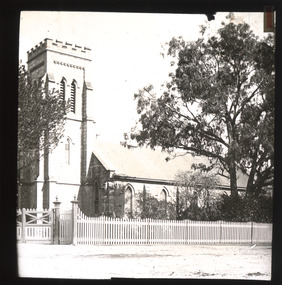
Photograph - Lantern Slide, c1900
... religious infrastructure in the late Nineteenth Century. It is also an example of an early photographic and film-making technology in use in regional Victoria in the time period. Beechworth Lantern Slide Slide Glass Slide Plate Burke Museum Collection Photograph Monochrome christ church indigo shire north-east victoria churches architecture anglican religion atlantic cedar organ magic lantern christ church st peter and st paul beechworth treescape group cork oak bunya pine bunya bunya kurrajong Quercus suber Cedrus atlantica f. glauca Araucaria bidwillii Brachychiton populneus Obverse: 1 / Thin translucent sheet of glass with a square image printed on the front and framed in a black backing. ...Beechworth's Anglican Church, Christ Church St Peter and St Paul, has served the Beechworth community since 1858 in its present form, following its beginnings in a tent in 1855. The Victorian branch of the National Trust classified the building as regionally significant in 1959 and the organ as of significance to the nation in 1992. Building a place for Anglican worship was a priority in the early days of Beechworth's settlement as the town was a site of regional administration due to its association with the economic and social expansion of Victoria during the Gold Rush period. The Church garden features several significant trees monitored by the Beechworth Treescape Group, including a cork oak growing near the Ford Street entrance, an Atlantic cedar, a bunya or bunya-bunya pine and two kurrajongs. Some of these long-established trees may be visible in this lantern-slide image. Lantern slides, sometimes called 'magic lantern' slides, are glass plates on which an image has been secured for the purpose of projection. Glass slides were etched or hand-painted for this purpose from the Eighteenth Century but the process became more popular and accessible to the public with the development of photographic-emulsion slides used with a 'Magic Lantern' device in the mid-Nineteenth Century. Photographic lantern slides comprise a double-negative emulsion layer (forming a positive image) between thin glass plates that are bound together. A number of processes existed to form and bind the emulsion layer to the base plate, including the albumen, wet plate collodion, gelatine dry plate and woodburytype techniques. Lantern slides and magic lantern technologies are seen as foundational precursors to the development of modern photography and film-making techniques.This glass slide is significant because it provides insight into Beechworth's social amenities and religious infrastructure in the late Nineteenth Century. It is also an example of an early photographic and film-making technology in use in regional Victoria in the time period.Thin translucent sheet of glass with a square image printed on the front and framed in a black backing. It is held together by metals strips to secure the edges of the slide.Obverse: 1 /beechworth, lantern slide, slide, glass slide, plate, burke museum collection, photograph, monochrome, christ church, indigo shire, north-east victoria, churches, architecture, anglican, religion, atlantic cedar, organ, magic lantern, christ church st peter and st paul, beechworth treescape group, cork oak, bunya pine, bunya bunya, kurrajong, quercus suber, cedrus atlantica f. glauca, araucaria bidwillii, brachychiton populneus -
 Mission to Seafarers Victoria
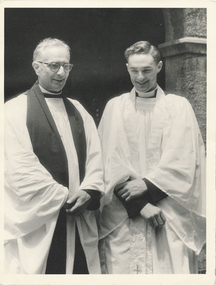
Photograph, 5 January 1958
... Each of his and Lesley’s four children, Jeremy (TC 1979), David, Antony and Kate (TC 1987) was born at that time, during which amongst other things, Rodney taught Religious Instruction, Latin and English, pioneered bushwalking and mountain climbing in western Victoria, ran a large scouting group and coached an Australian archer....Each of his and Lesley’s four children, Jeremy (TC 1979), David, Antony and Kate (TC 1987) was born at that time, during which amongst other things, Rodney taught Religious Instruction, Latin and English, pioneered bushwalking and mountain climbing in western Victoria, ran a large scouting group and coached an Australian archer. rodney oliver frank leslie oliver mission to seafarers flinders street st peter chapel courtyard ordination john rodney oliver (1931-2010) Medium format photograph depicting two chaplains. ...John Rodney Oliver (7 July 1931 – 26 September 2010) was the son of Frank and Moira. Rodney Oliver was born on 7 July 1931, and lived for many years at the Missions to Seamen at the Flinders St Extension. Rodney was schooled at Melbourne Grammar, matriculating in 1948. Then, after a couple of years as a lumberjack and jackaroo, he commenced at University of Melbourne, beginning more than half a century’s association with Trinity College. Graduating with a BA in 1953, Rodney then made the first of many trips to England, reading theology at Bishop’s College, Cheshunt. A man who revelled in scholarship, he was also a competitive and energetic bowler, snooker and squash player. Ordained deacon on 23 September 1956, in the St Albans Diocese, his first ministry as curate began at the picturebook village of Much Hadham, where he met the love of his life, Lesley Brooks. Rodney was ordained priest on 5 January 1958, at the Missions to Seamen, Melbourne, commenced twelve years as Chaplain of Ballarat Grammar School in February 1958, and returned to England to marry Lesley in early 1961. Each of his and Lesley’s four children, Jeremy (TC 1979), David, Antony and Kate (TC 1987) was born at that time, during which amongst other things, Rodney taught Religious Instruction, Latin and English, pioneered bushwalking and mountain climbing in western Victoria, ran a large scouting group and coached an Australian archer.Medium format photograph depicting two chaplains.rodney oliver, frank leslie oliver, mission to seafarers, flinders street, st peter chapel, courtyard, ordination, john rodney oliver (1931-2010) -
 Flagstaff Hill Maritime Museum and Village
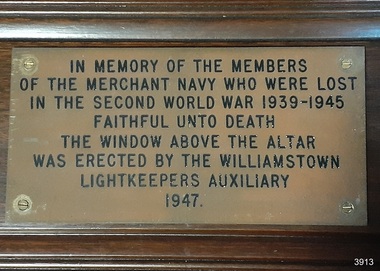
Plaque - Commemorative Plaque, circa August 1947
... group raised helped to furnish the St Nicholas Seamen’s Church in Williamstown, including the Sanctuary window, pews, carpets and hangings. These items are now part of the St Nicholas Seamen's Church Williamstown Collection at Flagstaff Hill Maritime Village, Warrnambool. flagstaff hill warrnambool flagstaff hill maritime museum maritime museum shipwreck coast flagstaff hill maritime village mission to seamen williamstown st nicholas seaman’s church williamstown missions to seamen victoria mission to seafarers lightkeepers auxiliary ladies harbour light guild 139 nelson place williamstown religion religious service sailors rest bethel sailors’ church bethel floating church e. s. & a. bank williamstown christ directing a sailor christ showing the helmsman the way quartermaster’s hand on the wheel stained glass window church window religious window sanctuary window memorial window war memorial window victorian war heritage inventory victorian heritage database merchant navy ww2 1939-1945 anglican church bishop mckie flying angel club williamstown lightkeepers' auxiliary ladies' harbour lights guild commemorative window memorial plaque merchant navy WW II St. ...This commemorative plaque was made for the round, stained glass memorial window titled “Christ showing the helmsman the way”, originally installed at the St Nicholas Seamen’s Church in Williamstown. The window was donated as a memorial to the members of the Merchant Navy whose lives were lost in the Second World War, 1939-1945. The donor was the Williamstown Lightkeepers Auxiliary, an independent ladies' association that worked with the Williamstown Missions to Seamen (renamed the Mission to Seafarers in 2000). The window was officially dedicated on December 14, 1947, by Geelong's Anglican Bishop, Rt. Rev. J.D. McKie. In the early months of 1948, this bronze plaque was also placed in the chapel above the altar. The Williamstown St Nicholas Seamen’s Church ceased operation in 1966. In 1979, the Victoria Missions to Seamen donated this round, stained glass window and the memorial plaque to Flagstaff Hill Maritime Village, along with many other items and furnishings. These items have been used to simulate the Williamstown Mission and Chapel as much as possible. THE MISSIONS TO SEAMEN: - The Missions to Seamen was an Anglican charity that served seafarers since 1856 in Great Britain. Its symbol is a Flying Angel, inspired by a Bible verse. Today, there are centres in over 200 ports worldwide where seamen of all backgrounds are offered a warm welcome and provided with a wide range of facilities. In Victoria, the orgainsation began in Williamstown in 1857 as a Sailors’ Church, also known as ‘Bethel’ or the ‘Floating Church’ in an old hulk floating in Hobson’s Bay, Port of Melbourne. It soon became part of the Missions to Seamen, Victoria. In the year 2000, the organisation, now named Mission to Seafarers, still operated locally in Melbourne, Portland, Geelong and Hastings. The Ladies’ Harbour Lights Guild was formed in 1906 to support the Missions to Seamen in Melbourne and other centres such as Williamstown. Two of the most significant ladies of the Guild were founder Ethel Augusta Godfrey and foundation member Alice Sibthorpe Tracy (who established a branch of the Guild in Warrnambool in 1920). The Guild continued its work until the 1960s. In 1943, a former Williamstown bank was purchased for the Missions to Seamen Club. The chapel was named St Nicholas’ Seamen’s Church and was supported by the Ladies’ Harbour Lights Guild, the Williamstown Lightkeepers’ Auxiliary and the League of Soldiers’ and Sailors’ Friends. It ceased operation in 1966. A Missions to Seamen Chapel and Recreation Room was a significant feature of ports during the late 1800s and into the 1900s. It seemed appropriate for Flagstaff Hill to include such a representation within the new Maritime Village, so the Melbourne Board of Management of Missions to Seamen Victoria gave its permission on 21st May 1979 for the entire furnishings of the Williamstown chapel to be transferred to Flagstaff Hill. The St Nicholas Seamen’s Church was officially opened on October 11, 1981 and closely resembles the Williamstown chapel. This plaque is significant for its connection with the round Sanctuary window above the altar in the chapel at Flagstaff Hill. The window was originally installed at the chapel of the St Nicholas Seamen’s Church in Williamstown in 1947, and is listed on the Victorian War Heritage Inventory No. 196973 as an object of significance. The plaque is also significant for its recognition of the members of the Merchant Navy who lost their lives in service to our country during World War II. The plaque is important for its connection with the Williamstown Lightkeepers’ Auxiliary and Missions to Seamen, which were dedicated to supporting seafarers from all over the world. The funds the group raised helped to furnish the St Nicholas Seamen’s Church in Williamstown, including the Sanctuary window, pews, carpets and hangings. These items are now part of the St Nicholas Seamen's Church Williamstown Collection at Flagstaff Hill Maritime Village, Warrnambool. Plaque: rectangular brass commemorative plaque. Each corner has a round hole. Inscription impressed into the metal and filled in with black paint. Plaque refers to the memorial, a stained glass window titled "Christ Showing the Helmsman the Way," donated by the Williamstown Lightkeepers' Auxiliary to the Willimastown Missions to Seamen. This plaque is part of the St. Nicholas Seamen's Church Collection. “IN MEMORY OF THE MEMBERS / OF THE MERCHANT NAVY WHO WERE LOST / IN THE SECOND WORLD WAR 1939-1945 / FAITHFUL UNTO DEATH / THE WINDOW ABOVE THE ALTAR / WAS ERECTED BY THE WILLIAMSTOWN / LIGHTKEEPERS AUXILIARY / 1947.”flagstaff hill, warrnambool, flagstaff hill maritime museum, maritime museum, shipwreck coast, flagstaff hill maritime village, mission to seamen williamstown, st nicholas seaman’s church williamstown, missions to seamen victoria, mission to seafarers, lightkeepers auxiliary, ladies harbour light guild, 139 nelson place williamstown, religion, religious service, sailors rest, bethel sailors’ church, bethel floating church, e. s. & a. bank williamstown, christ directing a sailor, christ showing the helmsman the way, quartermaster’s hand on the wheel, stained glass window, church window, religious window, sanctuary window, memorial window, war memorial window, victorian war heritage inventory, victorian heritage database, merchant navy ww2, 1939-1945, anglican church, bishop mckie, flying angel club, williamstown lightkeepers' auxiliary, ladies' harbour lights guild, commemorative window, memorial plaque, merchant navy, ww ii, st. nicholas seamen's church -
 Flagstaff Hill Maritime Museum and Village
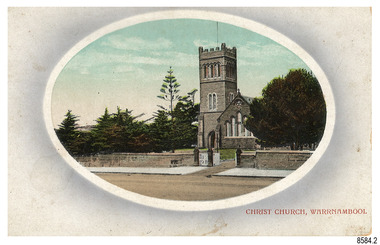
Postcard - Historical, Warrnambool, Christ Church, Warrnambool, Early 20th century
... groups and citizens of early Warrnambool. This postcard of Christ Church Warrnambool is significant for its connection to the church. The early building of the church in 1856, within the first decade of Warrnambool being proclaimed a town, shows the strong religious desire of the community. ...The nine postcards in this set were donated together and date to the early 1900s. All but one postcard in this set shows images of Warrnambool, in the Western District of Victoria; the other has a London image. The postcards were all printed in Great Britain according to that country’s postal regulations. The fronts of all cards have titles printed in red. Most of the images on the cards are attributed to photographer Joseph Jordan and belong to the Jordan Series. The back of these cards has an outline for a postage stamp, a vertical dividing line and a heading on each side of the line to separate the Correspondence from the Address. Postcards or ‘correspondence cards’ appeared in Britain in 1894. They were plain cards with a space for the message on one side and an address on the other; regulations didn’t allow anything but the address to be written on the ‘address’ side. In 1902 the British regulations then allowed a picture to be printed on the front and the address on the back, so messages had to be written on the picture side. Soon, the regulations changed and the back was divided for a message and the address. Christ Church Warrnambool – The image on this card shows Christ Church, a stone building built in 1856. The Anglican church is in Henna Street, Warrnambool. The church, outer buildings and grounds are heritage-listed. Its bell tower harbours German bells. Joseph Jordan - Joseph Jordan was born in 1841 in Leicester England. When he was 16 he joined the 7th Queen's Own Hussars and was sent to India at the outbreak of the mutiny. He took part in the relief of Lucknow and remained in India for eleven years. It was during this time, he became interested in photography. He was posted to New Zealand and later came to Victoria, becoming a sergeant major of the Mounted Rifles. In the mid-1880s he came to the Western district where he was responsible for establishing units of the Mounted Rifles in various country towns such as Dunkeld, Mortlake, Panmure, Bushfield, Koroit etc. He resigned from the army in 1889 and set up a professional photography studio in Liebig Street, Warrnambool. He became very well known in the Western District for family photographs, official photographs of local councillors and groups as well as views of local scenery. In 1891 he photographed the wrecked barque ‘Fiji’ at ‘Wrecks Beach’ near Princetown. His business was taken over by his son Arthur around 1917. Joseph was a keen rifle shot and in 1924 he donated the "Jordan Shield" as a prize to the Victorian Rifle Association. He was made a "Life Honorary Member" of the Warrnambool Returned Soldiers League and in 1933 he was recognised as being the oldest living soldier in Victoria. Joseph died in 1935 aged 95.This card is the only one of the nine cards with the location of Warrnambool added to the name 'Joseph Series'. It is also the only one that has text within the outline for the postage stamp. The font used for the test of the headings is slightly different to the other cards. Joseph Jordan is a significant figure in Warrnambool history as he helped to establish early units of the Mounted Rifles (G Company) in local towns during the late 1880's and later, photographed local scenes, groups and citizens of early Warrnambool. This postcard of Christ Church Warrnambool is significant for its connection to the church. The early building of the church in 1856, within the first decade of Warrnambool being proclaimed a town, shows the strong religious desire of the community. The church is part of Warrnambool's life events and the historical significance of the building,Postcard, one of nine, landscape orientation, coloured print within an oval border and mauve-toned shading. The cameo image is a stone castle-top bell tower beside a church building flanked by trees. A stone fence is across the front, with pedestrian and vehicle white picket gates. The title is in red print on the front of the card. There is no correspondence written on the card. The reverse has inscriptions and outlines for a postage stamp. Jordan Series, printed in Great Britain.Front, in red: “CHRIST CHURCH, WARRNAMBOOL” Back in black: “Jordan Series” “POST CARD” “PRINTED IN GREAT BRITAIN” “For correspondence” “The Address only to be written here”flagstaff hill maritime museum, flagstaff hill maritime village, flagstaff hill maritime museum and village, maritime museum, warrnambool, great ocean road, warrnambool and district, warrnambool scenes, local scenes, views of warrnambool, joseph jordan, jordan series, jordan photography, postcard, souvenir, correspondence, cameo postcard, landscape, christ church, bell tower, german bells, warrnambool church, religious building, stone building, anglican church, parish of warrnambool -
 Flagstaff Hill Maritime Museum and Village
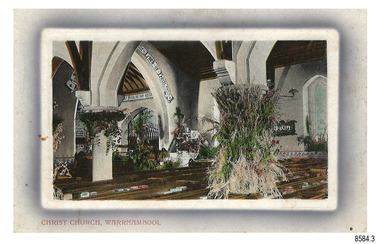
Postcard - Historical, Flagstaff Hill, Christ Church, Warrnambool, Early 20th century
... groups and citizens of early Warrnambool. This postcard of Christ Church Warrnambool is significant for its connection to the church. The early building of the church in 1856, within the first decade of Warrnambool being proclaimed a town, shows the strong religious desire of the community. ...The nine postcards in this set were donated together and date to the early 1900s. All but one postcard in this set shows images of Warrnambool, in the Western District of Victoria; the other has a London image. The postcards were all printed in Great Britain according to that country’s postal regulations. The fronts of all cards have titles printed in red. Most of the images on the cards are attributed to photographer Joseph Jordan and belong to the Jordan Series. The back of these cards has an outline for a postage stamp, a vertical dividing line and a heading on each side of the line to separate the Correspondence from the Address. Postcards or ‘correspondence cards’ appeared in Britain in 1894. They were plain cards with a space for the message on one side and an address on the other; regulations didn’t allow anything but the address to be written on the ‘address’ side. In 1902 the British regulations then allowed a picture to be printed on the front and the address on the back, so messages had to be written on the picture side. Soon, the regulations changed and the back was divided for a message and the address. Christ Church Warrnambool – The image on this card shows Christ Church, a stone building built in 1856. The Anglican church is in Henna Street, Warrnambool. The church, outer buildings and grounds are heritage-listed. Its bell tower harbours German bells. Joseph Jordan - Joseph Jordan was born in 1841 in Leicester England. When he was 16 he joined the 7th Queen's Own Hussars and was sent to India at the outbreak of the mutiny. He took part in the relief of Lucknow and remained in India for eleven years. It was during this time, he became interested in photography. He was posted to New Zealand and later came to Victoria, becoming a sergeant major of the Mounted Rifles. In the mid-1880s he came to the Western district where he was responsible for establishing units of the Mounted Rifles in various country towns such as Dunkeld, Mortlake, Panmure, Bushfield, Koroit etc. He resigned from the army in 1889 and set up a professional photography studio in Liebig Street, Warrnambool. He became very well known in the Western District for family photographs, official photographs of local councillors and groups as well as views of local scenery. In 1891 he photographed the wrecked barque ‘Fiji’ at ‘Wrecks Beach’ near Princetown. His business was taken over by his son Arthur around 1917. Joseph was a keen rifle shot and in 1924 he donated the "Jordan Shield" as a prize to the Victorian Rifle Association. He was made a "Life Honorary Member" of the Warrnambool Returned Soldiers League and in 1933 he was recognised as being the oldest living soldier in Victoria. Joseph died in 1935 aged 95.This card is the only one of the nine cards with the location of Warrnambool added to the name 'Joseph Series'. It is also the only one that has text within the outline for the postage stamp. The font used for the test of the headings is slightly different to the other cards. Joseph Jordan is a significant figure in Warrnambool history as he helped to establish early units of the Mounted Rifles (G Company) in local towns during the late 1880's and later, photographed local scenes, groups and citizens of early Warrnambool. This postcard of Christ Church Warrnambool is significant for its connection to the church. The early building of the church in 1856, within the first decade of Warrnambool being proclaimed a town, shows the strong religious desire of the community. The church is part of Warrnambool's life events and the historical significance of the building,Postcard, one of nine, landscape orientation, coloured print within an oval border and mauve-toned shading. The cameo image is of the Interior of the church chapel, with exposed timber beams, white arches decorated with flowers, pews with books on shelves, and organ pipes. There is text on the image. The title is in red print on the front of the card. The back has inscriptions and outlines for a postage stamp. There is no correspondence written on the card. Jordan Series, printed in Great Britain.Front, in red: “CHRIST CHURCH, WARRNAMBOOL” Back in black: “Jordan Series” “POST CARD” “PRINTED IN GREAT BRITAIN” “For correspondence” “The Address only to be written here” Text on the arch: "THE LORD OF HOSTS"flagstaff hill maritime museum, flagstaff hill maritime village, flagstaff hill maritime museum and village, maritime museum, warrnambool, great ocean road, warrnambool and district, warrnambool scenes, local scenes, views of warrnambool, joseph jordan, jordan series, jordan photography, postcard, souvenir, correspondence, cameo postcard, landscape, christ church, bell tower, german bells, warrnambool church, religious building, stone building, anglican church, parish of warrnambool, arch pillars -
 Flagstaff Hill Maritime Museum and Village
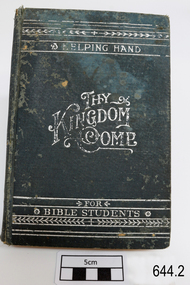
Book - Reference Religious Ideology, Charles Taze Russell, Millennial Dawn Vol 3 Thy Kingdom Come, 1905
... His religious calling began in the early 1870s when, after attending an Adventist meeting, he started holding his own independent Bible study groups to re-examine scripture without denominational creeds. ...His religious calling began in the early 1870s when, after attending an Adventist meeting, he started holding his own independent Bible study groups to re-examine scripture without denominational creeds. ...Millennial Dawn, Vol. 3 (Thy Kingdom Come) was published in 1905 by the Watch Tower Bible & Tract Society and is a central text in the history of modern American millenarianism. The subject book was originally published in 1886 under the title The Plan of the Ages, and later re-titled The Divine Plan of the Ages as part of the Studies in the Scriptures series. Volume 1 lays out the foundational theological framework of Charles Taze Russell's religious movement. The book argues that God operates through distinct chronological "dispensations" or ages, such as the Patriarchal Age, the Jewish Age, and the Gospel Age, leading up to the "Millennial Age". Its primary themes include the harmonising of the scriptures while attempting to systematically reconcile Old and New Testament prophecies.Millennial Dawn Vol 3 (Thy Kingdom Come) Author: Charles Taze Russell Publisher: Watch Tower Bible & Tract Society. Allegheny, PA USA 1905 Date: 1905 Further Information: Blue hard cover book with white text to lettering and front board edge pattern designnon-fictionMillennial Dawn, Vol. 3 (Thy Kingdom Come) was published in 1905 by the Watch Tower Bible & Tract Society and is a central text in the history of modern American millenarianism. The subject book was originally published in 1886 under the title The Plan of the Ages, and later re-titled The Divine Plan of the Ages as part of the Studies in the Scriptures series. Volume 1 lays out the foundational theological framework of Charles Taze Russell's religious movement. The book argues that God operates through distinct chronological "dispensations" or ages, such as the Patriarchal Age, the Jewish Age, and the Gospel Age, leading up to the "Millennial Age". Its primary themes include the harmonising of the scriptures while attempting to systematically reconcile Old and New Testament prophecies.flagstaff hill, warrnambool, shipwrecked-coast, flagstaff-hill, flagstaff-hill-maritime-museum, maritime-museum, shipwreck-coast, millennial dawn vol 1 the plan of the ages, book, religious works, watch tower bible & tract society, charles taze russell, jehova witness, bible studies -
 Flagstaff Hill Maritime Museum and Village
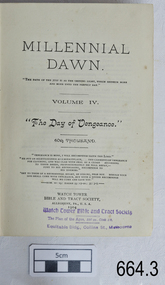
Book - Reference Religious Ideology, Charles Taze Russell, Millennial Dawn Vol 4 The Day of Vengeance, 1905
... His religious calling began in the early 1870s when, after attending an Adventist meeting, he started holding his own independent Bible study groups to re-examine scripture without denominational creeds. ...His religious calling began in the early 1870s when, after attending an Adventist meeting, he started holding his own independent Bible study groups to re-examine scripture without denominational creeds. ...Millennial Dawn, Vol. 4 (The Day of Vengeance) was published in 1905 by the Watch Tower Bible & Tract Society and is a central text in the history of modern American millenarianism. The subject book was originally published in 1886 under the title The Plan of the Ages, and later re-titled The Divine Plan of the Ages as part of the Studies in the Scriptures series. Volume 1 lays out the foundational theological framework of Charles Taze Russell's religious movement. The book argues that God operates through distinct chronological "dispensations" or ages, such as the Patriarchal Age, the Jewish Age, and the Gospel Age, leading up to the "Millennial Age". Its primary themes include the harmonising of the scriptures while attempting to systematically reconcile Old and New Testament prophecies.Millennial Dawn Vol 4 (The Day of Vengeance) Author: Charles Taze Russell Publisher: Watch Tower Bible & Tract Society. Allegheny, PA USA 1905 Date: 1905 Further Information: Blue hard cover book with white text to lettering and front board edge pattern designMillennial Dawn, Vol. 4 (The Day of Vengeance) was published in 1905 by the Watch Tower Bible & Tract Society and is a central text in the history of modern American millenarianism. The subject book was originally published in 1886 under the title The Plan of the Ages, and later re-titled The Divine Plan of the Ages as part of the Studies in the Scriptures series. Volume 1 lays out the foundational theological framework of Charles Taze Russell's religious movement. The book argues that God operates through distinct chronological "dispensations" or ages, such as the Patriarchal Age, the Jewish Age, and the Gospel Age, leading up to the "Millennial Age". Its primary themes include the harmonising of the scriptures while attempting to systematically reconcile Old and New Testament prophecies.flagstaff hill, warrnambool, shipwrecked-coast, flagstaff-hill, flagstaff-hill-maritime-museum, maritime-museum, shipwreck-coast, millennial dawn vol 1 the plan of the ages, book, religious works, watch tower bible & tract society, charles taze russell, jehova witness, bible studies -
 Flagstaff Hill Maritime Museum and Village
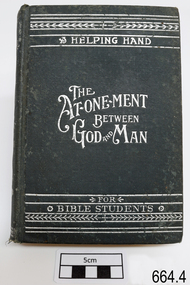
Book - Reference Religious Ideology, Charles Taze Russell, Millennial Dawn Vol 4 The Atonement of Man, 1905
... His religious calling began in the early 1870s when, after attending an Adventist meeting, he started holding his own independent Bible study groups to re-examine scripture without denominational creeds. ...His religious calling began in the early 1870s when, after attending an Adventist meeting, he started holding his own independent Bible study groups to re-examine scripture without denominational creeds. ...Millennial Dawn, Vol. 4 (The Atonement of Man) was published in 1905 by the Watch Tower Bible & Tract Society and is a central text in the history of modern American millenarianism. The subject book was originally published in 1886 under the title The Plan of the Ages, and later re-titled The Divine Plan of the Ages as part of the Studies in the Scriptures series. Volume 1 lays out the foundational theological framework of Charles Taze Russell's religious movement. The book argues that God operates through distinct chronological "dispensations" or ages, such as the Patriarchal Age, the Jewish Age, and the Gospel Age, leading up to the "Millennial Age". Its primary themes include the harmonising of the scriptures while attempting to systematically reconcile Old and New Testament prophecies.Millennial Dawn Vol 4 (The Atonement of Man) Author: Charles Taze Russell Publisher: Watch Tower Bible & Tract Society. Allegheny, PA USA 1905 Date: 1905 Further Information: Blue hard cover book with white text to lettering and front board edge pattern designnon-fictionMillennial Dawn, Vol. 4 (The Atonement of Man) was published in 1905 by the Watch Tower Bible & Tract Society and is a central text in the history of modern American millenarianism. The subject book was originally published in 1886 under the title The Plan of the Ages, and later re-titled The Divine Plan of the Ages as part of the Studies in the Scriptures series. Volume 1 lays out the foundational theological framework of Charles Taze Russell's religious movement. The book argues that God operates through distinct chronological "dispensations" or ages, such as the Patriarchal Age, the Jewish Age, and the Gospel Age, leading up to the "Millennial Age". Its primary themes include the harmonising of the scriptures while attempting to systematically reconcile Old and New Testament prophecies.flagstaff hill, warrnambool, shipwrecked-coast, flagstaff-hill, flagstaff-hill-maritime-museum, maritime-museum, shipwreck-coast, millennial dawn vol 1 the plan of the ages, book, religious works, watch tower bible & tract society, charles taze russell, jehova witness, bible studies -
 City of Moorabbin Historical Society (Operating the Box Cottage Museum)
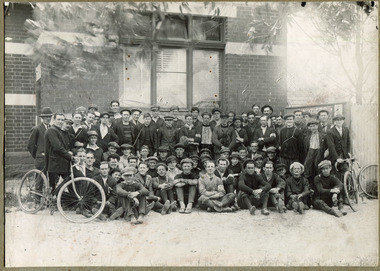
Photograph, Black & White, Cycling Group Cheltenham c1908, c1908
... Early settlers in Moorabbin Shire came together for social, religious, sporting and entertainment. This group is probably from the Cheltenham area, possibly a Church Group , and are preparing for a day of riding....Early settlers in Moorabbin Shire came together for social, religious, sporting and entertainment. This group is probably from the Cheltenham area, possibly a Church Group , and are preparing for a day of riding. ...Early settlers in Moorabbin Shire came together for social, religious, sporting and entertainment. This group is probably from the Cheltenham area, possibly a Church Group , and are preparing for a day of riding.Community Groups with Church or Sporting associations were integral to the spiritual well being and social life of the early settlers in Moorabbin Shire.Black & White photograph of a large group of male cyclists with their bicycles c1908, bicycles, moorabbin, cheltenham, dendy henry, dendy's special survey 1841, assisted emigrants early settlers, pioneers, market gardeners, marigold flowers, pharmacy, charman stephen, gettens mary, charman harriet, methodist church cheltenham, primitive methodists, box william, box elizabeth, state schools, education, moorabbin shire, moorabbin roads board, city of moorabbin, kingston city council -
 The Beechworth Burke Museum
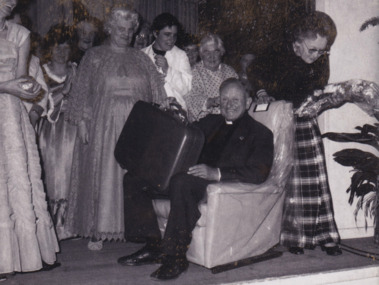
Photograph, c. 1960
... Depicted in this photograph is a religious minister or priest dressed in a dark suit with a clerical collar. He is seated in an armchair holding a small suitcase or a briefcase. A group...Depicted in this photograph is a religious minister or priest dressed in a dark suit with a clerical collar. He is seated in an armchair holding a small suitcase or a briefcase. A group ...Depicted in this photograph is a religious minister or priest dressed in a dark suit with a clerical collar. He is seated in an armchair holding a small suitcase or a briefcase. A group of adults (mainly women) dressed in formal attire are standing behind him, while a older women holding a bouquet stands beside him.Black and white rectangular reproduced photograph printed on matte photographic paper Reverse: 6952 (in pencil)/ B62K091 (stamped in black ink)/entertainment album, beechworth, burke museum, religion -
 The Beechworth Burke Museum
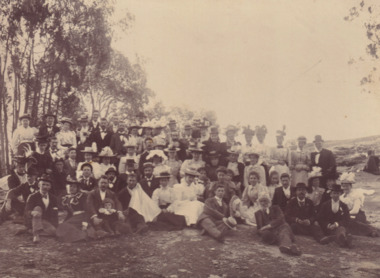
Photograph
... Group. The photograph provides insight into one of the first religious institutions in Beechworth. ...The photograph depicts a large group of young men and women dressed in formal attire. They were part of the Beechworth Methodist Church's Youth Group.The photograph provides insight into one of the first religious institutions in Beechworth. The Methodist Church is historically significant as it was the first permanent church built on the Ovens goldfield in 1857. A Sunday School group for local youth was established in 1869, emphasising the importance of children's religious education during the nineteenth century. Thus, the photograph reflects the importance of Methodism in Beechworth - and, more broadly, Victoria - at this time.Sepia rectangular photograph printed on matte photographic paper mounted on card.Reverse: 3714 / Beechworth Meth / 97.2332 / Endeavour / Beechworth Methodist / Endeavour Group /entertainment album, entertainment, church, religion, beechworth, methodist church, youth group, leisure, recreation -
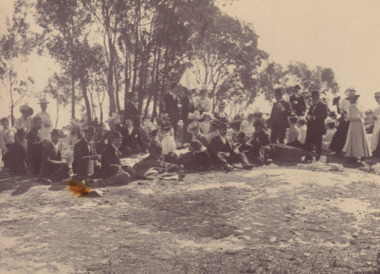 The Beechworth Burke Museum
Photograph, 1920
... Group. The photograph provides insight into one of the first religious institutions in Beechworth. ...The photograph depicts a large group of young men and women dressed in formal attire. They were part of the Beechworth Methodist Church's Youth Group.The photograph provides insight into one of the first religious institutions in Beechworth. The Methodist Church is historically significant as it was the first permanent church built on the Ovens goldfield in 1857. A Sunday School group for local youth was established in 1869, emphasising the importance of children's religious education during the nineteenth century. Thus, the photograph reflects the importance of Methodism in Beechworth - and, more broadly, Victoria - at this time.Sepia rectangular photograph printed on matte photographic paper mounted on card.Reverse: 3716 / 97.2339 / Beechworth / Meth Endeavour / Beechworth Methodist Church / Endeavour Group / A03289 /entertainment, entertainment album, church, beechworth, religion, recreation, leisure, youth group, methodist church -
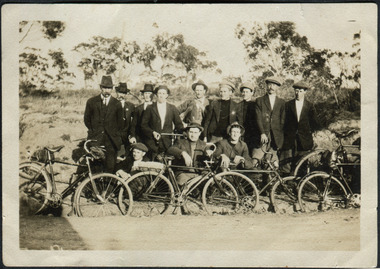 City of Moorabbin Historical Society (Operating the Box Cottage Museum)
Photographs, 7 x B&W Circa 1918 Cheltenham Methodist Youth Group, Circa 1918 Photos of Cheltenham Methodist Youth Group, 1918
... The Methodist Church, Balcombe Road was the 2nd religious building to be erected in Spring Grove now known as Cheltenham c 1857 cheltenham cheltenham methodist youth group 1914 1918 charman stephen, gettens mary, spring grove, methodist church, charman road, balcombe road, dendy henry, henry dendy's special survey 1841, youth groups, social groups, market gardners, early settlers, pioneers, dairy farmers, poultry farmers, pig farmers,moorabbin, brighton, Photo 1 - 3 on back : Flinders 1918 Photo 4 left on back : Holiday at Cockatoo right on back : Whitehead Photo 5-7 nil 7 small black and white photographs of the Cheltenham Methodist Youth Group at Flinders, Cockatoo and unkown locations, c 1918 . ...Circa 1918: Various Photos of the Cheltenham Methodist Youth Group. Row 1 and 2: "At Flinders". Row 3: 1st Left, "Holidaying at Cockatoo". in 1852 Stephen Charman, who had arrived in Melbourne 1842 aged 21 years as one of Henry Dendy's emigrants, purchased 160 acres in Spring Grove ( now Cheltenham). Stephen and his family lived in a wattle and daub hut and worked hard to establish a market garden, poultry and pig farm. The first Methodist Church Services were held at their home. In 1855 Stephen gave 1 acre of his land on Balcombe Road to the Methodist Church for a School, Burial ground and a Chapel which was built in 1857.The Methodist Church, Balcombe Road was the 2nd religious building to be erected in Spring Grove now known as Cheltenham c 18577 small black and white photographs of the Cheltenham Methodist Youth Group at Flinders, Cockatoo and unkown locations, c 1918 . First 3 photos are of male cyclists on a trip to Flinders, Victoria. Photo 4 shows 6 ladies and a man on holiday at Cockatoo in the Dandenong Ranges ,Victoria . Photos 5 to 7 show men, women and children in bushland surroundings of unrecorded locations.Photo 1 - 3 on back : Flinders 1918 Photo 4 left on back : Holiday at Cockatoo right on back : Whitehead Photo 5-7 nilcheltenham, cheltenham methodist youth group, 1914, 1918, charman stephen, gettens mary, spring grove, methodist church, charman road, balcombe road, dendy henry, henry dendy's special survey 1841, youth groups, social groups, market gardners, early settlers, pioneers, dairy farmers, poultry farmers, pig farmers,moorabbin, brighton, -
Glen Eira Historical Society
Document - Bambra Road Methodist Church, Northcote Avenue
... Caulfield North Religious Groups Methodist Church Uniting Church Clergy Sunday Schools Organs Church Furniture Stained Glass. ...Photocopy Of A 2 Page Extract From A Coming Together Book Compiled By Gwenda Mann Describing The History Of Bambra Road Methodist Church. It Contains Information From 75 Years At St Stephen’s Caulfield, Including Union With Bambra Road Methodist Church By Della Hilton, 1985. A Photograph Of Several Small Extracts From This Publication Is Also Included. Also Brief Note By Claire Barton Dated 07/05/2010 With Street And Directory References.bambra road, bambra road methodist church, caulfield north, everett l.d., st stephen’s presbyterian church caulfield, alday thomas rev, everett win, bambra road trustees, alday thomas mrs, everett keith, caulfield park, caulfield park bowling club, heazlewood vere, goddard sydney, smith ray j. m., hilton della, northcote avenue, pask n. h., goff j. t. j, talbot n. e. g, lavender j. c., o’ connor t. m., smith r. j. m, selomb h. w., hawkins h. l, freeman j. t., mannering c. w. j., gray n. a., weatherlake r. c., croxford r. l. g., wilson g. rev., small h. rev., dunstan a. rev., caulfield methodist circuit, caulfield council, anderson mrs., caulfield north, religious groups, methodist church, uniting church, clergy, sunday schools, organs, church furniture, stained glass. -
Glen Eira Historical Society
Document - Carnegie Methodist Church, Neerim Rd, 252- 254, Carnegie
... Carnegie Carnegie Methodist Church Schools Parsonages Rosstown State School Churches Sunday Schools Methodist Church Religious Groups Oakleigh Circuit Uniting Church Methodist Circuit Neerim Road Williams H. ...Four items about this church: 1/ Booklet Carnegie Methodist Church 70th Anniversary "Back to Carnegie" produced as the Carnegie Methodist Monthly Vol. 3 No. 1 - May 1956. Includes history information and Office Bearers of the Church with sketch 130mm x 65mm.18 pages plus covers. 2/ Booklet Carnegie Methodist Church, 80th anniversary "Back to Carnegie" covering 1886 to 1966. It includes a brief history of the Church. Includes sketch 130mm x 65mm. 8 pages plus covers. 3/ Booklet (on foolscap-sized card folded in half) titled Neerim Road (Carnegie) - Uniting Church of Australia - Formerly Carnegie Methodist Church - Centenary 1886 – 1986. Includes order of Morning Service. Includes exterior photograph 150mm x 80mm. Information printed on all 4 sides. Also an insert for the 04/05/1986 morning service celebrating the Neerim Road Centenary Anniversary - details of service and humns included 4/ 12 page music booklet for Harvest Anthem - I will feed My Flock composed by Caleb Simper, stamped Carnegie Methodist Choir on the front cover.carnegie, carnegie methodist church, schools, parsonages, rosstown state school, churches, sunday schools, methodist church, religious groups, oakleigh circuit, uniting church, methodist circuit, neerim road, williams h. j. rev, wells w. p. rev, jamison mr., wade mr, webb mr, baker mr., wilton mr., pearson mr., barrett mr., evans mr, stables, edgar w. h., secomb w. e. rev, tratham j. rev, rowse j. w. rev., alday t. rev, turner e. rev, leslie j. rev., adamson t. rev., palamountain wid. rev, holtham w. h. rev, wellard w. e. rev, rankin f. j. rev, bridgborn w. c. rev, tregear g. rev., newbegin f. w., harris h. r rev., phillips c. r. rev., wise mr., barnett mr., woods mr., phillp. mr., retallick mr., amos mr., long mr., ellis mr., ralph mr, walker mr., butler mr., snell mr., chisholm mr., bruce mr., sparlio mr., beecham mr., spencer mr., pascoe mr, archer mr., watson mr., arneil r., harwood charles, dunn j. t., gordon r., bracher l. a., johnson a. mrs., welch don, rose frank, hussack francis, marshall noreen, newitam ron, watson lawry, mathias rex rev, churchward a. rev, wallace g. e., smith jack mrs., byron mrs., daniels mrs, williams h. j. mrs, green anne, huffer n. mrs., cawthorn h. a., hunt a. w., kemp w. r. rev, addinsall c. roy, harrison w. r. rev, addisall c. r. mrs, addisall joan, bone bob, johns mrs., gordon e., rodgers keith, govers mrs, watters graham, wesleyan chilf, wesley hall carne, mcconachy r. s. rev, williams les. mrs., festivals and celebrations, mac rae chris, moorhead k. h. rev, shepparson avenue, james street, glenhuntly, toolambool road, edgar w. h., secomb w. e., hillis geoff, barners peter, moyle bruce, barry warrick, kilgour alex, green kevin rev, mcmullin bruce, gaylard heather, byard trevor rev, wells w. p. rev, trathen j, rouse j. w, alday t, turner e, leslie j., adamson t, palamountain w. j., secomb w. e., holtham w. h, hooper r. e., lloyd g., tregear g., shackelly e, rankin f, tonkin e, churchward s, harris g. c, beckett r., hamlett j. b., camilatos p., macrae jenny -
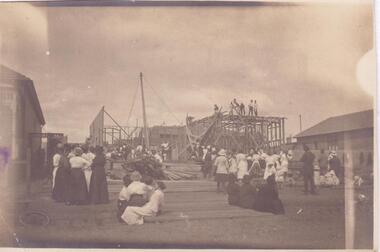 Glen Eira Historical Society
Letter - Bambra Road Church Of Christ
... L. Haddon A L Religious Groups Everett Maisie Youth Clubs Everett Doris Lynch Maisie Collings A. ...This file contains four items. 1/Photocopied pamphlet on the establishment of the Bambra Road Church of Christ, Caulfield South, including information on its early members and the pioneers of the nineteenth century church meetings. The pamphlet was produced for the fiftieth anniversary of the church in May 1970 and includes copies of photographs and drawings of the early church. 2/A postcard photograph by W. Sanderson, taken c. 1921, of the building of the church of Christ, Bambra Road, built in one day. Included with the photo is a letter for the donation dated 02/05/1998. 3/Information on Bambra Road Church of Christ, undated and unattributed, providing details about the pipe organ, Joint Choir and the Adult Group which continued at St. Stephen’s after the Union of the Churches. 4/Two photographs, dated 20/11/2009, of the front of the former Bambra Road Church of Christ and of the foundation stone. The Church is now used by the Beit Hamasiach Messianic Congregation.caulfield south, churches, ennis reg., glenhuntly, sunday schools, earl h.s., bambra road, princes park, cheek stephen, churches of christ, st. stephen’s church, killey f., bambra road church of christ, mcdiarmid a. b, mortimer w., clubs and associations, robbins h. b., religious ceremonies, williams e. l., haddon a l, religious groups, everett maisie, youth clubs, everett doris, lynch maisie, collings a. b., eaton c. burdell, mccann taylor, collings c., davey a., neeson mrs, brooker mr., venty mrs., buckingham mrs, brooker mrs., deveraux mrs, carnie mrs, meehan k., sanderson w., sanderson vera, architects, construction (events and activities), sunday school union of the churches of christ victoria, bible school committee of the churches of christ, beit hamasiach messianic congregation, sport and recreation -
Glen Eira Historical Society
Book - Christ Church, Ormond (Anglican)
... Holt Wilfred Poole Tony Wardrop George Stone Ron North Road Wheatley Road Katandra Road Manson Vi Religious Groups Morrison Bill Christian Bob Drumond Jack Downham Elise King Rita Mollinson Ada Baxter Edna Baxter Ted Bebbington Arthur Collinson Ed. ...The Christ Church Chronicles; 1901 – 2001: A presentation of Christ Church, Ormonds history for its centennial celebration, By Vi Manson. A detailed history of Christ Church Ormond, including the church building, vicars, the church community, furniture, organ and bells, societies and fellowships, social groups and youth groups, music, choir, sporting groups, social history, (e.g. fashion, transportation) role of church in the community, missionary work. Includes a list of vicars and long - serving parishioners. Includes black and white photos (36mm x 43mm – 165mm x 116mm).haste victor rev, laidlay w. w. rev., hamilton karl rev., connelly jim rev., cheong geoff rev., cooling w. r. rev., tunstall denise, mitchell e. (ted) rev., raymond c. h., zammit catherine, brown stan rev., williams r. h. b., durance ronald rev., backhouse walter rev., fullard leonard, dunlop julie, hewton mrs., dryden albert, laby beth, n’diaye maree, parker lorraine, seymour gary, sayce val, jackson nell, winn alan, mollison don, anderson bruce, savage jennie, clay cynthia, grant warwick, martin jon, ingamells phillip, ingamells hope, hewton d. r., phillips w.a., brewer c. a., martin w. perry, robinson e. e., thorp h. j., harvey e. a. c., coish c. j., huggett b. d., simpson m. j., holt wilfred, poole tony, wardrop george, stone ron, north road, wheatley road, katandra road, manson vi, religious groups, morrison bill, christian bob, drumond jack, downham elise, king rita, mollinson ada, baxter edna, baxter ted, bebbington arthur, collinson ed., grant gladys, grant alec, holt betty (geer), holt kath, ingamells fred, rivers pam, thompson merle, choirs, organs, anglican church, sunday schools, tennis clubs, depression 1929 – 1939, world war 1914 – 1918, clergy residences, bells, cemeteries, youth clubs, sport, libraries, camping, newspapers, ormond, christchurch ormond, anglican christ church ormond -
Glen Eira Historical Society
Article - Elsternwick Congregational Church – Caulfield Union Church
... Mary’s Anglican Church Architectural Styles Architectural Features Gothic Revival Architecture Fonts Clergy Religious Groups Sunday Schools Congregational Church Religious Structures and Establishments Article Elsternwick Congregational Church – Caulfield Union Church ...A two page article Elsternwick Congregational Church by J. O’Donnell, No. 12 October 1974 describing the church’s history. Includes references and exterior photograph. Undated typed Short History of Elsternwick Congregational Church by Jim McLoghlin. Brief handwritten note dated August 1984 by Jim McLoghlin about the church’s history. Brief typed, undated, unattributed not about the church’s early history. Brief undated, handwritten note by Jim McLoghlin about the church’s history in the 1970s and 1980s. Photocopy of a page from A Coming Together, entitled Elsternwick Congregational Church: Some Memories by Jim McLoghlin dated 01/01/1989. Two pages of undated typed and handwritten notes by Trevor Hart concerning the early history of the church including The Fincham Organ. Printout of brief biographical details of Rev. William Poole, first resident pastor at Caulfield Union Church, from a website. URL is included. Photocopy of brief article from The Southern Baptist of 26/01/1911 describing the life of Rev. John Reid, an early pastor at Caulfield Union Church after his recent death. Undated, unattributed handwritten brief note of rate book entries from 1879 and 1888 for the Caulfield Union Church site.elsternwick congregational church, o’donnell j., caulfield union church, watts thomas, black chapel, hawthorn road, balaclava road, glen eira road, orrong road, fulton thomas, rolfe g., jordan w.f., macartney h.b. rev., st. mary’s church of england, elsternwick, korong street, king street, de lacy evans g., mcmurtie mcnaughton and stewart, copland osric rev., day edwin rev., day louisa, day annie, day jeanie, cromarty school for girls, sandham street, presentation convent, pedler b.r., st. john’s uniting church, clarke g., clarke graham, mcloghlin jim, prahran grove, garden street, poole j.l. rev., poole william, old grammar school, regent street, little kids contact, st. john’s presbyterian church, pedler b.r., mills miss, shaw mary, mcloghlin mrs., martin les, riddle rev., cromarty girls school, gregson w. rev., mcnaughton mcmurtie and stewart, de lacy evans g., fincham geo., fletcher rich rev., reid john, beauchamp mr., jubilee hall st. mary’s anglican church, architectural styles, architectural features, gothic revival architecture, fonts, clergy, religious groups, sunday schools, congregational church, religious structures and establishments
