
Showing 25 items matching " representational"
-
 Robin Boyd Foundation
Document, Innovation in Representational Arrangements
... Innovation in Representational Arrangements...Foolscap photocopy, discoloured, one page Innovation in Representational Arrangements Document ...Letter from Deutsche Oper Berlin to Mr Hemmings, being happy to welcome Mrs Davies to Berlin and help with tickets to performances.Foolscap photocopy, discoloured, one page -
 Mission to Seafarers Victoria
Accessory - Tie, 20th C
... Necktie of MTS member, used for more formal or representational occasions. Worn by Captain Keith Dann, MtS Hastings....Necktie of MTS member, used for more formal or representational occasions. Worn by Captain Keith Dann, MtS Hastings. ...Necktie of MTS member, used for more formal or representational occasions. Worn by Captain Keith Dann, MtS Hastings.From the personal Collection of Mrs Pat Dann a former member of the Central MtSV and later with her husband Captain Keith Dann supported and founded the Hastings branch of the Mission to Seamen in the late 20th C. Men's polyester fabric necktie, in dark blue, covered with subtle black flying angel insignia patterns, in various sizes, and two more prominent white smaller flying angel insignia patternsnecktie, flying angel, tie, pat dann, captain keith dann, hastings mission, mission to seafarers -
 Mission to Seafarers Victoria
Accessory - Tie, 20th C
... Necktie of MTS member, used for more formal or representational occasions. Worn by Captain Keith Dann founder of the Mission to Seafarers, Hastings ...Necktie of MTS member, used for more formal or representational occasions. Worn by Captain Keith Dann founder of the Mission to Seafarers, Hastings From the personal Collection of Mrs Pat Dann a former member of the Central MtSV and later with her husband Captain Keith Dann supported and founded the Hastings branch of the Mission to Seamen in the late 20th C. tie necktie flying angel pat da pat dann captain keith dann hastings mission Men's polyester fabric dark blue necktie, with small prominent flying insignia in white Accessory Tie ...Necktie of MTS member, used for more formal or representational occasions. Worn by Captain Keith Dann founder of the Mission to Seafarers, Hastings From the personal Collection of Mrs Pat Dann a former member of the Central MtSV and later with her husband Captain Keith Dann supported and founded the Hastings branch of the Mission to Seamen in the late 20th C. Men's polyester fabric dark blue necktie, with small prominent flying insignia in white tie, necktie, flying angel, pat da, pat dann, captain keith dann, hastings mission -
 Beechworth RSL Sub-Branch
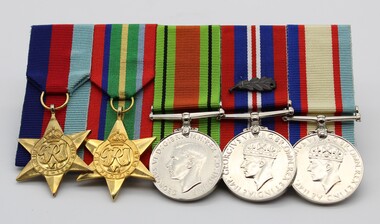
Medal - WWII Replica Medals Court Mounted, Medal issued to Pte Clarence H Howe
... This replica set is representational of the medal awarded for service in a declared war area. 1939-45 Star, Pacific Star, Defence Medal, War Medal 1939-45, and Australian Service Medal 1939-45...This replica set is representational of the medal awarded for service in a declared war area. 1939-45 Star, Pacific Star, Defence Medal, War Medal 1939-45, and Australian Service Medal 1939-45 The Howe family brothers (5) all served during WWII ww2 world war 2 medals Court Mounted Medals Replica court mounted medals Oak Leaf Replica set of WWII medals, court mounted, comprising 5 medals in order of precedence; 1939-45 Star, The Pacific Star, Australian Defence Medal, War Medal 1939-45 with Oak Leaf, and Australian Service Medal 1939-45. ...This replica set is representational of the medal awarded for service in a declared war area. 1939-45 Star, Pacific Star, Defence Medal, War Medal 1939-45, and Australian Service Medal 1939-45The Howe family brothers (5) all served during WWII Replica set of WWII medals, court mounted, comprising 5 medals in order of precedence; 1939-45 Star, The Pacific Star, Australian Defence Medal, War Medal 1939-45 with Oak Leaf, and Australian Service Medal 1939-45. ww2, world war 2, medals, court mounted medals, replica court mounted medals, oak leaf -
 Women's Art Register
Archive (Collection) - Jan Nelson Artist Archive
... ... Representational...Landscapes Representational Painting Video Installation Archive Jan Nelson Artist Archive ...landscapes, representational, painting, video, installationlandscapes, representational, painting, video, installation -
Women's Art Register
Archive (Series) - Nelson, Jan. Artist File 1
... ... Representational...Landscapes Representational Painting Video Installation Foolscap white archival 4 flap folder or document wallet Archive Nelson, Jan. ...Biography, Newspaper Clippings, Invitations, Promotional Materiallandscapes, representational, painting, video, installationlandscapes, representational, painting, video, installation -
Women's Art Register
Archive (Series) - Jan Nelson. Duplicate File 1
... ... Representational...Painting Video Installation Landscapes Representational Foolscap manilla file Archive Jan Nelson. ...Biography, Newspaper Clippings, Invitations, Promotional Materialpainting, video, installation, landscapes, representationalpainting, video, installation, landscapes, representational -
 Mission to Seafarers Victoria
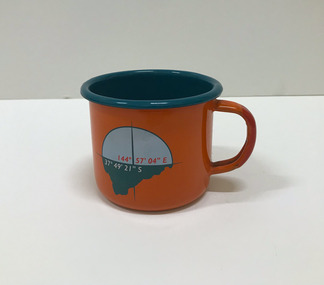
Souvenir - Cup, Margaret Woodward, 2015
... Beyond their representational role souvenirs also trigger intangible, affective qualities – reminders of journeys and places, new associations with tastes, sounds and people, and thereby becoming objects which focus and hold memories. ...Beyond their representational role souvenirs also trigger intangible, affective qualities – reminders of journeys and places, new associations with tastes, sounds and people, and thereby becoming objects which focus and hold memories. ...Margaret Woodward is a an artist and an an associate professor of design at Charles Sturt University. Artist statement: "The Sea is All Around us is a multi-layered event which creates a memorable experience for those visiting the Dome Gallery and the Mission to Seafarers in Melbourne’s Docklands. The event acknowledges and raises awareness of the often difficult and dangerous working lives and journeys of seafarers by making visible their role in transporting commodities, materials and objects to and from Australia’s shores. This installation at the Dome Gallery in the Mission to Seafarers in Melbourne’s Docklands marks the third stage of an ongoing research project which seeks to reveal the ‘social life’ of souvenirs. Beyond their representational role souvenirs also trigger intangible, affective qualities – reminders of journeys and places, new associations with tastes, sounds and people, and thereby becoming objects which focus and hold memories. This installation invites seafarers and visitors to participate in a global project which aims to witness sea journeys and trace the mobile life of seafarers and souvenirs. For a fortnight in May 2015, the Dome Gallery became an architectural large scale compass, with the circular floor marking the intersection of its latitude and longitude (37 º 49'21" S 144º 57'03"E). Over these two weeks the Dome Gallery was inscribed with marks recording journeys made by seafarers, recording destination and departure ports, home lands and waterways, and in doing so making visible a small segment of the global patterns of seafaring. Custom-made souvenirs designed for the installation are given to seafarers as gestures of welcome and a memento of their visit. The souvenirs originating in Poland continue their journey by sea, to destinations beyond the Dome becoming part of the global network of seafaring, with an invitation for seafarers to record their future journeys using QR code scanning technologies. It is hoped that by releasing the 200 limited edition souvenirs accompanying the seafarers the mobile life of souvenirs and seafarers will also become visible. Like messages in bottles they leave our shores, becoming ambassadors, representing the Dome Gallery at the Mission to Seafarers, the waters of Port Phillip Bay, Australia’s red soil and vegetation, and carrying memories of visiting Melbourne." The Mission has always been open to the community and has a tradition of hosting cultural events: shows, concerts, exhibitions, festivals.Orange enamel and teal mug created for the art installation by artist Margaret Woodward at the Mission to Seafarers. On one side it is decorated with a compass and a latitude and longitude; on the opposite side, a leaf, a QR code on the bottom takes you to the website.Written at the bottom of the mug: Please scan to map the journey of this souvenir * www.sensingtheremote.net *2015cultural events, norla dome, mso, 2015, art installation, margaret woodward -
 Mission to Seafarers Victoria
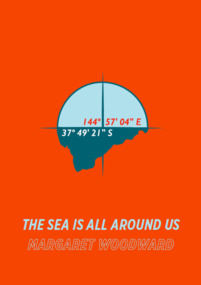
Booklet - Catalogue, Margaret Woodward, The Sea is All Around us, 2015
... Beyond their representational role souvenirs also trigger intangible, affective qualities – reminders of journeys and places, new associations with tastes, sounds and people, and thereby becoming objects which focus and hold memories. ...Beyond their representational role souvenirs also trigger intangible, affective qualities – reminders of journeys and places, new associations with tastes, sounds and people, and thereby becoming objects which focus and hold memories. ...Margaret Woodward is a an artist and an an associate professor of design at Charles Sturt University. Artist statement: "The Sea is All Around us is a multi-layered event which creates a memorable experience for those visiting the Dome Gallery and the Mission to Seafarers in Melbourne’s Docklands. The event acknowledges and raises awareness of the often difficult and dangerous working lives and journeys of seafarers by making visible their role in transporting commodities, materials and objects to and from Australia’s shores. This installation at the Dome Gallery in the Mission to Seafarers in Melbourne’s Docklands marks the third stage of an ongoing research project which seeks to reveal the ‘social life’ of souvenirs. Beyond their representational role souvenirs also trigger intangible, affective qualities – reminders of journeys and places, new associations with tastes, sounds and people, and thereby becoming objects which focus and hold memories. This installation invites seafarers and visitors to participate in a global project which aims to witness sea journeys and trace the mobile life of seafarers and souvenirs. For a fortnight in May 2015, the Dome Gallery became an architectural large scale compass, with the circular floor marking the intersection of its latitude and longitude (37 º 49'21" S 144º 57'03"E). Over these two weeks the Dome Gallery was inscribed with marks recording journeys made by seafarers, recording destination and departure ports, home lands and waterways, and in doing so making visible a small segment of the global patterns of seafaring. Custom-made souvenirs designed for the installation are given to seafarers as gestures of welcome and a memento of their visit. The souvenirs originating in Poland continue their journey by sea, to destinations beyond the Dome becoming part of the global network of seafaring, with an invitation for seafarers to record their future journeys using QR code scanning technologies. It is hoped that by releasing the 200 limited edition souvenirs accompanying the seafarers the mobile life of souvenirs and seafarers will also become visible. Like messages in bottles they leave our shores, becoming ambassadors, representing the Dome Gallery at the Mission to Seafarers, the waters of Port Phillip Bay, Australia’s red soil and vegetation, and carrying memories of visiting Melbourne." The Mission has always been open to the community and has a tradition of hosting cultural events: shows, concerts, exhibitions, festivals.Small flyer in PDf for the art installation by artist Margaret Woodward at the Mission to Seafarerscultural events, norla dome, mso, 2015, art installation, margaret woodward -
 Chiltern Athenaeum Trust
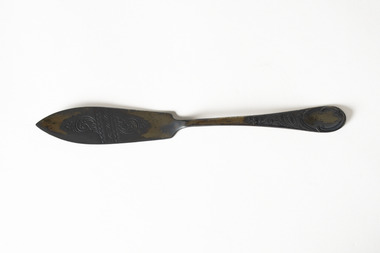
Domestic object - Butter knife belonging to W.C.Busse
... The delicate swirling fernlike motif on this particular butter knife appears to be stylised in either Art deco the decorative arts and craft style favoured in Europe between 1880-1930's and less representational than examples of Australiana flora captured in silversmithing from the 1850's onwards produced in Australia. ...The delicate swirling fernlike motif on this particular butter knife appears to be stylised in either Art deco the decorative arts and craft style favoured in Europe between 1880-1930's and less representational than examples of Australiana flora captured in silversmithing from the 1850's onwards produced in Australia. ...Wilfred Clarence Busse, born in Chiltern in 1898, His family moved to the region during the gold rush and continued to reside in the area, purchasing land adjacent the Murray River. Busse completed his secondary education at Wesley College in Melbourne then studied law at the University of Melbourne. Busse went on to become a barrister, often in the chambers of Sir Leo Finn Bernard Cussen (1859-1933) a judge of the Supreme Court of Victoria. He worked most of his life in Chiltern as a Barrister and Solicitor and gained the unofficial title of historian of Chiltern, leaving behind several manuscript histories and a scrap book. Busse was an avid fictional writer and in 1930 he published two novels. Time spent on a Victorian station in his early twenties, as well as careful documentary research, informed the writing of his historical novels of bush life. "The Blue Beyond; A Romance of the Early Days in South Eastern Australia” and "The Golden Plague: A Romance of the Early Fifties." "The Golden Plague” won the T. E. Role gold medal for the best historical novel which went on to become a best seller. Busse often drew inspiration for his novels from his younger years living Chiltern. His passion for the region lead him to write “The History of Chiltern” which was published in a serial form in the Chiltern Federal Standard from 1922-1923. Wilfred Clarence Busse was a member of Chiltern Athenaeum (where this object is now held) up until his death in 1960, he is buried in the Barnawartha Cemetery. Likely Silverplate due to the intensity of the tarnishing of the metal, with indecipherable hallmarks on the handle, the method of production and the maker mark are unclear. The delicate swirling fernlike motif on this particular butter knife appears to be stylised in either Art deco the decorative arts and craft style favoured in Europe between 1880-1930's and less representational than examples of Australiana flora captured in silversmithing from the 1850's onwards produced in Australia. It is likely that those producing silverware at the time would be drawing on the decorative arts movement while incorporating elements of the natural beauty in the flora of their newfound environment into the silverware they produced.Wilfred Clarence Busse was of social significance to Chiltern, he helped to document the cultural story of the area in his published works "The Golden Plague" and "The Beyond Blue" by recounting his own upbringing in a bush lifestyle. He was a respected Barrister and was the unofficial historian of the Chiltern Athenaeum for many years. This butter knife represents a window into the domestic life of this person who was well loved in the area, and it continues its relationship to Busse as well as Chiltern by being held within the very collection he helped to maintain in his life. Domestic objects tell us the story about how people lived, objects of daily use hold particular meaning in that they can tell us the story of an individual, we feel closer to their life and habits, it humanises and connects us across time. Wilfred Busse ate food, he buttered his bread and he did it with a wonderfully decorated silver butter knife.A tarnished metal butter knife with engraved and embossed spiral fern details on the knife and handlesilverware, wilfred clarence busse, busse, chiltern, chiltern athenaeum, federal standard, t. e. role, "the blue beyond, a romance of the early days in south eastern australia”, "the golden plague: a romance of the early fifties.", "the golden plague”, wesley college, university of melbourne, sir leo finn bernard cussen, supreme court of victoria, gold rush, murray river, “the history of chiltern”, silversmithing, decorative arts, floral, flora, australiana, australian flora, arts and craft movement, australian silver, cussen, cutlery, butter knife, knife, silverplate -
 Chiltern Athenaeum Trust
Domestic object - Spoon belonging to W.C.Busse
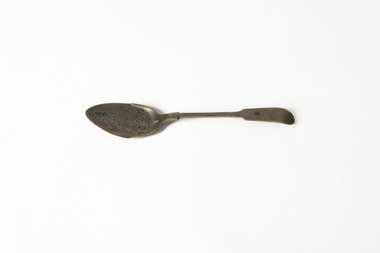
... The floral motif on this particular spoon appears to be stylised in the decorative arts and craft style favoured in Europe between 1880-1920 and less representational than examples of Australiana flora captured in silversmithing from the 1850's onwards produced in Australia. ...The floral motif on this particular spoon appears to be stylised in the decorative arts and craft style favoured in Europe between 1880-1920 and less representational than examples of Australiana flora captured in silversmithing from the 1850's onwards produced in Australia. ...Wilfred Clarence Busse, born in Chiltern in 1898, His family moved to the region during the gold rush and continued to reside in the area, purchasing land adjacent the Murray River. Busse completed his secondary education at Wesley College in Melbourne then studied law at the University of Melbourne. Busse went on to become a barrister, often in the chambers of Sir Leo Finn Bernard Cussen (1859-1933) a judge of the Supreme Court of Victoria. He worked most of his life in Chiltern as a Barrister and Solicitor and gained the unofficial title of historian of Chiltern, leaving behind several manuscript histories and a scrap book. Busse was an avid fictional writer and in 1930 he published two novels. Time spent on a Victorian station in his early twenties, as well as careful documentary research, informed the writing of his historical novels of bush life. "The Blue Beyond; A Romance of the Early Days in South Eastern Australia” and "The Golden Plague: A Romance of the Early Fifties." "The Golden Plague” won the T. E. Role gold medal for the best historical novel which went on to become a best seller. Busse often drew inspiration for his novels from his younger years living Chiltern. His passion for the region lead him to write “The History of Chiltern” which was published in a serial form in the Chiltern Federal Standard from 1922-1923. Wilfred Clarence Busse was a member of Chiltern Athenaeum (where this object is now held) up until his death in 1960, he is buried in the Barnawartha Cemetery. The floral motif on this particular spoon appears to be stylised in the decorative arts and craft style favoured in Europe between 1880-1920 and less representational than examples of Australiana flora captured in silversmithing from the 1850's onwards produced in Australia. It is likely that those producing silverware at the time would be drawing on the decorative arts movement while incorporating elements of the natural beauty in the flora of their newfound environment into the silverware they produced. This spoon seems more likely to have been produced in Europe and imported to the colony. The hallmarks on the handle DON and BP indicate it may have been produced from English electroplating silver which is a more cost effective product than solid silver, most likely produced by Cooper Brothers, Don Plate Works, established in Sheffield in 1866 who distributed silverware in Europe, America and the colonies well into the 1950's.Wilfred Clarence Busse was of social significance to Chiltern, he helped to document the cultural story of the area in his published works "The Golden Plague" and "The Beyond Blue" by recounting his own upbringing in a bush lifestyle. He was a respected Barrister and was the unofficial historian of the Chiltern Athenaeum for many years. This spoon represents a window into the domestic life of this person who was well loved in the area, and it continues its relationship to Busse as well as Chiltern by being held within the very collection he helped to maintain in his life. Domestic objects tell us the story about how people lived, objects of daily use hold particular meaning in that they can tell us the story of an individual, we feel closer to their life and habits, it humanises and connects us across time. Wilfred Busse ate food and he did it from a beautiful silver floral detailed spoon.A silver tablespoon with floral embossed head and hallmarks embossed on reverse handleDON/ BP/silverware, wilfred clarence busse, busse, chiltern, chiltern athenaeum, federal standard, t. e. role, "the blue beyond, a romance of the early days in south eastern australia”, "the golden plague: a romance of the early fifties.", "the golden plague”, wesley college, university of melbourne, sir leo finn bernard cussen, supreme court of victoria, gold rush, murray river, “the history of chiltern”, silversmithing, spoon, decorative arts, floral, flora, australiana, australian flora, arts and craft movement, australian silver, cussen -
 Chiltern Athenaeum Trust
Domestic object - Spoon belonging to W.C.Busse
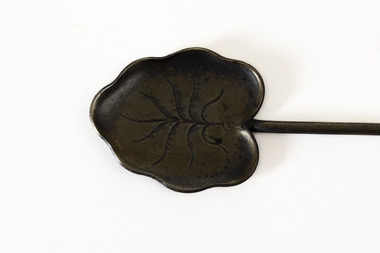
... The leaf shaped motif of this particular spoon appears to be stylised in a simple form of decorative arts and craft or even Art Nouveau style favoured in Europe between 1880-1920 and less representational than examples of Australiana flora captured in silversmithing from the 1850's onwards. ...The leaf shaped motif of this particular spoon appears to be stylised in a simple form of decorative arts and craft or even Art Nouveau style favoured in Europe between 1880-1920 and less representational than examples of Australiana flora captured in silversmithing from the 1850's onwards. ...Wilfred Clarence Busse, born in Chiltern in 1898, His family moved to the region during the gold rush and continued to reside in the area, purchasing land adjacent the Murray River. Busse completed his secondary education at Wesley College in Melbourne then studied law at the University of Melbourne. Busse went on to become a barrister, often in the chambers of Sir Leo Finn Bernard Cussen (1859-1933) a judge of the Supreme Court of Victoria. He worked most of his life in Chiltern as a Barrister and Solicitor and gained the unofficial title of historian of Chiltern, leaving behind several manuscript histories and a scrap book. Busse was an avid fictional writer and in 1930 he published two novels. Time spent on a Victorian station in his early twenties, as well as careful documentary research, informed the writing of his historical novels of bush life. "The Blue Beyond; A Romance of the Early Days in South Eastern Australia” and "The Golden Plague: A Romance of the Early Fifties." "The Golden Plague” won the T. E. Role gold medal for the best historical novel which went on to become a best seller. Busse often drew inspiration for his novels from his younger years living Chiltern. His passion for the region lead him to write “The History of Chiltern” which was published in a serial form in the Chiltern Federal Standard from 1922-1923. Wilfred Clarence Busse was a member of Chiltern Athenaeum (where this object is now held) up until his death in 1960, he is buried in the Barnawartha Cemetery. The leaf shaped motif of this particular spoon appears to be stylised in a simple form of decorative arts and craft or even Art Nouveau style favoured in Europe between 1880-1920 and less representational than examples of Australiana flora captured in silversmithing from the 1850's onwards. According to Christine Erratt, due to the goldrush in the 1850's, there was increased wealth in the colony and an influx of immigrants from Europe to Australia who brought with them silversmithing skills which began ‘the golden age’ of Australian silver', Erratt says that 'Australia's unique flora has been portrayed in the decorative arts since the early colonial times of the last decade of the 18th century. The use of Australian flora to decorate silverware is of particular interest and diversity'. It is likely that those producing silverware at the time would be drawing on the decorative arts movement while incorporating elements of the natural beauty in the flora of their newfound environment into the silverware they produced. There are no discerning maker hallmarks to place where it was produced or ascertain the material accurately.Wilfred Clarence Busse was of social significance to Chiltern, he helped to document the cultural story of the area in his published works "The Golden Plague" and "The Beyond Blue" by recounting his own upbringing in a bush lifestyle. He was a respected Barrister and was the unofficial historian of the Chiltern Athenaeum for many years. This spoon represents a window into the domestic life of this person who was well loved in the area, and it continues its relationship to Busse as well as Chiltern by being held within the very collection he helped to maintain in his life. Domestic objects tell us the story about how people lived, objects of daily use hold particular meaning in that they can tell us the story of an individual, we feel closer to their life and habits, it humanises and connects us across time. A tarnished small silver teaspoon with leaf-shaped head and slim handlesilverware, wilfred clarence busse, busse, chiltern, chiltern athenaeum, federal standard, t. e. role, "the blue beyond, a romance of the early days in south eastern australia”, "the golden plague: a romance of the early fifties.", "the golden plague”, wesley college, university of melbourne, sir leo finn bernard cussen, supreme court of victoria, gold rush, murray river, “the history of chiltern”, silversmithing, spoon, decorative arts, floral, flora, australiana, australian flora, arts and craft movement, australian silver, cussen -
 Mission to Seafarers Victoria
Photograph - Photograph, copy, David Conolly (left) and Peter Smith (centre) dining out
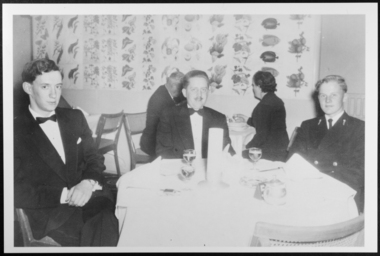
... Representational snapshot of the goodwill and support provided by members of the MTSV for visiting seafarers over the years. david conolly peter smith lay reader 'A night on the town, Two of the mission's Stipendiary Lay Readers, David Connolly (left) and Peter Smith (centre) take a midshipman from a British ship out to dinner. ...Representational snapshot of the goodwill and support provided by members of the MTSV for visiting seafarers over the years. Small rectangular (landscape orientation) monochrome photograph depicting 3 gentleman sitting informally at a restaurant table.'A night on the town, Two of the mission's Stipendiary Lay Readers, David Connolly (left) and Peter Smith (centre) take a midshipman from a British ship out to dinner. Circa 1957'david conolly, peter smith, lay reader -
 Mission to Seafarers Victoria
photograph - Photograph, Black and white, Herald, 22 August 1930
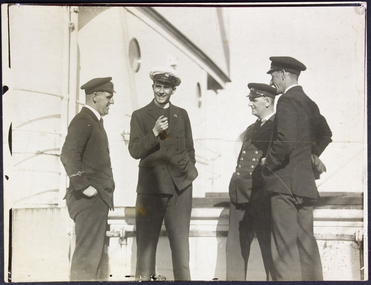
... A similar photograph from the Herald dating from the 22 August 1930 indices it was taken on board the Blue Funnel liner Nestor at Victoria Docks. Representational photograph portraying a typical ship visit by MTSV clergyman. ...A similar photograph from the Herald dating from the 22 August 1930 indices it was taken on board the Blue Funnel liner Nestor at Victoria Docks.Representational photograph portraying a typical ship visit by MTSV clergyman. Large rectangular (landscape oriented) black and white photograph of 3 ship's officers casually standing on deck with Father Frank Oliverfrank oliver, padre frank leslie oliver, officers, ship visit, ships, blue funnel, nestor -
 Montmorency–Eltham RSL Sub Branch
Instrument - Military Bugle
... This bugle has representational significance as a standard issue item of the British Commonwealth Forces. empire made bugle instrument musical instrument india Brass bugle, damaged/buckled bell, two pipes, chrome mouth piece. ...Unlike most regimental bugles made in England, this bugle does not bear a crest or evidence of manufacturer. This bugle is therefore believed to be manufactured in India.This bugle has representational significance as a standard issue item of the British Commonwealth Forces.Brass bugle, damaged/buckled bell, two pipes, chrome mouth piece. Missing original mouthpiece and chain.empire made, bugle, instrument, musical instrument, india -
 Ballarat Tramway Museum
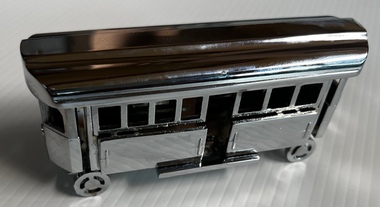
Model - model tramcar - Representational of a Melbourne W2
... Model model tramcar - Representational of a Melbourne W2 ...This is a small commercially made tram model. Its design appears to be very loosely based on a Melbourne W Class tram design. The motorman’s cabin is realistic, but the body with its centre doorway does not look like any known tram designs. The wheels and their arrangement at the very ends of the tram are not realistic at all. No details of the maker, or where or when the model was made. Demonstrates making tramcar models for decorative purposesNickel plated steel model with operable wheels at either end. Two copies held.models, trams, tramcars -
 Nillumbik Shire Council
Sculpture, Ghost, 2012
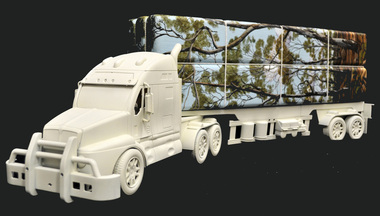
... The truck creates a playful nexus between painting (representational landscape) and sculpture, purposely bluring boundaries across these traditionally distinct disciplines. ...The (logging) truck carries a representation of John Glover’s painted landscapes, which Cox has painted on a solid block of wood. John Glover is one of Australia’s most celebrated colonial landscape painters. Born in England, he was a highly successful water-colourist and painter of landscapes in the tradition of French artist Claude Lorrain. Arriving in Australia in 1831, Glover adapted his picturesque style and luminous technique to his new surrounds, creating naturalistic and atmospheric paintings of Australian nature, settler life, and Aboriginal culture. Working out of doors, Glover developed an understanding of the unfamiliar Australian landscape, especially the twisting forms of native eucalyptus trees. His direct experience of nature, as both pioneer settler and painter, resulted in a new approach using a subtle palette of olive greens, ochres, misty greys and intense blues, and layered glazes of mauve, grey and gold, to portray Australian light and atmosphere. Dale Cox continues the ongoing preoccupation and tradition of landscape painting in the Nillumbik area and our impact on the environment in a contemporary way. The truck creates a playful nexus between painting (representational landscape) and sculpture, purposely bluring boundaries across these traditionally distinct disciplines. ‘Ghost’ seeks to convey the idea that when we remove something significant from a location, like the landscape itself, the remaining ‘place’ changes to become a new ‘place’. This may seem self-evident until we think more deeply about location and landscape. The white truck is a ghost, an ethereal, transient being that spirits away an entire place, forever removed from itself, and forever changed. Logging wild trees can never be like harvesting a ‘crop’. Logging removes a landscape, and changes a place forever. The ‘packaging’ of this painted landscape highlights the anomaly between commodity and our environment. Dale Cox was a local artist and this work was highly commended at the 2012 Nillumbik Prize. White plastic toy (logging) truck with a landscape painting on a wooden block. The landscape painting is reminiscent of paintings by colonial artist John Glover. N/Alandscape, truck, sculpture, environment, john glover, colonial, painting, ghost, nillumbik prize -
Women's Art Register
Archive (Collection) - Kathy Land Artist Archive
... Mixed Media Non-Representational Sculpture Archive Kathy Land Artist Archive ...mixed media, non-representational, sculpturemixed media, non-representational, sculpture -
Women's Art Register
Archive (Collection) - Jan Learmonth Artist Archive
... 1941- Nature Non-Representational Sculpture Mixed Media Drawing Archive Jan Learmonth Artist Archive ...nature, non-representational, sculpture, mixed media, drawingnature, non-representational, sculpture, mixed media, drawing -
Women's Art Register
Archive (Series) - Kathy Land. Duplicate File 1
... Sculpture Mixed Media Non-Representational Foolscap manilla file Archive Kathy Land. ...Promotional Materialsculpture, mixed media, non-representationalsculpture, mixed media, non-representational -
Women's Art Register
Archive (Series) - Jan Learmonth . Duplicate File 1
... Sculpture Mixed Media Drawing Nature Non-Representational Foolscap manilla file Archive Jan Learmonth . ...List of Images, CV, Biography, Newspaper Clippings, Invitations, Correspondence, Promotional Material, Artwork Images, Articlessculpture, mixed media, drawing, nature, non-representationalsculpture, mixed media, drawing, nature, non-representational -
Women's Art Register
Archive (Series) - Land, Kathy. Artist File 1
... Mixed Media Non-Representational Sculpture Foolscap white archival 4 flap folder or document wallet Archive Land, Kathy. ...Promotional Materialmixed media, non-representational, sculpturemixed media, non-representational, sculpture -
Women's Art Register
Archive (Series) - Learmonth , Jan. Artist File 1
... Nature Non-Representational Sculpture Mixed Media Drawing Foolscap white archival 4 flap folder or document wallet Archive Learmonth , Jan. ...List of Images, CV, Biography, Newspaper Clippings, Invitations, Correspondence, Promotional Material, Artwork Images, Articlesnature, non-representational, sculpture, mixed media, drawingnature, non-representational, sculpture, mixed media, drawing -
Women's Art Register
Archive (Series) - Jan Learmonth . Slide Kit
... Sculpture Mixed Media Drawing Nature Non-Representational Set of slides in Polypropylene sleeves, within a Polypropyline binder and slipcase. ...sculpture, mixed media, drawing, nature, non-representationalsculpture, mixed media, drawing, nature, non-representational -
Women's Art Register
Archive (Series) - Jan Learmonth , Digitised Slide Kit
... Sculpture Mixed Media Drawing Nature Non-Representational Archive Jan Learmonth , Digitised Slide Kit ...sculpture, mixed media, drawing, nature, non-representationalsculpture, mixed media, drawing, nature, non-representational
