
Showing 17 items matching " reverse applique"
-
 Embroiderers Guild, Victoria
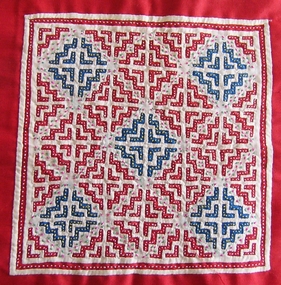
Textile - South American Reverse Appliqué, 1970's
... South American Reverse Appliqué...... Reverse applique...White and blue reverse applique on red ground in geometric design. ...Embroidery Quilting Reverse applique Applique South America 1970's White and blue reverse applique on red ground in geometric design. ...White and blue reverse applique on red ground in geometric design. The fabric includes some synthetic, and is embroidered in yellow, pink and green rayon threads, and a silver thread.embroidery, quilting, reverse applique, applique, south america, 1970's -
 Embroiderers Guild, Victoria
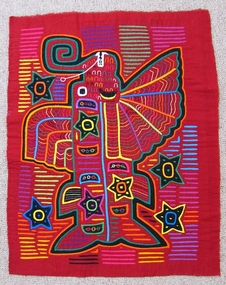
Textile - San Blas Mola Panel, c. mid 1990's
... ... Mola - reverse applique...Red cotton background, with applique and reverse applique, and embroidery in bright colours...Embroidery Mola - reverse applique Patchwork Central America Mid 1900's Red cotton background, with applique and reverse applique, and embroidery in bright colours Textile San Blas Mola Panel ...Purchased in Panama by Betty Colman, Seattle, and later given to Edna Wark.Red cotton background, with applique and reverse applique, and embroidery in bright coloursembroidery, mola - reverse applique, patchwork, central america, mid 1900's -
 Embroiderers Guild, Victoria
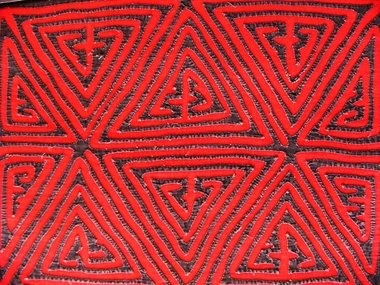
Textile - Panel, Mola Panel
... ... Mola - reverse applique...Red cotton background with black reverse applique mounted on grey cotton. Design includes the serpent symbol....Applique Mola - reverse applique South America Panels Red cotton background with black reverse applique mounted on grey cotton. ...The Mola or Molas is a hand-made textile that forms part of the traditional women's clothing of the indigenous Guna people from Panama. Their clothing includes a patterned wrapped skirt (saburet), a red and yellow headscarf (musue), arm and leg beads (wini), a gold nose ring (olasu) and earrings in addition to the mola blouse (dulemor). Two groups, Choco and Guna lived side by side without intermarriage and without adopting a similar culture.In Dulegaya, the Guna's native language, "mola" means "shirt" or "clothing". The mola originated with the tradition of Guna women painting their bodies with geometric designs, using available natural colors; at a certain point, after the arrival of the Spanish, these same designs were woven in cotton, and later still, sewn using cloth "acquired by trade from the ships that came to barter for coconuts during the 19th century". Red cotton background with black reverse applique mounted on grey cotton. Design includes the serpent symbol.applique, mola - reverse applique, south america, panels -
 Embroiderers Guild, Victoria
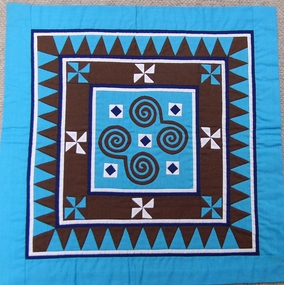
Textile - Mat, 1981
... ... Reverse applique...The square is made up of brown, dark blue, blue and white piecing, some reverse applique and applique. Some stitching showing on back which is cream cotton....The square is made up of brown, dark blue, blue and white piecing, some reverse applique and applique. Some stitching showing on back which is cream cotton. ...Made by Laotian refugees in camps in Northern Thailand. These pieces of patchwork are worked in their own traidtional way and style and are being sold for funds to help the camps.Applique panel. The square is made up of brown, dark blue, blue and white piecing, some reverse applique and applique. Some stitching showing on back which is cream cotton.patchwork, reverse applique, 1980-2000, thailand -
 Embroiderers Guild, Victoria
Textile - Mat, Prior to 1979
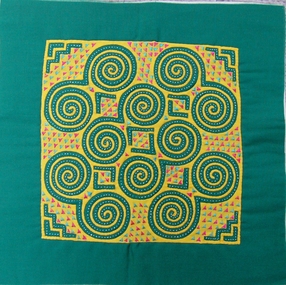
... ... Reverse applique...Reverse applique of concentric circles. Embroidery in red and green small triangles and white running stitches in circles. ...Embroidery Applique Surface stitchery Mats 1960-80 Thailand Reverse applique Reverse applique of concentric circles. ...Made by refugees in their camps in Northern Thailand. Traditional designs and embroidery used.Reverse applique of concentric circles. Embroidery in red and green small triangles and white running stitches in circles. Backing of natural cotton.embroidery, applique, surface stitchery, mats, 1960-80, thailand, reverse applique -
 Embroiderers Guild, Victoria
Accessory - San Blas Mola Panel
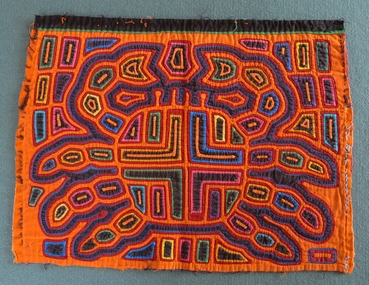
... ...Reverse applique...Rectangle of reverse applique in very bright colours - orange, blue, pink, black etc. ...Mola, which originally meant bird plumage, is the Kuna Indian word for clothing, specifically blouse, and the word Mola has come to mean the elaborate embroidered panels that make up the front and back of a Kuna woman’s traditional blouse. https://sanblas-islands.com/kuna-indians/art/ Embroidery Mola Reverse applique Rectangle of reverse applique in very bright colours - orange, blue, pink, black etc. ...The Kuna have been making their art works for many centuries. They were a nomadic tribe with their art being formed by decorating themselves with their artworks. This decoration is also called Mola or Molas, in Kuna this means shirt or clothing. Mola, which originally meant bird plumage, is the Kuna Indian word for clothing, specifically blouse, and the word Mola has come to mean the elaborate embroidered panels that make up the front and back of a Kuna woman’s traditional blouse. https://sanblas-islands.com/kuna-indians/art/Rectangle of reverse applique in very bright colours - orange, blue, pink, black etc. Shows a crab motif. Part of Mola - traditional garment.embroidery, mola, reverse applique -
 Embroiderers Guild, Victoria
Accessory - Bag, 20thC
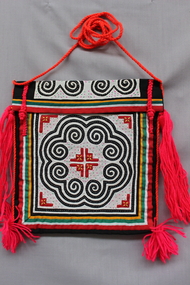
... ...Reverse Applique...Small bag, multi-coloured with reverse applique design front (black on white), back and edged with orange cord and hot pink tassels. ...Embroidery Applique Reverse Applique Bag Small bag, multi-coloured with reverse applique design front (black on white), back and edged with orange cord and hot pink tassels. ...Small bag, multi-coloured with reverse applique design front (black on white), back and edged with orange cord and hot pink tassels. Top of back is fold over envelope type.embroidery, applique, reverse applique, bag -
 Embroiderers Guild, Victoria
Accessory - San Blas Mola Panel
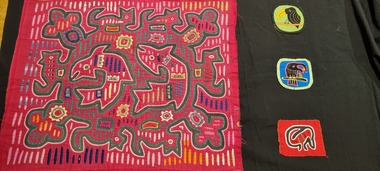
... ...Reverse applique...Black panel with rectangle of reverse applique in very bright colours - orange, blue, pink, black, with red fabric predominant. ...Embroidery Mola Reverse applique Black panel with rectangle of reverse applique in very bright colours - orange, blue, pink, black, with red fabric predominant. ...traditional hand sewn crafted by indigenous Guna (Kuna) people of the San Blas Islands, panama and Colombia. Usually made in pairs to decorate the front and back of a Guna woman's blouse. Artists fill nearly all the spaces, traditionally believed to leave no room for evil spirits to settle. Evolving from ancestral geometric body painting. Following 1925 Guna Revolution, securing their autonomy, making and wearing Molas became a symbol of cultural identity and independence.Black panel with rectangle of reverse applique in very bright colours - orange, blue, pink, black, with red fabric predominant. Depicting two dolphins/sharks. Three separate motifs depict birds. Part of Mola - traditional garment.embroidery, mola, reverse applique -
 Embroiderers Guild, Victoria
Textile - Panel, Mola Panel, 1960-80 (1968)
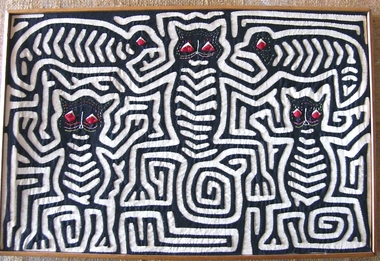
... ... Reverse applique...Patchwork Panel Reverse applique 1960-80 San Blas South America A Mola panel from the San Blas Islands. ...Given to the donor by Mr R.H. Cochrane who worked in Panama for 2 years with the food and agricultural organisation mounted by Mc Cochrane himself.A Mola panel from the San Blas Islands. Design is black on white to represent five cats with red and white eyes and delicate running stitch and stem stitch on the cats' faces. Panel is framed in plain wood and then set on another wood frame with a hessian mount.patchwork, panel, reverse applique, 1960-80, san blas, south america -
 Embroiderers Guild, Victoria
Clothing - Garment, Circa 1970
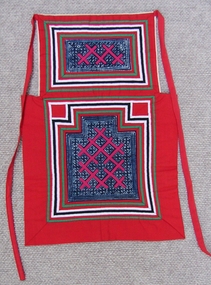
... ... Reverse applique...Made by Laotian refugees. Applique Reverse applique Laos Thailand Patchwork 1960-80 Red cotton fabric predominately with black white and green strips. ...Panel worn on a man's back, tied round neck to denote family and rank. Made by Laotian refugees.Red cotton fabric predominately with black white and green strips. Blue grey centres. Red straps to tie round neck.applique, reverse applique, laos, thailand, patchwork, 1960-80 -
 Embroiderers Guild, Victoria
Textile - Mat, Prior to 1979
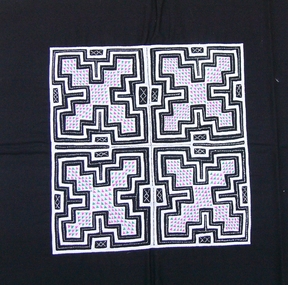
... ... Reverse applique...Embroidery Applique Surface stitchery Mats 1960-80 Thailand Laos Reverse applique Black and white cotton fabric, the white applied to the black. ...Made in refugee camps in norther Thailand. Traditional design.Black and white cotton fabric, the white applied to the black. White and black running stitches. Pink and green small triangles embroidered on silk or synthetic embroidery thread. Geometric design based on squares. Backed with natural cotton.embroidery, applique, surface stitchery, mats, 1960-80, thailand, laos, reverse applique -
 Embroiderers Guild, Victoria
Textile - San Blas Mola Panel
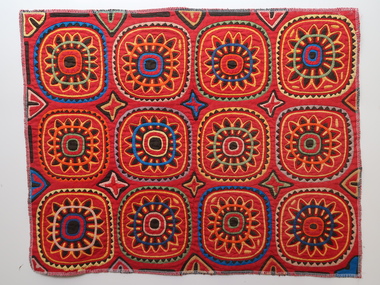
... Mola - reverse applique...Motifs: Feature geometric patterns (molas naga), traditional animal and spiritual figures (molas goaniggadi), or modern pop-culture and global icons (such as cigarette packets or commercial logos) adopted post-1925. Mola - reverse applique San Blas Mola applique with cut back panels. ...A San Blas Mola Panel is a hand-stitched textile artwork created by indigenous Guna (Kuna) women of the San Blas Islands (Guna Yala) in Panama. Technique: Made using multi-layered reverse appliqué and fine embroidery. Makers stack two to seven colored cotton fabrics, cut away top layers, and turn and stitch the edges to reveal vibrant underlying designs. Function: Traditionally worn as the front and back decorative panels of Guna women's blouses, paired with a wrap skirt (sabured) and headscarf (muswe). Motifs: Feature geometric patterns (molas naga), traditional animal and spiritual figures (molas goaniggadi), or modern pop-culture and global icons (such as cigarette packets or commercial logos) adopted post-1925.Mola applique with cut back panels. Stylized flower motifs using applique, hand stitching and needle turning.. Red background with yellow, blue, orange, brown, black details.mola - reverse applique, san blas -
 Embroiderers Guild, Victoria
Accessory - Chinese Robe Band, Late 19th century
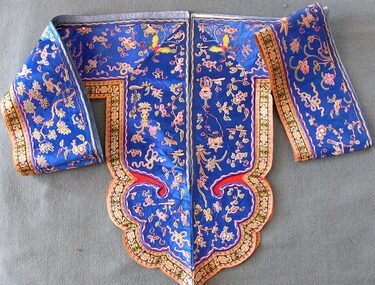
... Braids along inner edges. Reverse applique butterflies in four corners. Gold-cast button and roulette cords and loops on front. ...Braids along inner edges. Reverse applique butterflies in four corners. Gold-cast button and roulette cords and loops on front. ..."Doc" Rowe and his wife "Mora" were Australian entertainers who performed worldwide, including the Far East, during 1910-1930. The embroidered costumes were purchased in China and used in their performances in Australia and overseas.Front/band for a woman's robe. Royal blue satin embroidered Taoist and Buddhist emblems with pekin knot stitch edged with couched gold and white or black thread. Braids along inner edges. Reverse applique butterflies in four corners. Gold-cast button and roulette cords and loops on front. Lined with blue, woven patterned silk. embroidery, china, oriental, garments, late 19th century, silk embroidery -
 4th/19th Prince of Wales's Light Horse Regiment Unit History Room
Flag - Regimental Colour, Kyneton District Mounted Rifles, 1861 (exact)
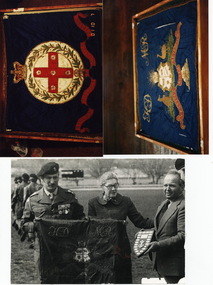
... Below this applique is a green satin stitch shape. The reverse has a red cross with stars surrounded by a green and gold laurel wreath. ...Below this applique is a green satin stitch shape. The reverse has a red cross with stars surrounded by a green and gold laurel wreath. ...Address given by Mrs Lavender on the presentation of the Kyneton Colours on 28 February 1861 “Gentlemen of the Kyneton District Mounted Rifles, I feel proud of the honour done me in being deputed by the ladies of Kyneton to present the colours to your honourable Corps. There has always been a peculiar honour and responsibility connected with the colours of a Regiment. They have been unfurled on a battlefield as rallying points for many a splendid troop of gallant soldiers and courageous hearts. They have been spread to the breeze on the storming of many a city and battles hardly fought and dearly won. To retain their position and maintain their integrity, many a brave soldier has freely offered his life in their defence and, when in the hour of adversity they have been lowered, overpowered by the foe, many a brave heart has bit the dust. We might say that the history of our country is written on the banners of our “Fatherland”. The names emblazoned there speak, it is true of many a battlefield, of many a desperate struggle and of many a glorious victory won by British bravery. Gentlemen, your colours are not decorated by names such as Waterloo, Alma, Inkerman, Delhir Cawnpore, and many others I might mention. They are blank and may the God of Peace grant that in this land of adoption, it may be long before necessity of duty calls upon you to maintain the integrity of your colours and win their names. But if in the providence of God, either from internal commotion or external aggression, you should be called into action, may these colours, the token of your Corps, be upheld with the bravery of British Soldiers, their honour maintained with your lives, and may they never be lowered to a foe. Gentlemen, your motto directs: Onward, onward; may it be so Onward at the shout of victory” This item is significant as The Kyneton Colour is the 2nd oldest Regimental Colour knownin Australia, and the oldest Australian Cavalry Colour. It is unique, in that it is hand made from an original design, there is no other colour of this type known to exist. The Kyneton District Mounted Rifles is the oldest ancestor unit of the 4th/19th Prince of Wales's Light Horse Regiment and therefore is historicaly significant to the Regiment in particular and to Australian Military History in general.Regimental Colour of the Kyneton District Mounted Rifles. A double-sided blue silk damask standard bounded on three sides by 30mm coiled metal fringing. It is heavily embroidered through a silk and cotton layer and these sections are are put back-to-back forming a sandwich of four layers. Several kinds of metal threads and sequins have been used for the embroidery as well as coloured silk floss, employing satin and stem stitch. The front shows a central insert in white silk divided into four and with a steam engine, bull, plough, and wheat sheaf in the segments. This crest is flanked on the left by a kangaroo and the right by an Emu. Above the crest is a horizontal baton, and above that a smiling sun sitting on a bed of clouds. The initials KD are in the upper hoist area and MD in the upper fly region.Below the crest is a red ribbon with the Latin words VESTICIA NULLA RETRORSUM in metal thread. Below this applique is a green satin stitch shape. The reverse has a red cross with stars surrounded by a green and gold laurel wreath. This is surmounted by a Queen's crown in embroidered metal thread over a base of red silk velvet. The bottom third of the flag is decorated with the words KYNETON DISTRIC MOUNTED RIFLES in embroidered metal thread.See description.standard, colours, kyneton district mounted rifles, kyneton -
 Bendigo Historical Society Inc.
Uniform - GSSC School polo shirt
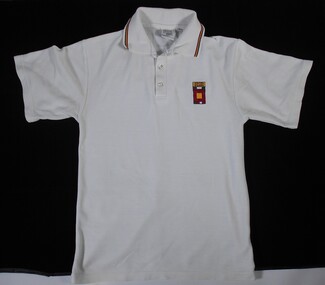
... reverse." Golden Square Secondary College girl's white short sleeved polo shirt. Red, yellow and dark green stripes on the collar. White buttons. Appliqued ...Golden Square High School in the city of Bendigo, was established in temporary accommodation at Camp Hill Primary School in central Bendigo in 1960. With the completion of the new school's buildings, it moved to Golden Square in 1962, providing for Forms 1 to 6, now known as years 7 to 12. In 1978 it became a 7–10 school and was one of the original feeder schools to Bendigo Senior High School. In 1986, a Hearing Impaired Unit was established and in 1990 it underwent a name change to become Golden Square Secondary College. The Golden Square Secondary College campus closed on 28 November 2008. It merged with Kangaroo Flat and Flora Hill secondary colleges as part of the implementation of the Bendigo Education Plan. Its buildings were demolished. (Wikipedia https://en.wikipedia.org/wiki/Golden_Square_Secondary_College) This uniform collection belonged to Anna Matthews, daughter of the donor, who attended GSSC as part of the last group enrolled before the school closed in 2008. Golden Square Secondary College girl's white short sleeved polo shirt. Red, yellow and dark green stripes on the collar. White buttons. Appliqued embroidered school logo on left hand side. Size 12.Tag below collar "DUX BY DOBSONS Phone 03 9619 1122" "NAME _ _ _ _ _ _ _ _ _ " "Washing Instructions on reverse."gssc, golden square secondary college, uniform, bendigo education plan., polo shirt -
 Embroiderers Guild, Victoria
Textile - Panel, Pat Allen, Tree Section with Fungus, Mid 20th century
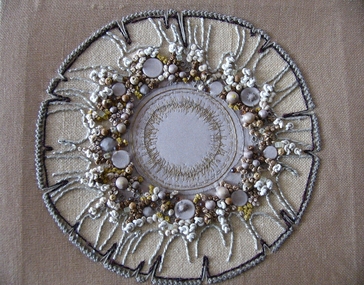
... reverse) Cross section of a tree showing fungus. Cream crash covered with brown net for the background only. The tree section has an applique centre with colours ranging from brown to beige. ...By courtesy of Lady Hamilton-Fairley to the Guild from embroideresses in U.K.Cross section of a tree showing fungus. Cream crash covered with brown net for the background only. The tree section has an applique centre with colours ranging from brown to beige. Circles,beads, french knots and surface stitchery."Tree Section with Fungus" by Pat Allen 1962 Group (on reverse)embroidery, panels, 1940-60, england, creative -
 Mont De Lancey
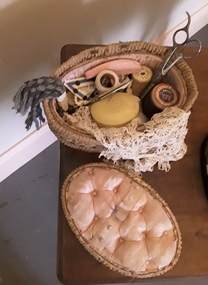
Domestic object - Sewing basket, Unknown
... reverse twist. A brown cane oval woven sewing basket with a lid which has a pink studded silk lining. It contains - a pair of scissors, a cotton reel, embroidery thread, a bone handled crochet hook, tailors chalk, plastic containers, darning wool, press studs, bias binding, a doily and applique flowers. ...A brown cane oval woven sewing basket with a lid which has a pink studded silk lining. It contains - a pair of scissors, a cotton reel, embroidery thread, a bone handled crochet hook, tailors chalk, plastic containers, darning wool, press studs, bias binding, a doily and applique flowers.Crotchet cotton - Coates fast 609 colour Mercer Crotchet 60, 6 Black British Snap press studs - Guaranteed Rustless Size 1 Made in England, Standard darning Wool, Tailor's Chalk - RogeR & Gallet Paris, Scissors 101, 89 on one side of blades and Razor Silver Steel Saranti Forge Nogent france on the other side, Standard darning Wool Co Pty Ltd Stawell, Vic. Australia, steel crotchet hook has an embossed pattern on the handle, Superior Linen Thread No 30, Lindsay Thompson (Threads) Ltd Belfast, black pure flax linen thread 60 750 yards reverse twist.sewing baskets, baskets, sewing equipment
