
Showing 16 items matching " scotch glass"
-
 Glenelg Shire Council Cultural Collection
Souvenir - Scotch Glass, n.d
... Scotch Glass...... scotch glass...Clear glass, small scotch glass pictorial re-enactment First Fleet, coloured picture of sailing vessel on front. ...commemorative glass first fleet scotch glass domestic item Clear glass, small scotch glass pictorial re-enactment First Fleet, coloured picture of sailing vessel on front. ...Clear glass, small scotch glass pictorial re-enactment First Fleet, coloured picture of sailing vessel on front. Gold rim.commemorative glass, first fleet, scotch glass, domestic item -
 Glenelg Shire Council Cultural Collection
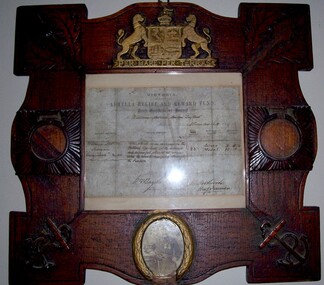
Certificate - Draft certificate of reward - Admella Relief and Reward Fund, 1859
... glass and framed. Frame is carved wood, stained brown. Top corner is a carved scotch thistle, bottom corner has carved anchors. ...glass and framed. Frame is carved wood, stained brown. Top corner is a carved scotch thistle, bottom corner has carved anchors. ...William Melrose volunteered as an oarsman in the Portland Lifeboat on the second and successfil attempt at rescue when he rowed manfully through the breakers. He was awarded a Silver Medal and [pound mark]12.10.0.Paper certificate mounted under glass and framed. Frame is carved wood, stained brown. Top corner is a carved scotch thistle, bottom corner has carved anchors. Centre of each side has a cavity for the medals. At the bottom centre is the Admella Relief and Reward Fund Draft certificate of reward to William Melrose Seaman 'Lady Bird' Melbourne Nov 12th 1859. Photograph of William Melrose in uniform with his two medals pinned to his jacket. A coat of arms is carved at the top centre with the motto "PER-MARE-PER-TERRAS".Front: Admella Relief and Reward Fund Draft certificate of reward to William Melrose Seaman 'Lady Bird' Melbourne Nov 12th 1859. Services rendered - volunteered as an oarsman in the Portland Lifeboat on the second and successfil attempt at rescue when he rowed manfully through the breakers. He was awarded a Silver Medal and [pound mark]12.10.0. Back: (no inscriptions)admella, shipwreck, portland lifeboat, rescue, reward -
 Orbost & District Historical Society
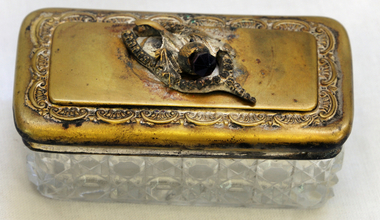
trinket box
... Small cut glass rectangular trinket box with gold-plated engraved lid and raised leaf and flower. Flower is amethyst with scotch thistle....trinket-box glass-technology glassware costume-accessories jewelry Small cut glass rectangular trinket box with gold-plated engraved lid and raised leaf and flower. Flower is amethyst with scotch thistle. trinket box ...Small cut glass rectangular trinket box with gold-plated engraved lid and raised leaf and flower. Flower is amethyst with scotch thistle.trinket-box glass-technology glassware costume-accessories jewelry -
 Flagstaff Hill Maritime Museum and Village
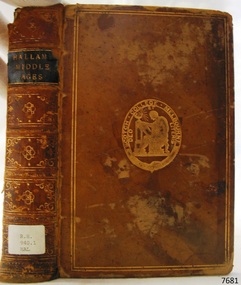
Book, View of The State of Europe
... Label on spine cover with typed text RH 940.1 HAL Pastedown front endpaper has sticker that reads "Scotch College, Melbourne. First Prize,General Excellence Vll Glass. Awarded to Meyers. ...Warrnambool Shipwrecked-coast Flagstaff-Hill Flagstaff-Hill-Maritime-Museum Maritime-Museum Shipwreck-coast Flagstaff-Hill-Maritime-Village Shipwrecked-artefact Book Great Ocean Road View of The State of Europe Henry Hallam Scotch College Alexander Morrison Meyers Label on spine cover with typed text RH 940.1 HAL Pastedown front endpaper has sticker that reads "Scotch College, Melbourne. First Prize,General Excellence Vll Glass. Awarded to Meyers. ...View of The State of Europe during The middle Ages. Author: Henry Hallam Publisher: Alex Murray & Son Date: 1869Label on spine cover with typed text RH 940.1 HAL Pastedown front endpaper has sticker that reads "Scotch College, Melbourne. First Prize,General Excellence Vll Glass. Awarded to Meyers. Alexander Morrison, A.M. Principal. 20th December 1871"warrnambool, shipwrecked-coast, flagstaff-hill, flagstaff-hill-maritime-museum, maritime-museum, shipwreck-coast, flagstaff-hill-maritime-village, shipwrecked-artefact, book, great ocean road, view of the state of europe, henry hallam, scotch college, alexander morrison, meyers -
 Bendigo Historical Society Inc.
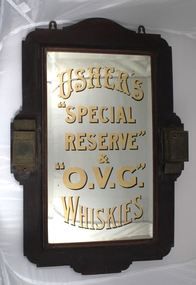
Sign - Pub Sign, 1920
... Scotch history – the trademark battle for ‘Glenlivet’. Iain Russell reports. Three badly damaged paper labels on the back. Pub mirror Andrew Usher O.V.C. Whiskies A mirror is mounted on a one centimetre thick, 67 by 43 centimetres wooden frame with 18 centimetres by three centimetres decorative extensions on all sides. there two pieces of metal on the top to hang the mirror. A box nine six by four centimetres is mounted on each side, one is labeled MATCHES and the other CIGAR CUTTER both have ANDREW USHER & Co written on them. Behind the glass ...The sons of a spirits dealer, Andrew and John Usher created one of the world’s most successful blended Scotch whiskies, Old Vatted Glenlivet, and played a key role in building the North British distillery. But they were also responsible for one of the most misunderstood lawsuits in Scotch history – the trademark battle for ‘Glenlivet’. Iain Russell reports. Three badly damaged paper labels on the back. A mirror is mounted on a one centimetre thick, 67 by 43 centimetres wooden frame with 18 centimetres by three centimetres decorative extensions on all sides. there two pieces of metal on the top to hang the mirror. A box nine six by four centimetres is mounted on each side, one is labeled MATCHES and the other CIGAR CUTTER both have ANDREW USHER & Co written on them. Behind the glass is gold coloured writing with black shadows stating USHER'S "SPECIAL RESERVE" & "O.V.C." WHISKIESpub mirror, andrew usher, o.v.c. whiskies -
 Bendigo Historical Society Inc.
Mixed media - DONEY COLLECTION: DARKROOM EQUIPMENT
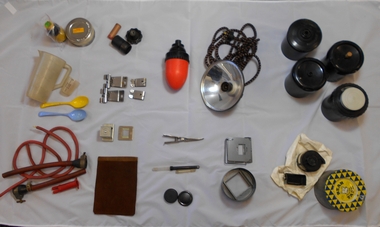
... Allan Doney darkroom collection: 40a dark room equipment collection 40b four film developing cannisters, adapts to adjustable film sizes (35mm, 120mm etc.) 40c spool winder in two parts, stored in scotch tape tin 40d developer lens holder and fil/negative constraint for enlarging photos 40e darkroom light shade with electricity chord 40f red darkroom safety light for developing film with the darkroom 40g three developing items - two lens caps, thermometer caps/containers, & photo developing tongs 40h leather pouch for protection of flat ground glass panes 40i steel slide cover & bracket 40j two sets of steel film weights to hold/hang developed photograph films 40k rubber tubes and syphons 40l two plastic measuring beakers & two (yellow & blue) plastic spoons for developing process 40m KODAK film flow solution (Keogh's Camera Store $1.02) & KODAK plus-X pan film tin container 40n three darkroom miscellaneous items (includes Uniprint equipment knob)...Allan Doney photograph Allan Doney darkroom collection: 40a dark room equipment collection 40b four film developing cannisters, adapts to adjustable film sizes (35mm, 120mm etc.) 40c spool winder in two parts, stored in scotch tape tin 40d developer lens holder and fil/negative constraint for enlarging photos 40e darkroom light shade with electricity chord 40f red darkroom safety light for developing film with the darkroom 40g three developing items - two lens caps, thermometer caps/containers, & photo developing tongs 40h leather pouch for protection of flat ground glass panes 40i steel slide cover & bracket 40j two sets of steel film weights to hold/hang developed photograph films 40k rubber tubes and syphons 40l two plastic measuring beakers & two (yellow & blue) plastic spoons for developing process 40m KODAK film flow solution (Keogh's Camera Store $1.02) & KODAK plus-X pan film tin container 40n three darkroom miscellaneous items (includes Uniprint equipment knob) Mixed media DONEY COLLECTION: DARKROOM EQUIPMENT ...Allan Doney darkroom collection: 40a dark room equipment collection 40b four film developing cannisters, adapts to adjustable film sizes (35mm, 120mm etc.) 40c spool winder in two parts, stored in scotch tape tin 40d developer lens holder and fil/negative constraint for enlarging photos 40e darkroom light shade with electricity chord 40f red darkroom safety light for developing film with the darkroom 40g three developing items - two lens caps, thermometer caps/containers, & photo developing tongs 40h leather pouch for protection of flat ground glass panes 40i steel slide cover & bracket 40j two sets of steel film weights to hold/hang developed photograph films 40k rubber tubes and syphons 40l two plastic measuring beakers & two (yellow & blue) plastic spoons for developing process 40m KODAK film flow solution (Keogh's Camera Store $1.02) & KODAK plus-X pan film tin container 40n three darkroom miscellaneous items (includes Uniprint equipment knob)allan doney, photograph -
 Bendigo Historical Society Inc.
Photograph - COHN BROS BREWERY EXHIBIT, c.1900
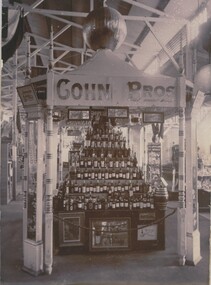
... glass display cases. Inscriptions in image: 'Cohn Bros', 'Prescott Jewellery, Bendigo, 'Highland Club, Whiskey', 'cordial', 'Scotch Whisky' 'DCL' Previous Acc. ...glass display cases. Inscriptions in image: 'Cohn Bros', 'Prescott Jewellery, Bendigo, 'Highland Club, Whiskey', 'cordial', 'Scotch Whisky' 'DCL' Previous Acc. ...Black and white photograph. Cohn Bros. Brewery Exhibit at the Victorian Gold Jubilee Exhibition Bendigo 1901 - 1902. This photograph also includes a small display case at the right for Prescott Jewellers, Bendigo. Cohn's display shows tiered bottles, some small barrells in a rotunda. Prescott's exhibit - goods in glass display cases. Inscriptions in image: 'Cohn Bros', 'Prescott Jewellery, Bendigo, 'Highland Club, Whiskey', 'cordial', 'Scotch Whisky' 'DCL' Previous Acc. No. 'MP 271', Card Index 'Cohn Brewery Show Exhibit'organization, business, cohn bros. limited, cohn bros limited -
 Bendigo Historical Society Inc.
Domestic Object - GLASS BOWL / SAUCER
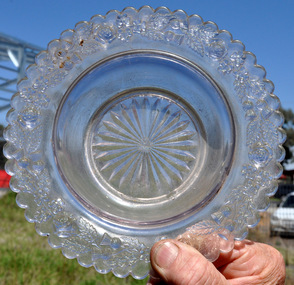
... Glass Bowl / Saucer (previously #92 from Eaglehawk Mechanics Institute) Glass bowl / saucer with raised decorations including holly, roses, scotch thistles, clover. 19cm diameter....COTTAGE Miners Glass Bowl / Saucer (previously #92 from Eaglehawk Mechanics Institute) Glass bowl / saucer with raised decorations including holly, roses, scotch thistles, clover. 19cm diameter. ...Glass Bowl / Saucer (previously #92 from Eaglehawk Mechanics Institute) Glass bowl / saucer with raised decorations including holly, roses, scotch thistles, clover. 19cm diameter.cottage, miners -
 Bendigo Historical Society Inc.
Photograph - MALE PORTRAIT - GROUP, approx. 1900
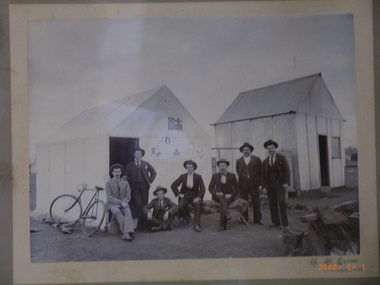
... One decorated with scotch thistle, Irish shamrock, english rose and a flag of unknown origins. Photo under glass, mounted on grey card and framed with a very ornate wood and plaster moulded frame cream in colour with some gilding....One decorated with scotch thistle, Irish shamrock, english rose and a flag of unknown origins. Photo under glass, mounted on grey card and framed with a very ornate wood and plaster moulded frame cream in colour with some gilding. ...Photograph: group of seven young men seated or standing dressed in suits waitcoats , ties and hats. Shown in background a bicycle, beer bottles and 2 outbuildings. One decorated with scotch thistle, Irish shamrock, english rose and a flag of unknown origins. Photo under glass, mounted on grey card and framed with a very ornate wood and plaster moulded frame cream in colour with some gilding.W.H. Grose, Photographerperson, group, male group -
 Williamstown Historical Society Inc
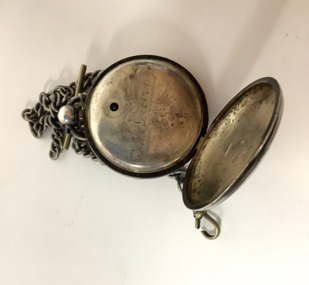
Functional object - Fob watch and chain
... glass is missing. A smaller minute dial is at the 6 o'clock mark. The second lid opens to reveal an inscription in copperplare writing - 'T. J. Grieve', engraved scotch...scotch thistles and three clover leaves. Men's silver fob watch with chain. Watch has two lids, one opens to reveal the watch face which has black roman numerals on a white background. The protective glass ...This watch belonged to T. J. Grieve, a member of an early Altona/Werribee pioneer familyMen's silver fob watch with chain. Watch has two lids, one opens to reveal the watch face which has black roman numerals on a white background. The protective glass is missing. A smaller minute dial is at the 6 o'clock mark. The second lid opens to reveal an inscription in copperplare writing - 'T. J. Grieve', engraved scotch thistles and three leaf clovers. The heavy silver chain has a clip and a shank. Inscription: "T.J. Grieve" three scotch thistles and three clover leaves. horology, fob watch -
Clunes Museum
Domestic object - BOTTLE, JOHN HAIG & CO
... SCOTCH WHISKY. LOCAL HISTORY DOMESTIC ITEM CONTAINERS DIMPLE [ON BASE:-JOHN HAIG & CO. LTD. SCOTLAND ] CLEAR GLASS BOTTLE, TRIANGULAR SHAPE, DIMPLED SIDES WIRE COVER AN GOLD COLOURED SCREW CAP. ...BOTTLE WAS USED FOR SCOTCH WHISKY.CLEAR GLASS BOTTLE, TRIANGULAR SHAPE, DIMPLED SIDES WIRE COVER AN GOLD COLOURED SCREW CAP.DIMPLE [ON BASE:-JOHN HAIG & CO. LTD. SCOTLAND ]local history, domestic item, containers, -
 Dandenong/Cranbourne RSL Sub Branch
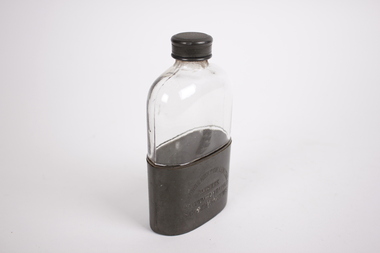
Memorabilia - Whiskey Bottle, George Morton Limited
... whiskey ration australia scotland military George Morton Limited / Dundee / Celebrated Scotch Whiskies Glass whiskey bottle with dark green metal covering on the lower half. ...Glass whiskey bottle with dark green metal covering on the lower half. Inscription on both sides of the metal covering and on the green metal lid.George Morton Limited / Dundee / Celebrated Scotch Whiskieswhiskey, ration, australia, scotland, military -
 Mont De Lancey
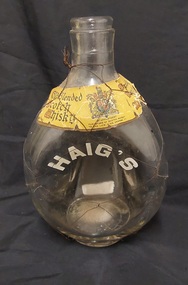
Domestic object - Whisky Bottle, Diageo, Unknown
... A clear glass squat Old Blended Scotch Whisky bottle with thin black wire wrapped around it for decoration. ...Haigh is a brand of Scotch Whisky, originally manufactured by Diageo in Scotland for John Haig and Co since the early 1720's. Containers Whisky bottles Glass 'Haigh's' printed in large white lettering on one side of the bottle. ...Haigh is a brand of Scotch Whisky, originally manufactured by Diageo in Scotland for John Haig and Co since the early 1720's.A clear glass squat Old Blended Scotch Whisky bottle with thin black wire wrapped around it for decoration. It has a white Haigh's label printed on one side. A torn paper label has the maunfacturer details and a signature emblem. There is no stopper.'Haigh's' printed in large white lettering on one side of the bottle. The paper label has, 'Old Blended Scotch Whisky, By appointment purveyors of Scotch Whisky to the late King George VI specially selected and prepared.' On the bottom 'Haigh's RA660 13 UGB'containers, whisky bottles, glass -
 Mont De Lancey
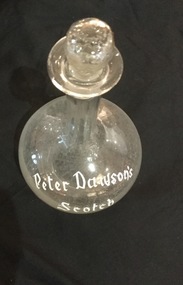
Decanter, 1902
... Clear glass whisky decanter with ground glass stopper. Has Peter Dawson's Scotch painted on decanter. ...Sebire decanters Clear glass whisky decanter with ground glass stopper. Has Peter Dawson's Scotch painted on decanter. ...From the late Miss E. M. SebireClear glass whisky decanter with ground glass stopper. Has Peter Dawson's Scotch painted on decanter. Specially manufactured to commemorate centenary of Company. decanters -
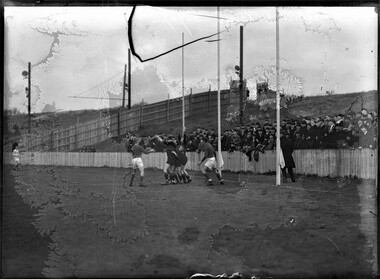 City of Melbourne Libraries
Photograph, Bull, Hugh Jones, 1897-1993, Photograph, Scotch College v. Xavier College football match, 1934
... Retrieved September 22, 2025, from http://nla.gov.au/nla.news-article242062970 football schools Photographer notations on slide: "Scotch v. Xavier - Olympic Park B42". Glass plate negative Photograph, Scotch College v. ...At the first match of the 1934 Public Schools Premiership and Championships at Olympic Park (where AAMI Park is now) between Scotch College (white shorts) and Xavier College, (black shorts) a mark is missed by Xavier players and then taken by a Scotch player. Research by project volunteer, Fiona Collyer: A crowd of schoolboys standing behind a picket fence, watch with anticipation as two teams contest a football at the goalposts. The Public Schools Premiership and Championship was an Australian Rules football tournament held every winter over five weeks between six schools- Scotch College, Xavier College, Melbourne Grammar, Wesley College and traditional rivals Geelong Grammar and Geelong College. The school that won the most games out of the five played, won the competition. As the 1933 Premiers, Xavier College had the honour of playing the opening match of the season on 28 June against runners-up Scotch College at Olympic Park (where AAMI Park is now). The Public Schools Premiership matches were widely reported in Melbourne’s daily newspapers with photographs and commentary of every game. Weekly society magazine “Table Talk” featured reports and seven photographs of the first games of the season. Australian Broadcasting Commission (ABC) wireless station 3AR interspersed their afternoon program of reproduced music with detailed descriptions of the matches. Also reporting the matches was “Forty-Years-On”, presumably a student in the 1890s, whose regular column in The Herald newspaper “Activities In The Public Schools” published all the latest news on Victoria’s public (private) schools. In his column for The Australasian 7 July 1934, “Old Boy” writes about the Scotch versus Xavier match: “For more than half the game last week, Scotch was outplayed, but took the lead early in the last term and kept it. Scotch surprised even its own supporters by its dash in the last 25 minutes. Xavier, who became over confident by the prospects of victory, could not withstand the final onslaught. In the last quarter Scotch was the better side and won by seven points.” The final score was Scotch 11.11 (77 points) and Xavier 10.10 (70 points). At the end of this exciting match the overjoyed Scotch boys swarmed over the Olympic Park fences to chair their captain, Stanley Steele and carry him shoulder high, to the pavilion. The first documented game of a variation of Australian Rules football was played at Richmond Paddock (now Yarra Park) from 7 August 1858. Australian Rules football writer Hugh Buggy of The Argus 16 April 1952 explains: “It began when boys and masters of Scotch College and Melbourne Grammar School decided to play a 40-a-side game, with the first team to score two goals to be the winner. Goal posts were pitched more than a mile apart, one set on the Jolimont Hill and the other at Punt road Richmond. Nobody defined the boundary, and the play swung over the broad acres of the park and around the gum trees. It went on and on like a Test match, from noon till dusk. After 15 hours of play on three Saturdays the score was one goal all, and the game was abandoned for that season.” Rules of the game hadn’t been decided at this time - the earliest known rules were codified a year later in 1859. A sculpture and plaque located outside the Melbourne Cricket Ground (MCG), created by sculptor Louis Laumen in 2001, commemorates this game. It depicts two school boys chasing a ball along with umpire Tom Wills, a co-writer of the rules and promoter of Australian Rules football. A medley of Gaelic football, an Aboriginal game called marngrook as well as football played in English public (that is private) schools have been cited as inspiration for Australian Rules football. The word “Marngrook” meaning “game ball”, comes from the language of the Gunditjmara, First Nations people of southwestern Victoria. Marngrook was played at gatherings and celebrations and involved players competing to jump and catch the ball after it was kicked high into the air. The player that catches the ball then gets to kick it. The ball was made from possum skin, filled with pounded charcoal and tied with kangaroo sinews. Protector of Aborigines in Victoria, William Thomas (1794-1867) observed in 1841- “The men and boys joyfully assemble when this game is to be played. One makes a ball of possum skin, somewhat elastic, but firm and strong… The players of this game do not throw the ball as a white man might do, but drop it and at the same time kick it with their feet, using the instep for that purpose. The tallest men have the best chances in this game. Some of them will leap as high as five feet from the ground to catch the ball. The person who secures the ball kicks it. This continues for hours and the natives never seem to tire of the exercise.” The Victorian Football League (VFL), was founded in 1897 with eight teams playing Australian Rules football and held its first Grand Final at the MCG in 1902. From the start the games attracted large enthusiastic crowds, which included women. “Viva” writing in the Supplement to The Weekly Times - 3 July 1886 LADIES COLUMN (By Viva) FOOTBALL. A Social Sketch. “…Of the popularity of football and footballers among women, there can be no doubt. Young, soft hearted girls, who would not “tread upon a worm," avow that football matches are "awfully jolly," and seem to regard accidents as a necessary part of the amusement…a great proportion of the spectators were ladies.” “Minetta” writing for Punch Magazine - “Ladies Letter, Holmby House, Toorak” 22 June 1905 “The "Football Girl" is a feminine genus at present much to the fore in Melbourne. Not that she plays football—at least not beyond a kick in the backyard or paddock—oh, dear, no! Her interest in the game is purely from a spectacular point of view. "Football Girls" usually hunt in couples, with two male barrackers attached. They know all about So-and-So's form, and whether he is a trier or has been bought. They go to each match of their particular club, and watch the play intently, their faces wearing a decidedly strained expression when their club is getting the worst of it. They are not ashamed to barrack either, when matters are progressing successfully… Yours ever, MINETTA.” The Herald 2 July 1909 published a cartoon by Ambrose Dyson depicting women football fans, which asked- “THE QUESTION OF THE DAY. Should Girls Go To Football Matches? Should they? The sex made up their mind about the matter very early on.” The resounding answer was- “Well, I’d like to see the man that would stop me!” At the final match of the 1934 tournament on August 2, Melbourne Grammar finished the season unbeaten, winning their tenth Public Schools premiership in 16 years. The Weekly Times 11 August 1934 reported-“Melbourne Grammar…had a rather lucky escape against Xavier…Had a Xavier player not touched a shot, kicked by a team-mate, as it was going through goal Grammar would have been beaten.” Final score - Melbourne Grammar 13.7 (85 points) defeated Xavier College 12.9 (81 points). Ladder for the 1934 Season- Melbourne Grammar-5 wins Wesley College- 4 wins Scotch College- 3 wins Xavier College- 2 wins Geelong Grammar- 1 win Geelong College- 0 wins The Associated Public Schools of Victoria (APS) exists today where eleven member (private) schools, including co-educational schools, participate in 21 sporting competitions throughout the year. (The descriptor “Public School” references the historical usage of the term and the model of the British public). PUBLIC SCHOOLS FOOTBALL BEGINS WITH SCOTCH--XAVIER MATCH. (1934, June 29). The Age (Melbourne, Vic. : 1854 - 1954), p. 11. Retrieved June 23, 2025, from http://nla.gov.au/nla.news-article204824484 PUBLIC SCHOOLS FOOTBALL AT OLYMPIC PARK (1934, July 5). Table Talk (Melbourne, Vic. : 1885 - 1939), p. 5. Retrieved May 30, 2025, from http://nla.gov.au/nla.news-article149682433 PUBLIC SCHOOLS FOOTBALL. (1936, July 3). The Argus (Melbourne, Vic. : 1848 - 1957), p. 18. Retrieved May 30, 2025, from http://nla.gov.au/nla.news-article11888301 PUBLIC SCHOOLS. (1934, June 29). The Age (Melbourne, Vic. : 1854 - 1954), p. 5. Retrieved August 6, 2025, from http://nla.gov.au/nla.news-article204824486 https://en.m.wikipedia.org/wiki/History_of_Australian_rules_football COLLEGE SPORTS (1934, July 7). The Australasian (Melbourne, Vic. : 1864 - 1946), p. 48 (METROPOLITAN EDITION). Retrieved August 6, 2025, from http://nla.gov.au/nla.news-article145238393 GRAMMAR CHAMPIONS (1934, August 11). Weekly Times (Melbourne, Vic. : 1869 - 1954), p. 72. Retrieved August 6, 2025, from http://nla.gov.au/nla.news-article224562842 LETS LOOK AT FOOTBALL with HUGH BUGGY (1952, April 16). The Argus (Melbourne, Vic. : 1848 - 1957), p. 9. Retrieved August 6, 2025, from http://nla.gov.au/nla.news-article23174340 FOR YOUNG PEOPLE AMONG THE SCHOOLS. (1934, August 7). The Age (Melbourne, Vic. : 1854 - 1954), p. 4. Retrieved August 6, 2025, from http://nla.gov.au/nla.news-article205521661 https://www.nma.gov.au/defining-moments/resources/australian-rules-football#:~:text=In%20the%20winter%20of%201858,games%20of%20Australian%20Rules%20football. https://apssport.org.au/about/ http://lindsaymagazine.co/from-marngrook-to-australian-rules-football/ https://collection.australiansportsmuseum.org.au/objects/70993/possum-skin-ball FOOTBALL. (1886, July 3). Weekly Times (Melbourne, Vic. : 1869 - 1954), p. 6 (SUPPLEMENT TO THE STORY TELLER). Retrieved September 7, 2025, from http://nla.gov.au/nla.news-article221741193 Ladies' Letter. (1905, June 22). Punch (Melbourne, Vic. : 1900 - 1918; 1925), p. 28. Retrieved September 22, 2025, from http://nla.gov.au/nla.news-article175410975 THE QUESTION OF THE DAY. (1909, July 2). The Herald (Melbourne, Vic. : 1861 - 1954), p. 9. Retrieved September 22, 2025, from http://nla.gov.au/nla.news-article242062970Photographer notations on slide: "Scotch v. Xavier - Olympic Park B42".football, schools -
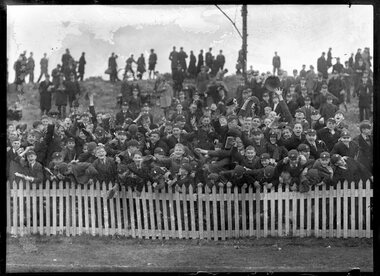 City of Melbourne Libraries
Photograph, Bull, Hugh Jones, 1897-1993, Scotch College v. Xavier College football match
... Retrieved September 17, 2025, from http://nla.gov.au/nla.news-article242062970 schools football Photographer notations on slide: "Scotch v Xavier - Olympic Park B42". Glass plate negative Scotch College v. ...Published: 29 June 1934 Published title: PUBLIC SCHOOLS FOOTBALL BEGINS WITH SCOTCH--XAVIER MATCH. Published caption: “The Public Schools 1934 Football season began yesterday when Scotch met Xavier on the Olympic Park ground, and after a wonderful recovery in the third term, Scotch registered a narrow win. Pictured above is the crowd of Scotch boys who congregated behind the goal after the addition of another goal to their score.” Description: Scotch College pupils exuberantly cheer their team’s goal at the first football match of the Public Schools Premiership and Championship for 1934 between Scotch College and Xavier College at Olympic Park, Melbourne (where AAMI Park is now). Research by project volunteer, Fiona Collyer: The Public Schools Premiership and Championship was an Australian Rules football tournament held every winter, over five weeks between six schools- Scotch College, Xavier College, Melbourne Grammar, Wesley College and traditional rivals Geelong Grammar and Geelong College. The school that won the most games out of the five played, won the competition. As the 1933 Premiers, Xavier College had the honour of playing the opening match of the season on 28 June against runners-up Scotch College at Olympic Park (where AAMI Park is now). The Public Schools Premiership matches were widely reported in Melbourne’s daily newspapers with photographs and commentary of every game. Weekly society magazine “Table Talk” featured reports and seven photographs of the first games of the season. Australian Broadcasting Commission (ABC) wireless station 3AR interspersed their afternoon program of reproduced music with detailed descriptions of the matches. Also reporting the matches was “Forty-Years-On”, presumably a student in the 1890s, whose regular column in The Herald newspaper “Activities In The Public Schools” published all the latest news on Victoria’s public (private) schools. In his column for The Australasian 7 July 1934, “Old Boy” writes about the Scotch versus Xavier match- “For more than half the game last week, Scotch was outplayed, but took the lead early in the last term and kept it. Scotch surprised even its own supporters by its dash in the last 25 minutes. Xavier, who became over confident by the prospects of victory, could not withstand the final onslaught. In the last quarter Scotch was the better side and won by seven points.” The final score was Scotch 11.11 (77 points) and Xavier 10.10 (70 points). At the end of this exciting match the overjoyed Scotch boys swarmed over the Olympic Park fences to chair their captain, Stanley Steele and carry him shoulder high, to the pavilion. The first documented game of a variation of Australian Rules football was played at Richmond Paddock (now Yarra Park) from 7 August 1858. Australian Rules football writer Hugh Buggy of The Argus 16 April 1952 explains- “It began when boys and masters of Scotch College and Melbourne Grammar School decided to play a 40-a-side game, with the first team to score two goals to be the winner. Goal posts were pitched more than a mile apart, one set on the Jolimont Hill and the other at Punt road Richmond. Nobody defined the boundary, and the play swung over the broad acres of the park and around the gum trees. It went on and on like a Test match, from noon till dusk. After 15 hours of play on three Saturdays the score was one goal all, and the game was abandoned for that season.” Rules of the game hadn’t been decided at this time - the earliest known rules were codified a year later in 1859. A sculpture and plaque located outside the Melbourne Cricket Ground (MCG), created by sculptor Louis Laumen in 2001, commemorates this game. It depicts two school boys chasing a ball along with umpire Tom Wills, a co-writer of the rules and promoter of Australian Rules football. A medley of Gaelic football, an Aboriginal game called marngrook as well as football played in English public (that is private) schools have been cited as inspiration for Australian Rules football. The word “Marngrook” meaning “game ball”, comes from the language of the Gunditjmara, First Nations people of southwestern Victoria. Marngrook was played at gatherings and celebrations and involved players competing to jump and catch the ball after it is kicked high into the air. The player that catches the ball then gets to kick it. The ball was made from possum skin, filled with pounded charcoal and tied with kangaroo sinews. Protector of Aborigines in Victoria, William Thomas (1794-1867) observed in 1841- “The men and boys joyfully assemble when this game is to be played. One makes a ball of possum skin, somewhat elastic, but firm and strong… The players of this game do not throw the ball as a white man might do, but drop it and at the same time kick it with their feet, using the instep for that purpose. The tallest men have the best chances in this game. Some of them will leap as high as five feet from the ground to catch the ball. The person who secures the ball kicks it. This continues for hours and the natives never seem to tire of the exercise.” The Victorian Football League (VFL), was founded in 1897 with eight teams playing Australian Rules football and held its first Grand Final at the MCG in 1902. From the start the games attracted large enthusiastic crowds, which included women. “Viva” writing in the Supplement to The Weekly Times-3 July 1886- LADIES COLUMN (By Viva) FOOTBALL. A Social Sketch. “…Of the popularity of football and footballers among women, there can be no doubt. Young, soft hearted girls, who would not “tread upon a worm," avow that football matches are "awfully jolly," and seem to regard accidents as a necessary part of the amusement…a great proportion of the spectators were ladies.” “Minetta” writing for Punch Magazine - “Ladies Letter, Holmby House, Toorak” 22 June 1905 “The "Football Girl" is a feminine genus at present much to the fore in Melbourne. Not that she plays football—at least not beyond a kick in the backyard or paddock—oh, dear, no! Her interest in the game is purely from a spectacular point of view. "Football Girls" usually hunt in couples, with two male barrackers attached. They know all about So-and-So's form, and whether he is a trier or has been bought. They go to each match of their particular club, and watch the play intently, their faces wearing a decidedly strained expression when their club is getting the worst of it. They are not ashamed to barrack either, when matters are progressing successfully… Yours ever, MINETTA.” The Herald 2 July 1909 published a cartoon by Ambrose Dyson depicting women football fans, which asked- “THE QUESTION OF THE DAY. Should Girls Go To Football Matches? Should they? The sex made up their mind about the matter very early on.” The resounding answer was- “Well, I’d like to see the man that would stop me!” At the final match of the 1934 tournament on August 2, Melbourne Grammar finished the season unbeaten, winning their tenth Public Schools premiership in 16 years. The Weekly Times 11 August 1934 reported-“Melbourne Grammar…had a rather lucky escape against Xavier…Had a Xavier player not touched a shot, kicked by a team-mate, as it was going through goal Grammar would have been beaten.” Final score - Melbourne Grammar 13.7 (85 points) defeated Xavier College 12.9 (81 points). Ladder for the 1934 Season- Melbourne Grammar-5 wins Wesley College- 4 wins Scotch College- 3 wins Xavier College- 2 wins Geelong Grammar- 1 win Geelong College- 0 wins The Associated Public Schools of Victoria (APS) exists today where eleven member (private) schools, including co-educational schools, participate in 21 sporting competitions throughout the year. (The descriptor “Public School” references the historical usage of the term and the model of the British public school). PUBLIC SCHOOLS FOOTBALL BEGINS WITH SCOTCH--XAVIER MATCH. (1934, June 29). The Age (Melbourne, Vic. : 1854 - 1954), p. 11. Retrieved June 18, 2025, from http://nla.gov.au/nla.news-article204824484 PUBLIC SCHOOLS FOOTBALL AT OLYMPIC PARK (1934, July 5). Table Talk (Melbourne, Vic. : 1885 - 1939), p. 5. Retrieved June 18, 2025, from http://nla.gov.au/nla.news-article149682433 PUBLIC SCHOOLS. (1934, June 29). The Age (Melbourne, Vic. : 1854 - 1954), p. 5. Retrieved June 3, 2025, from http://nla.gov.au/nla.news-article204824486 PUBLIC SCHOOLS FOOTBALL. (1936, July 3). The Argus (Melbourne, Vic. : 1848 - 1957), p. 18. Retrieved August 6, 2025, from http://nla.gov.au/nla.news-article11888301 https://en.m.wikipedia.org/wiki/History_of_Australian_rules_football COLLEGE SPORTS (1934, July 7). The Australasian (Melbourne, Vic. : 1864 - 1946), p. 48 (METROPOLITAN EDITION). Retrieved May 30, 2025, from http://nla.gov.au/nla.news-article145238393 GRAMMAR CHAMPIONS (1934, August 11). Weekly Times (Melbourne, Vic. : 1869 - 1954), p. 72. Retrieved June 1, 2025, from http://nla.gov.au/nla.news-article224562842 LETS LOOK AT FOOTBALL with HUGH BUGGY (1952, April 16). The Argus (Melbourne, Vic. : 1848 - 1957), p. 9. Retrieved June 15, 2025, from http://nla.gov.au/nla.news-article23174340 FOR YOUNG PEOPLE AMONG THE SCHOOLS. (1934, August 7). The Age (Melbourne, Vic. : 1854 - 1954), p. 4. Retrieved June 14, 2025, from http://nla.gov.au/nla.news-article205521661 https://www.nma.gov.au/defining-moments/resources/australian-rules-football#:~:text=In%20the%20winter%20of%201858,games%20of%20Australian%20Rules%20football. https://apssport.org.au/about/ http://lindsaymagazine.co/from-marngrook-to-australian-rules-football/ https://collection.australiansportsmuseum.org.au/objects/70993/possum-skin-ball FOOTBALL. (1886, July 3). Weekly Times (Melbourne, Vic. : 1869 - 1954), p. 6 (SUPPLEMENT TO THE STORY TELLER). Retrieved September 7, 2025, from http://nla.gov.au/nla.news-article221741193 Ladies' Letter. (1905, June 22). Punch (Melbourne, Vic. : 1900 - 1918; 1925), p. 28. Retrieved September 11, 2025, from http://nla.gov.au/nla.news-article175410975 THE QUESTION OF THE DAY. (1909, July 2). The Herald (Melbourne, Vic. : 1861 - 1954), p. 9. Retrieved September 17, 2025, from http://nla.gov.au/nla.news-article242062970 Photographer notations on slide: "Scotch v Xavier - Olympic Park B42".schools, football
