
Showing 3 items matching " second force architecture"
-
 Robin Boyd Foundation
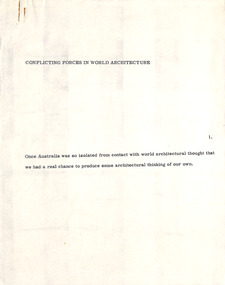
Document - Manuscript, Robin Boyd, Conflicting Forces in World Architecture, 1971
... ... Second force architecture...Discusses second force architecture and Giancarlo De Carlo. Mention of J M Richards and Peter Blake, who give an account of modern architecture -- its trials in its youth and its traumas in middle age....Discusses second force architecture and Giancarlo De Carlo. Mention of J M Richards and Peter Blake, who give an account of modern architecture -- its trials in its youth and its traumas in middle age. ...Since 1954, Australian architecture has been reflecting American architecture, ignoring Japan, Sweden, Italy etc. Discusses second force architecture and Giancarlo De Carlo. Mention of J M Richards and Peter Blake, who give an account of modern architecture -- its trials in its youth and its traumas in middle age.Original manuscript of the 'A Second Force at Work’ published in The Sunday Australian, 12.9.1971.Typewritten (c copy), pencil edits, quarto, 13 pagesaustralian architecture, american architecture, second force architecture, j m richards, peter blake, giancarlo de carlo, robin boyd, manuscript -
 Wangaratta RSL Sub Branch
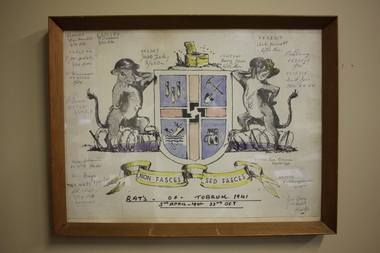
Work on paper - Coat of Arms, Rats of Tobruk 1941, 1941
... second world war and is signed by the artist and soldiers from the 2/24th Battalion known as "Wangaratta's Own". John Stuart Dowie AM (15 January 1915 – 19 March 2008) was an Australian painter, sculptor and teacher. He was born in the suburb of Prospect in Adelaide, South Australia, and studied architecture at the University of Adelaide. During World War II, Dowie worked in the Military History Unit of the Australian Imperial Force ...Hand drawn Coat of Arms for the soldiers known as the Rats of Tobruk with signatures of those involved in the engagement between 5th April to the 22nd of October 1941 The drawing is signed by artist John DOWIE AM, SX6087 who served with the 2/43rd Battalion Signatories are: VX42389 Eric Hamilton, 2/32 Battalion; VX30189 F.Baldwin, 2/23 Battalion; VX34544, F.J.Mc.Intosh 2/24 Battalion; VX34554 W.Harrison, 2/24 Battalion; WX7281 P.Bone 2/25 Battalion; VX33719 Duke Goldsmith, 2/24 Battalion; VX41179 Harry Frazer, 2/24 Battalion; VX29652 A.R.Stribley, 2/24 Battalion; SX6367 Arthur “Jack” Foley, 2/43 Battalion ( died in 1980 buried at Wangaratta); VX48340 Harry Jones, 2/23 Battalion; VX42317 Aub Jarrott, 2/24Battalion; VX28869 Rod Deering 2/24Battalion; VX15719 Ian F. Joss 7th Division AASC; VX19723 Len Dauria, 2/12 Field Regiment; NX35852 R.E (Snowy) Cornelius 2/13 Battalion; VX32559 Jim Gray, 2/24Battalion - James Cyril GRAY Born 6/1/1916 in Orroroo South Australia. Enlisted 28/5/1940 at Mildura. Awarded Military Medal for remarkable coolness, bravery and leadership at Tobruk on 24/4 and 1/5/1941. He was promoted to Sergeant on 14/8/1941, Lieutenant in November 1942 then Captain on 9/4/1945. He was wounded in action on 11/9/1943 and discharged on 20/12/1945. He married and had three children. He died on 10/4/1992 aged 76 and buried at Wangaratta Cemetery.This original drawing is by John DOWIE SX6087 who served with the 2/43rd Battalion during the second world war and is signed by the artist and soldiers from the 2/24th Battalion known as "Wangaratta's Own". John Stuart Dowie AM (15 January 1915 – 19 March 2008) was an Australian painter, sculptor and teacher. He was born in the suburb of Prospect in Adelaide, South Australia, and studied architecture at the University of Adelaide. During World War II, Dowie worked in the Military History Unit of the Australian Imperial Force, and as an assistant to Australia's official war sculptor, Lyndon Dadswell. As a soldier, he was one of the Rats of Tobruk. After studying art in London and Florence, Dowie returned to Australia. His work includes over 50 public sculpture commissions, including the "Three Rivers" fountain in Victoria Square, "Alice" in Rymill Park, the "Victor Richardson Gates" at Adelaide Oval and the "Sir Ross & Sir Keith Smith Memorial" at Adelaide Airport. He was made a Member of the Order of Australia in 1981 in recognition of service to the arts as a sculptor and painter. Dowie died on 19 March 2008, aged 93. There is a similiar version of the drawing on page 32 of the book Desert Sand and Jungle Green by Geoffrey Boss-Walker which is an illustrated history of the 2/43rd Battalion.Timber frame containing hand drawn Coat of Arms consisting of "rats" as shield supporters, crest with a swastika in the centre and motto surrounded by signatures.Signatures of artist John Dowie and soldiers engaged at Tobruk. The crest depicts a latrine and the motto reads NON FASCES SED FAECES (Latin translation - "Do not move but the dregs") rats of tobruk, coat of arms, 1941, john dowie, ww2, middle east, 2/24 battalion, 2/43 battalion -
 Sunshine and District Historical Society Incorporated
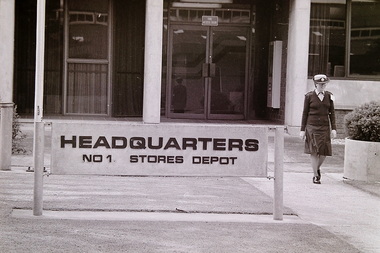
Photograph - RAAF No 1 Stores Depot South Road Braybrook Site Tour 1990 Photograph, C. McGee, 17th June 1991
... Force from 1945 to 1993. Established during the critical final years of the Second World War, the depot consolidated dozens of scattered storage sites into a single purpose‑built facility, demonstrating the Commonwealth’s shift toward modern, centralised military supply systems. Its extensive warehouses, rail sidings, and specialised training areas illustrate mid‑20th‑century defence planning and the functional architectural ...No. 1 RAAF Stores Depot in Braybrook (often called the Tottenham RAAF Stores Depot) was one of the most important defence facilities in Melbourne’s west, a massive wartime logistics base built in 1944–45 and operated until 1993. The site expanded significantly after WWII, adding: RAAF Police Dog Training Centre (established 1962), supply‑officer training facilities, accommodation blocks, mess halls, chapels, gyms and sports grounds which transformed the depot into a self‑contained military community. It shaped Braybrook’s industrial landscape, employed hundreds of locals, and played a central role in Australia’s WWII and post‑war supply chain. These photographs capture only a small part of the No. 1 RAAF Stores Depot that one of Australia’s major wartime and post‑war defence logistics centres, representing the scale, organisation, and industrial capability required to support the Royal Australian Air Force from 1945 to 1993. Established during the critical final years of the Second World War, the depot consolidated dozens of scattered storage sites into a single purpose‑built facility, demonstrating the Commonwealth’s shift toward modern, centralised military supply systems. Its extensive warehouses, rail sidings, and specialised training areas illustrate mid‑20th‑century defence planning and the functional architectural style of the Department of Works. The depot played a vital role in national logistics, handling equipment, clothing, barracks stores, demobilisation materials, and returned overseas supplies. It was also a major employer in Melbourne’s western suburbs, shaping the social and economic life of Braybrook, Sunshine, and Tottenham for nearly five decades. The presence of the RAAF Police Dog Training Centre further highlights the site’s operational diversity and long‑term importance to defence readiness. Although most of the depot has been demolished, the surviving guard house and office block on Ashley Street remain as rare physical evidence of a once‑vast military complex. The depot’s legacy endures in the urban form of Braybrook and in the community memory of the thousands who worked there. Its significance lies in its contribution to Australia’s defence history, its impact on the development of Melbourne’s west, and its representation of large‑scale wartime infrastructure.R.A.A.F. Base Tour 285.1raaf no 1 store, south road, braybrook
