
Showing 173 items matching " spectacles"
-
 City of Moorabbin Historical Society (Operating the Box Cottage Museum)
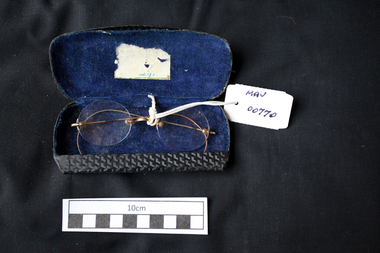
Optical Equipment, Spectacles, fine metal frame with case, 20thC
... spectacles...Glasses, also known as eyeglasses or spectacles, are frames bearing lenses worn in front of the eyes. ...A pair of fine metal framed spectacles with a blue lined case...OPTICAL PRESCRIPTION SPECTACLES / 23/ COLLINS ST MELBOURNE/...Prescription Spectacles Ltd...They are normally used for vision correction or eye protection. spectacles optical equipment moorabbin cheltenham bentleigh early settlers OPTICAL PRESCRIPTION SPECTACLES / 23/ COLLINS ST MELBOURNE/ A pair of fine metal framed spectacles with a blue lined case Optical Equipment, Spectacles, fine metal frame with case Prescription Spectacles Ltd ...Glasses, also known as eyeglasses or spectacles, are frames bearing lenses worn in front of the eyes. They are normally used for vision correction or eye protection. A pair of fine metal framed spectacles with a blue lined caseOPTICAL PRESCRIPTION SPECTACLES / 23/ COLLINS ST MELBOURNE/spectacles, optical equipment, moorabbin, cheltenham, bentleigh, early settlers -
 Vision Australia
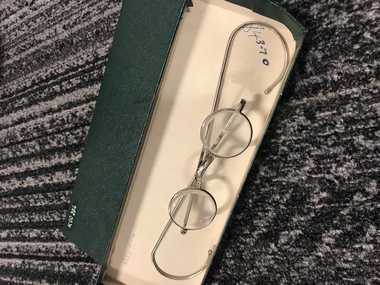
Functional object - Object, Spectacles
... Spectacles...Pair of spectacles made of small circular thick lenses and long silver bendable arms. ...Green cardboard box holding a pair of silver spectacles...Pair of spectacles made of small circular thick lenses and long silver bendable arms. ...Pair of spectacles made of small circular thick lenses and long silver bendable arms. Price of $43.70 handwritten on the inside of the box. These glasses were donated from the Kooyong Low Vision Clinic, who used and sold them to clients until the 1980's. Green cardboard box holding a pair of silver spectaclesassistive devices, association for the blind -
 Wodonga & District Historical Society Inc
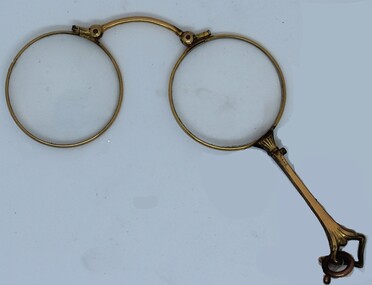
Functional object - Lady's Lorgnette or hand-held spectacles, c1900
... Lady's Lorgnette or hand-held spectacles...Lorgnette were a pair of spectacles with a handle, used to hold them in place, rather than fitting over the ears or nose. ...A lorgnette or pair of hand-held brass-rimmed spectacles....Jean Raper. lorgnette women's spectacles A lorgnette or pair of hand-held brass-rimmed spectacles. ...Lorgnette were a pair of spectacles with a handle, used to hold them in place, rather than fitting over the ears or nose. The name derives from the French lorgner, meaning to take a sidelong look. The lens were often just magnifiers although they later evolved to include prescription lenses. They became widely used in the 19th century and were popular in the Victorian Era.This item is from Raper Collection donated to the Wodonga Historical Society by Mrs. Jean Raper. A lorgnette or pair of hand-held brass-rimmed spectacles.lorgnette, women's spectacles -
 The Cyril Kett Optometry Museum
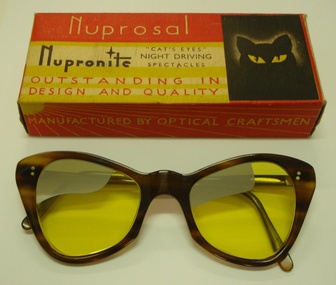
Spectacles, Nupro, 1950 (estimated)
... Spectacles...spectacles...These night driving spectacles are in a shape of frame fashionable for ladies in the 1950's. ...Boxed Nupronite night driving spectacles. Yellow flat plano glass lenses with silver mirror finish in wearer's upper right field of each lens (to minimise glare of oncoming lights). ...On box:'Nuprosal/ Nupronite/ "CAT'S EYES" NIGHT DRIVING SPECTACLES OUTSTANDING IN DESIGN AND QUALITY/ MANUFACTURED BY OPTICAL CRAFTSMEN/ MADE IN ENGLAND BY NUPRO LONDON/ MODEL:CAT'S EYES/ LENSES:SUPER/ COLOUR:AUTUMN LEAF'. ...These night driving spectacles are in a shape of frame fashionable for ladies in the 1950's. ...These night driving spectacles are in a shape of frame fashionable for ladies in the 1950's. The position of the lens silvering shows that these are designed for use in right hand drive cars. These were an expensive item in their day. Their excellent condition and original cardboard box suggest that they may be unsold new old stock.No other example of these Nupronite night driving spectacles is known in any Australian collection.Boxed Nupronite night driving spectacles. Yellow flat plano glass lenses with silver mirror finish in wearer's upper right field of each lens (to minimise glare of oncoming lights). Tortoise-shell look cat's eye frame. In original cardboard box.On box:'Nuprosal/ Nupronite/ "CAT'S EYES" NIGHT DRIVING SPECTACLES OUTSTANDING IN DESIGN AND QUALITY/ MANUFACTURED BY OPTICAL CRAFTSMEN/ MADE IN ENGLAND BY NUPRO LONDON/ MODEL:CAT'S EYES/ LENSES:SUPER/ COLOUR:AUTUMN LEAF'. Price added by hand '2 pound 17/6'spectacles, glare, night driving, eye protection -
 Clunes Museum
Functional object - SPECTACLES
... SPECTACLES...spectacles...Spectacles were found under the floor boards of a shop in Fraser Street, Clunes, Victoria, Australia, second shop from Service Street corner, at one time it was Haywoods chemist shop....Pair of old style black framed spectacles...Spectacles were found under the floor boards of a shop in Fraser Street, Clunes, Victoria, Australia, second shop from Service Street corner, at one time it was Haywoods chemist shop. spectacles eye glasses Pair of old style black framed spectacles Functional object SPECTACLES ...Spectacles were found under the floor boards of a shop in Fraser Street, Clunes, Victoria, Australia, second shop from Service Street corner, at one time it was Haywoods chemist shop.Pair of old style black framed spectaclesspectacles, eye glasses -
 Queen's College
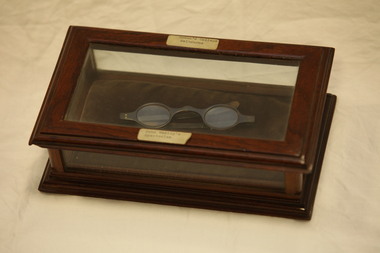
Spectacles in case, John Wesley's spectacles, Undated c.1750
... John Wesley's spectacles...Pair of spectacles in wooden framed display case....John Wesley's spectacles Spectacles in case ...Donated by Mrs Humphreys-Grey to the Auburn Methodist Church, then presented to Queen’s College by Walter Whitehead on behalf of the Trustees. Mrs Catherine Humphreys-Grey (1850-1914) was an Anglican, so it seems likely that the glasses came from her husband’s side of the family. William Humphreys (1850-1914 - Grey added to his name at some point) was born to a Methodist family in Longford Tasmania. The family originally came from Birmingham, England. William Humphreys-Grey died in 1914, so possibly the glasses were donated to Auburn Methodist Church some time after that.Pair of spectacles in wooden framed display case.john wesley, spectacles, auburn methodist church, humphreys-grey, walter whitehead -
 Emerald Museum & Nobelius Heritage Park
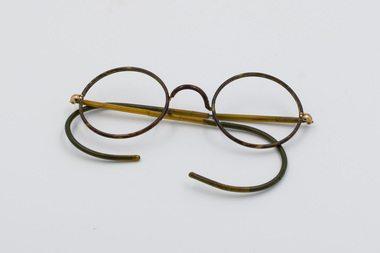
Functional object - Glasses case containing broken pair of spectacles (no lenses), Coles & Garrard Opticians, Glasses case containing broken pair of spectacles with no lenses, Early 20th century
... Glasses case containing broken pair of spectacles with no lenses...Brown coloured glasses case containing a broken pair of spectacles with no lenses...PHONE CENT. 10595, 370-2 BOURKE ST MELB Brown coloured glasses case containing a broken pair of spectacles with no lenses Glasses case containing broken pair of spectacles with no lenses Functional object Glasses case containing broken pair of spectacles (no lenses) Coles & Garrard Opticians ...This glasses case may have belonged to Arthur Ayers (nee Casement) 1887-1964. Arthur and his wife, Nina Ayers lived in Avonsleigh 1929-1964. Authur lost an eye at Passchendaele in 1917. Arthur was born in Hammersmith, London, England. Emigrated to Australia in 1911.Enlisted in the Australian Imperial Force 1914. Served at Gallipoli and the western front in WWI, wounded at Passchendaele in 1917. Glasses case and spectacles belonged to a WWI veteran, Arthur Ayres, who served at Gallipoli and the western front and was wounded at Passchendaele in 1917 Brown coloured glasses case containing a broken pair of spectacles with no lensesOn the outside of the glasses case is printed 'COLES & GARRARD OPTICIANS Pty.Ltd. PHONE CENT. 10595, 370-2 BOURKE ST MELBnina casement, arthur ayers, blanche casement, avonsleigh, wwi -
 Mont De Lancey
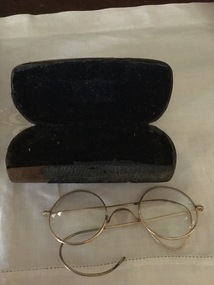
Functional object - Spectacles
... Spectacles...spectacles...Pair of spectacles with gold rims in brown metal case....spectacles spectacle cases Pair of spectacles with gold rims in brown metal case. ...Pair of spectacles with gold rims in brown metal case.spectacles, spectacle cases -
 Mont De Lancey
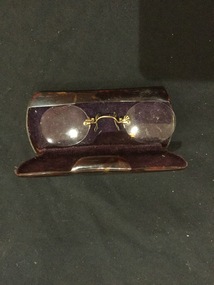
Spectacles, c1900
... Spectacles...spectacles...Pair of spectacles with clear rim, in brown tortoise shell case....spectacles spectacle cases Pair of spectacles with clear rim, in brown tortoise shell case. ...Pair of spectacles with clear rim, in brown tortoise shell case.spectacles, spectacle cases -
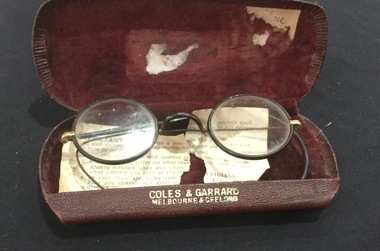 Mont De Lancey
Spectacles, Coles & Garrard
... Spectacles...spectacles...Pair of spectacles with black rims and arms in burgundy leather case....spectacles spectacle cases Pair of spectacles with black rims and arms in burgundy leather case. ...Pair of spectacles with black rims and arms in burgundy leather case.spectacles, spectacle cases -
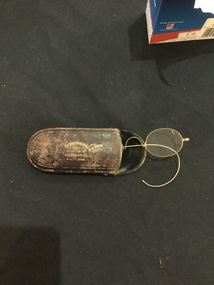 Mont De Lancey
Spectacles, H.A. Barraclough, c1885
... Spectacles...spectacles...Pair of spectacles with flat lens and gold frame, in brown leather case....spectacles spectacle cases English made. Pair of spectacles with flat lens and gold frame, in brown leather case. ...Pair of spectacles with flat lens and gold frame, in brown leather case.English made.spectacles, spectacle cases -
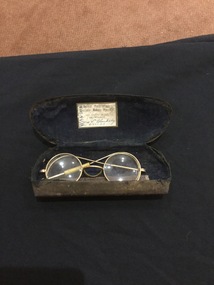 Mont De Lancey
Spectacles, Optical Prescription Spectacle Makers, c1915
... Spectacles...spectacles...Pair of spectacles with gold frame and double bridge flat lens. ...spectacles spectacle cases Pair of spectacles with gold frame and double bridge flat lens. ...Pair of spectacles with gold frame and double bridge flat lens. In brown tin case.spectacles, spectacle cases -
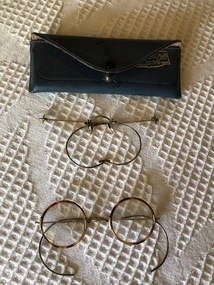 Mont De Lancey
Spectacles
... Spectacles...Spectacles...2 pairs of spectacles:- 1. Tortoiseshell frames and 2. ...Spectacles Spectacles cases "W. J. Aird Pty Ltd. 8a Elizabeth St, Melbourne" - on the glasses case. 2 pairs of spectacles:- 1. ...2 pairs of spectacles:- 1. Tortoiseshell frames and 2. Frameless, bifocals. Leather green glasses case."W. J. Aird Pty Ltd. 8a Elizabeth St, Melbourne" - on the glasses case.spectacles, spectacles cases -
 Mont De Lancey
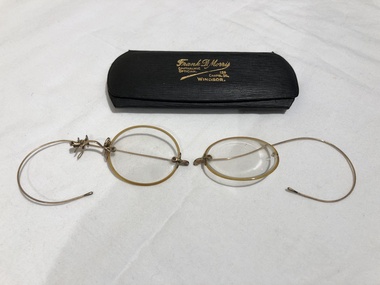
Spectacles
... Spectacles...Spectacles...Pair of spectacles in 2 pieces, clipped over each ear, with tortoiseshell surround and gold clips. ...Spectacles Case: "Frank D. Morris Ophthalmic Optician 12A chapel St, Windsor" Pair of spectacles in 2 pieces, clipped over each ear, with tortoiseshell surround and gold clips. ...Pair of spectacles in 2 pieces, clipped over each ear, with tortoiseshell surround and gold clips. In a black hard case with dark blue felt lining.Case: "Frank D. Morris Ophthalmic Optician 12A chapel St, Windsor"spectacles -
 Mont De Lancey
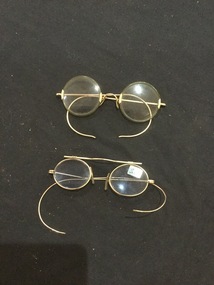
Spectacles
... Spectacles...spectacles...Two pairs of spectacles. 1 - Tinted lens with gold rims and wings. 2 - Clear lens,with gold rims....spectacles spectacle cases Two pairs of spectacles. 1 - Tinted lens with gold rims and wings. 2 - Clear lens,with gold rims. ...Two pairs of spectacles. 1 - Tinted lens with gold rims and wings. 2 - Clear lens,with gold rims.spectacles, spectacle cases -
 Bendigo Military Museum
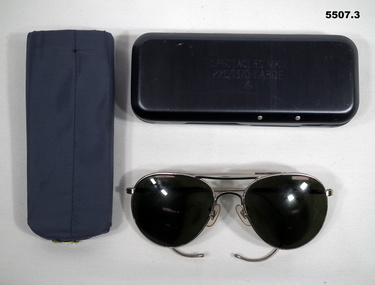
Accessory - FLYING GLASSES
... Original flying spectacles worn by Flight Lieutenant Ian A. Lyons. ....1) Blue metal spectacles case with silver coloured metal hinges and clasp. ....1) Stamped on top and bottom of case: 'SPECTACLES MKII. 22C/1370. LARGE, (upwards arrow)....Original flying spectacles worn by Flight Lieutenant Ian A. Lyons. ...Original flying spectacles worn by Flight Lieutenant Ian A. Lyons. Part of the Flight Lieutenant Ian A. 'Joe' Lyons MBE Collection. See Catalogue No. 5374P for his service record..1) Blue metal spectacles case with silver coloured metal hinges and clasp. Lined with blue velvet fabric. .2) Fabric covered metal frame for housing spectacles within the outer case - .1). .3) Metal framed aviator style spectacles with dark green lens. Clear plastic nose pieces..1) Stamped on top and bottom of case: 'SPECTACLES MKII. 22C/1370. LARGE, (upwards arrow).accessories, flying spectacles, flight lieutenant ian a. lyons -
 Warrnambool and District Historical Society Inc.
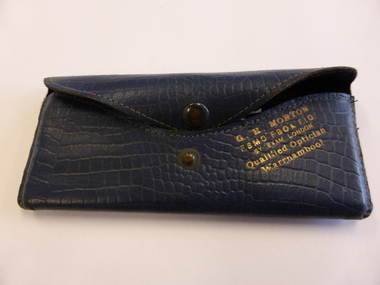
Personal item, Glasses case, Early 20th century
... The spectacles case comes from G.H. Morton, an optician at 192 Liebig Street, Warrnambool in the 1930s and 40s. ...This is a blue leather spectacles case with a wooden insert to hold the glasses. ...On spectacles case: ‘G.H.Morton, FSMC, FBOA, FIO, by exam, London, Qualified Optician, Warrnambool’...The spectacles case comes from G.H. Morton, an optician at 192 Liebig Street, Warrnambool in the 1930s and 40s. ...The spectacles case comes from G.H. Morton, an optician at 192 Liebig Street, Warrnambool in the 1930s and 40s. He advertised as being ‘near Bloore’s Corner’. The two pair of spectacles may not have been from Morton’s business but may have been stored in the case separately. These glasses and the case are of some interest, firstly because the case comes from the business of G.H.Morton, a Warrnambool optician for a number of years. They also have a social significance as representing the type of eyewear used early in the 20th century. This is a blue leather spectacles case with a wooden insert to hold the glasses. There are two pair of spectacles – one with rimless glass and a gold nose piece (there is a small chip at the edge of one piece of glass) and one with gold rimmed glass and gold handles. The latter has a small piece of metal attached to the side of the glass. On spectacles case: ‘G.H.Morton, FSMC, FBOA, FIO, by exam, London, Qualified Optician, Warrnambool’g.h.morton, optician, optician, warrnambool -
 Bendigo Historical Society Inc.
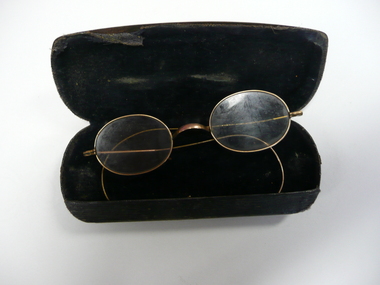
Accessory - SPECTACLES
... SPECTACLES......spectacles...Pair of gold wire framed spectacles in a black hard case with spring loaded lid lined with black velvet....PERSONAL EFFECTS Seeing aids spectacles Pair of gold wire framed spectacles in a black hard case with spring loaded lid lined with black velvet. ...Pair of gold wire framed spectacles in a black hard case with spring loaded lid lined with black velvet.personal effects, seeing aids, spectacles -
 Mont De Lancey
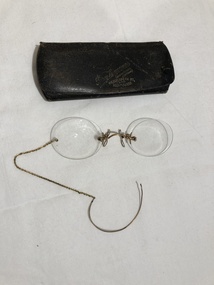
Accessory - Spectacles
... Spectacles...spectacles...A pair of frameless spectacles with a tiny gold chain holding one gold earpiece. ...spectacles spectacle cases Case: "Ophthalmic Optician Percy Bingemann London House (2nd Floor) 97, Elizabeth St, Melbourne" A pair of frameless spectacles with a tiny gold chain holding one gold earpiece. ...A pair of frameless spectacles with a tiny gold chain holding one gold earpiece. It has a metal snap case covered in black leather with black velvet lining.Case: "Ophthalmic Optician Percy Bingemann London House (2nd Floor) 97, Elizabeth St, Melbourne"spectacles, spectacle cases -
 Warrnambool and District Historical Society Inc.
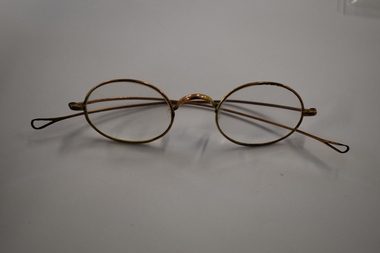
Functional object - spectacles, late 19th century
... spectacles...These spectacles or glasses have no known provenance but date back to the end of the 19th century...This pair of spectacles has two rounded pieces of glass in a gold-coloured metal frame with curved side pieces. ...These spectacles or glasses have no known provenance but date back to the end of the 19th century These spectacles are of minor historical interest and are kept for display purposes Vintage spectacles Warrnambool history This pair of spectacles has two rounded pieces of glass in a gold-coloured metal frame with curved side pieces. ...These spectacles or glasses have no known provenance but date back to the end of the 19th centuryThese spectacles are of minor historical interest and are kept for display purposesThis pair of spectacles has two rounded pieces of glass in a gold-coloured metal frame with curved side pieces. The side holders have a small loop at the ear end. The side holders fold across the glasses.vintage spectacles, warrnambool history -
 Bendigo Historical Society Inc.
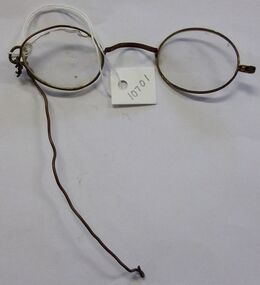
Accessory - SPECTACLES
... SPECTACLES......spectacles...Old metal framed pair of oval shapped spectacles. One glass broken along top edge and frame bent. ...PERSONAL EFFECTS Seeing aids spectacles Spectacles Old metal framed pair of oval shapped spectacles. ...Old metal framed pair of oval shapped spectacles. One glass broken along top edge and frame bent. No arms to go over ears, but a piece of copper wire has been added to the left side.personal effects, seeing aids, spectacles, spectacles -
 Emerald Museum & Nobelius Heritage Park
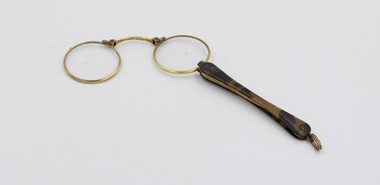
Accessory - Lorgnette Glasses, late 19th century
... ...spectacles...This pair of Lorgnette spectacles belonged to Nina Ayers (nee Casement) 1891-1972. ...Pair of vintage folding lorgnette spectacles with simulated tortoiseshell handle...This pair of Lorgnette spectacles belonged to Nina Ayers (nee Casement) 1891-1972. ...This pair of Lorgnette spectacles belonged to Nina Ayers (nee Casement) 1891-1972. She lived with her aunt, Blanche Casement (nee Balnarry) as a child after her mother died when Nina was seven. Her aunt would often take Nina to the theatre where these spectacles may have been used. Nina, in turn, gave the spectacles to her daughter Frances Ayers who later married the grandson of Carl Axel Nobelius.This needle case belonged to a local woman whose daughter was related by marriage to the Nobelius family.Pair of vintage folding lorgnette spectacles with simulated tortoiseshell handlenina casement, blanche casement, avonsleigh, carl axel nobelius, spectacles -
 Whitehorse Historical Society Inc.
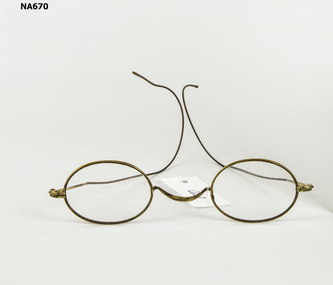
Functional object - Spectacles
... Spectacles...Small pair wire framed spectacles....personal effects seeing aids Small pair wire framed spectacles. Functional object Spectacles ...Small pair wire framed spectacles.personal effects, seeing aids -
 Flagstaff Hill Maritime Museum and Village
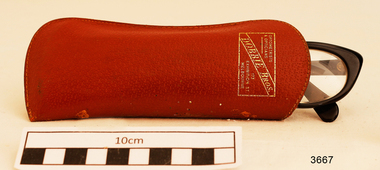
Functional object - Spectacles and case, c. 1969
... The history of spectacles The earliest form of spectacles are generally agreed to have been invented in Northern Italy in the thirteenth century. ...Spectacles and case, from the W.R. Angus Collection and used by Dr. ...Inscriptions read on spectacles;“52 (square) 18” and “RODENSTOCK > ELBA < 130“ and printed in gold lettering on the pouch “DOBBIE BROS. / OPTOMETRISTS & OPTICIANS / 173 EXHIBITION ST. ...The history of spectacles The earliest form of spectacles are generally agreed to have been invented in Northern Italy in the thirteenth century. ...The history of spectacles The earliest form of spectacles are generally agreed to have been invented in Northern Italy in the thirteenth century. Over hundreds of years of innovation and refinement, they have been perfected into the stylish and functional designs you see today worn by millions of people to correct their eyesight. Here's a look at the key moments that defined the history of spectacles. Thirteenth century - Rivet spectacles The earliest form of spectacles was simply two mounted lenses riveted together at the handle ends. They had no sides and were secured to the face by clamping the nose between the rims, some of which had notches which may have been intended to improve the grip. Even then the wearer could only keep them in place by remaining relatively still and would normally support them with the hand. These spectacles contained convex lenses for the correction of presbyopic long-sightedness and were generally suited only to those few who lived beyond their forties and had the ability to read. Sixteenth century - Nose spectacles Nose spectacles were in more common use by the early sixteenth century. These often had a bow-shaped continuous bridge, almost of a modern appearance, that was sometimes flexible depending upon the material, for example leather or whalebone. The bridge was as much an area to be gripped as to rest on the nose. Spectacles were still usually held in place with the hand whilst being used temporarily for a brief period of reading or close inspection. By now the lenses could be used to correct both long and short sight. The general design changed little through the seventeenth century, though certain refinements increased the flexibility and comfort for some wearers. In some localised areas, notably in Spain, people experimented with ear loops made of string. This allowed them to walk around with their spectacles on. Eighteenth century - Temple glasses Only in the eighteenth century did the first modern eyewear, or ‘glasses’ as we would understand them, start to appear. The lenses might be glass, rock crystal or any other transparent mineral substance and were prone to smashing if the spectacles fell off, so there was an impetus to develop frames that could be worn continuously and would stay in place. London optician Edward Scarlett is credited with developing the modern style of spectacles which were kept in place with arms, known as ‘temples’. These were made of iron or steel and gripped the side of the head but did not yet hook over the ears because often the ears were concealed beneath a powdered wig, such as was fashionable at the time. As temples developed they were made with wide ring ends through which the wearer could pass a ribbon, thus tying the spectacles securely to the head. As spectacles were no longer primarily for use in sedentary activities, people began to be noticed out and about in their spectacles and might come to be identified as a ‘spectacle wearer’. By the end of the eighteenth century, people who needed correction for both distance and near could choose bifocals. Nineteenth century - Pince-nez Pince-nez were a nineteenth century innovation that literally translates as ‘pinching the nose’. They had a spring clip to retain the item in place under its own tension. Sometimes this clip was too tight and the wearer struggled to breathe. If it was too loose the pince-nez could fall off so, for safety and security, they were often connected to the wearer's clothing by a cord or a chain to avoid them being dropped or lost. Pince-nez were sometimes chosen by people who felt that large spectacles were too prominent and drew attention to a physical defect. They were also suitable for mounting lenses that could correct astigmatism. Twentieth century spectacles Spectacle wearing continued to become more widespread, key developments being the supply of spectacles to troops in the First World War, cheaper spectacles being subsidised through insurance schemes arranged by friendly societies, and the beginning of the National Health Service in 1948, when free spectacles were made available to all who might benefit from them. This normalised spectacle wearing and led to a significant increase in the scale of production. Entirely separate categories of women’s spectacles and sports eyewear both emerged in the 1930s. The latter half of the twentieth century saw spectacles become more fashionable and stylish as frames with different shapes, materials, and colours became available. Plastics frames, in particular, allowed a greater choice of colours and textured finishes. Plastic lenses were more durable and could be made lighter and thinner than glass, spurring a renewed interest in rimless designs. Designer eyewear bearing popular high-street brand names encouraged patients to regard spectacles as a desirable commodity, even as a fashion accessory, not just a disability aid. https://www.college-optometrists.org/the-british-optical-association-museum/the-history-of-spectacles These spectacles and case were used by Dr. Angus in his surgery in Warrnambool to test patients' eye sight. They were donated to Flagstaff Hill Maritime Village by the family of Doctor William Roy Angus, Surgeon and Oculist. It is part of the “W.R. Angus Collection” that includes historical medical equipment, surgical instruments and material once belonging to Dr Edward Ryan and Dr Thomas Francis Ryan, (both of Nhill, Victoria) as well as Dr Angus’ own belongings. The Collection’s history spans the medical practices of the two Doctors Ryan, from 1885-1926 plus that of Dr Angus, up until 1969. ABOUT THE “W.R.ANGUS COLLECTION” Doctor William Roy Angus M.B., B.S., Adel., 1923, F.R.C.S. Edin.,1928 (also known as Dr Roy Angus) was born in Murrumbeena, Victoria in 1901 and lived until 1970. He qualified as a doctor in 1923 at University of Adelaide, was Resident Medical Officer at the Royal Adelaide Hospital in 1924 and for a period was house surgeon to Sir (then Mr.) Henry Simpson Newland. Dr Angus was briefly an Assistant to Dr Riddell of Kapunda, then commenced private practice at Curramulka, Yorke Peninsula, SA, where he was physician, surgeon and chemist. In 1926, he was appointed as new Medical Assistant to Dr Thomas Francis Ryan (T.F. Ryan, or Tom), in Nhill, Victoria, where his experiences included radiology and pharmacy. In 1927 he was Acting House Surgeon in Dr Tom Ryan’s absence. Dr Angus had become engaged to Gladys Forsyth and they decided he would take time to further his studies overseas in the UK in 1927. He studied at London University College Hospital and at Edinburgh Royal Infirmary and in 1928, was awarded FRCS (Fellow from the Royal College of Surgeons), Edinburgh. He worked his passage back to Australia as a Ship’s Surgeon on the on the Australian Commonwealth Line’s T.S.S. Largs Bay. Dr Angus married Gladys in 1929, in Ballarat. (They went on to have one son (Graham 1932, born in SA) and two daughters (Helen (died 12/07/1996) and Berenice (Berry), both born at Mira, Nhill ) Dr Angus was a ‘flying doctor’ for the A.I.M. (Australian Inland Ministry) Aerial Medical Service in 1928 . The organisation began in South Australia through the Presbyterian Church in that year, with its first station being in the remote town of Oodnadatta, where Dr Angus was stationed. He was locum tenens there on North-South Railway at 21 Mile Camp. He took up this ‘flying doctor’ position in response to a call from Dr John Flynn; the organisation was later known as the Flying Doctor Service, then the Royal Flying Doctor Service. A lot of his work during this time involved dental surgery also. Between 1928-1932 he was surgeon at the Curramulka Hospital, Yorke Peninsula, South Australia. In 1933 Dr Angus returned to Nhill where he’d previously worked as Medical Assistant and purchased a share of the Nelson Street practice and Mira hospital from Dr Les Middleton one of the Middleton Brothers, the current owners of what was once Dr Tom Ryan’s practice. Dr L Middleton was House Surgeon to the Nhill Hospital 1926-1933, when he resigned. [Dr Tom Ryan’s practice had originally belonged to his older brother Dr Edward Ryan, who came to Nhill in 1885. Dr Edward saw patients at his rooms, firstly in Victoria Street and in 1886 in Nelson Street, until 1901. The Nelson Street practice also had a 2 bed ward, called Mira Private Hospital ). Dr Edward Ryan was House Surgeon at the Nhill Hospital 1884-1902 . He also had occasions where he successfully performed veterinary surgery for the local farmers too. Dr Tom Ryan then purchased the practice from his brother in 1901. Both Dr Edward and Dr Tom Ryan work as surgeons included eye surgery. Dr Tom Ryan performed many of his operations in the Mira private hospital on his premises. He too was House Surgeon at the Nhill Hospital 1902-1926. Dr Tom Ryan had one of the only two pieces of radiology equipment in Victoria during his practicing years – The Royal Melbourne Hospital had the other one. Over the years Dr Tom Ryan gradually set up what was effectively a training school for country general-practitioner-surgeons. Each patient was carefully examined, including using the X-ray machine, and any surgery was discussed and planned with Dr Ryan’s assistants several days in advance. Dr Angus gained experience in using the X-ray machine there during his time as assistant to Dr Ryan. Dr Tom Ryan moved from Nhill in 1926. He became a Fellow of the Royal Australasian College of Surgeons in 1927, soon after its formation, a rare accolade for a doctor outside any of the major cities. He remained a bachelor and died suddenly on 7th Dec 1955, aged 91, at his home in Ararat. Scholarships and prizes are still awarded to medical students in the honour of Dr T.F. Ryan and his father, Dr Michael Ryan, and brother, John Patrick Ryan. ] When Dr Angus bought into the Nelson Street premises in Nhill he was also appointed as the Nhill Hospital’s Honorary House Surgeon 1933-1938. His practitioner’s plate from his Nhill surgery states “HOURS Daily, except Tuesdays, Fridays and Saturday afternoons, 9-10am, 2-4pm, 7-8pm. Sundays by appointment”. This plate is now mounted on the doorway to the Port Medical Office at Flagstaff Hill Maritime Village, Warrnambool. Dr Edward Ryan and Dr Tom Ryan had an extensive collection of historical medical equipment and materials spanning 1884-1926 and when Dr Angus took up practice in their old premises he obtained this collection, a large part of which is now on display at the Port Medical Office at Flagstaff Hill Maritime Village in Warrnambool. During his time in Nhill Dr Angus was involved in the merging of the Mira Hospital and Nhill Public Hospital into one public hospital and the property titles passed on to Nhill Hospital in 1939. In 1939 Dr Angus and his family moved to Warrnambool where he purchased “Birchwood,” the 1852 home and medical practice of Dr John Hunter Henderson, at 214 Koroit Street. (This property was sold in1965 to the State Government and is now the site of the Warrnambool Police Station. ). The Angus family was able to afford gardeners, cooks and maids; their home was a popular place for visiting dignitaries to stay whilst visiting Warrnambool. Dr Angus had his own silk worm farm at home in a Mulberry tree. His young daughter used his centrifuge for spinning the silk. Dr Angus was appointed on a part-time basis as Port Medical Officer (Health Officer) in Warrnambool and held this position until the 1940’s when the government no longer required the service of a Port Medical Officer in Warrnambool; he was thus Warrnambool’s last serving Port Medical Officer. (The duties of a Port Medical Officer were outlined by the Colonial Secretary on 21st June, 1839 under the terms of the Quarantine Act. Masters of immigrant ships arriving in port reported incidents of diseases, illness and death and the Port Medical Officer made a decision on whether the ship required Quarantine and for how long, in this way preventing contagious illness from spreading from new immigrants to the residents already in the colony.) Dr Angus was a member of the Australian Medical Association, for 35 years and surgeon at the Warrnambool Base Hospital 1939-1942, He served as a Surgeon Captain during WWII 1941-45, in Ballarat, Victoria, and in Bonegilla, N.S.W., completing his service just before the end of the war due to suffering from a heart attack. During his convalescence he carved an intricate and ‘most artistic’ chess set from the material that dentures were made from. He then studied ophthalmology at the Royal Melbourne Eye and Ear Hospital and created cosmetically superior artificial eyes by pioneering using the intrascleral cartilage. Angus received accolades from the Ophthalmological Society of Australasia for this work. He returned to Warrnambool to commence practice as an ophthalmologist, pioneering in artificial eye improvements. He was Honorary Consultant Ophthalmologist to Warrnambool Base Hospital for 31 years. He made monthly visits to Portland as a visiting surgeon, to perform eye surgery. He represented the Victorian South-West subdivision of the Australian Medical Association as its secretary between 1949 and 1956 and as chairman from 1956 to 1958. In 1968 Dr Angus was elected member of Spain’s Barraquer Institute of Barcelona after his research work in Intrasclearal cartilage grafting, becoming one of the few Australian ophthalmologists to receive this honour, and in the following year presented his final paper on Living Intrasclearal Cartilage Implants at the Inaugural Meeting of the Australian College of Ophthalmologists in Melbourne In his personal life Dr Angus was a Presbyterian and treated Sunday as a Sabbath, a day of rest. He would visit 3 or 4 country patients on a Sunday, taking his children along ‘for the ride’ and to visit with him. Sunday evenings he would play the pianola and sing Scottish songs to his family. One of Dr Angus’ patients was Margaret MacKenzie, author of a book on local shipwrecks that she’d seen as an eye witness from the late 1880’s in Peterborough, Victoria. In the early 1950’s Dr Angus, painted a picture of a shipwreck for the cover jacket of Margaret’s book, Shipwrecks and More Shipwrecks. She was blind in later life and her daughter wrote the actual book for her. Dr Angus and his wife Gladys were very involved in Warrnambool’s society with a strong interest in civic affairs. Their interests included organisations such as Red Cross, Rostrum, Warrnambool and District Historical Society (founding members), Wine and Food Society, Steering Committee for Tertiary Education in Warrnambool, Local National Trust, Good Neighbour Council, Housing Commission Advisory Board, United Services Institute, Legion of Ex-Servicemen, Olympic Pool Committee, Food for Britain Organisation, Warrnambool Hospital, Anti-Cancer Council, Boys’ Club, Charitable Council, National Fitness Council and Air Raid Precautions Group. He was also a member of the Steam Preservation Society and derived much pleasure from a steam traction engine on his farm. He had an interest in people and the community He and his wife Gladys were both involved in the creation of Flagstaff Hill, including the layout of the gardens. After his death (28th March 1970) his family requested his practitioner’s plate, medical instruments and some personal belongings be displayed in the Port Medical Office surgery at Flagstaff Hill Maritime Village, and be called the “W. R. Angus Collection”. The W.R. Angus Collection is significant for still being located at the site it is connected with, Doctor Angus being the last Port Medical Officer in Warrnambool. The collection of medical instruments and other equipment is culturally significant, being an historical example of medicine from late 19th to mid-20th century. Dr Angus assisted Dr Tom Ryan, a pioneer in the use of X-rays and in ocular surgery. Spectacles and case, from the W.R. Angus Collection and used by Dr. Angus for testing the sight of his patients. Black rimmed spectacles in tan, open ended pouch. Inscription is stamped into frame and printed in gold lettering on the case. c. 1969 Inscriptions read on spectacles;“52 (square) 18” and “RODENSTOCK > ELBA < 130“ and printed in gold lettering on the pouch “DOBBIE BROS. / OPTOMETRISTS & OPTICIANS / 173 EXHIBITION ST. MELBOURNE”flagstaff hill, warrnambool, shipwrecked coast, flagstaff hill maritime museum, maritime museum, shipwreck coast, flagstaff hill maritime village, great ocean road, dr w r angus, dr ryan, surgical instrument, t.s.s. largs bay, warrnambool base hospital, nhill base hospital, mira hospital, flying doctor, medical treatment, spectacles and case, optical testing, optometrist examination, dobbie bros melbourne -
 Flagstaff Hill Maritime Museum and Village
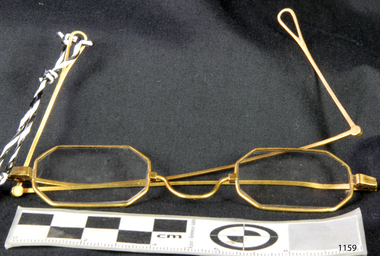
Functional object - Spectacles
... Spectacles...Spectacles, Stright Temple Spectacles, Gold frame, octagonal oblong has hinge for curving around ear and as a means to attach a retaining neck strap....Functional object Spectacles ...Spectacles, Stright Temple Spectacles, Gold frame, octagonal oblong has hinge for curving around ear and as a means to attach a retaining neck strap.flagstaff hill, warrnambool, shipwrecked-coast, flagstaff-hill, flagstaff-hill-maritime-museum, maritime-museum, shipwreck-coast, flagstaff-hill-maritime-village -
 Whitehorse Historical Society Inc.
Functional object - Spectacles
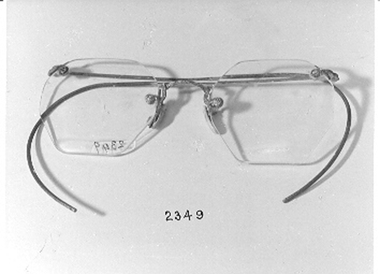
... Spectacles...Hexagon shaped spectacles with thin wire arms....personal effects seeing aids Hexagon shaped spectacles with thin wire arms. Functional object Spectacles ...Hexagon shaped spectacles with thin wire arms.personal effects, seeing aids -
 Flagstaff Hill Maritime Museum and Village
Functional object - Spectacles
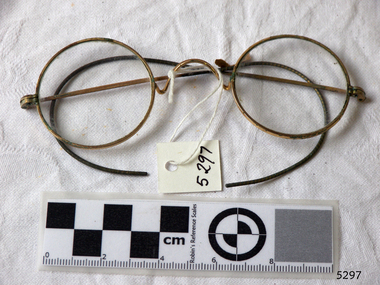
... Spectacles...Cable Bow gold filled spectacles with round lens. ...flagstaff hill warrnambool shipwrecked-coast flagstaff-hill flagstaff-hill-maritime-museum maritime-museum shipwreck-coast flagstaff-hill-maritime-village Cable Bow gold filled spectacles with round lens. Functional object Spectacles ...Cable Bow gold filled spectacles with round lens. flagstaff hill, warrnambool, shipwrecked-coast, flagstaff-hill, flagstaff-hill-maritime-museum, maritime-museum, shipwreck-coast, flagstaff-hill-maritime-village -
Coal Creek Community Park & Museum
Spectacles
... Spectacles...A pair of rimless spectacles with a metal nose piece. The lenses and arms are plastic....Spectacles ...A pair of rimless spectacles with a metal nose piece. The lenses and arms are plastic. -
 Warrnambool and District Historical Society Inc.
Domestic object - Case, spectacles, spectacles Case, 1900-1960
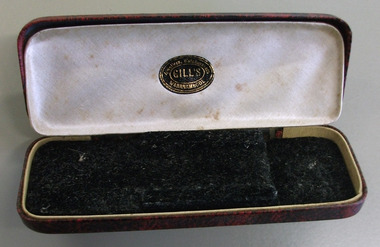
... spectacles Case, ...Lined with cream satin with black felt insert. Metal hinges. spectacles Case, Domestic object Case, spectacles ...Frederick James Gill operated from the early part of the 20th century, through until around the 1960’s. He died in Warrnambool in 1961. There is still a jeweller operating from the same site today.A common item with a link to a Warrnambool businessDark red and black patterned hard case with rounded corners. Lined with cream satin with black felt insert. Metal hinges.Oval sticker: Gill’s jewellers, watchmakers Warrnambool.warrnambool, f.j. gill, jeweller, frederick james gill -
Numurkah & District Historical Society
Functional object, Spectacles
... Spectacles...Small circular lenses with black sides Spectacles Functional object ...Small circular lenses with black sides
