
Showing 4 items matching " strathpine"
-
 Sunshine and District Historical Society Incorporated
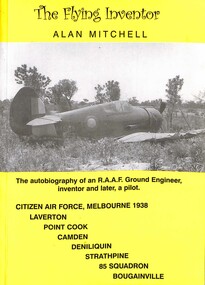
Booklet - The Flying Inventor, Alan Mitchell, 2000
... ... Strathpine...The Flying Inventor The autobiography of an R.A.A.F. ground engineer, inventor and later, a pilot|Citizen Air Force Melbourne 1938, Laverton, Point Cook, Camden, Deniliquin, Strathpine, 85 Squadron, Bougainville...Airforce Mitchell Laverton Point Cook Camden Deniliquin Strathpine Bougainville The Flying Inventor The autobiography of an R.A.A.F. ground engineer, inventor and later, a pilot|Citizen Air Force Melbourne 1938, Laverton, Point Cook, Camden, Deniliquin, Strathpine, 85 Squadron, Bougainville A yellow soft covered book with a picture of shot down plane on front The Flying Inventor Booklet The Flying Inventor Alan Mitchell ...A yellow soft covered book with a picture of shot down plane on frontairforce, mitchell, laverton, point cook, camden, deniliquin, strathpine, bougainville -
 Bendigo Historical Society Inc.
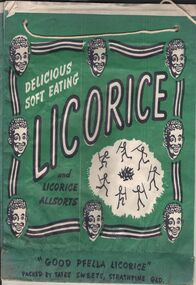
Ephemera - SHOWBAGS COLLECTION: GOOD PFELLA LICORICE SHOWBAG
... Underneath the square the words: " Good Pfella Licorice" Packed by tafes sweets, Strathpine QLD. The same design on both sides....Underneath the square the words: " Good Pfella Licorice" Packed by tafes sweets, Strathpine QLD. The same design on both sides. ...A paper showbag. A mainly green showbag with a black and white design, within a square made of black and white lines and 8 smiling faces of what appear to be an African or aborigine youth, we read: delicious soft eating Licorice and licorice all sorts. There is also a design of 7 stick figure holding a spear and dancing around a camp fire. Underneath the square the words: " Good Pfella Licorice" Packed by tafes sweets, Strathpine QLD. The same design on both sides.business, retail, advertising, business advertising usually found at agricultural shows and other promotional activities. -
 Eltham District Historical Society Inc
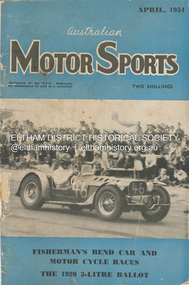
Journal - Magazine, Wylie Publishing Co. Pty. Ltd, Australian Motor Sports, April, 1954
... This issue features: Fisherman's Bend Car and Motor Cycle Races The 1929 3-Litre Ballot Australian Secials Strathpine Car Races Beveridge "Motorkhana" Collingrove Closed Hill Climb Of specific interest is the Rob Roy Hill Climb mentioned on page 30: "VICTORIAN HILL CLIMB CHAMPIONSHIOS, 1954 The Victorian Hill Climb Championships for 1954 are to be decided upon the results of three Victorian Hill Climbs conducted at Rob Roy and Templestowe by the Victorian Sporting Car Club and the Light Car Club of Australia (two at Rob Roy - one at Templestowe). " And on page 33, advertsing for the Rob Roy Hill Climb Climb to be held Sunday, May 23rd, 1954...This issue features: Fisherman's Bend Car and Motor Cycle Races The 1929 3-Litre Ballot Australian Secials Strathpine Car Races Beveridge "Motorkhana" Collingrove Closed Hill Climb Of specific interest is the Rob Roy Hill Climb mentioned on page 30: "VICTORIAN HILL CLIMB CHAMPIONSHIOS, 1954 The Victorian Hill Climb Championships for 1954 are to be decided upon the results of three Victorian Hill Climbs conducted at Rob Roy and Templestowe by the Victorian Sporting Car Club and the Light Car Club of Australia (two at Rob Roy - one at Templestowe). " And on page 33, advertsing for the Rob Roy Hill Climb Climb to be held Sunday, May 23rd, 1954 Light Car Club of Australia motor sports Rob Roy Hill Climb Templestowe Hill Climb Victorian Sporting Car Club Digital scan only of 52 page journal, approx. ...Monthly journal of Australian Motor Sports. This issue features: Fisherman's Bend Car and Motor Cycle Races The 1929 3-Litre Ballot Australian Secials Strathpine Car Races Beveridge "Motorkhana" Collingrove Closed Hill Climb Of specific interest is the Rob Roy Hill Climb mentioned on page 30: "VICTORIAN HILL CLIMB CHAMPIONSHIOS, 1954 The Victorian Hill Climb Championships for 1954 are to be decided upon the results of three Victorian Hill Climbs conducted at Rob Roy and Templestowe by the Victorian Sporting Car Club and the Light Car Club of Australia (two at Rob Roy - one at Templestowe). " And on page 33, advertsing for the Rob Roy Hill Climb Climb to be held Sunday, May 23rd, 1954light car club of australia, motor sports, rob roy hill climb, templestowe hill climb, victorian sporting car club -
 Australian Commando Association - Victoria
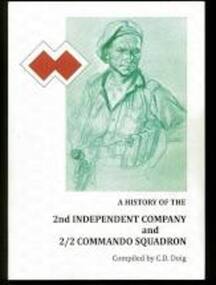
Book, A history of the 2nd Independent Company and 2/2nd Commando Squadron
... After 90 days leave, the squadron reformed at Strathpine in Queensland before sailing to New Britain in April 1945. ...After 90 days leave, the squadron reformed at Strathpine in Queensland before sailing to New Britain in April 1945. ...The history of the No. 2 Independent Commando Company and 2/2 Commando Squadron during World War II – scarce as a 1st edition dated 1986. Having completed its training at Foster, on Wilson’s Promontory, Victoria, the 2nd Independent Company was raised and travelled north to Katherine, in the Northern Territory. However, following Japan’s entry into the war, as with the other independent companies that were sent to the islands off Australia, the 2nd was sent to Timor, where it joined the 2/40th Battalion and the rest of Sparrow Force. Sparrow Force divided itself between west Timor, part of the Netherlands East Indies, and east Timor, which belonged to Portugal. The 2/40th Battalion defended the capital of west Timor, Koepang, and the airfield at Penfui. Most of the independent company moved to the airfield at Dili, in east Timor, and the nearby mountains. Portugal was opposed to the stationing of a Dutch or Australian garrison in case this provoked the Japanese, but despite this opposition, on 17 December 1941, elements of the 2nd Independent Company and Dutch troops landed near Dili. On 20 February 1942 the Japanese invaded the island, attacking east and west Timor simultaneously. The 2/40th Battalion held out for three days, but were overrun and were killed or captured. Similarly, the 2nd could not hold the airfield and were also driven back. But they were not captured and instead retreated to the mountains where they conducted a very successful and pursued a guerrilla war against the Japanese which lasted for over a year. Following the capture of Timor, the 2nd occupation the company was listed as “missing”, the company’s signallers were able to build a wireless transmitter, nicknamed ‘Winnie the War Winner’, and on 18/19 April were able to contact Darwin. At the end of May RAN vessels began landing supplies for the Australians on the south coast of east Timor. These supply runs were very dangerous but they allowed the Australians on Timor to continue fighting. In September the guerillas were reinforced with the 2/4th Independent Company. However, this could not go on indefinitely. In August the Japanese lunched a major offensive against the guerrillas and Japanese reprisals against the civilian population of east Timor reduced their support for the Australians. The 2nd (now named the 2/2nd Independent Company) and 2/4th were withdrawn in December and January 1943 respectively. Although the 2/2nd Independent Company is best known for its time on Timor, it also saw extensive service in New Guinea and New Britain. The independent company reformed at the army’s training centre at Canungra, Queensland, where it was reinforced and reequipped. The company then moved to the Atherton Tableland, where it briefly became part of the 2/6th Cavalry (Commando) Regiment. Due to this reorganisation, in October, the 2/2nd Independent Company was renamed the 2/2nd Cavalry (Commando) Squadron. This name was later simplified to just commando squadron. When this happened though, the 2/2nd was back in action. In June 1943 the 2/2nd sailed from Townsville for Port Moresby and was subsequently flown to Bena Bena, in the Bismark Range in New Guinea’s highlands. Here they supported the 2/7th Independent Company in patrolling the Ramu River area. In the second week of July the 2/2nd moved into position, with its headquarters at Bena Bena and with its platoons’ occupying neighbouring positions. By the end of the month their patrols were skirmishing with the Japanese. The 2/2nd remained in New Guinea until October 1944. After 90 days leave, the squadron reformed at Strathpine in Queensland before sailing to New Britain in April 1945. The 2/2nd landed at Jacquinot Bay on 17 April. The squadron then moved to Wide Bay, in order to support the 13th Brigade of the 5th Division, and was based at Lamarien. Following Japan’s surrender and the end of the war, the ranks of the squadron thinned quickly as men were discharged or transferred to other units. For those who were left, they returned to Australia and in early 1946 the 2/2nd Commando Squadron was disbanded. Includes Nominal Roll Soft Cover without Dust Jacket – 270 pages
