
Showing 68 items matching " street musicians"
-
 Bendigo Historical Society Inc.
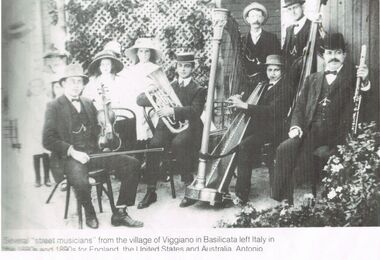
Photograph - PETER ELLIS COLLECTION: BAND
... ... Street Musicians...Copy of a black and white photo of street musicians from the village of Viggiano in Basilicata, Italy in the 1880's and 1890's. ...PHOTO Group musicians Peter Ellis Collection Street Musicians Copy of a black and white photo of street musicians from the village of Viggiano in Basilicata, Italy in the 1880's and 1890's. ...Copy of a black and white photo of street musicians from the village of Viggiano in Basilicata, Italy in the 1880's and 1890's. They travelled to England, the United States and Australia. There are six musicians, one has a violin, another a harp, one a bass, and two have wind instruments. There are also some girls in the picture.photo, group, musicians, peter ellis collection, street musicians -
 Dutch Australian Heritage Centre Victoria
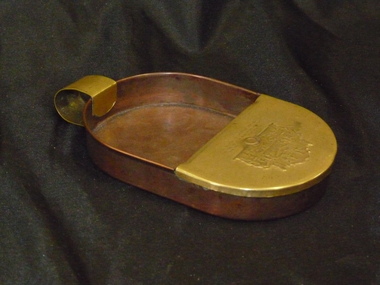
Money Collecting Dish (Geldbakje)
... street musicians; copper...Used to collect coins from those listening to street musicians, particularly the barrel organ grinder. ...Used to collect coins from those listening to street musicians, particularly the barrel organ grinder. It was customary to rattle the coins in an attempt to attract further donations.This is a copper, oval-shaped dish with low (about 2cm) sides, part covered in brass, with brass handle and about 15cm in length. Cover displays barrel organ in relief.street musicians; copper -
 Bendigo Historical Society Inc.
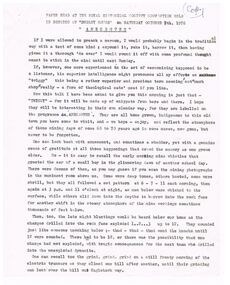
Document - BENDIGO & EAGLEHAWK ANECDOTES, 09/10/1976
... Notes mention what it was like in the early days, things that had happened, buildings in View Street, open-air theatres, musicians, and characters that roamed the streets...Notes mention what it was like in the early days, things that had happened, buildings in View Street, open-air theatres, musicians, and characters that roamed the streets Document BENDIGO & EAGLEHAWK ANECDOTES ...Seven typed pages and one page of additions titled 'Anecdotes' read at the RHS Convention held in Bendigo at 'Dudley House' on 9/10/1076. Notes mention what it was like in the early days, things that had happened, buildings in View Street, open-air theatres, musicians, and characters that roamed the streetsdocument, names of bendigo pioneers, bendigo & eaglehawk anecdotes, arblaster's powder factory, annals of bendigo, latham and watson's mine, gray, bendigo advertiser 1858, dr harry leigh atkinson, ravenswood property, a. n. a. hall, sir john quick, princess theatre, the tiv, mr frank cusack, pederewski, lyric photo plays, oscar flight, tiny coupe, fedder duster, overcoat charlie, bayonet, benevolent home, sydney myer, myer stores, robert harkness, nubby bux, j bruce, henry john king, louis williams -
 Ballaarat Mechanics' Institute (BMI Ballarat)
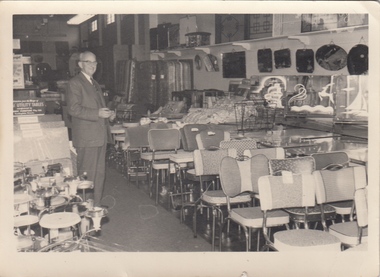
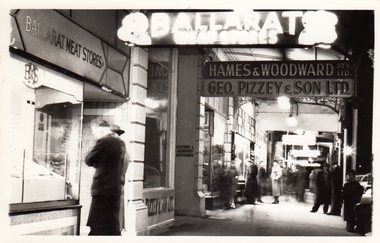
George Richmond in Hames and Woodward
... “Up to 1936, there used to be regular visits by street musicians, who were usually good for a few laughs.” ...“Up to 1936, there used to be regular visits by street musicians, who were usually good for a few laughs.” ...This photograph is held in the Ballaarat Mechanics' Institute Audio Visual Collection. Please contact BMI for all print and usage inquiries. BMI librarian Rosemary McInerney's father George Richmond ran this furnitue business on Armstrong St Nth. Here are his reminiscences of that shoppping area from The Courier March 1st 1978 THE GOOD OLD DAYS IN ARMSTRONG ST. NORTH Mr George Richmond began work in Armstrong street north as a lad in knickerbockers in 1926. He started with Hames and Woodward, a piano, music and record shop, which he took over when both Hames and Woodward died during the war. Mr Richmond was guest speaker at an informal dinner of the Armstrong St North Traders Association held at the Victoria Hotel on Monday night. At the meeting he was made a life member of the association, with which he had been involved since its inception in 1930. “I can remember when a man on a bicycle with a little ladder on his backrode up the street with a long stick and turned on the gas lights under the verandahs,” he said. “It was around that time when there used to be a little man with a broom walking up and down the street, sweeping away what was left behind by horses. “There also used to be a bellringer who would walk up and down Armstrong street announcing a sale in a shop. He used to have a tall black hat, a large black frock coat and had a large mustache.” “Up to 1936, there used to be regular visits by street musicians, who were usually good for a few laughs.” “The last musicians to come through were an Italian trio, who were very good.” Mr Richmond said the depression was a sad time for Armstrong street. “A lot of people had to put their properties up for sale, because not many people could afford to buy things like records then,” he said. Mr Richmond said Fridays were very busy then as it was market day for hundreds of farmers in the area. “The hotels put on extra groomsmen for the stables, and standing in the store I could smell the beer and tobacco drifting down from the hotels.”ballarat, hames, woodward, furniture, richmond, armstrong st nth, shop -
 Ballaarat Mechanics' Institute (BMI Ballarat)
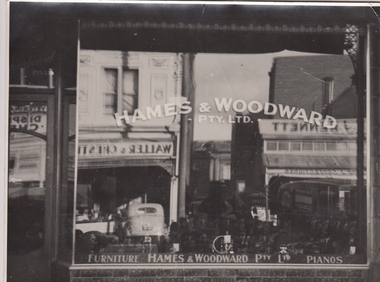
Hames and Woodward Pty Ltd
... “Up to 1936, there used to be regular visits by street musicians, who were usually good for a few laughs.” ...“Up to 1936, there used to be regular visits by street musicians, who were usually good for a few laughs.” ...This photograph is held in the Ballaarat Mechanics' Institute Audio Visual Collection. Please contact BMI for all print and usage inquiries. BMI librarian Rosemary McInerney's father George Richmond ran this furnitue business on Armstrong St Nth. Here are his reminiscences of that shoppping area from The Courier March 1st 1978 THE GOOD OLD DAYS IN ARMSTRONG ST. NORTH Mr George Richmond began work in Armstrong street north as a lad in knickerbockers in 1926. He started with Hames and Woodward, a piano, music and record shop, which he took over when both Hames and Woodward died during the war. Mr Richmond was guest speaker at an informal dinner of the Armstrong St North Traders Association held at the Victoria Hotel on Monday night. At the meeting he was made a life member of the association, with which he had been involved since its inception in 1930. “I can remember when a man on a bicycle with a little ladder on his backrode up the street with a long stick and turned on the gas lights under the verandahs,” he said. “It was around that time when there used to be a little man with a broom walking up and down the street, sweeping away what was left behind by horses. “There also used to be a bellringer who would walk up and down Armstrong street announcing a sale in a shop. He used to have a tall black hat, a large black frock coat and had a large mustache.” “Up to 1936, there used to be regular visits by street musicians, who were usually good for a few laughs.” “The last musicians to come through were an Italian trio, who were very good.” Mr Richmond said the depression was a sad time for Armstrong street. “A lot of people had to put their properties up for sale, because not many people could afford to buy things like records then,” he said. Mr Richmond said Fridays were very busy then as it was market day for hundreds of farmers in the area. “The hotels put on extra groomsmen for the stables, and standing in the store I could smell the beer and tobacco drifting down from the hotels.”ballarat, hames, woodward, furniture, richmond, armstrong st nth, shop, street, night -
 Ballaarat Mechanics' Institute (BMI Ballarat)
Hames and Woodward window Armstrong St Nth
... “Up to 1936, there used to be regular visits by street musicians, who were usually good for a few laughs.” ...“Up to 1936, there used to be regular visits by street musicians, who were usually good for a few laughs.” ...This photograph is held in the Ballaarat Mechanics' Institute Audio Visual Collection. Please contact BMI for all print and usage inquiries. BMI librarian Rosemary McInerney's father George Richmond ran this furnitue business on Armstrong St Nth. Here are his reminiscences of that shoppping area from The Courier March 1st 1978 THE GOOD OLD DAYS IN ARMSTRONG ST. NORTH Mr George Richmond began work in Armstrong street north as a lad in knickerbockers in 1926. He started with Hames and Woodward, a piano, music and record shop, which he took over when both Hames and Woodward died during the war. Mr Richmond was guest speaker at an informal dinner of the Armstrong St North Traders Association held at the Victoria Hotel on Monday night. At the meeting he was made a life member of the association, with which he had been involved since its inception in 1930. “I can remember when a man on a bicycle with a little ladder on his backrode up the street with a long stick and turned on the gas lights under the verandahs,” he said. “It was around that time when there used to be a little man with a broom walking up and down the street, sweeping away what was left behind by horses. “There also used to be a bellringer who would walk up and down Armstrong street announcing a sale in a shop. He used to have a tall black hat, a large black frock coat and had a large mustache.” “Up to 1936, there used to be regular visits by street musicians, who were usually good for a few laughs.” “The last musicians to come through were an Italian trio, who were very good.” Mr Richmond said the depression was a sad time for Armstrong street. “A lot of people had to put their properties up for sale, because not many people could afford to buy things like records then,” he said. Mr Richmond said Fridays were very busy then as it was market day for hundreds of farmers in the area. “The hotels put on extra groomsmen for the stables, and standing in the store I could smell the beer and tobacco drifting down from the hotels.” -
 Ballaarat Mechanics' Institute (BMI Ballarat)
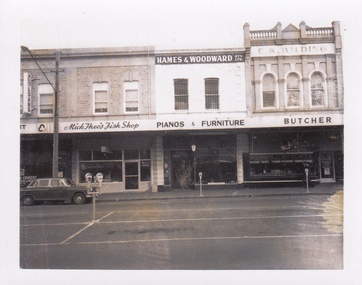
Hames and Woodward
... “Up to 1936, there used to be regular visits by street musicians, who were usually good for a few laughs.” ...“Up to 1936, there used to be regular visits by street musicians, who were usually good for a few laughs.” ...This photograph is held in the Ballaarat Mechanics' Institute Audio Visual Collection. Please contact BMI for all print and usage inquiries. BMI librarian Rosemary McInerney's father George Richmond ran this furnitue business on Armstrong St Nth. Here are his reminiscences of that shoppping area from The Courier March 1st 1978 THE GOOD OLD DAYS IN ARMSTRONG ST. NORTH Mr George Richmond began work in Armstrong street north as a lad in knickerbockers in 1926. He started with Hames and Woodward, a piano, music and record shop, which he took over when both Hames and Woodward died during the war. Mr Richmond was guest speaker at an informal dinner of the Armstrong St North Traders Association held at the Victoria Hotel on Monday night. At the meeting he was made a life member of the association, with which he had been involved since its inception in 1930. “I can remember when a man on a bicycle with a little ladder on his backrode up the street with a long stick and turned on the gas lights under the verandahs,” he said. “It was around that time when there used to be a little man with a broom walking up and down the street, sweeping away what was left behind by horses. “There also used to be a bellringer who would walk up and down Armstrong street announcing a sale in a shop. He used to have a tall black hat, a large black frock coat and had a large mustache.” “Up to 1936, there used to be regular visits by street musicians, who were usually good for a few laughs.” “The last musicians to come through were an Italian trio, who were very good.” Mr Richmond said the depression was a sad time for Armstrong street. “A lot of people had to put their properties up for sale, because not many people could afford to buy things like records then,” he said. Mr Richmond said Fridays were very busy then as it was market day for hundreds of farmers in the area. “The hotels put on extra groomsmen for the stables, and standing in the store I could smell the beer and tobacco drifting down from the hotels.”ballarat, hames, woodward, furniture, richmond, armstrong st nth, shop -
 Federation University Historical Collection
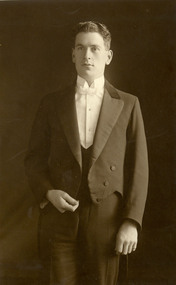
Photograph, Richards & Co, Frank Wright, 1922, 02/08/1922
... The Frank Wright Medal at the Royal South Street competition is awarded to an individual recognized as making an outstanding contribution to brass music in Australia. frank wright musician brass band Personal markings - "Frank Wright - taken on my 21st birthday - 2nd August, 1922, Age 21 years". ...Frank Wright was a renown resident of Smeaton, where he was born. He lived at Laura Villa, and attended Smeaton State School. His father William was a gold miner and his mother's name was Sarah. Their family won many singing and instrumental awards. Frank was tutored by Percy Code and became the Australian Open Cornet Champion by the age of eighteen. A year later, Frank conducted the City of Ballarat Band, and later the Ballarat Soldiers’ Memorial Band. He formed the Frank Wright Frisco Band and Frank Wright and his Coliseum Orchestra. These bands won many South Street awards, and Frank as conductor won many awards in the Australian Band Championship contest. In 1933 Frank Wright sailed to England to conduct the famous St Hilda’s Band and was later appointed Musical Director of the London County Council, where he organized many amazing concerts in parks, in and around the London district. He was made Professor of Brass and Military Band Scoring and conducted at the Guildhall of Music and Drama. Frank was often invited to adjudicate Brass Band Championships around Europe, in Australia, including South Street and in New Zealand. The Frank Wright Medal at the Royal South Street competition is awarded to an individual recognized as making an outstanding contribution to brass music in Australia.Frank Wright stands in tails. The photograph was taken on his 21st birthday.Personal markings - "Frank Wright - taken on my 21st birthday - 2nd August, 1922, Age 21 years". Richards & Co Photo Ballarat. Kodak Australiafrank wright, musician, brass band -
 Federation University Historical Collection
Photograph - black and white, Frank Wright at Loch Lomond, 1933, 1933
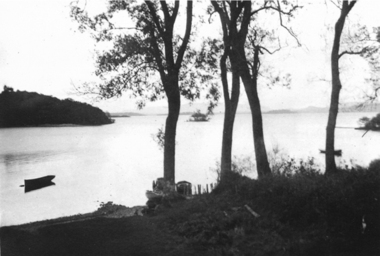
... The Frank Wright Medal at the Royal South Street competition is awarded to an individual recognized as making an outstanding contribution to brass music in Australia. He died on 16 November 1970. frank wright loch lomond musician composer Written in pencil on the reverse side of the photograph is 1). ...Frank Wright was a renoun resident of Smeaton, where he was born on 2 August 1901. He lived at Laura Villa, and attended Smeaton State School. His father William was a gold miner and his mother's name was Sarah. Their family won many singing and instrumental awards. Frank was tutored by Percy Code and was awarded a gold medal for the highest marks in the ALCM examinations in the British Colonies at the age of seventeen years. He became the Australian Open Cornet Champion by the age of eighteen. A year later, Frank conducted the City of Ballarat Band, and later the Ballarat Soldiers’ Memorial Band. He formed the Frank Wright Frisco Band and Frank Wright and his Coliseum Orchestra. These bands won many South Street awards, and Frank as conductor won many awards in the Australian Band Championship contest. In 1933 Frank Wright sailed to England to conduct the famous St Hilda’s Band and was later appointed Musical Director of the London County Council, where he organized many amazing concerts in parks, in and around the London district. He was made Professor of Brass and Military Band Scoring and conducted at the Guildhall of Music and Drama. Frank was often invited to adjudicate Brass Band Championships around Europe, in Australia, including South Street and in New Zealand. The Frank Wright Medal at the Royal South Street competition is awarded to an individual recognized as making an outstanding contribution to brass music in Australia. He died on 16 November 1970.1). A black and white photograph of a man dressed in a suit, overcoat and hat, standing on a wooden pier over a stretch of water which is Loch Lomond. There are mountains to be seen in the distance. The man is Frank Wright. 2). Black and white photograph of a lake. In the foreground is a grassed area with four trees. a small boat is at anchor just offshore. The place is Loch Lomond.Written in pencil on the reverse side of the photograph is 1). "Frank Wright at Loch Lomond 1933" 2). Loch Lomond 1933frank wright, loch lomond, musician, composer -
 Federation University Historical Collection
Booklet, The Worshipful Company of Musicians, 1969, 11 November, 1969
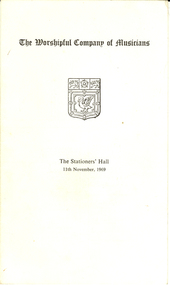
... The Frank Wright Medal at the Royal South Street competition is awarded to an individual recognized as making an outstanding contribution to brass music in Australia. In the 1960's Frank became 'The Senior Warden' of The Worshipful Company of Musicians....The Frank Wright Medal at the Royal South Street competition is awarded to an individual recognized as making an outstanding contribution to brass music in Australia. In the 1960's Frank became 'The Senior Warden' of The Worshipful Company of Musicians. frank wright stationers' hall worshipful company of musicians Printed with the title and emblem, place and date and the list of participant names, plus an index. ...Frank Wright was a renown resident of Smeaton, where he was born on 2 August 1901. He lived at Laura Villa, and attended Smeaton State School. His father William was a gold miner and his mother's name was Sarah. Their family won many singing and instrumental awards. Frank was tutored by Percy Code and was awarded a gold medal for the highest marks in the ALCM examinations in the British Colonies at the age of seventeen years. He became the Australian Open Cornet Champion by the age of eighteen. A year later, Frank conducted the City of Ballarat Band, and later the Ballarat Soldiers’ Memorial Band. He formed the Frank Wright Frisco Band and Frank Wright and his Coliseum Orchestra. These bands won many South Street awards, and Frank as conductor won many awards in the Australian Band Championship contest. In 1933 Frank Wright sailed to England to conduct the famous St Hilda’s Band and was later appointed Musical Director of the London County Council, where he organized many amazing concerts in parks, in and around the London district. He was made Professor of Brass and Military Band Scoring and conducted at the Guildhall of Music and Drama. Frank was often invited to adjudicate Brass Band Championships around Europe, in Australia, including South Street and in New Zealand. The Frank Wright Medal at the Royal South Street competition is awarded to an individual recognized as making an outstanding contribution to brass music in Australia. In the 1960's Frank became 'The Senior Warden' of The Worshipful Company of Musicians.This is a folded, light card programme of the table seating for The Worshipful Company of Musicians celebration held at The Stationers' Hall on the 11th November 1969. Gift of Frank Ritchie, Nephew of Frank WrightPrinted with the title and emblem, place and date and the list of participant names, plus an index.frank wright, stationers' hall, worshipful company of musicians -
 Federation University Historical Collection
Document, Whittington Hospital, Medical Report Relating to Frank Wright, 1970, 15/7/1970
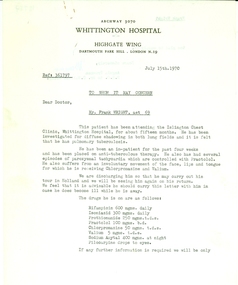
... The Frank Wright Medal at the Royal South Street competition is awarded to an individual recognized as making an outstanding contribution to brass music in Australia. He died on 16 November 1970. frank wright whittington hospital musician Signature at the end. ...Frank Wright was a renoun resident of Smeaton, where he was born on 2 August 1901. He lived at Laura Villa, and attended Smeaton State School. His father William was a gold miner and his mother's name was Sarah. Their family won many singing and instrumental awards. Frank was tutored by Percy Code and was awarded a gold medal for the highest marks in the ALCM examinations in the British Colonies at the age of seventeen years. He became the Australian Open Cornet Champion by the age of eighteen. A year later, Frank conducted the City of Ballarat Band, and later the Ballarat Soldiers’ Memorial Band. He formed the Frank Wright Frisco Band and Frank Wright and his Coliseum Orchestra. These bands won many South Street awards, and Frank as conductor won many awards in the Australian Band Championship contest. In 1933 Frank Wright sailed to England to conduct the famous St Hilda’s Band and was later appointed Musical Director of the London County Council, where he organized many amazing concerts in parks, in and around the London district. He was made Professor of Brass and Military Band Scoring and conducted at the Guildhall of Music and Drama. Frank was often invited to adjudicate Brass Band Championships around Europe, in Australia, including South Street and in New Zealand. The Frank Wright Medal at the Royal South Street competition is awarded to an individual recognized as making an outstanding contribution to brass music in Australia. He died on 16 November 1970.A typed letter on a single sheet of paper with the Whittington Hospital header. The letter indicated that Frank Wright was a patient of this hospital and the medications he was taking.Signature at the end.frank wright, whittington hospital, musician -
 Federation University Historical Collection
Document, Clive Carey, Reference for Frank Wright from Clive Carey, 1938, 23/4/1938
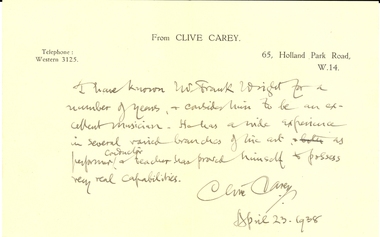
... The Frank Wright Medal at the Royal South Street competition is awarded to an individual recognized as making an outstanding contribution to brass music in Australia. He died on 16 November 1970. frank wright clive carey reference musician Hand written and signed Small slip of note paper with a printed header containing a hand written reference, from Clive Carey for Frank Wright. ...Frank Wright was a renoun resident of Smeaton, where he was born on 2 August 1901. He lived at Laura Villa, and attended Smeaton State School. His father William was a gold miner and his mother's name was Sarah. Their family won many singing and instrumental awards. Frank was tutored by Percy Code and was awarded a gold medal for the highest marks in the ALCM examinations in the British Colonies at the age of seventeen years. He became the Australian Open Cornet Champion by the age of eighteen. A year later, Frank conducted the City of Ballarat Band, and later the Ballarat Soldiers’ Memorial Band. He formed the Frank Wright Frisco Band and Frank Wright and his Coliseum Orchestra. These bands won many South Street awards, and Frank as conductor won many awards in the Australian Band Championship contest. In 1933 Frank Wright sailed to England to conduct the famous St Hilda’s Band and was later appointed Musical Director of the London County Council, where he organized many amazing concerts in parks, in and around the London district. He was made Professor of Brass and Military Band Scoring and conducted at the Guildhall of Music and Drama. Frank was often invited to adjudicate Brass Band Championships around Europe, in Australia, including South Street and in New Zealand. The Frank Wright Medal at the Royal South Street competition is awarded to an individual recognized as making an outstanding contribution to brass music in Australia. He died on 16 November 1970.Small slip of note paper with a printed header containing a hand written reference, from Clive Carey for Frank Wright.Hand written and signedfrank wright, clive carey, reference, musician -
 Federation University Historical Collection
Photograph, Page from Musicians Book of Remembrance, January 2nd 1955, 2/1/1955
... The Frank Wright Medal at the Royal South Street competition is awarded to an individual recognized as making an outstanding contribution to brass music in Australia. frank wright musicians book of remembrance g h salter nellie melba edward elgar A black and photograph of a page from the Musicians' Book of Remembrance, dedicated by the Dean of St. ...Frank Wright was a renown resident of Smeaton, where he was born on 2 August 1901. He lived at Laura Villa, and attended Smeaton State School. His father William was a gold miner and his mother's name was Sarah. Their family won many singing and instrumental awards. Frank was tutored by Percy Code and was awarded a gold medal for the highest marks in the ALCM examinations in the British Colonies at the age of seventeen years. He became the Australian Open Cornet Champion by the age of eighteen. A year later, Frank conducted the City of Ballarat Band, and later the Ballarat Soldiers’ Memorial Band. He formed the Frank Wright Frisco Band and Frank Wright and his Coliseum Orchestra. These bands won many South Street awards, and Frank as conductor won many awards in the Australian Band Championship contest. In 1933 Frank Wright sailed to England to conduct the famous St Hilda’s Band and was later appointed Musical Director of the London County Council, where he organized many amazing concerts in parks, in and around the London district. He was made Professor of Brass and Military Band Scoring and conducted at the Guildhall of Music and Drama. Frank was often invited to adjudicate Brass Band Championships around Europe, in Australia, including South Street and in New Zealand. The Frank Wright Medal at the Royal South Street competition is awarded to an individual recognized as making an outstanding contribution to brass music in Australia.A black and photograph of a page from the Musicians' Book of Remembrance, dedicated by the Dean of St. Pauls', The Reverend G.H. Salter. It contains many names of notable musicians including Nellie Melba and Edward Elgar. The Photograph is glued to a piece of cardboard. It was the property of Frank Wright.frank wright, musicians book of remembrance, g h salter, nellie melba, edward elgar -
Federation University Historical Collection
Brochure, Besson "Prototype", 1930s?
... The Frank Wright Medal at the Royal South Street competition is awarded to an individual recognized as making an outstanding contribution to brass music in Australia. frank wright brass band musical instruments william s may besson a p sykes A yellow, red and white three fold brochure printed in black, advertising the Besson brand brass band instruments, sold by A P Sykes of Melbourne. On the front cover are photographs of two musicians ...Frank Wright was a renown resident of Smeaton, where he was born in 1901. He lived at Laura Villa, and attended Smeaton State School. His father William was a gold miner and his mother's name was Sarah. He was the youngest of eleven children. Their family won many singing and instrumental awards. Frank was tutored by Percy Code and was awarded a gold medal for the highest marks in the ALCM examinations in the British Colonies at the age of seventeen years. He became the Australian Open Cornet Champion by the age of eighteen. A year later, Frank conducted the City of Ballarat Band, and later the Ballarat Soldiers’ Memorial Band. He formed the Frank Wright Frisco Band and Frank Wright and his Coliseum Orchestra. These bands won many South Street awards, and Frank as conductor won many awards in the Australian Band Championship contest. In 1933 Frank Wright sailed to England to conduct the famous St Hilda’s Band and was appointed in 1934 as the Musical Director of the London County Council (the GLC or Greater London Council), where he organized many amazing concerts in most of the 150 parks, in and around the London district. He was also responsible for some of London’s major concerts at Kenwood, the Crystal Palace and Holland Park. He was made Professor of Brass and Military Band Scoring and Conducting and was a Fellow of the Guildhall School of Music and Drama. Frank was often invited to adjudicate Brass Band Championships around Europe, in Australia, including South Street and in New Zealand. Frank was awarded an M.B.E. in 1967 and he died in November 1970. The Frank Wright Medal at the Royal South Street competition is awarded to an individual recognized as making an outstanding contribution to brass music in Australia.A yellow, red and white three fold brochure printed in black, advertising the Besson brand brass band instruments, sold by A P Sykes of Melbourne. On the front cover are photographs of two musicians who a giving their approval for these instruments. One is Frank Wright and the other is William S. May.frank wright, brass band, musical instruments, william s may, besson, a p sykes -
 Federation University Historical Collection
Badge - Leather disc, E.N.S.A. Frank Wright C.E, c1942
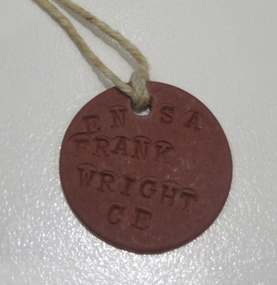
... The Frank Wright Medal at the Royal South Street competition is awarded to an individual recognized as making an outstanding contribution to brass music in Australia. frank wright armed forces entertainment musician conductor brass bands ensa entertainments national service association This red coloured 3.5 cm leather disc has been stamped with the letters ENSA Frank Wright CE. ...This disc belonged to Frank Wright. The letters ENSA refer to the Entertainments National Service Association, which was set up in 1939 to provide entertainment for the British armed forces personnel. Frank Wright was a renown resident of Smeaton, where he was born in 1901. He lived at Laura Villa, and attended Smeaton State School. His father William was a gold miner and his mother's name was Sarah. He was the youngest of eleven children. Their family won many singing and instrumental awards. Frank was tutored by Percy Code and was awarded a gold medal for the highest marks in the ALCM examinations in the British Colonies at the age of seventeen years. He became the Australian Open Cornet Champion by the age of eighteen. A year later, Frank conducted the City of Ballarat Band, and later the Ballarat Soldiers’ Memorial Band. He formed the Frank Wright Frisco Band and Frank Wright and his Coliseum Orchestra. These bands won many South Street awards, and Frank as conductor won many awards in the Australian Band Championship contest. In 1933 Frank Wright sailed to England to conduct the famous St Hilda’s Band and was appointed in 1934 as the Musical Director of the London County Council (the GLC or Greater London Council), where he organized many amazing concerts in most of the 150 parks, in and around the London district. He was also responsible for some of London’s major concerts at Kenwood, the Crystal Palace and Holland Park. He was made Professor of Brass and Military Band Scoring and Conducting and was a Fellow of the Guildhall School of Music and Drama. Frank was often invited to adjudicate Brass Band Championships around Europe, in Australia, including South Street and in New Zealand. Frank was awarded an M.B.E. in 1967 and he died in November 1970. The Frank Wright Medal at the Royal South Street competition is awarded to an individual recognized as making an outstanding contribution to brass music in Australia.This red coloured 3.5 cm leather disc has been stamped with the letters ENSA Frank Wright CE. It has a hole pinched in the top, through which a string has been threaded.frank wright, armed forces entertainment, musician conductor, brass bands, ensa, entertainments national service association -
 Federation University Historical Collection
Document, Frank Wright, Speech made at the Ancient Worshipful Company of Musicians by Junior Warden Frank Wright, 1967, 3/10/1968
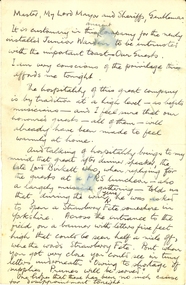
... The Frank Wright Medal at the Royal South Street competition is awarded to an individual recognized as making an outstanding contribution to brass music in Australia. freemason ancient worshipful company of musicians junior warden frank wright speech Handwritten speech Handwritten speech by Frank Wright on seven sheets of paper, in dark (almost black), blue pen with some smudges and some red underlined passages. ...Frank Wright was a renown resident of Smeaton, where he was born. He lived at Laura Villa, and attended Smeaton State School. His father William was a gold miner and his mother's name was Sarah. Their family won many singing and instrumental awards. Frank was tutored by Percy Code and was awarded a gold medal for the highest marks in the ALCM examinations in the British Colonies at the age of seventeen years. He became the Australian Open Cornet Champion by the age of eighteen. A year later, Frank conducted the City of Ballarat Band, and later the Ballarat Soldiers’ Memorial Band. He formed the Frank Wright Frisco Band and Frank Wright and his Coliseum Orchestra. These bands won many South Street awards, and Frank as conductor won many awards in the Australian Band Championship contest. In 1933 Frank Wright sailed to England to conduct the famous St Hilda’s Band and was appointed in 1934 as the Musical Director of the London County Council (the GLC or Greater London Council), where he organized many amazing concerts in most of the 150 parks, in and around the London district. He was also responsible for some of London’s major concerts at Kenwood, the Crystal Palace and Holland Park. He was made Professor of Brass and Military Band Scoring and Conducting and was a Fellow of the Guildhall School of Music and Drama. Frank was often invited to adjudicate Brass Band Championships around Europe, in Australia, including South Street and in New Zealand. Frank was awarded an M.B.E. in 1967. The Frank Wright Medal at the Royal South Street competition is awarded to an individual recognized as making an outstanding contribution to brass music in Australia.Handwritten speech by Frank Wright on seven sheets of paper, in dark (almost black), blue pen with some smudges and some red underlined passages. On pages 2, 4 and 7 there are additions in pencil and on page 6 is a passage in red. This speech made as the Junior Warden of the Ancient Worshipful Company of Musicians, was to welcome and propose a toast to the guests on Friday 3rd October 1968.Handwritten speechfreemason, ancient worshipful company of musicians, junior warden, frank wright, speech -
 Federation University Historical Collection
Magazine, Hansom Books Ltd, Music and Musicians, May 1967, 1967
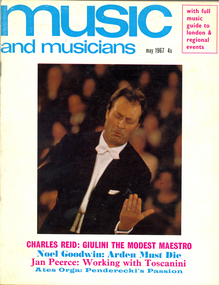
... The Frank Wright Medal at the Royal South Street competition is awarded to an individual recognized as making an outstanding contribution to brass music in Australia. music and musicians hansom books ltd frank wright A 66 page black and white magazine with a colour front cover. ...Frank Wright was a renown resident of Smeaton, where he was born. He lived at Laura Villa, and attended Smeaton State School. His father William was a gold miner and his mother's name was Sarah. Their family won many singing and instrumental awards. Frank was tutored by Percy Code and was awarded a gold medal for the highest marks in the ALCM examinations in the British Colonies at the age of seventeen years. He became the Australian Open Cornet Champion by the age of eighteen. A year later, Frank conducted the City of Ballarat Band, and later the Ballarat Soldiers’ Memorial Band. He formed the Frank Wright Frisco Band and Frank Wright and his Coliseum Orchestra. These bands won many South Street awards, and Frank as conductor won many awards in the Australian Band Championship contest. In 1933 Frank Wright sailed to England to conduct the famous St Hilda’s Band and was appointed in 1934 as the Musical Director of the London County Council (the GLC or Greater London Council), where he organized many amazing concerts in most of the 150 parks, in and around the London district. He was also responsible for some of London’s major concerts at Kenwood, the Crystal Palace and Holland Park. He was made Professor of Brass and Military Band Scoring and Conducting and was a Fellow of the Guildhall School of Music and Drama. Frank was often invited to adjudicate Brass Band Championships around Europe, in Australia, including South Street and in New Zealand. Frank was awarded an M.B.E. in 1967. The Frank Wright Medal at the Royal South Street competition is awarded to an individual recognized as making an outstanding contribution to brass music in Australia.A 66 page black and white magazine with a colour front cover. The magazine contains a guide to London and regional musical events for May 1967 as well as articles on various musicians. The book was owned by Frank Wright. On page 9 a piece has been cut out of the page.music and musicians, hansom books ltd, frank wright -
 Federation University Historical Collection
Programme - Music Score, W. Paxton & Co Ltd, Diadem of Gold Overture by G. Bailey and arranged by Frank Wright, mid 1900s
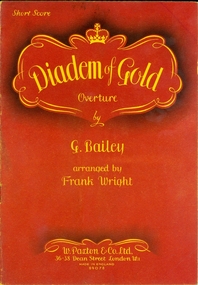
... The Frank Wright Medal at the Royal South Street competition is awarded to an individual recognized as making an outstanding contribution to brass music in Australia. frank wright g bailey diadem of gold overture musical score A 14 page booklet with a red and gold cover, containing the 'Short Score' of the 'Diadem of Gold Overture' written by G Bailey and arranged by Frank Wright. The score was written for brass bands and on the inside front cover is a printed note written by Frank to the musicians ...Frank Wright was a renown resident of Smeaton, where he was born in 1901. He lived at Laura Villa, and attended Smeaton State School. His father William was a gold miner and his mother's name was Sarah. He was the youngest of eleven children. Their family won many singing and instrumental awards. Frank was tutored by Percy Code and was awarded a gold medal for the highest marks in the ALCM examinations in the British Colonies at the age of seventeen years. He became the Australian Open Cornet Champion by the age of eighteen. A year later, Frank conducted the City of Ballarat Band, and later the Ballarat Soldiers’ Memorial Band. He formed the Frank Wright Frisco Band and Frank Wright and his Coliseum Orchestra. These bands won many South Street awards, and Frank as conductor won many awards in the Australian Band Championship contest. In 1933 Frank Wright sailed to England to conduct the famous St Hilda’s Band and was appointed in 1934 as the Musical Director of the London County Council (the GLC or Greater London Council), where he organized many amazing concerts in most of the 150 parks, in and around the London district. He was also responsible for some of London’s major concerts at Kenwood, the Crystal Palace and Holland Park. He was made Professor of Brass and Military Band Scoring and Conducting and was a Fellow of the Guildhall School of Music and Drama. Frank was often invited to adjudicate Brass Band Championships around Europe, in Australia, including South Street and in New Zealand. Frank was awarded an M.B.E. in 1967 and he died in November 1970. The Frank Wright Medal at the Royal South Street competition is awarded to an individual recognized as making an outstanding contribution to brass music in Australia.A 14 page booklet with a red and gold cover, containing the 'Short Score' of the 'Diadem of Gold Overture' written by G Bailey and arranged by Frank Wright. The score was written for brass bands and on the inside front cover is a printed note written by Frank to the musicians on how to play the new features in the music. frank wright, g bailey, diadem of gold overture, musical score -
 Federation University Historical Collection
Programme, Kerkrade World Music Programme, 1962, 1962
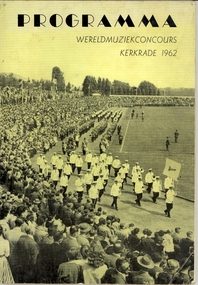
... The Frank Wright Medal at the Royal South Street competition is awarded to an individual recognized as making an outstanding contribution to brass music in Australia. frank wright kerkrade world music contest wereld muziek concours johan scholter Written on the first page in pen - [first two words are illegible] your friend Frank Wright, Johan Scholter 21 Juli 1962 An 84 page black and white booklet entitled 'Programma Wereldmuziekconcours Kerkrade 1962' containing the programme of the music competition held in Kerkrade in 1962, as well as photographs of adjudicators, orchestras, individual musicians and instruments. ...Frank Wright was a renown resident of Smeaton, where he was born in 1901. He lived at Laura Villa, and attended Smeaton State School. His father William was a gold miner and his mother's name was Sarah. He was the youngest of eleven children. Their family won many singing and instrumental awards. Frank was tutored by Percy Code and was awarded a gold medal for the highest marks in the ALCM examinations in the British Colonies at the age of seventeen years. He became the Australian Open Cornet Champion by the age of eighteen. A year later, Frank conducted the City of Ballarat Band, and later the Ballarat Soldiers’ Memorial Band. He formed the Frank Wright Frisco Band and Frank Wright and his Coliseum Orchestra. These bands won many South Street awards, and Frank as conductor won many awards in the Australian Band Championship contest. In 1933 Frank Wright sailed to England to conduct the famous St Hilda’s Band and was appointed in 1934 as the Musical Director of the London County Council (the GLC or Greater London Council), where he organized many amazing concerts in most of the 150 parks, in and around the London district. He was also responsible for some of London’s major concerts at Kenwood, the Crystal Palace and Holland Park. He was made Professor of Brass and Military Band Scoring and Conducting and was a Fellow of the Guildhall School of Music and Drama. Frank was often invited to adjudicate Brass Band Championships around Europe, in Australia, including South Street and in New Zealand. Frank was awarded an M.B.E. in 1967 and he died in November 1970. The Frank Wright Medal at the Royal South Street competition is awarded to an individual recognized as making an outstanding contribution to brass music in Australia.An 84 page black and white booklet entitled 'Programma Wereldmuziekconcours Kerkrade 1962' containing the programme of the music competition held in Kerkrade in 1962, as well as photographs of adjudicators, orchestras, individual musicians and instruments. There are also short bios about many of the photographs. The booklet is in Dutch and has an inscription on the first page as well as many handwritten notes written throughout the booklet. On page 15 there is a photograph and information about the adjudicator Frank Wright. The programme was Frank Wright's own copy.Written on the first page in pen - [first two words are illegible] your friend Frank Wright, Johan Scholter 21 Juli 1962frank wright, kerkrade, world music contest, wereld muziek concours, johan scholter -
 Federation University Historical Collection
Document, Frank Wright, Speech Notes by Frank Wright, 8 July 1970, 8 July 1970
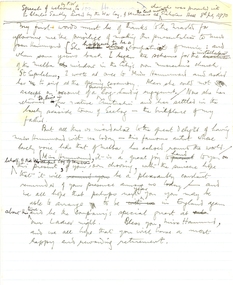
... The Frank Wright Medal at the Royal South Street competition is awarded to an individual recognized as making an outstanding contribution to brass music in Australia. frank wright, speech notes, joan hammond, worshipful company of musicians, composer, conductor All handwritten notes. 4 pages of handwritten notes by Frank Wright. ...Frank Wright was a renown resident of Smeaton, where he was born on 2 August 1901. He lived at Laura Villa, and attended Smeaton State School. His father William was a gold miner and his mother's name was Sarah. Their family won many singing and instrumental awards. Frank was tutored by Percy Code and was awarded a gold medal for the highest marks in the ALCM examinations in the British Colonies at the age of seventeen years. He became the Australian Open Cornet Champion by the age of eighteen. A year later, Frank conducted the City of Ballarat Band, and later the Ballarat Soldiers’ Memorial Band. He formed the Frank Wright Frisco Band and Frank Wright and his Coliseum Orchestra. These bands won many South Street awards, and Frank as conductor won many awards in the Australian Band Championship contest. In 1933 Frank Wright sailed to England to conduct the famous St Hilda’s Band and was later appointed Musical Director of the London County Council, where he organized many amazing concerts in parks, in and around the London district. He was made Professor of Brass and Military Band Scoring and conducted at the Guildhall of Music and Drama. Frank was often invited to adjudicate Brass Band Championships around Europe, in Australia, including South Street and in New Zealand. The Frank Wright Medal at the Royal South Street competition is awarded to an individual recognized as making an outstanding contribution to brass music in Australia.4 pages of handwritten notes by Frank Wright. Page 1 contains a 'Speech of welcome to Joan Hammond when she was resented with the Sir Charles Santley Award by the Worshipful Company of Musicians' on 8 July 1970. The final three pages are a report by Frank as the Chairman of the Committee to the Court of the Worshipful Company of Musicians at the same meeting.All handwritten notes.frank wright, speech notes, joan hammond, worshipful company of musicians, composer, conductor -
 Federation University Historical Collection
Letter, Roy Payne, Letter from Roy Payne of Royal Albert Hall to Frank Wright, 13 July 1970, 13 July 1970
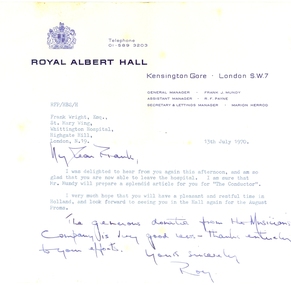
... The Frank Wright Medal at the Royal South Street competition is awarded to an individual recognized as making an outstanding contribution to brass music in Australia. frank wright roy payne royal albert hall worshipful company of musicians Additions are handwritten in blue pen. ...Frank Wright was a renown resident of Smeaton, where he was born on 2 August 1901. He lived at Laura Villa, and attended Smeaton State School. His father William was a gold miner and his mother's name was Sarah. Their family won many singing and instrumental awards. Frank was tutored by Percy Code and was awarded a gold medal for the highest marks in the ALCM examinations in the British Colonies at the age of seventeen years. He became the Australian Open Cornet Champion by the age of eighteen. A year later, Frank conducted the City of Ballarat Band, and later the Ballarat Soldiers’ Memorial Band. He formed the Frank Wright Frisco Band and Frank Wright and his Coliseum Orchestra. These bands won many South Street awards, and Frank as conductor won many awards in the Australian Band Championship contest. In 1933 Frank Wright sailed to England to conduct the famous St Hilda’s Band and was later appointed Musical Director of the London County Council, where he organized many amazing concerts in parks, in and around the London district. He was made Professor of Brass and Military Band Scoring and conducted at the Guildhall of Music and Drama. Frank was often invited to adjudicate Brass Band Championships around Europe, in Australia, including South Street and in New Zealand. The Frank Wright Medal at the Royal South Street competition is awarded to an individual recognized as making an outstanding contribution to brass music in Australia.A single page typed letter containing the logo of the Royal Albert Hall with handwritten additions. This was written to Frank Wright whilst in hospital by the Assistant Manager of Royal Albert Hall, Roy Payn, thanking him for the donation given by the Worshipful Company of Musicians.Additions are handwritten in blue pen.frank wright, roy payne, royal albert hall, worshipful company of musicians -
 Federation University Historical Collection
Photograph - Black and White, Frank Wright, 1920s
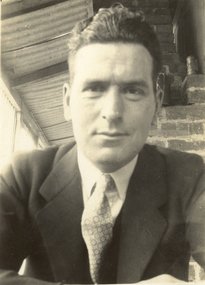
... The Frank Wright Medal at the Royal South Street competition is awarded to an individual recognized as making an outstanding contribution to brass music in Australia. He died on 16 November 1970. frank wright laura villa musician Black and white photograph of the torso of a young man dressed in a dark suit and tie. ...Frank Wright was a renoun resident of Smeaton, where he was born on 2 August 1901. He lived at Laura Villa, and attended Smeaton State School. His father William was a gold miner and his mother's name was Sarah. Their family won many singing and instrumental awards. Frank was tutored by Percy Code and was awarded a gold medal for the highest marks in the ALCM examinations in the British Colonies at the age of seventeen years. He became the Australian Open Cornet Champion by the age of eighteen. A year later, Frank conducted the City of Ballarat Band, and later the Ballarat Soldiers’ Memorial Band. He formed the Frank Wright Frisco Band and Frank Wright and his Coliseum Orchestra. These bands won many South Street awards, and Frank as conductor won many awards in the Australian Band Championship contest. In 1933 Frank Wright sailed to England to conduct the famous St Hilda’s Band and was later appointed Musical Director of the London County Council, where he organized many amazing concerts in parks, in and around the London district. He was made Professor of Brass and Military Band Scoring and conducted at the Guildhall of Music and Drama. Frank was often invited to adjudicate Brass Band Championships around Europe, in Australia, including South Street and in New Zealand. The Frank Wright Medal at the Royal South Street competition is awarded to an individual recognized as making an outstanding contribution to brass music in Australia. He died on 16 November 1970.Black and white photograph of the torso of a young man dressed in a dark suit and tie. The camera is pointing upward so the background is of the underside of a verandah roof and part of the brickwork of the chimney a house upon with have been placed a couple of objects including a can. The man is Frank Wright and the place could be the family home, Laura Villa at Smeaton.frank wright, laura villa, musician -
 Federation University Historical Collection
Photograph - black and white, Taylors' Super Snaps, Frank Wright at Rotorua, New Zealand, 1940, Feb 1940
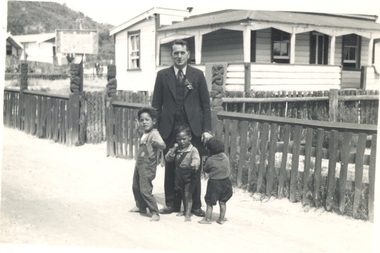
... The Frank Wright Medal at the Royal South Street competition is awarded to an individual recognized as making an outstanding contribution to brass music in Australia. He died on 16 November 1970. frank wright musician adjudicator brass bands rotorua maori carved fence posts Written in pencil on back - At Rotorua, Feb 1940 Black and white photograph of a man dressed in a dark suit standing on a made road with three little boys around him. ...Frank Wright was a renoun resident of Smeaton, where he was born on 2 August 1901. He lived at Laura Villa, and attended Smeaton State School. His father William was a gold miner and his mother's name was Sarah. Their family won many singing and instrumental awards. Frank was tutored by Percy Code and was awarded a gold medal for the highest marks in the ALCM examinations in the British Colonies at the age of seventeen years. He became the Australian Open Cornet Champion by the age of eighteen. A year later, Frank conducted the City of Ballarat Band, and later the Ballarat Soldiers’ Memorial Band. He formed the Frank Wright Frisco Band and Frank Wright and his Coliseum Orchestra. These bands won many South Street awards, and Frank as conductor won many awards in the Australian Band Championship contest. In 1933 Frank Wright sailed to England to conduct the famous St Hilda’s Band and was later appointed Musical Director of the London County Council, where he organized many amazing concerts in parks, in and around the London district. He was made Professor of Brass and Military Band Scoring and conducted at the Guildhall of Music and Drama. Frank was often invited to adjudicate Brass Band Championships around Europe, in Australia, including South Street and in New Zealand. The Frank Wright Medal at the Royal South Street competition is awarded to an individual recognized as making an outstanding contribution to brass music in Australia. He died on 16 November 1970.Black and white photograph of a man dressed in a dark suit standing on a made road with three little boys around him. Behind him is a timber house enclosed by a wooden fence. The fence posts and gate posts are carved in the Maori tradition. The man is Frank Wright and the place is Rotorua, New Zealand.Written in pencil on back - At Rotorua, Feb 1940frank wright, musician, adjudicator, brass bands, rotorua, maori carved fence posts -
 Federation University Historical Collection
Photograph - Black and White, Frank Wright with two ladies, March 1940
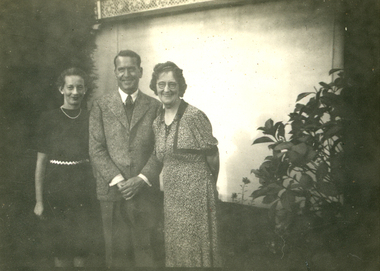
... The Frank Wright Medal at the Royal South Street competition is awarded to an individual recognized as making an outstanding contribution to brass music in Australia. He died on 16 November 1970. frank wright musician composer Written in pencil - March 1940 Small black and white photograph of a man dressed in a suit, standing with two ladies in an area with a few plants. ...Frank Wright was a renoun resident of Smeaton, where he was born on 2 August 1901. He lived at Laura Villa, and attended Smeaton State School. His father William was a gold miner and his mother's name was Sarah. Their family won many singing and instrumental awards. Frank was tutored by Percy Code and was awarded a gold medal for the highest marks in the ALCM examinations in the British Colonies at the age of seventeen years. He became the Australian Open Cornet Champion by the age of eighteen. A year later, Frank conducted the City of Ballarat Band, and later the Ballarat Soldiers’ Memorial Band. He formed the Frank Wright Frisco Band and Frank Wright and his Coliseum Orchestra. These bands won many South Street awards, and Frank as conductor won many awards in the Australian Band Championship contest. In 1933 Frank Wright sailed to England to conduct the famous St Hilda’s Band and was later appointed Musical Director of the London County Council, where he organized many amazing concerts in parks, in and around the London district. He was made Professor of Brass and Military Band Scoring and conducted at the Guildhall of Music and Drama. Frank was often invited to adjudicate Brass Band Championships around Europe, in Australia, including South Street and in New Zealand. The Frank Wright Medal at the Royal South Street competition is awarded to an individual recognized as making an outstanding contribution to brass music in Australia. He died on 16 November 1970.Small black and white photograph of a man dressed in a suit, standing with two ladies in an area with a few plants. The man is Frank Wright. The place is possibly in New Zealand.Written in pencil - March 1940frank wright, musician, composer -
 Federation University Historical Collection
Photograph - black and white, Frank Wright, mid 1900s
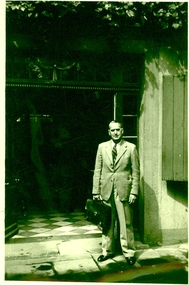
... The Frank Wright Medal at the Royal South Street competition is awarded to an individual recognized as making an outstanding contribution to brass music in Australia. He died on 16 November 1970. frank wright composer adjudicator musician Black and white photograph of a man dressed in a light jacket and trousers, carrying a brief case. ...Frank Wright was a renoun resident of Smeaton, where he was born on 2 August 1901. He lived at Laura Villa, and attended Smeaton State School. His father William was a gold miner and his mother's name was Sarah. Their family won many singing and instrumental awards. Frank was tutored by Percy Code and was awarded a gold medal for the highest marks in the ALCM examinations in the British Colonies at the age of seventeen years. He became the Australian Open Cornet Champion by the age of eighteen. A year later, Frank conducted the City of Ballarat Band, and later the Ballarat Soldiers’ Memorial Band. He formed the Frank Wright Frisco Band and Frank Wright and his Coliseum Orchestra. These bands won many South Street awards, and Frank as conductor won many awards in the Australian Band Championship contest. In 1933 Frank Wright sailed to England to conduct the famous St Hilda’s Band and was later appointed Musical Director of the London County Council, where he organized many amazing concerts in parks, in and around the London district. He was made Professor of Brass and Military Band Scoring and conducted at the Guildhall of Music and Drama. Frank was often invited to adjudicate Brass Band Championships around Europe, in Australia, including South Street and in New Zealand. The Frank Wright Medal at the Royal South Street competition is awarded to an individual recognized as making an outstanding contribution to brass music in Australia. He died on 16 November 1970.Black and white photograph of a man dressed in a light jacket and trousers, carrying a brief case. He is standing at the entrance of building with a wide doorway which has an ornate carving over the door frame. A light and dark chequer board tiled floor can be seen inside. Thick vine covers the outer wall above the door. The man is Frank Wright.frank wright, composer, adjudicator, musician -
 Federation University Historical Collection
Photograph - black and white, Frank Wright at a viewing spot, mid 1900s
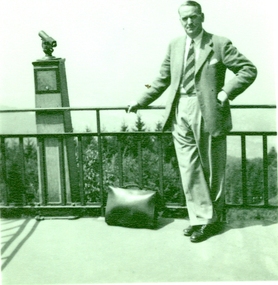
... The Frank Wright Medal at the Royal South Street competition is awarded to an individual recognized as making an outstanding contribution to brass music in Australia. He died on 16 November 1970. frank wright terrestrial telescope composer musician adjudicator Black and white photograph of a man standing against a railing near a terrestrial telescope at a viewing spot overlooking a pine tree clad terrain. ...Frank Wright was a renoun resident of Smeaton, where he was born on 2 August 1901. He lived at Laura Villa, and attended Smeaton State School. His father William was a gold miner and his mother's name was Sarah. Their family won many singing and instrumental awards. Frank was tutored by Percy Code and was awarded a gold medal for the highest marks in the ALCM examinations in the British Colonies at the age of seventeen years. He became the Australian Open Cornet Champion by the age of eighteen. A year later, Frank conducted the City of Ballarat Band, and later the Ballarat Soldiers’ Memorial Band. He formed the Frank Wright Frisco Band and Frank Wright and his Coliseum Orchestra. These bands won many South Street awards, and Frank as conductor won many awards in the Australian Band Championship contest. In 1933 Frank Wright sailed to England to conduct the famous St Hilda’s Band and was later appointed Musical Director of the London County Council, where he organized many amazing concerts in parks, in and around the London district. He was made Professor of Brass and Military Band Scoring and conducted at the Guildhall of Music and Drama. Frank was often invited to adjudicate Brass Band Championships around Europe, in Australia, including South Street and in New Zealand. The Frank Wright Medal at the Royal South Street competition is awarded to an individual recognized as making an outstanding contribution to brass music in Australia. He died on 16 November 1970.Black and white photograph of a man standing against a railing near a terrestrial telescope at a viewing spot overlooking a pine tree clad terrain. The man who is dressed i a suit, with a briefcase beside him is Frank Wright. frank wright, terrestrial telescope, composer, musician, adjudicator -
 Federation University Historical Collection
Photo - Black and White, Frank Wright, c1930s
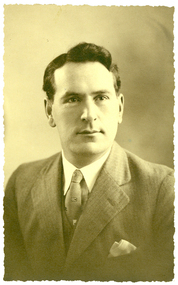
... The Frank Wright Medal at the Royal South Street competition is awarded to an individual recognized as making an outstanding contribution to brass music in Australia. He died on 16 November 1970. frank wright musician brass band composer Black and white studio photograph of the torso of a young man wearing a mid coloured suit and tie. ...Frank Wright was a renoun resident of Smeaton, where he was born on 2 August 1901. He lived at Laura Villa, and attended Smeaton State School. His father William was a gold miner and his mother's name was Sarah. Their family won many singing and instrumental awards. Frank was tutored by Percy Code and was awarded a gold medal for the highest marks in the ALCM examinations in the British Colonies at the age of seventeen years. He became the Australian Open Cornet Champion by the age of eighteen. A year later, Frank conducted the City of Ballarat Band, and later the Ballarat Soldiers’ Memorial Band. He formed the Frank Wright Frisco Band and Frank Wright and his Coliseum Orchestra. These bands won many South Street awards, and Frank as conductor won many awards in the Australian Band Championship contest. In 1933 Frank Wright sailed to England to conduct the famous St Hilda’s Band and was later appointed Musical Director of the London County Council, where he organized many amazing concerts in parks, in and around the London district. He was made Professor of Brass and Military Band Scoring and conducted at the Guildhall of Music and Drama. Frank was often invited to adjudicate Brass Band Championships around Europe, in Australia, including South Street and in New Zealand. The Frank Wright Medal at the Royal South Street competition is awarded to an individual recognized as making an outstanding contribution to brass music in Australia. He died on 16 November 1970.Black and white studio photograph of the torso of a young man wearing a mid coloured suit and tie. The man is Frank Wright.frank wright, musician, brass band, composer -
 Orbost & District Historical Society
illustrations, Kerr, Hilda (nee Temple) wife of Dr Kerr, approx 1900
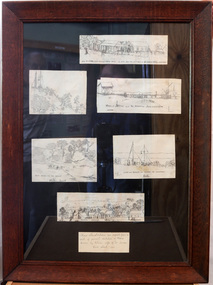
... Street, Orbost. Her husband, Dr James Kerr, was a Scot who had come to Australia as a ship's doctor and practised in NSW before visiting Orbost on a government vaccination programme. He liked Orbost and returned there, its first doctor, until his death in 1928. Hilda was sometimes referred to as 'Mrs Dr Kerr.' She and her sisters Mabel Stewart Temple and Margaret Ferrie Temple were all talented writers and musicians...Street, Orbost. Her husband, Dr James Kerr, was a Scot who had come to Australia as a ship's doctor and practised in NSW before visiting Orbost on a government vaccination programme. He liked Orbost and returned there, its first doctor, until his death in 1928. Hilda was sometimes referred to as 'Mrs Dr Kerr.' She and her sisters Mabel Stewart Temple and Margaret Ferrie Temple were all talented writers and musicians ...These drawings are by Hilda Kerr and are hand-drawn in Pencil. Hand drawn by Kerr, Hilda (nee Temple). Daughter of George Temple and Mary McAuslane of Castlemaine, Hilda married James Kerr in 1893 and lived at 'Lincluden', Raymond Street, Orbost. Her husband, Dr James Kerr, was a Scot who had come to Australia as a ship's doctor and practised in NSW before visiting Orbost on a government vaccination programme. He liked Orbost and returned there, its first doctor, until his death in 1928. Hilda was sometimes referred to as 'Mrs Dr Kerr.' She and her sisters Mabel Stewart Temple and Margaret Ferrie Temple were all talented writers and musicians. This item is associated with Hilda Kerr (Temple) a prominent resident of early Orbost. She and her sisters Mabel Stewart Temple and Margaret Ferrie Temple were all talented writers and musicians. These drawings are of historical significance in that they depict aspects of the settlement at Marlo, located at the mouth of the Snowy River. Marlo functioned as an important entry point for settlers coming to the Snowy River/Orbost area by sea. A selection of 7 pencil illustrations of Marlo mounted in a wooden frame. Hessian background with red/brown wood.Most drawings also have a caption which describes the scene depicted eg Marlo Jetty. illustrations marlo kerr temple -
 Ringwood and District Historical Society
Photograph, View of procession celebrating City of Ringwood 1960 in Maroondah Highway, 1960
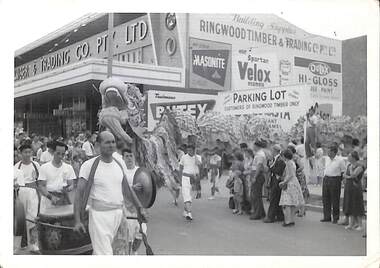
... View of procession celebrating City of Ringwood 1960 in Maroondah Highway corner of New Street outside Ringwood Timber and Trading, including Chinese dragon, musicians and spectators....View of procession celebrating City of Ringwood 1960 in Maroondah Highway corner of New Street outside Ringwood Timber and Trading, including Chinese dragon, musicians and spectators. ...View of procession celebrating City of Ringwood 1960 in Maroondah Highway corner of New Street outside Ringwood Timber and Trading, including Chinese dragon, musicians and spectators. -
 Orbost & District Historical Society
poem, We Come, early 20th century
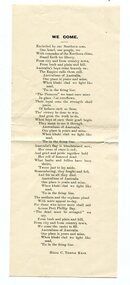
... Street, Orbost. Her husband, Dr James Kerr, was a Scot who had come to Australia as a ship's doctor and practised in NSW before visiting Orbost on a government vaccination programme. He liked Orbost and returned there, its first doctor, until his death in 1928. Hilda was sometimes referred to as 'Mrs Dr Kerr.' She and her sisters Mabel Stewart Temple and Margaret Ferrie Temple were all talented writers and musicians...Street, Orbost. Her husband, Dr James Kerr, was a Scot who had come to Australia as a ship's doctor and practised in NSW before visiting Orbost on a government vaccination programme. He liked Orbost and returned there, its first doctor, until his death in 1928. Hilda was sometimes referred to as 'Mrs Dr Kerr.' She and her sisters Mabel Stewart Temple and Margaret Ferrie Temple were all talented writers and musicians ...Hilda Kerr was the daughter of George Temple and Mary McAuslane of Castlemaine, later Orbost. Hilda married James Kerr in 1893 and lived at 'Lincluden,' Raymond Street, Orbost. Her husband, Dr James Kerr, was a Scot who had come to Australia as a ship's doctor and practised in NSW before visiting Orbost on a government vaccination programme. He liked Orbost and returned there, its first doctor, until his death in 1928. Hilda was sometimes referred to as 'Mrs Dr Kerr.' She and her sisters Mabel Stewart Temple and Margaret Ferrie Temple were all talented writers and musicians. This poem is an example of the talent of Hilda Temple Kerr. Hilda Temple Kerr (1874-1956) grew up in Orbost. She was very talented and published several books. It is reflective of the style of poetry in the early 19th century.A rectangular piece of paper with a typed poem titled, "We Come" by Hilda C. Temple-Kerr.poetry literature kerr-hilda-temple
