
Showing 16 items matching " sunday telegraph"
-
 Greensborough Historical Society
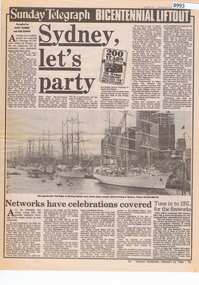
Newspaper - Newspaper supplement, Sunday Telegraph, Sunday Telegraph Bicentennial Liftout 24/01/1988. Sydney, let's party, 24/01/1988
... Sunday Telegraph Bicentennial Liftout 24/01/1988. ...Sunday Telegraph liftout for the Bicentennial of Australia in 1988, listing events taking place in Sydney, Canberra and other cities in NSW....Sunday Telegraph...Sunday Telegraph Bicentennial Liftout 24/01/1988. ...Sunday Telegraph liftout for the Bicentennial of Australia in 1988, listing events taking place in Sydney, Canberra and other cities in NSW. Newspaper supplement four p., text and images. bicentennial celebrations 1988, australia history -
 Returned Nurses RSL Sub-branch
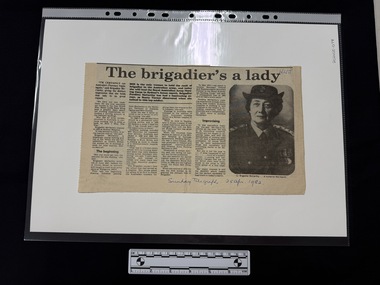
Newspaper - Newspaper clipping, Bunty Turner, The brigadier's a lady, [25 April 1982]
... 'WWII' [blue ink in the top right hand corner] 'Sunday Telegraph 25 Apr 1982' [blue ink across the lower border]......[Sunday Telegraph]...The brigadier's a lady Newspaper Newspaper clipping Bunty Turner [Sunday Telegraph] ...Article about Perditta Marjorie McCarthy's Army nursing career from 1941 until her retirement in 1972, the first female Brigadier in the Australian Army. Newspaper clipping with a headline, four columns of text and a black and white portrait photograph of a woman in Australian Army Nurses uniform. 'WWII' [blue ink in the top right hand corner] 'Sunday Telegraph 25 Apr 1982' [blue ink across the lower border] wwii, world war two, ww2, perditta marjorie mccarthy, royal australian army nursing corps -
 Moorabbin Air Museum
Document (item) - Rolls Royce Trent jet engine Turbomeca Arrius RTM 322 Arriel Makila Hawker Hurricane Panavia Tornado Douglas AH64 A Apache Grumman F14 Tomcat Approx 50 full scale photocopied drawings possibly of Bristol box kite 2 very large drawings of unknown aircraft component 5 drawings of Mirage jet 10 drawings of Beaufort bomber Reserve stock of acid proof paper Poster schematic of Rolls Royce RB 211 turbofan sketch of Maurice Farman Shorthorn biplane 1990 RAAF museum calendar 1999 Aeroplane magazine calendar Tiger moth poster Signed Poster of Vickers Vimy that flew to Australia 1930 Newspapers including The Age Argus The Herald Sunday Telegraph Pictorial The Daily Guardian, Mixture of items Jet engines Aircraft Posters Newspaper articles Calendars drawings
... Rolls Royce Trent jet engine Turbomeca Arrius RTM 322 Arriel Makila Hawker Hurricane Panavia Tornado Douglas AH64 A Apache Grumman F14 Tomcat Approx 50 full scale photocopied drawings possibly of Bristol box kite 2 very large drawings of unknown aircraft component 5 drawings of Mirage jet 10 drawings of Beaufort bomber Reserve stock of acid proof paper Poster schematic of Rolls Royce RB 211 turbofan sketch of Maurice Farman Shorthorn biplane 1990 RAAF museum calendar 1999 Aeroplane magazine calendar Tiger moth poster Signed Poster of Vickers Vimy that flew to Australia 1930 Newspapers including The Age Argus The Herald Sunday Telegraph Pictorial The Daily Guardian ...Mixture of items Jet engines Aircraft Posters Newspaper articles Calendars drawings Document Rolls Royce Trent jet engine Turbomeca Arrius RTM 322 Arriel Makila Hawker Hurricane Panavia Tornado Douglas AH64 A Apache Grumman F14 Tomcat Approx 50 full scale photocopied drawings possibly of Bristol box kite 2 very large drawings of unknown aircraft component 5 drawings of Mirage jet 10 drawings of Beaufort bomber Reserve stock of acid proof paper Poster schematic of Rolls Royce RB 211 turbofan sketch of Maurice Farman Shorthorn biplane 1990 RAAF museum calendar 1999 Aeroplane magazine calendar Tiger moth poster Signed Poster of Vickers Vimy that flew to Australia 1930 Newspapers including The Age Argus The Herald Sunday Telegraph Pictorial The Daily Guardian ... -
 City of Moorabbin Historical Society (Operating the Box Cottage Museum)
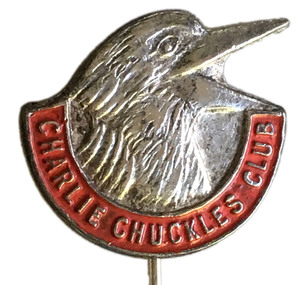
Badge - Charlie Chuckles Club Pin, 1941-1954
... ...sunday telegraph...Charlie Chuckles, who, in the early 1940s, presented weekly radio dramatisations of Sunday Telegraph comic strips. It was a great favourite with youngsters throughout the land. ...Charlie Chuckles, who, in the early 1940s, presented weekly radio dramatisations of Sunday Telegraph comic strips. It was a great favourite with youngsters throughout the land. ...Charlie Chuckles, who, in the early 1940s, presented weekly radio dramatisations of Sunday Telegraph comic strips. It was a great favourite with youngsters throughout the land. Charlie Chuckle commenced in 1941 and ran through until 1954. It was a 30 minute program. Silver pin with the head of a kookaburra and a red banner underneath with the words "Charlie Chuckles Club". Charlie Chuckles Club charlie chuckles, sunday telegraph, children's show, radio -
 Bendigo Historical Society Inc.
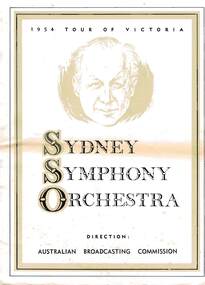
Document - SYDNEY SYMPHONY ORCHESTRA
... ... Sunday Telegraph...Direction: Australian Broadcasting Commission with the Co-operation of the Argus and Sydney Daily and Sunday Telegraph. Fourth and Final Concert of the International Celebrity Concert Season. ...EVENT Entertainment music Sydney Symphony Orchestra Australian Broadcasting Commission The Argus Sydney Daily Sunday Telegraph Eugene Goossens Ernest Llewellyn Sydney Symphony Orchestra - 1954 tour of Victoria. ...Sydney Symphony Orchestra - 1954 tour of Victoria. Direction: Australian Broadcasting Commission with the Co-operation of the Argus and Sydney Daily and Sunday Telegraph. Fourth and Final Concert of the International Celebrity Concert Season. Conductor: Eugene Gossens, Soloist: Ernest Llewellyn (Violinist) Capital Theatre, Bendigo, Thursday 14 Oct 1954 8 pm. Souvenir Programme - Two Shillings. event, entertainment, music, sydney symphony orchestra, australian broadcasting commission, the argus, sydney daily, sunday telegraph, eugene goossens, ernest llewellyn -
Tarnagulla History Archive
Article: The hammer falls at last on old smithy's shop in the town that time passed by, April 14th, 1974
... Full pages of The Sunday Telegraph including article...David Gordon Collection. mcnamee Full pages of The Sunday Telegraph including article Article: The hammer falls at last on old smithy's shop in the town that time passed by Stokes & Son ...David Gordon Collection. Full pages of The Sunday Telegraph including article mcnamee -
 Federation University Historical Collection
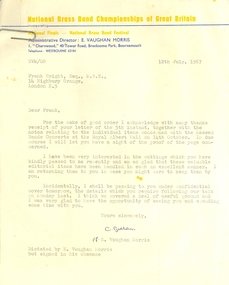
Correspondence, E. Vaughan Morris, National Brass Band Championships of Great Britain to Frank Wright, 1967, mid 1967
... Newspaper clipping from the Sun Telegraph on 2/7/1967 about 'Park Music' 3). Newspaper clipping from the Sunday Times on 14/5/1967 entitled 'The Lew Grade of the GLC'...Written in pen on the front - Sun Telegraph 2.7.67 3). Written in pen on the front - Sunday Times 14 May 67......Sun Telegraph...Sunday...Vaughan Morris Sun Telegraph Sunday Times ...Frank Wright was a renown resident of Smeaton, where he was born. He lived at Laura Villa, and attended Smeaton State School. His father William was a gold miner and his mother's name was Sarah. Their family won many singing and instrumental awards. Frank was tutored by Percy Code and was awarded a gold medal for the highest marks in the ALCM examinations in the British Colonies at the age of seventeen years. He became the Australian Open Cornet Champion by the age of eighteen. A year later, Frank conducted the City of Ballarat Band, and later the Ballarat Soldiers’ Memorial Band. He formed the Frank Wright Frisco Band and Frank Wright and his Coliseum Orchestra. These bands won many South Street awards, and Frank as conductor won many awards in the Australian Band Championship contest. In 1933 Frank Wright sailed to England to conduct the famous St Hilda’s Band and was later appointed Musical Director of the London County Council (the GLC or Greater London Council), where he organized many amazing concerts in most of the 150 parks, in and around the London district. He was also responsible for some of London’s major concerts at Kenwood, the Crystal Palace and Holland Park. He was made Professor of Brass and Military Band Scoring and conducted at the Guildhall of Music and Drama. Frank was often invited to adjudicate Brass Band Championships around Europe, in Australia, including South Street and in New Zealand. The Frank Wright Medal at the Royal South Street competition is awarded to an individual recognized as making an outstanding contribution to brass music in Australia. 1).Typed letter on National Brass Band Championships of Great Britain letterhead, acknowledging the receipt of a letter and newspaper clippings from Frank Wright regarding band concerts at Royal Albert Hall. 2). Newspaper clipping from the Sun Telegraph on 2/7/1967 about 'Park Music' 3). Newspaper clipping from the Sunday Times on 14/5/1967 entitled 'The Lew Grade of the GLC' 1). Typed Letter and signature 2). Written in pen on the front - Sun Telegraph 2.7.67 3). Written in pen on the front - Sunday Times 14 May 67 frank wright, e vaughan morris, conductor, london parks, royal albert hall -
 National Vietnam Veterans Museum (NVVM)
Newspaper
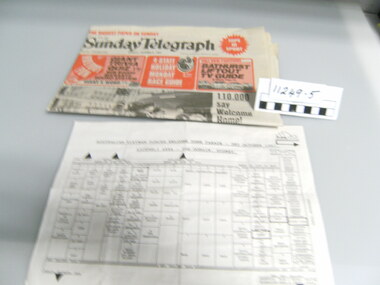
... Sunday Telegraph sydney dated 3rd Oct 1987 and a map of assembly area for the Welcome Home Parade...Newspaper Welcome Home Parade Sunday Telegraph sydney dated 3rd Oct 1987 and a map of assembly area for the Welcome Home Parade Newspaper Newspaper ...Sunday Telegraph sydney dated 3rd Oct 1987 and a map of assembly area for the Welcome Home Parade newspaper, welcome home parade -
 Bialik College
Mixed media (item) - Scrapbook page, 1968
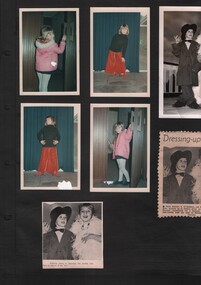
... Page from a scrapbook featuring on one side 1968 newspaper articles about the recipe book 'I Love to Eat Jewish': 'Try a monkey gland steak', The Herald, 2 August 1968, p. 2, 'Appealing Jewish Dishes' by Jean Forward, and an article about the launch, Sunday Telegraph, 17 November 1968 - a photograph of parent Julette Alexander, and an invitation to the launch of the book. ...Page from a scrapbook featuring on one side 1968 newspaper articles about the recipe book 'I Love to Eat Jewish': 'Try a monkey gland steak', The Herald, 2 August 1968, p. 2, 'Appealing Jewish Dishes' by Jean Forward, and an article about the launch, Sunday Telegraph, 17 November 1968 - a photograph of parent Julette Alexander, and an invitation to the launch of the book. ...Page from a scrapbook featuring on one side 1968 newspaper articles about the recipe book 'I Love to Eat Jewish': 'Try a monkey gland steak', The Herald, 2 August 1968, p. 2, 'Appealing Jewish Dishes' by Jean Forward, and an article about the launch, Sunday Telegraph, 17 November 1968 - a photograph of parent Julette Alexander, and an invitation to the launch of the book. On the other side of the scrapbook page is a newspaper article 'Dressing-up is fun', Australian Jewish News, 7 June 1968, p. 7, about a Bialik Parents' Association jumble sale in 1968, and photos of students Mark Sinclair and Kim Alexander advertising the event. 1960s, judaism, recipes -
Glen Eira Historical Society
Document - Gagliardi, Felice
... Photocopied article from Sunday Telegraph, dated 31/08/1969; gives Vigano musicians’ history and photo; plus enlargement of same photo. ...Photocopied article from Sunday Telegraph, dated 31/08/1969; gives Vigano musicians’ history and photo; plus enlargement of same photo. ...Four items about Italian musicians from Viggiano. Handwritten correspondence by Frank Delmonaco dated 24/02/2005, sent to Glen Eira Historical Society, giving information of former Italian musicians, including Felice Gagliardi (who played at the Crystal Palace Theatre, Caulfield) who travelled the country. Photocopied article from Sunday Telegraph, dated 31/08/1969; gives Vigano musicians’ history and photo; plus enlargement of same photo. Photocopied photo of group un-named but possibly same as above. Photocopy of Statutory Declaration, by Felice Gagliardi (dated 28/03/19?) giving personal and employment details plus absences from Australia. Occupation is musician and employer is Griffiths and West of Crystal Palace Theatre, Caulfield. gagliardi felice, crystal palace theatre, theatres, caulfield, musicians, musical ensembles, ‘labbs string band’, delmonaco frank, harps, grosjean frederick, griffiths and west -
 Ballarat and District Irish Association
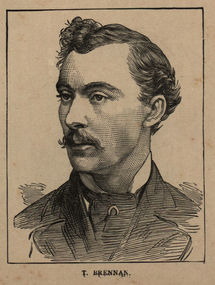
Image, T. Brennan, c1864, 1864
... The Connaught Telegraph's report of the meeting in its edition of 26 April 1879 began: Since the days of O'Connell a larger public demonstration has not been witnessed than that of Sunday last. ...The Connaught Telegraph's report of the meeting in its edition of 26 April 1879 began: Since the days of O'Connell a larger public demonstration has not been witnessed than that of Sunday last. ...Following the founding meeting of the Mayo Tenants Defence Association in Castlebar, County Mayo on 26 October 1878 the demand for The Land of Ireland for the people of Ireland was reported in the Connaught Telegraph 2 November 1878. The first of many "monster meetings" of tenant farmers was held in Irishtown near Claremorris on 20 April 1879, with an estimated turnout of 15,000 to 20,000 people. This meeting was addressed by James Daly (who presided), John O'Connor Power, John Ferguson, Thomas Brennan, and J. J. Louden. The Connaught Telegraph's report of the meeting in its edition of 26 April 1879 began: Since the days of O'Connell a larger public demonstration has not been witnessed than that of Sunday last. About 1 o'clock the monster procession started from Claremorris, headed by several thousand men on foot – the men of each district wearing a laural leaf or green ribbon in hat or coat to distinguish the several contingents. At 11 o'clock a monster contingent of tenant-farmers on horseback drew up in front of Hughes's hotel, showing discipline and order that a cavalry regiment might feel proud of. They were led on in sections, each having a marshal who kept his troops well in hand. Messrs. P.W. Nally, J.W. Nally, H. French, and M. Griffin, wearing green and gold sashes, led on their different sections, who rode two deep, occupying, at least, over an Irish mile of the road. Next followed a train of carriages, brakes, cares, etc. led on by Mr. Martin Hughes, the spirited hotel proprietor, driving a pair of rare black ponies to a phæton, taking Messrs. J.J. Louden and J. Daly. Next came Messrs. O'Connor, J. Ferguson, and Thomas Brennan in a covered carriage, followed by at least 500 vehicles from the neighbouring towns. On passing through Ballindine the sight was truly imposing, the endless train directing its course to Irishtown – a neat little hamlet on the boundaries of Mayo, Roscommon, and Galway. Evolving out of this a number of local land league organisations were set up to work against the excessive rents being demanded by landlords all over Ireland, but especially in Mayo and surrounding counties. From 1874 agricultural prices in Europe had dropped, followed by some bad harvests due to wet weather during the Long Depression. The effect by 1878 was that many Irish farmers were unable to pay the rents that they had agreed, particularly in the poorer and wetter parts of Connacht. The localised 1879 Famine added to the misery. Unlike other parts of Europe the Irish land tenure system was inflexible in times of hardship. (Wikipedia) The Irish National Land League was founded at the Imperial Hotel in Castlebar, the County town of Mayo, on 21 October 1879. At that meeting Charles Stewart Parnell was elected president of the league. Andrew Kettle, Michael Davitt, and Thomas Brennan were appointed as honorary secretaries. This united practically all the different strands of land agitation and tenant rights movements under a single organisation. Michael Davitt Founder of the Land League The two aims of the Land League, as stated in the resolutions adopted in the meeting, were: ...first, to bring out a reduction of rack-rents; second, to facilitate the obtaining of the ownership of the soil by the occupiers. That the object of the League can be best attained by promoting organisation among the tenant-farmers; by defending those who may be threatened with eviction for refusing to pay unjust rents; by facilitating the working of the Bright clauses of the Irish Land Act during the winter; and by obtaining such reforms in the laws relating to land as will enable every tenant to become owner of his holding by paying a fair rent for a limited number of years. (Wikipedia) Image of a man with a moustache. He is T. Brennan. ballarat irish, brennan, thomas brennan, irish land act, rent -
Tarnagulla History Archive
Telegram (partial), circa 1862
... Telegraph Office in the later 20th Century, during building works. Part of a telegram sent from Tarnagulla Telegram Office, from William Harper to the Archdeacon of Castlemaine. Text reads: 'Your letter only received today - Too late to announce for Sunday ...Donald Clark Collection. A large lot of papers, including this and many other telegrams, were apparently found in the ceiling cavity of the Sandy Creek/Tarnagulla Post and Telegraph Office in the later 20th Century, during building works. Part of a telegram sent from Tarnagulla Telegram Office, from William Harper to the Archdeacon of Castlemaine. Text reads: 'Your letter only received today - Too late to announce for Sunday School - shall be happy if you will preach - say if you will come'. -
Tarnagulla History Archive
Telegram, circa 1862
... Telegram sent from Tarnagulla Telegraph Office from James Hargreaves to Joseph Hargreaves, in care Mr Pendleton, Mitchel St, Sandhurst. Text reads 'I got the Box. I send all By George Turner Sunday...Telegram sent from Tarnagulla Telegraph Office from James Hargreaves to Joseph Hargreaves, in care Mr Pendleton, Mitchel St, Sandhurst. Text reads 'I got the Box. I send all By George Turner Sunday ...A large lot of papers, including this and many other telegrams, were apparently found in the ceiling cavity of the Sandy Creek/Tarnagulla Post and Telegraph Office in the later 20th Century, during building works. Donald Clark Collection. Telegram sent from Tarnagulla Telegraph Office from James Hargreaves to Joseph Hargreaves, in care Mr Pendleton, Mitchel St, Sandhurst. Text reads 'I got the Box. I send all By George Turner Sunday morning'. -
 Glenelg Shire Council Cultural Collection
Medal - Medal - Admella Shipwreck - awarded to John Dusting, Brush and MacDonnell, 1859
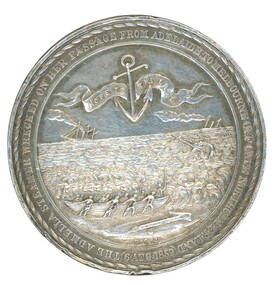
... Sunday afternoon that two sailors, managed to get to shore using a raft. It took them three hours and they then had to walk about 32 kilometres along the shore in the dark to Northumberland Lighthouse without shoes. They were met by Ben Germein the lighthouse keeper. His horse had died so he had to walk to a nearby station to borrow a horse. The horse he chose threw him off so in the end the station owner, Peter Black, rode the 24 km to the Mount Gambier telegraph...Sunday afternoon that two sailors, managed to get to shore using a raft. It took them three hours and they then had to walk about 32 kilometres along the shore in the dark to Northumberland Lighthouse without shoes. They were met by Ben Germein the lighthouse keeper. His horse had died so he had to walk to a nearby station to borrow a horse. The horse he chose threw him off so in the end the station owner, Peter Black, rode the 24 km to the Mount Gambier telegraph ...On Friday 5 August 1859, the steamship, Admella, left Adelaide bound for Melbourne. IT carried 82 passengers, a crew of 31 and 4 racehorses. he Admella was a 395 ton screw steamer built at Port Glasgow, Scotland in 1857. Her name is said to be derived from the ports she served - Adelaide, Melbourne and Launceston. It took her 42 hours to travel between Adelaide and Melbourne, usually stopping at Portland, Port Fairy and Warrnambool, making her the fastest ship to travel this route. The Admella’s final journey was her 36th voyage. Admella had been built with watertight bulkheads, riveted to the hull. These were designed as a special safety feature, but when the ship grounded on Carpenters Rocks it took only 15 minutes for the hull to break in three along the rivet lines. Many people were drowned immediately, and six horses stabled on deck tried to swim to shore. At least one of them made it alive. On Saturday August 6 1859, at 5am, Admella struck a reef. The three onboard lifeboats were washed away as were the four cork lifebelts kept on deck. Rubber lifebelts kept below deck were instantly lost. Cape Northumberland Lighthouse near Port McDonnell was about 24 km away so Captain McEwan ordered rocket flares to be fired to gain attention. However, all the ship’s rockets were damp. Only one ignited but soon fizzled out. The Captain attempted to make a raft but was unsuccessful and nearly drowned in the process. The ship was only about a kilometre from shore, but the surf, currents, cold water and sharks resulted in five men dying trying to reach safety. It wasn’t until Sunday afternoon that two sailors, managed to get to shore using a raft. It took them three hours and they then had to walk about 32 kilometres along the shore in the dark to Northumberland Lighthouse without shoes. They were met by Ben Germein the lighthouse keeper. His horse had died so he had to walk to a nearby station to borrow a horse. The horse he chose threw him off so in the end the station owner, Peter Black, rode the 24 km to the Mount Gambier telegraph station to share the news of the disaster. After several unsuccessful rescue attempts, eight days after the initial disaster, 19 people were rescued by the Portland Lifeboat and three people, including Captain McEwan were rescued in one of Admella’s lifeboats which had been found on the shore and fixed. It was captained by Ben Germein with six volunteer oarsmen. This was Germain’s sixth attempt to reach the wreck in the damaged boat. Of the 113 people on board Admella at the time of her wreck only 24 survived. At the official enquiry into the disaster, fog, lightning, compasses and bad mapping were all considered as the cause, but finally the swift and unpredictable currents which run between Cape Jaffa and Cape Northumberland were given the official blame. This medal is associated with one of Australia's worst maritime disasters, the wreck of SS Admella. This incident is significant to Portland because the Portland Lifeboat and its crew took part in a heroic rescue. 19 people were rescued by the crew of the Lifeboat. The Portland Lifeboat is listed on Victoria's State Heritage Register. Round silver medal awarded to John Dusting by the Victorian Colonists for his heroic efforts as part of the crew of the Portland Lifeboat in the rescue of survivors of the Admella Shipwreck. Admella wrecked off the South Australian Coast in 1859. This silver medal was one of only 39 silver medals awarded. There were 3 gold medals awarded. The medal is presented in a blue box. The box has beveled edges. Inside the lid is a fabric insert with details of the silversmith printed. The medal sits in a circular insert with a blue ribbon for taking the medal out with ease. Obverse: Scene of shipwreck near the coastline. In the foreground there is the Portland Lifeboat with crew. Above is an anchor with ribbon. Text around the edge of the medal reads 'The Admella Steamer wrecked on her passage from Adelaide to Melbourne off Cape Northumberland'. Across the ribbon - Hope to the last Reverse: Wreath around the edge. Beams of light from the sky. Text reads: Awarded to John Dusting/ By the Victorian Colonists / For / Heroic Exertions / In Saving Life / (Under divine providence) / From the wreck of the Admella portland lifeboat, admella, shipwrecks, admella shipwreck, admella medals, dusting, glenelg shire council cultural collection, portland -
 Glenelg Shire Council Cultural Collection
Medal - Box for Medal - Admella Shipwreck - awarded to John Dusting, Brush and MacDonnell, 1859
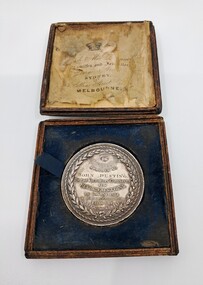
... Sunday afternoon that two sailors, managed to get to shore using a raft. It took them three hours and they then had to walk about 32 kilometres along the shore in the dark to Northumberland Lighthouse without shoes. They were met by Ben Germein the lighthouse keeper. His horse had died so he had to walk to a nearby station to borrow a horse. The horse he chose threw him off so in the end the station owner, Peter Black, rode the 24 km to the Mount Gambier telegraph...Sunday afternoon that two sailors, managed to get to shore using a raft. It took them three hours and they then had to walk about 32 kilometres along the shore in the dark to Northumberland Lighthouse without shoes. They were met by Ben Germein the lighthouse keeper. His horse had died so he had to walk to a nearby station to borrow a horse. The horse he chose threw him off so in the end the station owner, Peter Black, rode the 24 km to the Mount Gambier telegraph ...On Friday 5 August 1859, the steamship, Admella, left Adelaide bound for Melbourne. IT carried 82 passengers, a crew of 31 and 4 racehorses. he Admella was a 395 ton screw steamer built at Port Glasgow, Scotland in 1857. Her name is said to be derived from the ports she served - Adelaide, Melbourne and Launceston. It took her 42 hours to travel between Adelaide and Melbourne, usually stopping at Portland, Port Fairy and Warrnambool, making her the fastest ship to travel this route. The Admella’s final journey was her 36th voyage. Admella had been built with watertight bulkheads, riveted to the hull. These were designed as a special safety feature, but when the ship grounded on Carpenters Rocks it took only 15 minutes for the hull to break in three along the rivet lines. Many people were drowned immediately, and six horses stabled on deck tried to swim to shore. At least one of them made it alive. On Saturday August 6 1859, at 5am, Admella struck a reef. The three onboard lifeboats were washed away as were the four cork lifebelts kept on deck. Rubber lifebelts kept below deck were instantly lost. Cape Northumberland Lighthouse near Port McDonnell was about 24 km away so Captain McEwan ordered rocket flares to be fired to gain attention. However, all the ship’s rockets were damp. Only one ignited but soon fizzled out. The Captain attempted to make a raft but was unsuccessful and nearly drowned in the process. The ship was only about a kilometre from shore, but the surf, currents, cold water and sharks resulted in five men dying trying to reach safety. It wasn’t until Sunday afternoon that two sailors, managed to get to shore using a raft. It took them three hours and they then had to walk about 32 kilometres along the shore in the dark to Northumberland Lighthouse without shoes. They were met by Ben Germein the lighthouse keeper. His horse had died so he had to walk to a nearby station to borrow a horse. The horse he chose threw him off so in the end the station owner, Peter Black, rode the 24 km to the Mount Gambier telegraph station to share the news of the disaster. After several unsuccessful rescue attempts, eight days after the initial disaster, 19 people were rescued by the Portland Lifeboat and three people, including Captain McEwan were rescued in one of Admella’s lifeboats which had been found on the shore and fixed. It was captained by Ben Germein with six volunteer oarsmen. This was Germain’s sixth attempt to reach the wreck in the damaged boat. Of the 113 people on board Admella at the time of her wreck only 24 survived. At the official enquiry into the disaster, fog, lightning, compasses and bad mapping were all considered as the cause, but finally the swift and unpredictable currents which run between Cape Jaffa and Cape Northumberland were given the official blame. This medal is associated with one of Australia's worst maritime disasters, the wreck of SS Admella. This incident is significant to Portland because the Portland Lifeboat and its crew took part in a heroic rescue. 19 people were rescued by the crew of the Lifeboat. The Portland Lifeboat is listed on Victoria's State Heritage Register. The medal is presented in a blue box. The box has beveled edges. Inside the lid is a fabric insert with details of the silversmith printed. The medal sits in a circular insert with a blue ribbon for taking the medal out with ease. portland lifeboat, admella, shipwrecks, admella shipwreck, admella medals, dusting, glenelg shire council cultural collection, portland -
 Glenelg Shire Council Cultural Collection
Medal - Medal - Admella Shipwreck - awarded to John Dusting, Brush and MacDonnell, 1859
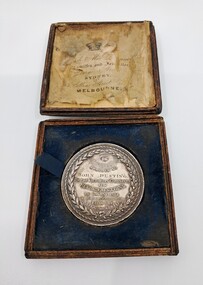
... Sunday afternoon that two sailors, managed to get to shore using a raft. It took them three hours and they then had to walk about 32 kilometres along the shore in the dark to Northumberland Lighthouse without shoes. They were met by Ben Germein the lighthouse keeper. His horse had died so he had to walk to a nearby station to borrow a horse. The horse he chose threw him off so in the end the station owner, Peter Black, rode the 24 km to the Mount Gambier telegraph...Sunday afternoon that two sailors, managed to get to shore using a raft. It took them three hours and they then had to walk about 32 kilometres along the shore in the dark to Northumberland Lighthouse without shoes. They were met by Ben Germein the lighthouse keeper. His horse had died so he had to walk to a nearby station to borrow a horse. The horse he chose threw him off so in the end the station owner, Peter Black, rode the 24 km to the Mount Gambier telegraph ...On Friday 5 August 1859, the steamship, Admella, left Adelaide bound for Melbourne. IT carried 82 passengers, a crew of 31 and 4 racehorses. he Admella was a 395 ton screw steamer built at Port Glasgow, Scotland in 1857. Her name is said to be derived from the ports she served - Adelaide, Melbourne and Launceston. It took her 42 hours to travel between Adelaide and Melbourne, usually stopping at Portland, Port Fairy and Warrnambool, making her the fastest ship to travel this route. The Admella’s final journey was her 36th voyage. Admella had been built with watertight bulkheads, riveted to the hull. These were designed as a special safety feature, but when the ship grounded on Carpenters Rocks it took only 15 minutes for the hull to break in three along the rivet lines. Many people were drowned immediately, and six horses stabled on deck tried to swim to shore. At least one of them made it alive. On Saturday August 6 1859, at 5am, Admella struck a reef. The three onboard lifeboats were washed away as were the four cork lifebelts kept on deck. Rubber lifebelts kept below deck were instantly lost. Cape Northumberland Lighthouse near Port McDonnell was about 24 km away so Captain McEwan ordered rocket flares to be fired to gain attention. However, all the ship’s rockets were damp. Only one ignited but soon fizzled out. The Captain attempted to make a raft but was unsuccessful and nearly drowned in the process. The ship was only about a kilometre from shore, but the surf, currents, cold water and sharks resulted in five men dying trying to reach safety. It wasn’t until Sunday afternoon that two sailors, managed to get to shore using a raft. It took them three hours and they then had to walk about 32 kilometres along the shore in the dark to Northumberland Lighthouse without shoes. They were met by Ben Germein the lighthouse keeper. His horse had died so he had to walk to a nearby station to borrow a horse. The horse he chose threw him off so in the end the station owner, Peter Black, rode the 24 km to the Mount Gambier telegraph station to share the news of the disaster. After several unsuccessful rescue attempts, eight days after the initial disaster, 19 people were rescued by the Portland Lifeboat and three people, including Captain McEwan were rescued in one of Admella’s lifeboats which had been found on the shore and fixed. It was captained by Ben Germein with six volunteer oarsmen. This was Germain’s sixth attempt to reach the wreck in the damaged boat. Of the 113 people on board Admella at the time of her wreck only 24 survived. At the official enquiry into the disaster, fog, lightning, compasses and bad mapping were all considered as the cause, but finally the swift and unpredictable currents which run between Cape Jaffa and Cape Northumberland were given the official blame. This medal is associated with one of Australia's worst maritime disasters, the wreck of SS Admella. This incident is significant to Portland because the Portland Lifeboat and its crew took part in a heroic rescue. 19 people were rescued by the crew of the Lifeboat. The Portland Lifeboat is listed on Victoria's State Heritage Register. Only 39 silver medals were awarded after the incident. Three gold medals were awarded. Round silver medal awarded to John Dusting by the Victorian Colonists for his heroic efforts as part of the crew of the Portland Lifeboat in the rescue of survivors of the Admella Shipwreck. Admella wrecked off the South Australian Coast in 1859. This silver medal was one of only 39 silver medals awarded. There were 3 gold medals awarded. The medal is presented in a blue box. The box has beveled edges. Inside the lid is a fabric insert with details of the silversmith printed. The medal sits in a circular insert with a blue ribbon for taking the medal out with ease. Obverse: Scene of shipwreck near the coastline. In the foreground there is the Portland Lifeboat with crew. Above is an anchor with ribbon. Text around the edge of the medal reads 'The Admella Steamer wrecked on her passage from Adelaide to Melbourne off Cape Northumberland'. Across the ribbon - Hope to the last Reverse: Wreath around the edge. Beams of light from the sky. Text reads: Awarded to John Dusting/ By the Victorian Colonists / For / Heroic Exertions / In Saving Life / (Under divine providence) / From the wreck of the Admella admella, portland, glenelg shire council cultural collection, portland lifeboat, admella shipwreck, shipwreck
