
Showing 5 items matching " target stores"
-
 Bendigo Historical Society Inc.
Document - BENDIGO FOUNDRIES
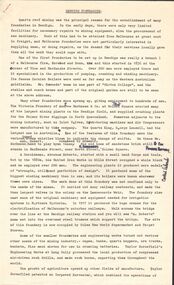
... ... Target Stores...DOCUMENT Bendigo Foundaries Horwood & Sons Girton College The Victoria Foundary Andrew Harkness & Co Palmer River Diggings George Lansell Robert Harkness Abraham Roberts United Iron Works Laanecoorie Weir Bendigo Railway Station Coles New World Supermarket Target Stores Taylor Horsefield's engineering Works Improved harvester Hugh Victor McKay Holland Bros. ...Typed notes on Bendigo Foundaries. Notes mention some of the foundries that were in Bendigo, the work they did, where they were, and where some of their work can be seen.document, bendigo foundaries, horwood & sons, girton college, the victoria foundary, andrew harkness & co, palmer river diggings, george lansell, robert harkness, abraham roberts, united iron works, laanecoorie weir, bendigo railway station, coles new world supermarket, target stores, taylor horsefield's engineering works, improved harvester, hugh victor mckay, holland bros., state rivers & water supply, civic buildings, st aiden's, bendigo hospital, carter & brown, osborn bros, bendigo building society, a'becket chambers, fortuna, george lansell, lansell mine, army survey regiment, jorgenson's, st killian's fence, redpath & brown -
 Melbourne Tram Museum
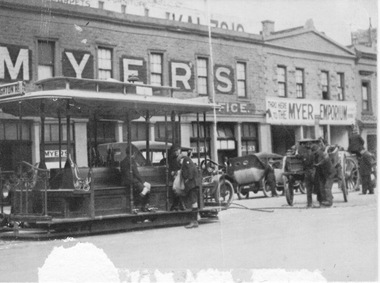
Photograph - Cable tram dummy outside Myer Lonsdale St, 1924-1925
... MYER - GROWING WITH AUSTRALIA since 1901 - today employs over 32,000 staff throughout the country in its Department Stores, Target Discount Stores and Supermarkets, speciality fashion stores, liquor and fast food outlets. ...MYER - GROWING WITH AUSTRALIA since 1901 - today employs over 32,000 staff throughout the country in its Department Stores, Target Discount Stores and Supermarkets, speciality fashion stores, liquor and fast food outlets. ...Postcard of cable tram dummy being shunted for return to Brighton Road via Swanston Street, stationary outside the double story "Myers" Parcels Office in Lonsdale Street, demolished late in 1925, between Elizabeth and Swanston Streets. Three boys in shorts sit or stand on the dummy. The dummy's destination reads "Brighton Rd", which dates the photograph as between February 1924 and December 1925, (not c1929 as written) between the construction of the track in this section of Lonsdale Street and the electric conversion of the Brighton Road line. Also in the street are horse drawn carts and motor cars.Yields information about cable trams in Lonsdale Street and MyerBlack and white postcard print with note on rear.In print on rear: "c1929 Lonsdale Street Warehouse, later to become 11-storey store. MYER - GROWING WITH AUSTRALIA since 1901 - today employs over 32,000 staff throughout the country in its Department Stores, Target Discount Stores and Supermarkets, speciality fashion stores, liquor and fast food outlets. AFFIX STAMP HERE"myers, lonsdale st, cable dummy, brighton rd line, electric conversion, horse drawn carts, warehouse, boys, shorts, cable trams -
 National Wool Museum
Letter, 10/7/1967
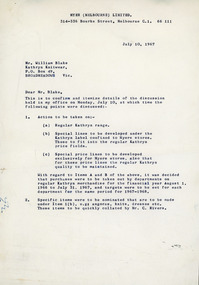
... stores, also that for these price lines the regular Kathryn quality to be maintained. With regard to Items A and B of the above, it was decided that purchases were to be taken out by departments on regular Kathryn merchandise for the financial year August 1, 1966 to July 31, 1967, and targets were to be set for each department for the same period for 1967-1968. 2. ...stores, also that for these price lines the regular Kathryn quality to be maintained. With regard to Items A and B of the above, it was decided that purchases were to be taken out by departments on regular Kathryn merchandise for the financial year August 1, 1966 to July 31, 1967, and targets were to be set for each department for the same period for 1967-1968. 2. ...Kathryn Knitwear, founded by Robert Blake, manufactured high quality children’s knitwear in Melbourne from the 1940s – 1980s. Robert Blake began manufacturing children’s knitwear in his bedroom in Strathmore using a hand powered machine in the late 1940s. The operation moved to Ascot Vale and Essendon, before eventually establishing a factory in Moonee Ponds in the early 1950s. The business continued to expand, necessitating a move to a new factory in Broadmeadows. By 1962, the Broadmeadows factory was producing an average of 20,000 garments per month, which increased to 24,000 by 1964. Robert Blake’s Son, Brendan recalls that “The Kathryn brand was famous around Australia, anywhere children needed to keep warm and dress smartly. It also won a number of wool fashion awards”, including the 1969 Wool Awards, which was held by the Australian Wool Bureau and published in Women’s Weekly. The Kathryn range was designed for durability, comfort and care, without sacrificing style. They used patterning techniques that increase stretchiness, comfort and fit, as well as integrating decorative elements into the fabric to prevent them from being bulky, uncomfortable or tight. Making longevity of style a priority, Brendan Blake remembers that “there was one particular garment that was in the range for at least thirty years”. He also recalls “In the past, when women have found out that I was associated with Kathryn Knitwear, they would often relate to me the story of a garment they had purchased or received as a gift and, when their child had grown out of it, they would hand it on to another child. Several ladies have told me of purchasing garments for their daughters’ glory box, or saving a particular garment after their daughter had grown out of it. Brendan Blake: “At the peak of their operation they employed approximately two hundred people, mainly women and girls. A family would often seek to send their daughter to work in this company because they knew they would be looked after and safe. One lady wrote to me telling me that working at the Moonee Ponds Factory prior to getting married was the happiest time of her life.” In 1963, workers at the Kathryn factory earned £13 per week, which was 8 shillings and 8 pence higher than the minimum weekly wage for female workers in the textile manufacturing industry (£12 11s 4d). By 1970, the Kathryn Knitwear brand expanded from children’s knitwear into womenswear under the brand name ‘Lady Kathryn’, and for boys and men under ‘Robert Blake’. Continuing to diversify their distribution, they also began exporting ‘Kathryn’ garments to New Zealand, the Pacific Islands, and Japan. ‘Kathryn Knitwear’ was well-known for their early adoption of modern materials and techniques that had broad appeal to their customer base. This is shown in their early use of the acrylic fibre ‘Orlon’ in the 50s and 60s and ‘Superwash’ wool in the 1970s. Many of Kathryn Knitwear’s styles, particularly those that were long running staples of the brand, were available in both wool and Orlon to suit the consumer’s preference. Far from the humble origins of one man in his bedroom with a hand-cranked machine; at its closure in 1980, the Broadmeadows factory of ‘Kathryn’ housed more than 100 machines, including 53 sewing machines and 45 knitting machines. Robert Blake was “a passionate advocate for wool and Australian Made” throughout his whole life. A strong thread that ties through the lifespan of Robert Blake and Kathryn Knitwear is a balance between adopting new innovations without sacrificing the core values of durability, comfort, care and style that had made the brand so well known. Their legacy forms an integral part of both Australian social and manufacturing history.Letter from Myer (Melbourne) Limited to William Blake. The letter confirms and details of a meeting held to discuss business arrangements between Kathryn Knitwear and Myer. Due to the lack of signatory, it is likely there was originally additional pages that have been lost. It is typewritten in blue ink on white paper, with smudges and pen marks evident.MYER (MELBOURNE) LIMITED. 314-336 Bourke Street, Melbourne C.1. 66 111 July 10, 1967 Mr. William Blake Kathryn Knitwear. P.O. Box 49. BROADMEADOWS Vic. Dear Mr. Blake. This is to confirm and itemize details of the discussion held in my office on Monday, July 10, at which time the following points were discussed: - 1. Action to be taken on:- (a) Regular Kathryn range. (b) Special lines to be developed under the Kathryn label confined to Myers stores. These to fit into the regular Kathryn price fields. (c) Special price lines to be developed exclusively for Myers stores, also that for these price lines the regular Kathryn quality to be maintained. With regard to Items A and B of the above, it was decided that purchases were to be taken out by departments on regular Kathryn merchandise for the financial year August 1, 1966 to July 31, 1967, and targets were to be set for each department for the same period for 1967-1968. 2. Specific items were to be nominated that are to be made under Item 1(b), eg: angoras, knits, dresses, etc. these items to be quickly collated by Mr C. Rivers.business, business history, manufacturing, knitting machine, fashion textile production, business archives, manufacturing documents, myer, myer emporium, myer (melbourne) -
 Moorabbin Air Museum
Booklet - Jindivik target aircraft, The Jindivik Mk 4 Target Aircraft
... Jindivik target aircraft Accessories available as Jindivik stores Component breakdown-diagram Jindivik configuration-diagrams Flight envelope Turning flight envelope Symmetric pull ups Low altitiude performance Endurance & climb performance Technical & promotional overview of GAF Jindivik target aircraft. ...Technical & promotional overview of GAF Jindivik target aircraft.Plastic covernon-fictionTechnical & promotional overview of GAF Jindivik target aircraft.accessories available as jindivik stores, component breakdown-diagram, jindivik configuration-diagrams, flight envelope, turning flight envelope, symmetric pull ups, low altitiude performance, endurance & climb performance -
 City of Melbourne Libraries
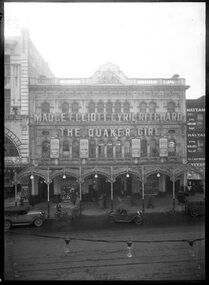
Photograph, Bull, Hugh Jones, 1897-1993, Theatre Royal, Bourke Street
... stores...demolished buildings...commemorative plaques...incidents...concrete...Whelan the Wrecker...bricks...Kmart...Bourke Street Melbourne...Manton's department store...Theatre Royal...Coles...Target...Retrieved March 25, 2026, from http://nla.gov.au/nla.news-article205554863 It's smart to be thrifty: the story of Manton's department store, Annette Cooper, https://www.slv.vic.gov.au/sites/default/files/3%20Annette%20Cooper%20-%20It%E2%80%99s%20smart%20to%20be%20thrifty%2C%20the%20story%20of%20Manton%27s%20department%20store.pdf theatres 1930-1939 fires musicals films department stores demolished buildings commemorative plaques incidents concrete Whelan the Wrecker bricks Kmart Bourke Street Melbourne Manton's department store Theatre Royal Coles Target Photographer notations on slide: "Theatre Royale 1933 B4". ...Closing time for the Theatre Royal Melbourne’s Theatre Royal opened 16 July 1855 at 236 Bourke Street, between Swanston and Russell, in the heart of the city’s entertainment district and it was comparable in size to London’s Drury Lane and Covent Garden. It was rebuilt in 1872 following a fire, remodelled in 1904, and demolished in 1933, due in part to the Great Depression, and also to the growing popularity of moving pictures. On the site was erected Manton’s department store, then Coles, Target, and now Kmart. The Quaker Girl, a 1910 Edwardian musical comedy with long running success in London, Paris and Broadway, opened in Melbourne at the Theatre Royal on 22 July 1933. Stars Cyril Ritchard and Madge Elliott were to become husband and wife, their Sydney wedding photograph now an iconic Australian image of that time. The theatre closed 13 November 1933. MCK080 Published: The Age 4 November 1933 Featured in "Newsworthy: Melbourne in photographs 1933-1936" exhibition at East Melbourne Library, October to December 2023. Exhibition caption by project volunteer, Louise McKenzie. THEATRE ROYAL (1933, November 4). The Age (Melbourne, Vic. : 1854 - 1954), p. 5. Retrieved October 16, 2025, from http://nla.gov.au/nla.news-article203364238 Additional research by project volunteer, Fiona Collyer and librarian, Fiona Campbell: The Theatre Royal closed on 13 November 1933. During demolition in December, a worker was pinned by the legs under two tons of collapsing ceiling concrete. Miraculously he escaped with only a broken leg. A commemorative plaque was unveiled in 1937, displayed at the front of Manton's department store. The event was covered in The Age on 20 Dec 1937. It was a beautiful blue enamel and brass with the comedy and tragedy masks, one crying and one laughing, at the top with a timeline of the theatre underneath. Its whereabouts became unknown after the multiple changes with department stores on the site. In 2019 Greg Sampson set out on a mission to find it and in 2021 eventually tracked it down, on a wall behind the door of a staff tea room in Kmart. After much arduous lobbying by Greg it was eventually relocated to the Kmart arcade on the site where the Theatre Royal was originally located. Annette Cooper's history of Manton's and the Bourke Street site described the process of acquisition and demolition of the theatre: "Around 1933, the theatre came on the market – ‘a gift from heaven’ for its enterprising neighbours. Manton’s acquired the theatre and started planning for its demolition to enable the expansion of the store. William Manton and his sons, Jack and Ivor, watched the final production at the theatre, Harold Fraser-Simson’s musical comedy The Maid of the Mountains. 'It was, for the theatre-goers, a nostalgic last appearance, an emotional night, the end of an era. There were those who were mortified at the prospect of a store taking the place of their palace of dreams.' Even Whelan the Wrecker sensed the importance of the occasion and donated four bricks from the theatre to the National Museum of Victoria. They are the oldest bricks in the museum’s collection and form part of its Whelan the Wrecker collection." UNDER BIG FALL OF CONCRETE (1933, December 8). The Herald (Melbourne, Vic. : 1861 - 1954), p. 1. Retrieved April 14, 2026, from http://nla.gov.au/nla.news-article243215969 The Relocation of the Theatre Royal Plaque, Greg Sampson, https://theatreheritage.org.au/on-stage-magazine/news/item/989-the-relocation-of-the-theatre-royal-plaque Photo of theatre interior, Arts Centre Melbourne, https://collections.artscentremelbourne.com.au/#details=ecatalogue.184409 OLD THEATRE ROYAL (1937, December 20). The Age (Melbourne, Vic. : 1854 - 1954), p. 10. Retrieved March 25, 2026, from http://nla.gov.au/nla.news-article205554847 AMATEUR ATHLETICS -- LIFE SAVING DISPLAY MEMORIAL PLAQUE UNVEILED (1937, December 20). The Age (Melbourne, Vic. : 1854 - 1954), p. 15. Retrieved March 25, 2026, from http://nla.gov.au/nla.news-article205554863 It's smart to be thrifty: the story of Manton's department store, Annette Cooper, https://www.slv.vic.gov.au/sites/default/files/3%20Annette%20Cooper%20-%20It%E2%80%99s%20smart%20to%20be%20thrifty%2C%20the%20story%20of%20Manton%27s%20department%20store.pdfPhotographer notations on slide: "Theatre Royale 1933 B4". theatres, 1930-1939, fires, musicals, films, department stores, demolished buildings, commemorative plaques, incidents, concrete, whelan the wrecker, bricks, kmart, bourke street melbourne, manton's department store, theatre royal, coles, target
