
Showing 4 items matching " tennis commentator"
-
 Musculoskeletal Health Australia (now held by the Glen Eira Historical Society)
Photograph - Group photo, 01/06/1979
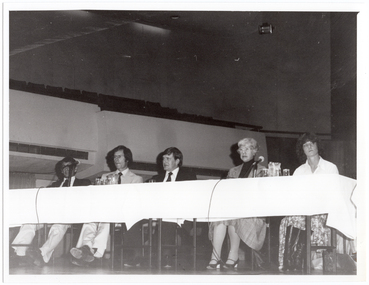
... ... tennis commentator...On the panel were Olympic distance runner, Ron Clarke (1937-2015); Davis Cup tennis player and Channel 7 tennis commentator, Allan Stone (1945-); Australian cricketer, Captain of the Carlton Cricket Club and sports writer, Keith Stackpole Jr (1940-); captain of the All Australia carnival netball team (1946-47) and President of the Women's Netball Association, Eunice Gill (1918-1987); Olympic sprinter and Little Athletics coach, Denise Boyd (1952-); sports medicine physician, Dr K Threlfall; physiotherapist, Barry Richardson; orthopaedic surgeon, Mr Jonathan Hooper; rheumatologist and RAAV Executive member, Dr Murray Ingpen (1940-2015); Secretary of the Sports Medicine Federation, Dr Hugo MacKay; and President of RAAV, Dr Les Koadlow (1920-2006). ...On the panel were Olympic distance runner, Ron Clarke (1937-2015); Davis Cup tennis player and Channel 7 tennis commentator, Allan Stone (1945-); Australian cricketer, Captain of the Carlton Cricket Club and sports writer, Keith Stackpole Jr (1940-); captain of the All Australia carnival netball team (1946-47) and President of the Women's Netball Association, Eunice Gill (1918-1987); Olympic sprinter and Little Athletics coach, Denise Boyd (1952-); sports medicine physician, Dr K Threlfall; physiotherapist, Barry Richardson; orthopaedic surgeon, Mr Jonathan Hooper; rheumatologist and RAAV Executive member, Dr Murray Ingpen (1940-2015); Secretary of the Sports Medicine Federation, Dr Hugo MacKay; and President of RAAV, Dr Les Koadlow (1920-2006). ...On the 1st of June, 1979, a panel event was held to address the topic of Arthritis and Sport. On the panel were Olympic distance runner, Ron Clarke (1937-2015); Davis Cup tennis player and Channel 7 tennis commentator, Allan Stone (1945-); Australian cricketer, Captain of the Carlton Cricket Club and sports writer, Keith Stackpole Jr (1940-); captain of the All Australia carnival netball team (1946-47) and President of the Women's Netball Association, Eunice Gill (1918-1987); Olympic sprinter and Little Athletics coach, Denise Boyd (1952-); sports medicine physician, Dr K Threlfall; physiotherapist, Barry Richardson; orthopaedic surgeon, Mr Jonathan Hooper; rheumatologist and RAAV Executive member, Dr Murray Ingpen (1940-2015); Secretary of the Sports Medicine Federation, Dr Hugo MacKay; and President of RAAV, Dr Les Koadlow (1920-2006). Around 550 people attended the event, which was held at Dallas Brooks Hall. This photo depicts panellists Ron Clarke, Allan Stone, Keith Stackpole, Eunice Gill, and Denise Boyd. A similar photo appears on page 1 (cover page) of the Vol 13, June 1979 edition of RAAV's News Review, in which all the panelists are depicted.Black and white photo of five people sitting at a long table on a stage. On the table, there are two microphones on stands, two glass jugs of water, and some glasses.[Handwritten in pencil] Sporting Panel L-R Ron Clarke, Alan [sic] Stone, Keith Stackpole, Eunice Gill, & Denise Boyd (Ron Barassi was marooned in Sydney - he arrived after the meeting concluded.)rheumatism and arthritis association of victoria, raav, sports panel, arthritis and sport, ron clarke, olympic distance runner, allan stone, tennis player, davis cup, tennis commentator, channel 7, keith stackpole jr, australian cricketer, carlton cricket club, captain, sports writer, eunice gill, all australia carnival netball team, captain, women’s netball association, president, denise boyd, olympic sprinter, little athletics, coach, dallas brooks hall, 1979 -
 Musculoskeletal Health Australia (now held by the Glen Eira Historical Society)
Photograph - Group photo, 01/06/1979
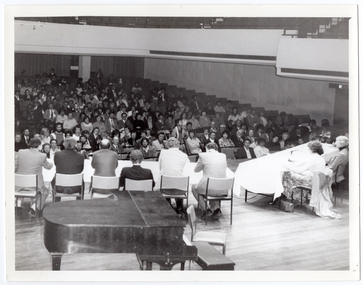
... On the panel were Olympic distance runner, Ron Clarke (1937-2015); Davis Cup tennis player and Channel 7 tennis commentator, Allan Stone (1945-); Australian cricketer, Captain of the Carlton Cricket Club and sports writer, Keith Stackpole Jr (1940-); captain of the 'all Australia carnival netball team' (1946-47) and President of the Women's Netball Association, Eunice Gill (1918-1987); Olympic sprinter and Little Athletics coach, Denise Boyd (1952-); sports medicine physician, Dr K Threlfall; physiotherapist, Barry Richardson; orthopaedic surgeon, Mr Jonathan Hooper; rheumatologist and RAAV Executive member, Dr Murray Ingpen (1940-2015); Secretary of the Sports Medicine Federation, Dr Hugo MacKay; and President of RAAV, Dr Les Koadlow (1920-2006). ...On the panel were Olympic distance runner, Ron Clarke (1937-2015); Davis Cup tennis player and Channel 7 tennis commentator, Allan Stone (1945-); Australian cricketer, Captain of the Carlton Cricket Club and sports writer, Keith Stackpole Jr (1940-); captain of the 'all Australia carnival netball team' (1946-47) and President of the Women's Netball Association, Eunice Gill (1918-1987); Olympic sprinter and Little Athletics coach, Denise Boyd (1952-); sports medicine physician, Dr K Threlfall; physiotherapist, Barry Richardson; orthopaedic surgeon, Mr Jonathan Hooper; rheumatologist and RAAV Executive member, Dr Murray Ingpen (1940-2015); Secretary of the Sports Medicine Federation, Dr Hugo MacKay; and President of RAAV, Dr Les Koadlow (1920-2006). ...On the 1st of June, 1979, a panel event was held to address the topic of Arthritis and Sport. On the panel were Olympic distance runner, Ron Clarke (1937-2015); Davis Cup tennis player and Channel 7 tennis commentator, Allan Stone (1945-); Australian cricketer, Captain of the Carlton Cricket Club and sports writer, Keith Stackpole Jr (1940-); captain of the 'all Australia carnival netball team' (1946-47) and President of the Women's Netball Association, Eunice Gill (1918-1987); Olympic sprinter and Little Athletics coach, Denise Boyd (1952-); sports medicine physician, Dr K Threlfall; physiotherapist, Barry Richardson; orthopaedic surgeon, Mr Jonathan Hooper; rheumatologist and RAAV Executive member, Dr Murray Ingpen (1940-2015); Secretary of the Sports Medicine Federation, Dr Hugo MacKay; and President of RAAV, Dr Les Koadlow (1920-2006). Around 550 people attended the event, which was held at Dallas Brooks Hall. This photo depicts many of the panelists from behind, facing the large audience before them.Black and white photo of eight people sitting at two long tables on a stage. There are six people on one table and two people evident sitting on the second table (which is partially obscured). There is a large piano in the foreground, behind one of the tables. In the background, a large audience, who are seated on rows of seats, fills the auditorium.rheumatism and arthritis association of victoria, raav, sports panel, arthritis and sport, dr k threlfall, sports medicine physician, barry richardson, physiotherapist, mr jonathan hooper, orthopaedic surgeon, dr murray ingpen, rheumatologist, raav executive member, dr hugo mackay, sports medicine federation, secretary, dr les koadlow, raav, president, eunice gill, all australia carnival netball team, captain, women’s netball association, president, denise boyd, olympic sprinter, little athletics, coach, dallas brooks hall, 1979 -
 City of Melbourne Libraries
Photograph, Bull, Hugh Jones, 1897-1993, Tennis player Fred Perry, Kooyong
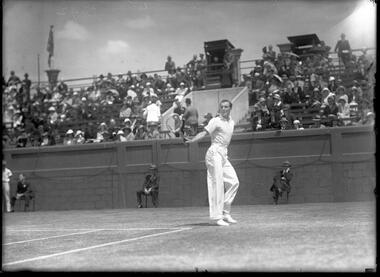
... After Fred retired from competition tennis in 1956, he worked as a BBC tennis commentator for TV and radio and wrote columns for British newspapers. ...After Fred retired from competition tennis in 1956, he worked as a BBC tennis commentator for TV and radio and wrote columns for British newspapers. ...Tennis champion Fred Perry backhands the ball at Kooyong, 1934 “I didn’t aspire to be a good sport, “champion” was good enough for me.” Fred Perry (1909-1995) was an English tennis champion who won eight Grand Slam titles including Wimbledon in 1934, 1935, 1936 and the Australian Open in 1934. Australian sports journalist Alan Trengove remarked, “When Perry walked out to play in his crisp white flannels and matching white blazer, thousands of female hearts missed a beat!” In 1935, Fred and Dorothy defeated Harry and Nell Hopman in the Wimbledon mixed doubles, and in 1936 they won against America. Fred started a successful sportswear brand in 1952, which continues today. Fred initially wanted a smoking pipe as the emblem as he was an enthusiastic smoker, but was talked out of it because it wouldn’t appeal to women. The familiar laurel was used instead. Featured in "Newsworthy: Melbourne in photographs 1933-1936" exhibition at East Melbourne Library, October to December 2023. Exhibition caption by project volunteer Fiona Collyer. Photographer notations on slide: "F. Perry 1934 Action B42" Photograph taken at Kooyong, Melbourne, but used in article about Wimbledon 1934. Published: The Age 7 July 1934 p 13 Published title: "THE FINAL STAGE." Published caption: F. J. Perry (England) Trove article identifier: http://nla.gov.au/nla.news-article205525840 Research by project volunteer Fiona Collyer: Frederick John Perry, 18 May 1909 to 2 Feb 1995 Fred Perry was an English tennis and table-tennis champion. He won eight Grand Slam titles – Wimbledon Gentlemen’s Singles, US Open three times, Australian Open and French Open once each. Fred had natural hand-to eye co-ordination, solid strokes and a devastating forehand that he used soon after the ball bounced. His fierce competitiveness and unabashed confidence gave him the winning edge. Fred was born in Stockport, Cheshire in 1909. His father, Samuel, a committed socialist, was a cotton spinner who became Secretary of the Co-Operative Party and later a Labour and Co-Operative Party M.P. When Fred was nine years old the family moved to Ealing, London. In 1929, at the age of 19, Fred became the World Champion at table-tennis – a new international sport at the time. He then decided to switch from table-tennis to tennis after his father told him to stop spending so much time in the smoke-filled halls that held table-tennis events. “You look like death warmed up.” he said. In the tennis world, Fred was regarded as an upstart intruder, and was the victim of snobbery and prejudice for his working class background. Fred trained with Arsenal Football Club in defiance of the LTA (Lawn Tennis Association) which had a dim view of extra-curricular exercise. His sarcastic toff-baiting call of “very clevah” when an opponent played a good shot and his habit of vaulting over the net whenever he won a match made Fred compelling to watch. Fred’s prize for winning Wimbledon was a £25 shopping voucher and a replica trophy. There was no on-court presentation; instead it was the custom to offer congratulations in the dressing rooms. One of the defining moments of Fred’s career came on the day he won Wimbledon for the first time in 1934. He was in the bathtub after the match when he over-heard former tennis player Brame Hillyard, a committee member of the All-England Club talking to Australian runner-up Jack Crawford. “This was the one day when the best man didn’t win.” Hillyard had brought a bottle of champagne and an All-England neck-tie, which was official recognition of Fred now being a member of one of the sporting world’s most elite clubs. Instead of a formal presentation to Fred, Hillyard draped the tie unceremoniously over his seat in the dressing room, handed Jack the bottle of champagne, and left. “Instead of Fred Perry the Champ, I felt like J. Fred Muggs the Chimp!” he said. When Fred finally went professional, an official at LTA told him he would never wear the club sweater again. Fred said “I made sure he wouldn’t have to worry about that, I sent a sleeve to him as a present!” In 1935, RKO offered Fred a contract for two movies at $50,000 each, but he had to turn down the offer as it would be in breach of LTA rules and he would lose his amateur status. In 1935, Fred married American film actress Helen Vinson in Harrison, New York, waking up a registrar at five minutes to midnight to avoid being married on Friday the thirteenth – “To be on the safe side” they said. In 1936, having been world number one tennis player for three years, Fred quit amateur tennis and moved to America. He joined tennis players Ellsworth Vines and Don Budge on a professional tennis circuit, travelling around US cities and receiving a share of the gate receipts. The All-England Club removed his honorary membership and the tie that went with it – “After all the trouble they’d gone to presenting it to me.” he quipped acidly. Despite being a three-time Wimbledon champion, Fred was barred from playing on LTA affiliated courts, so when he held his pro-tour through the UK in 1937, the matches had to be played on a portable wooden court, transported around by truck to football grounds. Fred was co-owner of the Beverley Hills Tennis Club. The exclusive membership consisted of Hollywood actors, directors, writers and studio heads. At the launch of the re-branded club in 1937, Fred played a doubles match with Charlie Chaplin, Groucho Marx and Ellsworth Vines, which he won with Charlie. Watching on was a Who’s Who of Hollywood actors including Barbara Stanwyck, Joan Crawford, the Marx Brothers, Errol Flynn, and Ronald Coleman to name a few. Fred was romantically linked to Hollywood actresses Marlene Dietrich, Jean Harlow, and Bette Davis, and was engaged to British actress Mary Lawson. In 1939, he became a US citizen and in 1942 enlisted in the US Air Force. Fred wore medical gauze around his right wrist while playing to stop sweat from flowing onto the handle of his racket and to wipe sweat from his brow. He paired up with former footballer Austrian Tibby Wegner to develop an anti-perspirant device. The prototype towelling sweatbands were given free to players at tournaments and proved popular. In 1952, Fred Perry Sportswear began and the trademark slimfit white polo shirt with embroidered laurel wreath on the left breast was born. The laurel wreath was inspired by Wimbledon’s original emblem and is the ancient symbol for triumph and victory. Fred was an enthusiastic pipe smoker and wanted a pipe to be the logo, however he was persuaded that it wouldn’t appeal to women. Years after the brand started, French tennis champion and sportswear designer Rene Lacoste and Fred were interviewed together for TV. Lacoste said ”I made the shirt and you made me a great compliment doing the same thing.” Fred responded “You made the back of it longer than the front – so between us we revolutionised it, didn’t we?” After Fred retired from competition tennis in 1956, he worked as a BBC tennis commentator for TV and radio and wrote columns for British newspapers. He also coached at Beca Raton Club in Florida and was director of golf at Runaway Bay in Jamaica. In 1984, 50 years after his first title, Wimbledon erected a statue of Fred. “I never thought I’d live to see the day when a statue was put up to the son of a Labour M.P. inside the manicured grounds of Wimbledon,” he said. Fred married four times, firstly to Texan actress Helen Vinson. His final marriage to Barbara Riese in 1952 lasted until his death. They had two children, Penny and David. Fred died in the Epworth Hospital, Richmond, Melbourne after falling in his hotel bathroom while visiting for the Australian Open. His ashes are in an urn near his statue at Wimbledon. - In 1975, Fred was inducted into the International Tennis Hall of Fame. - In 2002, the Fred Perry 23 km walking route was opened in Stockport. - An English Heritage blue plaque was attached to his Ealing house where he lived in from 1919-1935. A letter to The Times… In 1932, Dr Daniel Prenn and Gottfried Von Cramm of Germany beat the formally dominant Great Britain team of Fred Perry and Bunny Austin in the Davis Cup. Prenn was not selected for the 1933 Davis Cup Team after Chancellor Adolf Hitler announced his “Aryan only” agenda for Germany’s sporting bodies. Dr Prenn, a Jew, was born in Vilnius (then part of Russia), and in 1920 his family fled to Berlin as refugees after the pogroms. On 15 April 1933, Fred Perry and Bunny Austin (a member at the Oxford Group, a Christian anti-war movement), wrote a letter of protest to the London Times: "Sir, We have read with considerable dismay the official statement which has appeared in the Press that Dr D.D. Prenn is not to represent Germany in the Davis Cup on the grounds that he is of Jewish origin. We cannot but recall the scene when, less than twelve months ago, Dr Prenn before a large crowd at Berlin won for Germany against Great Britain the semi-final round of the European Zone of the Davis Cup, and was carried from the arena amidst spontaneous and tremendous enthusiasm. We have always valued our participation in international sport, because we believed it to be a great opportunity for the promotion of better international understanding and because it was a human activity that countenanced no distinction of race, class or creed. For this reason, if for none other, we view with great misgivings any action which may well undermine all that is most valuable in international competitions. Yours faithfully, H.W. Austin, Fred Perry.” Daniel Prenn emigrated to Britain in 1935. References: Fred Perry: British tennis legend, Kevin Jefferys, Pitch Publishing, 2017 'Fred Perry: The hero from the wrong side of the tramlines', Paul Newman, tennis correspondent, The Independent, 21 November 2015 https://www.independent.co.uk/sport/tennis/fred-perry-the-hero-from-the-wrong-side-of-the-tramlines-a6743721.html. 'Fred Perry: the radical of Wimbledon', Bob Holman, Socialist Worker, 26 June 2009 https://socialistworker.co.uk/comment/fred-perry-the-radical-of-wimbledon/ 'Daniel Prenn (1904-1991) – A little-known Jewish German tennis player', newmark401, Tennis Warehouse forums, 12 May 2011 http://tt.tennis-warehouse.com/index.php?threads/daniel-prenn-1904-1991-–-a-little-known-jewish-german-tennis-player.379780/Photographer notations on slide: "F. Perry 1934 Action B42".tennis, 1930-1939 -
 Carlton Football Club
Scrap Book, Dedicated to Carlton Player John Goold
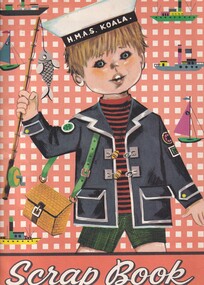
... commentator Lou Richards. Supporters and team-mates however, called him ‘Rags’ or ‘Ragsy,’ because of his involvement in the clothing, or ‘rag’ trade. Goold first came under notice as an outstanding junior athlete at Melbourne Grammar School. A true all-round sportsman, he shone at tennis ...John Goold double Premiership PlayerA scrap Book dedicated to twice Premiership Player 1968 - 1970 John Goold Career : 1963 - 1970 Debut : Round 7, 1963 vs Footscray, aged 21 years, 338 days Carlton Player No. 754 Games : 108 Goals : 3 Last Game : Grand Final, 1970 vs Collingwood, aged 29 years, 90 days Guernsey No. 11 Height : 184 cm (6 ft ½ in.) Weight : 76 kg (12 stone, 0 lbs.) DOB : June 27, 1941 Premiership Player 1968, 1970 Carlton Hall of Fame All Australian 1966 A brilliant, flamboyant, two-time Premiership player for Carlton during the Barassi years in the ‘swingin’ sixties,’ John William Crosbie Goold became almost as famous for his dapper appearance off the field, as for his exploits on it. At the height of his football career, he was also a prominent ladies fashion designer – which led to him being dubbed ‘Mr Elegance’ by leading football commentator Lou Richards. Supporters and team-mates however, called him ‘Rags’ or ‘Ragsy,’ because of his involvement in the clothing, or ‘rag’ trade. Goold first came under notice as an outstanding junior athlete at Melbourne Grammar School. A true all-round sportsman, he shone at tennis, athletics, football and cricket. He was also a keen horseman who loved the game of polo and the rough and tumble of fox hunting. While at school he was a fervent Melbourne supporter, but strangely, never had much confidence in his football ability. “If I thought I was good enough, I would certainly have gone to Melbourne,” he said many years later. “But I honestly didn’t think I would ever amount to anything in this game. Cricket and tennis were the games that really interested me.’ However, after graduating from MGS, Goold went home to Healesville to star in the Bloods’ 1962 Yarra Valley Football Association Premiership team – an achievement that brought tempting offers from more than one VFL club. “Incentives were offered elsewhere,” he recalled, “but I gravitated to Carlton – partly because the deep blue of their guernsey attracted me, but mostly because of the good advice I got from people who even then were longsighted enough to predict that big things were ahead for this club.” The Blues were confident enough in Goold’s potential to offer him the guernsey number 11 previously worn with distinction by the likes of Jack Hale, Jim Knight, Ron Hines and Laurie Kerr, and his first senior game came in round 7, 1963 against Footscray at the Western Oval. He played on a half-forward flank alongside Brownlow Medallists Gordon Collis and John James on that Saturday afternoon, and kicked his first career goal in an 8-point win. Little did he know though, that it would be another six seasons before he would again experience the thrill of sending a football spinning between the big posts, because his future lay in defence. By his own admission, Goold struggled to find his feet in VFL football during his first two seasons, until the shock appointment of Ron Barassi as captain-coach of Carlton in 1965 began steering his career back on track. “I think you could say that 1965 was my first year of League football,” he said, “That’s the way I felt - that’s the way I reacted to Barassi.” Under Barassi, Goold rapidly developed into a superb running half-back flanker. Tenacious, and an often freakish high mark, he was unmistakable on the field thanks to his mane of dark hair, his loping running style and somewhat awkward kicking action. Furthermore, he had boundless courage. There is no doubt that he would have played many more games had he not been regularly pole-axed under the high ball – a fact he later freely admitted. “I was always getting knocked out,” he said, “and spent half my bloody time in hospital.” In the second half of 1965, an injury to centre half-back Gordon Collis forced Barassi to use Goold in the key defensive post. While it curtailed his rebounding instincts somewhat, ‘Ragsy’ rose to the challenge and rarely lowered his colours. Testament to his improvement, he finished third behind John Nicholls and Sergio Silvagni in Carlton’s 1965 Best and Fairest award, and followed up by being selected in the Victorian team for the 1966 Hobart Carnival. There, he had a superb series in which he was runner-up to West Australian Barry Cable in voting for the Tassie Medal, and capped it off by being named on a half-back flank in the All Australian team. Barassi’s influence at Carlton bore fruit in his third year, when the Blues returned to finals football at last. Richmond, Carlton, Geelong and Collingwood fought out the 1967 Premiership, and Ragsy Goold won the hearts of the Carlton faithful with two lion-hearted performances. Although Carlton was knocked out of contention by successive losses to Richmond and Geelong, Goold was tireless throughout both games, and it was obvious that he thrived on the added pressure of finals football. Precisely twelve months later, the bitter taste of those defeats was washed away when Barassi’s Blues edged out Essendon by 3 points in the 1968 Grand Final, and ended 21 years of despair at Princes Park. To win Carlton’s ninth VFL flag, the Blues had had to defeat the minor premier Bombers twice during the finals – and did so, thanks to a watertight defence led by Goold, and a dominant ruck division headed by John Nicholls. In round 5, 1969, Carlton hosted South Melbourne at Princes Park in a match significant for a number of reasons. As he regularly did, Ron Barassi swung his team around prior to the opening bounce, and Goold found himself in the unaccustomed role of ruck-rover. While the Blues set about establishing a good break on the scoreboard, Ragsy relished the freedom to kick two first half goals - his first majors for 78 games. Just before half-time however, he was flattened in a pack, concussed again, and replaced during the long break by Barry Gill. Alex Jesaulenko was substituted at the same time – by a shy, ambitious youngster named Bruce Doull, making his senior debut for Carlton in guernsey number 4. In September, 1969 the Navy Blues began their third straight finals campaign with an impressive 6-goal Semi Final win over Collingwood in front of more than 108,000 fans at the MCG. A fortnight later, Richmond stunned the flag favourites with a withering last quarter in the Grand Final, and knocked Carlton out of the Premiership race again at the last hurdle. Half-way through the year, Carlton's club doctor discovered that Goold had been playing with shin splints in both of his lower legs. The pain they caused was considerable, but Ragsy soldiered on and held down centre half-back throughout the season. John Goold’s VFL career at Carlton culminated in the fabled 1970 Grand Final triumph over Collingwood. What is not so well known is that Ragsy was only cleared to play in that game on the morning of the match. After narrowly losing to Collingwood in the second Semi Final, the Navy Blues destroyed St Kilda by 62 points in the Preliminary Final, and earned another shot at the Magpies in the decider. But one of Carlton’s problems was that Goold had been kicked on a shin against St Kilda, causing a burst blood vessel and serious swelling. Despite the best efforts of the club medical staff, Ragsy had only a slim chance of playing in the Grand Final right up until game day, when his worried coach reluctantly allowed him to take his place in the side. Later, Barassi justified his decision by saying that in his opinion, a less than fully fit Goold was still worth his place in the team. By half time in the Grand Final however, he was probably questioning that judgement - because Carlton had been totally outplayed, and trailed an impressive, cohesive Collingwood by 44 points. Therefore, Carlton’s magnificent comeback – orchestrated by Barassi, and sparked by the fairytale exploits of 19th man Ted Hopkins – is one of the greatest of all football stories. Against enormous odds, the Navy Blues fought their way back into the contest, and eventually, rolled over the top of the frantic Magpies to snatch victory by 10 points in the last few minutes of the match. Hopkins ended up with four goals, Barassi was hailed a genius, and Ragsy Goold was carted off to hospital immediately after the game to have further urgent treatment. While there, he decided that there was no better time to end his VFL career – especially because his burgeoning business interests were demanding more and more of his time. In the years after his football career ended, John Goold created a remarkably successful business empire. In 1971 he sold his fashion label and took up farming at Mortlake in western Victoria, where he coached the local football team for three seasons. Later, he formed a diversified pastoral company, and purchased a magnificent complex called Ballangeich Run at nearby Ellerslie. While his passion for farming and livestock grew, he began breeding top quality polo ponies, and represented Australia in international competition. During the 1997 and 1998 seasons, John's son Ed Goold played reserve grade football for Carlton. MEMORIES.... Ragsy Goold; the name stirs memories form my long ago childhood. Ragsy, with his unique kicking style, where he'd hold the ball (always a drop punt - in a time when the drop kick and the torpedo punt still reigned supreme) at the point of the ball, elbows bent and he'd lavishly drop the ball, his right arm then flinging back and up dramatically. That was the thing about Ragsy (so named because he worked in the clothing, or 'rag' trade), he was always dramatic. He always ensured his ankle guards and wrist guard were glowing white to match the great white CFC monogram he wore proudly on his chest, and with his long flowing locks, cut a dynamic figure through a young boy's mind. Ragsy was my idol. I loved his dashes from half back, his long accurate drop punts, most of all I loved his flair for the game. Ragsy played the game as an entertainer as well as a sportsman - he leapt high to punch or mark, and always seemed to have a bit of the thoroughbred about him - which is probably why after he retired, he took up fox chasing, polo, and riding his beloved thoroughbreds across the paddocks and over the fences of his property, I think he may have even represented Australia at the sport – really, that’s sort of how he played as a footballer. All sinewy muscle, long legs and famous leaps for the saving punch. Ragsy was part of the great backline that helped revive Carlton's fortunes. Legendary players Wes Lofts, Ian Collins, Kevin 'Racehorse' Hall, Vinnie Waite among them. All great teams have a great defence and the defence that Ragsy was an integral part of was no different. Where others provided the biffo, the muscle or the defensive pressure, Ragsy provided the dash, the flair, the sense of adventure that all great backlines must have. AND MORE.... I have had many favourite players while following the Blues, but there will always be a special spot for Ragsy Goold - running the lines, all long hair and flashing white guards. As a young man I moved to Carlton and began acting in a place called one-c-one. One night after a play, I was walking home. It was winter, and I was wearing my favouritte overcoat, a genuine ankle length tweed affair I had picked up in an Op Shop in Oakleigh for three dollars. As I strutted across Lygon Street, a deep male voice behind me called, 'hey laddie, how much for the overcoat?' I turned, and there was my childhood idol, Ragsy Goold, two beautiful women in tow, smiling and waiting for my answer. I loved that coat too much to part with it, even to Ragsy, so I shook my head - and he smiled, then walked off. I stood for a moment in the middle of the street shaking my head in disbelief. Ragsy bloody Goold had just offered to buy my overcoat! I knew at that point, as a young man of about twenty three, that life was going to be full of surprises and very entertaining - a bit like John ‘Ragsy’ Goold. ONE MORE.... A cold, wet day in the mid 1960's at the MCG and Victoria were playing South Australia (?) The ball that day was like a piece of soap, with players finding it impossible to mark. Just before half time a long kick sailed toward the mud heap that was the centre of the ground, and the pack rose to meet it. From this group of players an arm shot straight up, and the ball instantly came to a dead stop. The footy stuck in the player's palm as if the hand was coated in Tarzan's Grip. After all these years, it's the only recollection I have of that match, and that player was 'Mr. Elegance' John Goold. HUMOROUS HUNGRY.... Former opponent Richmond's Kevin Bartlett on Radio SEN in 2012 received a phone call from John. After the call Kevin told his listeners how "Mr Elegance" would always be dressed in a nice suit, shirt-tie and highly polished shoes. He then cracked a joke saying something like; "You know, John was so 'posh' that he used to play football wearing a cravat!" Milestones 50 Games: Round 15, 1967 vs Melbourne 100 Games: Round 13, 1970 vs Geelong Career Highlights 1965 - Percy Bentley Trophy - 3rd Best & Fairest 1966 - 5th Best & Fairest 1967 - Maurie Sankey Memorial Trophy - 4th Best & Fairest (on count back) 1968 - Premiership Player 1970 - 7th Best & Fairest 1970 - Premiership PlayerFoolscap Scrap Book
