
Showing 15 items matching " text morton"
-
 Ballarat Tramway Museum
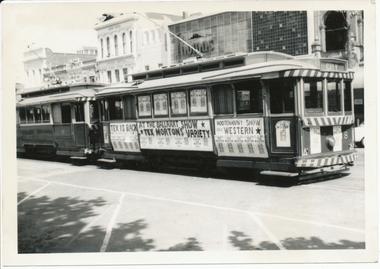
Negative - SECV Ballarat 18 advertising the Tex Morton Variety Show, Wal Jack, 9/11/1963
... ... Text Morton...Trams tramways Sturt St Decorated Trams Text Morton tram 18 tram 12 On rear in ink "SEC Ballarat No.18 decorated with Tex Morten's Variety Show posters - Sturt St, Parking Loop 9-11-63". ...Photograph of Ballarat 18 dressed in extensive advertising posters and panels including the windows advertising the Tex Morton Variety Show, photographed in the parking loop, Sturt St by Wal Jack 9-11-1963. Has Thomas Jewellers shop, Gear chemist and the Union Hotel in the background. Tram No. 12 is parked behind No. 18. See image i2 for rear of photograph. See image i3 for hi res scan of print. See image i4 for hi res scan of negative Tex Morton died in 1983 and was a well known Country and Western performer. See Wikipedia and similar websites for more details.Yields information about a posters applied to a tram to advertise a Tex Morton variety show in Ballarat in 1963.Negative and Digital image from the Wal Jack Ballarat Album.On rear in ink "SEC Ballarat No.18 decorated with Tex Morten's Variety Show posters - Sturt St, Parking Loop 9-11-63". In top right hand corner is Wal Jack stamp with negative number "T1275" written in.trams, tramways, sturt st, decorated trams, text morton, tram 18, tram 12 -
 Mont De Lancey
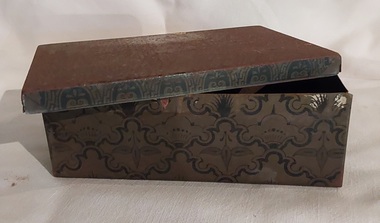
Container - Lidded Tin, C.E Morton, late 19th and early 20th C
... Brown metal box with black decorative pattern and text "Seidlitz Powders C.E Morton London England". Sachets inside were wrapped in tissue paper. ...Brown metal box with black decorative pattern and text "Seidlitz Powders C.E Morton London England". Sachets inside were wrapped in tissue paper. ...Seidlitz powders were a vintage, effervescent, and mild laxative and digestive regulator popular in the 19th and early 20th centuries. Named after the Bohemian village of Seidlitz (now Sedlec in the Czech Republic), they were commonly used to relieve constipation, heartburn, and gas due to stomach acidity. Seidlitz powders is the generic name under which a commonly known laxative and digestion regulator was marketed and sold by numerous manufacturers, particularly in the late 19th and early 20th centuries. The effervescing salts consisting of one powder of sodium bicarbonate and Rochelle salt and another of tartaric acid that are mixed in water and drunk as a mild cathartic. Brown metal box with black decorative pattern and text "Seidlitz Powders C.E Morton London England". Sachets inside were wrapped in tissue paper. A rusty small metal empty vintage brown and black patterned rectangular lidded old tin which contained Seidlitz Powders. The details printed on the lid are almost indescipherable. There is an overall black stylish pattern all over the outside of the lid and base. The powders were commonly used to relieve constipation, heartburn, and gas due to stomach acidity. This tin was used for other purposes when emptied.The print on the top of the lid is indescipherable as to the manufacturer and instructions for use of the Seidlitz Powders. medications, medication containers, containers, medicines -
 Flagstaff Hill Maritime Museum and Village
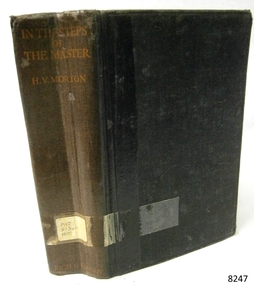
Book, In The Steps of The Master
... The Warrnambool Mechanics' Institute’s publication collection is of both local and state significance. flagstaff hill warrnambool shipwrecked coast flagstaff hill maritime museum maritime museum shipwreck coast flagstaff hill maritime village great ocean road book pattison collection warrnambool library warrnambool mechanics’ institute ralph eric pattison corangamite regional library service warrnambool city librarian mechanics’ institute library victorian library board warrnambool books and records warrnambool children’s library in the steps of the master h v morton The label on spine cover with typed text PAT 915.6 MOR Inside the front loose endpaper has a sticker from Warrnambool Mechanics Institute covered by a sticker from Corangamite Regional Library Service Inside the front loose endpaper has a stamp from Corangamite Regional Library Service In The Steps of The Master Author: H V Morton Publisher: Rich & Cowan Ltd Date: 1st Published October 1934 In The Steps of The Master Book ...This book was part of a large group of books referred to as the Pattison Collection, which belonged to the Warrnambool Public Library, part of the Warrnambool Mechanics’ Institute. About RALPH ERIC PATTISON and the ‘PATTISON COLLECTION’ The ‘Pattison Collection’ is a collection of books and records that was originally owned by the Warrnambool Mechanics’ Institute, founded in Warrnambool in 1853. By 1886 the Warrnambool Mechanics’ Institute (WMI) had grown to have a Library, Museum and Fine Arts Gallery, with a collection of “… choice productions of art and valuable specimens in almost every branch and many wonderful national curiosities are now to be seen there, including historic relics of the town and district.” It later included a School of Design. Although it was very well patronised, the WMI was led to ask the City Council to take it over in 1911 due to lack of financial support. In 1935 Ralph Pattison was appointed as City Librarian to establish and organise the Warrnambool Public Library as it was then called. Ralph Eric Pattison was born in Rockhampton, Queensland, in 1891. He married Maude Swan from Warrnambool in 1920 and they set up home in Warrnambool. In 1935 when Pattison accepted the position as City Librarian for the Warrnambool City Council his huge challenge was to make a functional library within two rooms of the Mechanics’ Institute. He tirelessly cleaned, cleared and sorted a disarrayed collection of old books, jars of preserved specimens and other items reserved for exhibition in the city’s museum. He developed and updated the library with a wide variety of books for all tastes, including reference books for students; a difficult task to fulfil during the years following the Depression. He converted all of the lower areas of the building into a library, reference room and reading room for members and the public. The books were sorted and stored using a cataloguing and card index system that he had developed himself. He also prepared the upper floor of the building and established the Art Gallery and later the Museum, a place to exhibit the many old relics that had been stored for years for this purpose. One of the treasures he found was a beautiful ancient clock, which he repaired, restored and enjoyed using in his office during the years of his service there. Ralph Pattison was described as “a meticulous gentleman whose punctuality, floorless courtesy and distinctive neat dress were hallmarks of his character, and ‘his’ clock controlled his daily routine and his opening and closing of the library’s large heavy doors to the minute.” Pattison took leave from 1942 to 1945 to serve in the Royal Australian Navy, Volunteer Reserve as Lieutenant. A few years later he converted one of the Museum’s rooms into a Children’s Library, stocking it with suitable books for the younger generation. This was an instant success. In the 1950’s he had the honour of being appointed to the Victorian Library Board and received more inspiration from the monthly conferences in Melbourne. He was sadly retired in 1959 after over 23 years of service, due to the fact that he had gone over the working age of council officers. However, he continued to take a very keen interest in the continual development of the Library until his death in 1969. THE NEW WARRNAMBOOL LIBRARY When the WMI building was pulled down in 1963 a new civic building was erected on the site and the new Warrnambool Library, on behalf of the City Council, took over all the holdings of the WMI. At this time some of the items were separated and identified as the ‘Pattison Collection’, named after Pattison. Eventually, the components of the WMI were distributed from the Warrnambool Library to various places, including the Art Gallery, Historical Society and Flagstaff Hill. Later some were even distributed to other regional branches of Corangamite Regional Library and passed to and fro. It is difficult now to trace just where all of the items have ended up. The books at Flagstaff Hill Maritime Village generally display stamps and markings from Pattison as well as a variety of other institutions including the Mechanics’ Institute itself. WARRNAMBOOL MECHANICS’ INSTITUTE Warrnambool's Mechanics' Institute (or Institution as it was sometimes called) was one of the earliest in Victoria. On 17th October 1853, a meeting was held where it was resolved to request the Lieutenant Governor of the Colony to grant land for the erection of a Mechanics' Institutes building. A committee was formed at the meeting and Richard Osburne chaired the first meeting of this committee. The land on the North West corner of Banyan and Merri Streets was granted but there were no funds to erect the building. The Formal Rights of the Warrnambool Mechanics' Institute's encompassed its aims and these were officially adopted in1859; "This Institution has for its object the diffusion of literary, scientific, and other useful knowledge amongst its members, excluding all controversial subjects, religious or political. These objects are sought to be obtained by means of a circulating library, a reading room, the establishment of classes, debates, and the occasional delivery of lectures on natural and experimental philosophy, mechanics, astronomy, chemistry, natural history, literature, and the useful and ornamental arts, particularly those which have a more immediate reference to the colony." The Warrnambool Mechanics' Institute opened its first reading room in November 1884 in the National School building at the corner of Banyan and Timor Streets. The Institute was funded by member subscription, payable on a quarterly, half-yearly or yearly basis. Samuel Hannaford, the Manager of the Warrnambool Bank of Australasia, was the first Honorary Secretary of the Mechanics' Institutes, and an early President and Vice-President. He also gave several of the early lectures in the Reading Room. Another early Secretary, Librarian and lecturer was Marmaduke Fisher, the teacher at the National School. Lecture topics included The Poets and Poetry of Ireland', 'The Birth and Development of the Earth', 'The Vertebrae - with Remarks on the pleasures resulting from the study of Natural History' and 'Architecture'. In 1856 the Reading Room was moved to James Hider's shop in Timor Street, and by 1864 it was located in the bookshop of Davies and Read. In the 1860's the Mechanics' Institute struggled as membership waned but in 1866, after a series of fundraising efforts, the committee was able to purchase land in Liebig Street, on a site then called Market Square, between the weighbridge and the fire station. A Mechanics' Institute building was opened at this site in August 1871. The following year four more rooms were added to the main Reading Room and in 1873 the Artisan School of Design was incorporated into the Institute. The same year Joseph Archibald established a Museum; however, it deteriorated when he was transferred to Bendigo in 1877. In 1880, with Archibald's return to Warrnambool, the Museum was re-established, and in 1885 a new building was built at the back of the Institute to accommodate the re-created School of Design, the Art Gallery and the Museum. In 1887 the Museum section was moved to the former courthouse in Timor Street (for some time the walls of the building formed part of the TAFE cafeteria but all is now demolished)). In 1911 the Museum was transferred back to the original building and the management of the Mechanics' Institute was handed over to the Warrnambool City Council. The Museum and Art Gallery became one and housed many fine works of art, and the Library continued to grow. The building was well patronised, with records showing that at the beginning of the 20th century there were between 500 and 800 visitors. During World War One the monthly figures were in the thousands, with 3,400 people visiting in January 1915. The Museum was a much - loved Institution in Warrnambool until the contents of the Museum and Art Gallery were removed to make room for the Warrnambool City Council Engineers' Department. The contents were stored but many of the items were scattered or lost. When the original building was demolished the site became occupied by the Civic Centre, which included the new City Library. (The library was temporarily located in the old Palais building in Koroit Street.) In the process of reorganisation the Collection was distributed amongst the community groups: -The new City Library took some of the historical books and some important documents, historic photographs and newspapers. -The Art Gallery kept the 19th Century art collection and some of the artefacts from the museum. -The Historical Society has some items -The State Museum has some items -Some items were destroyed -Flagstaff Hill Maritime Village has old newspapers, Government Gazettes, most of the Mechanics' Institute Library, ledgers and documents connected to the Mechanics' Institute Library, some framed and unframed artworks and some photographs. The Warrnambool Mechanics' Institute Library book collection is deemed to be of great importance because it is one of the few collections in an almost intact state, and many of the books are now very rare and of great value. The Pattison Collection, along with other items at Flagstaff Hill Maritime Village, was originally part of the Warrnambool Mechanics' Institute’s collection. The Warrnambool Mechanics’ Institute Collection is primarily significant in its totality, rather than for the individual objects it contains. Its contents are highly representative of the development of Mechanics' Institute libraries across Australia, particularly Victoria. A diversity of publications and themes has been amassed, and these provide clues to our understanding of the nature of and changes in the reading habits of Victorians from the 1850s to the middle of the 20th century. The collection also highlights the Warrnambool community’s commitment to the Mechanics’ Institute, reading, literacy and learning in the regions, and proves that access to knowledge was not impeded by distance. These items help to provide a more complete picture of our community’s ideals and aspirations. The Warrnambool Mechanics Institute book collection has historical and social significance for its strong association with the Mechanics Institute movement and the important role it played in the intellectual, cultural and social development of people throughout the latter part of the nineteenth century and the early twentieth century. The collection of books is a rare example of an early lending library and its significance is enhanced by the survival of an original collection of many volumes. The Warrnambool Mechanics' Institute’s publication collection is of both local and state significance. In The Steps of The Master Author: H V Morton Publisher: Rich & Cowan Ltd Date: 1st Published October 1934 The label on spine cover with typed text PAT 915.6 MOR Inside the front loose endpaper has a sticker from Warrnambool Mechanics Institute covered by a sticker from Corangamite Regional Library Service Inside the front loose endpaper has a stamp from Corangamite Regional Library Serviceflagstaff hill, warrnambool, shipwrecked coast, flagstaff hill maritime museum, maritime museum, shipwreck coast, flagstaff hill maritime village, great ocean road, book, pattison collection, warrnambool library, warrnambool mechanics’ institute, ralph eric pattison, corangamite regional library service, warrnambool city librarian, mechanics’ institute library, victorian library board, warrnambool books and records, warrnambool children’s library, in the steps of the master, h v morton -
 Greensborough Historical Society
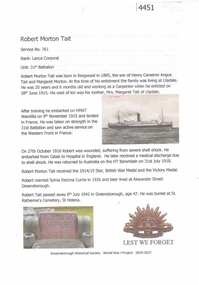
Article, Greensborough Historical Society et al, Robert Morton Tait, 1914-1918
... In the post-war period, Robert and his wife lived in Alexandra Street Greensborough. world war 1 project robert morton tait 1 page, text and colour images. Robert Morton Tait Article Greensborough Historical Society World War 1 Project ...A short article about Robert Morton Tait and his service in World War 1. In the post-war period, Robert and his wife lived in Alexandra Street Greensborough.1 page, text and colour images.world war 1 project, robert morton tait -
 Flagstaff Hill Maritime Museum and Village
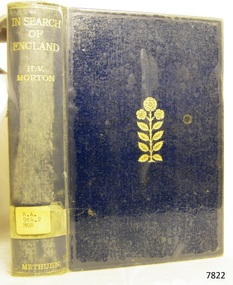
Book, In Search of England
... warrnambool shipwrecked-coast flagstaff-hill flagstaff-hill-maritime-museum maritime-museum shipwreck-coast flagstaff-hill-maritime-village shipwrecked-artefact great ocean road book warrnambool library warrnambool mechanics’ institute mechanics’ institute library victorian library board warrnambool books and records warrnambool children’s library warrnambool public library In Search of England H V Morton Label on spine cover with typed text RA 914.2 MOR In Search of England Author: H V Morton Publisher: Methuen & Co Date: 1935 In Search of England Book ...In Search of England Author: H V Morton Publisher: Methuen & Co Date: 1935Label on spine cover with typed text RA 914.2 MOR warrnambool, shipwrecked-coast, flagstaff-hill, flagstaff-hill-maritime-museum, maritime-museum, shipwreck-coast, flagstaff-hill-maritime-village, shipwrecked-artefact, great ocean road, book, warrnambool library, warrnambool mechanics’ institute, mechanics’ institute library, victorian library board, warrnambool books and records, warrnambool children’s library, warrnambool public library, in search of england, h v morton -
 Ringwood and District Historical Society
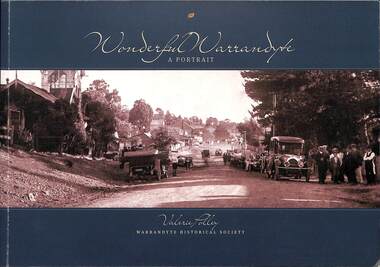
Book, Valerie Polley, Wonderful Warrandyte - A Portrait, 2014
... text and selected photographs. Special thanks go to the Steering Committee of Margaret Kelly, Andy Bevan-Jones, Richard Morton and Wayne Rankin for their knowledgeable input and beneficial editing advice, Murray Houghton for his specialised historical knowledge and advice on further references, and Diane Baird for editing. ...text and selected photographs. Special thanks go to the Steering Committee of Margaret Kelly, Andy Bevan-Jones, Richard Morton and Wayne Rankin for their knowledgeable input and beneficial editing advice, Murray Houghton for his specialised historical knowledge and advice on further references, and Diane Baird for editing. ...Soft-covered book by Valerie Polley, Warrandyte Historical Society, featuring photographs, sketches and text outlining early and contemporary development of Warrandyte township and community, first published in April 2014.Front cover - Peace Day celebrations in Warrandyte, July 1919. Acknowledgements: The book project Wonderful Warrandyte-A Portrait was made possible by a grant under the Australian Government's 2012-2013 Your Community Heritage Program (Your Community Heritage - Sharing Community Heritage Stories). Several members of the Warrandyte Historical Society were involved in this book project which evolved after several years of development ideas. Valerie Polley wrote the text and selected photographs. Special thanks go to the Steering Committee of Margaret Kelly, Andy Bevan-Jones, Richard Morton and Wayne Rankin for their knowledgeable input and beneficial editing advice, Murray Houghton for his specialised historical knowledge and advice on further references, and Diane Baird for editing. The book would not have been possible without all the dedicated work of the Society's members, past and present, who have contributed to the Society's substantial archive. All proceeds from the sale of this book go to the Warrandyde Historical Society. Photographs: Stephen Reynolds, Austin Polley, Valerie Polley, Wayne Rankin, Ron Harris, Merv Naughton. Flora and Fauna photography by Nth Warrandyte, Osborne Peninsula, Landcare, Inc. Maps: Jock Macneish -
 Ringwood and District Historical Society
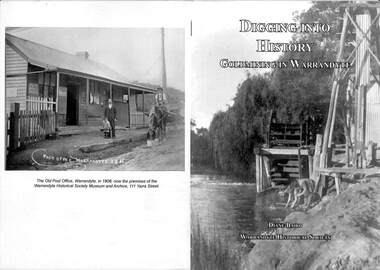
Book, Diane Baird, Digging Into History - Goldmining in Warrandyte, 2007
... It was developed and written by Diane Baird; Murray Houghton and Ted Rotherham provided specialist historical details and further references; Jo Laurence and Shirley Rotherham collected and identified photographs; Brian Laurence prepared images for electronic format; and Richard Morton edited and formatted the text. The Society gratefully acknowledges the dedicated work of all its members who collect, preserve and share Warrandyte's history. ...It was developed and written by Diane Baird; Murray Houghton and Ted Rotherham provided specialist historical details and further references; Jo Laurence and Shirley Rotherham collected and identified photographs; Brian Laurence prepared images for electronic format; and Richard Morton edited and formatted the text. The Society gratefully acknowledges the dedicated work of all its members who collect, preserve and share Warrandyte's history. ...Information about early mining in Victoria's first gold field. Cover photographs: Front cover - Fossickers working below the water-wheen driven stamper battery located on the south side of the Yarra River upstream of the Warrandyte Bridge. Back cover - The Old Post Office, Warrandyte, in 1906, now the premises of the Warrandyte Historical Society Museum and Archive, 111 Yarra Street.Acknowledgements: Several members of the Warrandyte Historical Society were involved in the development of this publication. It was developed and written by Diane Baird; Murray Houghton and Ted Rotherham provided specialist historical details and further references; Jo Laurence and Shirley Rotherham collected and identified photographs; Brian Laurence prepared images for electronic format; and Richard Morton edited and formatted the text. The Society gratefully acknowledges the dedicated work of all its members who collect, preserve and share Warrandyte's history. In particular, the research by the late Bruce Bence and the dedicated work of the late Jo Laurence have been an invaluable contribution to the history of Warrandyte. -
 Royal Australian and New Zealand College of Obstetricians & Gynaecologists (RANZCOG)
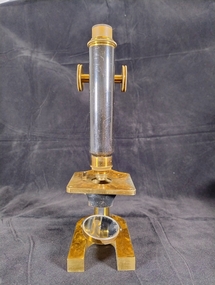
Instrument - Beck microscope used by Henry Morton Marshall and Peter Renou, R & J Beck, c.1875-1880
... The inner edge of the base is engraved with the text 'ELLIOTT BROTHERS AGENTS SYDNEY'. Instrument Beck microscope used by Henry Morton Marshall and Peter Renou R & J Beck Elliott Brothers ...Henry Morton Marshall was a doctor who worked in Gundagai until 1900. Born in England, he worked with King Thakombau in Fiji and worked at the goldfields in northern Victoria before settling in Gundagai.Microscope in wooden case. Base of microscope is engraved with the text 'R & J. BECK/LONDON/7733'. Microscope has a brass, roughly horseshoe shaped base brass plate, and brass handles and fittings. A circular mirror is attached just above the base. Microscope is stored in a wooden case, the lid of which is engraved with the text 'M. RENOU'. The case contains 16 additional parts for the microscope, including additional lenses and a mirror. The inner edge of the base is engraved with the text 'ELLIOTT BROTHERS AGENTS SYDNEY'. 'R & J. BECK/LONDON/7733'; 'M.RENOU'medicine -
 Alfred Hospital Nurses League - Nursing History Collection
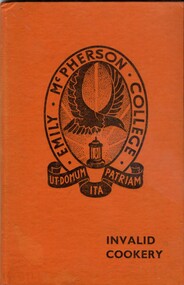
Book - text book, Dorothy M. Giles et al, Notes and recipes on invalid cookery and nutrition, [ca.1940's]
... Morton (handwritten in ink) Previous catalogue number is handwritten in ink at top right of this page.Several pages have penciled underlinings and notations Book with orange cloth cover and black print. On the front is an oval crest: a bird with outstretched wings holding a lantern in its claws. This image is bordered by the words Emily McPherson College and the motto 'Ut domum ita patriam' (As the home so the country) At lower right of front cover are printed the words 'Invalid Cookery' Notes and recipes on invalid cookery and nutrition Book text book Dorothy M. ...Textbook for student nurses about invalid cookery and nutrition with notes and recipesBook with orange cloth cover and black print. On the front is an oval crest: a bird with outstretched wings holding a lantern in its claws. This image is bordered by the words Emily McPherson College and the motto 'Ut domum ita patriam' (As the home so the country) At lower right of front cover are printed the words 'Invalid Cookery'non-fictionTextbook for student nurses about invalid cookery and nutrition with notes and recipesinvalid cookery, nutrition, nursing-education -
 Alfred Hospital Nurses League - Nursing History Collection
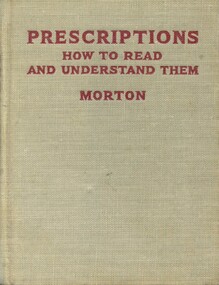
Book - Text book, A L Morton, Prescriptions: how to read and understand them, 1944
... Abbreviated title stamped in red on spine Prescriptions: how to read and understand them Book Text book A L Morton Faber and Faber Ltd Butler and Tanner Ltd. ...Vintage medical reference designed for professionals and students to understand prescriptions icludes translation of Latin termsBook bound in grey cloth. Title and author stamped in red on front cover. Abbreviated title stamped in red on spinenon-fictionVintage medical reference designed for professionals and students to understand prescriptions icludes translation of Latin termsmateria medica, pharmaceuticals, prescription abbreviations, posology, drug incombatabilities -
 Vision Australia
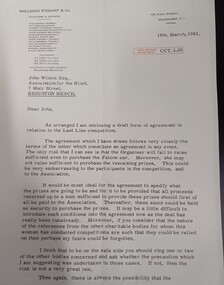
Letter - Text, Letter regarding "Last Line" competition, 16/3/1961
... Association for the Blind Fundraising John Wilson Emma Parkins On top left hand side: Malleson Stewart & Co Solicitors & Notaries Tom Compson Trumble Roy James Mc Arthur Herbert Fitzgerald Walsh Richard Francis Maplestone Clark Frank Stewart Dethridge Ross Morton Macdonald Maxwell Rupert Ham Peter Campbell Trumble Colin Campbell Trumble William Gerson Shmith Roy Ernest Ricker Bernard James Walter Sydney Bruce Powell Telephones 61 3431 (8 lines) 62 3594 (4 lines) 62 3111 (3 lines) Telegraphic & Cable Address: Mallesons, Melbourne On the top right hand side: 105 King Street Melbourne C.1. Victoria 2 page typed letter in response to query Letter regarding "Last Line" competition Letter Text ...Letter to John Wilson from Colin Trumble accompanying an agreement between the Association and Mrs Parkins over the 'Last Line' competition and advising of taking additional precautions to ensure its success. 2 page typed letter in response to queryOn top left hand side: Malleson Stewart & Co Solicitors & Notaries Tom Compson Trumble Roy James Mc Arthur Herbert Fitzgerald Walsh Richard Francis Maplestone Clark Frank Stewart Dethridge Ross Morton Macdonald Maxwell Rupert Ham Peter Campbell Trumble Colin Campbell Trumble William Gerson Shmith Roy Ernest Ricker Bernard James Walter Sydney Bruce Powell Telephones 61 3431 (8 lines) 62 3594 (4 lines) 62 3111 (3 lines) Telegraphic & Cable Address: Mallesons, Melbourne On the top right hand side: 105 King Street Melbourne C.1. Victoriaassociation for the blind, fundraising, john wilson, emma parkins -
 Bacchus Marsh & District Historical Society
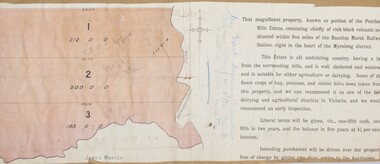
Map, Pentland Hills Estate Land Sale 1904
... A single page paper map showing a portions of land available for sale from the Pentland Hills Estate near Bacchus Marsh.The name of the seller, Mrs Grant, can seen handwritten on this map and the buyers of the three portions for sale, Lidgett lot 1, Robertson lot 2 and Morton lot 3. Parts of the text are missing along the edges due to tearing or excessive trimming of the edges. ...A single page paper map showing a portions of land available for sale from the Pentland Hills Estate near Bacchus Marsh.The name of the seller, Mrs Grant, can seen handwritten on this map and the buyers of the three portions for sale, Lidgett lot 1, Robertson lot 2 and Morton lot 3. Parts of the text are missing along the edges due to tearing or excessive trimming of the edges. ...The Pentland Hills Estate property shown in this auction plan was put up for sale in 1904. It was a deceased estate sale. The property had been owned by Peter Grant who died in 1899. Peter Grant had worked and farmed in the Myrniong area for many years and had also been a Councillor on the Bacchus Marsh Shire for a number of terms. A property sales report in the Express newspaper recorded that the land for sale comprised 500 acres of the old Pentland Hills Estate. It was subdivided into three lots, all of which were sold at good prices. Lot l, 212 acres was sold to Messrs Thomas and Robert Lidgett of Myrniong, at £11/15/ per acre, lot 2, 200 acres, to Mr David Robertson, of Bacchus Marsh, at £9 17/0 per acre, and lot 3, 38 acres, was sold to Mr James Norton, jun at £11 per acre. A single page paper map showing a portions of land available for sale from the Pentland Hills Estate near Bacchus Marsh.The name of the seller, Mrs Grant, can seen handwritten on this map and the buyers of the three portions for sale, Lidgett lot 1, Robertson lot 2 and Morton lot 3. Parts of the text are missing along the edges due to tearing or excessive trimming of the edges. The map is pasted into a bound volume containing 76 maps or plans in total. High resolution digital image stored on BMDHS computer network. Handwritten: Mrs Grant, Myrniong, Executrix in the deceased Estate of Mr. Peter Grant to sell by public auction.land sales, pentland hills maps, myrniong area land sales, pentland hills estate -
 Flagstaff Hill Maritime Museum and Village
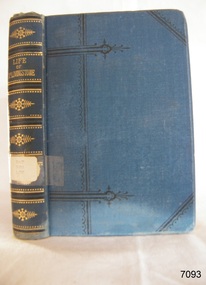
Book - Biography Compilation, J S Robertson, The Life of David Livingstone, 1880s to 1890s
... It was a popular, mass-market compilation rather than an original scholarly biography, capitalising on the huge public fascination with Livingstone after Henry Morton Stanley's famous 1871 encounter and Livingstone's 1873 death. The label on the spine with typed text PAT 920 LIV Paste down front end paper has a sticker from Warrnambool Public Library covered by a sticker from Corangamite Regional Library Service. ...Subject copy is a variant issue of "The Life and Explorations of David Livingstone, LL.D., edited by J S Robinson and carefully compiled from reliable sources" the work is sometimes issued with the shorter cover title "The Life of David Livingstone, LL.D., the Great Missionary Explorer" or "Livingstone, the Great Missionary Traveller"). It's a complete history of Livingstone's life written following the news of his death, aimed particularly at educating young readers about his life and ministry. It covers his childhood in a Scottish mill, his medical training, his missionary and exploration career in Africa the naming of Victoria Falls, and the search for the Nile's source, his campaign against the slave trade, and in later printings extracts from his last journals. It was a popular, mass-market compilation rather than an original scholarly biography, capitalising on the huge public fascination with Livingstone after Henry Morton Stanley's famous 1871 encounter and Livingstone's 1873 death.Hard cover book. The Life of David Livingstone Editor: J S Robertson Publisher: J G Murdoch & Co. Ltd, Date: 1880s to 1890s Further Information: Blue Cloth hardcover with lettering and patterning to spine in Gilt. The spine has a Library label with an inscription.non-fictionSubject copy is a variant issue of "The Life and Explorations of David Livingstone, LL.D., edited by J S Robinson and carefully compiled from reliable sources" the work is sometimes issued with the shorter cover title "The Life of David Livingstone, LL.D., the Great Missionary Explorer" or "Livingstone, the Great Missionary Traveller"). It's a complete history of Livingstone's life written following the news of his death, aimed particularly at educating young readers about his life and ministry. It covers his childhood in a Scottish mill, his medical training, his missionary and exploration career in Africa the naming of Victoria Falls, and the search for the Nile's source, his campaign against the slave trade, and in later printings extracts from his last journals. It was a popular, mass-market compilation rather than an original scholarly biography, capitalising on the huge public fascination with Livingstone after Henry Morton Stanley's famous 1871 encounter and Livingstone's 1873 death. warrnambool, shipwrecked-coast, flagstaff-hill, flagstaff-hill-maritime-museum, maritime-museum, shipwreck-coast, flagstaff-hill-maritime-village, shipwrecked-artefact, book, the life of david livingstone, j s robertson -
 Returned Nurses RSL Sub-branch
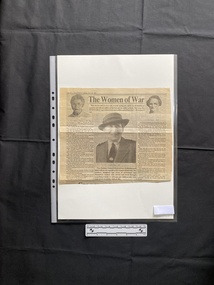
Newspaper - Newspaper clipping, The Telegraph, The women of war, 19890425
... Morton, who was with the RAAF. WWII World war two WW2 Agnes Ivy Clyne (nee Benson) A large newspaper clipping with two large columns of text and three black and white portrait photos. ...The article details the war experiences of two women whose primary service was during WWII: (Agnes) Ivy Clyne (neé Benson), a nurse and Jean Morton, who was with the RAAF. A large newspaper clipping with two large columns of text and three black and white portrait photos. All three photos are portrait headshots, with the two smaller photos of older women and the larger one of a young woman in nurse's uniformwwii, world war two, ww2, agnes ivy clyne (nee benson) -
 Flagstaff Hill Maritime Museum and Village
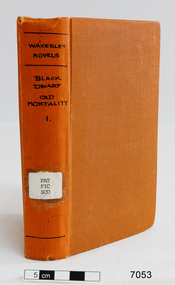
Book - Fictional stories, Sir Walter Scott, Waverley Novels Tales of my Landlord Vol 9, 1836
... Morton and the Covenanters’ guerrilla struggle against royal and Episcopal authority of the time. The “Tales of My Landlord” is framed and introduced through the fictional narrator editor, the stories are supposedly gathered from the landlord of the Wallace Inn at Gandercleugh, compiled by “Peter Pattieson” and edited by the schoolmaster and parish clerk Jedediah Cleishbotham. This framework is laid out in the introductions and prefatory material to the first series, especially in the prefatory pages to “The Black Dwarf” and the opening of Old Mortality. The label on spine with typed text ...The subject volume “Waverley Novels Vol 9” published by Fisher Son & Co (1836) is part of a collected edition of Sir Walter Scott's works, containing stories from the "Tales of My Landlord" series. This edition of set 1,of Vol. 9” is the beginning of the first series of “Tales of My Landlord” in which is included “The Black Dwarf” and “The Tale of Old Mortality”. In many multi volume collected edition runs, Vol. 9 will be the first volume of “The Tale of Old Mortality” a more substantial and famous novel in the series, with the other half of the story following in Vol 10. The opening volume of “The Tale of Old Mortality”, is about the Scottish Presbyterian movement that supported two agreements made by the National Covenant of 1638, or the Solemn League and Covenant of 1643. These agreements were intended to defend and extend through the Scottish Presbyterianism resistance that occurred between 1679–1689. The story is told through the journey of the young landowner Henry Morton and the Covenanters’ guerrilla struggle against royal and Episcopal authority of the time. The “Tales of My Landlord” is framed and introduced through the fictional narrator editor, the stories are supposedly gathered from the landlord of the Wallace Inn at Gandercleugh, compiled by “Peter Pattieson” and edited by the schoolmaster and parish clerk Jedediah Cleishbotham. This framework is laid out in the introductions and prefatory material to the first series, especially in the prefatory pages to “The Black Dwarf” and the opening of Old Mortality.Waverley Novels Tales of my Landlord Set-1 Vol 9, Light brown hardcover lettering in black text. Author: Sir Walter Scott Publisher: Fisher Son & Co. Date: 1836fictionThe subject volume “Waverley Novels Vol 9” published by Fisher Son & Co (1836) is part of a collected edition of Sir Walter Scott's works, containing stories from the "Tales of My Landlord" series. This edition of set 1,of Vol. 9” is the beginning of the first series of “Tales of My Landlord” in which is included “The Black Dwarf” and “The Tale of Old Mortality”. In many multi volume collected edition runs, Vol. 9 will be the first volume of “The Tale of Old Mortality” a more substantial and famous novel in the series, with the other half of the story following in Vol 10. The opening volume of “The Tale of Old Mortality”, is about the Scottish Presbyterian movement that supported two agreements made by the National Covenant of 1638, or the Solemn League and Covenant of 1643. These agreements were intended to defend and extend through the Scottish Presbyterianism resistance that occurred between 1679–1689. The story is told through the journey of the young landowner Henry Morton and the Covenanters’ guerrilla struggle against royal and Episcopal authority of the time. The “Tales of My Landlord” is framed and introduced through the fictional narrator editor, the stories are supposedly gathered from the landlord of the Wallace Inn at Gandercleugh, compiled by “Peter Pattieson” and edited by the schoolmaster and parish clerk Jedediah Cleishbotham. This framework is laid out in the introductions and prefatory material to the first series, especially in the prefatory pages to “The Black Dwarf” and the opening of Old Mortality. warrnambool, shipwrecked-coast, flagstaff-hill, flagstaff-hill-maritime-museum, maritime-museum, shipwreck-coast, flagstaff-hill-maritime-village, shipwrecked-artefact, book, waverley novels vol 46 tales of my landlord, sir walter scott, pattison collection, warrnambool library, warrnambool mechanics’ institute, ralph eric pattison, corangamite regional library service, warrnambool city librarian, mechanics’ institute library, victorian library board, warrnambool books and records, warrnambool children’s library, waverley novels
