
Showing 3 items matching " the campaign palace"
-
 Glen Eira Historical Society
Book - Ormond Amateur Football Club
... ... The Campaign Palace...Dalton Fine Paper Sponsors Berby Graham Typographical Services PIL Ashley Ray Ashley Dean PIC The Campaign Palace Peterson Janis Hall Tony Rankine Chris Harris Geoff Moran G. ...This file contains 2 items: 1/An 83 page book titled ‘The First Fifty Years. Ormond Amateur Football Club.’ The book details why it was written and by whom. It then goes on to describe the playing years from 1931-1981, missing the 6 years from 1940-1946 during WWII. Includes 11 photographs, Presidents’ history, captains and Premiership coaches, Best and fairest winners, life members. 2/A responsible drinking poster distributed in 2013.ormond amateur football club, burdekin e., donaldson e., foulsham c., kingston j., rowe g., scott d., sheehan j., bray j., dart s., godfredson r., hassed m., johnston m., yewdall m., dalton fine paper, sponsors, berby graham, typographical services pil, ashley ray, ashley dean pic, the campaign palace, peterson janis, hall tony, rankine chris, harris geoff, moran g. f., lacey scott, victorian amateur football association, districtclub, smith l. e., president, organizations, sporting clubs, emblems, sports, uniforms, johnson alex, ormond park, smith mr., stevens mr., gunn e. e., elliston mr., hogan mr., coffey mr., skates mr., gymnasiums, jasper road, junior club, smith east suburban football league, ormond junior football club, kingston jack, australian rules football, football clubs, sports officials, clubs and associations -
 Glenelg Shire Council Cultural Collection
Ephemera - Pamphlet - Liquor Trades Defence Union of Australia, Liquor Trades Defence Union, Workers Standards Threatened, Early 1900s
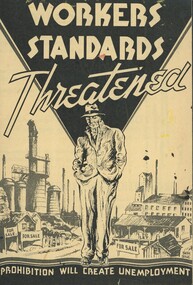
... campaigns against prohibition. The Temperance movement began in Australia in the earl 1800s and advocated for moderation rather than abstinence. In response to this many hotels were converted to 'Coffee Palaces' in the late 1800s and did not serve any alcohol. ...campaigns against prohibition. The Temperance movement began in Australia in the earl 1800s and advocated for moderation rather than abstinence. In response to this many hotels were converted to 'Coffee Palaces' in the late 1800s and did not serve any alcohol. ...This pamphlet was produced by the Liquor Trades Defence Union. Mr John James Liston was secretary to the Union and appointed to this office in 1906. He directed many campaigns against prohibition. The Temperance movement began in Australia in the earl 1800s and advocated for moderation rather than abstinence. In response to this many hotels were converted to 'Coffee Palaces' in the late 1800s and did not serve any alcohol. During World War I early closing was introduced in many states including Victoria. This led to the advent of the 'six o'clock swill' where people would rush to drink as much as they could before closing. Unions such as the Liquor Trades Defence Union opposed this due to workers losing jobs and lost earnings.The pamphlet illustrates the history of temperance in Australia and the part that trade unions played in the fight against prohibition. Paper pamphlet. One piece of paper, folded to make 4 pages. The front page depicts a black triangle shape coming down from the top of the page with the point reaching down. At the top of the triangle are the words 'Workers Standards Threatened'. At the point of the triangle is a man in a rumpled suit and hat. His hands are in his pockets and he has a serious expressions. In the background is an industrial estate with what looks like factory chimneys. There are also small weatherboard houses with 'for sale' signs in front of them. Along the bottom of the page is a black wavy line with the words in off white ' 'prohibition will create unemployment'. The paper is off white/yellow with black text. Inside is a two page spread calling for union members to vote ' No'. The back page features rhetoric on what prohibition would mean to workers and talks of job displacement and lost earnings. The pamphlet is authorised by J. J. Liston, The Block, Collins St, C1. There are what appears to be paint marks on the pamphlet.temperance, prohibition, trades union, union, melbourne, glenelg shire council cultural collection, australian history, alcohol -
 Flagstaff Hill Maritime Museum and Village
Instrument - Azimuth Compass, Early 20th Century
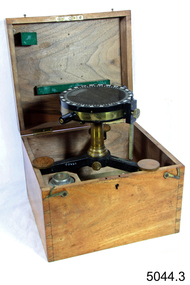
... Palace Company, which allowed them to photograph the interior and grounds of the new building. The firm made use of this access to produce a number of stereographs. Between 1855 and 1857 Negretti and Zambra commissioned photographer Pierre Rossier to travel to China to document the Second Opium War. Although Rossier subsequently was unable to accompany to Anglo-French forces in that campaign...Palace Company, which allowed them to photograph the interior and grounds of the new building. The firm made use of this access to produce a number of stereographs. Between 1855 and 1857 Negretti and Zambra commissioned photographer Pierre Rossier to travel to China to document the Second Opium War. Although Rossier subsequently was unable to accompany to Anglo-French forces in that campaign ...Negretti and Zambra 1850-1980s were optical instrument makers and mathematical instrument makers based in London, England. The firm of Negretti and Zambra was established in 1850 by Henry Negretti and Joseph Zambra who had formed a partnership. Their skill was immediately apparent when exhibiting at the 1851 Great Exhibition at Hyde Park, they were the only English instrument makers to receive a prize medal for meteorological instruments, resulting in their appointment as instrument makers to the queen, Greenwich observatory, and the British Meteorological Society. In 1853, when the Crystal Palace was re-erected in Sydenham, Negretti and Zambra became the official photographers of the Crystal Palace Company, which allowed them to photograph the interior and grounds of the new building. The firm made use of this access to produce a number of stereographs. Between 1855 and 1857 Negretti and Zambra commissioned photographer Pierre Rossier to travel to China to document the Second Opium War. Although Rossier subsequently was unable to accompany to Anglo-French forces in that campaign, he nevertheless produced a number of stereographs and other photographs of China, Japan, the Philippines and Siam (now Thailand), which Negretti and Zambra published and that represented the first commercial photographs of those countries. In 1856 Negretti and Zambra sponsored a photographic expedition to Egypt, Nubia and Ethiopia conducted by Francis Firth. In 1864 Negretti and Zambra (themselves) photographed Shakespeare's House at Stratford on Avon. A sepia photograph was then pasted onto card 4" × 2.5". This was then presented to visitors to the Crystal Palace to enable them to compare it with the model erected by Mr E. T. Parr in the Centre Transept. The card itself is headed "Crystal Palace April 23rd 1864." That year they also published a book, titled A Treatise on Meteorological Instruments, (which was reprinted in 1995). Throughout World War One Negretti and Zambra were entirely engaged in the production of various instruments for the Ministry of Munitions. They developed many instruments for the Air Ministry including a mercury-in-steel distance thermometer for taking the oil and air temperatures in aircraft which was patented in 1920. In 1946 the company went private and in 1948 the company was made public, and by 1950 Negretti and Zambra had 821 employees in Britain. In order to increase production and to safeguard future development in 1964, they purchased a modern factory at Aylesbury for all their production. In 1981 Negretti and Zambra were taken over by a group of financial institutions in the form of Western Scientific Instruments and in 1985 the company was acquired by Meggitt Holdings.The subject compass is just one type of the many marine and scientific, optical items this company produced over it’s life time. Negretti and Zambra were prolific manufactures of types of items as well as being very prominent in photography pioneering new innervation's and sponsoring expeditions to little known countries to document peoples daily lives and culture through photography.Azimuth compass on tripod in a fitted wooden box with a round spirit level included, lid of box has three indented circles where the legs of the compass fit when it is set up for use. Stamped "C.M.O. 9" on with Maker Negretti & Zambra London.flagstaff hill, warrnambool, flagstaff-hill, flagstaff-hill-maritime-museum, shipwreck-coast, flagstaff-hill-maritime-village, azimuth compass, nautical instrument, negretti & zambra london, navigational instrument, compass
