
Showing 11 items matching " thebes"
-
 Glenelg Shire Council Cultural Collection
Photograph - Photograph Portland Harbour, n.d
... ... Thebes...Coloured photo of the 'Thebes' berthed at No. 1 on 2, K. S. Anderson wharf, view of stern and starboard side....Port of Portland Authority Archives Port of Portland Archives Portland Harbour Thebes ship carrier Coloured photo of the 'Thebes' berthed at No. 1 on 2, K. ...Port of Portland Authority Archivesport of portland archives, portland harbour, thebes, ship, carrier -
Glenelg Shire Council Cultural Collection
Photograph - Photograph - The 'Thebes' berthed at Portland Harbour, n.d
... ... Thebes...Coloured photo of the 'Thebes' (carrier ship) berthed at No. 1 on 2, K. ...Port of Portland Archives Thebes carrier ship cargo Coloured photo of the 'Thebes' (carrier ship) berthed at No. 1 on 2, K. ...Port of Portland Authority Archives.port of portland archives, thebes, carrier ship, cargo -
 The Beechworth Burke Museum
Ceremonial object - Ushabti of Taweret-Khaiti, Circa 1292 BC
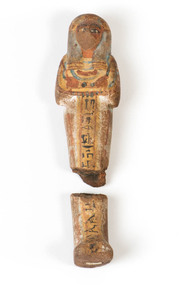
... It likely comes from an undetermined tomb in the locality of Thebes. This figure is made from Nile silt clay (a polyester terracotta; clay sourced from the banks of the Nile River) which was a popular material for Ushabti construction in the early 19th Dynasty. ...Thebes (modern name: Luxor), Egypt...It likely comes from an undetermined tomb in the locality of Thebes. This figure is made from Nile silt clay (a polyester terracotta; clay sourced from the banks of the Nile River) which was a popular material for Ushabti construction in the early 19th Dynasty. ...Ushabti are tiny anthropoid (human-shaped) figures placed in the tombs of wealthy Egyptians. They were intended to do the work of the deceased in the afterlife. This purpose is implied through their name, which may have derived from the Egyptian word “to answer”. The Burke Museum in Beechworth is home to a particular ancient Egyptian Ushabti figure. This artefact was donated to the Museum in 1875. No details about how it left Egypt, arrived in Australia, and where it was located before this donation are known. The Nineteenth Century, when this artefact was donated, was a period when many museums acquired items of ancient Egyptian heritage. Many of these items were procured in less than desirable circumstances, having often been looted from ancient tombs and sold to tourists without documentation as to their original location and/or accompanying grave goods. These artefacts were also divested through partage (the trading of artefacts for funds); however, the latter is unlikely to have been the case for this artefact. Since the Ushabti was donated by an unknown donor, it is likely to have been in a private collection rather than an institution. Ushabti can be dated using iconographic analysis which is non-invasive and provides a comprehensive study of the artefact. The later period of the 18th Dynasty marked the beginning of an increase in both the inclusion of Ushabti as essential funerary items and the creation of Ushabti with tools. From this period, they are no longer depicted without tools. Depictions of tools including gardening hoes are frequently depicted grasped in the Ushabti’s hands whilst items like the seed-bag are depicted hanging on the back rather than in an alternative position. This Ushabti figure grasps a gardening hoe and a mattock and a small seed bag surrounded by a yoke bearing water jars are depicted on the upper back of the Ushabti. These features are essential in helping narrow this dating to the late 18th and before the early 20th Dynasty. The position of this seed bag also provides dating information. In the early 18th Dynasty this bag was consistently drawn on the front of the figurine; however, by the reign of Seti I, this feature moved to the back. Thus, since the seed bag is located on the back of this Ushabti, it cannot date to the early 18th Dynasty. By the 19th Dynasty, Ushabti’s were increasingly made from either faience or terracotta. The availability of these materials in Egypt resulted in the increase of Ushabti production with tombs containing many more figurines than previously seen. The Ushabti held by the Burke collections is made from terracotta. Terracotta was rarely used for Ushabti before and during the early 18th Dynasty with only the odd appearance until the late 18th Dynasty and becoming common through that period until the late Third Intermediate Period. Whilst the face has been damaged, there is no evidence for the Ushabti having been provided with an Osirian false beard. This omission rules out a dating of later than the 25th Dynasty when beards became prominent. The inscriptions also date the Ushabti to the New Kingdom. This is because of the use of sḥḏ (“to illuminate”) with Wsjr (“Osiris”) which only occurs in these periods. Therefore, considering all these elements, the Ushabti can be confidently be dated to between the late 18th to early 19th dynasty.Artefacts like this Ushabti are no longer exclusively representative of their origins in burial assemblages and significance in the mythology of the Egyptian afterlife but are also significant for the accumulated histories they have gained through travel. The movement of this artefact from Egypt to Australia allows insight into the collecting habits of the 19th century, and in particular, the reception of ancient Egyptian artefacts in small rural museums. The procurement of Egyptian artefacts was a social trend around the late 1800s to early 1900s. Egyptian artefacts were considered curiosities and recognised for their ability to attract public attention to museums. They were also utilised in Australian museums, like the Burke Museum, to connect the collection to one of the oldest civilisations known to man and since Australia was considered a “young” country by European settlers, this was vital and derived from an interest in Darwin’s “Origin of the Species” 1859. Furthermore, there was a culture of collecting in the 1800s amongst the affluent in English society which led to the appearance of many Egyptian artefacts in private collections. The acquisition of this Ushabti figure is not certain, but it was likely donated from a private collection rather than an institution. This particular artefact is significant as an example of a high-quality Ushabti representative of those produced during the late 18th or early 19th century. It provides insight into the individualism of an Ushabti and the mythology of ancient Egypt. It also provides an example of the types of items required in the tomb assemblages of this period and reinforces the importance of ensuring the successful afterlife of the deceased through art. This Ushabti belonged to a woman named Taweret-Khaiti, Chantress of Amun, in the late 18th Dynasty or early 19th Dynasty (c.1292 BC) of the Egyptian New Kingdom. It likely comes from an undetermined tomb in the locality of Thebes. This figure is made from Nile silt clay (a polyester terracotta; clay sourced from the banks of the Nile River) which was a popular material for Ushabti construction in the early 19th Dynasty. It is in a fair state of preservation (with the exception of a break through the centre) and originally made to a high quality. The face has been damaged but the eyes and eyebrows are clearly marked with black ink and the sclera painted white. The Ushabti is painted a light brown/yellow colour and features a vertical line of inscription down the lower front. The Ushabti wears a large wig and and a schematic collar. The arms are painted light brown and depicted crossed with bracelets around the wrists. It grasps a hoe and mattock. A yellow seed-basket is depicted on the Ushabti’s back. These features represent the likelihood that this particular Ushabti was intended to complete farm work for the deceased in the next life. There would have been additional Ushabti of similar design within the tomb who worked under the supervision of a foreman Ushabti. The foreman Ushabti would be depicted dressed in the clothing of the living. The inscriptions are painted freehand in black ink and written in a vertical column from the base of the collar to the foot pedestal on the front of the Ushabti. The owner of the Ushabti could elect to have the figures inscribed with their name, the Ushabti spell and any other details they deemed necessary. In the case of this example, the Ushabti is inscribed with the owner’s details and is an abbreviated version of the standard Ushabti formula. This formula ensured that the Ushabti would complete the desired task in the afterlife when called upon by the deceased. Ushabti which were not inscribed would represent their intended purpose through design; however, this Ushabti, like most made in the late 18th Dynasty, conveys its purpose both through both design and inscription. The inscription is as follows: sHD wsir nbt pr Smayt imn tA-wr(t)-xai(ti) mAa xrw which translates to: "The illuminated one, the Osiris (the deceased), the mistress of the household, Chantress of Amun, Taweret-Khaiti, true of voice (justified)"ancient egypt -
 Queen's College
Funerary cone, New Kingdom, 18th Dynasty, 1550 - 1295 BCE
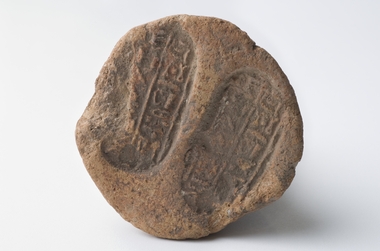
... Thebes ...This item is part of the Dodgson Collection, which was bequeathed to Queen's College in 1892 by the Rev. James Dodgson. The collection was created by Aquila Dodgson, brother of James. Aquila Dodgson was a friend of the English Egyptologist Flinders Petrie, and it was through this friendship the Aquila was able to acquire ancient Egyptian artefacts. A detailed study of the collection was made by Christine Elias "Discovering Egypt: Egyptian Antiquities at the University of Melbourne", M.A. thesis 2010.Two ovals of hieroglyphs with remains of a red/brown paint on face of cone and round edge. Small paper label inscribed with 'A6' attached to cone.funerary cone, james dodgson, aquila dodgson, flinders petrie -
 Queen's College
Funerary cone, New Kingdom, 18th Dynasty, 1550 - 1295 BCE
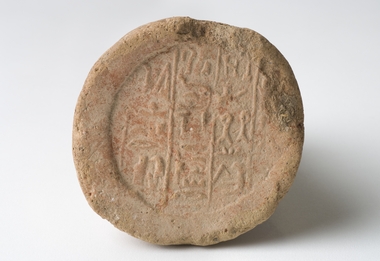
... Thebes ...This item is part of the Dodgson Collection, which was bequeathed to Queen's College in 1892 by the Rev. James Dodgson. The collection was created by Aquila Dodgson, brother of James. Aquila Dodgson was a friend of the English Egyptologist Flinders Petrie, and it was through this friendship the Aquila was able to acquire ancient Egyptian artefacts. A detailed study of the collection was made by Christine Elias "Discovering Egypt: Egyptian Antiquities at the University of Melbourne", M.A. thesis 2010.Three columns of hieroglyphs and remains of a red/brown paint on the face of the cone and on body, end broken off. Small paper label inscribed with 'A6' attached to cone.funerary cone, james dodgson, aquila dodgson, flinders petrie -
 Queen's College
Canopic jar sherds with inscription in hieroglyphs, New Kingdom, 18th Dynasty, 1550 - 1295 BCE
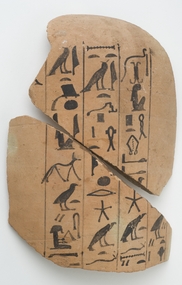
... Thebes ...This item is part of the Dodgson Collection, which was bequeathed to Queen's College in 1892 by the Rev. James Dodgson. The collection was created by Aquila Dodgson, brother of James. Aquila Dodgson was a friend of the English Egyptologist Flinders Petrie, and it was through this friendship the Aquila was able to acquire ancient Egyptian artefacts. A detailed study of the collection was made by Christine Elias "Discovering Egypt: Egyptian Antiquities at the University of Melbourne", M.A. thesis 2010.Two sherds that join to form a Canopic jar which held the stomach removed during mummification. The stomach was placed under the protection of Duamutef, one of the four Sons of Horus, who were charged with protection of the viscera removed during mummification. He was represented as a human figure with the head of a dog. Duamutef was then placed under the protection of the goddess Neith. Small paper label inscribed with 'A11' attached to back of sherd. The inscription, consisting of four columns of text reads: Words spoken by Neith My arms embrace what is in me I protect Nuamutef, who is in me The revered one with Duamutef, (Osiris) the dignitary Tusy true of voice. (translation by Dr Olaf Kaaper)canopic jar, hieroglyphs, james dodgson, aquila dodgson, flinders petrie -
Glenelg Shire Council Cultural Collection
Photograph - Photograph - Portland Harbour, n.d
... Silos in background, part of 'thebes' visible on right....Silos in background, part of 'thebes' visible on right. Photograph Photograph - Portland Harbour ...Port of Portland Authority Archivesport of portland archives, portland harbour, ship berthed -
 Ringwood RSL Sub-Branch
Photograph - Photos, Middle East WW2
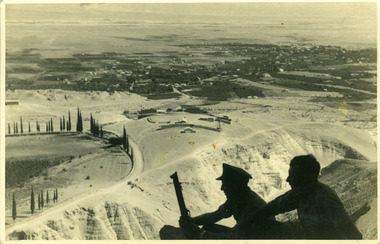
... Photos depict a soldier visiting Luxor, Karnak, Thebes, Giza and Palestine. ...Photos depict a soldier visiting Luxor, Karnak, Thebes, Giza and Palestine. Photograph Photos, Middle East WW2 ...Soldiers experiences in Egypt.Sixteen black and white photographs with handwritten notes on back. Photos depict a soldier visiting Luxor, Karnak, Thebes, Giza and Palestine. (Example of type of description inscribed on back of photographs. 00143.1 ‘Again showing Jericho from very top of mountain with self holding rifle and officer of party. Oct 1941.’world war 1 -
 Flagstaff Hill Maritime Museum and Village
Book - Reference Book/History, Henry Smith Williams, The Historians History of the World Vol 4 set 1 - Edited by Henry Smith Williams L.L.D. Published by “The Times” 1908, 1908
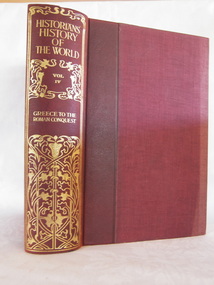
... This volume also chronicles the rise and fall of Thebes with a significant portion is dedicated to the brief but brilliant period when Thebes became the supreme power in Greece under leaders like Epaminondas and Pelopidas, culminating in the Battle of Leuctra. ...This volume also chronicles the rise and fall of Thebes with a significant portion is dedicated to the brief but brilliant period when Thebes became the supreme power in Greece under leaders like Epaminondas and Pelopidas, culminating in the Battle of Leuctra. ...The 1908 edition of The Historians' History of the World is a monumental work of Edwardian scholarship, representing a specific era of "universal history" where the goal was to synthesise all human knowledge into a single narrative. Volume 4 is a deep dive into the later history of Ancient Greece, specifically focusing on the period from the aftermath of the Peloponnesian War through to the Roman conquest. This volume bears the subtitle "Greece to the Roman Conquest." It covers several pivotal shifts in power regards the post war struggle (404 to 374 BC.)Book is part of a 25 volume set with red cloth bindings and gold filigree design to rib.non-fictionThe 1908 edition of The Historians' History of the World is a monumental work of Edwardian scholarship, representing a specific era of "universal history" where the goal was to synthesise all human knowledge into a single narrative. Volume 4 is a deep dive into the later history of Ancient Greece, specifically focusing on the period from the aftermath of the Peloponnesian War through to the Roman conquest. This volume bears the subtitle "Greece to the Roman Conquest." It covers several pivotal shifts in power regards the post war struggle (404 to 374 BC.)flagstaff hill, warrnambool, shipwrecked-coast, flagstaff-hill, flagstaff-hill-maritime-museum, maritime-museum, book, the historians history of the world vol 4 set 1, henry smith williams -
 Australian Institute of Archaeology
Mummified Cat, Charlie, Pre Ptolemaic - before 330BC
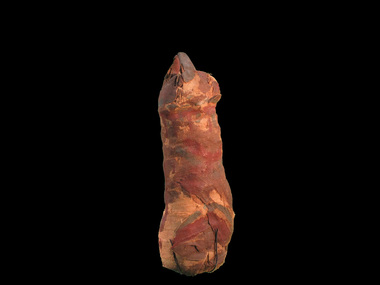
... Cat cemeteries have been found throughout Egypt, and it is probably the Goddess, Bastet's association with her divine sisters in the wild, the malevolent Sakhmet and other lion-headed goddesses, that accounts for the presence of very large cat catacombs at Saqqara, Thebes, and Beni Hasan, where these leonine deities were particularly revered. ...Cat cemeteries have been found throughout Egypt, and it is probably the Goddess, Bastet's association with her divine sisters in the wild, the malevolent Sakhmet and other lion-headed goddesses, that accounts for the presence of very large cat catacombs at Saqqara, Thebes, and Beni Hasan, where these leonine deities were particularly revered. ...Neutron scans from ANSTO reveal that only portion of the animal, probably a cat, was wrapped in the mummy. Preliminary reports of C14 dating indicates that it dates from about 600BCE. It was discovered in the 1850s in Egypt. Many animals in ancient Egypt were deemed to represent a specific deity. Egyptologists have suggested that in the first millennium B.C. an act of popular piety was to place a mummified animal as a votive offering in a catacomb established at a cult center of that deity. Such an act may be expected to afford protection and bring good fortune. More recently, a close connection between the veneration of sacred animals and the worship of the king has been proposed, with the suggestion that these offerings were obligatory for religious officials and soldiers connected with certain royal cults. Interment of sacred animals was quite common in the Ptolemaic period (304-30 BCE) and continued well into the first half of the Roman period, or the second century CE. Cat cemeteries have been found throughout Egypt, and it is probably the Goddess, Bastet's association with her divine sisters in the wild, the malevolent Sakhmet and other lion-headed goddesses, that accounts for the presence of very large cat catacombs at Saqqara, Thebes, and Beni Hasan, where these leonine deities were particularly revered. There were several ways in which the cats were prepared for deposition; in the simplest cases the bodies were mummified and wrapped in linen strips, which were sometimes dyed different brown tones and woven to form geometric patterns. Usually the limbs were positioned close to the body, making a compact bundle but some mummies held lifelike poses. Egyptians considered certain individual animals to be living manifestations of a god, such as, the Apis bull. Individuals were mummified when they died and buried for eternal life, then replaced by another single living manifestation. Research on animal mummies shows that the majority of mummies found at the large animal cemetery sites are pre-adults who were purposely killed for use, sometimes by breaking the neck. Some mummies are 'substitutes' containing only a few bones or feathers or possibly sticks or sand. Mummified cat remains. -
 Ballarat Heritage Services
Photograph, Italian Holy Cards from the 1860s
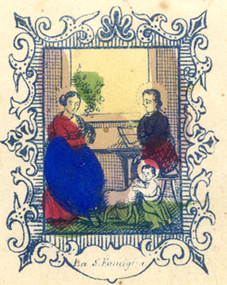
... A contemporary of Paul of Thebes, he is considered the founder of Christian monasticism and the first of the abbots; he is responsible for the permanent establishment of families of monks who, under the guidance of a spiritual father, abba, consecrated themselves to the service of God. ...A contemporary of Paul of Thebes, he is considered the founder of Christian monasticism and the first of the abbots; he is responsible for the permanent establishment of families of monks who, under the guidance of a spiritual father, abba, consecrated themselves to the service of God. ...The Sanctuary of the Blessed Virgin of the Coast is located in the picturesque municipality of San Giovanni Bianco, is a fascinating example of a subsidiary church immersed in the greenery of the mountains. Its privileged location, at an altitude offering breathtaking views, has made this place an important point of reference for the local community since its founding. The church, characterized by a simple yet elegant architectural style, features a façade that exudes serenity and welcome, inviting visitors to discover its history and significance. The feast of the Blessed Virgin of the Coast is celebrated every year on 15 August, becoming a moment of joy and sharing for the community. True Image of the Blessed Virgin venerated in the Church of the Costa of St. Gall One black and white holy card shows an artwork of the Blessed Virgin, St. Joseph, and the Magi and is venerated in the Church of the Costa of S. Gallo. The history of the sanctuary has its roots in an extraordinary event that occurred on 04 April 1492. A sacred image depicting the Virgin Mary, kept in the home of Caterina Lupis, was the scene of a miracle: tears of blood flowed from the painting. This event, interpreted as a divine sign, stirred great emotion and devotion in the local community. After a series of miraculous events, the Madonna herself expressed the desire to build a sanctuary in her honor, in a specific place: the coast overlooking the town and the hamlets of San Giovanni. Construction of the sanctuary began in 1492, marking the beginning of a story of faith and devotion that continues to this day. S. Antonio Abate, or St Anthony the Abbot Anthony the Abbot, Saint Anthony the Great, Saint Anthony of Egypt, Saint Anthony of the Fire, Saint Anthony of the Desert and Saint Anthony the Anchorite , ( Qumans , 12 January 251 – Thebaid Desert , 17 January 356 ) was an Egyptian abbot and hermit. A contemporary of Paul of Thebes, he is considered the founder of Christian monasticism and the first of the abbots; he is responsible for the permanent establishment of families of monks who, under the guidance of a spiritual father, abba, consecrated themselves to the service of God. His life has been handed down by his disciple Athanasius of Alexandria. He is one of the four Fathers of the Eastern Church who bear the title of "Great" together with Athanasius himself, Basil and Photius of Constantinople. He is remembered in the Calendar of Saints of the Catholic Church and the Lutheran Church on January 17, but the Coptic Orthodox Church celebrates him on January 31, which corresponds, in its calendar, to the 22nd of the month of Tobit . St Catherine of Alexandra was a martyr. T he emperor angrily ordered her to be executed on a breaking wheel. The breaking wheel is an ancient form of torture where a person's limbs are threaded among the spokes and their bones are shattered by an executioner with a heavy rod. It is a brutal punishment that results in a slow and painful death, normally reserved for the worst criminals. When Catherine was presented before the wheel, she touched it and a miracle occurred that caused the wheel to shatter. Unable to torture her to death, the emperor simply ordered her beheaded. Around the year 800, a legend spread that her body has been found with her hair still growing and a constant stream of oil coming from her body. Nothing exists to this day of her remains, and her very existence has been called into question. Despite these questions, and the possibility that her story may be confused with that of one or more other saints, she is still venerated in the Eastern Orthodox Church as a Martyr. Many Roman Catholics also venerate her to this day as one of the great virgin saints of the early Church. During the medieval period, St. Catherine was one of the most famous saints of the Church. She has was a popular subject in renaissance art and many paintings from the period are dedicated to her. St. Henry, son of Henry, Duke of Bavaria, and of Gisella, daughter of Conrad, King of Burgundy, was born in 972. He received an excellent education under the care of St. Wolfgang, Bishop of Ratisbon. In 995, St. Henry succeeded his father as Duke of Bavaria, and in 1002, upon the death of his cousin, Otho III, he was elected emperor. Firmly anchored upon the great eternal truths, which the practice of meditation kept alive in his heart, he was not elated by this dignity and sought in all things, the greater glory of God. He was most watchful over the welfare of the Church and exerted his zeal for the maintenance of ecclesiastical discipline through the instrumentality of the Bishops. He gained several victories over his enemies, both at home and abroad, but he used these with great moderation and clemency. In 1014, he went to Rome and received the imperial crown at the hands of Pope Benedict VIII. On that occasion he confirmed the donation, made by his predecessors to the Pope, of the sovereignty of Rome and the exarchate of Ravenna. Circumstances several times drove the holy Emperor into war, from which he always came forth victorious. He led an army to the south of Italy against the Saracens and their allies, the Greeks, and drove them from the country. The humility and spirit of justice of the Saint were equal to his zeal for religion. He cast himself at the feet of Herebert, Bishop of Cologne, and begged his pardon for having treated him with coldness, on account of a misunderstanding. He wished to abdicate and retire into a monastery, but yielded to the advice of the Abbot of Verdun, and retained his dignity. Both he and his wife, St. Cunegundes, lived in perpetual chastity, to which they had bound themselves by vow. The Saint made numerous pious foundations, gave liberally to pious institutions and built the Cathedral of Bamberg. His holy death occurred at the castle of Grone, near Halberstad, in 1024. His feast day is July 13th. He is the patron saint of the childless, of Dukes, of the handicapped and those rejected by Religious Order. What we know of St. Elizabeth comes from the Gospel, the book of Luke, in particular. In Luke, Elizabeth, a daughter of the line of Aaron, and the wife of Zechariah, was "righteous before God" and was "blameless" but childless. Elizabeth is also a cousin to the Virgin Mary.What we know of St. Elizabeth comes from the Gospel, the book of Luke, in particular. In Luke, Elizabeth, a daughter of the line of Aaron, and the wife of Zechariah, was "righteous before God" and was "blameless" but childless. Elizabeth is also a cousin to the Virgin Mary. Five holy cards from San Gallo, Lombardy, Italy, carried by Luigi Gervasoni in a small prayer book that he carried to Australia. Two of the Holy Cards are hand coloured, and one mentions the Church were he was baptised, The Chiesa della Costa di S. Gallo. caterina lupis, san gallo, luigi gervasoni, italy, saint elizabeth, san giovanni bianco, chiesa di costa san giovanni bianco, holy family, saint anthony the abbot, st catherine
