
Showing 15 items matching " third culture"
-
 Robin Boyd Foundation
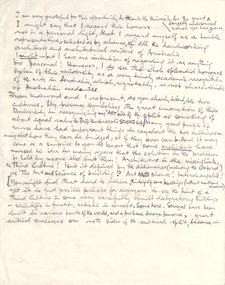
Document - Speech, Robin Boyd, 1967
... ... third culture...Boyd proposes that Architecture is the Third Culture, combining art and science....Boyd proposes that Architecture is the Third Culture, combining art and science. definition third culture speech Robin Boyd manuscript Handwritten, pencil, incomplete, quarto, one page, finishes mid-sentence Document Speech Robin Boyd ...Part of a speech that Boyd gave on receiving an honourary Doctorate of Letters awarded by the University of New England. Boyd proposes that Architecture is the Third Culture, combining art and science.Handwritten, pencil, incomplete, quarto, one page, finishes mid-sentencedefinition, third culture, speech, robin boyd, manuscript -
 Robin Boyd Foundation
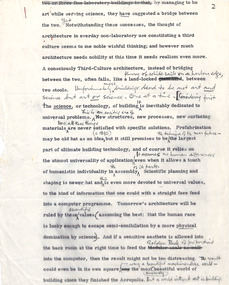
Document - Manuscript, Robin Boyd, ("by managing to be art…")
... ... Third Culture...Prefabrication art science Third Culture Third Culturalists; Statler-Hilton vision Robin Boyd manuscript Page 1 missing, pages 4 and 6 handwritten Typewritten, handwritten major pencil edits, quarto, 5 pages. ...Early draft of an article exploring the relationship between art, science and architecture.Typewritten, handwritten major pencil edits, quarto, 5 pages. Page 1 is missing.Page 1 missing, pages 4 and 6 handwrittenprefabrication, art, science, third culture, third culturalists; statler-hilton vision, robin boyd, manuscript -
 Ithacan Historical Society
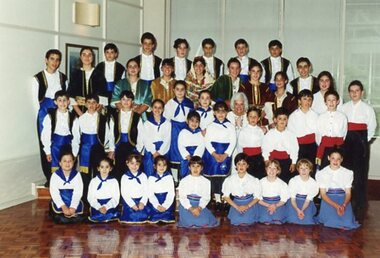
Photograph, Greek dance groups, 1990s
... The teaching of Greek dance to second and third generations of Australian born children of Greek background is one way of ensuring that the culture will be passed on. ...The children were members of the Ithacan and Kastellorizian dance groups which performed at many functions in the 1990s. Olga Black photographed with the group was their dance teacher.The teaching of Greek dance to second and third generations of Australian born children of Greek background is one way of ensuring that the culture will be passed on. Together with Ithacans, the Kastellorizian community is one of the oldest Greek communities in Melbourne. A coloured photograph of a large group of children and dressed in Greek national costumes. There is one adult with the group. The names of the participants are written on the back of the photograph. -
 Robin Boyd Foundation
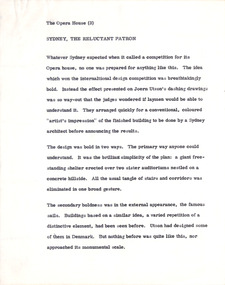
Document - Manuscript, Robin Boyd, Sydney, The Reluctant Patron, 1965
... culture? Article concludes that the true worth of the Sydney Opera House is in its audacity, presence on the global stage, and its patronage to the arts. A copy of the published article was in the Sydney Opera House scrapbook in the desk cupboard (item P1378.21). Original manuscript of an article published in The Australian on 21.09.1965. This is the third ...Article questioning the assessment of the success of the Sydney Opera House by three main categories: will it work; artistically, is the vision exciting; what does the project do for Australian culture? Article concludes that the true worth of the Sydney Opera House is in its audacity, presence on the global stage, and its patronage to the arts. A copy of the published article was in the Sydney Opera House scrapbook in the desk cupboard (item P1378.21).Original manuscript of an article published in The Australian on 21.09.1965. This is the third part of a three part series called 'This Opera House' published 18th, 19th and 21st September 1965 (see D174 and D175).Typewritten, quarto, 8 pagesinternational architecture competition, utzon, sydney opera house, sydney opera house project, cost of building, robin boyd, manuscript -
 Victorian Aboriginal Corporation for Languages
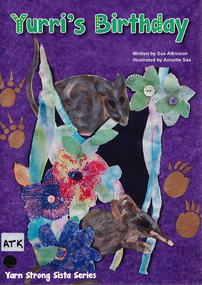
Book, Sue Atkinson, Yurri's birthday, 2013
... This is the third book in the YSS series, giving young children insight into Indigenous Victorian culture. ...This is the third book in the YSS series, giving young children insight into Indigenous Victorian culture. ...Tonight would be a very special night for Yurri, it is her birthday. At midnight each of Yurri's friends arrive with a basket. Inside each basket is a gift for Yurri. Each illustrated basket has been made by women who live in Victoria and are passionate about the revival of basket coiling! Yurri's Birthday written by Sue Atkinson (Yorta Yorta) and illustrated by Annette Sax (Taungurung). This is the third book in the YSS series, giving young children insight into Indigenous Victorian culture. The Yarn Strong Sista series is supported by background notes and ideas for related activities.Illustrations, mapsyorta yorta, barmah forest, basket weaving, educational activities, language list -
 National Wool Museum
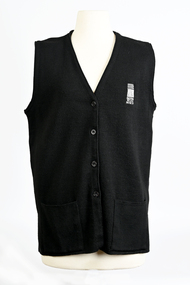
Textile - Black Woollen Vest, 2000s
... third of five children. My father was in the RAAF when I was born, and on leaving the air force he became a carpenter/joiner. When I was young, we had the bread and milk delivered. There was a special tin for the bread and a big billy for the milk left of the front veranda to collect these items. My mother, elder sister, Wendy and my younger sister Zaidee, all went to “Physical Culture...third of five children. My father was in the RAAF when I was born, and on leaving the air force he became a carpenter/joiner. When I was young, we had the bread and milk delivered. There was a special tin for the bread and a big billy for the milk left of the front veranda to collect these items. My mother, elder sister, Wendy and my younger sister Zaidee, all went to “Physical Culture ...This vest was worn by Lynette Wekwerth when she worked as a volunteer in the National Wool Museum shop during the early 2000s. Lynette volunteered at the National Wool Museum for 25 years from 2001 until her passing in 2025, and was a much loved and respected member of the team. "I was born at Coonara Private Hospital at 173 Yarra Street, Geelong, on the 29th of March 1944, the third of five children. My father was in the RAAF when I was born, and on leaving the air force he became a carpenter/joiner. When I was young, we had the bread and milk delivered. There was a special tin for the bread and a big billy for the milk left of the front veranda to collect these items. My mother, elder sister, Wendy and my younger sister Zaidee, all went to “Physical Culture” held downstairs under the old Plaza Theatre building in Ryrie Street. We girls made our own sports clothes to do exercises (rods, dumbbells, and song and dance). It kept us fit, and we all won medals at some stage at the end-of-year concert. I was the only girl of my age in the street where I lived. There were boys my age, so I learned to play cricket and kick a football, all of which I did well. I attended Tate Street and then went on to Matthew Flinders Girls Secondary College in 1956. Matthew Flinders was a domestic arts school, where I learnt sewing, cookery, home management, and how to be a ‘good’ housekeeper. I enjoyed all the domestic subjects. Ray and I were engaged in August 1963. We purchased our engagement ring in Melbourne and went to dinner at the Playboy Club in Melbourne to celebrate. In preparation for our wedding, I spent many hours making my own wedding dress (with assistance from my mother). We were married at 11 am on Saturday, the 10th April 1965 at St. Matthew’s, Church of England, Geelong. When Ray retired, he responded to an advertisement for volunteers at the National Wool Museum to be a volunteer. He started in 1998. The year that the ‘Pharaohs exhibition’ started. That was fine by me, as he wouldn’t be getting under my feet. At this time I was playing golf regularly and didn’t want to miss out on this activity. I joined the volunteers in the Wool Museum in March/April 2001. I was allocated to the Museum Shop and thoroughly enjoyed being a member of the shop staff. I then became shop assistant. I enjoyed talking and serving the customers. I was soon asked if I would mind repairing some of the garments that may have pulled a thread or a minor fault. I also enjoyed doing ‘stock taking’ in the shop. (Not many staff enjoyed this job, but I did.) In those early days, the Museum staff wore the red blazer and the black wool cardigan." - Lynette WekwerthBlack woollen vest with four buttons at the front, and two pockets. Vest has National Wool Museum logo on left chest. printed [label]: BELLA / Collection / made in australia / WEKWERTH / TO FIT / SIZE / 12working life, volunteer, national wool museum, clothing, uniform, lynette wekwerth, staff, employment, wool clothing, geelong -
 National Wool Museum
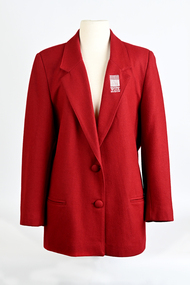
Textile - Red Woollen Jacket, Sabena, 2000s
... third of five children. My father was in the RAAF when I was born, and on leaving the air force he became a carpenter/joiner. When I was young, we had the bread and milk delivered. There was a special tin for the bread and a big billy for the milk left of the front veranda to collect these items. My mother, elder sister, Wendy and my younger sister Zaidee, all went to “Physical Culture...third of five children. My father was in the RAAF when I was born, and on leaving the air force he became a carpenter/joiner. When I was young, we had the bread and milk delivered. There was a special tin for the bread and a big billy for the milk left of the front veranda to collect these items. My mother, elder sister, Wendy and my younger sister Zaidee, all went to “Physical Culture ...This jacket was worn by Lynette Wekwerth when she worked as a volunteer in the National Wool Museum shop during the early 2000s. Lynette volunteered at the National Wool Museum for 25 years from 2001 until her passing in 2025, and was a much loved and respected member of the team. "I was born at Coonara Private Hospital at 173 Yarra Street, Geelong, on the 29th of March 1944, the third of five children. My father was in the RAAF when I was born, and on leaving the air force he became a carpenter/joiner. When I was young, we had the bread and milk delivered. There was a special tin for the bread and a big billy for the milk left of the front veranda to collect these items. My mother, elder sister, Wendy and my younger sister Zaidee, all went to “Physical Culture” held downstairs under the old Plaza Theatre building in Ryrie Street. We girls made our own sports clothes to do exercises (rods, dumbbells, and song and dance). It kept us fit, and we all won medals at some stage at the end-of-year concert. I was the only girl of my age in the street where I lived. There were boys my age, so I learned to play cricket and kick a football, all of which I did well. I attended Tate Street and then went on to Matthew Flinders Girls Secondary College in 1956. Matthew Flinders was a domestic arts school, where I learnt sewing, cookery, home management, and how to be a ‘good’ housekeeper. I enjoyed all the domestic subjects. Ray and I were engaged in August 1963. We purchased our engagement ring in Melbourne and went to dinner at the Playboy Club in Melbourne to celebrate. In preparation for our wedding, I spent many hours making my own wedding dress (with assistance from my mother). We were married at 11 am on Saturday, the 10th April 1965 at St. Matthew’s, Church of England, Geelong. When Ray retired, he responded to an advertisement for volunteers at the National Wool Museum to be a volunteer. He started in 1998. The year that the ‘Pharaohs exhibition’ started. That was fine by me, as he wouldn’t be getting under my feet. At this time I was playing golf regularly and didn’t want to miss out on this activity. I joined the volunteers in the Wool Museum in March/April 2001. I was allocated to the Museum Shop and thoroughly enjoyed being a member of the shop staff. I then became shop assistant. I enjoyed talking and serving the customers. I was soon asked if I would mind repairing some of the garments that may have pulled a thread or a minor fault. I also enjoyed doing ‘stock taking’ in the shop. (Not many staff enjoyed this job, but I did.) In those early days, the Museum staff wore the red blazer and the black wool cardigan." - Lynette WekwerthRed jacket with two buttons and two pockets at the front, and two decorative buttons on each cuff. Jacket has National Wool Museum logo on the left lapel. printed [label]: SABENA / 14working life, volunteer, national wool museum, clothing, uniform, lynette wekwerth, staff, employment, wool clothing, geelong -
 Plutarch Project
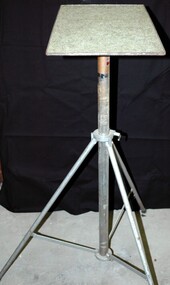
Projector tripod stand, circa 1950's
... third in order to ensure that technology will not be letting them down at the time of film projection. At times the films were projected onto a white sheet of cloth because there was no proper screen to project it on at the venue they were using. This projector stand was the actual projector stand used in their trips around Australia. Historic and rarity (only one left that was used by "Cosmopolitan Motion Pictures") Primary significance stand tripod projector film culture ...From January 1959 and until 1982, “Cosmopolitan Motion Pictures”, owned by Mr Peter Yannoudes (Παναγιώτης Γιαννούδης) and Mr Stathis Raftopoulos (Στάθης Ραφτόπουλος) travelled around Australia to entertain the Greek, Turkish, Indian and Yugoslav speaking population of Australia and provide a significant cinema culture. They travelled as far as Perth in WA, Adelaide in SA, Tasmania, Darwin in Nt, Canberra in ACT and Sydney and NSW. However they found themselves also in places like Berri and Renmark in NSW, where concentrations of migrants lived and thrived during the period. Initially they were travelling by train, carrying all their equipment by hand and placing them in boxes and suitcases. However after 1962 when they acquired their first automobile, travelling became less of a burden, nevertheless cumbersome and laborious. They carried with them initially two portable projectors (second one as a backup) and at times travelled with a third in order to ensure that technology will not be letting them down at the time of film projection. At times the films were projected onto a white sheet of cloth because there was no proper screen to project it on at the venue they were using. This projector stand was the actual projector stand used in their trips around Australia.Historic and rarity (only one left that was used by "Cosmopolitan Motion Pictures") Primary significanceMetal construction Projector tripod with a cloth on top to stop damaging the projectors. It has an adjustable height depending that extends to about 1.5 metres.T.J.N. Macey - Toolmaker and Manufacturing Engineerstand, tripod, projector, film, culture, language, greek, entertainment, yiannoudes, γιαννούδης, τρίποδο -
 The Celtic Club
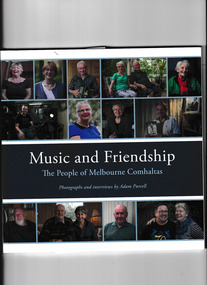
Book, Adam Purcell, Music and friendship : the people of Melbourne Comhaltas, 1984
... The stories explore themes of immigration, culture and heritage, and feature, among others, prominent members of the Melbourne Irish scene, such as:-Accordion legend Paddy Fitzgerald-Set dancing teacher Marie Brouder-Prolific musician Tony O'Neill-Leader of the Melbourne Comhaltas band, Joan Mundy. Among the people interviewed are Irish expats, second- and third ...A collection of personal stories from 32 past and present members of the Melbourne branch of the worldwide Irish cultural organisation, Comhaltas Ceoltoiri Éireann, produced to mark the 50th anniversary of Melbourne Comhaltas.The stories, collected by oral history interview, are accompanied by photographic portraits of each subject. The stories explore themes of immigration, culture and heritage, and feature, among others, prominent members of the Melbourne Irish scene, such as:-Accordion legend Paddy Fitzgerald-Set dancing teacher Marie Brouder-Prolific musician Tony O'Neill-Leader of the Melbourne Comhaltas band, Joan Mundy. Among the people interviewed are Irish expats, second- and third-generation Australians, and people from Scotland, Japan and the Ukraine.The book includes forewords from Irish Ambassador to Australia, Breandán Ó Caollai - Director-General of Comhaltas Ceoltoiri Éireann, Dr. Labhrás Ó Murchú· and Melbourne Comhaltas President, Mary McBride.Ill, p.95.A collection of personal stories from 32 past and present members of the Melbourne branch of the worldwide Irish cultural organisation, Comhaltas Ceoltoiri Éireann, produced to mark the 50th anniversary of Melbourne Comhaltas.The stories, collected by oral history interview, are accompanied by photographic portraits of each subject. The stories explore themes of immigration, culture and heritage, and feature, among others, prominent members of the Melbourne Irish scene, such as:-Accordion legend Paddy Fitzgerald-Set dancing teacher Marie Brouder-Prolific musician Tony O'Neill-Leader of the Melbourne Comhaltas band, Joan Mundy. Among the people interviewed are Irish expats, second- and third-generation Australians, and people from Scotland, Japan and the Ukraine.The book includes forewords from Irish Ambassador to Australia, Breandán Ó Caollai - Director-General of Comhaltas Ceoltoiri Éireann, Dr. Labhrás Ó Murchú· and Melbourne Comhaltas President, Mary McBride.cultural societies - irish - melbourne, irish music and dancing -
 Unions Ballarat
Survival now : the human transformation, Cairns, Jim, 1982
... culture of conservation, of a respect for all forms of life, of an appreciation that the essential importance is within each human person." "The first consciousness, a female-centred one, brought the first humanising forces in the evolution of the species. The second consciousness, that of patriarchy, transformed it and gave man fantastic power to build and destroy but finally to destroy himself. The third...culture of conservation, of a respect for all forms of life, of an appreciation that the essential importance is within each human person." "The first consciousness, a female-centred one, brought the first humanising forces in the evolution of the species. The second consciousness, that of patriarchy, transformed it and gave man fantastic power to build and destroy but finally to destroy himself. The third ...This book has been described as New Age (Reverend Paul Seiler, The New Age Movement, http://tinyurl.com/cairnsNE). Seiler provides the following quotations from Cairns' book: "The new culture will be a culture of conservation, of a respect for all forms of life, of an appreciation that the essential importance is within each human person." "The first consciousness, a female-centred one, brought the first humanising forces in the evolution of the species. The second consciousness, that of patriarchy, transformed it and gave man fantastic power to build and destroy but finally to destroy himself. The third consciousness will be whole - the child, the woman, the man, the earth and the cosmos. The signs of it can be seen everywhere. Aquarius is rising."Social evolution. Paper; bookThe book has been autographed by Jim Cairns (author). Front cover: title and author's name.btlc, ballarat trades hall, ballarat trades and labour council, new age, cairns, jim, social evolution, social change -
![Artwork - Painting, [Reconciliation] by Leoda Atkinson, 1999](/media/collectors/530576742162ef0fa09a2288/items/534748159821f420f8c03607/item-media/5e86ea5321ea671ae822b1ca/item-fit-380x285.jpg?cb=6) Federation University Art Collection
Federation University Art CollectionArtwork - Painting, [Reconciliation] by Leoda Atkinson, 1999
... culture. ... (The Age, September 9, 1997) This work was commissioned by the University for the Aboriginal Education Centre's wall. It was designed and painted by Leoda Atkinson, a graduate of the University of Ballarat Koorie Art and Design course. With the assistance of Tom Clark and two third...culture. ... (The Age, September 9, 1997) This work was commissioned by the University for the Aboriginal Education Centre's wall. It was designed and painted by Leoda Atkinson, a graduate of the University of Ballarat Koorie Art and Design course. With the assistance of Tom Clark and two third ...Leoda ATKINSON "A few years ago Leoda Atkinson had never painted but now she works around the clock to keep up with the demand for her work. Leoda, a student in Koorie Art and Design at the School of Mines and Industries, Ballarat, was separated from her family as a child and wanted to learn more about her culture. ... (The Age, September 9, 1997) This work was commissioned by the University for the Aboriginal Education Centre's wall. It was designed and painted by Leoda Atkinson, a graduate of the University of Ballarat Koorie Art and Design course. With the assistance of Tom Clark and two third year students the painting of the mural was completed in two weeks. This item is part of the Federation University Art Collection. The Art Collection features over 1000 works and was listed as a 'Ballarat Treasure' in 2007.A brightly coloured work featuring themes of reconciliation and the University's campuses and learning. The use of the platypus reminded the artist of many different animals, represented the coming together of cultures at the University. art, artwork, leoda atkinson, aboriginal, alumni -
 St Patrick's Old Collegians Association (SPOCA)
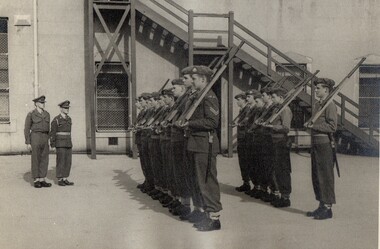
Photograph - Culture, Cadets
... third along from Corporal Geoff Fitzpatrick. In second row after gap are TBN1, Adrian Conroy, Dennis Quinn, TBN2 and then at row-end is Bob Gilbert. Photograph Culture ... -
 St Patrick's Old Collegians Association (SPOCA)
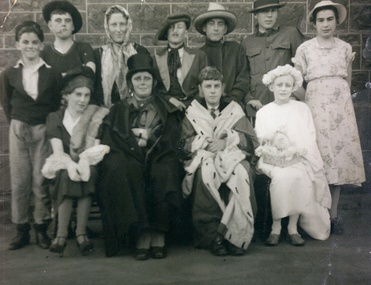
Photograph - Culture, Performing Arts, Theatre
... John McClusky third from right in rear. Photograph Culture, Performing Arts, Theatre ... -
 Merri-bek City Council
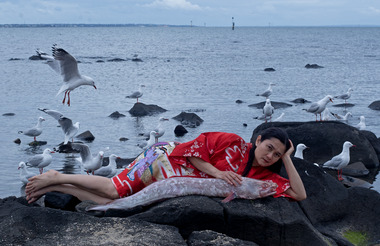
Photograph - Photographic print, Where is a Place for Us to Sleep in Peace?, 2021
... culture of Merri-bek. -Engages with important social, cultural or environmental issues. -Enhances the status and diversity of the Merri-bek Art Collection Artwork significance Where is a Place for Us to Sleep in Peace? was a key work in the artist’s solo exhibition at the Counihan Gallery. It is part of an ongoing photographic series responding to the 2021 Myanmar military coup that reflects on the impossibility of safety and rest during times of political conflict. This photograph is the eleventh work in the series and the third ...myanmar, conflict, displacement, resilience -
 Flagstaff Hill Maritime Museum and Village
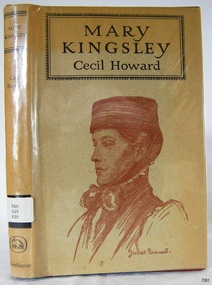
Book - Biography, Cecil Howard, Mary Kingsley, 1957
... third impression was released in 1959. Howard's writing career is limited, and prior to publishing his full biography of Mary Kingsley, Howard published an essay introducing Mary Kingsley's life and legacy in the historical journal History Today in February 1954 (Vol. 4, Issue 2). His work focused on Victorian exploration, African colonial history, and ethnography, examining how Kingsley, who was a self-taught woman bound by domestic duties until her thirties, defied Victorian conventions to travel through West Africa, collect biological specimens, and advocate for African cultures and traders. ...third impression was released in 1959. Howard's writing career is limited, and prior to publishing his full biography of Mary Kingsley, Howard published an essay introducing Mary Kingsley's life and legacy in the historical journal History Today in February 1954 (Vol. 4, Issue 2). His work focused on Victorian exploration, African colonial history, and ethnography, examining how Kingsley, who was a self-taught woman bound by domestic duties until her thirties, defied Victorian conventions to travel through West Africa, collect biological specimens, and advocate for African cultures and traders. ...Mary Kingsley is a popular biography of Mary Henrietta Kingsley (1862–1900), the English explorer, travel writer, and self-taught ethnographer known for her solo travels through West Africa (Sierra Leone, Angola, Gabon, Cameroon) in 1893–95. She collected zoological specimens for the British Museum, wrote sympathetically about African religions, law, and customs that challenged many contemporary European prejudices of the time, and published two influential books of her own: Travels in West Africa (1897) and West African Studies (1899). She died of typhoid while nursing Boer prisoners during the Second Boer War in 1900. Howard's book retells her life and travels for a general readership, and descriptions call it a lively account drawn from "the raciest and most exciting passages" of her own travel writing, tracing her journeys along the Ogowe River and through West African swamps.Hard cover book. Author: Cecil Howard Publisher: Hutchinson & Co Date: 1957 Further Information: Hardcover bound with dust cover intact with portrait frontispiece lettering in black. The spine has a Library label with an inscription.non-fictionMary Kingsley is a popular biography of Mary Henrietta Kingsley (1862–1900), the English explorer, travel writer, and self-taught ethnographer known for her solo travels through West Africa (Sierra Leone, Angola, Gabon, Cameroon) in 1893–95. She collected zoological specimens for the British Museum, wrote sympathetically about African religions, law, and customs that challenged many contemporary European prejudices of the time, and published two influential books of her own: Travels in West Africa (1897) and West African Studies (1899). She died of typhoid while nursing Boer prisoners during the Second Boer War in 1900. Howard's book retells her life and travels for a general readership, and descriptions call it a lively account drawn from "the raciest and most exciting passages" of her own travel writing, tracing her journeys along the Ogowe River and through West African swamps.shipwrecked-coast, flagstaff-hill, flagstaff-hill-maritime-museum, warrnambool, maritime-museum, shipwreck-coast, flagstaff-hill-maritime-village, shipwrecked-artefact, book, pattison collection, warrnambool library, warrnambool mechanics’ institute, ralph eric pattison, corangamite regional library service, warrnambool city librarian, mechanics’ institute library, victorian library board, warrnambool books and records, warrnambool children’s library, mary kingsley, cecil howard
