
Showing 408 items matching " timber industry"
-
 Lakes Entrance Historical Society
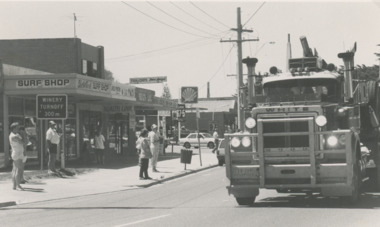
Photograph, Timber Industry blockade Lakes Entrance, 1990
... Timber Industry blockade Lakes Entrance...... Timber Industry...Black and white photo of Timber Industry blockade Lakes Entrance Victoria. ...Second photo of Ashley Green, Mark Howard and Neil Rogan. Education Timber Industry Events Black and white photo of Timber Industry blockade Lakes Entrance Victoria. ...trucks on their way to Melbourne, taken at the corner of Esplanade and Carpenter Streets Lakes Entrance. Second photo of Ashley Green, Mark Howard and Neil Rogan.Black and white photo of Timber Industry blockade Lakes Entrance Victoria. Plus another photo of Ashley Green, Mark Howard and Neil Reagan at blockade.education, timber industry, events -
 Orbost & District Historical Society
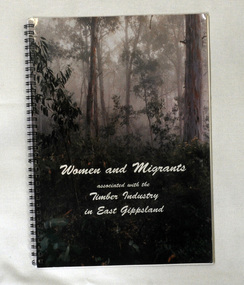
book, Quick Print, Women and Migrants Associated With The Timber Industry in East Gippsland, 2001
... Women and Migrants Associated With The Timber Industry in East Gippsland...timber-industry east-gippsland orbost-women's-awareness-group...The title is in cursive writing in white print. it contains the personal stories and b/w photographs of both women and migrants who have been associated with the timber industry in East Gippsland. ...This book is a research tool for those interested in the timber industry of East Gippsland. timber-industry east-gippsland orbost-women's-awareness-group A spiral bound 44pp book with a photo of the forests of East Gippsland on the cover. ...This book developed from a project undertaken by the Orbost Women's Awareness Group. It began as an activity in learning how to conduct "Oral Histories". With a substantial amount of information resulting the group decided to publish the information in the form of this book. Orbost Women's Awareness Group was originally the "Orbost Women's Pulp Mill Association" created in 1989 to disseminate information about a proposed pulp mill planned for the area. When the proposal became non viable the group continued to meet as an awareness group. It continues today as the Orbost Women's Awareness Group.This book is a research tool for those interested in the timber industry of East Gippsland.A spiral bound 44pp book with a photo of the forests of East Gippsland on the cover. The title is in cursive writing in white print. it contains the personal stories and b/w photographs of both women and migrants who have been associated with the timber industry in East Gippsland. timber-industry east-gippsland orbost-women's-awareness-group -
 Lakes Entrance Historical Society
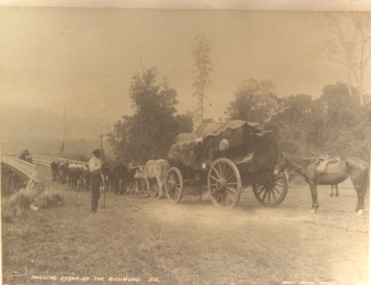
Postcard - Timber Industry, Kerry Photographics Sydney, Hauling Cedar. Richmond R. NSW, 1910 c
... Timber Industry......Timber Industry...NSW Postcard Timber Industry Kerry Photographics Sydney ...Sepia toned postcard showing bullock team pulling a four wheeled wagon with load of large logs and other timber Richmond NSWHauling Cedar Richmond R.settlers, timber industry -
 Lakes Entrance Historical Society
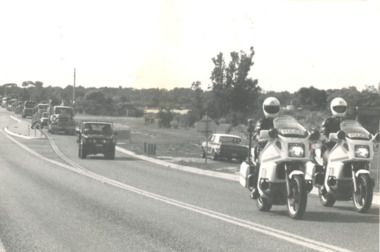
Photograph, Timber Industry Truck Blockade, 1/02/1990 12:00:00 AM
... Timber Industry Truck Blockade ...... Timber Industry...Escorting the truck blockade Princes Highway East Gippsland Victoria. protest Timber Industry Events Black and white photograph of two motor cycle police. ...Escorting the truck blockade Princes Highway East Gippsland Victoria. Black and white photograph of two motor cycle police. Also five black and white photographs taken during the timber truck convoy in East Gippsland protest, timber industry, events -
 Lakes Entrance Historical Society
Book, LERHS, Reminiscences of the Timber Industry in East Gippsland, 2000
... Reminiscences of the Timber Industry in East Gippsland...Timber Industry...Timber Industry Emergency Services Reminiscences of three men who spent most of their lives working in forests recording incidents and personalities over approximately forty years East Gippsland Victoria Reminiscences of the Timber Industry in East Gippsland Book LERHS ...Reminiscences of three men who spent most of their lives working in forests recording incidents and personalities over approximately forty years East Gippsland Victoriatimber industry, emergency services -
 Marysville & District Historical Society
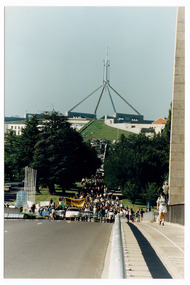
Photograph (item) - Colour photographs, Photographs were taken in January 1995
... ...timber industry...A series of twelve photographs taken in January 1995 of a rally in and to Canberra to make representation on the long term viability of the timber industry, which was seen to be under threat....A series of twelve photographs taken in January 1995 of a rally in and to Canberra to make representation on the long term viability of the timber industry, which was seen to be under threat....January 1995 rally in Canberra to make/ representation on the long term viability of the timber/ industry, which was seen to be under threat. ...A series of twelve photographs taken in January 1995 of a rally in and to Canberra to make representation on the long term viability of the timber industry, which was seen to be under threat. marysville victoria australia canberra timber industry forest protection society photograph January 1995 rally in Canberra to make/ representation on the long term viability of the timber/ industry, which was seen to be under threat. ...A series of twelve photographs taken in January 1995 of a rally in and to Canberra to make representation on the long term viability of the timber industry, which was seen to be under threat.A series of twelve photographs taken in January 1995 of a rally in and to Canberra to make representation on the long term viability of the timber industry, which was seen to be under threat.January 1995 rally in Canberra to make/ representation on the long term viability of the timber/ industry, which was seen to be under threat. A flotilla of trucks, bush workers, sawmill employees,/ office staff, associated industry representatives and/ families all travelled in convoy to Parliament House to/ make representation to Parliamentarians, and to be/ heard.marysville, victoria, australia, canberra, timber industry, forest protection society, photograph -
 Stawell Historical Society Inc
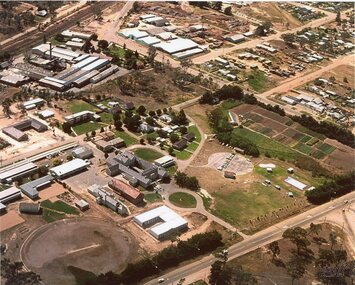
Photograph, Stawell Industrial Area Aerial View with the Woollen Mills, Stawell Timber Industry & Pleasant Creek Hospital
... Stawell Industrial Area Aerial View with the Woollen Mills, Stawell Timber Industry & Pleasant Creek Hospital...Aerial Photograph Woollen Mills, Stawell Timber Industry, Pleasant Creek Hospital, Oval,....Aerial Photograph Woollen Mills, Stawell Timber Industry, Pleasant Creek Hospital, Oval,. industry Stawell Industrial Area Aerial View with the Woollen Mills, Stawell Timber Industry & Pleasant Creek Hospital Photograph ...Aerial Photograph Woollen Mills, Stawell Timber Industry, Pleasant Creek Hospital, Oval,.industry -
 Marysville & District Historical Society
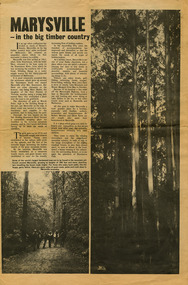
Newspaper (Item) - Newspaper article, MARYSVILLE-in the big timber country, Unknown
... ...timber industry...A newspaper article on some of the history of Marysville, the timber industry and some local attractions....A newspaper article on some of the history of Marysville, the timber industry and some local attractions....A newspaper article on some of the history of Marysville, the timber industry and some local attractions. A newspaper article on some of the history of Marysville, the timber industry and some local attractions. marysville victoria australia newspaper article timber industry A newspaper article on some of the history of Marysville, the timber industry and some local attractions. ...A newspaper article on some of the history of Marysville, the timber industry and some local attractions.A newspaper article on some of the history of Marysville, the timber industry and some local attractions.marysville, victoria, australia, newspaper article, timber industry -
 Lakes Entrance Historical Society
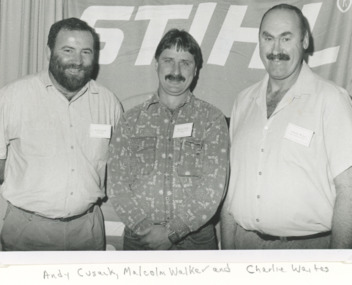
Photograph, Lakes Post Newspaper, Andy Cusack, Malcolm Walker and Charlie Waites, 1/10/1993 12:00:00 AM
... ... Timber Industry... at timber industry workshop TAFE Bairnsdale Victoria...Black and white photograph of Andy Cusack, Malcolm Walker and Charlie Waites at timber industry workshop TAFE Bairnsdale Victoria...at timber industry workshop TAFE Bairnsdale Victoria Businesses Timber Industry Training Black and white photograph of Andy Cusack, Malcolm Walker and Charlie Waites at timber industry workshop TAFE Bairnsdale Victoria Andy Cusack, Malcolm Walker and Charlie Waites Photograph Lakes Post Newspaper ...at timber industry workshop TAFE Bairnsdale VictoriaBlack and white photograph of Andy Cusack, Malcolm Walker and Charlie Waites at timber industry workshop TAFE Bairnsdale Victoriabusinesses, timber industry, training -
 Stawell Historical Society Inc
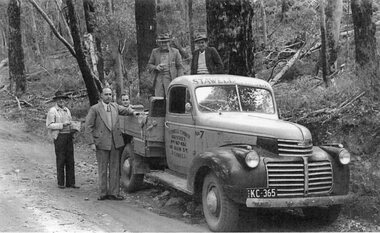
Photograph, Stawell Timber Industries Truck 1940's
... Five men with Stawell Timber Industries truck in bush setting...Stawell Timber Industries 141 Main Street Stawell...Used in the STI display in museum Manufacturing Stawell Timber Industries 141 Main Street Stawell Five men with Stawell Timber Industries truck in bush setting Stawell Timber Industries Truck 1940's Photograph ...Used in the STI display in museumFive men with Stawell Timber Industries truck in bush settingStawell Timber Industries 141 Main Street Stawellmanufacturing -
 Stawell Historical Society Inc
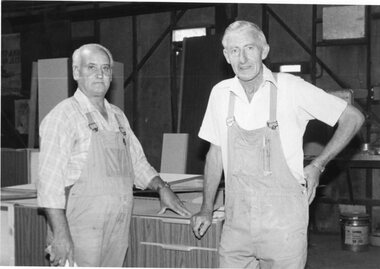
Photograph, Mr Theo Prior & Mr Jack Chapman -- Stawell Timber Industry Workers
... Mr Theo Prior & Mr Jack Chapman -- Stawell Timber Industry Workers...Workers Stawell Mr Theo Prior & Mr Jack Chapman -- Stawell Timber Industry Workers Photograph ...Theo Prior & Jack Chapman - S.T.I. Workersstawell -
 Victorian Railway History Library
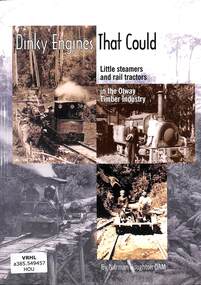
Book, Houghton, Norm, Dinky Engines That Could: Little Steamers and rail tractors in the Otway Timber Industry, 1992
... Dinky Engines That Could: Little Steamers and rail tractors in the Otway Timber Industry...Dinky Engines That Could: Little Steamers and rail tractors in the Otway Timber Industry Book Houghton, Norm Light Railway Research Society of Australia ...A history of small steam and diesel locomotives operating on the various Otway Timber tramways in South West Victoria.ill, maps, p.84.non-fictionA history of small steam and diesel locomotives operating on the various Otway Timber tramways in South West Victoria.narrow gauge railroads - australia - history, timber tramways - victoria - history -
 Victorian Railway History Library
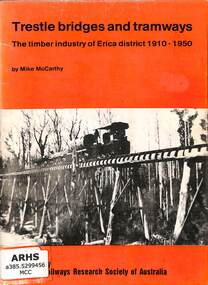
Booklet, McCarthy, Mike, Trestle bridges and tramways: The timber industry of Erica district 1910-1950, 1983
... Trestle bridges and tramways: The timber industry of Erica district 1910-1950...Trestle bridges and tramways: The timber industry of Erica district 1910-1950 Booklet McCarthy, Mike Light Railway Research Society of Australia ...A brief history of the narrow gauge timber railways of the Erica District north of Moe in Victoria from 1910 to 1950.ill, maps, p.24.non-fictionA brief history of the narrow gauge timber railways of the Erica District north of Moe in Victoria from 1910 to 1950.timber tramways - australia - history, narrow gauge railroads - australia - history -
 Kiewa Valley Historical Society
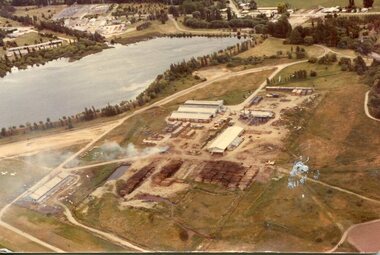
Photograph - Mt Beauty timber Industries, 1960's (estimate only)
... Mt Beauty timber industry...Handwritten in ink on back of photograph in very faint writing – Recent photo of Mt Beauty Timber Industries Mt Beauty Operations...A pictorial record of the development of the Mt Beauty community and the local timber industry. Mt Beauty timber industry timber industry timber mill SECV Handwritten in ink on back of photograph in very faint writing – Recent photo of Mt Beauty Timber Industries Mt Beauty Operations Colour photograph of aerial view of Mt Beauty Timber Mills and surrounding area including pondage and part of airfield. ...Hume and Hovell discovered the area in 1824 and by the end of the 19th century the valley was transformed by logging, dairy and beef cattle properties and tobacco farms. Timber was required for construction of McKay Creek Power Station which began construction in 1951 and also the camps and houses for the workers and their families. There was a need for housing and infrastructure for an increasing population of workers for the hydro-electric scheme as there was a general shortage of this commodity. A timber mill was started in Tawonga by Mates, of Albury, in 1945, and electricity became available in 1946 the S.E.C. bought the mill, and enlarged it. In 1960 it was purchase by a local family. They also started a timber mill in Mt Beauty and worked both until 1980 when they closed the Tawonga mill and enlarged the mill called Mt. Beauty Timbers Pty Ltd which employed approximately 50 people. A pictorial record of the development of the Mt Beauty community and the local timber industry.Colour photograph of aerial view of Mt Beauty Timber Mills and surrounding area including pondage and part of airfield. Photo taken in 1960’s (estimate only)Handwritten in ink on back of photograph in very faint writing – Recent photo of Mt Beauty Timber Industries Mt Beauty Operationsmt beauty timber industry, timber industry, timber mill, secv -
 Kiewa Valley Historical Society
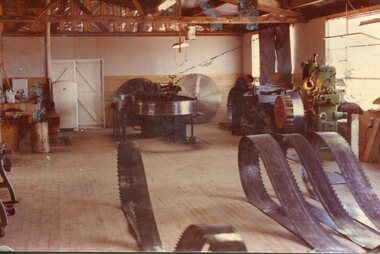
Photograph - Mount Beauty Timber Industries, 1960's (estimate only)
... ...Mt Beauty Timber industry...Colour photograph of Mt Beauty Timber Industries Mill. Photo taken inside the workshop showing saw blades and equipment...Mt Beauty Mt Beauty Timber industry timber mill Colour photograph of Mt Beauty Timber Industries Mill. ...Hume and Hovell discovered the area in 1824 and by the end of the 19th century the valley was transformed by logging, dairy and beef cattle properties and tobacco farms. Timber was required for construction of McKay Creek Power Station which began construction in 1951 and also the camps and houses for the workers and their families. There was a need for housing and infrastructure for an increasing population of workers for the hydro-electric scheme as there was a general shortage of this commodity. A timber mill was started in Tawonga by Mates, of Albury, in 1945, and electricity became available in 1946 the S.E.C. bought the mill, and enlarged it. In 1960 it was purchase by a local family. They also started a timber mill in Mt Beauty and worked both until 1980 when they closed the Tawonga mill and enlarged the mill called Mt. Beauty Timbers Pty Ltd which employed approximately 50 people. A pictorial record of the development of the local timber industry in the Kiewa Valley showing equipment used in timber milling.Colour photograph of Mt Beauty Timber Industries Mill. Photo taken inside the workshop showing saw blades and equipmentmt beauty, mt beauty timber industry, timber mill -
Marysville & District Historical Society
Article (item) - Magazine article, Murrindindi Magic, TIMBER - A HISTORY, 2012
... A transcription of an article outlining the history of the timber industry in Marysville and the surrounding district. ...A transcription of an article outlining the history of the timber industry in Marysville and the surrounding district. ...A transcription of an article outlining the history of the timber industry in Marysville and the surrounding district. ...A transcription of an article outlining the history of the timber industry in Marysville and the surrounding district. The original article was published in Murrindindi Magic in 2012.A transcription of an article outlining the history of the timber industry in Marysville and the surrounding district.marysville, victoria, austalia, taggerty, buxton, cambarville, narbethong, blue range, black range, mount margaret, big river, acheron fall, j.l. gould sawmill, bennett's pine mill, narbethong timber mill, alexandra, woodend, orbost, heyfield, murrundindi magic, magazine article -
 Orbost & District Historical Society
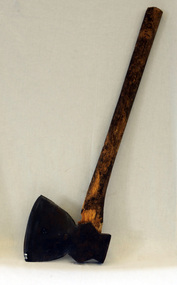
broad axe, c. early to mid 20th century
... broad-axe sleeper-cutting timber-industry...Used in the timber industry for trimming sleepers or shaping timber....Used in the timber industry for trimming sleepers or shaping timber. ...Used in the timber industry for trimming sleepers or shaping timber.This item is associated with the timber and sleeper-cutting industry in the Orbost Region. Timber sleepers were superceded by concrete sleepers in c. 1970s.An iron axe with a long cutting edge. The neck of the wooden handle is chipped.broad-axe sleeper-cutting timber-industry -
Marysville & District Historical Society
Magazine (item) - Magazine article, North By North-East, Timber in his blood, June-July 2014
... A magazine article regarding Robert Gale's life during and after working in the timber industry in and around Marysville from the 1930s to the 1990s....A magazine article regarding Robert Gale's life during and after working in the timber industry in and around Marysville from the 1930s to the 1990s....A magazine article regarding Robert Gale's life during and after working in the timber industry in and around Marysville from the 1930s to the 1990s. ...A magazine article regarding Robert Gale's life during and after working in the timber industry in and around Marysville from the 1930s to the 1990s.A magazine article regarding Robert Gale's life during and after working in the timber industry in and around Marysville from the 1930s to the 1990s.marysville, victoria, australia, robert gale, magazine article -
 Orbost & District Historical Society
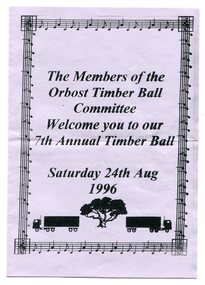
program, Orbost Timber Ball Committee, 1996
... dancing recreation Orbost-timber-industry...It was sponsored by the Timber Industry....It was sponsored by the Timber Industry. Orbost has historically been based on the timber industry, but that industry has declined considerably over the last 20 years. ...This is a program for the 7th Annual Timber Ball held in August 1996. It was sponsored by the Timber Industry.Orbost has historically been based on the timber industry, but that industry has declined considerably over the last 20 years. The number of locals involved in the timber industry has declined and these balls are no longer held. Community balls and dances are becoming rarer as more home entertainment is available and musical tastes have changed. This item is reminiscent of a previous social activity.A pale mauve coloured paper folded in half as a program. Print is black. Front page is framed with a graphical musical frame. Underneath print are images of two timber trucks on either side of a tree. The wording is : "Members of the Orbost Timber Ball Committee welcome you to our 7th Annual Ball Saturday 24 August 1996.' Inside are the names of committee members and sponsors. dancing recreation orbost-timber-industry -
Emerald Museum & Nobelius Heritage Park
Book - Timber history book, A. P. Winzenried, Britannia Creek an Essay in Wood Distillation, 1986
... ...timber industry...History of the Warburton timber industry in the first 20 years of the 20th century. ...History of the Warburton timber industry in the first 20 years of the 20th century. ...History of the Warburton timber industry in the first 20 years of the 20th century. The focus is on the linked process of producing various chemicals from the wood waste.1900s, timber industry, yarra valley -
 Orbost & District Historical Society
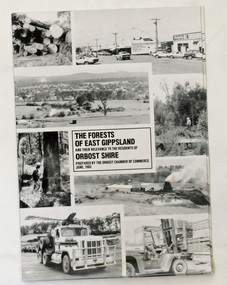
magazines, The Forests of East Gippsland, June 1983
... timber-industry-Orbost...There are eight black/white photographs on the front cover depicting the timber industry. In the centre inside a black frame is "THE FORESTS OF EAST GIPPSLAND AND THEIR RELEVANCE TO RESIDENCE OF THE ORBOST SHIRE PREPARED BY THE ORBOST CHAMBER OF COMMERCE JUNE, 1983"....This is a useful reference tool. timber-industry-Orbost Two copies of a 10 pp black / white magazine titled, " The Forests of East Gippsland". ...This is a useful reference tool.Two copies of a 10 pp black / white magazine titled, " The Forests of East Gippsland". There are eight black/white photographs on the front cover depicting the timber industry. In the centre inside a black frame is "THE FORESTS OF EAST GIPPSLAND AND THEIR RELEVANCE TO RESIDENCE OF THE ORBOST SHIRE PREPARED BY THE ORBOST CHAMBER OF COMMERCE JUNE, 1983".timber-industry-orbost -
 Lakes Entrance Historical Society
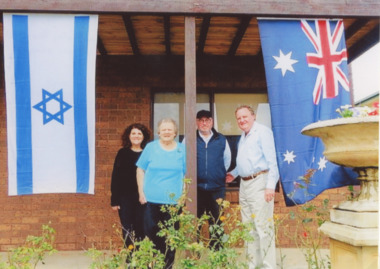
Photograph - Shirley and Brian Hancock, Jeffrey Lederman and Sharon Siger, Hancock family Lakes Entrance Victoria, 1/12/2016 12:00:00 AM
... ...Timber Industry... Lederman family were financiers of East Gippsland Timber Industry - . Shirley Hancock's Sharon Frock Salon on Esplanade Lakes Entrance was named after Sharon Siger...Lederman family were financiers of East Gippsland Timber Industry - . Shirley Hancock's Sharon Frock Salon on Esplanade Lakes Entrance was named after Sharon Siger Businesses Timber Industry Colour photograph showing Shirley and Brian Hancock welcoming Jeffrey Lederman and Sharon Siger nee Lederman on verandah at 5 Uplands Avenue, with Australian and Jewish flags flying, Lakes Entrance Victoria Hancock family Lakes Entrance Victoria Photograph Shirley and Brian Hancock, Jeffrey Lederman and Sharon Siger ...Lederman family were financiers of East Gippsland Timber Industry - . Shirley Hancock's Sharon Frock Salon on Esplanade Lakes Entrance was named after Sharon SigerColour photograph showing Shirley and Brian Hancock welcoming Jeffrey Lederman and Sharon Siger nee Lederman on verandah at 5 Uplands Avenue, with Australian and Jewish flags flying, Lakes Entrance Victoriabusinesses, timber industry -
 Orbost & District Historical Society
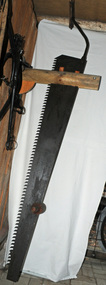
raker saw, c 1880 - 1940
... timber-industry-tool raker-saw pit-saw...Used in the timber industry in the Orbost district. This is a two person operated cross cut saw which functions as a pit saw. ...Used in the timber industry in the Orbost district. This is a two person operated cross cut saw which functions as a pit saw. ...Used in the timber industry in the Orbost district. This is a two person operated cross cut saw which functions as a pit saw. A log is placed over a pit lengthways. The man on the top walks along the log and pulls the saw upwards, and he man below pulls the saw downwards. This saw therefore cuts in both directions. This type of saw was often used in the ship building industry for cutting planks.A long raker saw which has been installed into the Slab Hut Shed in a vertical position as a pit saw. It has a metal handle extension at the top which has a wooden handgrip attached. Towards the bottom of the saw, a wooden handle had been added to the saw. timber-industry-tool raker-saw pit-saw -
Lakes Entrance Historical Society
Book, Morrissey, D.W and Morrissey E.W, Lakes Entrance a Short History revised Edition, 1980
... History of Koorie inhabitants through to fishing industry, timber industry, early settlers and survey and sale of land. ...History of Koorie inhabitants through to fishing industry, timber industry, early settlers and survey and sale of land. ...History of Koorie inhabitants through to fishing industry, timber industry, early settlers and survey and sale of land. ...History of Koorie inhabitants through to fishing industry, timber industry, early settlers and survey and sale of land. The opening of the entrance to allow shipping industry to operate bringing much trade and movement of primary produce etc. Local schoolHistory of Koorie inhabitants through to fishing industry, timber industry, early settlers and survey and sale of land. The opening of the entrance to allow shipping industry to operate bringing much trade and movement of primary produce etc. Local schoolMargaret Campbell''land settlement, religion, aboriginals -
 Marysville & District Historical Society
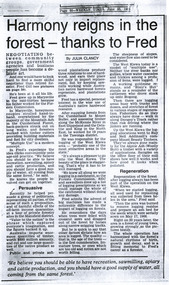
Newspaper (item) - Newspaper article, Weekly Times, Harmony reigns in the forest - thanks to Fred, 25-06-1986
... A photocopy of a newspaper article regarding one man, Fred Gill's, lobbying for the timber industry in and around Marysville and the district. ...A photocopy of a newspaper article regarding one man, Fred Gill's, lobbying for the timber industry in and around Marysville and the district. ...A photocopy of a newspaper article regarding one man, Fred Gill's, lobbying for the timber industry in and around Marysville and the district. ...A photocopy of a newspaper article regarding one man, Fred Gill's, lobbying for the timber industry in and around Marysville and the district. Fred Gill was born and grew up in Marysville and his father worked for the Forests Commission. The original article appeared in the Weekly Times on June 25th, 1986.A photocopy of a newspaper article regarding one man, Fred Gill's, lobbying for the timber industry in and around Marysville and the district.marysville, victoria, australia, fred gills, forest commission, newspaper article -
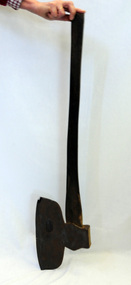 Orbost & District Historical Society
broad axe, c. 1900 to 1970s
... broad-axe sleeper-cutting timber-industry...Used in the timber and sleeper-cutting industry. Used to square sleepers. ...broad-axe sleeper-cutting timber-industry broad-axe sleeper-cutting timber-industry An iron axe head with a very long cutting blade and a long wooden handle. broad axe ...Used in the timber and sleeper-cutting industry. Used to square sleepers. This axe was possibly used by the donor John McMahon.Used in the timber and sleeper-cutting industry in the Orbost region.Timber sleepers were superceded by concrete sleepers in c. 1970s. broad-axe sleeper-cutting timber-industry An iron axe head with a very long cutting blade and a long wooden handle. broad-axe sleeper-cutting timber-industry -
Emerald Museum & Nobelius Heritage Park
Book - Dandenongs book, Nick Anchen, The Dandenong Ranges, 2016
... ...timber industry...This book explores the history of the Dandenongs, focusing on local towns, pioneer settlers and industries, including timber and gold mining and local wildlife. ...Dandenong Ranges Victoria Australia timber industry Wild life township settlers Hard back. 140 pages with over 190 color and black and white images. ...This book explores the history of the Dandenongs, focusing on local towns, pioneer settlers and industries, including timber and gold mining and local wildlife. It also includes historic events since European settlement of the area.Hard back. 140 pages with over 190 color and black and white images.dandenong ranges, victoria, australia, timber industry, wild life, township, settlers -
Stawell Historical Society Inc
Archive - Film Reels, Stawell Timber Industries, Stawell Timber Industries Opening, 1949
... Official Opening of Stawell Timber Industries 1949 One 16mm and one 35mm Films...Manufacturing STI Forests 35mm print Official Opening Stawell Plant Herschells Film Laboratories Melbourne Official Opening of Stawell Timber Industries 1949 One 16mm and one 35mm Films Stawell Timber Industries Opening Archive Film Reels Stawell Timber Industries ...Official Opening of Stawell Timber Industries 1949 One 16mm and one 35mm Films35mm print Official Opening Stawell Plant Herschells Film Laboratories Melbournemanufacturing, sti, forests -
Stawell Historical Society Inc
Archive - Eight LP Records, Stawell Timber Industries et al, Opening of Stawell Timber Industries, 1949
... Eight 78 Long Play Records Containing the Original Radio Recordings of the Official Opening of Stawell Timber Industries 1949...Soundtrack of Broadcasting of Opening Manufacturing STI Forests Broadcast Exchange of Australia Eight 78 Long Play Records Containing the Original Radio Recordings of the Official Opening of Stawell Timber Industries 1949 Opening of Stawell Timber Industries Archive Eight LP Records Stawell Timber Industries Broadcast Exchange of Australia ...Soundtrack of Broadcasting of Opening Eight 78 Long Play Records Containing the Original Radio Recordings of the Official Opening of Stawell Timber Industries 1949Broadcast Exchange of Australiamanufacturing, sti, forests -
Stawell Historical Society Inc
Uniform - Costume and Accessories, 1950
... Stawell Timber Industry (STI) Social Club Blazer. Junior Navy Colour. ...Stawell Clothing Material Stawell Timber Industry (STI) Social Club Blazer. Junior Navy Colour. ...Stawell Timber Industry (STI) Social Club Blazer. Junior Navy Colour. Blue and Blue trimming on pockets and sleeves.stawell clothing material
