
Showing 5 items matching " time without clocks"
-
 Greensborough Historical Society
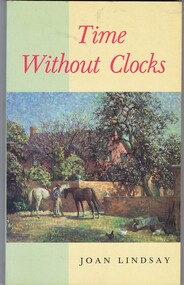
Book, joan lindsay, Time without clocks by Joan Lindsay, 1994
... Time without clocks by Joan Lindsay...Autobiography of Joan Lindsay and her life with her husband, Sir Daryl Lindsay joan lindsay daryl lindsay mulberry hill authors 213 p. Time without clocks by Joan Lindsay Book Book joan lindsay Loch Haven Books ...213 p.non-fictionjoan lindsay, daryl lindsay, mulberry hill, authors -
 Bacchus Marsh & District Historical Society
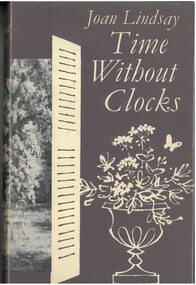
Book, Time Without Clocks
... Time Without Clocks...BMDHS Location: AR/SU63/S2 Time Without Clocks Book ...The Australian writer and artist Joan Lindsay lived in Bacchus Marsh for a number of years in the 1930s. She and her husband, the artist Daryl Lindsay lived in a house in Main Street, Bacchus Marsh. They called the house 'The Laurels. This house was demolished in 1983 but the Lindsay's memories of living in the house and in Bacchus Marsh during the 1930s are recounted in parts of this book. See in particular chapter 7, 'Retreat to Bacchus Marsh'.Book, hard cover. First edition. Melbourne, Vic., Cheshire, 1962. By Joan Lindsay. 216 pages. BMDHS Location: AR/SU63/S2non-fictionThe Australian writer and artist Joan Lindsay lived in Bacchus Marsh for a number of years in the 1930s. She and her husband, the artist Daryl Lindsay lived in a house in Main Street, Bacchus Marsh. They called the house 'The Laurels. This house was demolished in 1983 but the Lindsay's memories of living in the house and in Bacchus Marsh during the 1930s are recounted in parts of this book. See in particular chapter 7, 'Retreat to Bacchus Marsh'. joan lindsay 1896-1984, authors, bacchus marsh history -
 Glen Eira Historical Society
Letter - Crotonhurst
... ... Time Without Clocks...Philip Gillespie Ray Lindsay Joan Ring M Paterson Mrs Coffey Eileen Fitzsimmons Eileen Ronald Heather William Gluyas Maidment Isobel Langdon RR Langdon Charles Langdon R B Knox David Langdon Dick Hart Trevor McLaughlin J Ballantyne R Webb Matilda Sarah Somers Charles Mckenzie Barbara McLeod Lexie Richards Barbara Richards Lexie Sims Betty Anderson Irene Victoria Short hand writer Lawyers Phthisis Queen’s Counsel Judge of the Supreme Court Court reporter Architectural features World War 1914-1918 Soldiers Point to Point Steeplechase Master of the Hounds Organs Sculptor Statues Stained glass Crests and emblems Elsternwick Congregational Church Government Shorthand Writers’ Department Eureka treason trials Swamp Sand and Heath Dickson and Yorston Caulfield Council Caulfield Historical Society Harrison Ramsay Time Without Clocks The Hounds are Running Melbourne Hunt Club St Mary’s Church Geo. ...A letter from Mrs M Ring to the Caulfield Historical Society, dated 14/03/1986, conveying gratitude for the information provided about the house Crotonhurst located at the corner of Hawthorn Road and Glen Eira Road, Caulfield North, and requesting information about the Langdon and Webb families and the property Lirrewa. Enclosed with the letter is a copy of a two page report on the Life of George Frederick Webb. The file also includes a seven page report conducted by Irene Victoria Anderson in 1982 on the history of the Langdon and Webb families and the house Crotonhurst. Two earlier drafts of the same report are included and one of these has further handwritten notes.crotonhurst, rosecraddock, lirrewa, caulfield north, hawthorn road, langdon road, glen eira road, mitchell road, crotonhurst avenue, caulfield city hall, city of caulfield, polo ground, polo parade, neerim road, powderham road, walworth avenue, langdon family, webb family, rosecraddock family, webb george henry frederick, webb george henry webb justice, field matilda, agg sophia sarah, agg sophia sarah annie, webb sophie sarah annie, agg dottie, webb dottie, langdon william farrar, langdon willie, langdon bill, langdon h j mrs, langdon mrs, webb george edward, webb matilda elizabeth, webb isabella elizabeth, webb james hemming, murray peter r, wells john c, langdon marie, langdon clive, murdoch keith, egerton-warburton mr, yorston mr, yorston rita, langdon violet, langdon. philip, gillespie ray, lindsay joan, ring m, paterson mrs, coffey eileen, fitzsimmons eileen, ronald heather, william gluyas, maidment isobel, langdon rr, langdon charles, langdon r b, knox david, langdon dick, hart trevor, mclaughlin j, ballantyne r, webb matilda sarah, somers charles, mckenzie barbara, mcleod lexie, richards barbara, richards lexie, sims betty, anderson irene victoria, short hand writer, lawyers, phthisis, queen’s counsel, judge of the supreme court, court reporter, architectural features, world war 1914-1918, soldiers, point to point steeplechase, master of the hounds, organs, sculptor, statues, stained glass, crests and emblems, elsternwick congregational church, government shorthand writers’ department, eureka treason trials, swamp sand and heath, dickson and yorston, caulfield council, caulfield historical society, harrison ramsay, time without clocks, the hounds are running, melbourne hunt club, st mary’s church, geo. fincham and sons, city hall gallery, mansions -
 Eltham District Historical Society Inc
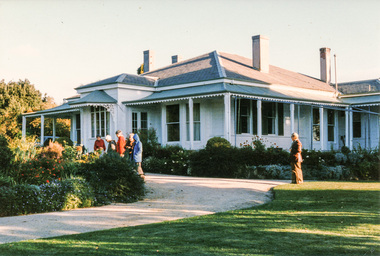
Photograph, Mulberry Hill, Golf Links Road, Baxter; Spring Excursion to The Briars and Mulberry Hill, 27 October 1991, 27/10/1991
... Members may find it interesting to read her autobiography "Time Without Clocks" prior to this trip. Members are welcome to bring their friends. ...Members may find it interesting to read her autobiography "Time Without Clocks" prior to this trip. Members are welcome to bring their friends. ...[from EDHS Newsletter No. 80, September 1991:] SPRING EXCURSION: As usual for October we have arranged a bus tour outside the local area. We will leave from the Eltham Shire Offices at 9.00 am on Sunday 27th October and travel to "The Briars" at Mornington and "Mulberry Hill" at Baxter. The cost will be $16.00 for adults and $8.00 for children. This includes admission to each of the houses and afternoon tea at "Mulberry Hill". Bring your own lunch to eat at "The Briars" and something for morning tea if you wish. "The Briars" is one of the oldest pastoral stations on the Mornington Peninsula. It has historical associations with the early settlement of the district and with Alexander Balcombe who settled in the area about 1843. Near the house is a wetland wildlife reserve with walking paths and bird observation hides. "Mulberry Hill" was the home of Sir Darryl Lindsay and his wife Joan. Darryl (1889-1976) was a member of the famous art family of Lindsays and was a prominent artist in his own right. He was also a noted art administrator, being appointed Director of the National Gallery of Victoria in 1942. Joan Lindsay (1896-1984) was an important writer. Her best known work was "Picnic at Hanging Rock". Members may find it interesting to read her autobiography "Time Without Clocks" prior to this trip. Members are welcome to bring their friends. Bookings will only be confirmed on payment. Please complete the attached form and return with payment to the September meeting or to our post office box. The trip is still some time off but there is no further Newsletter before then. Note the date in your diary how. As this will probably be the first day of daylight saving you will need to remember that in organizing yourself on the day. Please arrive at 8.45 am ready for a prompt start at 9.00 am.Two colour photographsactivities, mulberry hill, the briars -
 Flagstaff Hill Maritime Museum and Village
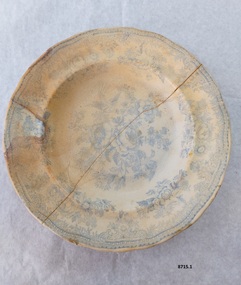
Domestic object - Dinner plate, circa 1878
... without the “ENGLAND” stamp, confusing the matter. Over time the body shape of the pieces changed, the feathered, curved and fluted edges giving way to simpler, cheaper oblong shapes The ship Loch Ard was built on the River Clyde in Scotland in 1873 for the prestigious Loch Line of colonial clipper ships, designed for the Australian run. It sailed from England on 1st March 1878 carrying 37 crew, 17 passengers and a load of cargo. The general cargo reflected the affluence of Melbourne at the time. On board were straw hats, umbrellas, perfumes, clay pipes, pianos, clocks...without the “ENGLAND” stamp, confusing the matter. Over time the body shape of the pieces changed, the feathered, curved and fluted edges giving way to simpler, cheaper oblong shapes The ship Loch Ard was built on the River Clyde in Scotland in 1873 for the prestigious Loch Line of colonial clipper ships, designed for the Australian run. It sailed from England on 1st March 1878 carrying 37 crew, 17 passengers and a load of cargo. The general cargo reflected the affluence of Melbourne at the time. On board were straw hats, umbrellas, perfumes, clay pipes, pianos, clocks ...These earthenware dinner plates were recovered from the wreck of the Loch Ard, on the southwest coast of Victoria and donated by a friend of the diver. The plates are very similar to other plates recovered from the wreck of the Loch Ard - some of which are already on display at Flagstaff Hill Museum and Village in Warrnambool. It is uncertain whether the plates were personal belongings or part of the cargo. The Asiatic Pheasant pattern is a transfer design and was the most popular design of the 19th-century Victorian era. It is still being produced today. The design was produced as high-quality, decorative dinnerware by the potters in the Staffordshire, England, area from the late 1830s, but no one is sure exactly who the original designer was. The industrial age made the production of this design more affordable to the ordinary person who purchased and proudly displayed settings in their homes. The high demand for production resulted in the loss of quality in both potting and design, particularly between 1860-1914 when the design reached its height of popularity, and the results were often a poor match for the earlier pieces’ quality and detail. Some engravers would make copies of the Asiatic Pheasant design (and other designs) onto copper plates and sell them to more than one pottery producer (the Copyright Act of 1842 was intended to control this very thing). Consequently, the list of Makers’ Marks associated with the Asiatic Pheasant is well over 100. A single pottery factory could have several owners, all with their own Marks. The makers mark on these two plates are also difficult to read but appear to include the letters "O H E ?' over "L". These factors all make the dating of pieces difficult. Also, after 1891, pieces produced for export were required to be stamped with “ENGLAND”, but pieces produced for the domestic market in England did not need this stamp, so early pieces and pieces produced for the domestic market would all be without the “ENGLAND” stamp, confusing the matter. Over time the body shape of the pieces changed, the feathered, curved and fluted edges giving way to simpler, cheaper oblong shapes The ship Loch Ard was built on the River Clyde in Scotland in 1873 for the prestigious Loch Line of colonial clipper ships, designed for the Australian run. It sailed from England on 1st March 1878 carrying 37 crew, 17 passengers and a load of cargo. The general cargo reflected the affluence of Melbourne at the time. On board were straw hats, umbrellas, perfumes, clay pipes, pianos, clocks, confectionary, linen and candles, as well as a heavier load of railway irons, cement, lead and copper. There were items included that were intended for display in the Melbourne International Exhibition in 1880 - a diverse general cargo ranging from luxury items to bulk railway iron. On 1 June 1878, emerging from fog and hearing too late the sound of breakers against the tall limestone cliffs, the vessel struck the southern foot of Mutton Bird Island and sank in 23 metres of water. Of the fifty-four people on board only two survived, one young male crewman, Tom Pearce, and one young female passenger, Eva Carmichael. Ten days after the Loch Ard tragedy, salvage rights to the wreck were sold at auction for £2,120. Cargo valued at £3,000 was salvaged and placed on the beach, but most washed back into the sea when another storm developed. The wreck of Loch Ard still lies at the base of Mutton Bird Island. Much of the cargo has now been salvaged and some was washed up into what is now known as Loch Ard Gorge. Cargo and artefacts have also been illegally salvaged over many years before protective legislation was introduced. One of the most unlikely pieces of cargo to have survived the shipwreck was a Minton porcelain peacock - one of only seven in the world. The peacock was destined for the Melbourne International Exhibition in 1880. It had been well packed, which gave it adequate protection during the violent storm. Today, the Minton peacock can be seen at the Flagstaff Hill Maritime Museum in Warrnambool. From Australia's most dramatic shipwreck it has now become Australia's most valuable shipwreck artefact and is one of very few 'objects' on the Victorian State Heritage Register.Flagstaff Hill’s collection of artefacts from LOCH ARD is significant for being one of the largest collections of artefacts from this shipwreck in Victoria. It is significant for its association with the shipwreck, which is on the Victorian Heritage Register (VHR S417). The collection is significant because of the relationship between the objects, as together they have a high potential to interpret the story of the LOCH ARD. The LOCH ARD collection is archaeologically significant as the remains of a large international passenger and cargo ship. The LOCH ARD collection is historically significant for representing aspects of Victoria’s shipping history and its potential to interpret sub-theme 1.5 of Victoria’s Framework of Historical Themes (living with natural processes). The collection is also historically significant for its association with the LOCH ARD, which was one of the worst and best known shipwrecks in Victoria’s history.Two plates recovered from the wreck of the Loch Ard. Earthenware dinner plates with blue and white transfer design (Asiatic Pheasant) with a clear over-glaze. The outer rim is scalloped. Plate 8715.1 has substantial brown stain over a large part of it and a large crack across the plate from rim to rim. The back of the plate shows evidence of the glue used to repair it. Plate 8715.2 has minor brown staining and is in better condition.Floral makers mark on the back featuring a scroll inscribed with "Asiatic Pheasant" and underneath the letters "O H E ?" over "L".flagstaff hill maritime museum and village, great ocean road, shipwreck coast, warrnambool, loch ard, lock ard wreck, plates, crockery, asiatic pheasant design, salvage, loch ard gorge, dinner plates
