
Showing 24 items matching " twenty love"
-
 Women's Art Register
Archive (Series) - Firstdraft. Subject File 1
... ... Twenty Love...NSW Twenty Love How Fragile Foolscap white archival 4 flap folder or document wallet Archive Firstdraft. ...nsw, twenty love, how fragilensw, twenty love, how fragile -
Women's Art Register
Archive (Collection) - Firstdraft Gallery Archive
... ... Twenty Love...NSW Twenty Love How Fragile Archive Firstdraft Gallery Archive ...nsw, twenty love, how fragilensw, twenty love, how fragile -
 Flagstaff Hill Maritime Museum and Village
Article - Ointment, Bates & Co. (William Usher), 1851 - mid-1900s
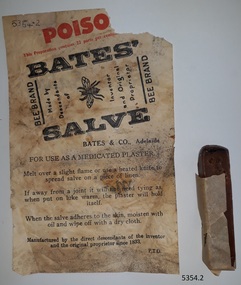
... twenty years younger than William) and had seven more children. The treatment’s packaging labels it as a POISON. It seems that its active ingredient was lead oxide (22 per cent), which is no longer considered unsafe. A member of the public mentioned that in 2016 they found some Bates’ Salve in an old family medicine chest. Its label stated that the product “contains a minimum of 25.8 per cent of red lead oxide”. That particular sample was made at 470 Wallon Road, West Molesey, Surrey, England. Some people would love...twenty years younger than William) and had seven more children. The treatment’s packaging labels it as a POISON. It seems that its active ingredient was lead oxide (22 per cent), which is no longer considered unsafe. A member of the public mentioned that in 2016 they found some Bates’ Salve in an old family medicine chest. Its label stated that the product “contains a minimum of 25.8 per cent of red lead oxide”. That particular sample was made at 470 Wallon Road, West Molesey, Surrey, England. Some people would love ...Bates' Salve has been used as a home remedy for the treatment of boils, skin infections, splinters, pimples and insect bites for decades, from the mid-1800s to the mid-1900s. It is a drawing application for bringing out foreign bodies and pusses from a wound. There are still many families who remember using it and others who have been using it and are down to their last ‘inch’. One comment from a reader from Queensland tells how his Dad was a sleeper cutter in the 1950s and on school holidays his brother and he used to help their Dad. When doing this task after a wet season they would be confronted with spear grass about a metre high. Sometimes the spears would enter their skin, and when the spears were wet they would screw like a corkscrew into their flesh. If they left them for too long it was impossible to dig them out with a needle. That's when the Bates Salve was put into action to draw the spearhead out. "It worked wonders. It was a marvellous invention." Many people say that they would love to be able to purchase more of it today and hope that someone will produce a ‘safe’ version of it. There are several versions of a recipe for the salve available online. It appears that the salve is named after Daisy Bates, wife of the Bates’ Salve proprietor, William Usher. William’s son Victor continued making Bates’ Salve well into the mid-1900s, with the business being carried on by Victor’s only son, Alan. There are still descendants in the family home in Norwood, Adelaide. William’s great-grandchild has stated that, despite being subject to the salve during childhood, there have been no noticeable ill effects. A small notice in the Adelaide Advertiser in 1915 made a suggestion “It is said that Bates’ Salve is the popular line with OUR BOYS in Gallipoli. They recently sent to the Adelaide Red Cross for a supply, so it would be a good line to put in soldiers’ Christmas Billies.“ Over 700 ‘Christmas Billies’ were sent from generous Warrnambool citizens to our soldiers in the trenches in Gallipoli. The average cost of filling a billy with gifts was Ten Shillings, calculated at about Fifty-four Dollars in 2021. The contents included Christmas puddings and tobacco. The huge project was coordinated by a local Committee and involved generous businesses and hundreds of kind-hearted community members, with recognition sown by naming many of those involved in an article in the Warrnambool Standard. The project’s idea was initiated by Australia’s Department of Defence and all states were involved in supporting the soldiers in this way. Mr Bates (Theopholis) of Hull, England, was the original owner of the Bates’ Salve recipe. When he died he left his business to William Usher, his son-in-law. William arrived in South Australia in 1851 after he had sold his recipe to an English firm, giving them the rights to make and sell it all over the world, except in Australia. Bates then became the registered proprietor of Bates’ Salve for the Commonwealth and still had a large market for his product. William Usher made the salve at his Norwood home, in a wood-fired copper in the garden within a three-sided enclosure. The ointment was then taken to a room in the house where it was divided, labelled and packaged. It was then sent to Faulding’s Wholesale Chemist for distribution. William and his wife May (or Mary) had three children; Jack, Victor and Ivy. When May died, William married Mary Williams (May’s maid, from Tasmania, twenty years younger than William) and had seven more children. The treatment’s packaging labels it as a POISON. It seems that its active ingredient was lead oxide (22 per cent), which is no longer considered unsafe. A member of the public mentioned that in 2016 they found some Bates’ Salve in an old family medicine chest. Its label stated that the product “contains a minimum of 25.8 per cent of red lead oxide”. That particular sample was made at 470 Wallon Road, West Molesey, Surrey, England. Some people would love to be able to use the product still and even take the risk of poisoning. Instructions for its use are included on the wrapper. Here is a transcription - "Bates' Salve. Bee Brand. POISON. This Preparation contains 22 parts per centum [lead oxide]… Made by Descendants of the Inventor and Original Proprietor. For use as a medicated plaster. Melt over a slight flame or use a heated knife to spread the salve on a piece of linen. If away from a joint it will not need tying as, when put on lukewarm, the plaster will hold itself. When the salve adheres to the skin moisten it with oil and wipe it off with a dry cloth. Manufactured by the direct descendants of the inventor and the original proprietor since 1833."This package of Bates' Salve has been used as a home remedy since the mod-1800s and even up to now in 2019 by those who consider themselves lucky to still have some at home. It was promoted as a 'cure all' treatment and kept handy for use at home and away. It represents our early industry and health management when medical treatment was often difficult to access. The product is the part of many childhood memories of those alive today.Bates’ Salve ointment; oblong stick of firm, brown waxy substance wrapped in waxed paper, with an outer printed wrapper. Text on wrapper warns that it is POISON and includes instructions for use as a medicated plaster, to be heated and spread onto linen then applied to the injury. Made by Bates & Co., Adelaide. The wrapper shows an emblem of a bee. The formula has been used since 1833.Text on wrapper includes "POISO[N]", "BATES' SALVE", "BEE BRAND", "BATES & CO., ADELAIDE". "This Preparation contains 22 parts per centum [lead oxide]" There is an emblem of a bee with wings outstretched.flagstaff hill, warrnambool, shipwrecked-coast, flagstaff-hill, flagstaff-hill-maritime-museum, maritime-museum, shipwreck-coast, flagstaff-hill-maritime-village, bates’ salve, bates’ salve medicated plaster, bates and co adelaide, bee brand, medicated plaster, medical treatment, remedy, drawing treatment for infection, medicine cabinet, home remedy, pharmacy treatment, mid 1800s – mid 1900s remedy, topical application, treatment for boils, bites, splinters and infections, poison, preparation for treatment, ointment -
 Warrnambool and District Historical Society Inc.
Postcard - A Gallant Rescue Under Fire, 1914-1918
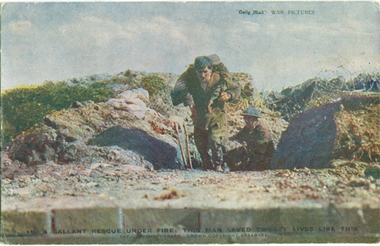
... loved and dedicated teachers that the school ever had. She married the Reverend Fred Ogier and continued her association with the school after her husband's death. This card is interesting because of its association with World War One and two local people Daisy Vickers and Arthur Anderson daisy vickers arthur anderson warrnambool technical school world war 1 postcard A Gallant Rescue Under Fire. This man saved twenty ...This is number 16 of 27 items in the Daisy Vickers collection of World War One memorabilia. These items were sent or given to Daisy Ogier (nee Vickers) during World War One by Corporal Arthur Anderson who enlisted from Warrnambool in 1915 at the age of 21. He served in Egypt and France and returned to Australia in 1919. Daisy Ogier (1907-1987) was a student and then a teacher at Warrnambool Technical School with her early teaching years there from 1925 to 1936 and in 1949. She became the head mistress from 1950 to 1963 and in 1968. She officially retired in 1976. Daisy Vickers was one of the best loved and dedicated teachers that the school ever had. She married the Reverend Fred Ogier and continued her association with the school after her husband's death.This card is interesting because of its association with World War One and two local people Daisy Vickers and Arthur AndersonThis postcard shows a photograph of a soldier carrying another soldier under fire. A Gallant Rescue Under Fire. This man saved twenty lives like this. Office photograph Crown Copyright Reserved "Daily Mail" Miss Daisy Vickers Bushfield Post Office Victoria Aus.daisy vickers, arthur anderson, warrnambool technical school, world war 1 postcard -
 Eltham District Historical Society Inc
Book, Miegunyah Press, Memoirs of a Young Bastard: the diaries of Tim Burstall compiled by Hilary McPhee, 2012
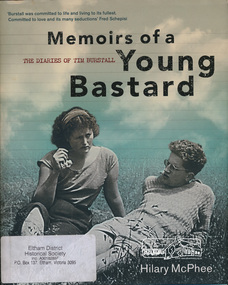
... twenties, with two young sons and an open marriage with his wife, Betty. Eager to become a writer, to go against the grain, he kept a record almost daily-of the parties and the talk in pubs and studios, about art and politics and sex, of Communist Party branch meetings and film societies, of political rallies and the first Herald Outdoor Art Show. Somehow, while holding down a public relations job in the Antarctic Division and juggling his love...twenties, with two young sons and an open marriage with his wife, Betty. Eager to become a writer, to go against the grain, he kept a record almost daily-of the parties and the talk in pubs and studios, about art and politics and sex, of Communist Party branch meetings and film societies, of political rallies and the first Herald Outdoor Art Show. Somehow, while holding down a public relations job in the Antarctic Division and juggling his love ...Diaries of Tim Burstall November 1953 to December 1954. Tim Burstall lived in Eltham. Tim Burstall, the celebrated director of Stork, Alvin Purple and numerous other definitive 'ocker' comedies, is credited with shaking the moribund Australian film industry out of its torpor. But long before that, in the early 1950s, he began keeping a diary to record the world of the group of 'arties' and 'intellectuals' he was living among in Eltham, then a rural area outside Melbourne, where cheap land was available for mudbrick houses and studios, and where suburban rigidities could be mercilessly flouted. Burstall was in his mid-twenties, with two young sons and an open marriage with his wife, Betty. Eager to become a writer, to go against the grain, he kept a record almost daily-of the parties and the talk in pubs and studios, about art and politics and sex, of Communist Party branch meetings and film societies, of political rallies and the first Herald Outdoor Art Show. Somehow, while holding down a public relations job in the Antarctic Division and juggling his love affairs and obsession with the beautiful, brainy Fay, he wrote 500 words almost every day. Betty, according to the diaries, kept the show on the road, feeding friends after the pub, milking goats and working in her pottery making bowls and mugs, which Tim sometimes decorated at weekends. These Memoirs of a Young Bastard, as Burstall dubbed himself and them, are among the most evocative Australian diaries of modern times. Burstall can write. He has an eye for the telling detail, an unerring ear for cant and pomposity and, most endearingly, an ability to mock himself-always from the perspective of a bloke of his generation. Source: Publisherxxiv, 343 p., [18] p. of plates : ill., maps, ports., facsims. ; 27 cm.ISBN 9780522858143diary, motion picture director, film director, author -
 Monbulk RSL Sub Branch
Book, Review, After midnight, 2005
... world war 1939-1945 - fiction war stories Twenty years after her father disappears on a bombing mission over Italy, Linda Carr resolves to find out what happened to the father she never knew. She is joined on her journey by Jack Kirby a former mosquito pilot who wants to find again a partisan he fell passionately in love with all those years ago. p.310. ...Twenty years after her father disappears on a bombing mission over Italy, Linda Carr resolves to find out what happened to the father she never knew. She is joined on her journey by Jack Kirby a former mosquito pilot who wants to find again a partisan he fell passionately in love with all those years ago.p.310.fictionTwenty years after her father disappears on a bombing mission over Italy, Linda Carr resolves to find out what happened to the father she never knew. She is joined on her journey by Jack Kirby a former mosquito pilot who wants to find again a partisan he fell passionately in love with all those years ago.world war 1939-1945 - fiction, war stories -
 Bendigo Historical Society Inc.
Card - 25 years Bush Trefoil Guild
... Twenty-five years ago you were a very young Guild and I was a very new State Adviser. We have all travelled a long way and have done much ion those years. I am very sorry that I am unable to be with you to take part in your celebrations, but you will be in my thoughts. My love...Twenty-five years ago you were a very young Guild and I was a very new State Adviser. We have all travelled a long way and have done much ion those years. I am very sorry that I am unable to be with you to take part in your celebrations, but you will be in my thoughts. My love ...The first meeting of the 1st Bendigo Guides was held by Miss Merle Bush on the 22nd of August 1922 in the St Paul' School Room. Twelve girls were present. Miss Bush was given permission to open the Company by Miss R. Hamilton, State Secretary for Victoria, she received her Captain's Warrant on 12th December 1922.Happy Birthday card - White with two pink roses on front and one larger pink rose on backTo the members of Merle Bush Trefoil Guild. Congratulations on achieving 25 years of service fellowship and fun. Twenty-five years ago you were a very young Guild and I was a very new State Adviser. We have all travelled a long way and have done much ion those years. I am very sorry that I am unable to be with you to take part in your celebrations, but you will be in my thoughts. My love and very best wishes to you all Mary Grigggirl guides, guiding, merle bush, trefoil guild, the australian womens register -
 Uniting Church Archives - Synod of Victoria
Photograph, Before 1919
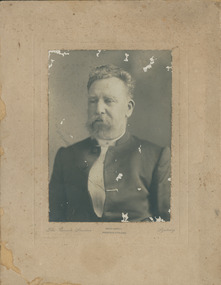
... loved of the earlier ministers of the Wesleyan Methodist Church in Australia. The announcement of the death of Mr. Knight, who was in his 85th year, was received by cable on May 11 from Christ-church, New Zealand, where he had re-sided during the last few years with his only son, the Rev. Percy N. Knight, B.A. The veteran preacher spent over twenty...loved of the earlier ministers of the Wesleyan Methodist Church in Australia. The announcement of the death of Mr. Knight, who was in his 85th year, was received by cable on May 11 from Christ-church, New Zealand, where he had re-sided during the last few years with his only son, the Rev. Percy N. Knight, B.A. The veteran preacher spent over twenty ...B. 1835 England, D. 1919 Christchurch NZ. Methodist minister. Chronicle 17 May 1919, p.43: Deep regret will be felt in South Aus-tralia at the passing away of the Rev. Samuel Knight, one of the best-known and most loved of the earlier ministers of the Wesleyan Methodist Church in Australia. The announcement of the death of Mr. Knight, who was in his 85th year, was received by cable on May 11 from Christ-church, New Zealand, where he had re-sided during the last few years with his only son, the Rev. Percy N. Knight, B.A. The veteran preacher spent over twenty years of his busy and useful life in this State. His last visit to Adelaide was in July, 1915, and it was through his agency and influence that £1,150 was raised for the reduction of the debt on the Archer-street Methodist Church. At that time, except for his head being crowned with snow-white hair, there was little in Mr. Knight's appearance to indicate his great age. He was obviously perfectly happy, and was still the tender shepherd who was so well beloved by his flock when he labored in South Australia. The older members of the Methodist Church remember well the splendid work he did more than half a century ago. He won similarly widespread respect in Vic-toria when he was transferred to the Con-ference there. He had charge of the prin-cipal circuits in both States, and he was equally successful as an eloquent preacher, a sympathetic and an assiduous pastor, and a wise and prudent administrator. His presence in the pulpit was always greeted by a large congregation, and the earnest-ness and spiritually of his discourses never failed to impress them. He was imbued with the true spirit of Methodism, and he had a firm and confident belief in the doctrines which he inculcated with such emotional fervor. Mr. Knight was a broad-minded, genial man with a keen sense of humor, and he shone on the platform. A true Christian, he was also a man of the world, and he could, when appealed to, give valuable counsel. He was a friend to be trusted, and he was ever ready to help those in need of his practical sympathy or his well-considered advice. He lived in an era of great Australian Methodists, and he was one of the greatest among them. Mr. Knight was an indefatigable worker, and under his control all the institutions of the circuits in which he worked nourished abundantly. He was a guide, philosopher, and friend to the younger ministers and exercised a great influence for good in Conference. Mr. Knight was born in Liverpool in 1834 and came to Australia in 1854. After spending several years in Victoria he arrived in Adelaide in 1867 to take charge of the Pirie-street Church. He received three ap-pointments as pastor at Pirie-street, two at Kent Town, and two at North Ade-laide (Archer-street), and he was also at Burra, Gawler, and Moonta. He was president of the Wesleyan Methodist Con-ference in 1877. In 1889 he returned to Victoria, and among the circuits of which he had charge at different times were Brunswick-st (Melbourne), St. Kilda, Ballarat, and Geelong. His activities by no means ceased after he went on the supernumerary list. For some years he was connected with Queen's College (Uni-versity of Melbourne), for which he col-lected a large sum for the liquidation of certain liabilities. The Samuel Knight scholarship was founded last year at Queen's College in his honor. Mr. Knight had taken up in recent years the work of establishing ministers in new circuits and of helping struggling churches. He undertook an energetic campaign of attack upon the debts on various churches that, recognising what his personality could do for them, had appealed to him for assistance, and achieved remarkable success in placing the finances on a sounder footing. A considerable portion of his own income in recent years was devoted to the assistance of young ministers, and to aug-menting the stipends that could be offered by newly established circuits in various parts of Victoria. Mr. Knight had been a widower for many years. His only daughter, Dr. Adela Knight, who appeared to have a brilliant career before her in medicine, died in Vienna about 25 years ago. The Rev. Samuel Knight was for many years a close personal friend of the late Sir Samuel Way, with whom he always stayed when visiting Adelaide. His death was a subject of reference at a number of Methodist churches in and around Ade-laide.B & W head & shoulders studio portrait of Rev. Samuel Knight, mounted on buff card.Rev. S. Knightknight, samuel, rev. -
 Uniting Church Archives - Synod of Victoria
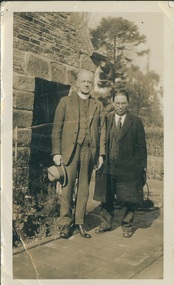
photograph, May 10th or 11th 1935
... Most of his writings are collected in the twenty-four volume Kagawa Toyohiko Zenshu (The work of Kagawa Toyohiko) (1964). His theological focus was on the redemptive love of God, manifest in the life of Jesus Christ, to whom people can commit themselves through a mystical experience of faith and intellectual creativity. ...Most of his writings are collected in the twenty-four volume Kagawa Toyohiko Zenshu (The work of Kagawa Toyohiko) (1964). His theological focus was on the redemptive love of God, manifest in the life of Jesus Christ, to whom people can commit themselves through a mystical experience of faith and intellectual creativity. ...Kagawa, Toyohiko (1888-1960) Japanese evangelist and social movement leader Kagawa was born in Kobe to Kame and Junichi Kagawa. In lonely years following the death of his parents at age four, he met Harry W. Myers and Charles A. Logan, missionaries of the (Southern) Presbyterian Church, U.S., and was baptized by Myers on February 14, 1904, at the Tokushima church. He pursued theological study at Meiji Gakuin in Tokyo and Kobe Theological Seminary. During his student days in Kobe he moved into the Shinkawa slum to serve the physical and spiritual needs of some 7,500 people. Between August 1914 and May 1917 Kagawa studied in the United States at Princeton Theological Seminary and then became involved in labor and peasants movements in Japan and in organizing religious programs, with the Jesus Band of Kobe as the base of his work. In 1921 Kagawa organized the Friends of Jesus. This Franciscan-like band of young people strove for spiritual discipline, compassion for the poor, and an evangelical life of witness. When Tokyo suffered a massive earthquake in 1923, he shifted the main emphasis of his work to that city. He promoted economic cooperatives in Japan and peace and social reform programs before and after World War II. Kagawa was a prolific writer. Most of his writings are collected in the twenty-four volume Kagawa Toyohiko Zenshu (The work of Kagawa Toyohiko) (1964). His theological focus was on the redemptive love of God, manifest in the life of Jesus Christ, to whom people can commit themselves through a mystical experience of faith and intellectual creativity. Kagawa was known more as a Christian social reformer than as a religious leader both in and out of Japan, but he was fundamentally an evangelist throughout his life. Robert M. Fukada, “Kagawa, Toyohiko” in Biographical Dictionary of Christian Missions, ed. Gerald H. Anderson (New York: Macmillan Reference USA, 1998), 350. This article is reprinted from Biographical Dictionary of Christian Missions, Macmillan Reference USA, copyright © 1998 Gerald H. Anderson, by permission of Macmillan Reference USA, New York, NY. All rights reserved. B & W informal photograph of the Rev. H.C. Matthew and Toyohiko Kagawa standing in front of the door to Captain Cook's Cottage in the Fitzroy Gardens, Melbourne. "Melbourne May 19th or 11th 1935. H.C. Matthew & Toyohiko Kagawa standing by the cottage recently removed to Australia & re-erected in Melbourne Botanical Gardens in which Captain Cook was born."toyohiko kagawa, h.c. matthews, captain cook's cottage, friends of jesus, christian missions. -
 National Wool Museum
Textile - Quilt, Wheat Bag Wagga, Percy Perkins, 1945
... Mr Perkins joined the police force in his early twenties and apart from an 18-month posting in Melbourne, spent the rest of his career serving communities in country Victoria. He was a keen fisherman and hunter- his first love was sitting on the banks of the Murray River with a fishing rod in his hand. ...Mr Perkins joined the police force in his early twenties and apart from an 18-month posting in Melbourne, spent the rest of his career serving communities in country Victoria. He was a keen fisherman and hunter- his first love was sitting on the banks of the Murray River with a fishing rod in his hand. ...Mr Perkins joined the police force in his early twenties and apart from an 18-month posting in Melbourne, spent the rest of his career serving communities in country Victoria. He was a keen fisherman and hunter- his first love was sitting on the banks of the Murray River with a fishing rod in his hand. Family camping trips were spent by the river where everyone slept on stretchers with several army blankets underneath and a wheat bag wagga on top. This wagga is made from two standard sized jute wheat bags split and hand bound along the seams. It is typical of a basic wagga made by shearers, farmers and swagmen. The paint stains on this wagga display signs of later use as a painting drop sheet by descendants who inherited the quilt. Quilt made of two standard size jute wheat bags (a bushel = 150lbs) split and hand bound along seams. It is an example of the basic type of wagga made by shearers, farmers or swagmen. Another use for the wagga was as a 'drop sheet' when doing house painting- possibly explaining the paint stains on the wagga.quilting history, running stitch group, running stitch collection, highlights of the national wool museum: from waggas to the wool quilt prize - exhibition (22/09/2001 - 02/12/2001), perkins, mr percy, quilting - history -
 National Wool Museum
Textile - Green Wheat Bag Wagga, Percy Perkins, 1945
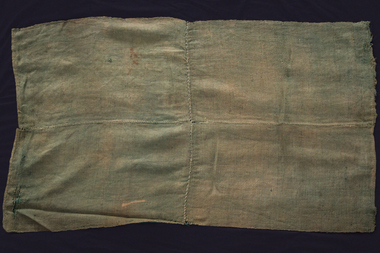
... Mr Perkins joined the police force in his early twenties and apart from an 18-month posting in Melbourne, spent the rest of his career serving communities in country Victoria. He was a keen fisherman and hunter- his first love was sitting on the banks of the Murray River with a fishing rod in his hand. ...Mr Perkins joined the police force in his early twenties and apart from an 18-month posting in Melbourne, spent the rest of his career serving communities in country Victoria. He was a keen fisherman and hunter- his first love was sitting on the banks of the Murray River with a fishing rod in his hand. ...Mr Perkins joined the police force in his early twenties and apart from an 18-month posting in Melbourne, spent the rest of his career serving communities in country Victoria. He was a keen fisherman and hunter- his first love was sitting on the banks of the Murray River with a fishing rod in his hand. Family camping trips were spent by the river where everyone slept on stretchers with several army blankets underneath and a wheat bag wagga on top. The green colour of this wagga is from "Dekkol" a preservative which Mr Perkins used to protect his cotton fishing nets from rotting.Quilt made of two standard size jute wheat bags (a bushel = 150lbs) split and hand bound along seams.It is an example of the basic type of wagga made by shearers, farmers or swagmen. The green colour results from the application of "Dekkol" a preservative used for cotton fishing nets.quilting history, running stitch group, running stitch collection, highlights of the national wool museum: from waggas to the wool quilt prize - exhibition (22/09/2001 - 02/12/2001), perkins, mr percy, quilting - history -
 Westbourne Grammar Heritage Collection
Photograph - Mabel Molland at Monomeith 1962
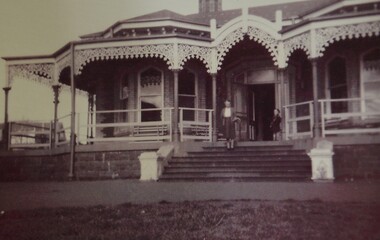
... White, Monomeith was leased from the Melbourne Harbour Trust under a seven-year lease, which eventuated as a twenty-one year lease, followed by purchase of the property in 1972. Since then this historic building has come to be a much-loved symbol of the history of Westbourne Grammar School. ...White, Monomeith was leased from the Melbourne Harbour Trust under a seven-year lease, which eventuated as a twenty-one year lease, followed by purchase of the property in 1972. Since then this historic building has come to be a much-loved symbol of the history of Westbourne Grammar School. ...This reproduction photograph was donated at a major reunion in 2008, organised by students of the school from the 1950s. It pictures Mabel Molland and a young student at Monomeith, home to the school since 1956. Monomeith is a Victorian Heritage Register listed (VHR number H0452), italianate styled brick villa, built in 1887 for one of Williamstown’s most important identities, James Styles. Styles’ distinguished career in public life included membership of the Williamstown Council, a stint in state parliament as the Member for Williamstown (1894-1900) and, in 1901, election to the first commonwealth parliament as a senator. During the 1890s he was also a commissioner of both the Melbourne Harbour Trust and the Melbourne and Metropolitan Board of Works and one of the trustees of the Williamstown Grammar School. The property comprises the residence designed by W Bennett Hall and built by James Styles in 1887 and the former migrant hostel buildings (now administration and classrooms), erected around 1951 by the then owner the Melbourne Harbour Trust, and intended to house migrant workers during the dredging of Port Phillip Bay. By the 1950s, the School had outgrown its home at Holy Trinity Hall and Mabel Molland reached out to Mr. Keith White, president of the Parent's Association and well-respected member of Williamstown Council for assistance. In 1956, following lengthy negotiations led by Mr. White, Monomeith was leased from the Melbourne Harbour Trust under a seven-year lease, which eventuated as a twenty-one year lease, followed by purchase of the property in 1972. Since then this historic building has come to be a much-loved symbol of the history of Westbourne Grammar School. This is a rare image of Mabel Molland at Monomeith, taken in the year prior to her retirement having taken over the school in 1914 and then set it on a path for the future as an incorporated company in the hands of a school council, with Mr Keith White as president, in 1956. Black and white reproduction photograph of a a residence (Monomeith) with steps in the middle ground, leading up to a verandah with ornate ironwork. Mabel Molland stands on the steps and a young student can be seen on the verandah. -
Tatura Irrigation & Wartime Camps Museum
Book, Apex The First Twenty Five Years, 1957 1st edition 1980 2nd edition
... love rs branson vm service clubs apex Tatura Apex Brown hardcover. Dust jacket of grey. Black letters "Apex". White letters First 25 yrs of Apex. Triangle logo of Apex in orange/gold and black on white square Apex The First Twenty Five Years Book Book ...Written to commemorate the 25th anniversary of founding of ApexBrown hardcover. Dust jacket of grey. Black letters "Apex". White letters First 25 yrs of Apex. Triangle logo of Apex in orange/gold and black on white squarefirst 25 years of apex, love rs, branson vm, service clubs, apex, tatura apex -
 Tatura Irrigation & Wartime Camps Museum
Document, Twenty newspaper and other extracts
... Twenty newspaper and other extracts. Photograph 1 & 2. Newspaper articles on interview Archie Wilson with Tom Nevett. Various newspaper articles on John West, rate book information. Photograph 14. Log hut on J. D. Love's...Twenty newspaper and other extracts. Photograph 1 & 2. Newspaper articles on interview Archie Wilson with Tom Nevett. Various newspaper articles on John West, rate book information. Photograph 14. Log hut on J. D. Love's ...Twenty newspaper and other extracts. Photograph 1 & 2. Newspaper articles on interview Archie Wilson with Tom Nevett. Various newspaper articles on John West, rate book information. Photograph 14. Log hut on J. D. Love's property. Photograph 15. Log and other early fencing. -
 Clayton RSL Sub Branch
soft cover non-fiction book, The Long Gray Line, West Points to Vietnam, 1989
... twenty-five-year saga of the West Point class of 1966. With a novelist's eye for detail, Rick Atkinson illuminates this powerful story through the lives of three classmates and the women they loved―from the boisterous cadet years, to the fires of Vietnam, to the hard peace and internal struggles that followed the war. ...twenty-five-year saga of the West Point class of 1966. With a novelist's eye for detail, Rick Atkinson illuminates this powerful story through the lives of three classmates and the women they loved―from the boisterous cadet years, to the fires of Vietnam, to the hard peace and internal struggles that followed the war. ...A classic of its kind, The Long Gray Line is the twenty-five-year saga of the West Point class of 1966. With a novelist's eye for detail, Rick Atkinson illuminates this powerful story through the lives of three classmates and the women they loved―from the boisterous cadet years, to the fires of Vietnam, to the hard peace and internal struggles that followed the war. The rich cast of characters also includes Douglas MacArthur, William C. Westmoreland, and a score of other memorable figures. The class of 1966 straddled a fault line in American history, and Atkinson's masterly book speaks for a generation of American men and women about innocence, patriotism, and the price we pay for our dreamsFollowing the lives of 3 graduates, from cadets through to post war and their integration back into a changes Americasoft cover non-fiction book with 592 pages with photos -
 Federation University Art Collection
Work on paper - Artwork - Printmaking, Geoffrey Ricardo, 'Love Street' by Geoffrey Ricardo, 1999
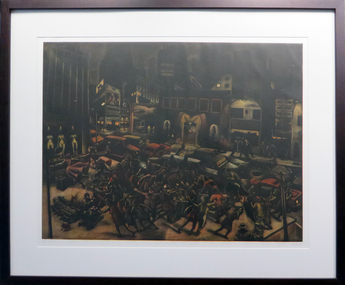
... Erickson, Dorothy; “The Festival that could have been”, The Bulletin, March 1994 Farmer, Alison; “Ricardo makes poster splash”, Sunday Times - Entertainment Extra, 19 September 1993 “Festival taps weaver’s art”, The West Australian, 11February 1994 Fiasco (web-page), March 2003 Jenkins, John; “A Dark City Narrative”, Imprint, Vol. 34, No. 4, 1999 Grishin, Sasha; “Multiplicity – collecting Australian prints”, Australian Art Review, Issue 13, March-June 2007, pp. 52-55 Grishin, Sasha; “Profiles in Print - Geoffrey Ricardo”, Craft Arts International, Issue 76, 2009, pp.1-4 Lloyd, Tim; “The elephant man”, The Advertiser (Review section), December 2007 Manzana Arné, Josep; “De L’Ex-Libris a L’Ex-Webis: Ex-Libris a Internet”, Ex-Libris, Associació Catalana D’Exlibristes, Barcelona, No. 27, July-December 2002, p.11 McDonald, John; “Dreams of hope and menace” The Sydney Morning Herald, 18 March 1995 McMillan, Peter; “Darkness visible”, The Age, 11September 1999 Nelson, Robert; “Circuses can be curated, but not cured”, The Age, 18 January 1995 Nelson, Robert; “Dream Weavers”, The Age, June 1995 Nelson, Robert; “Paen To Ricardo”, Imprint, Vol. 29, No.1, April, 1994 Nelson, Robert; “Revealed: Mother Nature’s vulgar past”, The Age, September 6, 2000 Nelson, Robert; “Riddled with hidden meaning”, The Age, September 8, 1999 Quadrant, April, 1995 Quadrant, Jan/Feb, 1995 Quadrant, October, 1995 Quadrant, November, 1994 “Ricardo’s surreal works at gallery”, Times-Spectator, 25 July 2003, p.7 Snell, Ted; “Art”, The Australian, 18 February1994 Snell, Ted; “Visual arts at the Festival of Perth”, Art Monthly, April 1994 Sunday Arts, ABC TV, 6 May 2007 Timms, Peter; “Geoff Ricardo: emerging from darkness”, Art Monthly, Issue 140, June 2001 Wallace, Dr Carmel; “Ways of seeing Australia”, Asian Art News, May/June 2004 BOOKS & CATALOGUES A Dark City Narrative, Australian Galleries, Melbourne, 1999 ARC Biennial Exhibition (Exhibition catalogue), Queensland University of Technology Art Museum, 2007, pp. 78-79 Clabburn, Anna; “The Collaborative Spirit”, Australian Tapestries: Victorian Tapestry Workshop, 1995, p. 37 Fantastic Art, Orange Regional Gallery, NSW, 2001 Field, Caroline; Herd, catalogue essay, Australian Galleries, Sydney, 2007 Grishin, Sasha; Australian Identities in Printmaking, Wagga Wagga Regional Art Gallery, 2000 Grishin, Sasha; Australian Printmaking in the 1990’s, Craftsman House, 1997 Havighurst, Sophie (Illustrations by Geoffrey Ricardo); When Lester lost his cool, The University of Melbourne, 2007 Kolenberg, Hendrik & Ryan, Anne; Australian Prints, Art Gallery of New South Wales, 1998 Lawrence, Michel; Framed; photographs of Australian Artists, 1998 Modern Australian Tapestries, Victorian Tapestry Workshop, 2000 The Rapunzel Suite, Australian Galleries, Melbourne, 2002 Wallace, Dr Carmel (Essay); Surface Tension, Twenty One Contemporary Australian Printmakers, Gallery 101, Melbourne, 2004 Workings of the Mind : Melbourne Prints of the 1960s to the 1990s, Queensland University of Technology Art Museum, Brisbane, 2000 TELEVISION Sunday Arts, ABC TV, 6 May 2007 Inside Art TV, Channel 31, July 2012 geoffrey ricardo printmaking artworks artist Under image in pencil '7/25 "Love street" Ricardo 99' Framed intaglio print from Geoffrey Ricardo's 'A Dark City, A Narrative' suite. ...GEOFFREY RICARDO Born 1964, Melbourne, Australia 1984-86 Bachelor of Arts (Fine Art), Printmaking, Chisholm Institute of Technology, Melbourne 1987-89 Printing Assistant at Bill Young Studios, Editioning intaglio prints, King Valley, VIC 1988 Full-time Studio Technician at Printmaking Department, Chisholm Institute of Technology, Melbourne 1989-90 Graduate Diploma (Fine Art), Printmaking, Monash University, Melbourne 1991 Traveled to England, France, Spain and USA (Winsor & Newton International Travelling Bursary, National Students Art Prize) Worked in private studios in Gaucin, Spain and New York, USA 1994-95 Master of Fine Arts, Monash University, Melbourne 1995 Guest Lecturer, Victorian College of the Arts, Melbourne Traveled to Europe and America 1996 Guest Lecturer, Royal Melbourne Institute of Technology, Melbourne 1990-98 Sessional Lecturer, Monash University, Melbourne 1998 Traveled to America and Mexico 2001-05 Sessional Lecturer, The Victorian College of the Arts, Melbourne 2003-10 Printmaking Workshops, Warrnambool TAFE, Warrnambool, VIC 2004 Traveled to Europe, Mexico and Cuba 2005 Lecturer, National Art School (Summer School), Sydney Sessional Lecturer, Monash University, Melbourne Lecturer, Institution of Koorie Education, Deakin University, Geelong, VIC SOLO EXHIBITIONS 2012 ‘Collection of Works’ The Art Vault Mildura ‘Deeper Meanings’, The Incinerator Gallery, Melbourne ‘Three Projects’, Australian Galleries, Glenmore Road, Sydney Melbourne Art Fair Stand F33, Australian Galleries, Melbourne 2009 ‘Anno Domino, Antarctica and The Anatomy Lesson’, Australian Galleries Derby Street, Melbourne The Art Vault, Mildura, VIC 2008 MV Orlova (Quark Expeditions), The Drake Passage, Antarctica 2007 ‘Herd’, BMGArt, Adelaide ‘Herd’, Australian Galleries Painting & Sculpture, Sydney 2006 ‘Herd’, Australian Galleries Painting & Sculpture, Melbourne 2004 ‘Recent work’, BMGArt, Adelaide 2003 ‘The Rapunzel Suite and Other New Works’, Australian Galleries Works on Paper, Sydney ‘Recent Works’, Australian Galleries Painting & Sculpture, Melbourne ‘Recent works’, Cowwarr Art Space, Cowwarr, VIC 2002 ‘The Rapunzel Suite’, Australian Galleries Works on Paper, Melbourne ‘Strange Games’, Australian Galleries Works on Paper, Sydney 1999 ‘A Dark City Narrative’, Australian Galleries Works on Paper, Sydney ‘A Dark City Narrative’, Australian Galleries Works on Paper, Melbourne 1998 Cullity Gallery, School of Architecture and Fine Art, University of Western Australia, Perth 1997 Delaney Gallery, Perth Chapman Gallery, Canberra BMGArt, Adelaide ‘Menagerie’, Australian Galleries, Sydney ‘Menagerie’, Australian Galleries, Melbourne 1995 ‘Paintings, Prints and Sculpture’, Australian Galleries, Sydney ‘Prints, Paintings and Sculpture’, Australian Galleries, Melbourne 1994 Lawrence Wilson Art Gallery, University of Western Australia, Perth Graham Galleries + Editions, Brisbane ‘Wishful Thinking, Prints and Sculptures’, Lawrence Wilson Art Gallery, University of Western Australia, Perth 1992 ‘Prints, Sculptures and Watercolours’, Australian Galleries, Melbourne and Sydney 1990 ‘Watercolours, Prints and Small Bronzes’, Australian Galleries, Sydney ‘Paintings, Prints and Sculptures’, Australian Galleries, Melbourne GROUP EXHIBITIONS 2013 ‘Sculpture by the Sea’ Cottlesloe, Western Australia 2012 ‘Brave New World’, Toyota Community Spirit Gallery, Port Melbourne, VIC ‘Sculpture by the Sea’, Bondi, Sydney 2011 ‘Sculpture by the sea’, Aarhus, Denmark ‘Artwork to Tapestry’, Tarrawarra Museum of Art, Healesville, VIC Burnie Print Prize, Burnie Regional Gallery, Burnie, TAS ‘large exhibition of small works’, Australian Galleries, Roylston Street, Sydney ‘large exhibition of small works’, Australian Galleries, Derby Street, Melbourne ‘Nature of the Mark’, Australian Galleries, Smith Street, Melbourne Rick Amor Print Prize, Montsalvat, Eltham, VIC 2010 ‘Summer show’, Australian Galleries, Glenmore Road, Sydney ‘Summer stock show’, Australian Galleries, Smith Street, Melbourne ‘Sub10’, Substation, Melbourne ‘McClelland Sculpture Survey and Award 2010’, McClelland Gallery + Sculpture Park, Langwarrin, VIC ‘Artists’ Prints made with Integrity I’, Australian Galleries, Smith Street, Melbourne Montalto Sculpture Prize, Montalto Vineyard and Olive Grove, Red Hill South, VIC 2009 ‘Artists’ ink: printmaking from the Warrnambool Art Gallery Collection, 1970-2001’, Ararat Regional Art Gallery, Ararat, VIC ‘Lorne Sculpture’ (Winner), Lorne, VIC 2008 ‘Summer Stock Show’, Australian Galleries Smith Street, Melbourne 2007 ARC Biennial (Art, Design and Craft), Queensland University of Technology Art Museum, Brisbane ‘Prints Tokyo: International Print Exhibition’, Tokyo, Japan Seoul International Print, Photo and Edition Works Art Fair, Seoul, Korea Guanlan International Print Biennial, Guanlan, China ‘Summer Stock Show’, Australian Galleries Works on Paper, Sydney ‘Summer Stock Show’, Australian Galleries Painting & Sculpture, Melbourne ‘Summer Stock Show’, Australian Galleries Works on Paper, Melbourne ‘Antipodean Bestiary’, Project Space / Spare Room, RMIT University, Melbourne Montalto Sculpture Prize, Montalto Vineyard and Olive Grove, Red Hill South, VIC McClelland Sculpture Survey and Award 2007, McClelland Gallery + Sculpture Park, Langwarrin, VIC ‘2007: Works from the studio’, Lancaster Press, Melbourne ‘50 - a print exchange portfolio’, Geelong Art Gallery, Geelong, VIC ‘Small Pleasures’, Australian Galleries Painting & Sculpture, Melbourne ‘Stock Show’, Australian Galleries Painting & Sculpture, Melbourne ‘Artists for Kids Culture’, Brightspace, Melbourne 2006 ‘Partnership or perish’, Academy of the Arts, School of Visual and Performing Arts, University of Tasmania, Hobart Libris Awards, Artspace Mackay, Mackay, QLD ‘Summery’, Australian Galleries Painting & Sculpture, Sydney ‘Summer Stock Show’, Australian Galleries Works on Paper, Melbourne ‘Bookish’, Australian Galleries Works on Paper, Melbourne Melbourne Art Fair, Australian Galleries, Melbourne ‘Artists for Kids Culture’, Brightspace, Melbourne ‘50th Anniversary Exhibition’, Australian Galleries Painting & Sculpture, Melbourne 2005 ‘End of Year Group Exhibition’, Australian Galleries Painting & Sculpture, Sydney ‘Contemporary Works on Paper’, Australian Galleries Works on Paper, Melbourne ‘Expansion’, Lancaster Press, Melbourne ‘The Art of Collaboration’, Singapore Tyler Print Institute, Singapore ‘Double take’, Arts Project Australia, Melbourne ‘Small Treasures - 20 emerging and established artists’, TILT Contemporary Art, Melbourne Jacques Cadry Memorial Art Prize, Fox Studios and State Library of NSW, Sydney ‘Tales of the City’, Australian Galleries Painting & Sculpture, Melbourne ‘A Decade of Collecting 1995-2005’, Cairns Regional Gallery, Cairns, QLD ‘Artists for Kids Culture’, Brightspace, Melbourne ‘Surface Tension: 21 Contemporary Australian Printmakers’, University of Tasmania, Launceston, TAS ‘Neo-millenium’, Toyota Community Spirit Gallery, Melbourne 2004 ‘Artists for Kids Culture’, Brightspace, Melbourne ‘Group Exhibition’, Australian Galleries Painting & Sculpture, Melbourne ‘Species’, Australian Galleries Works on Paper, Melbourne ‘In the presence of creatures great and small’, Australian Galleries Works on Paper, Sydney ‘Tapestries from the Victorian Tapestry Workshop’, Australian Galleries, Melbourne ‘Sculpture’, Australian Galleries Painting & Sculpture, Sydney ‘Contemporary Australian Prints’, National Arts Club, New York, USA ‘Contemporary Australian Prints’, Gallery 101, Melbourne ‘Contemporary Australian Prints from the Collection’, Art Gallery of New South Wales, Sydney ‘Bridge’, Toyota Community Spirit Gallery, Melbourne ‘Vivid’, Fortyfive Downstairs, Melbourne Lake Gallery, Paynesville, VIC 2003 ‘Paper matters’, Lawrence Wilson Art Gallery, University of Western Australia, Perth ‘Artists for Kids Culture’, Brightspace, Melbourne ‘Less is more’, BMGArt, Adelaide ‘The ink’s on me: Bill Young master printmaker’, Wangaratta Exhibitions Gallery, Wangaratta, VIC ‘Fantastic and Visionary Art’, Touring: Global Arts Link, QLD; Ipswich Regional Gallery, QLD ; Orange Regional Gallery, NSW; Manning Regional Gallery, NSW; Parramatta Heritage Centre, Sydney; Ballarat Regional Gallery, VIC 2002 Shell Fremantle Print Award, Fremantle Arts Centre, Fremantle, WA ‘Artists for Kids Culture’, Brightspace, Melbourne 2001 Shell Fremantle Print Award, Fremantle Arts Centre, Fremantle, WA ‘Six Degrees of Collaboration’, RMIT Faculty of Art, Design and Communication Gallery, Melbourne ‘Reciprocal Moves’, Warrnambool Art Gallery, Warrnambool, VIC International Print Triennial, Kanagawa, Japan ‘Fantastic Art’, Orange Regional Gallery, Orange, NSW ‘Dancing Made a Man out of Me’, The Switchback Gallery, Monash University, Gippsland, VIC ‘Artists for Kids Culture’, Brightspace, Melbourne ‘Celebration’, Regional touring exhibition, VIC 2000-01 ‘Workings of the Mind: Melbourne Prints of the 1960s to the 1990s’, Touring: Grafton Regional Gallery, NSW; Toowoomba Regional Art Gallery, QLD; Nolan Gallery, Canberra; Bendigo Art Gallery, VIC; PercTucker Regional Gallery, QLD 2000 Shell Fremantle Print Award, Fremantle Arts Centre, Fremantle, WA The Hutchins Art Prize, Long Gallery, Hobart ‘Artists for Kids Culture’, Brightspace, Melbourne 1999 Shell Fremantle Print Award, Fremantle Arts Space, Fremantle, WA ‘We are Australian’, George Adams Gallery, Victorian Arts Centre, Melbourne Rena Ellen Jones Memorial Print Award, Warrnambool Art Gallery, Warrnambool, VIC ‘National Works on Paper’, Mornington Peninsula Gallery, Mornington, VIC ‘Artists for Kids Culture’, Brightspace, Melbourne ‘Pleasure’, Australian Galleries, Melbourne 1998-99 ‘Australian Prints’, Art Gallery of New South Wales, Sydney 1997 ‘KNOCK, KNOCK’, Australian Galleries, Melbourne ‘Woven Colour, The Art of Tapestry’, Dr Earl Lu Gallery, Singapore 1996 M.P.A.C. Print Award, Mornington Peninsula Arts Centre, Mornington, VIC Academy of Art & Culture, Calcutta, India ‘Synergy’, Touring: Lalit Kala Akademi, New Dehli, India; Jehangir Nicholson Gallery, Bombay, India; Birla, India ‘Contemporary Australian Tapestry’, Frederikshavn Kunstmuseum, Denmark; Australia House, London, UK 1995 ‘Interweave - Tapestry A Collaborative Art’, Heide Museum of Modern Art, Melbourne ‘Contemporary Printmakers’, La Trobe Regional Gallery, Morwell, VIC ‘Contemporary Australian Tapestry’, Australian High Commission, Singapore ‘Circus Capers’, Caulfield Arts Complex, Melbourne 1994 M.P.A.C. Print Award, Mornington Peninsula Arts Centre, Mornington, VIC Fremantle Print Award, Fremantle Arts Centre, Fremantle, WA Australian Universities of Visual Art, Australian High Commission, Singapore ‘Prints, Paintings and Sculpture’, BMGArt, Adelaide Fourth Australian Contemporary Art Fair, Royal Exhibition Building, Melbourne 1993 Fremantle Print Award, Fremantle Arts Centre, Fremantle, WA 1992 Fremantle Print Award, Fremantle Arts Centre, Fremantle, WA ‘Transitional Times’, Print Council of Australia, Melbourne ‘Second Kochi International Triennial Exhibition of Prints’, Japan 1991 Henry Worland Memorial Print Prize, Warrnambool Regional Art Gallery, Warrnambool, VIC Fremantle Print Award, Fremantle Arts Centre, Fremantle, WA ‘Table Top Sculpture’, Australian Galleries, Melbourne ‘Art 91’, London Contemporary Art Fair, London, UK 1990 M.P.A.C. Print Prize, Mornington Peninsula Arts Centre, Mornington, VIC Fremantle Print Prize, Fremantle Arts Centre, Fremantle WA ‘The Christmas Show’, Intaglio Printmaker, London, England ‘Australian Contemporary Art’, AZ Gallery, Tokyo, Japan 1989 National Student Art Prize, Mitchell College, Bathurst, NSW Fremantle Print Award, Fremantle Arts Centre, Fremantle, WA City of Doncaster Acquisitive Print Prize, Manningham Gallery, Melbourne ‘Affiliations’, Monash University Gallery, Melbourne 1988 M.P.A.C. Acquisitive Print Prize, Mornington Peninsula Arts Centre, Mornington, VIC Henry Worland Memorial Print Prize, Warrnambool Regional Art Gallery, Warrnambool, VIC 1987 ‘The Comedy Show’, Print Guild, Melbourne ‘Fluxus Art Flow’, Melbourne 1986 Mornington Peninsula Arts Council Acquisitive Print Prize, Mornington Peninsula, VIC Chisolm Institute of Technology, Graduating Students exhibition, Melbourne AWARDS 2013 King Valley Art Prize (printmaking) 2009 Lorne Sculpture Exhibition (Winner), Lorne, VIC 1989 Windsor and Newton International Travelling Bursary, UK Linbrook International First Prize for Printmaking, Australia COMMISSIONS 2005 Tapestry design for Bairnsdale Hospital (woven by the Victorian Tapestry Workshop, Melbourne), Bairnsdale, VIC 1999 Tapestry design ‘Emblem’ (woven by the Victorian Tapestry Workshop, Melbourne), Australia 1995 ‘A Night of Infectious Laughter’ Poster, St Kilda Festival, Melbourne 1994 Tapestry design ‘Elephant Gingham’ (woven by the Victorian Tapestry Workshop, Melbourne), Australia 1993 Tapestry design for the Festival of Perth Official Poster (woven by the Victorian Tapestry Workshop, Melbourne), Perth RESIDENCIES & PROJECTS 2013 ‘Come In Outside’, Collaboration set design for Pocketfool 2011 Mildura Wentworth Arts Festival Project, Mildura, VIC Residency, The Art Vault , Mildura, VIC 2010 ‘Wish’, Collaboration set design for Pocketfool, Artplay, Melbourne The Art Vault (included continuous public flag making workshops which were flown as part of The Wentworth Mildura Art Festival), Mildura, VIC 2009 The Art Vault (included two public printmaking workshops), Mildura, VIC 2008 Artist in residence, MV Orlova, Quark Expeditions, Antarctica 2003 Residency, Bairnsdale Regional Health Service, Bairnsdale, VIC 1998 Residency, School of Architecture & Fine Art, University of Western Australia, Perth 1997 Residency, La Salle/Fia, College of the Arts, Singapore 1996 Artist in residence, Victorian Tapestry Workshop, Melbourne 1993 Reduction Aquatint Workshop & Residency, Graphic Investigation Department, Canberra School of Art, Canberra NB: all residencies have included workshops involving students, children or the general public COLLECTIONS Artbank, Sydney Art Gallery of New South Wales, Sydney Canson Australia Pty Ltd, Australia City of Box Hill, Melbourne City of Whitehorse, Melbourne Downlands College, Toowoomba, QLD Geelong Grammar School, Geelong, VIC Gold Coast City Art Gallery, Gold Coast, QLD Griffith University, Gold Coast, QLD Helensvale High School, Brisbane Holmes à Court Collection, Perth Latrobe Regional Gallery, Morwell, VIC Monash University, Melbourne Mornington Peninsula Arts Council Collection, Mornington, VIC National Gallery of Australia, Canberra National Gallery of Victoria, Melbourne Parliament House Art Collection, Canberra Print Council of Australia, Melbourne Private collections in Australia, Switzerland, USA, UK, Singapore, Germany, Japan, Malaysia, Holland Queen Victoria Museum & Art Gallery, Launceston, TAS Queensland Art Gallery, Brisbane Queensland University of Technology, Brisbane Shire of Diamond Valley, Diamond Valley, VIC Star of the Sea College, Melbourne The Melbourne Club, Melbourne University of Central Queensland, Brisbane University of Technology, Sydney Wagga Wagga Regional Art Gallery, Wagga Wagga, NSW Warrnambool Regional Art Gallery, Warrnambool, VIC BIBLIOGRAPHY PERIODICALS AQ Journal of Contemporary Analysis, Vol. 70, Issue 4, July-August 1998 AQ Journal of Contemporary Analysis, Vol. 70, Issue 6, November-December 1998 AQ Journal of Contemporary Analysis, Vol.71, Issue 7, April 1999 Backhouse, Megan; “Going out of print and back to basics”, The Age, February 2003 Bellamy, Louise; “Renaissance of Western Art”, The Age (A2 section), 26 November 2005 Clabburn, Anna; “Fables and Foibles”, Art Monthly, September 1994 Dutkiewicz, Adam; “Edge of the sublime”, Advertiser, 1 December 2003, p. 76. Erickson, Dorothy; “The Festival that could have been”, The Bulletin, March 1994 Farmer, Alison; “Ricardo makes poster splash”, Sunday Times - Entertainment Extra, 19 September 1993 “Festival taps weaver’s art”, The West Australian, 11February 1994 Fiasco (web-page), March 2003 Jenkins, John; “A Dark City Narrative”, Imprint, Vol. 34, No. 4, 1999 Grishin, Sasha; “Multiplicity – collecting Australian prints”, Australian Art Review, Issue 13, March-June 2007, pp. 52-55 Grishin, Sasha; “Profiles in Print - Geoffrey Ricardo”, Craft Arts International, Issue 76, 2009, pp.1-4 Lloyd, Tim; “The elephant man”, The Advertiser (Review section), December 2007 Manzana Arné, Josep; “De L’Ex-Libris a L’Ex-Webis: Ex-Libris a Internet”, Ex-Libris, Associació Catalana D’Exlibristes, Barcelona, No. 27, July-December 2002, p.11 McDonald, John; “Dreams of hope and menace” The Sydney Morning Herald, 18 March 1995 McMillan, Peter; “Darkness visible”, The Age, 11September 1999 Nelson, Robert; “Circuses can be curated, but not cured”, The Age, 18 January 1995 Nelson, Robert; “Dream Weavers”, The Age, June 1995 Nelson, Robert; “Paen To Ricardo”, Imprint, Vol. 29, No.1, April, 1994 Nelson, Robert; “Revealed: Mother Nature’s vulgar past”, The Age, September 6, 2000 Nelson, Robert; “Riddled with hidden meaning”, The Age, September 8, 1999 Quadrant, April, 1995 Quadrant, Jan/Feb, 1995 Quadrant, October, 1995 Quadrant, November, 1994 “Ricardo’s surreal works at gallery”, Times-Spectator, 25 July 2003, p.7 Snell, Ted; “Art”, The Australian, 18 February1994 Snell, Ted; “Visual arts at the Festival of Perth”, Art Monthly, April 1994 Sunday Arts, ABC TV, 6 May 2007 Timms, Peter; “Geoff Ricardo: emerging from darkness”, Art Monthly, Issue 140, June 2001 Wallace, Dr Carmel; “Ways of seeing Australia”, Asian Art News, May/June 2004 BOOKS & CATALOGUES A Dark City Narrative, Australian Galleries, Melbourne, 1999 ARC Biennial Exhibition (Exhibition catalogue), Queensland University of Technology Art Museum, 2007, pp. 78-79 Clabburn, Anna; “The Collaborative Spirit”, Australian Tapestries: Victorian Tapestry Workshop, 1995, p. 37 Fantastic Art, Orange Regional Gallery, NSW, 2001 Field, Caroline; Herd, catalogue essay, Australian Galleries, Sydney, 2007 Grishin, Sasha; Australian Identities in Printmaking, Wagga Wagga Regional Art Gallery, 2000 Grishin, Sasha; Australian Printmaking in the 1990’s, Craftsman House, 1997 Havighurst, Sophie (Illustrations by Geoffrey Ricardo); When Lester lost his cool, The University of Melbourne, 2007 Kolenberg, Hendrik & Ryan, Anne; Australian Prints, Art Gallery of New South Wales, 1998 Lawrence, Michel; Framed; photographs of Australian Artists, 1998 Modern Australian Tapestries, Victorian Tapestry Workshop, 2000 The Rapunzel Suite, Australian Galleries, Melbourne, 2002 Wallace, Dr Carmel (Essay); Surface Tension, Twenty One Contemporary Australian Printmakers, Gallery 101, Melbourne, 2004 Workings of the Mind : Melbourne Prints of the 1960s to the 1990s, Queensland University of Technology Art Museum, Brisbane, 2000 TELEVISION Sunday Arts, ABC TV, 6 May 2007 Inside Art TV, Channel 31, July 2012Framed intaglio print from Geoffrey Ricardo's 'A Dark City, A Narrative' suite. Donated through the Australian Government's Cultural Gifts Programme by Katherine Littlewood.Under image in pencil '7/25 "Love street" Ricardo 99'geoffrey ricardo, printmaking, artworks, artist -
 Carlton Football Club
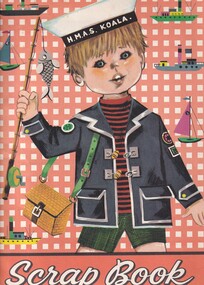
Scrap Book, Dedicated to Carlton Player John Goold
... loved that coat too much to part with it, even to Ragsy, so I shook my head - and he smiled, then walked off. I stood for a moment in the middle of the street shaking my head in disbelief. Ragsy bloody Goold had just offered to buy my overcoat! I knew at that point, as a young man of about twenty ...John Goold double Premiership PlayerA scrap Book dedicated to twice Premiership Player 1968 - 1970 John Goold Career : 1963 - 1970 Debut : Round 7, 1963 vs Footscray, aged 21 years, 338 days Carlton Player No. 754 Games : 108 Goals : 3 Last Game : Grand Final, 1970 vs Collingwood, aged 29 years, 90 days Guernsey No. 11 Height : 184 cm (6 ft ½ in.) Weight : 76 kg (12 stone, 0 lbs.) DOB : June 27, 1941 Premiership Player 1968, 1970 Carlton Hall of Fame All Australian 1966 A brilliant, flamboyant, two-time Premiership player for Carlton during the Barassi years in the ‘swingin’ sixties,’ John William Crosbie Goold became almost as famous for his dapper appearance off the field, as for his exploits on it. At the height of his football career, he was also a prominent ladies fashion designer – which led to him being dubbed ‘Mr Elegance’ by leading football commentator Lou Richards. Supporters and team-mates however, called him ‘Rags’ or ‘Ragsy,’ because of his involvement in the clothing, or ‘rag’ trade. Goold first came under notice as an outstanding junior athlete at Melbourne Grammar School. A true all-round sportsman, he shone at tennis, athletics, football and cricket. He was also a keen horseman who loved the game of polo and the rough and tumble of fox hunting. While at school he was a fervent Melbourne supporter, but strangely, never had much confidence in his football ability. “If I thought I was good enough, I would certainly have gone to Melbourne,” he said many years later. “But I honestly didn’t think I would ever amount to anything in this game. Cricket and tennis were the games that really interested me.’ However, after graduating from MGS, Goold went home to Healesville to star in the Bloods’ 1962 Yarra Valley Football Association Premiership team – an achievement that brought tempting offers from more than one VFL club. “Incentives were offered elsewhere,” he recalled, “but I gravitated to Carlton – partly because the deep blue of their guernsey attracted me, but mostly because of the good advice I got from people who even then were longsighted enough to predict that big things were ahead for this club.” The Blues were confident enough in Goold’s potential to offer him the guernsey number 11 previously worn with distinction by the likes of Jack Hale, Jim Knight, Ron Hines and Laurie Kerr, and his first senior game came in round 7, 1963 against Footscray at the Western Oval. He played on a half-forward flank alongside Brownlow Medallists Gordon Collis and John James on that Saturday afternoon, and kicked his first career goal in an 8-point win. Little did he know though, that it would be another six seasons before he would again experience the thrill of sending a football spinning between the big posts, because his future lay in defence. By his own admission, Goold struggled to find his feet in VFL football during his first two seasons, until the shock appointment of Ron Barassi as captain-coach of Carlton in 1965 began steering his career back on track. “I think you could say that 1965 was my first year of League football,” he said, “That’s the way I felt - that’s the way I reacted to Barassi.” Under Barassi, Goold rapidly developed into a superb running half-back flanker. Tenacious, and an often freakish high mark, he was unmistakable on the field thanks to his mane of dark hair, his loping running style and somewhat awkward kicking action. Furthermore, he had boundless courage. There is no doubt that he would have played many more games had he not been regularly pole-axed under the high ball – a fact he later freely admitted. “I was always getting knocked out,” he said, “and spent half my bloody time in hospital.” In the second half of 1965, an injury to centre half-back Gordon Collis forced Barassi to use Goold in the key defensive post. While it curtailed his rebounding instincts somewhat, ‘Ragsy’ rose to the challenge and rarely lowered his colours. Testament to his improvement, he finished third behind John Nicholls and Sergio Silvagni in Carlton’s 1965 Best and Fairest award, and followed up by being selected in the Victorian team for the 1966 Hobart Carnival. There, he had a superb series in which he was runner-up to West Australian Barry Cable in voting for the Tassie Medal, and capped it off by being named on a half-back flank in the All Australian team. Barassi’s influence at Carlton bore fruit in his third year, when the Blues returned to finals football at last. Richmond, Carlton, Geelong and Collingwood fought out the 1967 Premiership, and Ragsy Goold won the hearts of the Carlton faithful with two lion-hearted performances. Although Carlton was knocked out of contention by successive losses to Richmond and Geelong, Goold was tireless throughout both games, and it was obvious that he thrived on the added pressure of finals football. Precisely twelve months later, the bitter taste of those defeats was washed away when Barassi’s Blues edged out Essendon by 3 points in the 1968 Grand Final, and ended 21 years of despair at Princes Park. To win Carlton’s ninth VFL flag, the Blues had had to defeat the minor premier Bombers twice during the finals – and did so, thanks to a watertight defence led by Goold, and a dominant ruck division headed by John Nicholls. In round 5, 1969, Carlton hosted South Melbourne at Princes Park in a match significant for a number of reasons. As he regularly did, Ron Barassi swung his team around prior to the opening bounce, and Goold found himself in the unaccustomed role of ruck-rover. While the Blues set about establishing a good break on the scoreboard, Ragsy relished the freedom to kick two first half goals - his first majors for 78 games. Just before half-time however, he was flattened in a pack, concussed again, and replaced during the long break by Barry Gill. Alex Jesaulenko was substituted at the same time – by a shy, ambitious youngster named Bruce Doull, making his senior debut for Carlton in guernsey number 4. In September, 1969 the Navy Blues began their third straight finals campaign with an impressive 6-goal Semi Final win over Collingwood in front of more than 108,000 fans at the MCG. A fortnight later, Richmond stunned the flag favourites with a withering last quarter in the Grand Final, and knocked Carlton out of the Premiership race again at the last hurdle. Half-way through the year, Carlton's club doctor discovered that Goold had been playing with shin splints in both of his lower legs. The pain they caused was considerable, but Ragsy soldiered on and held down centre half-back throughout the season. John Goold’s VFL career at Carlton culminated in the fabled 1970 Grand Final triumph over Collingwood. What is not so well known is that Ragsy was only cleared to play in that game on the morning of the match. After narrowly losing to Collingwood in the second Semi Final, the Navy Blues destroyed St Kilda by 62 points in the Preliminary Final, and earned another shot at the Magpies in the decider. But one of Carlton’s problems was that Goold had been kicked on a shin against St Kilda, causing a burst blood vessel and serious swelling. Despite the best efforts of the club medical staff, Ragsy had only a slim chance of playing in the Grand Final right up until game day, when his worried coach reluctantly allowed him to take his place in the side. Later, Barassi justified his decision by saying that in his opinion, a less than fully fit Goold was still worth his place in the team. By half time in the Grand Final however, he was probably questioning that judgement - because Carlton had been totally outplayed, and trailed an impressive, cohesive Collingwood by 44 points. Therefore, Carlton’s magnificent comeback – orchestrated by Barassi, and sparked by the fairytale exploits of 19th man Ted Hopkins – is one of the greatest of all football stories. Against enormous odds, the Navy Blues fought their way back into the contest, and eventually, rolled over the top of the frantic Magpies to snatch victory by 10 points in the last few minutes of the match. Hopkins ended up with four goals, Barassi was hailed a genius, and Ragsy Goold was carted off to hospital immediately after the game to have further urgent treatment. While there, he decided that there was no better time to end his VFL career – especially because his burgeoning business interests were demanding more and more of his time. In the years after his football career ended, John Goold created a remarkably successful business empire. In 1971 he sold his fashion label and took up farming at Mortlake in western Victoria, where he coached the local football team for three seasons. Later, he formed a diversified pastoral company, and purchased a magnificent complex called Ballangeich Run at nearby Ellerslie. While his passion for farming and livestock grew, he began breeding top quality polo ponies, and represented Australia in international competition. During the 1997 and 1998 seasons, John's son Ed Goold played reserve grade football for Carlton. MEMORIES.... Ragsy Goold; the name stirs memories form my long ago childhood. Ragsy, with his unique kicking style, where he'd hold the ball (always a drop punt - in a time when the drop kick and the torpedo punt still reigned supreme) at the point of the ball, elbows bent and he'd lavishly drop the ball, his right arm then flinging back and up dramatically. That was the thing about Ragsy (so named because he worked in the clothing, or 'rag' trade), he was always dramatic. He always ensured his ankle guards and wrist guard were glowing white to match the great white CFC monogram he wore proudly on his chest, and with his long flowing locks, cut a dynamic figure through a young boy's mind. Ragsy was my idol. I loved his dashes from half back, his long accurate drop punts, most of all I loved his flair for the game. Ragsy played the game as an entertainer as well as a sportsman - he leapt high to punch or mark, and always seemed to have a bit of the thoroughbred about him - which is probably why after he retired, he took up fox chasing, polo, and riding his beloved thoroughbreds across the paddocks and over the fences of his property, I think he may have even represented Australia at the sport – really, that’s sort of how he played as a footballer. All sinewy muscle, long legs and famous leaps for the saving punch. Ragsy was part of the great backline that helped revive Carlton's fortunes. Legendary players Wes Lofts, Ian Collins, Kevin 'Racehorse' Hall, Vinnie Waite among them. All great teams have a great defence and the defence that Ragsy was an integral part of was no different. Where others provided the biffo, the muscle or the defensive pressure, Ragsy provided the dash, the flair, the sense of adventure that all great backlines must have. AND MORE.... I have had many favourite players while following the Blues, but there will always be a special spot for Ragsy Goold - running the lines, all long hair and flashing white guards. As a young man I moved to Carlton and began acting in a place called one-c-one. One night after a play, I was walking home. It was winter, and I was wearing my favouritte overcoat, a genuine ankle length tweed affair I had picked up in an Op Shop in Oakleigh for three dollars. As I strutted across Lygon Street, a deep male voice behind me called, 'hey laddie, how much for the overcoat?' I turned, and there was my childhood idol, Ragsy Goold, two beautiful women in tow, smiling and waiting for my answer. I loved that coat too much to part with it, even to Ragsy, so I shook my head - and he smiled, then walked off. I stood for a moment in the middle of the street shaking my head in disbelief. Ragsy bloody Goold had just offered to buy my overcoat! I knew at that point, as a young man of about twenty three, that life was going to be full of surprises and very entertaining - a bit like John ‘Ragsy’ Goold. ONE MORE.... A cold, wet day in the mid 1960's at the MCG and Victoria were playing South Australia (?) The ball that day was like a piece of soap, with players finding it impossible to mark. Just before half time a long kick sailed toward the mud heap that was the centre of the ground, and the pack rose to meet it. From this group of players an arm shot straight up, and the ball instantly came to a dead stop. The footy stuck in the player's palm as if the hand was coated in Tarzan's Grip. After all these years, it's the only recollection I have of that match, and that player was 'Mr. Elegance' John Goold. HUMOROUS HUNGRY.... Former opponent Richmond's Kevin Bartlett on Radio SEN in 2012 received a phone call from John. After the call Kevin told his listeners how "Mr Elegance" would always be dressed in a nice suit, shirt-tie and highly polished shoes. He then cracked a joke saying something like; "You know, John was so 'posh' that he used to play football wearing a cravat!" Milestones 50 Games: Round 15, 1967 vs Melbourne 100 Games: Round 13, 1970 vs Geelong Career Highlights 1965 - Percy Bentley Trophy - 3rd Best & Fairest 1966 - 5th Best & Fairest 1967 - Maurie Sankey Memorial Trophy - 4th Best & Fairest (on count back) 1968 - Premiership Player 1970 - 7th Best & Fairest 1970 - Premiership PlayerFoolscap Scrap Book -
 Southern Sherbrooke Historical Society Inc.
Booklet, "Songs From The Dandenongs", n.d. but pre-1950. Possibly 1939
... love. June 1950. Marie. "There's joy in Remembrance." Stapled booklet with cardboard covers and twenty-four pages, containing lyrics and music to ten songs composed by Olga D. ...A 1939 booklet of nursery rhymes designed to inspire Australian children with their own fairy stories. Olga Dorothea Agnes Ernst published the rhymes under her married name Waller. This copy was presumably used by Helen Gibson in her pre-school teaching and was donated to the society as part of her collection of materials.Stapled booklet with cardboard covers and twenty-four pages, containing lyrics and music to ten songs composed by Olga D. A. Waller M. A. (words) and Jean M. Fraser (music). The songs, described as "Mountain nursery rhymes" are all concerned with the Dandenong Ranges.In ink on flyleaf: To dear Rita, With love. June 1950. Marie. "There's joy in Remembrance."dandenong ranges -
 Wodonga & District Historical Society Inc
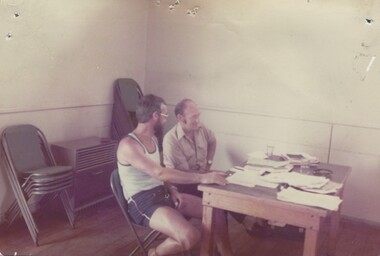
Photograph - Fred Rochow Railways Collection - David Naldrett and Rex McDonnell, 1982
... After his retirement, Fred continued to share his love of steam miniature trains with the community. The first railway union in the world was created in Melbourne in 1861 when twenty locomotive drivers banded together to form the Locomotive Engine Drivers Association of Victoria. ...After his retirement, Fred continued to share his love of steam miniature trains with the community. The first railway union in the world was created in Melbourne in 1861 when twenty locomotive drivers banded together to form the Locomotive Engine Drivers Association of Victoria. ...The Fred Rochow Railways Collection incorporates photos related to the operation of the Wodonga Railway Station including different types of trains and railways staff C. 1930 – 1990. It was donated to the Wodonga Historical Society by Fred Rochow, a railwayman who spent many years based in Wodonga. He joined the Victorian Railways on 17th June l947 and retired in 1988. For some time, he was a member of the Australian Federated Union of Locomotive Enginemen and served a term as a member of the Trades Hall Council. He had an extensive knowledge of the struggles that took place to achieve better conditions for railway workers. Fred worked for many years as a fireman and then worked his way up the ranks to driver, experiencing many changes from the days of steam locomotives through to diesel trains, locomotives and even the modern XPT train. He worked throughout Victoria at different stages of his career, with his final working years focused on the northeast of Victoria and the Albury to Melbourne line. After his retirement, Fred continued to share his love of steam miniature trains with the community. The first railway union in the world was created in Melbourne in 1861 when twenty locomotive drivers banded together to form the Locomotive Engine Drivers Association of Victoria. The forerunner to the A.F.U.L.E., the Association continues today and is the oldest continuous railway union in the world.This collection has local and statewide significance as it captures images of trains, locomotives and personnel who operated the railway services in Wodonga and throughout Northeast Victoria. The railways played a critical role in opening up Victoria and connecting Australia for trade, business, social communication and transport.A photo of David Naldrett, AFULE Chairman and Rex McDonnell, Branch Secretary, conducting a meeting in Wodonga in 1982. AFULE is the Australian Federated Union of Locomotive Employees.railways wodonga, fred rochow, afule, railways workers unions -
 Wodonga & District Historical Society Inc
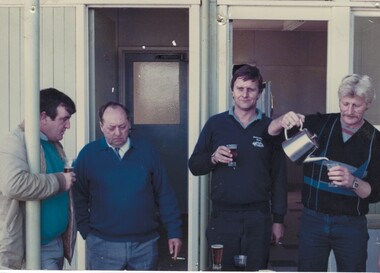
Photograph - Fred Rochow Railways Collection - Group of 4 men in Wodonga
... After his retirement, Fred continued to share his love of steam miniature trains with the community The first railway union in the world was created in Melbourne in 1861 when twenty locomotive drivers banded together to form the Locomotive Engine Drivers Association of Victoria. ...After his retirement, Fred continued to share his love of steam miniature trains with the community The first railway union in the world was created in Melbourne in 1861 when twenty locomotive drivers banded together to form the Locomotive Engine Drivers Association of Victoria. ...The Fred Rochow Railways Collection incorporates photos related to the operation of the Wodonga Railway Station including different types of trains and railways staff C. 1930 – 1990. It was donated to the Wodonga Historical Society by Fred Rochow, a railwayman who spent many years based in Wodonga. He joined the Victorian Railways on 17th June l947 and retired in 1988. For some time, he was a member of the Australian Federated Union of Locomotive Enginemen and served a term as a member of the Trades Hall Council. He had an extensive knowledge of the struggles that took place to achieve better conditions for railway workers. Fred worked for many years as a fireman and then worked his way up the ranks to driver, experiencing many changes from the days of steam locomotives through to diesel trains, locomotives and even the modern XPT train. He worked throughout Victoria at different stages of his career, with his final working years focused on the northeast of Victoria and the Albury to Melbourne line. After his retirement, Fred continued to share his love of steam miniature trains with the community The first railway union in the world was created in Melbourne in 1861 when twenty locomotive drivers banded together to form the Locomotive Engine Drivers Association of Victoria. The forerunner to the A.F.U.L.E., the Association continues today and is the oldest continuous railway union in the world. A.R.U. - The Australian Railways Union formed in September 1920 with the amalgamation of the Queensland Railways Union, the New South Wales Amalgamated Railway and Tramway Service Association, the Victorian Railway Union, the Railway and Tramway Employees Association of South Australia and the Tasmanian Railway Union. It was the first Australian all-grades organisation of railway workers and was federally registered on 8 February 1921. In 1993 the ARU merged with other unions to form the Rail Tram & Bus Industry Union.This collection has local and statewide significance as it captures images of trains, locomotives and personnel who operated the railway services in Wodonga and throughout Northeast Victoria. The railways played a critical role in opening up Victoria and connecting Australia for trade, business, social communication and transport.A group 4 men in Wodonga. Possibly at branch union meeting.Left to right: Driver R. Heathcote AFULE Branch Secretary; Guard J. Young, ARU Branch Secretary; Driver S. Withers; P. Murnane.fred rochow, victorian railways wodonga, railway employees wodonga, railway trade unions -
 Wodonga & District Historical Society Inc
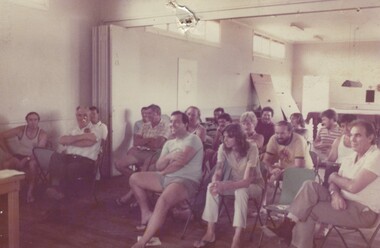
Photograph - Fred Rochow Railways Collection - Members at A.F.U.L.E meeting in Wodonga
... After his retirement, Fred continued to share his love of steam miniature trains with the community The first railway union in the world was created in Melbourne in 1861 when twenty locomotive drivers banded together to form the Locomotive Engine Drivers Association of Victoria. ...After his retirement, Fred continued to share his love of steam miniature trains with the community The first railway union in the world was created in Melbourne in 1861 when twenty locomotive drivers banded together to form the Locomotive Engine Drivers Association of Victoria. ...The Fred Rochow Railways Collection incorporates photos related to the operation of the Wodonga Railway Station including different types of trains and railways staff C. 1930 – 1990. It was donated to the Wodonga Historical Society by Fred Rochow, a railwayman who spent many years based in Wodonga. He joined the Victorian Railways on 17th June l947 and retired in 1988. For some time, he was a member of the Australian Federated Union of Locomotive Enginemen and served a term as a member of the Trades Hall Council. He had an extensive knowledge of the struggles that took place to achieve better conditions for railway workers. Fred worked for many years as a fireman and then worked his way up the ranks to driver, experiencing many changes from the days of steam locomotives through to diesel trains, locomotives and even the modern XPT train. He worked throughout Victoria at different stages of his career, with his final working years focused on the northeast of Victoria and the Albury to Melbourne line. After his retirement, Fred continued to share his love of steam miniature trains with the community The first railway union in the world was created in Melbourne in 1861 when twenty locomotive drivers banded together to form the Locomotive Engine Drivers Association of Victoria. The forerunner to the A.F.U.L.E., the Association continues today and is the oldest continuous railway union in the world.This collection has local and statewide significance as it captures images of trains, locomotives and personnel who operated the railway services in Wodonga and throughout Northeast Victoria. The railways played a critical role in opening up Victoria and connecting Australia for trade, business, social communication and transport.A group members at a branch meeting of the A.F.U.L.E in Wodonga.Left to right: Mick Bergin, Mick Seymour, Mick O’Brien, Les Hallawell, John Wortman, John Hickey, Fred Rochow, Kevin Hammond, Ray Newton, Paul Hines, Peter Murnane, Paul Byrne, Keith Porter, Benny Hill, Mick Mathews, Keith Moore.fred rochow, victorian railways wodonga, railway employees wodonga, railway trade unions, australian federated union of locomotive enginemen -
 Flagstaff Hill Maritime Museum and Village
Book - Semi Biographical, George Meredith, The Ordeal of Richard Feverel, 1909
... loves a girl of a lower social class, with both men self-deluded and proud, and the story ending tragically. The story's theme is that Sir Austin Feverel, after his wife's departure, becomes a strict and misogynistic figure who imposes a rigid educational 'System' meant to raise the 'perfect' son, shielded from female influence, until Richard turns twenty-five. ...The Ordeal of Richard Feverel (1859) was George Meredith's first full-length novel. Its subject is the relationship between a cruelly manipulative father and a son who loves a girl of a lower social class, with both men self-deluded and proud, and the story ending tragically. The story's theme is that Sir Austin Feverel, after his wife's departure, becomes a strict and misogynistic figure who imposes a rigid educational 'System' meant to raise the 'perfect' son, shielded from female influence, until Richard turns twenty-five. Richard nonetheless falls for Lucy Desborough, a farmer's niece, defying his father's plans, and the novel follows the fallout, including a scheme by Sir Austin's friend Lord Mountfalcon to have a courtesan seduce Richard, Richard's flight abroad, his return, a duel with Mountfalcon in which he is badly wounded, and Lucy's death after losing her mind from the shock. The novel was drawn from painful personal experience: in 1856, Meredith's wife Mary began an affair with the artist Henry Wallis and, having become pregnant by him, she left the following year, abandoning her young son, whom Meredith raised himself.Hard cover book. The Ordeal of Richard Feverel Author: George Meredith Publisher: Archibald Constable & Co Ltd Date: 1909 Further Information: Red cloth hardcover with lettering and patterning to spine in gilt. The spine has a Library label with an inscription.fictionThe Ordeal of Richard Feverel (1859) was George Meredith's first full-length novel. Its subject is the relationship between a cruelly manipulative father and a son who loves a girl of a lower social class, with both men self-deluded and proud, and the story ending tragically. The story's theme is that Sir Austin Feverel, after his wife's departure, becomes a strict and misogynistic figure who imposes a rigid educational 'System' meant to raise the 'perfect' son, shielded from female influence, until Richard turns twenty-five. Richard nonetheless falls for Lucy Desborough, a farmer's niece, defying his father's plans, and the novel follows the fallout, including a scheme by Sir Austin's friend Lord Mountfalcon to have a courtesan seduce Richard, Richard's flight abroad, his return, a duel with Mountfalcon in which he is badly wounded, and Lucy's death after losing her mind from the shock. The novel was drawn from painful personal experience: in 1856, Meredith's wife Mary began an affair with the artist Henry Wallis and, having become pregnant by him, she left the following year, abandoning her young son, whom Meredith raised himself.shipwrecked-coast, flagstaff-hill, flagstaff-hill-maritime-museum, warrnambool, maritime-museum, shipwreck-coast, flagstaff-hill-maritime-village, shipwrecked-artefact, book, pattison collection, warrnambool library, warrnambool mechanics’ institute, ralph eric pattison, corangamite regional library service, warrnambool city librarian, mechanics’ institute library, victorian library board, warrnambool books and records, warrnambool children’s library, the ordeal of richard feverel, george meredith -
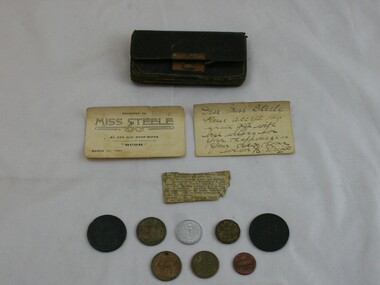 Emerald Museum & Nobelius Heritage Park
Domestic object - Leather purse, Unknown maker, 1907
... love N. Wright' Small leather purse with brass clips and 4 compartments containing hand written note to "Mrs. Steele" from "Mrs Wright" and old coins and tokens. Coins - UK 1943 threepence, 2 X UK 1907 halfpenny (one with hole in it), French 1952 twenty franc, USA one cent, UK 1906 one shilling. ...This purse was a donation to the Fernlea House Opportunity Shop in Emerald which the shop then donated to the Museum. The identity of Miss Steele is a mystery but it is impressive that printed cards were manufactured on the occasion of her leaving her workplace in the city for the "Bush"Small leather purse with brass clips and 4 compartments containing hand written note to "Mrs. Steele" from "Mrs Wright" and old coins and tokens. Coins - UK 1943 threepence, 2 X UK 1907 halfpenny (one with hole in it), French 1952 twenty franc, USA one cent, UK 1906 one shilling. Card -presented to Miss Steele by her old shop mates. "Bush" March 27, 1907. Newspaper cutting - in back pocket, T.W. Bull, disease reader and herbalist - advertisement.Card: printed 'Presented to Miss Steele, by her old shop-mates on the occasion of her leaving for the "BUSH". March 27, 1907.' Card: handwritten 'Dear Miss Steele, Please accept this small gift with best wishes for your happiness in your new home. With love N. Wright'purse, 1900s, coins -
 Returned Nurses RSL Sub-branch
Book - Hardcover book, Betty Jeffrey (1908-2000) et al, White Coolies, 1954
... Of the fifty-three survivors who scrambled ashore, twenty-one were murdered and the remainder taken prisoner. this engrossing record was kept by one of the surviving sisters, Betty Jeffrey, during the three-and-a-half gruelling years of imprisonment that followed. [From Trove] 'To Shirley / With love ...In 1942, a group of Australian Army nursing sisters was evacuated from Malaya a few days before the fall of Singapore. two days later their ship was bombed and sunk by the Japanese. Of the fifty-three survivors who scrambled ashore, twenty-one were murdered and the remainder taken prisoner. this engrossing record was kept by one of the surviving sisters, Betty Jeffrey, during the three-and-a-half gruelling years of imprisonment that followed. [From Trove]Green cloth bound book with a gold compass symbol on the front cover and gold printed heading and author on the spine.non-fictionIn 1942, a group of Australian Army nursing sisters was evacuated from Malaya a few days before the fall of Singapore. two days later their ship was bombed and sunk by the Japanese. Of the fifty-three survivors who scrambled ashore, twenty-one were murdered and the remainder taken prisoner. this engrossing record was kept by one of the surviving sisters, Betty Jeffrey, during the three-and-a-half gruelling years of imprisonment that followed. [From Trove]wwii, world war ii, ww2, betty jeffrey, prisoners of war, australian army nursing service
