
Showing 5 items matching " west pakistan"
-
 Embroiderers Guild, Victoria
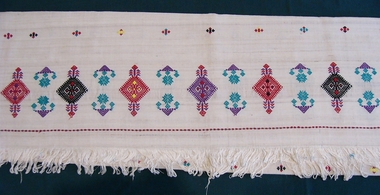
Textile - Rawalpindi Pakistan Stole, c. 1960-80
... ... West Pakistan...Rawalpindi, West Pakistan...Darning Stole 1960-80 West Pakistan Rectangular woven ecru silk fabric ground. ...Purchased by donor for his wife who was a Guild member, now deceased.Rectangular woven ecru silk fabric ground. Silk, pattern darned motifs include triangular amulets, large diamonds, and regular repeat small geometric spot pattern. Main pattern along both ends. Self fringe, both ends.darning, stole, 1960-80, west pakistan -
 Bendigo Military Museum
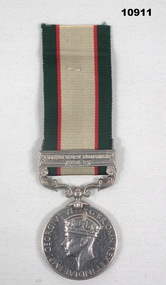
Award - MEDAL, INDIA, Unknown
... The North West Frontier is now Pakistan....The North West Frontier is now Pakistan. Ron Mills Collection Medal India Named to "21077 Sepoy Ibrahim Khan F.C". ...Awarded for minor campaigns in India during 1936-39. The two clasps refer to North West Frontier 1936-37 ad the North West Frontier 1937-39. The North West Frontier is now Pakistan.Medal with ribbon - unmounted. Indian Service Medal 36-39 with 2 clasps.Named to "21077 Sepoy Ibrahim Khan F.C".ron mills collection, medal, india -
 Federation University Art Collection
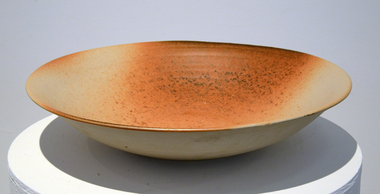
Ceramic, Roswitha Wulff, Woodfired Bowl by Roswitha Wulff, 1986, 1986
... From 1969-70, she worked in North-West Pakistan as a research scholar for the Smithonian Institute and the University of NSW. ...From 1969-70, she worked in North-West Pakistan as a research scholar for the Smithonian Institute and the University of NSW. ..."I am an Australian of German parents born in Persia. I was taught by Peter Rushforth, with a very strong Japanese influence. My work attempts to incorporate these four elements of my history. For form, my influence comes from Art Nouveau, or Jugendstil as it is called in Germany. Techniques are informed by pottery from Japan, China, Korea and Germany. My colours are inspired by the Australian landscape. Using the language of woodfiring, I create a personal vocabulary with new subjects, grammar and syntax, which make each pot a one-off object containing all my diverse influences." (Roswitha Wulff)Roswitha WULFF (1941- ) Born Tabrize, Iran. Arrived Austrqalia c1949 Roswitha Wulff spent her early childhood with her mother, potter Helma Klett, in Germany. In 1964, she obtained a ceramics certificate from the East Sydney Technical College. From 1964-65, she worked with Robin Welch and Ian Sprague at Sprague's Mungeribar Pottery in Upper Beaconsfield, VIC. In 1966 she worked at the Sturt Pottery in Mittagong, NSW under Les Blakebrough. Between 1967 and 1969 Roswitha Wulff travelled overseas, spending 6 monthe with Robin Welch after his return to England and 9 months as a full-time thrower at Briglin Pottery, London, as well as working in potteries in Denmark and Germany. From 1969-70, she worked in North-West Pakistan as a research scholar for the Smithonian Institute and the University of NSW. Returning to Australia in 1970, she set up a workshop in Paddington, NSW, with the help of an Australia Council grant and taught part-time at the East Sydney Technical College and the Willoughby Workshop Art Centre. Since then she has been a lecturer and Head of Ceramics in many institutions, including the National Art School. In the 1990s she moved her studio to Botany Bay, NSW.. While working with the vessel form, she sees her pots as abstract landscapes. Recently she has also been working with wall tiles. During a residency at the Canberra School of Art in 2002, she developed tiles that looked like woodfired pillows with soft rounded rims. In 2007, she used such tiles to create a mural commemorating the Sesquicentenary of St Vincent's Hospital in Paddington. Woodfired stoneware bowl with flay ashSigned on baseroswitha wulff, jan feder, jan feder memorial ceramics collection, woodfire, ceramics, gippsland campus, botany bay studio pottery -
 Mission to Seafarers Victoria
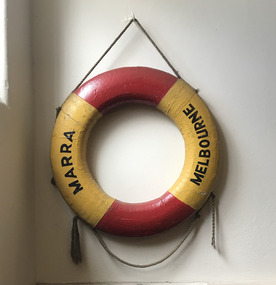
Equipment - Lifebuoy, Marra Melbourne, 1955-1984
... West Australian coast being used on the Ord River Project under 'Stateships' perhaps under lease. The Clydebuilt shipsite states she was renamed Asian Queen in 1976 , Arabian Victory in 1980 and finally Sea Rose in 1981. The ship was scrapped in May 1984 at Gadani Beach, Pakistan...West Australian coast being used on the Ord River Project under 'Stateships' perhaps under lease. The Clydebuilt shipsite states she was renamed Asian Queen in 1976 , Arabian Victory in 1980 and finally Sea Rose in 1981. The ship was scrapped in May 1984 at Gadani Beach, Pakistan ...Marra was a refrigerated cargo ship built by Ardrossan Dry Dock & Ship Building Co. in 1955. The first owner was the Adelaide Steamship Co. Ltd., Melbourne . 1,396 gross tons. Lbd: 233'2" x 37'8" x 14'9". in May 1965 it was sold to the Australian Army and renamed AS3051 (John Monash) and provided a shuttle service from Australia to Vietnam transporting cargo for the Australian Task Force. In September 1974, it was sold to unknown buyers however prior to that sale, she worked the West Australian coast being used on the Ord River Project under 'Stateships' perhaps under lease. The Clydebuilt shipsite states she was renamed Asian Queen in 1976 , Arabian Victory in 1980 and finally Sea Rose in 1981. The ship was scrapped in May 1984 at Gadani Beach, Pakistan. Lifebuoys are an essential piece of equipment on a ship. Because the name of the ships it belongs to is written on it is often the only memorabilia left from the ship when it is sent to scrapyard.Round buoy decorated in red and yellow sections with the word "Marra Melbourne" painted on the front. There is a rope that is strung through sections of the exterior.In black paint on the front of the buoy: "MARRA MELBOURNE"safety wheel, lifebelt, water wheely, ring buoy, lifering, lifesaver, life donut, life preserver, perry buoy, lifebuoy, lifesaving equipment, rescue, drowning, vietnam war, adelaide steamship, john monash, australian army, life buoy -
 Monbulk RSL Sub Branch
Book, David Kilcullen, The accidental guerrillan : Fighting small wars in the midst of a big one, 2009
... Pakistan. He explains that today's conflicts are a complex hybrid of contrasting trends: local social networks and worldwide movements; traditional and postmodern culture; local insurgencies seeking autonomy and a broader terrorist campaign. He warns that the United States has tended to conflate these trends, blurring the distinction between local and global struggles and thereby enormously complicating our challenges. The West ...n The Accidental Guerrilla, Kilcullen takes us on the ground to uncover the face of modern warfare, illuminating both the global challenge (the "War on Terrorism") and small wars across the world: Afghanistan, Iraq, Indonesia, Thailand, East Timor, and Pakistan. He explains that today's conflicts are a complex hybrid of contrasting trends: local social networks and worldwide movements; traditional and postmodern culture; local insurgencies seeking autonomy and a broader terrorist campaign. He warns that the United States has tended to conflate these trends, blurring the distinction between local and global struggles and thereby enormously complicating our challenges. The West has continually misidentified insurgents with limited aims and legitimate grievances - "accidental guerrillas" - as members of a unified worldwide terror network. We must learn how to disentangle these strands, develop strategies that deal with global threats, avoid local conflicts where possible, and win them where necessary.Index, ill, p.346.non-fictionn The Accidental Guerrilla, Kilcullen takes us on the ground to uncover the face of modern warfare, illuminating both the global challenge (the "War on Terrorism") and small wars across the world: Afghanistan, Iraq, Indonesia, Thailand, East Timor, and Pakistan. He explains that today's conflicts are a complex hybrid of contrasting trends: local social networks and worldwide movements; traditional and postmodern culture; local insurgencies seeking autonomy and a broader terrorist campaign. He warns that the United States has tended to conflate these trends, blurring the distinction between local and global struggles and thereby enormously complicating our challenges. The West has continually misidentified insurgents with limited aims and legitimate grievances - "accidental guerrillas" - as members of a unified worldwide terror network. We must learn how to disentangle these strands, develop strategies that deal with global threats, avoid local conflicts where possible, and win them where necessary.guerrilla warfare, insurgencies
