
Showing 19 items matching " wimbledon court"
-
 Glen Eira Historical Society
Document - Wimbledon Tennis Courts
... ... Wimbledon Court...Typed notes on Wimbledon Tennis Courts Alexandra Street St. Kilda East. ...Typed notes on Wimbledon Tennis Courts Alexandra Street St. Kilda East. ...This file contains one item. Typed notes on Wimbledon Tennis Courts Alexandra Street St. Kilda East. Included is extra research by Margaret Dunbar about tennis courts and Wimbledon Court flats. Further research included about Holmbush Independent Primary School by Claire Barton.dunbar margaret, barton claire, alexandra street, st. kilda east, katos spero, bickham mr., mairs mrs., wimbledon court, masada hospital, holmbush school, balaclava road, tennis courts, tennis -
 Tennis Australia
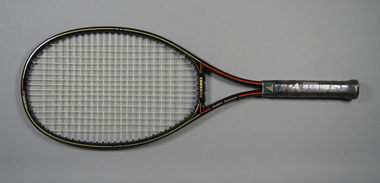
Racquet, Circa 1983
... A Pro Kennex 'Graphite Dominator' tennis racquet, strung with Wimbledon 'Court 5' nylon strings. Racquet features original plastic wrap around handle. ...Tennis A Pro Kennex 'Graphite Dominator' tennis racquet, strung with Wimbledon 'Court 5' nylon strings. Racquet features original plastic wrap around handle. ...A Pro Kennex 'Graphite Dominator' tennis racquet, strung with Wimbledon 'Court 5' nylon strings. Racquet features original plastic wrap around handle. Materials: Graphite, Paint, Plastic, Adhesive tape, Leather, Ink, Adhesive label, Nylon, Metaltennis -
 Tennis Australia
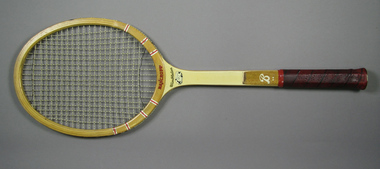
Racquet, Circa 1950
... Throat features model name, and a decal image of Wimbledon main court. 'B' trademark features on lower shaft. ...Throat features model name, and a decal image of Wimbledon main court. 'B' trademark features on lower shaft. ...A Bancroft Wimbledon tennis racquet, with plastic whipping from shoulders to shaft, and leather handle with patterned perforations. Bancroft logo features across base of head. Throat features model name, and a decal image of Wimbledon main court. 'B' trademark features on lower shaft. Materials: Wood, Nylon, Leather, Glue, Lacquer, Metal, Ink, Plastic, Cloth, Adhesive tape, Paint, Stringtennis -
 Tennis Australia
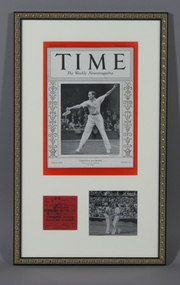
Collage, 1936, 1937
... Framed collage of three components: 1) Time magazine cover of Sept 13, 1937 featuring Gottfreid von Cramm; 2) stamped ticket to Wimbledon Centre Court Championship match on July 4, 1936; 3) original photograph of von Cramm and Peryy shaking hands over the net in a crowded stadium. ...Tennis Framed collage of three components: 1) Time magazine cover of Sept 13, 1937 featuring Gottfreid von Cramm; 2) stamped ticket to Wimbledon Centre Court Championship match on July 4, 1936; 3) original photograph of von Cramm and Peryy shaking hands over the net in a crowded stadium. ...Framed collage of three components: 1) Time magazine cover of Sept 13, 1937 featuring Gottfreid von Cramm; 2) stamped ticket to Wimbledon Centre Court Championship match on July 4, 1936; 3) original photograph of von Cramm and Peryy shaking hands over the net in a crowded stadium. UV glass. Materials: Paper, Ink, Cardboard, Metal, Wood, Adhesive tapetennis -
 Tennis Australia
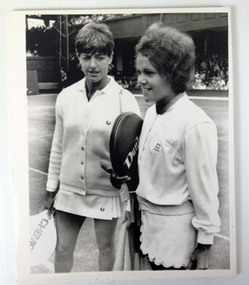
Photographic print, 1971
... Photograph of Margaret Court and Evonne Goolaging standing on a court at Wimbledon when playing as a doubles team, 1971. ...Tennis Photograph of Margaret Court and Evonne Goolaging standing on a court at Wimbledon when playing as a doubles team, 1971. ...Photograph of Margaret Court and Evonne Goolaging standing on a court at Wimbledon when playing as a doubles team, 1971. Press photo (credit UPI). Materials: Photographic emulsion, Papertennis -
 Tennis Australia
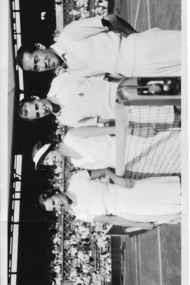
Photographic print, 1934
... Black and white photographic print of four tennis players at the net on a tennis court. Wimbledon Mixed Doubles Final 1934. Handwritten on back of print: 'Dorothy Round, Eileen Whittingstall, Bunny Austin, Miki''. ...Tennis Black and white photographic print of four tennis players at the net on a tennis court. Wimbledon Mixed Doubles Final 1934. Handwritten on back of print: 'Dorothy Round, Eileen Whittingstall, Bunny Austin, Miki''. ...Black and white photographic print of four tennis players at the net on a tennis court. Wimbledon Mixed Doubles Final 1934. Handwritten on back of print: 'Dorothy Round, Eileen Whittingstall, Bunny Austin, Miki''. Actually it is Dorothy Shepherd-Barron, not Whittingstall, and Miki is Ryuki Miki, Japanese player. Miki and Round were victorious. Part of collection of photos taken/owned by Australian player D.P. Turnbull - found in collection in a vinyl album marked 'Photos by D P Turnbull'.. Materials: Paper, Photographic emulsiontennis -
 Flagstaff Hill Maritime Museum and Village
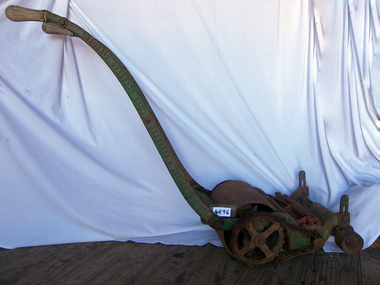
Machine - Lawn Mower, Alex Shanks & Sons Ltd Engineers Arbroth London, 1903-1925
... Although Shanks himself died at a young age, his son showed the mowers at the Great Exhibition in 1851 which led to a successful business that continued into the 20th century, supplying mowers to cut the tennis courts of Wimbledon, the cricket grounds at Lords and the Old golf course at St Andrews. ...Although Shanks himself died at a young age, his son showed the mowers at the Great Exhibition in 1851 which led to a successful business that continued into the 20th century, supplying mowers to cut the tennis courts of Wimbledon, the cricket grounds at Lords and the Old golf course at St Andrews. ...The firm of Alexander Shanks & Sons Ltd of Arbroath, were engineers, founders and boiler makers the company was incorporated in the year 1893. At the Dens Iron Works, purchased by the firm in the same year, a wide variety of products was manufactured including cranes, hoists, pumps and lawnmowers. In the 1960s the firm was taken over by Alexander Shanks (1801-1845) was an Inventor of the modern lawnmower, who lived in Arbroath Scotland. While credit is usually given to the Englishman Edwin Budding (1795-1846) for the invention of the lawnmower, it is Shanks' machine which was the direct predecessor of the modern mower. Shanks' innovation was a machine which rolled the grass as well as mowing it. Although Shanks himself died at a young age, his son showed the mowers at the Great Exhibition in 1851 which led to a successful business that continued into the 20th century, supplying mowers to cut the tennis courts of Wimbledon, the cricket grounds at Lords and the Old golf course at St Andrews. The firm was also well known for the manufacture of portable steam engines and steam cranes. In 1968, the company was taken over by Giddings & Lewis Fraser Ltd, Engineers of Arbroath. The subject item is a good example of an early lawn mower made by the company that is credited with being the first to patent and manufacture such a machine. The company Alexander Shanks founded was known throughout the world as significant manufactures of large steam machines used from the middle of the 19th century to the first quarter of the 20th century. The subject item is now regarded as a collector's item.Lawnmower, cast iron handles has two wooden ends and two wooden rollers at front. Blades driven by chain fixed to metal roller. Shanks's Standard Chain. Shanks's Standard Chain Arbroth London. Alex Shanks & Sons Ltd Engineers Arbroth Londonflagstaff hill, warrnambool, shipwrecked coast, flagstaff hill maritime museum, maritime museum, shipwreck coast, flagstaff hill maritime village, great ocean road, hand mower, lawn mower, mower, shanks, arboth -
 City of Melbourne Libraries
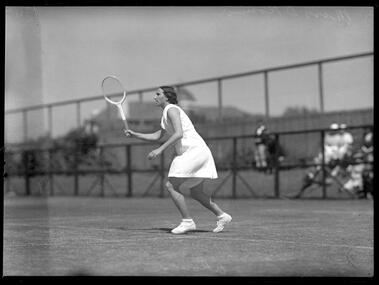
Photograph, Bull, Hugh Jones, 1897-1993, Tennis player, Dorothy Round, Albert Grounds, Melbourne
... British player Henry “Bunny” Austin was the first top male player to wear shorts at Centre Court Wimbledon in 1933, and his sister Joan Lycett nee Austin became the first female player to play without stockings on Centre Court, appearing with bare legs and ankle socks in 1931. ...British player Henry “Bunny” Austin was the first top male player to wear shorts at Centre Court Wimbledon in 1933, and his sister Joan Lycett nee Austin became the first female player to play without stockings on Centre Court, appearing with bare legs and ankle socks in 1931. ...Dorothy Round in shorts English-born Dorothy Round (1909-1982) plays tennis at Albert Park Cricket Ground, wearing her signature white sleeveless dress with divided skirt, pleated to form loose shorts. Dorothy won Wimbledon in 1934 and 1937, and the Australian Open in 1935. In the early 1930s, many women players in Europe and USA swapped stockings and long skirts for bare legs, short skirts and shorts. In October 1933, Mr Harley Malcolm, Secretary of Lawn Tennis Association Australia (LTAA) declared, “I consider shorts not regulation costume and would stop both men and women, particularly women, wearing them. I think women’s desire to strut themselves in such a costume is unreasonable.” However by November, the Victorian Lawn Tennis Association (VLTA) officially allowed shorts at Kooyong for both sexes. At the July 1934 Wimbledon Women’s Final, played in front of the King and Queen, Dorothy wore a sleeveless dress with the skirt divided. Her American competitor, Helen Jacobs, wore white tailored shorts with a black stripe on either side, described as “mannish, though businesslike”. In October, Australian tennis player Mrs Nell Hopman warned, “When Miss Dorothy Round arrives in a few weeks’ time, the LTAA will have to reconsider its decision about women playing in dresses, as she is sure to bring a trunkful of shorts. Miss Round has a “shorts only” rule which I fancy she will stick to here. She is the most stylish player I saw abroad.” The papers also reported that “Mrs Hopman saw no “he girls” among tennis players in Europe. Even the almost universal rule for shorts did not make them look masculine.” Dorothy said, “I wear shorts because they do not get in the way as a frock does. Mine are made in one piece and this avoids any tightness around the waist.” Featured in "Newsworthy: Melbourne in photographs 1933-1936" exhibition at East Melbourne Library, October to December 2023. Exhibition caption by project volunteer, Fiona Collyer. Photographer notations on slide: "Mrs D Round; D Round B6" Description: Dorothy Round plays tennis at Albert Grounds, Albert Park, Melbourne. She is wearing her signature white sleeveless dress with divided skirt, pleated to form loose shorts. Research by project volunteer, Fiona Collyer: Dorothy Round (1909-1982) was an English tennis champion from Dudley, Worcestershire. She won the Wimbledon Women’s Singles in 1934 and 1937. In 1935 she won the Australian Championships Women’s Singles in Melbourne. Dorothy won the Mixed Doubles at Wimbledon in 1934, 1935 and 1936. Dorothy was a staunch Methodist and taught Sunday School at Dudley Wesleyan Methodist Church throughout her career. She did not drink, smoke, dance or play tennis on Sundays and declined to compete in the 1933 French Open as tennis officials refused to comply to her scheduling preferences of No Sundays. During the Wightman Cup in New York when play was rained out on the Saturday, Dorothy refused to return on the Sunday. Officials reluctantly agreed to reschedule the clash for Monday, where she put in a sub par performance, prompting the New York Times to quip “Miss Round doesn’t play on Sundays, and doesn’t play particularly well on Mondays!”. In the early 1930s many women tennis players in Europe and USA abandoned their stockings and long skirts for bare legs, short skirts and shorts and some men swapped their long flannel trousers for shorts. British player Henry “Bunny” Austin was the first top male player to wear shorts at Centre Court Wimbledon in 1933, and his sister Joan Lycett nee Austin became the first female player to play without stockings on Centre Court, appearing with bare legs and ankle socks in 1931. In 1933 Mr Harley Malcolm, Secretary of the Lawn Tennis Association Australia (LTAA) and referee of big tournaments , said “the rules say regulation costume must be worn – I consider shorts are not regulation costume and would stop both men and women, particularly women, wearing them. I think women’s desire to strut themselves in such a costume is unreasonable.” (Herald 5/10/1933) However, by November 1933 the Victorian Lawn Tennis Assn officially allowed shorts as regulation dress at Kooyong for both sexes. One speaker suggested that as the majority of women were knock-kneed, the privilege of wearing shorts would not be taken up extensively by them. He added that women were not intended by nature to wear such garments. Another member mentioned that men were rather handsome objects and “works of art” and would carry off the short pants vogue nicely. (Sun Sydney 15/11/33) At the 1934 Wimbledon Singles Finals, playing in front of King George V and Queen Mary, Dorothy wore her signature outfit of sleeveless white dress with the skirt divided and pleated to form loose shorts and American Helen Jacobs wore white tailored shorts with a black stripe on either side described as “mannish, though business like.” In the lead up to Dorothy’s arrival in Australia to compete in the Australian Championship of 1935, there was much speculation written in the press about Dorothy’s preference for wearing shorts. Tennis player Mrs Nell Hopman warned “When Miss Dorothy Round arrives in a few weeks’ time, the Australian Lawn Tennis Association will have to reconsider its decision about women playing in dresses, as she is sure to bring a trunkful of shorts.” “Miss Round has a “shorts only” rule which I fancy she will stick to here. She is the most stylish player abroad.” Mrs Hopman saw no “he girls” among the tennis players in Europe. Even the almost universal rule for shorts did not make them look masculine. Mrs Hopman brought back a couple of pleated pairs that tennis player and designer Mrs Fearnley-Whittingstall (nee Eileen Bennett) made popular and worn by most English players. “They are really quite radical for they look no more startling than a short, pleated skirt” she said. (Newcastle Sun 1/10/1934) Writing for the Sydney Morning Herald 6/12/34, Dorothy said ”I have heard that a photograph of a player wearing shorts was sent to the Queen for her approval and I understand that she said in reply “that they were very attractive”. The Queen is a frequent and interested visitor to Wimbledon so this story is most credible and possibly explains the lack of official opposition to shorts this year.” “I wear shorts because they do not get in the way as a frock does. You have probably noticed that mine are made in one piece and this avoids any tightness around the waist. I don’t know whether shorts have come to stay. They do not suit everybody and the majority of the men don’t like the women in them and this may help condemn the fashion. I really think the men dislike them because too many people who shorts obviously do not suit rushed to be in the fashion and the result was devastating. For my part, I hope that this comfortable fashion endures.” Dorothy’s doubles partner, English tennis champion Fred Perry, did not approve of shorts for men and was particularly perturbed at the idea of women wearing them. Fred always wore long, white flannel trousers and white collared polo shirt on the tennis court. In July 1935 Dorothy took up a post as a dress designer and sportswear design advisor at British outfitters Jaeger. She published two books – “Modern Lawn Tennis” in 1935 and ”Tennis for Girls” in 1938 – described as cheerful and sensible guides. In 1937, Dorothy married Dr Douglas Leigh Little at Dudley Wesleyan Methodist Church. Her wedding dress was designed by renowned fashion designer Teddy Tinling who specialised in designing tennis dresses. (Tinling designed the dress worn by Billie Jean King for the famous “Battle of the Sexes” tennis match against Bobby Riggs in 1973.) News reel co. Gaumont British News filmed the wedding, showing 10,000 people, mostly women, surging towards the couple, describing it as a riot, and quipping that Dorothy’s forehand was useful when cutting the wedding cake. The city of Dudley gifted the couple an antique walnut bedroom suite chosen by them. Dorothy and Douglas had a son, Ian, and a daughter, Patricia. She gave up competitive tennis to coach and write newspaper articles. In later life she took up golf. Dorothy died of cancer in 1982 aged 73. She was inducted into the International Tennis Hall of Fame 1986. In 2004 a bronze bust of Dorothy was installed at Wimbledon, and in 2013 a life size bronze statue was erected at Priory Park, Dudley. References: MRS. HOPMAN RETURNS (1934, October 1). The Newcastle Sun (NSW : 1918 - 1954), p. 9. Retrieved September 20, 2023, from http://nla.gov.au/nla.news-article166292409 FIGURED IT OUT (1933, November 15). The Sun (Sydney, NSW : 1910 - 1954), p. 13 (FINAL EXTRA). Retrieved September 20, 2023, from http://nla.gov.au/nla.news-article230199908 FASHIONS OF THE TENNIS COURTS. (1934, December 6). The Sydney Morning Herald (NSW : 1842 - 1954), p. 7 (Women's Supplement). Retrieved September 20, 2023, from http://nla.gov.au/nla.news-article28021332 Leading Tennis Referee Condemns Wearing of Shorts (1933, October 5). The Herald (Melbourne, Vic. : 1861 - 1954), p. 11. Retrieved September 20, 2023, from http://nla.gov.au/nla.news-article243193607 DOROTHY ROUND Chooses Going-Away TROUSSEAU (1937, September 4). The Australian Women's Weekly (1933 - 1982), p. 39. Retrieved September 20, 2023, from http://nla.gov.au/nla.news-article51588090 Ban On Shorts For Tennis Girls? (1934, April 15). The Sun (Sydney, NSW : 1910 - 1954), p. 3. Retrieved February 5, 2024, from http://nla.gov.au/nla.news-article230535547 Dorothy Round Little - one of Britain's greatest champions, 13 September 2009, Tennis Forum, https://www.tennisforum.com/threads/dorothy-round-little-one-of-britains-greatest-champions.409612/Photographer notations on slide: "Mrs D Round; D Round B6".tennis, clothing and dress, 1930-1939 -
 Tennis Australia
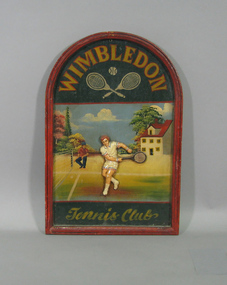
Artwork, Circa 1970
... Painted wood panel with carved relief with title text 'WIMBLEDON/TENNIS CLUB'. Curved upper edge. Depicts trees, house and a tennis court with a male figure seated next to net. ...Tennis Painted wood panel with carved relief with title text 'WIMBLEDON/TENNIS CLUB'. Curved upper edge. Depicts trees, house and a tennis court with a male figure seated next to net. ...Painted wood panel with carved relief with title text 'WIMBLEDON/TENNIS CLUB'. Curved upper edge. Depicts trees, house and a tennis court with a male figure seated next to net. Separate piece of wood carved in relief and attached to surface depicts a male tennis player in action. Materials: Pigment, Woodtennis -
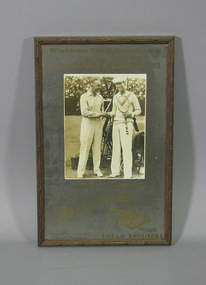 Tennis Australia
Black and white photographic print, 1933
... A black and white photograph of Jack Crawford and Ellsworth Vines, shaking hands, on court, before a tennis match. Inscription across mount: WIMBLEDON TENNIS CHAMPIONSHIP/MEN'S SINGLES FINAL, 1933/JACK CRAWFORD v. ...Tennis A black and white photograph of Jack Crawford and Ellsworth Vines, shaking hands, on court, before a tennis match. Inscription across mount: WIMBLEDON TENNIS CHAMPIONSHIP/MEN'S SINGLES FINAL, 1933/JACK CRAWFORD v. ...A black and white photograph of Jack Crawford and Ellsworth Vines, shaking hands, on court, before a tennis match. Inscription across mount: WIMBLEDON TENNIS CHAMPIONSHIP/MEN'S SINGLES FINAL, 1933/JACK CRAWFORD v. H. ELLSWORTH VINES/.../THEY'RE WEARING/SNUGFIT/NO BUTTONS/.../CREAM TROUSERS. Materials: Paper, Ink, Cardboard, Glass, Metal, Photographic emulsiontennis -
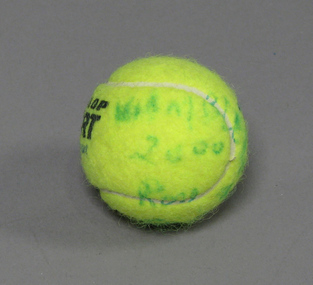 Tennis Australia
Ball, 2000
... A Dunlop 'Fort All Court', tennis ball, with Perrier advertisement. Autograph, in blue marker, reads: WIMBLEDON/2000/ROSS/CASE. ...Tennis A Dunlop 'Fort All Court', tennis ball, with Perrier advertisement. Autograph, in blue marker, reads: WIMBLEDON/2000/ROSS/CASE. ...A Dunlop 'Fort All Court', tennis ball, with Perrier advertisement. Autograph, in blue marker, reads: WIMBLEDON/2000/ROSS/CASE. Materials: Rubber, Felt, Inktennis -
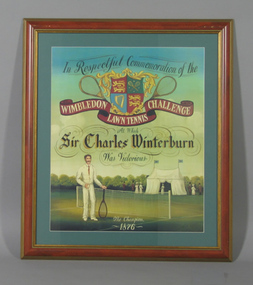 Tennis Australia
Reproduction, 1876
... Reproduction of painting: Depicting heraldry and male tennis player on lawn tennis court with several spectators around a marquee. Featuring text: 'In Respectful Commemoration of the Wimbledon Lawn Tennis Challenge/at which/Sir Charles Winterburn/was victorious/The Champion/ 1876'. ...Tennis Reproduction of painting: Depicting heraldry and male tennis player on lawn tennis court with several spectators around a marquee. Featuring text: 'In Respectful Commemoration of the Wimbledon Lawn Tennis Challenge/at which/Sir Charles Winterburn/was victorious/The Champion/ 1876'. ...Reproduction of painting: Depicting heraldry and male tennis player on lawn tennis court with several spectators around a marquee. Featuring text: 'In Respectful Commemoration of the Wimbledon Lawn Tennis Challenge/at which/Sir Charles Winterburn/was victorious/The Champion/ 1876'. Materials: Pigment, Paper, Metal, Wood, Glass, Cardboardtennis -
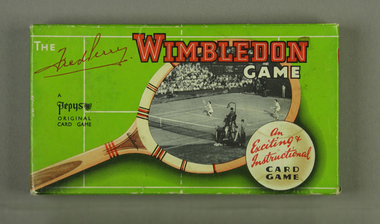 Tennis Australia
Card game, Circa 1962
... Wimbledon' game. Contains four identical rules sheets, a wood ball, a dice, fourteen 'serve' cards, 45 stroke cards, a cardboard 'court' and a rules booklet. ...Wimbledon' game. Contains four identical rules sheets, a wood ball, a dice, fourteen 'serve' cards, 45 stroke cards, a cardboard 'court' and a rules booklet. ...'Fred Perry's Wimbledon' game. Contains four identical rules sheets, a wood ball, a dice, fourteen 'serve' cards, 45 stroke cards, a cardboard 'court' and a rules booklet. Complete set. Materials: Cardboard, Paper, Ink, Wood, Glue, Plastictennis -
 Tennis Australia
Book, Circa 1984
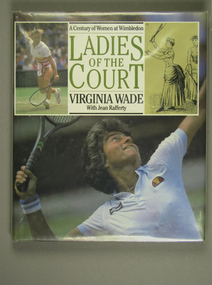
... Book: 'LADIES OF THE COURT: A CENTURY OF WOMEN AT WIMBLEDON'. Hardcover with dust jacket. ...Tennis Book: 'LADIES OF THE COURT: A CENTURY OF WOMEN AT WIMBLEDON'. Hardcover with dust jacket. ...Book: 'LADIES OF THE COURT: A CENTURY OF WOMEN AT WIMBLEDON'. Hardcover with dust jacket. First published 1984. Materials: Ink, Paper, Cardboard, Plastictennis -
 Wodonga & District Historical Society Inc
Book - Ancestors of a Wimbledon Champion, June M Shanahan, 2012
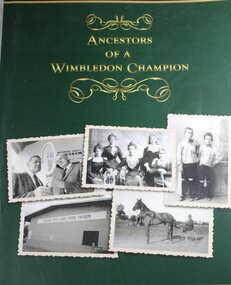
... ancestry margaret court nee smith...wimbledon...margaret court margaret smith ancestry margaret court nee smith wimbledon champions australian tennis players Ancestors of a Wimbledon Champion (2010) by June Shanahan tells the story of June’s sister Margaret Court (née Smith) and her ancestors. ...Ancestors of a Wimbledon Champion (2010) by June Shanahan tells the story of June’s sister Margaret Court (née Smith) and her ancestors. Margaret grew up in Albury and became one of the greatest tennis players that the world has seen.non-fictionAncestors of a Wimbledon Champion (2010) by June Shanahan tells the story of June’s sister Margaret Court (née Smith) and her ancestors. Margaret grew up in Albury and became one of the greatest tennis players that the world has seen.margaret court, margaret smith, ancestry margaret court nee smith, wimbledon champions, australian tennis players -
 City of Melbourne Libraries
Photograph, Bull, Hugh Jones, 1897-1993, Tennis player Fred Perry, Kooyong
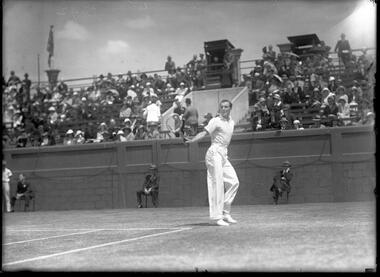
... Fred’s prize for winning Wimbledon was a £25 shopping voucher and a replica trophy. There was no on-court presentation; instead it was the custom to offer congratulations in the dressing rooms. ...Fred’s prize for winning Wimbledon was a £25 shopping voucher and a replica trophy. There was no on-court presentation; instead it was the custom to offer congratulations in the dressing rooms. ...Tennis champion Fred Perry backhands the ball at Kooyong, 1934 “I didn’t aspire to be a good sport, “champion” was good enough for me.” Fred Perry (1909-1995) was an English tennis champion who won eight Grand Slam titles including Wimbledon in 1934, 1935, 1936 and the Australian Open in 1934. Australian sports journalist Alan Trengove remarked, “When Perry walked out to play in his crisp white flannels and matching white blazer, thousands of female hearts missed a beat!” In 1935, Fred and Dorothy defeated Harry and Nell Hopman in the Wimbledon mixed doubles, and in 1936 they won against America. Fred started a successful sportswear brand in 1952, which continues today. Fred initially wanted a smoking pipe as the emblem as he was an enthusiastic smoker, but was talked out of it because it wouldn’t appeal to women. The familiar laurel was used instead. Featured in "Newsworthy: Melbourne in photographs 1933-1936" exhibition at East Melbourne Library, October to December 2023. Exhibition caption by project volunteer Fiona Collyer. Photographer notations on slide: "F. Perry 1934 Action B42" Photograph taken at Kooyong, Melbourne, but used in article about Wimbledon 1934. Published: The Age 7 July 1934 p 13 Published title: "THE FINAL STAGE." Published caption: F. J. Perry (England) Trove article identifier: http://nla.gov.au/nla.news-article205525840 Research by project volunteer Fiona Collyer: Frederick John Perry, 18 May 1909 to 2 Feb 1995 Fred Perry was an English tennis and table-tennis champion. He won eight Grand Slam titles – Wimbledon Gentlemen’s Singles, US Open three times, Australian Open and French Open once each. Fred had natural hand-to eye co-ordination, solid strokes and a devastating forehand that he used soon after the ball bounced. His fierce competitiveness and unabashed confidence gave him the winning edge. Fred was born in Stockport, Cheshire in 1909. His father, Samuel, a committed socialist, was a cotton spinner who became Secretary of the Co-Operative Party and later a Labour and Co-Operative Party M.P. When Fred was nine years old the family moved to Ealing, London. In 1929, at the age of 19, Fred became the World Champion at table-tennis – a new international sport at the time. He then decided to switch from table-tennis to tennis after his father told him to stop spending so much time in the smoke-filled halls that held table-tennis events. “You look like death warmed up.” he said. In the tennis world, Fred was regarded as an upstart intruder, and was the victim of snobbery and prejudice for his working class background. Fred trained with Arsenal Football Club in defiance of the LTA (Lawn Tennis Association) which had a dim view of extra-curricular exercise. His sarcastic toff-baiting call of “very clevah” when an opponent played a good shot and his habit of vaulting over the net whenever he won a match made Fred compelling to watch. Fred’s prize for winning Wimbledon was a £25 shopping voucher and a replica trophy. There was no on-court presentation; instead it was the custom to offer congratulations in the dressing rooms. One of the defining moments of Fred’s career came on the day he won Wimbledon for the first time in 1934. He was in the bathtub after the match when he over-heard former tennis player Brame Hillyard, a committee member of the All-England Club talking to Australian runner-up Jack Crawford. “This was the one day when the best man didn’t win.” Hillyard had brought a bottle of champagne and an All-England neck-tie, which was official recognition of Fred now being a member of one of the sporting world’s most elite clubs. Instead of a formal presentation to Fred, Hillyard draped the tie unceremoniously over his seat in the dressing room, handed Jack the bottle of champagne, and left. “Instead of Fred Perry the Champ, I felt like J. Fred Muggs the Chimp!” he said. When Fred finally went professional, an official at LTA told him he would never wear the club sweater again. Fred said “I made sure he wouldn’t have to worry about that, I sent a sleeve to him as a present!” In 1935, RKO offered Fred a contract for two movies at $50,000 each, but he had to turn down the offer as it would be in breach of LTA rules and he would lose his amateur status. In 1935, Fred married American film actress Helen Vinson in Harrison, New York, waking up a registrar at five minutes to midnight to avoid being married on Friday the thirteenth – “To be on the safe side” they said. In 1936, having been world number one tennis player for three years, Fred quit amateur tennis and moved to America. He joined tennis players Ellsworth Vines and Don Budge on a professional tennis circuit, travelling around US cities and receiving a share of the gate receipts. The All-England Club removed his honorary membership and the tie that went with it – “After all the trouble they’d gone to presenting it to me.” he quipped acidly. Despite being a three-time Wimbledon champion, Fred was barred from playing on LTA affiliated courts, so when he held his pro-tour through the UK in 1937, the matches had to be played on a portable wooden court, transported around by truck to football grounds. Fred was co-owner of the Beverley Hills Tennis Club. The exclusive membership consisted of Hollywood actors, directors, writers and studio heads. At the launch of the re-branded club in 1937, Fred played a doubles match with Charlie Chaplin, Groucho Marx and Ellsworth Vines, which he won with Charlie. Watching on was a Who’s Who of Hollywood actors including Barbara Stanwyck, Joan Crawford, the Marx Brothers, Errol Flynn, and Ronald Coleman to name a few. Fred was romantically linked to Hollywood actresses Marlene Dietrich, Jean Harlow, and Bette Davis, and was engaged to British actress Mary Lawson. In 1939, he became a US citizen and in 1942 enlisted in the US Air Force. Fred wore medical gauze around his right wrist while playing to stop sweat from flowing onto the handle of his racket and to wipe sweat from his brow. He paired up with former footballer Austrian Tibby Wegner to develop an anti-perspirant device. The prototype towelling sweatbands were given free to players at tournaments and proved popular. In 1952, Fred Perry Sportswear began and the trademark slimfit white polo shirt with embroidered laurel wreath on the left breast was born. The laurel wreath was inspired by Wimbledon’s original emblem and is the ancient symbol for triumph and victory. Fred was an enthusiastic pipe smoker and wanted a pipe to be the logo, however he was persuaded that it wouldn’t appeal to women. Years after the brand started, French tennis champion and sportswear designer Rene Lacoste and Fred were interviewed together for TV. Lacoste said ”I made the shirt and you made me a great compliment doing the same thing.” Fred responded “You made the back of it longer than the front – so between us we revolutionised it, didn’t we?” After Fred retired from competition tennis in 1956, he worked as a BBC tennis commentator for TV and radio and wrote columns for British newspapers. He also coached at Beca Raton Club in Florida and was director of golf at Runaway Bay in Jamaica. In 1984, 50 years after his first title, Wimbledon erected a statue of Fred. “I never thought I’d live to see the day when a statue was put up to the son of a Labour M.P. inside the manicured grounds of Wimbledon,” he said. Fred married four times, firstly to Texan actress Helen Vinson. His final marriage to Barbara Riese in 1952 lasted until his death. They had two children, Penny and David. Fred died in the Epworth Hospital, Richmond, Melbourne after falling in his hotel bathroom while visiting for the Australian Open. His ashes are in an urn near his statue at Wimbledon. - In 1975, Fred was inducted into the International Tennis Hall of Fame. - In 2002, the Fred Perry 23 km walking route was opened in Stockport. - An English Heritage blue plaque was attached to his Ealing house where he lived in from 1919-1935. A letter to The Times… In 1932, Dr Daniel Prenn and Gottfried Von Cramm of Germany beat the formally dominant Great Britain team of Fred Perry and Bunny Austin in the Davis Cup. Prenn was not selected for the 1933 Davis Cup Team after Chancellor Adolf Hitler announced his “Aryan only” agenda for Germany’s sporting bodies. Dr Prenn, a Jew, was born in Vilnius (then part of Russia), and in 1920 his family fled to Berlin as refugees after the pogroms. On 15 April 1933, Fred Perry and Bunny Austin (a member at the Oxford Group, a Christian anti-war movement), wrote a letter of protest to the London Times: "Sir, We have read with considerable dismay the official statement which has appeared in the Press that Dr D.D. Prenn is not to represent Germany in the Davis Cup on the grounds that he is of Jewish origin. We cannot but recall the scene when, less than twelve months ago, Dr Prenn before a large crowd at Berlin won for Germany against Great Britain the semi-final round of the European Zone of the Davis Cup, and was carried from the arena amidst spontaneous and tremendous enthusiasm. We have always valued our participation in international sport, because we believed it to be a great opportunity for the promotion of better international understanding and because it was a human activity that countenanced no distinction of race, class or creed. For this reason, if for none other, we view with great misgivings any action which may well undermine all that is most valuable in international competitions. Yours faithfully, H.W. Austin, Fred Perry.” Daniel Prenn emigrated to Britain in 1935. References: Fred Perry: British tennis legend, Kevin Jefferys, Pitch Publishing, 2017 'Fred Perry: The hero from the wrong side of the tramlines', Paul Newman, tennis correspondent, The Independent, 21 November 2015 https://www.independent.co.uk/sport/tennis/fred-perry-the-hero-from-the-wrong-side-of-the-tramlines-a6743721.html. 'Fred Perry: the radical of Wimbledon', Bob Holman, Socialist Worker, 26 June 2009 https://socialistworker.co.uk/comment/fred-perry-the-radical-of-wimbledon/ 'Daniel Prenn (1904-1991) – A little-known Jewish German tennis player', newmark401, Tennis Warehouse forums, 12 May 2011 http://tt.tennis-warehouse.com/index.php?threads/daniel-prenn-1904-1991-–-a-little-known-jewish-german-tennis-player.379780/Photographer notations on slide: "F. Perry 1934 Action B42".tennis, 1930-1939 -
 City of Melbourne Libraries
Photograph, Bull, Hugh Jones, 1897-1993, Tennis player Joan Hartigan (Australia) tries a low ball, 1934 Victorian Championships, Kooyong
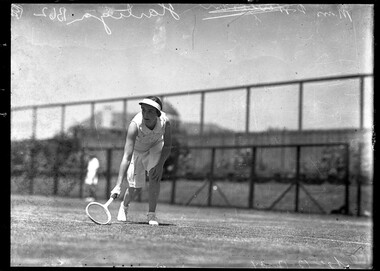
... court wearing a white tennis dress and sun visor holds a tennis racquet while stooping and holding her knee. Research by project volunteer,Fiona Collyer: Joan competed in the 1934 Victorian Tennis Championships and was defeated in the singles final by Wimbledon champion Miss Dorothy Round of England, 9-7, 6-0. ...court wearing a white tennis dress and sun visor holds a tennis racquet while stooping and holding her knee. Research by project volunteer,Fiona Collyer: Joan competed in the 1934 Victorian Tennis Championships and was defeated in the singles final by Wimbledon champion Miss Dorothy Round of England, 9-7, 6-0. ...Australian tennis champion Joan Hartigan stoops to hit a low ball at the Victorian Championships, Albert Grounds in 1934. Photographer notations on slide: "Miss Hartigan Age 12-12-34 B62" Published: The Age (Melbourne, Vic. : 1854 - 1954), Wednesday 12 December 1934, page 13. Published title: INCIDENTS OF YESTERDAY'S CHAMPIONSHIP TENNIS. Published caption: Miss J. Hartigan in a curious attitude as she tries for a low ball from Miss D. Stevenson whom she defeated in straight sets. Trove article identifier: http://nla.gov.au/nla.news-article205077983 Description: A young woman on a tennis court wearing a white tennis dress and sun visor holds a tennis racquet while stooping and holding her knee. Research by project volunteer,Fiona Collyer: Joan competed in the 1934 Victorian Tennis Championships and was defeated in the singles final by Wimbledon champion Miss Dorothy Round of England, 9-7, 6-0. Writing in the Sydney Morning Herald newspaper on 17 December 1934, Dorothy Round stated “As far as international matches are concerned, Joan is an inexperienced player, and Australians should remember this, and not think that she should win every time. Her tennis has by no means reached its apex and there is a great future for her, given the right practice and match experience.” However, in the 1935 Wimbledon Championships Ladies’ singles, Joan sensationally eliminated 1934 title holder, Dorothy Round in the the quarterfinals, 6-4, 4-6, 3-6. When interviewed, Dorothy said -“I just did my best, but Miss Hartigan played too well for me” The Daily Express described Joan as a “one-stroke terror. Nobody thought that the modest, almost apologetic lassie from ‘down under’ would win.” The Daily Telegraph wrote -“Miss Hartigan has the right heart for lion hunting. Stubbornly and courageously she defended with her backhand until she got the ball that fed her robust forehand.” Unfortunately Joan was defeated in the semifinal in straight sets by American champion Mrs Helen Wills Moody, the ultimate winner of the tournament. Joan Marcia Hartigan (Bathurst) 1912-2000 was an Australian tennis champion. She won the Australian Championships Women’s singles (now known as the Australian Open) in 1933, 1934, 1936 and was a Wimbledon Ladies’ singles semifinalist in 1934, 1935. A tall, stylish presence in visor and pleated dress, Joan was renowned for her power game and her “upside down backhand” i.e. striking the shot with the same face of the racquet that she hit her forehand. Joan’s world ranking was No. 8 in 1934. Unfortunately, her career was interrupted by the outbreak of World War Two when international matches were suspended for five years so Joan’s potential was never reached. Joan enlisted in the Australian Military Forces during World War Two and in 1947 she married Hugh Bathurst, private secretary to Senator James Fraser, Prime Minister Ben Chifley’s Health Minister. They had a daughter Mary and a son Thomas who became Chief Justice of NSW. Joan died in Sydney in 2000. References: INCIDENTS OF YESTERDAY'S CHAMPIONSHIP TENNIS. (1934, December 12). The Age (Melbourne, Vic. : 1854 - 1954), p. 13. Retrieved March 18, 2024, from http://nla.gov.au/nla.news-article205077983 AUSTRALIAN PLAYERS. (1934, December 17). The Sydney Morning Herald (NSW : 1842 - 1954), p. 10. Retrieved March 19, 2024, from http://nla.gov.au/nla.news-article17114940 MISS HARTIGAN (1935, July 4). Newcastle Morning Herald and Miners' Advocate (NSW : 1876 - 1954), p. 9. Retrieved March 21, 2024, from http://nla.gov.au/nla.news-article138142569Photographer notations on slide: "Miss Hartigan Age 12-12-34 B62".tennis, 1930-1939 -
 City of Melbourne Libraries
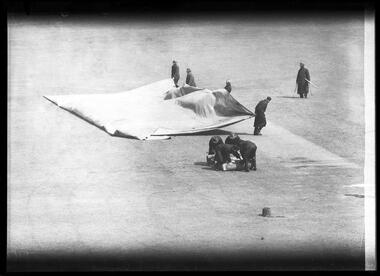
Photograph, Bull, Hugh Jones, 1897-1993, Groundsmen cover wicket during rain at the MCG match, Victoria v South Australia
... There he prepared the tennis courts for the 1908 Davis Cup - Australia v USA featuring the eventual winner of the tournament, Wimbledon champion Sir Norman Brookes. ...There he prepared the tennis courts for the 1908 Davis Cup - Australia v USA featuring the eventual winner of the tournament, Wimbledon champion Sir Norman Brookes. ...“How’s the wicket, Bert?” During the 4-Day Victoria v South Australia Sheffield Shield match, held 13-17 November 1936 at the Melbourne Cricket Ground, the play was often interrupted by rain squalls, causing the groundsmen to cover their carefully prepared wicket with tarpaulins to protect it. “How’s the wicket, Bert?” is the question on everyone’s lips – Will it be a batsman’s nightmare? A bowler’s dream? Will the spectators see a full day’s play or will rain spoil it? With a twinkle in his eye, Bert “Maker of Pitches” Luttrell, the MCG curator’s response is: “It’s not the wicket when batsmen get out early, it’s good bowling!” FRC Published: The Age 17 November 1936 Featured in "Newsworthy: Melbourne in photographs 1933-1936" exhibition at East Melbourne Library, October to December 2023. Exhibition caption by project volunteer, Fiona Collyer. Photographer notations on slide: "Covering wicket during Vict v Sth Aust Cricket at M.C.G. Nov 1936 B117" Published: Age (Melbourne, Vic. : 1854 - 1954), Tuesday 17 November 1936, page 13 Published title: SHEFFIELD SHIELD CRICKET. Published caption: Placing the tarpaulin over the wicket during one of the showers. This was done four times during the day. Trove article identifier: http://nla.gov.au/nla.news-article205952141 Description: Nine men wearing black macintoshes and hats drag a tarpaulin over a cricket pitch. There is a bucket containing pegs in the foreground. Research by project volunteer, Fiona Collyer: During the four day Victoria v South Australia Sheffield Shield match, held 13-17 November 1936 at the Melbourne Cricket Ground, the play was often interrupted by rain squalls, causing the groundsmen to cover their carefully prepared wicket with tarpaulins to protect it. “How’s the wicket, Bert?” is the question on everybody’s lips - will it be a batsman’s nightmare? A bowler’s dream? Will the spectators see a full day’s play or will rain spoil it? With a twinkle in his eye, Bert “Maker of Pitches” Luttrell, the MCG curator’s response is: “It’s not the wicket when batsmen get out early, it’s good bowling!” Albert (Bert) John Wesley Luttrell 1875-1951, was born in Geelong and worked as a painter and decorator. He played cricket for Clarendon Cricket Club while helping to prepare the wicket at Kardinia Park. In 1890, Mr Phillip Russell, a wealthy merino sheep breeder of Osborne House, North Geelong, offered Bert the job of curator and cricket player for his team “The Nondescripts”, a social team who played at his private oval at Osborne House. After five years at Osborne House, Bert took up a position at Geelong Grammar School and then in 1900 he was appointed curator of Warehousemen’s Ground, Albert Park (later called Albert Ground). There he prepared the tennis courts for the 1908 Davis Cup - Australia v USA featuring the eventual winner of the tournament, Wimbledon champion Sir Norman Brookes. Following the retirement of the MCG curator, Bert was offered the position there for the 1919/20 season. Sport was resuming at the MCG after the suspension caused by the Great War and the Spanish Influenza pandemic. Cricket grounds and matches are always at the mercy of the weather. Sudden heavy downpours can make the ground unfit for play. In 1933, Bert invented and patented an absorbent roller for soaked pitches. Similar to a lawn mower in appearance, it was fitted with a rubber sponge which sucked up the water and then squeezed it into a tank. The sponge was said to mop up a gallon (3.78 litres) of water in 32 seconds and remove 100 to 120 gallons (378 - 454 litres) of water from any wet sports ground in an hour. Bert worked as a curator of the MCG for nearly 30 years, invariably creating his famous “shirt front” wicket. He retired in 1947 due to ill health. He was married to Emma and they had six children- Albert, Harry, Nell, Lily, Frank and Jack. Bert died at home in South Yarra in 1951 at 76 years of age. References: SHEFFIELD SHIELD CRICKET. ENGLISH FLYING BOAT. VICTORIA DOCK. (1936, November 17). The Age (Melbourne, Vic. : 1854 - 1954), p. 13. Retrieved May 19, 2024, from http://nla.gov.au/nla.news-article205952141 To Dry Grounds (1933, May 13). Sporting Globe (Melbourne, Vic. : 1922 - 1954), p. 3 (Edition2). Retrieved May 20, 2024, from http://nla.gov.au/nla.news-article183038194 No title (1937, February 25). The Age (Melbourne, Vic. : 1854 - 1954), p. 10. Retrieved May 19, 2024, from http://nla.gov.au/nla.news-article206185862 GOSSIP of THE GAME (1937, November 12). The Herald (Melbourne, Vic. : 1861 - 1954), p. 21. Retrieved May 20, 2024, from http://nla.gov.au/nla.news-article244541623Photographer notations on slide: "Covering wicket during Vict v Sth Aust Cricket at M.C.G. Nov 1936 B117".cricket, 1930-1939 -
 City of Melbourne Libraries
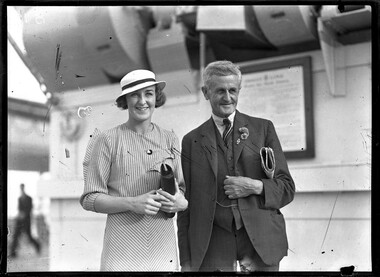
Photograph, Bull, Hugh Jones, 1897-1993, Miss Joan Hartigan and Mr Harley Malcolm embark on the RMS Orford for Wimbledon
... In 1933, Henry “Bunny” Austin stunned the Wimbledon crowd when he wore shorts onto Centre Court - the first top male player to do so. ...In 1933, Henry “Bunny” Austin stunned the Wimbledon crowd when he wore shorts onto Centre Court - the first top male player to do so. ...“MISS JOAN HARTIGAN, the well known New South Wales tennis player, who intends to play at Wimbledon this year. A photograph taken on board R.M.S. Orford before she sailed yesterday.” - The Age Photographer notations on slide: "B19" Published: Age (Melbourne, Vic. : 1854 - 1954), Wednesday 21 March 1934, page 13 Published title: MISS JOAN HARTIGAN Published caption: MISS JOAN HARTIGAN the well-known New South Wales tennis player, who intends to play at Wimbledon this year. A photograph taken on board R.M.S. Orford before she sailed yesterday. Trove article identifier: http://nla.gov.au/nla.news-article203827087 Description: On the deck of a ship, a smiling young woman wearing a white hat, printed fabric dress with brooch and holding a black clutch bag stands next to a middle aged man wearing a dark three piece suit and necktie with cornflower buttonhole and lapel pin and a newspaper under his arm. Research by project volunteer, Fiona Collyer: Twenty-one year old Australian Championships, (now known as the Australian Open) winner Miss Joan Hartigan and Mr Harley Malcolm, Lawn Tennis Association of Australia (LTAA) Honorary Secretary and referee, embark on the R.M.S. Orford at Station Pier, Port Melbourne on their way to Wimbledon. The Australian Test cricket and Davis Cup teams were also on the same voyage. Joan Marcia Hartigan (Bathurst) 1912-2000 from Sydney, won the Australian Championships three times in 1933, 1934, 1936 and was a Wimbledon semifinalist in 1934, 1935. A tall, stylish presence in visor and pleated dress, Joan was renowned for her power game and her “upside down backhand” i.e. striking the shot with the same face of the racquet that she hit her forehand. Joan’s world ranking was No.8 in 1934. Unfortunately, her career was interrupted by the outbreak of WW11 with international matches suspended for five years. Joan enlisted in the Australian Military Forces during WW11 and in 1947 she married Hugh Bathurst, private secretary to Senator James Fraser, Prime Minister Ben Chifley’s Health Minister. They had a daughter Mary and a son Thomas who became Chief Justice of NSW. Joan died in Sydney in 2000. In October 1933, Mr Harley Malcolm, declared “I consider shorts not regulation costume and would stop both men and women, particularly women, wearing them. I think women’s desire to strut in such a costume is unreasonable.” However, Harley was on the wrong side of history. In Europe and USA, many women tennis players were swapping their long skirts and stockings for bare legs, short skirts and shorts and men their long flannels for tailored shorts. In 1933, Henry “Bunny” Austin stunned the Wimbledon crowd when he wore shorts onto Centre Court - the first top male player to do so. He found it too hot to play in long trousers so he asked his tailor to run up some prototype shorts. At the 1933 Wimbledon Women’s Final, in front of the King and Queen, English champion Dorothy Round wore her trademark sleeveless dress with a divided skirt and her American competitor Helen Jacobs wore white, tailored shorts with a black stripe on each side, described as “mannish, though businesslike.” In November 1933, the Victorian Lawn Tennis Association officially allowed shorts as regulation dress at Kooyong for both sexes. In 1935, Dorothy wore her shorts while competing in Melbourne at the Australian Championships, Kooyong and there was hardly a murmur of dissent. Mr Harley Malcolm was involved with Australian tennis for 57 years, first as a player, then as a referee and administrator. He always wore a cornflower buttonhole on his lapel as he said the blue in that flower was his favourite colour. Cornflowers are sometimes referred to as “bachelor’s button” due to the old practice of men wearing cornflower buttonholes to indicate they are either in love or ready for courting. The Bleuet de France is the French flower of remembrance. References: WOMEN CITIZENS' MOVEMENT. (1934, March 21). The Age (Melbourne, Vic. : 1854 - 1954), p. 13. Retrieved March 20, 2024, from http://nla.gov.au/nla.news-article203827087 'Joan Hartigan', Wikipedia, https://en.wikipedia.org/wiki/Joan_Hartigan Leading Tennis Referee Condemns Wearing of Shorts (1933, October 5). The Herald (Melbourne, Vic. : 1861 - 1954), p. 11. Retrieved March 6, 2024, from http://nla.gov.au/nla.news-article243193607 REMEMBERING 57 YEARS OF TENNIS (1947, December 10). Daily Mercury (Mackay, Qld. : 1906 - 1954), p. 5. Retrieved April 1, 2024, from http://nla.gov.au/nla.news-article171166922Photographer notations on slide: "B19".tennis, 1930-1939, ships, sport, clothing and dress
