
Showing 3 items matching "108 australian general hospital"
-
 Flagstaff Hill Maritime Museum and Village
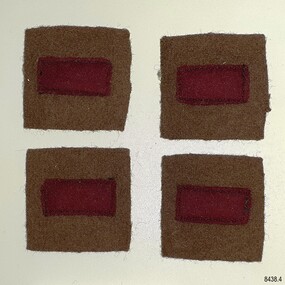
Badge - Australian Military cloth patch, Army Medical Corps, 108 Australian General Hospital, 1939-1945
... Army Medical Corps, 108 Australian General Hospital......108 Australian General Hospital...The badges date to the Second World War era, when Dr Angus was a Surgeon Captain for the Australian Defence Forces in the Army Medical Corps, 108 Australian General Hospital and 106 Australian General Hospital, stationed in Ballarat, Victoria, and in Bonegilla, N.S.W. ...Insignia of the Australian Defence Forces, Army Medical Corps, 108 Australian General Hospital, WWII era. Dr W R Angus owned the cloth patches that are now part of the W. ...Army Medical Corps, 108 Australian General Hospital Badge Australian Military cloth patch ...The four cloth patches belonged to Dr William Roy Angus and are now part of Flagstaff Hill’s comprehensive W.R. Angus Collection, donated by the family of Dr W R Angus (1901-1970), surgeon and oculist. The badges date to the Second World War era, when Dr Angus was a Surgeon Captain for the Australian Defence Forces in the Army Medical Corps, 108 Australian General Hospital and 106 Australian General Hospital, stationed in Ballarat, Victoria, and in Bonegilla, N.S.W. He completed his service just before the end of the war due to suffering from a heart attack. In World War I the troops of the Australian Military Forces staked coloured flags of various shapes and colours in the ground where they camped to identify their units. These flag codes were quickly recognised. The system worked so well that miniature flags were called colour patches. They became part of the uniform, to be worn on both sleeves just below the shoulder. The system was slightly modified for use in the Second World War. The W.R. Angus Collection: - The W.R. Angus Collection includes historical medical equipment, surgical instruments and material belonging to Dr Edward Ryan and Dr Thomas Francis Ryan, (both of Nhill, Victoria) and Dr Angus’ own belongings. The Collection’s history spans the medical practices of the two Doctors Ryan, from 1885-1926 plus that of Dr Angus, up until 1969. It includes historical medical and surgical equipment and instruments from the doctors Edward and Thomas Ryan of Nhill, Victoria. Dr Angus married Gladys in 1927 at Ballarat, the nearest big city to Nhill where he began as a Medical Assistant. He was also Acting House surgeon at the Nhill hospital where their two daughters were born. During World War II He served as a Military Doctor in the Australian Defence Forces. Dr Angus and his family moved to Warrnambool in 1939, where Dr Angus operated his own medical practice. He later added the part-time Port Medical Officer responsibility and was the last person appointed to that position. Both Dr Angus and his wife were very involved in the local community, including the planning stages of the new Flagstaff Hill and the layout of the gardens there. Dr Angus passed away in March 1970.Dr W R Angus (1901-1970), surgeon and oculist, collected a range of military objects including those he personally used during his time as Surgeon Captain in the Australian Defence Forces in World War II. The objects allow insight into military life in the early-to-mid 20th century. The W.R. Angus Collection is significant for still being located at the site it is connected with, Doctor Angus being the last Port Medical Officer in Warrnambool. The Collection includes historical medical objects that date back to the late 1800s.Badges; set of four cloth patches, red rectangles on brown squares. Insignia of the Australian Defence Forces, Army Medical Corps, 108 Australian General Hospital, WWII era. Dr W R Angus owned the cloth patches that are now part of the W. R. Angus Collection.flagstaff hill, warrnambool, maritime village, maritime museum, shipwreck coast, great ocean road, flagstaff hill maritime museum and village, dr w r angus, w.r. angus collection, australian army, surgeon captain, ballarat, bonegilla, badge, insignia, badge collection, world war 2, second world war, australian defence forces, army medical corps, 108 australian general hospital, great war, military uniform, 106 australian general hospital, 1939-1945 -
 Flagstaff Hill Maritime Museum and Village
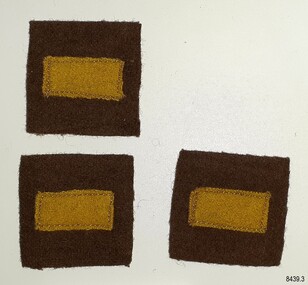
Badge - Australian Military cloth patch, Army Medical Corps, 106 Australian General Hospital, 1939-1945
... ...108 Australian General Hospital...The badges date to the Second World War era, when Dr Angus was a Surgeon Captain for the Australian Defence Forces in the Army Medical Corps, 108 Australian General Hospital and 106 Australian General Hospital, stationed in Ballarat, Victoria, and in Bonegilla, N.S.W. ...The badges date to the Second World War era, when Dr Angus was a Surgeon Captain for the Australian Defence Forces in the Army Medical Corps, 108 Australian General Hospital and 106 Australian General Hospital, stationed in Ballarat, Victoria, and in Bonegilla, N.S.W. ...The three cloth patches belonged to Dr William Roy Angus and are now part of Flagstaff Hill’s comprehensive W.R. Angus Collection, donated by the family of Dr W R Angus (1901-1970), surgeon and oculist. The badges date to the Second World War era, when Dr Angus was a Surgeon Captain for the Australian Defence Forces in the Army Medical Corps, 108 Australian General Hospital and 106 Australian General Hospital, stationed in Ballarat, Victoria, and in Bonegilla, N.S.W. He completed his service just before the end of the war due to suffering from a heart attack. In World War I the troops of the Australian Military Forces staked coloured flags of various shapes and colours in the ground where they camped to identify their units. These flag codes were quickly recognised. The system worked so well that miniature flags were called colour patches. They became part of the uniform, to be worn on both sleeves just below the shoulder. The system was slightly modified for use in the Second World War. The W.R. Angus Collection: - The W.R. Angus Collection includes historical medical equipment, surgical instruments and material belonging to Dr Edward Ryan and Dr Thomas Francis Ryan, (both of Nhill, Victoria) and Dr Angus’ own belongings. The Collection’s history spans the medical practices of the two Doctors Ryan, from 1885-1926 plus that of Dr Angus, up until 1969. It includes historical medical and surgical equipment and instruments from the doctors Edward and Thomas Ryan of Nhill, Victoria. Dr Angus married Gladys in 1927 at Ballarat, the nearest big city to Nhill where he began as a Medical Assistant. He was also Acting House surgeon at the Nhill hospital where their two daughters were born. During World War II He served as a Military Doctor in the Australian Defence Forces. Dr Angus and his family moved to Warrnambool in 1939, where Dr Angus operated his own medical practice. He later added the part-time Port Medical Officer responsibility and was the last person appointed to that position. Both Dr Angus and his wife were very involved in the local community, including the planning stages of the new Flagstaff Hill and the layout of the gardens there. Dr Angus passed away in March 1970.Dr W R Angus (1901-1970), surgeon and oculist, collected a range of military objects including those he personally used during his time as Surgeon Captain in the Australian Defence Forces in World War II. The objects allow insight into military life in the early-to-mid 20th century. The W.R. Angus Collection is significant for still being located at the site it is connected with, Doctor Angus being the last Port Medical Officer in Warrnambool. The Collection includes historical medical objects that date back to the late 1800s.Badges; set of three cloth patches, yellow rectangles on brown squares. Insignia of the Australian Defence Forces, Army Medical Corps, 106 Australian General Hospital, WII era. Dr W R Angus owned the cloth patches that are now part of the W. R. Angus Collection.flagstaff hill, warrnambool, maritime village, maritime museum, shipwreck coast, great ocean road, flagstaff hill maritime museum and village, dr w r angus, w.r. angus collection, australian army, surgeon captain, ballarat, bonegilla, badge, insignia, world war 1, 1914-1918, badge collection, world war 2, second world war, australian defence forces, army medical corps, 108 australian general hospital, great war, military uniform, 106 australian general hospital -
 Northern District School of Nursing. Managed by Bendigo Historical Society Inc.
Newspaper - Northern District School of Nursing Graduates Association - Article "They will nurse fond memories of their school", Tues July 18 1989
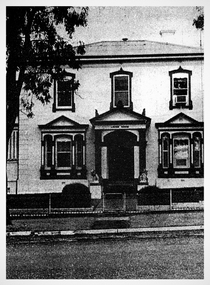
... Australia's first independent nursing school, has closed after nearly 40 years of training nurses in central and northern Victoria. School 108 was the last after almost 40 years of nurse training. All general nurse training in the region will now be conducted in colleges instead of at NDSN. The school began in 1950 at Lister House, a historic mansion in Bendigo. It was certified as a training school for registered nurses in 1951, working with several regional hospitals...Australia's first independent nursing school, has closed after nearly 40 years of training nurses in central and northern Victoria. School 108 was the last after almost 40 years of nurse training. All general nurse training in the region will now be conducted in colleges instead of at NDSN. The school began in 1950 at Lister House, a historic mansion in Bendigo. It was certified as a training school for registered nurses in 1951, working with several regional hospitals ...The Northern District School of Nursing in Victoria, Australia Graduates Association: The closure of the Northern District School of Nursing (NDSN) in Bendigo:Closure and TransitionNDSN, Australia's first independent nursing school, has closed after nearly 40 years of training nurses in central and northern Victoria. School 108 was the last after almost 40 years of nurse training. All general nurse training in the region will now be conducted in colleges instead of at NDSN. The school began in 1950 at Lister House, a historic mansion in Bendigo. It was certified as a training school for registered nurses in 1951, working with several regional hospitals. Initially, NDSN collaborated with hospitals in Castlemaine, Kyneton, Bendigo, Mildura, Swan Hill, Echuca, St. Arnaud, Dunolly, and Ouyen. Over time, some hospital affiliations changed, with trainees from smaller hospitals gaining clinical experience at larger base hospitals in Bendigo and Mildura. All students attended Lister House for study blocks during their three-year training. The school was known for its highly trained and experienced tutors.Staff numbers dwindled as the school closed, with tutors moving to other jobs, hospitals, or early retirement.The last tutor to leave was Mary Ryan, who had been at Lister House for over 10 years. The school, once lively, is now described as silent and empty, likened to a 'morgue.'Former students and staff find the emptiness unsettling, highlighting the emotional impact of the closure. Despite the sadness, staff members emphasize the school's positive environment and achievements. The assistant dean notes high retention and pass rates, indicating strong academic performance. Over the years, significant renovations were made, including the construction of a new hall.Staff express pride in these improvements and the school's development. The School of Nursing in Bendigo has a rich history, remembered fondly by many Victorians who trained there.Staff, such as Mary, found it rewarding when former students returned to share their career progress and experiences. Anecdotes include students reaching out for support, such as requesting references to secure jobs while traveling. Graduation balls ('grad balls') were a significant tradition, known for their fun, themed events and memorable costumes. Themes ranged from 'Your fantasy' to 'Wear something you've never dared to wear before.'The final grad ball for School 108 is scheduled with the theme 'The wake,' marking the end of an era. The NDSN building currently stands empty, with its future undecided.A feasibility study is underway to consider repurposing the building, possibly for a government department such as the Health Department.Other groups have shown interest, but the final decision will be made by the Health Minister, Caroline Hogg.Northern District School of Nursing Graduates Association - Article "They will nurse fond memories of their school" from the Midland Express Tues 18 July 1988 by Linda Harrow Page 14 This item contains the following document: 3792.9a From the article black and white photo of Lister House 3792.9b Part of the Article "They will nurse fond memories of their school" from the Midland Express 3792.9c From the article black and white photo of the first group of general nurses ever to be trained at the Northern District School of Nursing 3792.9d Part of the Article "They will nurse fond memories of their school" from the Midland Express 3792.9e Part of the Article "They will nurse fond memories of their school" from the Midland Expressnurse training, lister house, history, mary ryan
