
Showing 12 items matching "1770s"
-
 Royal Australian and New Zealand College of Obstetricians & Gynaecologists (RANZCOG)
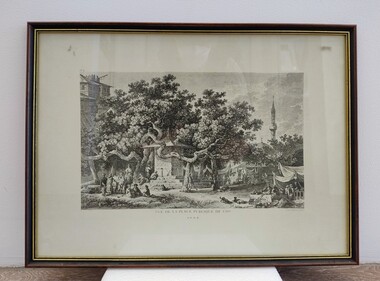
Print - Reproduction print, Carl William Weisbrod (active 1770s) et al, Vue de la Place Publique de Cos, c. late 18th century
... Carl William Weisbrod (active 1770s)...Vue de la Place Publique de Cos Print Reproduction print Carl William Weisbrod (active 1770s) Jean-Baptiste Hilair (1751-1828) Jacques Aliamet (1726-1788) ...This is an image of a public square on the island of Kos in Greece. Kos was the home of Hippocrates, and the tree in this image is reputedly the plane tree under which Hippocrates sat as he taught his pupils medicine. Hippocrates is known as the "Father of Medicine" for his revolutionary impact on the field of medicine. The letters 'A.P.D.R' printed below the title on this artwork refer to the copyright granted to engravers in France.Black and white engraving of a market square scene on the island of Kos in Greece. A large tree dominates the scene. Below the tree sits a roofed structure with a series of small steps. Water appears to be coming out of a channel of each of the visible sides of the structure, suggesting a fountain. To the left, an array of human figures, horses and a dog sit or stand beneath the tree and on the steps of the fountain. To the right, there are shaded platforms on which people are sitting in groups. There are three dogs in front of the group sitting on a platform at bottom right. Text printed below image reads 'VUE DE LA PLACE PUBLIQUE DE COS/A.P.D.R.' Small, printed text below bottom left corner of image is partially illegible, but it references the original creator of the artwork, Jean-Baptiste Hilair. Small printed text below bottom right corner of image reads ' Gravé à l'eau forte par C. Weisbrod/ el terminé au burin par J. Aliamet'. Small printed text above top left hand corner of image reads 'Pl. 59.' The print has been framed in a brown wooden frame with gold trim. An old display label is affixed to the back of the object. A card from Professor Franco Crainz is affixed to the back of the object, thanking the unnamed receiver for a reprint of their "interesting paper on D.D.Davis' Obstetric Atlas". The front of the card carries a print of the Temple of Esculapia, located in the Villa Borghese in Rome. A wire and two hooks have been attached to the rear of the work for hanging.There is black and white engraving of a market square scene on the island of Kos in Greece. Text printed below image reads 'VUE DE LA PLACE PUBLIQUE DE COS/A.P.D.R.' Small printed text below bottom left corner of image is partially illegible, but it references the original creator of the artwork, Jean-Baptiste Hilair. Small, printed text below bottom right corner of image reads ' Gravé à l'eau forte par C. Weisbrod/ el terminé au burin par J. Aliamet'. Small, printed text above top left-hand corner of image reads 'Pl. 59.' The print has been framed in a brown wooden frame with gold trim. An old display label is affixed to the back of the object. A card from Professor Franco Crainz is affixed to the back of the object, thanking the unnamed receiver for a reprint of their "interesting paper on D.D.Davis' Obstetric Atlas". The front of the card carries a print of the Temple of Esculapia, located in the Villa Borghese in Rome. A wire and two hooks have been attached to the rear of the work for hanging. The letters 'A.P.D.R' printed below the title on this artwork refer to the copyright granted to engravers in France.medicine -
 Charlton Golden Grains Museum Inc
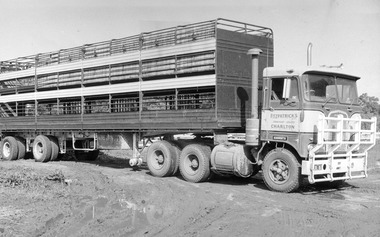
Photograph - Black and White Photograph of Fitzpatrick's Transport Service truck with c 1770s
... Black and White Photograph of one of Fitzpatrick's numerous trucks with stock crate c 1770s. Business located on Calder Highway....Photograph Black and White Photograph of Fitzpatrick's Transport Service truck with c 1770s ...Fitzpatrick's Transport Service c 1970sBlack and White Photograph of one of Fitzpatrick's numerous trucks with stock crate c 1770s. Business located on Calder Highway.On door of truck FITZPATRICK'S TRANSPORT SERVICE, CHARLTON KENWORTH fitzpatrick's transport service -
 Brighton Historical Society
Bonnet, Calash, 1770s-1860s
... 1770s-1860s ...Black taffeta calash with ribs made of baleen. calash, headwear -
 City of Moorabbin Historical Society (Operating the Box Cottage Museum)
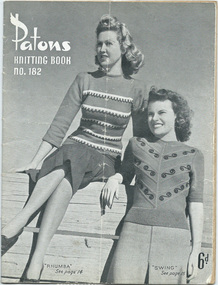
Booklet - Patons Knitting Book No.182, Patons & Baldwins Ltd, c1950
... Patons' & Baldwin Ltd began as two separate companies: J & J Baldwin and Partners, founded in the late 1770s by James Baldwin of Halifax, West Yorkshire, England, and John Paton Son & Co., founded in 1814 by John Paton of Alloa, Scotland. ...Patons' & Baldwin Ltd began as two separate companies: J & J Baldwin and Partners, founded in the late 1770s by James Baldwin of Halifax, West Yorkshire, England, and John Paton Son & Co., founded in 1814 by John Paton of Alloa, Scotland. ...Gladys Reed was a member of the Ormond Choral Society c 1950. who performed plays and musicals the City of Moorabbin and she was skilled in hand knitting, crochet and dressmaking. Her garments were used by her family and the Ormond Choral Society . Patons' & Baldwin Ltd began as two separate companies: J & J Baldwin and Partners, founded in the late 1770s by James Baldwin of Halifax, West Yorkshire, England, and John Paton Son & Co., founded in 1814 by John Paton of Alloa, Scotland. The two companies merged in 1920 and diversified into producing wool for home knitters, as well as publishing knitting patterns under the "Patons Rose" and "Baldwins Beehive" trademark. By the mid-1930s, the company had establishments across Scotland and Northern England, Canada, New Zealand, Launceston, Tasmania, Australia.Patons' knitting books have been used by hand knitters in many countries since they were published early in 20thC Gladys Reed and other residents of the City of Moorabbin used these pattern guides to make clothing for their families and community c1940A printed black and white booklet with 31 pages of knitting instructions and photographs c 1940Front Cover ; Patons / Knitting Book / No. 182 / 'Rhumba' See page 14 'Swing" See page 15 / 6d ( decimal = 5cents) Back Cover ; Patons / No. 182 / Knitting Book / 'Fandango ' /See page 17 / 'Tarantella' /See page 18knitting, crochet, craftwork, john paton son & co., baldwin j &j ltd, aloa scotland, launceston tasmania, melbourne, knitting mills, knitting books, coates j&p ltd, early settlers, moorabbin shire, mechanics institute cheltenham, ormond choral society, postworld war 11 settlers, housing estates moorabbin 1950, bentleigh, ormond, moorabbin, cheltenham, drama societies, musical society cheltenham, clark judy, reed gladys, reed george -
 Orbost & District Historical Society
pattern books, Patons Specialty Knitting Book, 1940-1950
... Patons & Baldwin began as two separate companies: J & J Baldwin and Partners, founded in the late 1770s by James Baldwin of Halifax, West Yorkshire, England, and John Paton Son and Co., founded in 1814 by John Paton of Alloa, Scotland. ...Patons & Baldwin began as two separate companies: J & J Baldwin and Partners, founded in the late 1770s by James Baldwin of Halifax, West Yorkshire, England, and John Paton Son and Co., founded in 1814 by John Paton of Alloa, Scotland. ...These knitting pattern leaflets were published by Patons and Baldwins and contain knitting patterns for women's and men's garments. Patons & Baldwin began as two separate companies: J & J Baldwin and Partners, founded in the late 1770s by James Baldwin of Halifax, West Yorkshire, England, and John Paton Son and Co., founded in 1814 by John Paton of Alloa, Scotland. Both men had formed their businesses using the spinning mule developed by Samuel Crompton. They mainly produced yarns for commercial knitting machines. Patons established itself in Australia with its first mill built in Tasmania in 1923. For decades, Patons was the leading hand knitting yarn brand but due to the market conditions in the mid 1980's, Patons felt the decline and eventually amalgamated with Alliance Textiles, New Zealand in 1996. Patons Australia was acquired by Australian Country Spinners in 2000. Knitting has always had a great appeal to women, as it needs few tools. Companies which manufactured yarn often produced instruction guides and patterns. These pattern books are typical of the knitting pattern books commonly used in the mid 20th century. The patterns contained are for garments commonly worn at that time.Two knitting pattern books. Both are black / white and contain knitting patterns. 821.1 cost 7d, is titled "Patons Specialty Knitting Book No. 145" and has on the front cover a lady standing near a buggy wheel. 821.2 cost 1/3, is titled " Patons Knitting Book No. 394 (introducing Patons Double Quick Knitting)" and has has on the front cover a photograph of a man on a boat.knitting-patterns needlecraft patons-baldwin -
 Orbost & District Historical Society
pattern book, Patons Knitting Book, mid 20th century
... Patons & Baldwin began as two separate companies: J & J Baldwin and Partners, founded in the late 1770s by James Baldwin of Halifax, West Yorkshire, England, and John Paton Son and Co., founded in 1814 by John Paton of Alloa, Scotland. ...Patons & Baldwin began as two separate companies: J & J Baldwin and Partners, founded in the late 1770s by James Baldwin of Halifax, West Yorkshire, England, and John Paton Son and Co., founded in 1814 by John Paton of Alloa, Scotland. ...This knitting pattern leaflet was published by Patons and Baldwins and contains knitting patterns for women's garments. Patons & Baldwin began as two separate companies: J & J Baldwin and Partners, founded in the late 1770s by James Baldwin of Halifax, West Yorkshire, England, and John Paton Son and Co., founded in 1814 by John Paton of Alloa, Scotland. Both men had formed their businesses using the spinning mule developed by Samuel Crompton. They mainly produced yarns for commercial knitting machines. Patons established itself in Australia with its first mill built in Tasmania in 1923. For decades, Patons was the leading hand knitting yarn brand but due to the market conditions in the mid 1980's, Patons felt the decline and eventually amalgamated with Alliance Textiles, New Zealand in 1996. Patons Australia was acquired by Australian Country Spinners in 2000.Knitting has always had a great appeal to women, as it needs few tools. Companies which manufactured yarn often produced instruction guides and patterns. This pattern book is typical of the knitting pattern books commonly used in the mid 20th century. The patterns contained are for garments worn at that time.A seven page stapled booklet of knitting patterns. It is titled Patons Knitting Book No. 444, Ladies' and Girls' Gloves and Hats. It has a price 1/3.On the front cover are photos of the garments for which the patterns are provided.knitting handicrafts patons-and-baldwins -
 Mont De Lancey
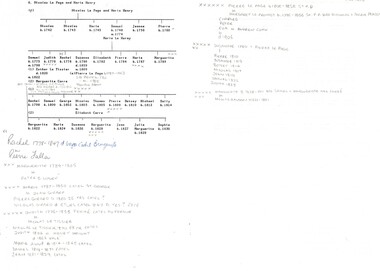
Document - Family Tree Pedigree, c.1980-c.2020
... ...1770s...Family tree of Marie Henry and Nicholas le Page going down 4 generations, spanning 1742-1911 Family trees Family History Marie le Page (nee Henry) Nicholas le Page le Page Family Henry Family 1750s 1740s 1760s 1770s 1780s 1790s 1800s 1810s 1820s 1830s 1840s 1850s 1860s 1870s 1880s 1890s 1900s 1910s 1 A4 page one sided typed tree graph in black ink with annotations on front and back in graylead Document Family Tree Pedigree ...Family tree of Marie Henry and Nicholas le Page going down 4 generations, spanning 1742-19111 A4 page one sided typed tree graph in black ink with annotations on front and back in grayleadfamily trees, family history, marie le page (nee henry), nicholas le page, le page family, henry family, 1750s, 1740s, 1760s, 1770s, 1780s, 1790s, 1800s, 1810s, 1820s, 1830s, 1840s, 1850s, 1860s, 1870s, 1880s, 1890s, 1900s, 1910s -
 Flagstaff Hill Maritime Museum and Village
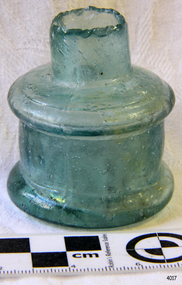
Container - Ink Bottle, Second half of 19th Century or first half of the 20th Century
... In the United States, large-scale production of bottles was pioneered by Caspar Wistar in 1739 at his New Jersey plant. In the 1770s the carbonation process for producing soft drinks was developed, and so began an entirely new bottling industry. ...In the United States, large-scale production of bottles was pioneered by Caspar Wistar in 1739 at his New Jersey plant. In the 1770s the carbonation process for producing soft drinks was developed, and so began an entirely new bottling industry. ...Although glass containers for wine and beer are probably 1,600 years old, much of their use began only in the late 17th century. In the United States, large-scale production of bottles was pioneered by Caspar Wistar in 1739 at his New Jersey plant. In the 1770s the carbonation process for producing soft drinks was developed, and so began an entirely new bottling industry. At the Great Exhibition of 1851 in the Crystal Palace in London, one million “pop” bottles were consumed. The first beer pasteurised in glass was produced in Copenhagen in 1870. Pasteurisation of milk followed soon after. The moulding of a screw thread on a container was invented by John Mason in 1858. The principles of the “press-and-blow” process for making wide-mouth jars were shown in the United States by Philip Arbogast in 1882, and the “blow-and-blow” process for making narrow-neck containers was demonstrated by Howard Ashley in England in 1885. These processes employed manual delivery; fully automatic jar forming by a suction-and-blow process was perfected by Michael Owens over the period 1895–1917 at the Toledo (Ohio) Glass Company, which subsequently became the Owens Bottle Machine Company. The automatic single-gob feeder was developed in 1919–22 by Karl Peiler at the Hartford-Fairmont Company in Connecticut. Fully automatic machines followed, but the true rugged survivor, utilising fully automatic gob delivery to the maximum versatility, was the Individual Section, or IS, machine invented by Henry Ingle at the Hartford Empire Company in 1925. Source: https://www.britannica.com/topic/glass-properties-composition-and-industrial-production-234890/History-of-glassmakingUnlike item 4018, this is a much smaller ink bottle, and was probably used by an individual, as against the supply of ink to pupils from a much larger bottle.Cotton Reel Ink Bottle, green glass, small, chipped around the lip, bubbles in glass.None.flagstaff hill, warrnambool, shipwrecked-coast, flagstaff-hill, flagstaff-hill-maritime-museum, maritime-museum, shipwreck-coast, flagstaff-hill-maritime-village, ink, bottle, glass -
 City of Moorabbin Historical Society (Operating the Box Cottage Museum)
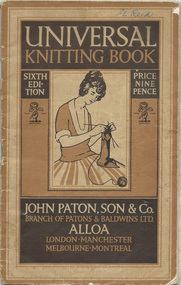
Booklet - 'Universal Knitting Book' Paton, John Paton, Son & Co. 6th Edition 1923, c1923
... Patons' & Baldwin Ltd began as two separate companies: J & J Baldwin and Partners, founded in the late 1770s by James Baldwin of Halifax, West Yorkshire, England, and John Paton Son & Co., founded in 1814 by John Paton of Alloa, Scotland. ...Patons' & Baldwin Ltd began as two separate companies: J & J Baldwin and Partners, founded in the late 1770s by James Baldwin of Halifax, West Yorkshire, England, and John Paton Son & Co., founded in 1814 by John Paton of Alloa, Scotland. ...Gladys Reed was a member of the Ormond Choral Society c 1950. who performed plays and musicals the City of Moorabbin and she was skilled in hand knitting, crochet and dressmaking. Her garments were used by her family and the Ormond Choral Society . Patons' & Baldwin Ltd began as two separate companies: J & J Baldwin and Partners, founded in the late 1770s by James Baldwin of Halifax, West Yorkshire, England, and John Paton Son & Co., founded in 1814 by John Paton of Alloa, Scotland. Both men had formed their businesses using the spinning mule developed by Samuel Crompton. They mainly produced yarns for commercial knitting machines. The two companies merged in 1920 and diversified into producing wool for home knitters, as well as publishing knitting patterns under the "Patons Rose" and "Baldwins Beehive" trademark. By the mid-1930s, the company had establishments across Scotland and Northern England, Canada, New Zealand, Launceston, Tasmania, Australia. The company branched out into various related lines of business, and the development of new products such as nylon and Terylene. In 1961, the company was merged with J & P Coats Ltd. The Patons trademark is still in use today.The yarn production facility at Alloa was closed in 1999 and the large factory in Launceston, Tasmania, Australia,closed in 1997. In 1952 J. & P. Coats and the Clark Thread Co. merged.and in 1961 a merger with Patons and Baldwins created Coats Patons. In 2015 the business returned to the market as "Coats Group".Patons' knitting books have been used by hand knitters in many countries since they were published early in 20thC Gladys Reed and other residents of the City of Moorabbin used these pattern guides to make clothing for their families and community c1950A printed paper booklet with 64 pages of knitting and crochet patterns, instructions, photographs bound by 2 metal staplesFront Cover ; UNIVERSAL/ KNITTING BOOK / SIXTH / ED / ITION / PRICE / NINE / PENCE / Photo of lady knitting / Trade Mark / JOHN PATON, SON & CO. / BRANCH OF PATONS & BALDWINS LTD. / ALLOA / LONDON, MANCHESTER / MELBOURNE / MONTREAL Written top right ; G Reed Back Cover ; Trade Mark / Registered / THIS TRADE MARK / IS YOUR GUARANTEE / WHEN BUYING / PATONS' ALLOA / KNITTING WOOLS knitting, crochet, craftwork, john paton son & co., baldwin j &j ltd, aloa scotland, launceston tasmania, melbourne, knitting mills, knitting books, coates j&p ltd, early settlers, moorabbin shire, mechanics institute cheltenham, ormond choral society, postworld war 11 settlers, housing estates moorabbin 1950, bentleigh, ormond, moorabbin, cheltenham, drama societies, musical society cheltenham, clark judy, reed gladys, reed george -
 Flagstaff Hill Maritime Museum and Village
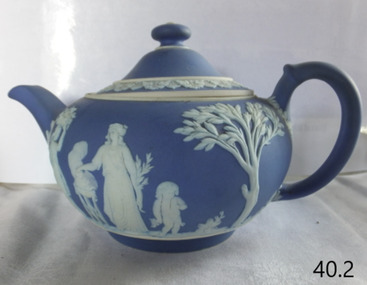
Ceramic - Teapot, Josiah Wedgwood & Sons Ltd, 1890
... Wedgwood developed several further industrial innovations for his company, notably a way of measuring kiln temperatures accurately, and several new ceramic bodies including the "dry-body" Stoneware, "black basalt" (by 1769), cane ware, and jasperware (the 1770s), all designed to be sold unglazed, like "biscuit porcelain". ...Wedgwood developed several further industrial innovations for his company, notably a way of measuring kiln temperatures accurately, and several new ceramic bodies including the "dry-body" Stoneware, "black basalt" (by 1769), cane ware, and jasperware (the 1770s), all designed to be sold unglazed, like "biscuit porcelain". ...Josiah Wedgwood (1730–95), came from an established family of potters and trained with his elder brother. He was in partnership with the leading potter Thomas Whieldon from 1754 until 1759 when a new green ceramic glaze he had developed encouraged him to start a new business on his own. Relatives leased him the Ivy House in Burslem, Stoke-on-Trent, and his marriage to Sarah Wedgwood, a distant cousin with a sizeable dowry, helped him launch his new venture. After an extensive and systematic program of experiment Wedgwood in 1765 created a new variety of creamware, a fine glazed earthenware, which was the main body used for his table wares thereafter. After he supplied Queen Charlotte with a tea set for twelve the same year, she gave official permission to call it "Queen's Ware" (from 1767). This new form, perfected as white pearlware (from 1780), sold extremely well across Europe, and to America. It had the additional advantage of being relatively light, saving on transport costs and import tariffs in foreign markets. Wedgwood developed several further industrial innovations for his company, notably a way of measuring kiln temperatures accurately, and several new ceramic bodies including the "dry-body" Stoneware, "black basalt" (by 1769), cane ware, and jasperware (the 1770s), all designed to be sold unglazed, like "biscuit porcelain". In the later 19th century the company returned to being a leader in the design and technical innovation, as well as continuing to make many of the older styles. Despite increasing local competition in its export markets, the business continued to flourish in the 19th and early 20th centuries, remaining in the hands of the Wedgwood family, but after World War II it began to contract, along with the rest of the English pottery industry. After buying several other Staffordshire ceramics companies, in 1987 Wedgwood merged with Waterford Crystal to create Waterford Wedgwood plc, an Ireland-based luxury brands group. After a 2009 purchase by KPS Capital Partners, a New York-based private equity firm. Wedgwood has always been associated with fine china, porcelain, and luxury accessories, the entrepreneur Josiah Wedgwood rapidly became successful and was soon one of the largest manufacturers of Staffordshire pottery. Wedgwood is a significant pottery manufacturer as the company is especially associated with the "dry-bodied" (unglazed) stoneware Jasperware in contrasting colours, and in particular that in "Wedgwood blue" and white that has become a trademark. Teapot and lid, Wedgwood blue Jasperware with white patternImpressed name Wedgewood and date letter "S" = 1890flagstaff hill, warrnambool, flagstaff hill maritime museum, maritime museum, shipwreck coast, flagstaff hill maritime village, great ocean road, teapot, wedgewood blue, wedgewood teapot, tea pot, kitchen ware, josiah wedgwood, staffordshire potteries -
 Flagstaff Hill Maritime Museum and Village
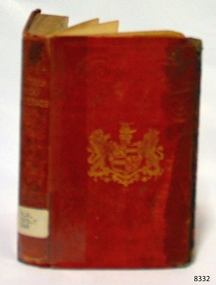
Book - Referance Book, Thomas Curson Hansard Junior, Hansards Pocket Peerage, 1854
... Born in Norwich, England, he was the son of a manufacturer and was apprenticed to a local printer. In the early 1770s, after his apprenticeship ended, Luke walked to London with just a single guinea in his pocket. ...Born in Norwich, England, he was the son of a manufacturer and was apprenticed to a local printer. In the early 1770s, after his apprenticeship ended, Luke walked to London with just a single guinea in his pocket. ...This volume is a genealogical and biographical reference directory of the British nobility. It was designed as a compact, portable handbook detailing the titles, lineages, coats of arms, and family histories of the peers of Great Britain and Ireland, as well as bishops and baronets. While Thomas Curson Hansard is famous for establishing the printing of Britain's official parliamentary debates (Hansard), his firm also published these highly practical, condensed pocket guides for politicians, gentlemen, and libraries who needed quick access to the details of high society and parliamentary ranks.Hansards Pocket Peerage Publisher: T C Newby Date: 1854 Further Information: Signed by John Pascoe Fawknernon-fictionThis volume is a genealogical and biographical reference directory of the British nobility. It was designed as a compact, portable handbook detailing the titles, lineages, coats of arms, and family histories of the peers of Great Britain and Ireland, as well as bishops and baronets. While Thomas Curson Hansard is famous for establishing the printing of Britain's official parliamentary debates (Hansard), his firm also published these highly practical, condensed pocket guides for politicians, gentlemen, and libraries who needed quick access to the details of high society and parliamentary ranks.flagstaff hill, warrnambool, shipwrecked coast, flagstaff hill maritime museum, maritime museum, shipwreck coast, flagstaff hill maritime village, great ocean road, book, pattison collection, warrnambool library, warrnambool mechanics’ institute, ralph eric pattison, corangamite regional library service, warrnambool city librarian, mechanics’ institute library, victorian library board, warrnambool books and records, warrnambool children’s library, hansards pocket peerage, thomas cautley newby, thomas curson hansard junior, john pascoe fawkner -
 Royal Australian and New Zealand College of Obstetricians & Gynaecologists (RANZCOG)
Print, James Bretherton (British, active 1755–1799), Mutual Accusation
... This print is significant as it displays the frequent claims ingenuity of medicine during the 1770s, and also highlights how prominent of a disease scurvy was during this time. ...This is a copy of a print originally published in 1774 by James Bretherton (British, active 1755–1799), after Henry William Bunbury (British, 1750–1811). This copy of a print originally designed by James Bretherton in 1774 displays the way in which 'manufacturers would frequently claim that only their medicine was genuine, and that other similar preparations were an inferior ‘quack’ copy' (Royal Pharmaceutical Society). In 1774 scurvy was a prominent disease caused by a severe lack of vitamin C, and antiscorbutic pills are an antioxidant medication used to prevent low vitamin C levels.This print is black and white and is framed. The scene depicts two male 'quack' doctors (at the left of the image) arguing over the relative merits of their antiscorbutic pills. The two men appear to have set up business directly opposite each other in the street, as a sign on the upper left of the image reads 'Dr WALKER'S/VERITABLE/ANTISCORBUTIC/PILLS/Beware of Impostors.' Whilst a sign on the upper right of the image, which is directly opposite, reads 'TRUE/ANTISCORBUTIC/PILLS.' Directly behind the two men arguing, two dogs can be seen fighting each other. To the right of the men, the two wives of the doctors are also having a violent altercation, and to their right, two cats have their backs arched and are hissing at each other. There is a shield emblem resembling a coat of arms 'hanging' from the top centre of the image. The shield features images of two ducks, above the phrase 'QUACK QUACK QUACK'. The title of the image is printed at bottom centre of image and reads 'MUTUAL ACCUSATION./Publish'd by Bretherton Ed. January 1774'. Text printed below image to the left of the title reads 'when once you've told and can't recall a Lye/Boldly, percist in't or your Fame will die.' (sic). The text printed below image to the right of the title reads 'Learn this ye Wives, with unrelenting Claws/Or right or wrong, Afsert your husbands cause.' (sic). There is small text printed below bottom left corner of image which reads 'Mr Bunbury del.' Small text printed below bottom right corner of image reads 'Js Bretherton f.' The print is mounted on card and housed in a gold-coloured wooden frame. A sticker for Gibson's Auctioneers is attached to the bottom right of the front of the frame, printed with the number '67'. There are two small auction house stickers stuck to the back of the frame of the work, as well as a sticker for the framer of the piece, Artist Framing Services. Two sets of D-rings and two wires have been attached to the back of the frame for hanging. There are two small auction house stickers stuck to the back of the frame of the work, as well as a sticker for the framer of the piece, Artist Framing Services.
