
Showing 11 items matching "1790s"
-
 City of Greater Geelong
Cameron Dirk, Comunn Na Feinne 1858, 1858
... Beautifully ornamented and engraved Scottish military dirk dating from the 1790s, presented to Comunn Na Feinne Society Geelong in the 1850s and passed on to Newtown Council during their reinvigoration of the Highland Gathering....Beautifully ornamented and engraved Scottish military dirk dating from the 1790s, presented to Comunn Na Feinne Society Geelong in the 1850s and passed on to Newtown Council during their reinvigoration of the Highland Gathering. ...Beautifully ornamented and engraved Scottish military dirk dating from the 1790s, presented to Comunn Na Feinne Society Geelong in the 1850s and passed on to Newtown Council during their reinvigoration of the Highland Gathering. -
 City of Greater Bendigo - Civic Collection
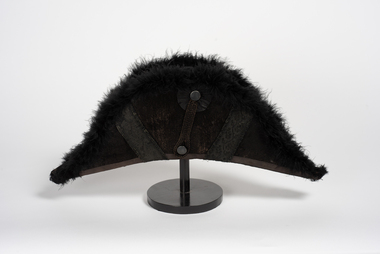
Ceremonial object - Bicorne Hat, 19th Century
... The bicorne or bicorn (two-cornered) was a hat widely adopted in the 1790s as an item of uniform by European and American army and naval officers. ...The bicorne or bicorn (two-cornered) was a hat widely adopted in the 1790s as an item of uniform by European and American army and naval officers. ...The bicorne or bicorn (two-cornered) was a hat widely adopted in the 1790s as an item of uniform by European and American army and naval officers. Military style uniforms were largely adopted for any man serving in an official capacity, such as a post master, mayor or police before specifically designed uniforms or robes were created.Black hand made hat with two distinctive halves pinned up to create a semi circular fan shape. Black braided cockade with two buttons and decorative knot with two decorative fabric pieces running top to bottom on front face only. Trimmed with black ostrich feathers.Makers print under crown illegible (London - Melbourne)city of greater bendigo ceremonial item -
 City of Greater Bendigo - Civic Collection
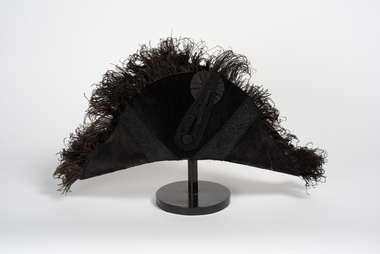
Ceremonial object - Bicorne Hat, 19th Century
... The bicorne or bicorn (two-cornered) was a hat widely adopted in the 1790s as an item of uniform by European and American army and naval officers. ...The bicorne or bicorn (two-cornered) was a hat widely adopted in the 1790s as an item of uniform by European and American army and naval officers. ...The bicorne or bicorn (two-cornered) was a hat widely adopted in the 1790s as an item of uniform by European and American army and naval officers. Military style uniforms were largely adopted for any man serving in an official capacity, such as a Post Master, Mayor or Police officer before specifically designed uniforms or robes were worn.Black hand made hat with two distinctive halves pinned up to create a semi circular fan shape. Black braided cockade with single button and decorative knot with wo decorative fabric pieces running top to bottom on front face only. Trimmed with black ostrich feathers.Nonecity of greater bendigo ceremonial item -
 Flagstaff Hill Maritime Museum and Village
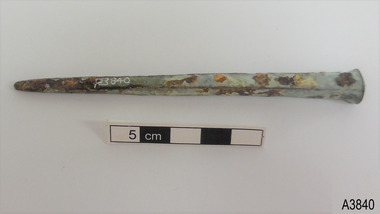
Functional object - Nail
... This historic bronze nail dates back to 1790s to 1890s. Nails such as this one were used for ship building, as deck fasteners and many other uses. ...This historic bronze nail dates back to 1790s to 1890s. Nails such as this one were used for ship building, as deck fasteners and many other uses. ...This historic bronze nail dates back to 1790s to 1890s. Nails such as this one were used for ship building, as deck fasteners and many other uses. This nail was made at a time when the shanks of nails were usually machine cut but the heads were hand formed by blacksmiths. The nail was recovered from a shipwreck along the coast of Victoria in around 1968 and is part of the John Chance Collection. The nail is significant historically as an example of hardware used when building wooden ships in the early to mid-19th century. The nail is historically significant as an example of the work and trade of blacksmith. The nail is also significant as it was recovered by John Chance, a diver in Victoria’s coastal waters in the late 1960s to early 1970s. Items that come from several wrecks have since been donated to the Flagstaff Hill Maritime Village’s museum collection by his family, illustrating this item’s level of historical value.Nail; bronze, deck nail. Rounded rectangular head, rectangular shank cross-section, tip flattened to a rounded wedge shape. The surface is pitted and rough and has blue-grey, green and orange concretion and degradation on the nail's surface. Recovered from an unspecified shipwreck along the coast of Victoria. Part of the John Chance Collection. flagstaff hill, warrnambool, flagstaff hill maritime museum, maritime museum, shipwreck coast, flagstaff hill maritime village, great ocean road, john chance, fastener, nail, square nail, machine cut mail, blacksmith, historic nail, bronze nail, hand forged, coastal shipwreck, victorian shipwreck -
 Royal Australian and New Zealand College of Obstetricians & Gynaecologists (RANZCOG)
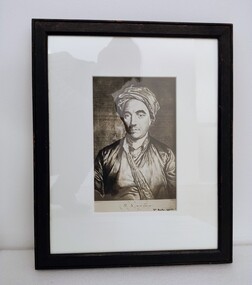
Print - Reproduction photograph of engraving of William Smellie MD, Charles Grignion (1753–1804) et al, c.1790s
... c.1790s ...William Smellie (1697-1763) was a Scottish obstetrician who primarily practised and taught in London. Smellie was groundbreaking in his understanding of childbirth and became an influential teacher of obstetrics. He diligently studied the birthing process, particularly the descent of the baby’s head down the birth canal. His observations lead to him noting that many deaths occurred because of a lack of understanding of this process and the inappropriate handling of forceps. Smellie is generally given the credit for improving the forceps to make them easier to use and less likely to damage the baby. Smellie’s "Treatise on the Theory and Practice of Midwifery" was published In 1751 and became a widely influential teaching resource. Copies of this birth atlas are held in the Frank Forster Library, RANZCOG. The RANZCOG collection also holds a set of forceps supposedly used by William Smellie.Photographic of an engraving. Image depicts a man in silken clothing, including scarf/tie and turban. The image is a head and shoulders portrait, and the subject is facing the artist. The man has stubble on his cheeks and dark coloured eyebrows. Text printed below image reads 'W.S. M.D. Aged 56'. Handwritten inscription below printed text reads 'Wm. Smellie, aged 56'. The image is mounted in white card and housed in a black wooden frame. An old display label is affixed to the bottom left hand corner of the back of the object. Handwritten inscription at centre on the back of the work reads 'John Green Room/Presented by Frank Forster, 1975'. Two hooks and a wire are attached to the back of the frame for hanging. -
 Flagstaff Hill Maritime Museum and Village
Vehicle - Vessel, Whaleboat, Flagstaff Hill Boat Builders, 1989
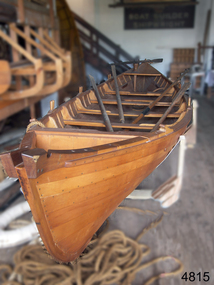
... Whaling was carried out in the 1790s up until the 1970s in the Southern Ocean off the coast of Australia, including southwest Victoria. ...Whaling was carried out in the 1790s up until the 1970s in the Southern Ocean off the coast of Australia, including southwest Victoria. ...The Huon Pine whaleboat was made on site by the boat builders at Flagstaff Hill in1989, of the clinker-planked construction method. Whaling was carried out in the 1790s up until the 1970s in the Southern Ocean off the coast of Australia, including southwest Victoria. The whales were hunted for their oil, baleen, meat and other products. It was a lucrative but very dangerous occupation. The small whaleboats with their five crew members were easy to maneuver but also easily overturned by a writhing whale. The Southern Right whales had desirable attributes; they came close to shore, they were slow swimmers and they floated when dead - hence the name 'Right' describing the right whale to hunt. The whale population was greatly reduced until 1979 when the Australian government prohibited whaling. These whales still visit the area annually to breed in the shallow bays along what is now called the Shipwreck Coast of Victoria. The whaleboat represents a significant time in Australia between the 1790s and 1979, when the whaling trade was carried in this area, and around Australia, providing employment and meeting the demand for whale oil, meat and other products. A time during which the population of whales was greatly depleted. Australian whaleboat; a long narrow vessel constructed of clinker-planked Huon Pine timber. It has provision for a crew of 5five oarsmen and a sweep or helmsman. Made in 1989.flagstaff hill maritime museum and village, maritime museum, maritime village, great ocean road, shipwreck coast, whaleboat, vessel, clinker built, huon pine whaleboat, whaling, whaleling industry -
 City of Greater Bendigo - Civic Collection
Ceremonial object - Bicorne Hat, Ede and Ravescroft
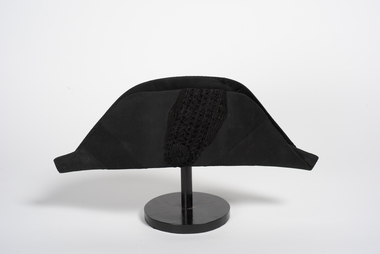
... The bicorne or bicorn (two-cornered) was a hat widely adopted in the 1790s as an item of uniform by European and American army and naval officers. ...The bicorne or bicorn (two-cornered) was a hat widely adopted in the 1790s as an item of uniform by European and American army and naval officers. ...The bicorne or bicorn (two-cornered) was a hat widely adopted in the 1790s as an item of uniform by European and American army and naval officers. Military style uniforms were largely adopted for any man serving in an official capacity, such as a post master, mayor or police before specifically designed uniforms or robes were created. Ede & Ravenscroft is London’s oldest tailor formally established in 1689 in Aldwych from where it had been operating for many years before. It was from here, amongst the many tailors, cloth merchants, robemakers, furriers, embroiderers and haberdashers that the company began its illustrious path of dressing the modern British gent. It began with the respected tailoring family the Shudalls whose work won them the honour of creating the robes for the coronation of their Majesties King William III and Queen Mary II. They soon became a recognised supplier for the royal family, going on to produce a large number or ceremonial robes for the coronation of His Majesty King George III.Black hand made fabric hat with two distinctive halves pinned up to create a semi circular fan shape. Black braided cockade with decorative knot. Makers label underside of crown; Ede and Ravenscroft / Londoncity of greater bendigo ceremonial item -
 City of Greater Bendigo - Civic Collection
Ceremonial object - Bicorne Hat, Ede and Ravenscroft
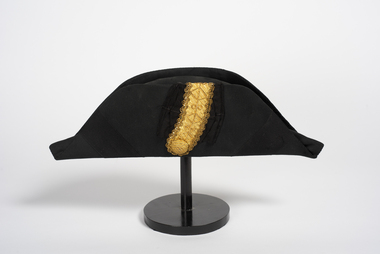
... The bicorne or bicorn (two-cornered) was a hat widely adopted in the 1790s as an item of uniform by European and American army and naval officers. ...The bicorne or bicorn (two-cornered) was a hat widely adopted in the 1790s as an item of uniform by European and American army and naval officers. ...The bicorne or bicorn (two-cornered) was a hat widely adopted in the 1790s as an item of uniform by European and American army and naval officers. Military style uniforms were largely adopted for any man serving in an official capacity, such as a post master, mayor or police before specifically designed uniforms or robes were created. Ede & Ravenscroft is London’s oldest tailor formally established in 1689 in Aldwych from where it had been operating for many years before. It was from here, amongst the many tailors, cloth merchants, robemakers, furriers, embroiderers and haberdashers that the company began its illustrious path of dressing the modern British gent. It began with the respected tailoring family the Shudalls whose work won them the honour of creating the robes for the coronation of their Majesties King William III and Queen Mary II. They soon became a recognised supplier for the royal family, going on to produce a large number or ceremonial robes for the coronation of His Majesty King George III.Black hand made fabric hat with two distinctive halves pinned up to create a semi circular fan shape. Gold braided and beaded cockade with decorative knot.Makers label underside of crown; Ede and Ravenscroft / Londoncity of greater bendigo ceremonial item -
 Flagstaff Hill Maritime Museum and Village
Book - Captain James Cooks Voyages Including aditional Anthology of Explorers Journals, Captain James Cook, Captain Cook's Voyages Round The World, 1790
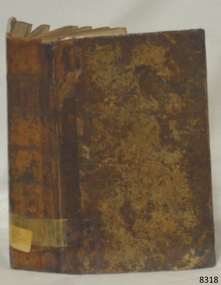
... It was printed and published by Matthew Brown. During the 1790s, provincial printers outside of London commonly acted as their own publishers and booksellers. ...It was printed and published by Matthew Brown. During the 1790s, provincial printers outside of London commonly acted as their own publishers and booksellers. ...This specific printing of Captain Cook's voyages is a fascinating piece of late 18th-century provincial book history. This is a rare 18th-century provincial English edition. In the definitive reference work for Cook collectors M. K. Beddie’s Bibliography of Captain James Cook this exact printing is catalogued and recognised globally as Beddie No. 44. It was issued as a multi-volume set, typically bound in three thick octavo volumes or sometimes split into four. Rather than just copying the standard London texts, this specific edition is an expansive compilation. It includes Cook's three major voyages alongside supplementary accounts of the era, such as Captain Furneaux’s journals, Commodore Phipps’s expedition to the North Pole and, notably, Governor Arthur Phillip’s historic voyage to Botany Bay and the establishment of the Port Jackson colony.Captain Cook's Voyages Round The World Author: Captain James Cook Editor: M. K. Beddie. Publisher: Matthew Brown, Newcastle Upon Tyne. (At Bible Shop the Fresh Market) Date: 1790 Brown plain leather hardcover badly spotted. The spine has a Library label with an inscription.non-fictionThis specific printing of Captain Cook's voyages is a fascinating piece of late 18th-century provincial book history. This is a rare 18th-century provincial English edition. In the definitive reference work for Cook collectors M. K. Beddie’s Bibliography of Captain James Cook this exact printing is catalogued and recognised globally as Beddie No. 44. It was issued as a multi-volume set, typically bound in three thick octavo volumes or sometimes split into four. Rather than just copying the standard London texts, this specific edition is an expansive compilation. It includes Cook's three major voyages alongside supplementary accounts of the era, such as Captain Furneaux’s journals, Commodore Phipps’s expedition to the North Pole and, notably, Governor Arthur Phillip’s historic voyage to Botany Bay and the establishment of the Port Jackson colony.flagstaff hill, warrnambool, shipwrecked coast, flagstaff hill maritime museum, maritime museum, shipwreck coast, flagstaff hill maritime village, great ocean road, book, pattison collection, warrnambool library, warrnambool mechanics’ institute, ralph eric pattison, corangamite regional library service, warrnambool city librarian, mechanics’ institute library, victorian library board, warrnambool books and records, warrnambool children’s library, captain cooks voyages round the world, james cook -
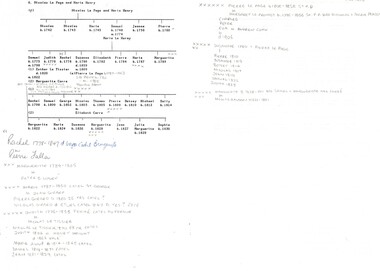 Mont De Lancey
Document - Family Tree Pedigree, c.1980-c.2020
... ...1790s...Family tree of Marie Henry and Nicholas le Page going down 4 generations, spanning 1742-1911 Family trees Family History Marie le Page (nee Henry) Nicholas le Page le Page Family Henry Family 1750s 1740s 1760s 1770s 1780s 1790s 1800s 1810s 1820s 1830s 1840s 1850s 1860s 1870s 1880s 1890s 1900s 1910s 1 A4 page one sided typed tree graph in black ink with annotations on front and back in graylead Document Family Tree Pedigree ...Family tree of Marie Henry and Nicholas le Page going down 4 generations, spanning 1742-19111 A4 page one sided typed tree graph in black ink with annotations on front and back in grayleadfamily trees, family history, marie le page (nee henry), nicholas le page, le page family, henry family, 1750s, 1740s, 1760s, 1770s, 1780s, 1790s, 1800s, 1810s, 1820s, 1830s, 1840s, 1850s, 1860s, 1870s, 1880s, 1890s, 1900s, 1910s -
 Kew Historical Society Inc
Print - Framed Fashion Plate, History of Fashion - Republic from 1790 to 1792, Republic from 1793 to 1794, c.1878
... fashion -- 1790s fashion - france fashion plates Framed fashion plate showing the 'History of Fashion' from 1792-94 in France. ...Framed fashion plate showing the 'History of Fashion' from 1792-94 in France.fashion -- 1790s, fashion - france, fashion plates
