
Showing 134 items matching "1861-1865"
-
 Warrnambool and District Historical Society Inc.
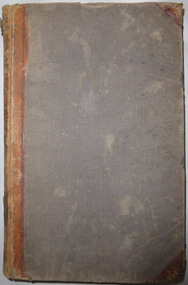
Document - Ledger: Warrnambool Shire Letter book 1861-1865, Circa 1860
... Ledger: Warrnambool Shire Letter book 1861-1865......1861-1865...Document Ledger: Warrnambool Shire Letter book 1861-1865 Sands &Kenny, Collins St Melbourne. ...Contains correspondence pertaining to matters of infrastructure in the period of the 1860’s. The period contained within this ledger is very early in the establishment of the district. It shows the co-operation and initiative between councils, government departments and individuals in matters relating drainage, bridges , roads all vital to the development of the region. Fawn cloth on card cover with tan corner and spine binding. Contains alphabetical index at the front. Letters are written on very fine paper. : On the spine is a paper label, “January1861-April 1865.Label inside front cover “Sands &Kenny. Account Book Manufacturers, Stationers &Printers, Collins St Melbourne. The index contains the following names :W G Allan, Bostock, Biggs, Bench of Magistrates Caramut, Niel Black, Commissioner of the Crown Lands Warrnambool, Commissioner of Roads and Bridges, Cross, Carr, Duffy, Davies, Duffus, Fitzmaurice, Horace Flower warrnambool, warrnambool shire, tenders, district roads board, a davies, 1861-1865 -
 Port Melbourne Historical & Preservation Society
Document - Minutes, Sandridge Municipality Reports Valuation and other Committees, 1861 - 1865
... Minutes of Sandridge Council Valuation and other committees in badly deteriorated binder, 1861-1865...1861 - 1865...Local Government - Borough of Sandridge Local Government - Municipal District of Sandridge Edward CLARK Town Clerks William MAY Mayors Robert BYRNE William MORLEY Minutes of Sandridge Council Valuation and other committees in badly deteriorated binder, 1861-1865 Sandridge Municipality Reports Valuation and other Committees Document Minutes ...Minutes of Sandridge Council Valuation and other committees in badly deteriorated binder, 1861-1865 local government - borough of sandridge, local government - municipal district of sandridge, edward clark, town clerks, william may, mayors, robert byrne, william morley -
 Monbulk RSL Sub Branch
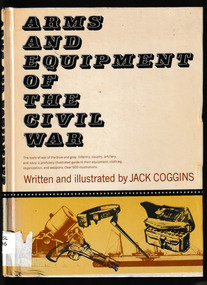
Book, Doubleday, Arms and equipment of the Civil War, 1962
... American civil war 1861-1865...American civil war 1861-1865 American Civil War - Armaments A guide to the weapons and equipment used during the Civil War when the metallic cartridge and repeating rifles were first introduced. ...A guide to the weapons and equipment used during the Civil War when the metallic cartridge and repeating rifles were first introduced. A description of the implements employed by the forces of both sides.Index, ill, p.160. non-fiction A guide to the weapons and equipment used during the Civil War when the metallic cartridge and repeating rifles were first introduced. A description of the implements employed by the forces of both sides. american civil war 1861-1865, american civil war - armaments -
 Monbulk RSL Sub Branch
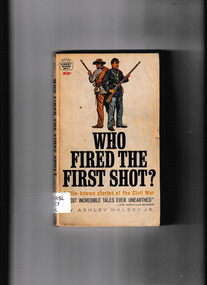
Book, Hawthorn Books, Who fired the first shot? And other untold stories of the Civil War, 1963
... American civil war 1861-1865...American civil war 1861-1865 United States - History This book unfolds the human side of the American civil war - the flesh and blood drama of men and women to whom the war was an intimate, emotional experience. ...This book unfolds the human side of the American civil war - the flesh and blood drama of men and women to whom the war was an intimate, emotional experience.Index, p.218. non-fiction This book unfolds the human side of the American civil war - the flesh and blood drama of men and women to whom the war was an intimate, emotional experience. american civil war 1861-1865, united states - history -
 Monbulk RSL Sub Branch
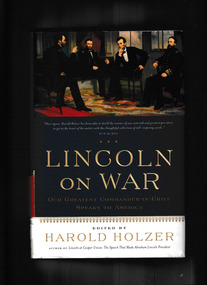
Book, Algonquin Books of Chapel Hil, Lincoln on war, 2011
... American civil war 1861-1865 - History...American civil war 1861-1865 - History Abraham Lincoln 1809-1865 - Leadership President Lincoln used his own weapons--his words--to fight the Civil War as brilliantly as any general who ever took the field. ...President Lincoln used his own weapons--his words--to fight the Civil War as brilliantly as any general who ever took the field. In Lincoln on War, historian Harold Holzer gathers and interprets Lincoln's speeches, letters, memoranda, orders, telegrams, and casual remarks, organizing them chronologically and allowing readers to experience Lincoln's growth from an eager young Indian War officer to a middle-aged dove congressman to a surprisingly hardened and determined hawk as the Union's commander-in-chief. We observe a man willing to sacrifice life and treasure in unprecedented quantities, to risk wounding the pride of vain generals, and even to mislead the public if it meant the preservation of an unbreakable union of states, the destruction of slavery, and the restoration of America as an example to inspire the world. This volume covers strategy; tactics; the endless hiring, sustaining, motivating, and dismissal of commanders; military discipline; and military technology. Modern commanders-in-chief have repeatedly quoted Lincoln to justify their own wars, so it behooves us as citizens to know Lincoln's record well. From masterpieces such as the Gettysburg Address to lesser-known meditations on God's purposes, Lincoln on War is the first book to highlight exclusively Lincoln's sublime and enduring words on warIndex, ill, p.296. President Lincoln used his own weapons--his words--to fight the Civil War as brilliantly as any general who ever took the field. In Lincoln on War, historian Harold Holzer gathers and interprets Lincoln's speeches, letters, memoranda, orders, telegrams, and casual remarks, organizing them chronologically and allowing readers to experience Lincoln's growth from an eager young Indian War officer to a middle-aged dove congressman to a surprisingly hardened and determined hawk as the Union's commander-in-chief. We observe a man willing to sacrifice life and treasure in unprecedented quantities, to risk wounding the pride of vain generals, and even to mislead the public if it meant the preservation of an unbreakable union of states, the destruction of slavery, and the restoration of America as an example to inspire the world. This volume covers strategy; tactics; the endless hiring, sustaining, motivating, and dismissal of commanders; military discipline; and military technology. Modern commanders-in-chief have repeatedly quoted Lincoln to justify their own wars, so it behooves us as citizens to know Lincoln's record well. From masterpieces such as the Gettysburg Address to lesser-known meditations on God's purposes, Lincoln on War is the first book to highlight exclusively Lincoln's sublime and enduring words on war american civil war 1861-1865 - history, abraham lincoln 1809-1865 - leadership -
 Mrs Aeneas Gunn Memorial Library
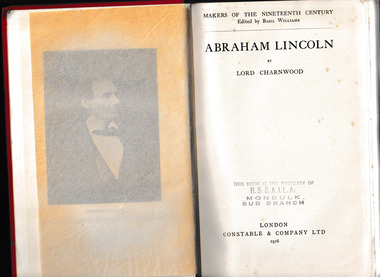
Book, Constable and Company, Abraham Lincoln, 1916
... United Staes - History - Civil war 1861-1865...United Staes - History - Civil war 1861-1865 Presidents - United States - Biography Charnwood describes the frontier life and continual self-education that developed Lincoln's rare character and helped him to adapt to great events and demands such as few other men have experienced. ...Charnwood describes the frontier life and continual self-education that developed Lincoln's rare character and helped him to adapt to great events and demands such as few other men have experienced. Lincoln, the man, is analyzed against the dramatic historical background of the colonial days, the revolution, the War of 1812, the Missouri compromise, secession, and the Civil War. Lincoln's Administrative genius, his war strategy, and his neglect of the lesser for the greater are all presented in this portrait.Index, ill, map, p.479. non-fiction Charnwood describes the frontier life and continual self-education that developed Lincoln's rare character and helped him to adapt to great events and demands such as few other men have experienced. Lincoln, the man, is analyzed against the dramatic historical background of the colonial days, the revolution, the War of 1812, the Missouri compromise, secession, and the Civil War. Lincoln's Administrative genius, his war strategy, and his neglect of the lesser for the greater are all presented in this portrait. united staes - history - civil war 1861-1865, presidents - united states - biography -
Port Melbourne Historical & Preservation Society
Book - Borough of Sandridge, Fire Committee MInutes Book, 1861 - 1865
... Minute book, Municipal Council of Sandridge Fire Committee, March 1861 to April 1865...1861 - 1865...local government - borough of sandridge fire and fire services Minute book, Municipal Council of Sandridge Fire Committee, March 1861 to April 1865 Fire Committee MInutes Book Book Borough of Sandridge ...Minute book, Municipal Council of Sandridge Fire Committee, March 1861 to April 1865 local government - borough of sandridge, fire and fire services -
 Bendigo Historical Society Inc.
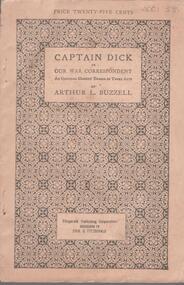
Booklet - BAGGALEY COLLECTION: Comedy drama, Arthur L. Buzzell
... Play is based on the American Civil War 1861 - 1865. ...Play is based on the American Civil War 1861 - 1865. Booklet BAGGALEY COLLECTION: Comedy drama Arthur L. ...Booklet owned by Arthur Baggaley, Fruiterer, who lived at 15 Forest Street, Bendigo. His business 'C.A. Baggaley & Son' was at Covent Garden, Mitchell Street, Bendigo. Arthur was born in Bendigo in 1903 to Charles Arthur Baggaley and Ada (Mallon). He married Evelyn May Grigg. Arthur died in September, 1993. Thirty nine page booklet, on front cover: 'Captain Dick or Our War Correspondent' an original comedy drama in three acts by Arthur L. Buzzell'. Play is based on the American Civil War 1861 - 1865. fruiterer, confectioner, business, mitchell street, covent garden, entertainment, play script -
Port Melbourne Historical & Preservation Society
Book, Sandridge Municipality Reports - Fire Committee, 1861 - 1865
... Sandridge Fire Committee reports for period July 1861 to June 1865, held in large binder. Twenty leaves only. ...1861 - 1865...Frederick SANDERSON Henry McBRIDE Sandridge Fire Committee reports for period July 1861 to June 1865, held in large binder. Twenty leaves only. ...Sandridge Fire Committee reports for period July 1861 to June 1865, held in large binder. Twenty leaves only. Reports 26.3.63 and 24.8.63 describe Brigade uniforms (contains signatures of Fire Brigade members 1863) fire and fire services, local government - borough of sandridge, built environment - civic, uniforms, william ramsden holmes, william morley, thomas swallow, andrew plummer, william marsh, james smith, thomas hester, william bacon, thomas owen, john fose (?), j r sayle (?), frederick sanderson, henry mcbride -
Port Melbourne Historical & Preservation Society
Book - Reports, Sandridge Municipality Reports - Health Committee, 1861 - 1865
... Health Committee reports for period 1 Jan 1861 to 30 June 1865, held in large binder. Eleven pages only, plus three pages of notes for Central Board of Health, including by-law 23, bound in....1861 - 1865...Henry Charles CURTIS, Health Officer Health - General Health Built Environment - Domestic Engineering - Canals and Drainage Livestock Frederick POOLMAN Henry Charles CURTIS Business and Traders - Butchers Victoria Sugar Works Reports signed by Mayors Health Committee reports for period 1 Jan 1861 to 30 June 1865, held in large binder. Eleven pages only, plus three pages of notes for Central Board of Health, including by-law 23, bound in. ...Henry Charles CURTIS, Health Officer Health Committee reports for period 1 Jan 1861 to 30 June 1865, held in large binder. Eleven pages only, plus three pages of notes for Central Board of Health, including by-law 23, bound in. Reports signed by Mayors health - general health, built environment - domestic, engineering - canals and drainage, livestock, frederick poolman, henry charles curtis, business and traders - butchers, victoria sugar works -
 Frankston RSL Sub Branch
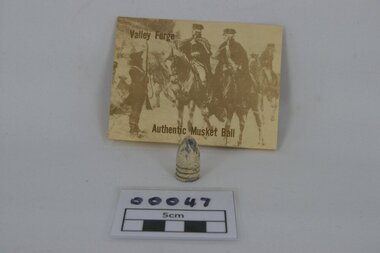
Projectile, Musket
... This is a type of musket ball used in the Civil War period 1861 to 1865....This is a type of musket ball used in the Civil War period 1861 to 1865. Projectile, Musket ...Early smooth bore firearm projectile referred to as a 'Minie Ball' found at the site of the American Civil War battle of Chancellorsville. This is a type of musket ball used in the Civil War period 1861 to 1865. war, ball, projectile, minie, civil -
Unions Ballarat
Jefferson Davis: The real and the unreal (Don Woodward Collection), McElroy, Joseph, 1995 (1937)
... Davis was the President of the Confederate States - 1861 to 1865. ...Davis was the President of the Confederate States - 1861 to 1865. Political (USA) and biographical. ...Historical and biographical account of Jefferson Davis. Davis was the President of the Confederate States - 1861 to 1865. Political (USA) and biographical. Book; 698 pages. Dustjacket: light brown background; artistic impression of Jefferson Davis and confederate flag; green and blue lettering; author's name and title. Cover: green background; gold lettering; author's name and title on the spine. btlc, ballarat trades hall, ballarat trades and labour council, history - usa, politics - united states of america, biography, military - usa, parliament, confederate states of america -
Port Melbourne Historical & Preservation Society
Document - Voters Rolls, District of Sandridge
... Five (5) municipal electoral rolls(photocopies), District of Sandridge 1861; 1862; 1863; 1865; 1866 Photocopy of 1860 map, catalogue no 2083...local government - borough of sandridge Five (5) municipal electoral rolls(photocopies), District of Sandridge 1861; 1862; 1863; 1865; 1866 Photocopy of 1860 map, catalogue no 2083 Document Voters Rolls, District of Sandridge ...Five (5) municipal electoral rolls(photocopies), District of Sandridge 1861; 1862; 1863; 1865; 1866 Photocopy of 1860 map, catalogue no 2083 local government - borough of sandridge -
 Bendigo Historical Society Inc.
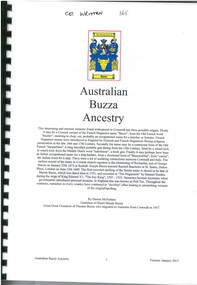
Document - AUSTRALIAN BUZZA ANCESTRY, 2013
... He bought the BAckCreek sawmill (1861-1865). He had several other sawmilling enterprises and later operated a hay and corn produce store. ...He bought the BAckCreek sawmill (1861-1865). He had several other sawmilling enterprises and later operated a hay and corn produce store. ...Thomas Buzza (1833-1904) was a Cornish born miner who came to Bendigo in 1853. He bought the BAckCreek sawmill (1861-1865). He had several other sawmilling enterprises and later operated a hay and corn produce store. He also built and operated paddle-steamers in the Murray Darling system. He left Myers Flat in 1893 and died in Goolwa, SA in 1904. He had married Emily Rainsdon (1852-1926) in 1867. Printed family history spiral bound with perspex cover. Contents page - no index. Contains family trees, summary of Thomas Buzza and his migration from Cornwall, details of descendants of Thomas Buzza, photographs, maps and images of birth, death and marriage certificates. Darren McFarlane genealogy, family, cornish, buzza, bendigo, eaglehawk -
 Eltham District Historical Society Inc
Photograph - Cabinet Photograph, William Ingram family, Birmingham, England, c.1880
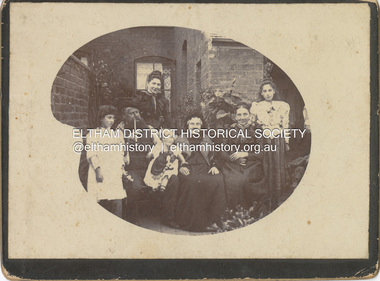
... William and Pamela had six children; William George Grove (1861-1939), Elizabeth (1865), Evan Thomas (1867-1956), Joseph (1868-1934), Louis (1870-1941) and John (1872-1958). ...William and Pamela had six children; William George Grove (1861-1939), Elizabeth (1865), Evan Thomas (1867-1956), Joseph (1868-1934), Louis (1870-1941) and John (1872-1958). ...William Ingram with possibly his wife Pamela Thomas and family members. William is second from left with pipe, the others unidentified. The family lived in Birmgham, England. William, a baker died in 1905. William and Pamela had six children; William George Grove (1861-1939), Elizabeth (1865), Evan Thomas (1867-1956), Joseph (1868-1934), Louis (1870-1941) and John (1872-1958). John Ingram learnt his trade from his father but following a quarrel with his father, he ran away and worked his passage to Australia as a ships baker. His elder brother Evan was already in Australia living in Malvern. It was here that he met Ada Key. John and Ada were married in Fremantle, Western Australia. They travelled to England then Cape Town, a family already started. They returned to Melbourne and in 1901 bought land at Research where he worked to establish an orchard and worked at night asa baker in Eltham. The fashion and hairstyles appear trypical of around 1880 ingram family, birmingham, william ingram, baker, pam thoonen (nee ingram) collection -
 St Kilda Historical Society
Photograph
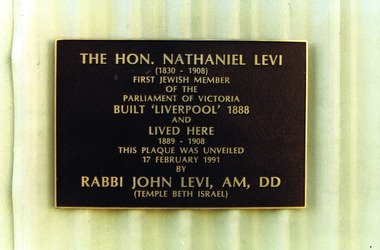
... He served in the Legislative Assembly from 1861-1867, representing the electorates of Maryborough (1 Jan 1861 - 1 Dec 1865) and East Melbourne (1 Feb 1866 - 1 Dec 1867). ...He served in the Legislative Assembly from 1861-1867, representing the electorates of Maryborough (1 Jan 1861 - 1 Dec 1865) and East Melbourne (1 Feb 1866 - 1 Dec 1867). ...The Hon. Nathaniel Levi (1830-1908) was the first Jewish Member of the Parliament of Victoria. He served in the Legislative Assembly from 1861-1867, representing the electorates of Maryborough (1 Jan 1861 - 1 Dec 1865) and East Melbourne (1 Feb 1866 - 1 Dec 1867). He later served in the Legislative Council for the North Yarra electorate (1 Sep 1872 - 1 Jan 1904). Born in Liverpool on 20 Jan 1830, he arrived in Melbourne in April 1854 on the Matilda Wattenbach, opened a store and established a career as a businessman. In 1858 he joined the firm of John Levey & Son, Melbourne and Maryborough. He pioneered the coal and sugar beet industries; established the firm of Nathaniel Levi & Company c1867; commenced auctioneering and agency business c1870; obtained contract for railway advertising c1875; with his two sons (Joseph and John) as partners, the firm became Nathaniel Levi & Sons c1884. He commenced a short-lived newspaper, the Daily News, in Oct 1885. He was a founder and trustee of the Chamber of Manufactures, and its President 1893-1895. He married Sarah Levy in 1855. Nathaniel Levi was prominent in the Jewish community and was President of the Melbourne Hebrew Congregation in 1880–82 and 1904–05. He is a forebear of Rabbi John Levi. colour photograph unmounted The Hon. Nathaniel Levi (1830-1908) first Jewish member of the Parliament of Victoria. Built "Liverpool" 1888 and lived here 1889-1908. This plaque was unveiled 17 February 1991 by Rabbi John Levi AM DD (Temple Beth Israel) plaques, st kilda, nathaniel levi, hon nathaniel levi, member of parliament, liverpool, princes street -
 Mission to Seafarers Victoria
Administrative record (sub-series) - Annual Reports, Victorian Seamen's Mission, Annual Reports - Victorian Seamen's Mission, 1857 -1905
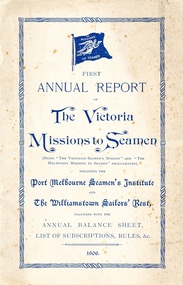
... From 1906, the Victorian mission amalgamated with the London Mission and changed its name to The Victoria Missions to Seamen. 1857: Missing 1858 1859 1860 1861 1862 1863 1864 1865: AR.1865 1866 1867 1868 1869 1870 1871 1872 1873 1874 1875 1876 1877 1878 1879 1880 1881 1882 1883 1884 1885 1886 1887 1888 1889 1890 1891 1892 1893 1894 1895 1896 1897 1898 1899: AR.1899 1900 1901 1902 1903 1904 1905 ...From 1906, the Victorian mission amalgamated with the London Mission and changed its name to The Victoria Missions to Seamen. 1857: Missing 1858 1859 1860 1861 1862 1863 1864 1865: AR.1865 1866 1867 1868 1869 1870 1871 1872 1873 1874 1875 1876 1877 1878 1879 1880 1881 1882 1883 1884 1885 1886 1887 1888 1889 1890 1891 1892 1893 1894 1895 1896 1897 1898 1899: AR.1899 1900 1901 1902 1903 1904 1905 The Annual Reports together with 'Jottings from our Log' and the Epitomised History of matters of interest...0045]] Provide the best accounts and story of the Mission from the late 19th Century through to the end of the 20th Century. ...Victorian Seamen's Mission Chronological annual-report, victoria-missions-to-seamen, victorian-seamens-mission, melbourne-missions-to-seamen, port-melbourne-seamens-institute, williamstown-sailors-rest, 1906, financial reports, members, rules for members, war memorial fund, administrative document-annual report annual-report, victoria-missions-to-seamen, victorian-seamens-mission, melbourne-missions-to-seamen, port-melbourne-seamens-institute, williamstown-sailors-rest, 1906, financial reports, members, rules for members, war memorial fund, administrative document-annual report -
 Flagstaff Hill Maritime Museum and Village
Domestic object - Wash trough, Melvin Newton Lovell, Mangle was Patented June 10, 1898 by Lovell Trough is possibly of later manufacture by a local unknown cabinet maker between 1900-1920
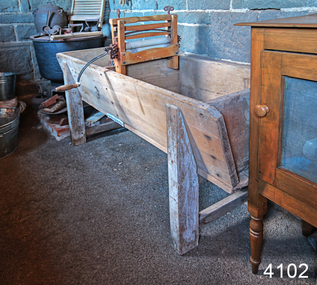
... In 1861, at seventeen years of age, Melvin Lovell left his home and, without parental authority, and entered the Union army soon after the outbreak of the Civil war. In August 1862, he was enlisted as a private in the 127th Pennsylvania Volunteer Infantry and saw active service until receiving his discharge at the end of May 1863. In 1865...In 1861, at seventeen years of age, Melvin Lovell left his home and, without parental authority, and entered the Union army soon after the outbreak of the Civil war. In August 1862, he was enlisted as a private in the 127th Pennsylvania Volunteer Infantry and saw active service until receiving his discharge at the end of May 1863. In 1865 ...Melvin Newton Lovell was born in Allegheny, Venango county, Pennsylvania, on 31 August 1844, to Darius T. Lovell (1815-1855) and Susan B. (Conover) Lovell (1827-1883). When Melvin Lovell was a boy, the family removed to Kerrtown, a village located in the vicinity of Titusville, PA. There Melvin served an apprenticeship at the carpenter's trade, and his natural mechanical talent enabled him to become a skilled workman. He followed his trade during the major portion of his term of residence in Kerrtown. In 1861, at seventeen years of age, Melvin Lovell left his home and, without parental authority, and entered the Union army soon after the outbreak of the Civil war. In August 1862, he was enlisted as a private in the 127th Pennsylvania Volunteer Infantry and saw active service until receiving his discharge at the end of May 1863. In 1865 he took up his residence in Erie, where he worked at the carpenter's trade for several years thereafter. In 1869 Melvin Lovell invented and patented several useful articles for household use, and in that year he began the manufacturing of certain of these inventions, in partnership with Franklin Farrar Adams, another inventor. Among the principal products of the original factory were washing machines and step-ladders. In 1881 Lovell individually began manufacturing other of his patents, including spring beds, and from modest inception, his Lovell Manufacturing Company grew to be one of the largest industrial concerns of its kind in the country and was recognized as being the most extensive manufacture of clothes-wringers in the entire world. In connection with his manufacture of domestic items, Lovell established sales agencies for his products in all parts of the country, and these branches were known as the Lovell stores. These goods were sold on the instalment plan and after his business had already been established becoming a substantial concern Lovell invented and patented the famous wringer which bears his name under the “Anchor” brand, and in later years he confined his operations largely to the manufacture of this very superior household invention. Lovell was also one of the organizers and stockholders of the Combination Roll & Rubber Manufacturing Co, of New York, which was formed to manufacture his patents, with headquarters in New York and a factory at Bloomfield, New Jersey. A significant household item used in the process of washing clothes by a man who had started in 1869, as a young carpenter and later he became a successful businessman and manufacturer of household items. Lovell was granted numerous patents for various devices during his career including several patents for adding machines (cash registers). This item is now sought by collectors and is even rarer due to it's combination with a Lovell clothes wringer. Wooden wash trough with 2 troughs & attached a Lovell wringer (or mangle Anchor Brand) Hard to make out as worn off with use flagstaff hill, warrnambool, shipwrecked-coast, flagstaff-hill-maritime-museum, flagstaff-hill-maritime-village, wash trough, wringer, mangle, laundry, cleaning, washing, housework, domestic, melvin newton lovell, wooden was trough -
 Flagstaff Hill Maritime Museum and Village
Domestic object - Wringer/Mangle, Melvin Newton Lovell, 1898 -1900
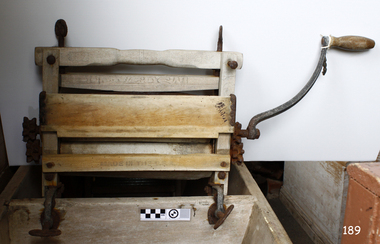
... In 1861, at seventeen years of age, Melvin Lovell left his home and, without parental authority, and entered the Union army soon after the outbreak of the Civil war. In August 1862, he was enlisted as a private in the 127th Pennsylvania Volunteer Infantry and saw active service until receiving his discharge at the end of May 1863. In 1865...In 1861, at seventeen years of age, Melvin Lovell left his home and, without parental authority, and entered the Union army soon after the outbreak of the Civil war. In August 1862, he was enlisted as a private in the 127th Pennsylvania Volunteer Infantry and saw active service until receiving his discharge at the end of May 1863. In 1865 ...Melvin Newton Lovell was born in Allegheny, Venango county, Pennsylvania, on 31 August 1844, to Darius T. Lovell (1815-1855) and Susan B. (Conover) Lovell (1827-1883). When Melvin Lovell was a boy, the family removed to Kerrtown, a village located in the vicinity of Titusville, PA. There Melvin served an apprenticeship at the carpenter's trade, and his natural mechanical talent enabled him to become a skilled workman. He followed his trade during the major portion of his term of residence in Kerrtown. In 1861, at seventeen years of age, Melvin Lovell left his home and, without parental authority, and entered the Union army soon after the outbreak of the Civil war. In August 1862, he was enlisted as a private in the 127th Pennsylvania Volunteer Infantry and saw active service until receiving his discharge at the end of May 1863. In 1865 he took up his residence in Erie, where he worked at the carpenter's trade for several years thereafter. In 1869 Melvin Lovell invented and patented several useful articles for household use, and in that year he began the manufacturing of certain of these inventions, in partnership with Franklin Farrar Adams, another inventor. Among the principal products of the original factory were washing machines and step-ladders. In 1881 Lovell individually began manufacturing other of his patents, including spring beds, and from modest inception, his Lovell Manufacturing Company grew to be one of the largest industrial concerns of its kind in the country and was recognized as being the most extensive manufacture of clothes-wringers in the entire world. In connection with his manufacture of domestic items, Lovell established sales agencies for his products in all parts of the country, and these branches were known as the Lovell stores. These goods were sold on the instalment plan and after his business had already been established becoming a substantial concern Lovell invented and patented the famous wringer which bears his name under the “Anchor” brand, and in later years he confined his operations largely to the manufacture of this very superior household invention. Lovell was also one of the organizers and stockholders of the Combination Roll & Rubber Manufacturing Co, of New York, which was formed to manufacture his patents, with headquarters in New York and a factory at Bloomfield, New Jersey. A significant household item used in the process of washing clothes by a man who had started in 1869, as a young carpenter and later he became a successful businessman and manufacturer of household items. Lovell was granted numerous patents for various devices during his career including several patents for adding machines (cash registers). Wringer (or mangle); portable wooden washing wringer with rubber rollers, manually driven by iron set of gears and handle. Includes iron clamps and adjusting screws for attaching. Marked on frame "382", "12 x 1 3/4" Anchor Brand "Made in USA" flagstaff hill, warrnambool, shipwrecked coast, flagstaff hill maritime museum, flagstaff hill maritime village, great ocean road, mangle, clothes wringer, washing equipment, laundry, wringer, domestic, washing mangle -
 Flagstaff Hill Maritime Museum and Village
Book - A Fictional story, Chapman & Hall Ltd, Little Dorrit, 1890s
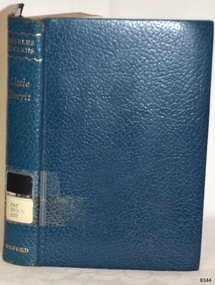
... 1861). His novels themes were in blending humour, pathos, along with critiquing the era’s industrial society. Later, he edited magazines like “Household Words” and toured with dramatic readings. A train crash in 1865...1861). His novels themes were in blending humour, pathos, along with critiquing the era’s industrial society. Later, he edited magazines like “Household Words” and toured with dramatic readings. A train crash in 1865 ...Charles Dickens (1812–1870) was one of the great English novelists of the Victorian era, famous for vivid characters, social criticism, and stories that were first published in serial form. He began as a journalist, rose to enormous popularity during his lifetime, and wrote major works such as Oliver Twist, David Copperfield, and Great Expectations. Little Dorrit is about Amy “Little” Dorrit, a gentle, selfless woman born and raised in the Marshalsea debtors’ prison where her father, William Dorrit, has been imprisoned for unpaid debts. The story follows her as she works as a seamstress outside the prison, gradually becoming entangled with Arthur Clennam, a businessman returning from abroad. Dickens interweaves a sharp critique of Victorian bureaucracy, finance, and class throughout the story. The theme centres around Amy Dorrit who lives her whole early life in Marshalsea, supporting her family with quiet dignity while her father clings to fragile genteel pretensions. Arthur Clennam, disillusioned after years in China, becomes involved with the Dorrits and uncovers a web of secrets involving his own mother, a hidden inheritance, and shady business dealings. William Dorrit suddenly inherits a fortune and is able to lift the family out of poverty and into fashion conscious society.The novel shows how money distorts their characters and relationships, while Amy remains the moral centre.Little Dorrit. Author: Charles Dickens. Publisher: Chapman & Hall Ltd, London. Date: 1890s. (See note section this document for more information on Edition). Green cloth hardcover with Authors name to front cover in gold. Spine has gold title lettering. The spine has a Library label. fiction Charles Dickens (1812–1870) was one of the great English novelists of the Victorian era, famous for vivid characters, social criticism, and stories that were first published in serial form. He began as a journalist, rose to enormous popularity during his lifetime, and wrote major works such as Oliver Twist, David Copperfield, and Great Expectations. Little Dorrit is about Amy “Little” Dorrit, a gentle, selfless woman born and raised in the Marshalsea debtors’ prison where her father, William Dorrit, has been imprisoned for unpaid debts. The story follows her as she works as a seamstress outside the prison, gradually becoming entangled with Arthur Clennam, a businessman returning from abroad. Dickens interweaves a sharp critique of Victorian bureaucracy, finance, and class throughout the story. The theme centres around Amy Dorrit who lives her whole early life in Marshalsea, supporting her family with quiet dignity while her father clings to fragile genteel pretensions. Arthur Clennam, disillusioned after years in China, becomes involved with the Dorrits and uncovers a web of secrets involving his own mother, a hidden inheritance, and shady business dealings. William Dorrit suddenly inherits a fortune and is able to lift the family out of poverty and into fashion conscious society.The novel shows how money distorts their characters and relationships, while Amy remains the moral centre. flagstaff hill, warrnambool, shipwrecked coast, flagstaff hill maritime museum, maritime museum, shipwreck coast, flagstaff hill maritime village, great ocean road, book, pattison collection, warrnambool library, warrnambool mechanics’ institute, ralph eric pattison, corangamite regional library service, warrnambool city librarian, mechanics’ institute library, victorian library board, warrnambool books and records, warrnambool children’s library, little dorrit, charles dickens -
 Flagstaff Hill Maritime Museum and Village
Book - A Fictional Story, Charles Dickens, Barnaby Rudge, (1871–1879)
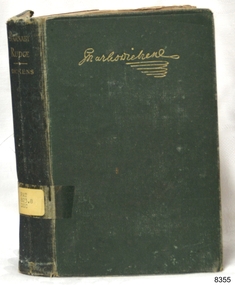
... 1861). His novels themes were in blending humour, pathos, along with critiquing the era’s industrial society. Later, he edited magazines like “Household Words” and toured with dramatic readings. A train crash in 1865...1861). His novels themes were in blending humour, pathos, along with critiquing the era’s industrial society. Later, he edited magazines like “Household Words” and toured with dramatic readings. A train crash in 1865 ...Charles Dickens (1812–1870) was one of the great English novelists of the Victorian era, famous for vivid characters, social criticism, and stories that were first published in serial form. He began as a journalist, rose to enormous popularity during his lifetime, and wrote major works such as Oliver Twist, David Copperfield, and Great Expectations. Barnaby Rudge is a historical Dickens novel set against the Gordon Riots of 1780, mixing mystery, political unrest, family secrets, and the story of a simple minded young man, Barnaby, and his pet raven Grip. It is considered Dickens’s first historical novel and one of his less widely read works, but it remains important for its treatment of mob violence and social disorder. The novel begins with a murder mystery linked to the Haredale and Rudge families, then broadens into the chaos of the anti Catholic Gordon Riots in London. Barnaby, an innocent and impressionable character, is drawn into the riotous crowd. Other threads involve love, family conflict, imprisonment, and eventual reckoning. Dickens uses the riot setting to show how crowd panic and prejudice can spread destructively through society.Barnaby Rudge Author: Charles Dickens Publisher: Chapman & Hall Ltd Date: Household Edition (1871–1879) (See note section this document for more information on Edition). Green cloth hardcover with a black spine with authors name signed on front cover, lettering in gold. The spine has a Library label. First Published as part of the weekly Master Humphrey's Clock series (1840-1841) fiction Charles Dickens (1812–1870) was one of the great English novelists of the Victorian era, famous for vivid characters, social criticism, and stories that were first published in serial form. He began as a journalist, rose to enormous popularity during his lifetime, and wrote major works such as Oliver Twist, David Copperfield, and Great Expectations. Barnaby Rudge is a historical Dickens novel set against the Gordon Riots of 1780, mixing mystery, political unrest, family secrets, and the story of a simple minded young man, Barnaby, and his pet raven Grip. It is considered Dickens’s first historical novel and one of his less widely read works, but it remains important for its treatment of mob violence and social disorder. The novel begins with a murder mystery linked to the Haredale and Rudge families, then broadens into the chaos of the anti Catholic Gordon Riots in London. Barnaby, an innocent and impressionable character, is drawn into the riotous crowd. Other threads involve love, family conflict, imprisonment, and eventual reckoning. Dickens uses the riot setting to show how crowd panic and prejudice can spread destructively through society. flagstaff hil, warrnambool, flagstaff hill maritime museum, maritime museum, shipwreck coast, flagstaff hill maritime village, great ocean road, book, pattison collection, warrnambool library, warrnambool mechanics’ institute, ralph eric pattison, corangamite regional library service, warrnambool city librarian, mechanics’ institute library, victorian library board, warrnambool books and records, warrnambool children’s library, barnaby rudge, charles dickens -
 Flagstaff Hill Maritime Museum and Village
Functional object - String Dispenser, Lovell Manufacturing Company, 1900-1948
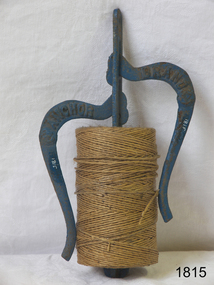
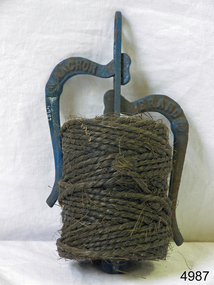
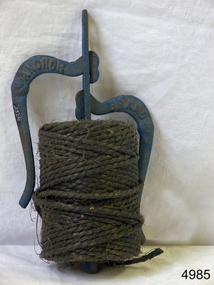
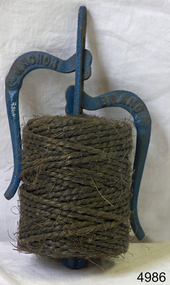
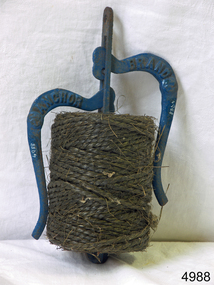
... In 1861, at seventeen years of age, Melvin left home, without parental authority, and joined the Union Army soon after the outbreak of the Civil war, in August 1862, he enlisted as a private in the 127th Pennsylvania Volunteer Infantry, and was discharged the end of May 1863. In 1865...In 1861, at seventeen years of age, Melvin left home, without parental authority, and joined the Union Army soon after the outbreak of the Civil war, in August 1862, he enlisted as a private in the 127th Pennsylvania Volunteer Infantry, and was discharged the end of May 1863. In 1865 ...The string has long been a household and office utility, but an easily tangled one. generations of manufactures have devised cast-iron string holders and string reels in an attempt to distribute this material more efficiently. Many different designs of cast-iron string holders exist some nickel, others painted many had an open pattern so clerks behind the counter of the general store could see at a glance if he or she was about to run out of string. In the 20th century, string holders became more decorative, morphing into novelty items for the home. History: Starting from 1869, the young carpenter by trade, Melvin Newton Lovell (1844-1895) from Erie, Pennsylvania, later a manufacturer and successful businessman, was granted numerous patents for various devices, between them several patents for adding machines and cash registers in 1891. The Lovell Manufacturing Company was founded by Melvin Newton Lovell who was born in Allegheny, Venango county, Pennsylvania, on 31 August 1844, to Darius T. Lovell (1815-1855) and Susan B. (Conover) Lovell (1827-1883). When Melvin Lovell was a boy, the family moved to Kerrtown, a village located in the vicinity of Titusville, Pennsylvania. There Melvin served an apprenticeship as a carpenter's and his natural mechanical talent, soon enabled him to become a skilled workman. In 1861, at seventeen years of age, Melvin left home, without parental authority, and joined the Union Army soon after the outbreak of the Civil war, in August 1862, he enlisted as a private in the 127th Pennsylvania Volunteer Infantry, and was discharged the end of May 1863. In 1865 he took up residence in Erie, where he worked as a carpenter for some years. In 1869 Melvin Lovell invented and patented several useful articles for household use, and in that year he began the manufacturing certain of these inventions, in partnership with Franklin Farrar Adams, another inventor. The company's principal products were washing machines and step-ladders but also made many other cast iron household items known as the “Anchor Brand” when manufacturing began in earnest in 1881. As a result, the Lovell Manufacturing Company grew to be one of the largest industrial concerns of its kind in the country, recognized as being the most extensive manufacturer of clothes-wringers in the entire world. Lovell established sales agencies for his products in all parts of the country, and these branches were known as the Lovell stores. These goods were sold on the instalment plan, an innervation at the time for which Lovell was credited as the originator. Lovell invented and patented the famous wringer which bears his name, and in later years he confined his operations largely to the manufacture and improvement of this invention. Lovell was also one of the organisers and stockholders of the Combination Roll & Rubber Manufacturing Co, of New York, which was formed to manufacture his patents. With headquarters in New York and a factory at Bloomfield, New Jersey. Unfortunately, during a trip to Atlanta, while representing the state of Pennsylvania at a trade exposition, he passed away in his prime, on 21 November 1895, and was buried in Erie Cemetery, Erie, PA. Today the Lovell Manufacturing Company and foundry is preserved and situated at Lovell Place 1301 French Street Erie Pennsylvania, the site is regarded as a historic complex and national historic district. It includes nine contributing buildings built between 1883 and 1946 and has now been converted to luxury apartments. An item used in shops, offices etc to dispense string although the item was commonly found in many areas of general commerce. It was made by a factory and patented in the USA by Melvin Lovell who had invented the first adding machine and the original mangle or wringer washing machine used in every house throughout the world from 1891 and the forerunner to our modern day washing machines. Its age and connection to this once notable maker and his company and it's age makes it an interesting item from a historical view point. Dispenser,cast iron for string with a central rod & 2 curved handing hooks. Marked Anchor Brand & blue in colour. flagstaff hill, warrnambool, flagstaff-hill-maritime-museum, shipwreck-coast, flagstaff-hill-maritime-village, melvin newton lovell, string dispenser, string, packaging, anchor brand -
 Flagstaff Hill Maritime Museum and Village
Functional object - String Dispenser, Lovell Manufacturing Company, 1900-1948
... In 1861, at seventeen years of age, Melvin left home, without parental authority, and joined the Union Army soon after the outbreak of the Civil war, in August 1862, he enlisted as a private in the 127th Pennsylvania Volunteer Infantry, and was discharged the end of May 1863. In 1865...In 1861, at seventeen years of age, Melvin left home, without parental authority, and joined the Union Army soon after the outbreak of the Civil war, in August 1862, he enlisted as a private in the 127th Pennsylvania Volunteer Infantry, and was discharged the end of May 1863. In 1865 ...The string has long been a household and office utility, but an easily tangled one. generations of manufactures have devised cast-iron string holders and string reels in an attempt to distribute this material more efficiently. Many different designs of cast-iron string holders exist some nickel, others painted many had an open pattern so clerks behind the counter of the general store could see at a glance if he or she was about to run out of string. In the 20th century, string holders became more decorative, morphing into novelty items for the home. History: Starting from 1869, the young carpenter by trade, Melvin Newton Lovell (1844-1895) from Erie, Pennsylvania, later a manufacturer and successful businessman, was granted numerous patents for various devices, between them several patents for adding machines and cash registers in 1891. The Lovell Manufacturing Company was founded by Melvin Newton Lovell who was born in Allegheny, Venango county, Pennsylvania, on 31 August 1844, to Darius T. Lovell (1815-1855) and Susan B. (Conover) Lovell (1827-1883). When Melvin Lovell was a boy, the family moved to Kerrtown, a village located in the vicinity of Titusville, Pennsylvania. There Melvin served an apprenticeship as a carpenter's and his natural mechanical talent, soon enabled him to become a skilled workman. In 1861, at seventeen years of age, Melvin left home, without parental authority, and joined the Union Army soon after the outbreak of the Civil war, in August 1862, he enlisted as a private in the 127th Pennsylvania Volunteer Infantry, and was discharged the end of May 1863. In 1865 he took up residence in Erie, where he worked as a carpenter for some years. In 1869 Melvin Lovell invented and patented several useful articles for household use, and in that year he began the manufacturing certain of these inventions, in partnership with Franklin Farrar Adams, another inventor. The company's principal products were washing machines and step-ladders but also made many other cast iron household items known as the “Anchor Brand” when manufacturing began in earnest in 1881. As a result, the Lovell Manufacturing Company grew to be one of the largest industrial concerns of its kind in the country, recognized as being the most extensive manufacturer of clothes-wringers in the entire world. Lovell established sales agencies for his products in all parts of the country, and these branches were known as the Lovell stores. These goods were sold on the instalment plan, an innervation at the time for which Lovell was credited as the originator. Lovell invented and patented the famous wringer which bears his name, and in later years he confined his operations largely to the manufacture and improvement of this invention. Lovell was also one of the organisers and stockholders of the Combination Roll & Rubber Manufacturing Co, of New York, which was formed to manufacture his patents. With headquarters in New York and a factory at Bloomfield, New Jersey. Unfortunately, during a trip to Atlanta, while representing the state of Pennsylvania at a trade exposition, he passed away in his prime, on 21 November 1895, and was buried in Erie Cemetery, Erie, PA. Today the Lovell Manufacturing Company and foundry is preserved and situated at Lovell Place 1301 French Street Erie Pennsylvania, the site is regarded as a historic complex and national historic district. It includes nine contributing buildings built between 1883 and 1946 and has now been converted to luxury apartments. An item used in shops, offices etc to dispense string although the item was commonly found in many areas of general commerce. It was made by a factory and patented in the USA by Melvin Lovell who had invented the first adding machine and the original mangle or wringer washing machine used in every house throughout the world from 1891 and the forerunner to our modern day washing machines. Its age and connection to this once notable maker and his company and it's age makes it an interesting item from a historical view point. Dispenser,cast iron for string with a central rod & 2 curved handing hooks. Marked Anchor Brand & blue in colour. flagstaff hill, warrnambool, flagstaff-hill-maritime-museum, shipwreck-coast, flagstaff-hill-maritime-village, melvin newton lovell, string dispenser, string, packaging, anchor brand -
 Flagstaff Hill Maritime Museum and Village
Functional object - String Dispenser, Lovell Manufacturing Company, 1900-1948
... In 1861, at seventeen years of age, Melvin left home, without parental authority, and joined the Union Army soon after the outbreak of the Civil war, in August 1862, he enlisted as a private in the 127th Pennsylvania Volunteer Infantry, and was discharged the end of May 1863. In 1865...In 1861, at seventeen years of age, Melvin left home, without parental authority, and joined the Union Army soon after the outbreak of the Civil war, in August 1862, he enlisted as a private in the 127th Pennsylvania Volunteer Infantry, and was discharged the end of May 1863. In 1865 ...The string has long been a household and office utility, but an easily tangled one. generations of manufactures have devised cast-iron string holders and string reels in an attempt to distribute this material more efficiently. Many different designs of cast-iron string holders exist some nickel, others painted many had an open pattern so clerks behind the counter of the general store could see at a glance if he or she was about to run out of string. In the 20th century, string holders became more decorative, morphing into novelty items for the home. History: Starting from 1869, the young carpenter by trade, Melvin Newton Lovell (1844-1895) from Erie, Pennsylvania, later a manufacturer and successful businessman, was granted numerous patents for various devices, between them several patents for adding machines and cash registers in 1891. The Lovell Manufacturing Company was founded by Melvin Newton Lovell who was born in Allegheny, Venango county, Pennsylvania, on 31 August 1844, to Darius T. Lovell (1815-1855) and Susan B. (Conover) Lovell (1827-1883). When Melvin Lovell was a boy, the family moved to Kerrtown, a village located in the vicinity of Titusville, Pennsylvania. There Melvin served an apprenticeship as a carpenter's and his natural mechanical talent, soon enabled him to become a skilled workman. In 1861, at seventeen years of age, Melvin left home, without parental authority, and joined the Union Army soon after the outbreak of the Civil war, in August 1862, he enlisted as a private in the 127th Pennsylvania Volunteer Infantry, and was discharged the end of May 1863. In 1865 he took up residence in Erie, where he worked as a carpenter for some years. In 1869 Melvin Lovell invented and patented several useful articles for household use, and in that year he began the manufacturing certain of these inventions, in partnership with Franklin Farrar Adams, another inventor. The company's principal products were washing machines and step-ladders but also made many other cast iron household items known as the “Anchor Brand” when manufacturing began in earnest in 1881. As a result, the Lovell Manufacturing Company grew to be one of the largest industrial concerns of its kind in the country, recognized as being the most extensive manufacturer of clothes-wringers in the entire world. Lovell established sales agencies for his products in all parts of the country, and these branches were known as the Lovell stores. These goods were sold on the instalment plan, an innervation at the time for which Lovell was credited as the originator. Lovell invented and patented the famous wringer which bears his name, and in later years he confined his operations largely to the manufacture and improvement of this invention. Lovell was also one of the organisers and stockholders of the Combination Roll & Rubber Manufacturing Co, of New York, which was formed to manufacture his patents. With headquarters in New York and a factory at Bloomfield, New Jersey. Unfortunately, during a trip to Atlanta, while representing the state of Pennsylvania at a trade exposition, he passed away in his prime, on 21 November 1895, and was buried in Erie Cemetery, Erie, PA. Today the Lovell Manufacturing Company and foundry is preserved and situated at Lovell Place 1301 French Street Erie Pennsylvania, the site is regarded as a historic complex and national historic district. It includes nine contributing buildings built between 1883 and 1946 and has now been converted to luxury apartments. An item used in shops, offices etc to dispense string although the item was commonly found in many areas of general commerce. It was made by a factory and patented in the USA by Melvin Lovell who had invented the first adding machine and the original mangle or wringer washing machine used in every house throughout the world from 1891 and the forerunner to our modern day washing machines. Its age and connection to this once notable maker and his company and it's age makes it an interesting item from a historical view point. Dispenser,cast iron for string with a central rod & 2 curved handing hooks. Marked Anchor Brand & blue in colour. flagstaff hill, warrnambool, flagstaff-hill-maritime-museum, shipwreck-coast, flagstaff-hill-maritime-village, melvin newton lovell, string dispenser, string, packaging, anchor brand -
 Flagstaff Hill Maritime Museum and Village
Functional object - String Dispenser, Lovell Manufacturing Company, 1900-1948
... In 1861, at seventeen years of age, Melvin left home, without parental authority, and joined the Union Army soon after the outbreak of the Civil war, in August 1862, he enlisted as a private in the 127th Pennsylvania Volunteer Infantry, and was discharged the end of May 1863. In 1865...In 1861, at seventeen years of age, Melvin left home, without parental authority, and joined the Union Army soon after the outbreak of the Civil war, in August 1862, he enlisted as a private in the 127th Pennsylvania Volunteer Infantry, and was discharged the end of May 1863. In 1865 ...The string has long been a household and office utility, but an easily tangled one. generations of manufactures have devised cast-iron string holders and string reels in an attempt to distribute this material more efficiently. Many different designs of cast-iron string holders exist some nickel, others painted many had an open pattern so clerks behind the counter of the general store could see at a glance if he or she was about to run out of string. In the 20th century, string holders became more decorative, morphing into novelty items for the home. History: Starting from 1869, the young carpenter by trade, Melvin Newton Lovell (1844-1895) from Erie, Pennsylvania, later a manufacturer and successful businessman, was granted numerous patents for various devices, between them several patents for adding machines and cash registers in 1891. The Lovell Manufacturing Company was founded by Melvin Newton Lovell who was born in Allegheny, Venango county, Pennsylvania, on 31 August 1844, to Darius T. Lovell (1815-1855) and Susan B. (Conover) Lovell (1827-1883). When Melvin Lovell was a boy, the family moved to Kerrtown, a village located in the vicinity of Titusville, Pennsylvania. There Melvin served an apprenticeship as a carpenter's and his natural mechanical talent, soon enabled him to become a skilled workman. In 1861, at seventeen years of age, Melvin left home, without parental authority, and joined the Union Army soon after the outbreak of the Civil war, in August 1862, he enlisted as a private in the 127th Pennsylvania Volunteer Infantry, and was discharged the end of May 1863. In 1865 he took up residence in Erie, where he worked as a carpenter for some years. In 1869 Melvin Lovell invented and patented several useful articles for household use, and in that year he began the manufacturing certain of these inventions, in partnership with Franklin Farrar Adams, another inventor. The company's principal products were washing machines and step-ladders but also made many other cast iron household items known as the “Anchor Brand” when manufacturing began in earnest in 1881. As a result, the Lovell Manufacturing Company grew to be one of the largest industrial concerns of its kind in the country, recognized as being the most extensive manufacturer of clothes-wringers in the entire world. Lovell established sales agencies for his products in all parts of the country, and these branches were known as the Lovell stores. These goods were sold on the instalment plan, an innervation at the time for which Lovell was credited as the originator. Lovell invented and patented the famous wringer which bears his name, and in later years he confined his operations largely to the manufacture and improvement of this invention. Lovell was also one of the organisers and stockholders of the Combination Roll & Rubber Manufacturing Co, of New York, which was formed to manufacture his patents. With headquarters in New York and a factory at Bloomfield, New Jersey. Unfortunately, during a trip to Atlanta, while representing the state of Pennsylvania at a trade exposition, he passed away in his prime, on 21 November 1895, and was buried in Erie Cemetery, Erie, PA. Today the Lovell Manufacturing Company and foundry is preserved and situated at Lovell Place 1301 French Street Erie Pennsylvania, the site is regarded as a historic complex and national historic district. It includes nine contributing buildings built between 1883 and 1946 and has now been converted to luxury apartments. An item used in shops, offices etc to dispense string although the item was commonly found in many areas of general commerce. It was made by a factory and patented in the USA by Melvin Lovell who had invented the first adding machine and the original mangle or wringer washing machine used in every house throughout the world from 1891 and the forerunner to our modern day washing machines. Its age and connection to this once notable maker and his company and it's age makes it an interesting item from a historical view point. Dispenser,cast iron for string with a central rod & 2 curved handing hooks. Marked Anchor Brand & blue in colour. flagstaff hill, warrnambool, flagstaff-hill-maritime-museum, shipwreck-coast, flagstaff-hill-maritime-village, melvin newton lovell, string dispenser, string, packaging, anchor brand -
 Flagstaff Hill Maritime Museum and Village
Functional object - String Dispenser, Lovell Manufacturing Company, 1900-1948
... In 1861, at seventeen years of age, Melvin left home, without parental authority, and joined the Union Army soon after the outbreak of the Civil war, in August 1862, he enlisted as a private in the 127th Pennsylvania Volunteer Infantry, and was discharged the end of May 1863. In 1865...In 1861, at seventeen years of age, Melvin left home, without parental authority, and joined the Union Army soon after the outbreak of the Civil war, in August 1862, he enlisted as a private in the 127th Pennsylvania Volunteer Infantry, and was discharged the end of May 1863. In 1865 ...The string has long been a household and office utility, but an easily tangled one. generations of manufactures have devised cast-iron string holders and string reels in an attempt to distribute this material more efficiently. Many different designs of cast-iron string holders exist some nickel, others painted many had an open pattern so clerks behind the counter of the general store could see at a glance if he or she was about to run out of string. In the 20th century, string holders became more decorative, morphing into novelty items for the home. History: Starting from 1869, the young carpenter by trade, Melvin Newton Lovell (1844-1895) from Erie, Pennsylvania, later a manufacturer and successful businessman, was granted numerous patents for various devices, between them several patents for adding machines and cash registers in 1891. The Lovell Manufacturing Company was founded by Melvin Newton Lovell who was born in Allegheny, Venango county, Pennsylvania, on 31 August 1844, to Darius T. Lovell (1815-1855) and Susan B. (Conover) Lovell (1827-1883). When Melvin Lovell was a boy, the family moved to Kerrtown, a village located in the vicinity of Titusville, Pennsylvania. There Melvin served an apprenticeship as a carpenter's and his natural mechanical talent, soon enabled him to become a skilled workman. In 1861, at seventeen years of age, Melvin left home, without parental authority, and joined the Union Army soon after the outbreak of the Civil war, in August 1862, he enlisted as a private in the 127th Pennsylvania Volunteer Infantry, and was discharged the end of May 1863. In 1865 he took up residence in Erie, where he worked as a carpenter for some years. In 1869 Melvin Lovell invented and patented several useful articles for household use, and in that year he began the manufacturing certain of these inventions, in partnership with Franklin Farrar Adams, another inventor. The company's principal products were washing machines and step-ladders but also made many other cast iron household items known as the “Anchor Brand” when manufacturing began in earnest in 1881. As a result, the Lovell Manufacturing Company grew to be one of the largest industrial concerns of its kind in the country, recognized as being the most extensive manufacturer of clothes-wringers in the entire world. Lovell established sales agencies for his products in all parts of the country, and these branches were known as the Lovell stores. These goods were sold on the instalment plan, an innervation at the time for which Lovell was credited as the originator. Lovell invented and patented the famous wringer which bears his name, and in later years he confined his operations largely to the manufacture and improvement of this invention. Lovell was also one of the organisers and stockholders of the Combination Roll & Rubber Manufacturing Co, of New York, which was formed to manufacture his patents. With headquarters in New York and a factory at Bloomfield, New Jersey. Unfortunately, during a trip to Atlanta, while representing the state of Pennsylvania at a trade exposition, he passed away in his prime, on 21 November 1895, and was buried in Erie Cemetery, Erie, PA. Today the Lovell Manufacturing Company and foundry is preserved and situated at Lovell Place 1301 French Street Erie Pennsylvania, the site is regarded as a historic complex and national historic district. It includes nine contributing buildings built between 1883 and 1946 and has now been converted to luxury apartments. An item used in shops, offices etc to dispense string although the item was commonly found in many areas of general commerce. It was made by a factory and patented in the USA by Melvin Lovell who had invented the first adding machine and the original mangle or wringer washing machine used in every house throughout the world from 1891 and the forerunner to our modern day washing machines. Its age and connection to this once notable maker and his company and it's age makes it an interesting item from a historical view point. Dispenser,cast iron for string with a central rod & 2 curved handing hooks. Marked Anchor Brand & blue in colour. flagstaff hill, warrnambool, flagstaff-hill-maritime-museum, shipwreck-coast, flagstaff-hill-maritime-village, melvin newton lovell, string dispenser, string, packaging, anchor brand -
 Flagstaff Hill Maritime Museum and Village
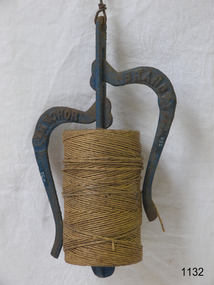
Functional object - String Dispenser, Lovell Manufacturing Company, 1900-1948
... In 1861, at seventeen years of age, Melvin left home, without parental authority, and joined the Union Army soon after the outbreak of the Civil war, in August 1862, he enlisted as a private in the 127th Pennsylvania Volunteer Infantry, and was discharged the end of May 1863. In 1865...In 1861, at seventeen years of age, Melvin left home, without parental authority, and joined the Union Army soon after the outbreak of the Civil war, in August 1862, he enlisted as a private in the 127th Pennsylvania Volunteer Infantry, and was discharged the end of May 1863. In 1865 ...The string has long been a household and office utility, but an easily tangled one. generations of manufactures have devised cast-iron string holders and string reels in an attempt to distribute this material more efficiently. Many different designs of cast-iron string holders exist some nickel, others painted many had an open pattern so clerks behind the counter of the general store could see at a glance if he or she was about to run out of string. In the 20th century, string holders became more decorative, morphing into novelty items for the home. History: Starting from 1869, the young carpenter by trade, Melvin Newton Lovell (1844-1895) from Erie, Pennsylvania, later a manufacturer and successful businessman, was granted numerous patents for various devices, between them several patents for adding machines and cash registers in 1891. The Lovell Manufacturing Company was founded by Melvin Newton Lovell who was born in Allegheny, Venango county, Pennsylvania, on 31 August 1844, to Darius T. Lovell (1815-1855) and Susan B. (Conover) Lovell (1827-1883). When Melvin Lovell was a boy, the family moved to Kerrtown, a village located in the vicinity of Titusville, Pennsylvania. There Melvin served an apprenticeship as a carpenter's and his natural mechanical talent, soon enabled him to become a skilled workman. In 1861, at seventeen years of age, Melvin left home, without parental authority, and joined the Union Army soon after the outbreak of the Civil war, in August 1862, he enlisted as a private in the 127th Pennsylvania Volunteer Infantry, and was discharged the end of May 1863. In 1865 he took up residence in Erie, where he worked as a carpenter for some years. In 1869 Melvin Lovell invented and patented several useful articles for household use, and in that year he began the manufacturing certain of these inventions, in partnership with Franklin Farrar Adams, another inventor. The company's principal products were washing machines and step-ladders but also made many other cast iron household items known as the “Anchor Brand” when manufacturing began in earnest in 1881. As a result, the Lovell Manufacturing Company grew to be one of the largest industrial concerns of its kind in the country, recognized as being the most extensive manufacturer of clothes-wringers in the entire world. Lovell established sales agencies for his products in all parts of the country, and these branches were known as the Lovell stores. These goods were sold on the instalment plan, an innervation at the time for which Lovell was credited as the originator. Lovell invented and patented the famous wringer which bears his name, and in later years he confined his operations largely to the manufacture and improvement of this invention. Lovell was also one of the organisers and stockholders of the Combination Roll & Rubber Manufacturing Co, of New York, which was formed to manufacture his patents. With headquarters in New York and a factory at Bloomfield, New Jersey. Unfortunately, during a trip to Atlanta, while representing the state of Pennsylvania at a trade exposition, he passed away in his prime, on 21 November 1895, and was buried in Erie Cemetery, Erie, PA. Today the Lovell Manufacturing Company and foundry is preserved and situated at Lovell Place 1301 French Street Erie Pennsylvania, the site is regarded as a historic complex and national historic district. It includes nine contributing buildings built between 1883 and 1946 and has now been converted to luxury apartments. An item used in shops, offices etc to dispense string although the item was commonly found in many areas of general commerce. It was made by a factory and patented in the USA by Melvin Lovell who had invented the first adding machine and the original mangle or wringer washing machine used in every house throughout the world from 1891 and the forerunner to our modern day washing machines. Its age and connection to this once notable maker and his company and it's age makes it an interesting item from a historical view point. Dispenser,cast iron for string with a central rod & 2 curved handing hooks. Marked Anchor Brand & blue in colour. flagstaff hill, warrnambool, shipwrecked-coast, flagstaff-hill, flagstaff-hill-maritime-museum, maritime-museum, shipwreck-coast, flagstaff-hill-maritime-village -
 Flagstaff Hill Maritime Museum and Village
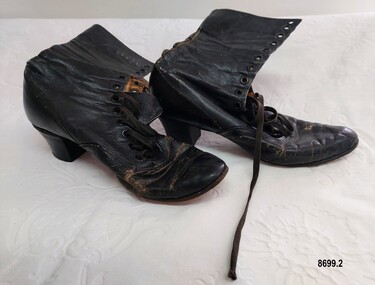
Footwear - Leather boots, Adler Boots and Shoes, circa 1920
... Matthew Stephenson (1861 – 1943) who had grown up on the Bendigo goldfields and shifted to Melbourne in the early 1900’s was a train driver and later, a fireman with the railways. His wife Elizabeth Jane (Betsy) Wigley (1865...Matthew Stephenson (1861 – 1943) who had grown up on the Bendigo goldfields and shifted to Melbourne in the early 1900’s was a train driver and later, a fireman with the railways. His wife Elizabeth Jane (Betsy) Wigley (1865 ...This item is one of a collection of clothing items that belonged to the Stephenson family who lived at 22 McCracken Street, Kensington, Melbourne. Matthew Stephenson (1861 – 1943) who had grown up on the Bendigo goldfields and shifted to Melbourne in the early 1900’s was a train driver and later, a fireman with the railways. His wife Elizabeth Jane (Betsy) Wigley (1865 – 1953) also grew up on the goldfields around Majorca and Bendigo. They married in 1885 in Bendigo. They had two daughters – Ethel Evelyn Stephenson (1886 – 1956) and Lillian or Lila (1891 – 1977) who were milliners and dressmakers and who continued to live in the family home after the death of their parents. The family are recorded as living at 22 McCracken Street, Kensington, as early as 1914. It is not known who made or owned the clothing that makes up this collection but as it appears to be from the late Victorian and early Edwardian era, the different pieces were probably made and worn by any of the three ladies of the house – Betsy, Ethel and/or Lila. During W.W.2, a local Warrnambool couple (Meryl and Tony Everard) boarded with them – Tony was in the airforce training paratroopers to jump into (and survive) enemy territory and his wife Meryl worked in the Methodist baby Home. The Everards developed a close friendship with the Stephensons and were responsible for clearing out the house (and finding this clothing collection) after Lila died in 1977. Starting in around 1850, women began wearing boots that resembled the ones already worn by men in high society. Victorian women's boots were slightly more feminine in nature, however, than those worn by their male counterparts. The boots first worn by women extended to the middle of the calf so that her ankle would stay properly covered underneath her many skirts. These boots often featured laces or a row of buttons to keep them secure to the foot and ankle. Although usually made from durable materials like rubber and leather, boots that were worn purely for fashion were sometimes made of more elegant materials like patent leather or dyed suede. Edwardian boots were lace up or button up. The most remarkable thing about women's shoes in the 1920's was that they were visible! This led to an increase in demand for new styles every season which made ordering custom fit shoes a thing of the past. New shoes were made in standard sizes, ready to buy from local clothing stores or mail order catalogues. Working women, however, tended to wear sensible, lace up shoes and boots. These boots appear to be of a practical nature, designed for comfort, warmth, and proof against the rain and mud, rather than high fashion. They feature the brand name "adler" printed on the inner sole and have stamped letters and numbers suggesting ready-made sizes. This pair of boots are a significant example of a working woman's footwear dating around the early 20th century. Pair of lady's black leather, lace up boots featuring 3.75 cm heels, 14 pairs of lacing eyelets, a black leather tongue and black shoelaces. The leather soles have tacks on the heels and near the instep. The boots have a black leather inner sole and the inner shaft and upper part of the boots are lined with a durable cotton type fabric. Both boots have ink markings (handwritten and stamped) at the top of the shaft lining and the inner sole of the left hand boot is labelled "adler". Both boots - "0/128 /X" (handwritten) and "6MC200" (stamped). Left boot inner sole - "adler" left boot upper shaft lining - "X/8FH?" (handwritten) flagstaff hill maritime museum and village, great ocean road, shipwreck coast, warrnambool, boots, lady's boots, footwear, leather boots, lace up boots, adler, stephenson family -
 Flagstaff Hill Maritime Museum and Village
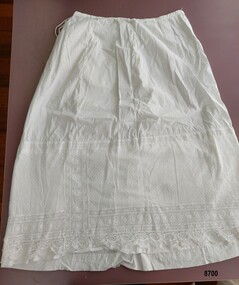
Textile - Petticoat, circa 1900
... Matthew Stephenson (1861 – 1943) who had grown up on the Bendigo goldfields and shifted to Melbourne in the early 1900’s was a train driver and later, a fireman with the railways. His wife Elizabeth Jane (Betsy) Wigley (1865...Matthew Stephenson (1861 – 1943) who had grown up on the Bendigo goldfields and shifted to Melbourne in the early 1900’s was a train driver and later, a fireman with the railways. His wife Elizabeth Jane (Betsy) Wigley (1865 ...This item is one of a collection of clothing items that belonged to the Stephenson family who lived at 22 McCracken Street, Kensington, Melbourne. Matthew Stephenson (1861 – 1943) who had grown up on the Bendigo goldfields and shifted to Melbourne in the early 1900’s was a train driver and later, a fireman with the railways. His wife Elizabeth Jane (Betsy) Wigley (1865 – 1953) also grew up on the goldfields around Majorca and Bendigo. They married in 1885 in Bendigo. They had two daughters – Ethel Evelyn Stephenson (1886 – 1956) and Lillian or Lila (1891 – 1977) who were milliners and dressmakers and who continued to live in the family home after the death of their parents. The family are recorded as living at 22 McCracken Street, Kensington, as early as 1914. It is not known who made or owned the clothing that makes up this collection but as it appears to be from the late Victorian and early Edwardian era, the different pieces were probably made and worn by any of the three ladies of the house – Betsy, Ethel and/or Lila. During W.W.2, a local Warrnambool couple (Meryl and Tony Everard) boarded with them – Tony was in the airforce training paratroopers to jump into (and survive) enemy territory and his wife Meryl worked in the Methodist baby Home. The Everards developed a close friendship with the Stephensons and were responsible for clearing out the house (and finding this clothing collection) after Lila died in 1977. A petticoat is a lady's undergarment - worn under a skirt or dress. They provided warmth, modesty and shape to the dress. In the middle of the 19th century, petticoats were worn over hoops, bustles or in layers. Petticoats varied according to the style of the outside skirt or dress. Plain petticoats tended to be worn with everyday wear whilst better dresses (party dresses or silk gowns) were worn with petticoats that often had more trim and embellishments. Edwardian petticoats had less volume than Victorian era petticoats and they had a "dust ruffle" or lining under a lace flounce. The "dust ruffle" protected the lace flounce and gave the petticoat more flare at the bottom, greater freedom when walking as well as saving the flounce (which was often made of finer material) from everyday wear and tear. Tucks are another feature of Edwardian petticoats - when the lace at the bottom became worn, it could be cut off and the tucks released. This extended the life of the petticoat. This petticoat features an intricate trim of broderie anglaise. Although broderie anglaise was a lace that could be made by hand, it was very time consuming to make. St Gallen was a city in Switzerland that had become known for producing quality textiles. At the beginning of the 19th century, the first embroidery machines were developed in St Gallen. Factories used embroidery machines but people also had them in their homes. They were able to produce broderie anglaise for export. By the early 20th century, machine made lace, fabric, ribbons etc. were being sold in drapers shops all over England and Wales to women who were making clothes and furnishings for their families. It is highly likely that the lady who made this petticoat brought the lengths of broderie anglaise already made to embellish and personalise her petticoat. This item is an example of the needlework skills of women in the late 19th century - creating pintucks and adding lace to personalise and embellish a practical item of clothing. A lady's fine cotton and lace ankle length petticoat featuring a deep decorative hem made from sheer pinspot fabric and bands of eyelet lace. The top section of the petticoat is made from five sections of fine cotton sewn together with french seams and gathered with pleats and darts into the waistband. The waistband opening has two button holes and one button (the top button is missing) and a front section with a drawstring. The lace hem is lined with the same fine cotton as the top of the petticoat. There are three different lace bands - a narrow one featuring small flowers, a similar wider band with larger flowers and it is finished at the bottom with a broad band of lace with an intricate leaf design. flagstaff hill maritime museum and village, great ocean road, warrnambool, shipwreck coast, petticoat, lady's petticoat, broderie anglaise, decorative petticoat, draw string waist, machine sewn, dressmaker, stephenson family, pintucks, needlework -
 Flagstaff Hill Maritime Museum and Village
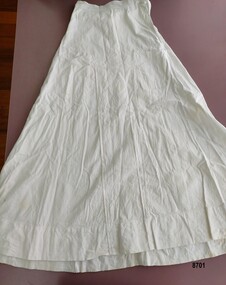
Textile - Overskirt, circa 1910
... Matthew Stephenson (1861 – 1943) who had grown up on the Bendigo goldfields and shifted to Melbourne in the early 1900’s was a train driver and later, a fireman with the railways. His wife Elizabeth Jane (Betsy) Wigley (1865...Matthew Stephenson (1861 – 1943) who had grown up on the Bendigo goldfields and shifted to Melbourne in the early 1900’s was a train driver and later, a fireman with the railways. His wife Elizabeth Jane (Betsy) Wigley (1865 ...This item is one of a collection of clothing items that belonged to the Stephenson family who lived at 22 McCracken Street, Kensington, Melbourne. Matthew Stephenson (1861 – 1943) who had grown up on the Bendigo goldfields and shifted to Melbourne in the early 1900’s was a train driver and later, a fireman with the railways. His wife Elizabeth Jane (Betsy) Wigley (1865 – 1953) also grew up on the goldfields around Majorca and Bendigo. They married in 1885 in Bendigo. They had two daughters – Ethel Evelyn Stephenson (1886 – 1956) and Lillian or Lila (1891 – 1977) who were milliners and dressmakers and who continued to live in the family home after the death of their parents. The family are recorded as living at 22 McCracken Street, Kensington, as early as 1914. It is not known who made or owned the clothing that makes up this collection but as it appears to be from the late Victorian and early Edwardian era, the different pieces were probably made and worn by any of the three ladies of the house – Betsy, Ethel and/or Lila. During W.W.2, a local Warrnambool couple (Meryl and Tony Everard) boarded with them – Tony was in the airforce training paratroopers to jump into (and survive) enemy territory and his wife Meryl worked in the Methodist baby Home. The Everards developed a close friendship with the Stephensons and were responsible for clearing out the house (and finding this clothing collection) after Lila died in 1977. This overskirt is an outer protective garment made of durable cotton and was probably worn over a lady's skirt or dress to protect it whilst they were working. The pockets are large enough for the wearer to keep small items in and there is a loop at the back that would allow the wearer to hang it on a hook, when she finished her work. This item is an example of clothing worn by working women in the late 19th and early 20th century A heavy cotton ankle length overskirt made with two wide gored sections containing inset pockets joined to a middle T shaped front band. It has a waistband of grosgrain ribbon and a side opening with 3 pairs of metal snaps (one pair is missing) and a hook and eye at the top. The waistband also has a taped loop (for hanging) and an unusual double fabric overlay with unattached curved ends. flagstaff hill maritime museum and village, great ocean road, shipwreck coast, warrnambool, overskirt, needlework, sewing, protective garment, stephenson family
